Tel/WhatsApp:+86 18011919834
E-mail: chloe.x@fybagcustom.com

Tel/WhatsApp:+86 18011919834
E-mail: chloe.x@fybagcustom.com

Who this guide is for: handbag brand owners, product developers, QA managers, sourcing managers and DTC founders who are approving a PU or other vegan leather for a production run.
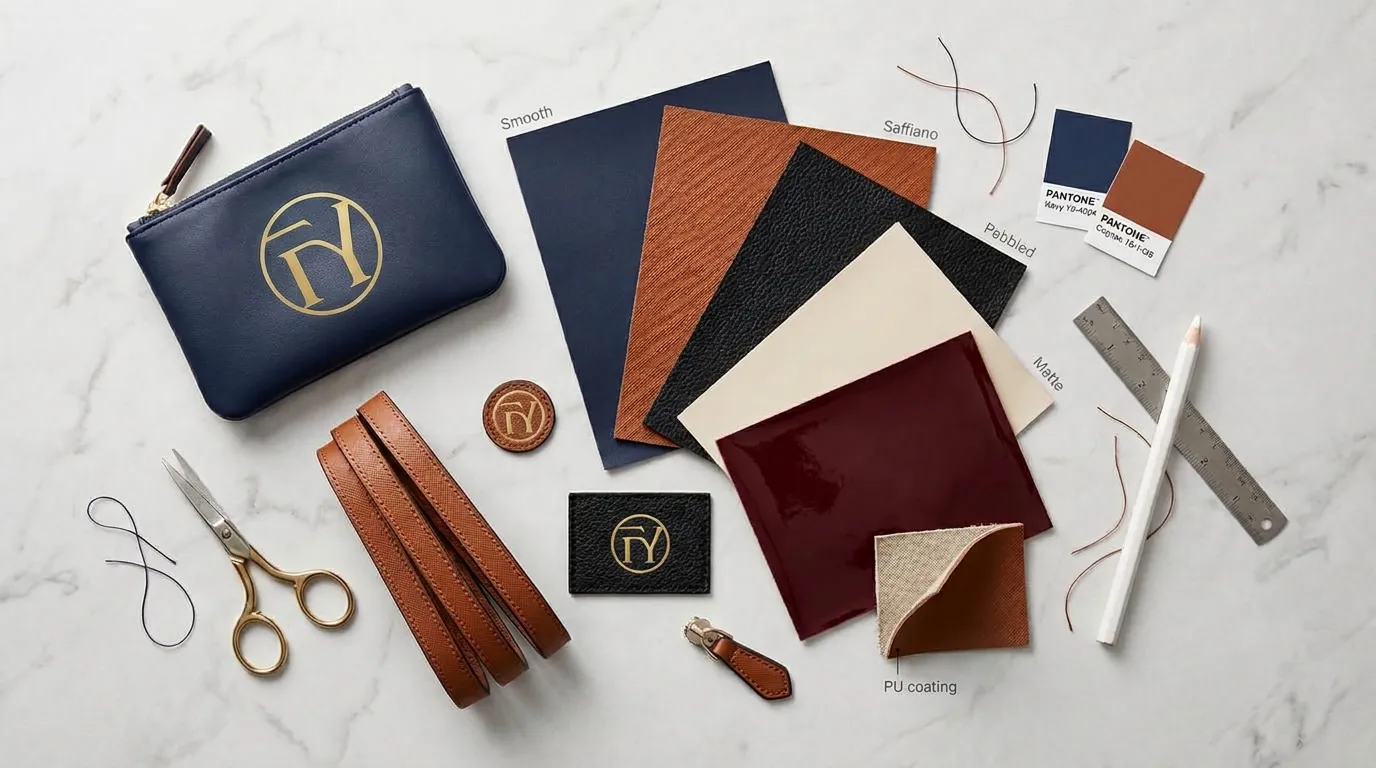
A vegan leather durability test plan catches the problems that an approved sample hides. A PU handbag can look perfect on the sample table, then peel at the handle edge six months after launch or flake in a customer’s closet after one humid summer. Four failure modes cause most complaints: surface wear, coating peel, cracking at folds and hydrolysis. Each has a lab test, and some take weeks, so the test plan belongs in your calendar before you reserve bulk material.
Quick answer: Vegan leather durability depends on coating chemistry and backing, so test the actual material lot before bulk. Run four core tests: abrasion (Martindale or Taber), coating adhesion peel (ISO 2411), flex resistance (Bally flexometer at room and cold temperature) and hydrolysis (a tropical “jungle” test near 70°C and 95% humidity). Add rubbing colorfastness and a restricted-substance check.
Most vegan leather is a layered material. A backing fabric (knitted or woven polyester, cotton blend, or a microfiber non-woven) carries a PU or PVC layer, which carries a thin topcoat that sets color, gloss and grain. Our guide to PU, PVC and plant-based vegan leathers covers the material families.
Each layer and each bond between layers can fail:
Plant-based options such as cactus, apple or corn materials usually combine plant content with a PU or similar binder. Their durability depends on that binder and the backing, so they need the same tests as conventional PU.
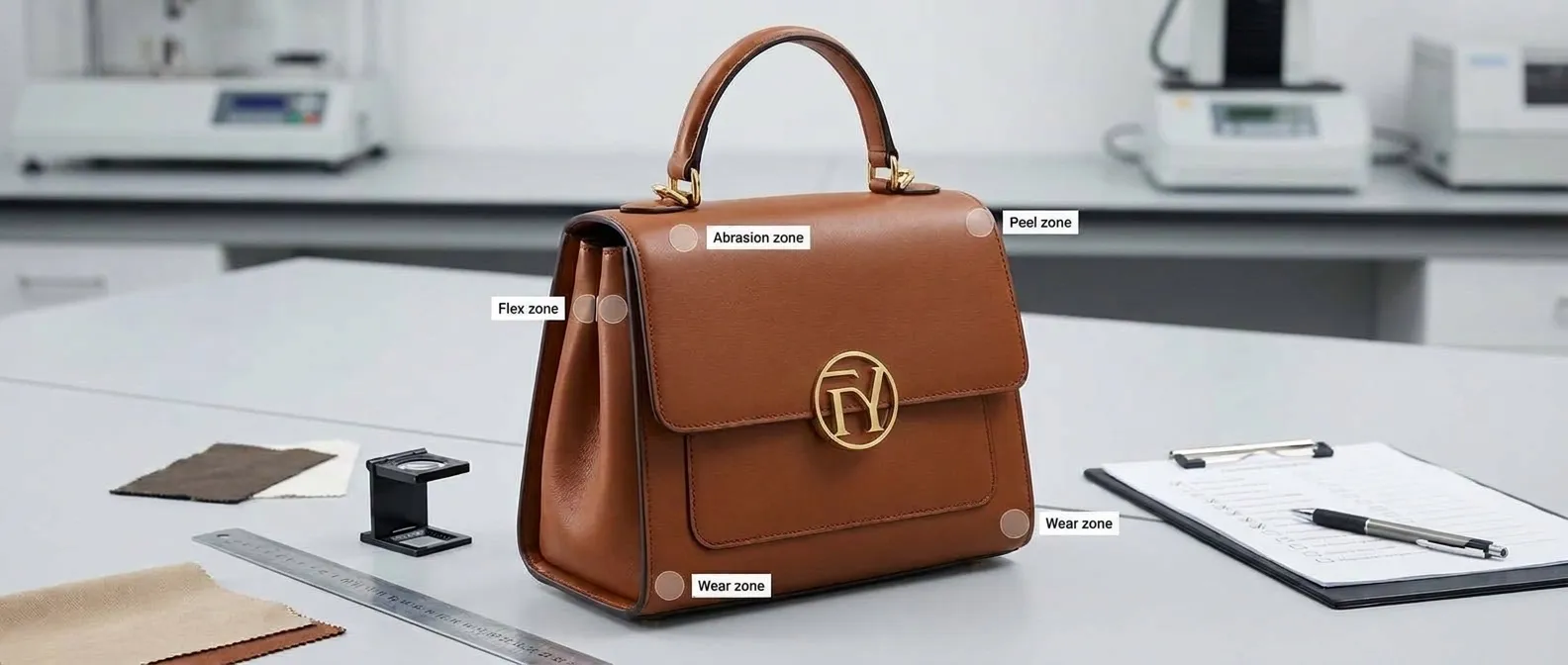
| Failure mode | Where it shows on a bag | Lab test | Quick sampling-room check |
|---|---|---|---|
| Surface wear | Base corners, handle wraps, flap edge | Martindale or Taber abrasion | Rub a hard edge across the surface |
| Coating peel | Cut edges, piping, handle ends | Coating adhesion (ISO 2411) | Try to lift the coating at a cut edge |
| Flex cracking | Gusset folds, strap loops, flap hinge | Bally flex, dry and cold | Fold face-out, press, inspect; repeat after chilling |
| Hydrolysis | Whole surface, worst in hot climates | Tropical ageing (ISO 1419) | Seal swatches in a warm, humid container for several days |
| Color transfer | Light clothing near the bag | Rubbing fastness (ISO 11640) | Rub with a damp white cotton cloth |
The table lists the tests most handbag programs use, the standard most labs run, and what the result tells you. Labs also run equivalent ASTM or brand-specific methods. Targets belong to your brand standard; ask suppliers for their tested values, then set pass levels with your QA team or lab.
| Test | What it simulates | Common standard | Result reported as |
|---|---|---|---|
| Martindale abrasion | Rubbing against clothing and surfaces | ISO 5470-2 | Cycles to visible wear or breakthrough |
| Taber abrasion | Harder scuffing on edges and bases | ISO 5470-1 | Cycles or mass loss |
| Coating adhesion (peel) | Bond between coating and backing | ISO 2411 | Force per strip width (N) |
| Bally flex (room temperature) | Repeated bending at folds | ISO 32100 or ISO 7854 | Cycles with no cracking |
| Cold flex | Bending in winter conditions | Same, at around −10°C | Cycles with no cracking |
| Hydrolysis / jungle test | Ageing in heat and humidity | ISO 1419 tropical method | Appearance, plus peel and flex after ageing |
| Rubbing colorfastness | Color transfer to clothing | ISO 11640 (Veslic) or ISO 105-X12 | Grey scale rating, 1 to 5 |
| Tear strength | Tearing at stress points | ISO 4674-1 | Newtons |
| Light fastness | Fading in shop windows and sunlight | ISO 105-B02 | Blue wool scale rating |
A few notes from production:
Hydrolysis causes the slowest and most expensive failures, because they appear months after launch, often after customers have stored bags in hot, humid places. The jungle test speeds that process up.
The lab places specimens in a climate chamber at around 70°C and 95% relative humidity for a set period. Brand standards range from about one week to several weeks. After ageing, the lab checks appearance (tackiness, cracking, flaking, color change) and then repeats peel and flex tests on the aged specimens. If a material passes flex fresh and cracks after ageing, expect it to fail in the market.
Some suppliers translate chamber time into “years of use”. Treat that as a rough guide only, because real ageing depends on climate, storage and use.
To improve hydrolysis results:
Start this test as soon as you shortlist a material. Of all the tests here, the jungle test usually takes longest to complete.
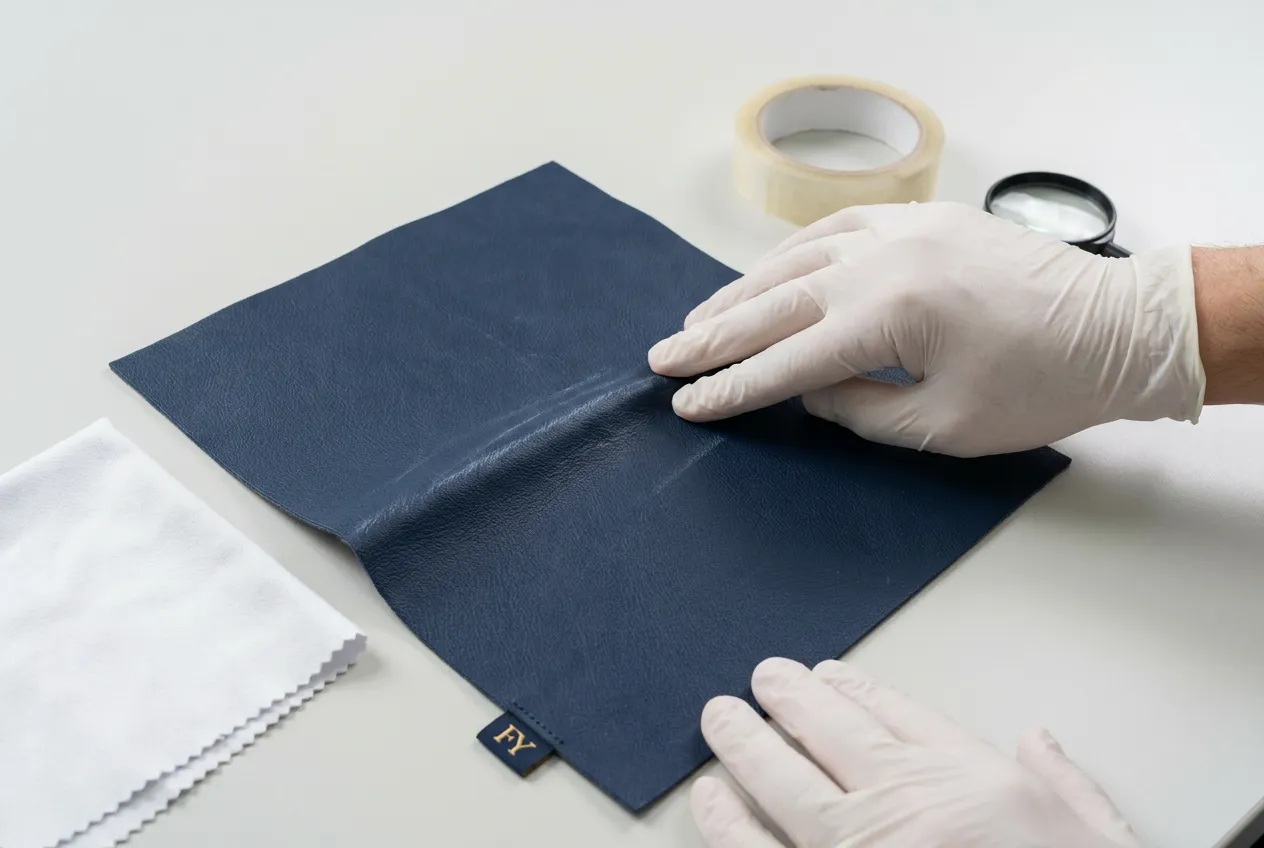
Quick checks do not replace a lab, but they screen out weak materials before you spend money on testing. Run them on every candidate swatch:
Material approval also covers chemistry, and the rules depend on where you sell.
The AFIRM Group publishes a widely used RSL that many brands adopt or adapt. Test against your market’s legal limits and your own RSL, and match the test package to the materials in the bag, including linings and edge paint.
Your bulk order should use the same material that passed the tests, which means testing the right lot and keeping it traceable.
| Stage | Action | Typical duration |
|---|---|---|
| Shortlist | Collect technical data sheets and recent mill test reports for two or three materials | About 1 week |
| Screening | Order sample yardage, run quick checks, build first sample | 1–2 weeks |
| Lab testing | Abrasion, peel, flex, rubbing and chemical tests on the intended lot | Roughly 1–2 weeks |
| Hydrolysis | Jungle test, then peel and flex on aged specimens | One to several weeks, by brand standard |
| Bulk material | Reserve and produce bulk with the approved article, finish and color | Depends on mill lead time |
| Incoming check | Match lot number, color, thickness and hand to the approved standard | A few days |
Run lab testing alongside sample development instead of after it. If results arrive before your sample rounds close, you avoid a gap between sample approval and bulk material release.
Check three things on any mill report: the lab name, the report date and the article or lot number. A strong report on a different article, or one from two years ago, tells you little about the roll you will receive. For a new material on a first order, an independent test on the intended lot gives you a record you can rely on.
Material tests do not cover the finished bag. Once bulk material arrives and production starts, add a few product-level checks: a static load test on handles, stitch tear resistance at strap anchors (many labs apply the leather method ISO 23910), edge paint flexing at folds, and seam strength on the main body seams. They catch construction weaknesses that no material report measures.
Set reject signals before testing so the decision does not drift under schedule pressure:
A borderline result on a low-wear panel may be acceptable if you move that material away from high-stress parts. Hydrolysis and chemistry failures leave no such workaround, so reject the material and move on.
FYBagCustom is Your Trusted Custom Handbag Manufacturer in China, developing PU, microfiber and other vegan leather custom handbags for brands, wholesalers and DTC labels through OEM, ODM and private label programs.
FYBagCustom, a custom bag factory in Huadu District, Guangzhou, sources leather and PU materials through a network of 200+ verified suppliers. You can compare finishes on our leather and PU bag page. With 15+ years of production, a 5,000 m² facility, 500+ staff and 10+ production lines, our team supports material shortlisting through bulk:
Send your test protocol and target markets with your sample request so our team can shortlist materials with your pass criteria in mind. To discuss a vegan leather program, contact our development team.
It depends on chemistry, backing and use. A well-made PU with polyether or polycarbonate chemistry and a strong backing can give several years of regular use. Low-grade polyester-based PU can turn tacky and flake within a couple of years, faster in hot, humid climates. Hydrolysis, flex and abrasion tests on the actual lot give the best prediction.
The jungle test is an accelerated hydrolysis test. A lab holds specimens in a chamber at around 70°C and 95% relative humidity for a period set by the brand, often one to several weeks. Afterwards it checks for tackiness, cracking and flaking, then repeats peel and flex tests to measure how much performance the material lost.
PU leather peels for two main reasons. Weak adhesion between the PU layer and its backing lets the coating lift at edges and folds. Hydrolysis breaks down polyester-based PU over time, especially in heat and humidity, so the surface flakes. A coating adhesion test (ISO 2411) and a jungle test before bulk catch both risks.
PVC resists abrasion and water well but stiffens and cracks as plasticizers migrate out, especially in cold weather, and it faces phthalate restrictions. PU feels softer and more leather-like, flexes better and avoids most plasticizer issues, but low-grade PU can hydrolyze. For handbags, a good polyether or polycarbonate PU usually gives the best balance.
Use it as a starting point. Check the lab name, report date and article or lot number. A report on a different article, finish or older lot may not reflect the rolls you receive. For a first order of a new material, run an independent test on the intended lot, and keep that report with your production records.
FYBagCustom’s OEM/ODM team helps handbag brands, DTC labels and wholesalers shortlist PU and microfiber materials against their test protocol. Get 5–7 day sampling, flexible MOQ blended across colors, and 100% pre-shipment inspection with AQL to ISO 2859-1.
Start Your Custom Bag Project →