Tel/WhatsAapp:+86 18011919834
E-mail: chloe.x@fybagcustom.com

Tel/WhatsAapp:+86 18011919834
E-mail: chloe.x@fybagcustom.com

Who this guide is for: brand owners, product developers, sourcing managers, Amazon FBA sellers and outdoor or lifestyle DTC founders who are taking a backpack from design brief to first bulk order with a factory in China.
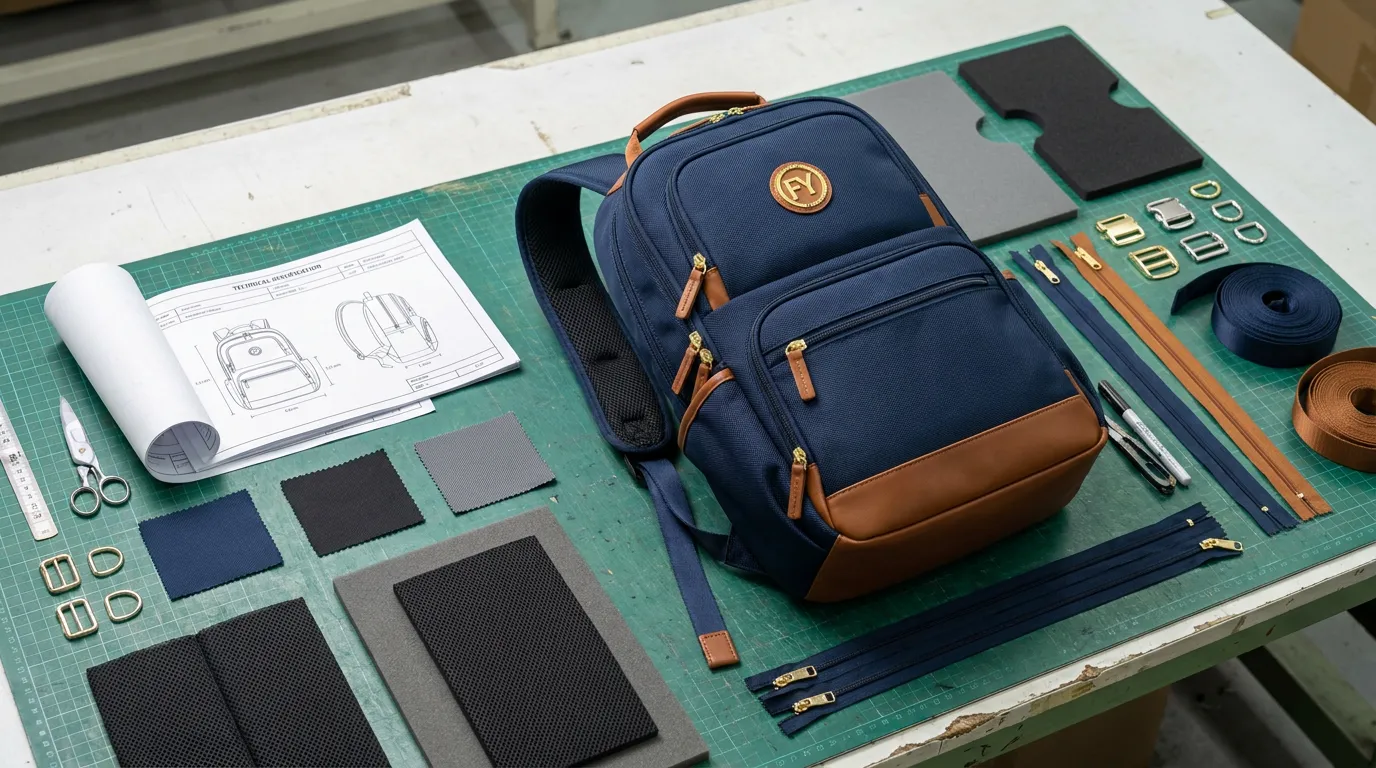
A typical commuter backpack has dozens of pattern pieces, several foam and mesh components and stress points that carry loads every day for years. You get the most from a private label backpack manufacturer when you hand over a tech pack the factory can price and build without guessing, then control each stage from sample to inspection. Brands developing custom backpacks can follow the same path, from defining the category to packing the first bulk shipment.
Quick answer: A good private label backpack manufacturer turns your tech pack into a prototype, refines fit and function over one to three sample rounds, seals a pre-production sample, then runs bulk with material checks, inline QC and AQL final inspection. To choose one, compare its experience with your backpack category, its fabric and hardware sourcing, its testing practice and how it documents revisions.
The term “private label” gets used loosely. Some suppliers mean putting your logo on their catalog bag. Others mean building your own design from scratch. Clarify which model you are buying, because each one changes development time, tooling, exclusivity and cost.
| Model | Who designs | Development time | Exclusivity | Best for |
|---|---|---|---|---|
| Private label (catalog base) | The factory’s existing design, with your branding and minor changes | Shortest | Low: others may sell the same base | Fast market tests, promotional programs, first collections |
| OEM | You supply the design and tech pack; the factory engineers and builds it | Longer | High: your pattern and spec | Brands with a defined product and design team |
| ODM | The factory designs to your brief; you approve and brand it | Moderate | Moderate to high, depending on agreement | Brands with a clear concept but no in-house pattern maker |
Many brands start with a modified catalog base and move to OEM once they know what sells. Our comparison of OEM vs ODM factory partnerships explains the trade-offs in more depth, and the same logic applies to backpacks.
Category sets the engineering. A minimalist daypack and a 40-liter travel pack share a name, but they need different fabrics, foam, hardware and testing.
| Category | Key specification points | Common shell fabrics | Relative complexity |
|---|---|---|---|
| Commuter or daypack | Clean exterior, organized front pocket, water bottle sleeve | 600D polyester, 420D nylon, rPET | Moderate |
| Laptop backpack | Padded, suspended laptop compartment; sized to specific screen sizes | 840D–1050D nylon, 900D polyester | Moderate to high |
| Travel or carry-on | Clamshell opening, compression straps, luggage pass-through, airline size limits | High-tenacity nylon, coated polyester | High |
| School or kids’ backpack | Durability, reflective details, child-safety compliance | 600D polyester | Moderate |
| Outdoor or hiking | Load transfer, hip belt, frame sheet, hydration port | Ripstop nylon, laminated fabrics | Highest |
| Fashion or mini backpack | Small size, leather-look materials, decorative hardware | PU, nylon, canvas | Low to moderate |
| Rolltop or urban | Roll closure, welded or taped seams for weather protection | TPU-coated polyester or nylon | Moderate to high |
Pick the category first, then write the tech pack around the features that define it. Customers judge a laptop backpack by its laptop compartment, so specify its internal dimensions, foam thickness and whether the sleeve floats above the base. A travel pack depends on its opening and the airline limits you target.
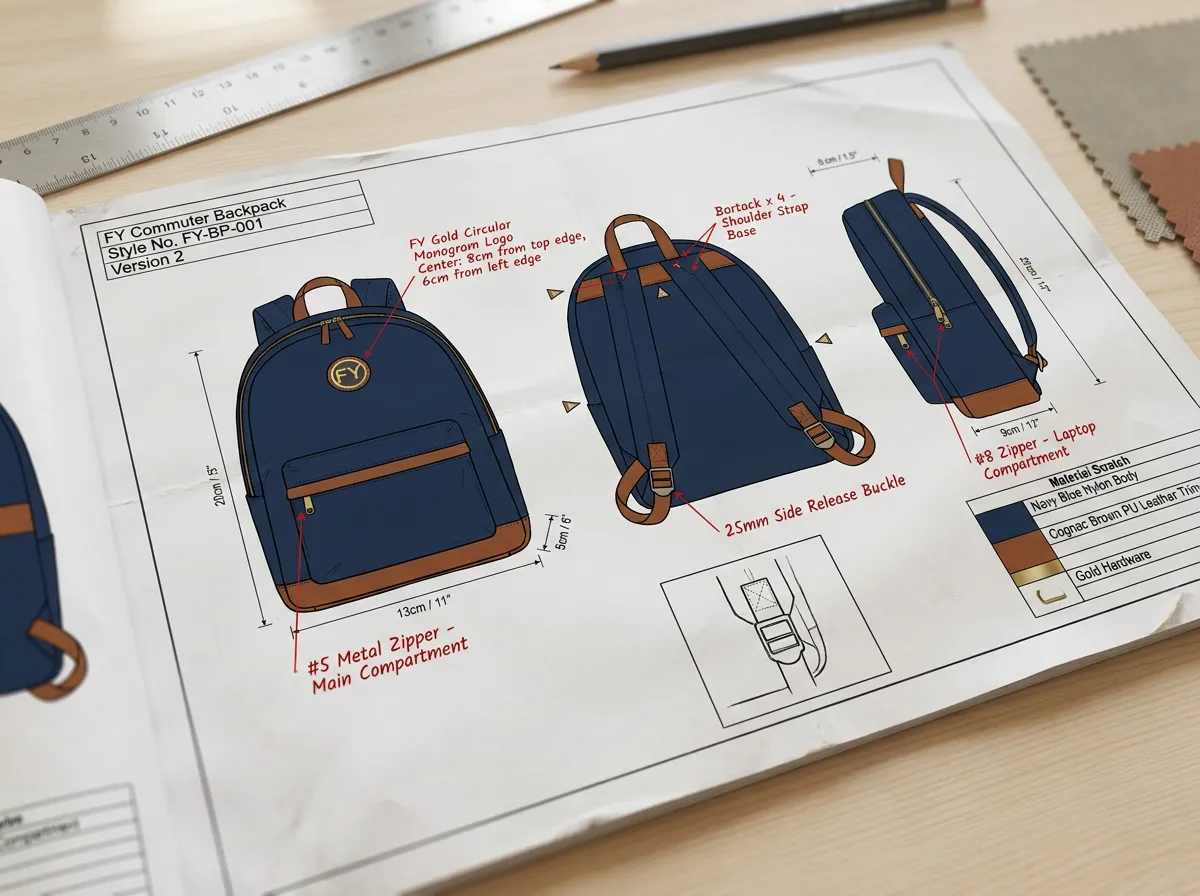
A tech pack tells the factory what to build. Each blank field forces the pattern maker to guess, and a wrong guess costs you a revision round. The table lists the sections a backpack tech pack needs.
| Section | What to include | Common mistake |
|---|---|---|
| Flat sketches | Front, back, both sides, top, bottom and open interior views | Showing only the front, so pocket depths and back panel layout are guessed |
| Dimensions and capacity | External height, width and depth in centimeters; capacity in liters; laptop compartment internal size | Giving external size only, so the laptop does not fit |
| Bill of materials | Shell, lining, foam type and thickness, back panel mesh, webbing, binding tape, thread | Writing “nylon” with no denier, weave or coating |
| Hardware and trims | Zipper size and type, pullers, buckles and sliders by width, D-rings, hook-and-loop | Mixing buckle and webbing widths that do not match |
| Construction | Seam types, binding, stitch density, bartack locations, reinforcement patches | Leaving strap anchor reinforcement to the factory’s default |
| Branding | Method, size and position of each logo, measured from fixed points, with color references | Placing logos “centered” without a measurement |
| Colorways | Color of every component in each colorway, including zipper tape, webbing and thread | Forgetting zipper and webbing colors, which need separate dye lots |
| Labels and packaging | Care and origin labels, hang tags, polybag, carton size, barcodes | Ignoring carton dimensions until freight is booked |
| Performance requirements | Load rating, water resistance target, test standards | No written pass criteria, so “durable” means different things to each side |
| Revision log | Date, change and reason for every update | Changes agreed in chat but never added to the tech pack |
If you do not have a pattern maker or technical designer, ask the factory what design support it offers. FYBagCustom’s custom design service can turn sketches and reference photos into a production-ready specification.
Denier measures fiber thickness (the weight in grams of 9,000 meters of yarn). Higher denier usually means a heavier, more abrasion-resistant fabric, but fiber type, weave and coating matter as much as the number. A high-tenacity 500D nylon can outlast a standard 900D polyester.
| Fabric | Hand and weight | Abrasion resistance | Water resistance (with coating) | Relative cost | Best for |
|---|---|---|---|---|---|
| 210D ripstop nylon | Light, thin | Moderate | Good | Low to moderate | Linings, packable bags, lightweight panels |
| 420D nylon | Medium | Good | Good | Moderate | Daypacks, outdoor panels |
| 840D–1050D ballistic nylon | Heavy, stiff, slight sheen | Excellent | Good | High | Laptop and travel packs, base panels |
| High-tenacity nylon (500D–1000D) | Medium to heavy | Excellent | Good | High | Premium travel and outdoor packs |
| 600D polyester | Medium | Moderate | Good | Low | School and promotional backpacks |
| 900D polyester | Heavy | Good | Good | Low to moderate | Commuter and value laptop packs |
| Recycled polyester (rPET) | Similar to virgin polyester | Moderate to good | Good | Moderate | Sustainability-led collections |
| Waxed or coated canvas | Heavy, natural look | Good | Moderate | Moderate to high | Heritage and lifestyle backpacks |
Nylon gives better abrasion resistance and a softer hand at the same weight, while polyester holds color well and costs less. Our nylon bag fabric page covers the deniers and weaves available for custom programs.
Coatings decide water performance. A PU backing coating adds water resistance and body, a TPU lamination goes further, and a durable water repellent (DWR) finish makes the face fabric bead water. Several US states, including California, now restrict intentionally added PFAS in textile articles, so most brands specify PFAS-free DWR.
Components matter as much as fabric:
Backpack development usually runs through four sample types, and each one has a different job:
Test function as well as appearance. Load the prototype with the weight your customers will carry, wear it for a full commute and pack it with a real laptop, water bottle and charger. Check whether the bag tips over when set down, whether the straps dig into the shoulders and whether the laptop sleeve bottoms out. Write each finding into the revision log with a photo and a measurement.
Lab tests turn “durable” into numbers you can write into a purchase order. Agree on the tests and pass criteria before sampling ends, then test on bulk material lots, not only on mill samples.
| Test | Example standards | What it tells you |
|---|---|---|
| Fabric tear strength | ISO 13937, ASTM D2261 | Resistance to a tear spreading from a cut or snag |
| Fabric tensile strength | ISO 13934-1, ASTM D5034 | Force the fabric withstands before breaking |
| Seam strength | ISO 13935-2 | Whether seams fail before the fabric does |
| Abrasion resistance | ISO 12947 (Martindale), ASTM D3884 (Taber) | Surface wear over time, critical for base panels |
| Water resistance | ISO 811 (hydrostatic head), ISO 4920 (spray) | Coating performance and face fabric repellency |
| Colorfastness | ISO 105-X12 (rubbing), ISO 105-B02 (light) | Color transfer onto clothing and fading in sunlight |
| Zipper strength | ASTM D2061 | Strength of the zipper chain, slider and stops |
| Load and strap attachment | Brand-defined protocol | Whether strap anchors and handles hold under static and dynamic loads |
| Chemical compliance | REACH, Proposition 65, CPSIA for children’s products | Restricted substances in fabrics, coatings, prints and hardware |
Load testing has no single industry standard for backpacks, so brands write their own. A common approach hangs the filled bag from each strap at a multiple of its rated load for a set time, then repeats with a dynamic drop or jerk test. Children’s backpacks sold in the United States count as children’s products, so CPSIA lead limits, tracking labels, third-party testing and a Children’s Product Certificate apply.
Once you approve the PPS and pay the deposit, the factory orders materials and schedules your line. The durations below are typical industry ranges and depend on quantity, materials and decoration.
| Stage | Typical duration | Key controls |
|---|---|---|
| Material and hardware procurement | 2–4 weeks; longer for custom-dyed fabric or custom hardware | Incoming inspection of color, coating, denier and plating |
| Cutting | A few days | Die cutting or hot-knife cutting to seal synthetic edges; panel counts checked against the BOM |
| Panel decoration | A few days, overlapping cutting | Screen printing, heat transfer or embroidery on flat panels before assembly |
| Sub-assembly and final assembly | 2–4 weeks | Straps, back panel and pockets built separately, then joined; inline checks at each station |
| Finishing and final inspection | Several days | Thread trimming, shaping, AQL inspection against the sealed PPS |
| Packing | 1–3 days | Polybags, hang tags, carton labels, FBA or retailer labeling |
Decorating flat panels before assembly gives cleaner prints and embroidery than decorating a finished bag, which is one reason logo placement must be fixed before cutting starts. Inline checks matter most at strap anchors and zipper installation, because those defects are hard to repair once the bag is closed up.
For cost planning, our guide to how much backpacks cost to produce breaks down how fabric, foam, hardware and order size affect the factory price.
Backpacks offer more branding surfaces than most bags, from the front panel and straps to zipper pullers and the back panel. Common methods:
Choose one hero branding element and keep the rest tonal. A single well-made patch reads as more premium than four logos competing for attention.
FYBagCustom is Your Trusted Custom Backpack Manufacturer in China, offering OEM, ODM and private label development for backpack brands, retailers and e-commerce sellers.
FYBagCustom, a custom bag factory in Huadu District, Guangzhou, has 15+ years of bag manufacturing experience, a 5,000 m² facility, 500+ staff and 10+ production lines. For backpack programs, that translates into:
Send your tech pack, sketches or reference backpack through our contact page, and our development team will review the specification and suggest materials and construction for your first sample.
Private label usually means adding your branding to a factory’s existing design, sometimes with small changes to colors or pockets. OEM means the factory builds your own design from your tech pack. Private label is faster and cheaper to develop but offers little exclusivity. OEM takes longer and needs a complete specification, but the pattern and product belong to your brand.
A complete backpack tech pack includes flat sketches from every side and inside, external and internal dimensions with capacity in liters, a bill of materials with fabric deniers and foam thickness, hardware sizes, construction notes including bartack locations, branding positions with measurements, colorways for every component, labels and packaging, performance requirements and a dated revision log.
It depends on the category and price point. 600D or 900D polyester suits value commuter, school and promotional backpacks. 420D nylon works for lightweight daypacks, while 840D to 1050D ballistic or high-tenacity nylon suits premium laptop and travel packs. Recycled polyester supports sustainability claims. Coating and weave matter as much as denier, so compare tested performance as well as names.
Development usually takes four to eight weeks, covering the prototype, one to three revision rounds and pre-production sample approval. Bulk production then takes roughly five to eight weeks, including material procurement, cutting, decoration, assembly and final inspection. Custom-dyed fabrics, custom hardware molds and large quantities add time. Ocean freight to North America or Europe adds several more weeks.
Typical tests cover fabric tear and tensile strength, seam strength, abrasion resistance, water resistance, colorfastness to rubbing and light, zipper strength and a brand-defined load test on strap anchors and handles. Chemical tests for REACH, Proposition 65 or CPSIA apply depending on the market and the end user. Run the tests on bulk material lots and set pass criteria in writing.
FYBagCustom’s OEM/ODM team builds private label backpacks for brand owners, Amazon FBA sellers and lifestyle retailers. Send your tech pack or sketches: we respond with material recommendations from 200+ verified suppliers, 5–7 day sampling and flexible MOQ blended across colorways.
Start Your Custom Bag Project →