Tel/WhatsApp:+86 18011919834
E-mail: chloe.x@fybagcustom.com

Tel/WhatsApp:+86 18011919834
E-mail: chloe.x@fybagcustom.com

Who this guide is for: brand owners, promotional product buyers, retail merchandisers, corporate gifting leads and Amazon sellers who need to pick one fabric for a custom tote bag program and defend that choice to a finance or sustainability team.
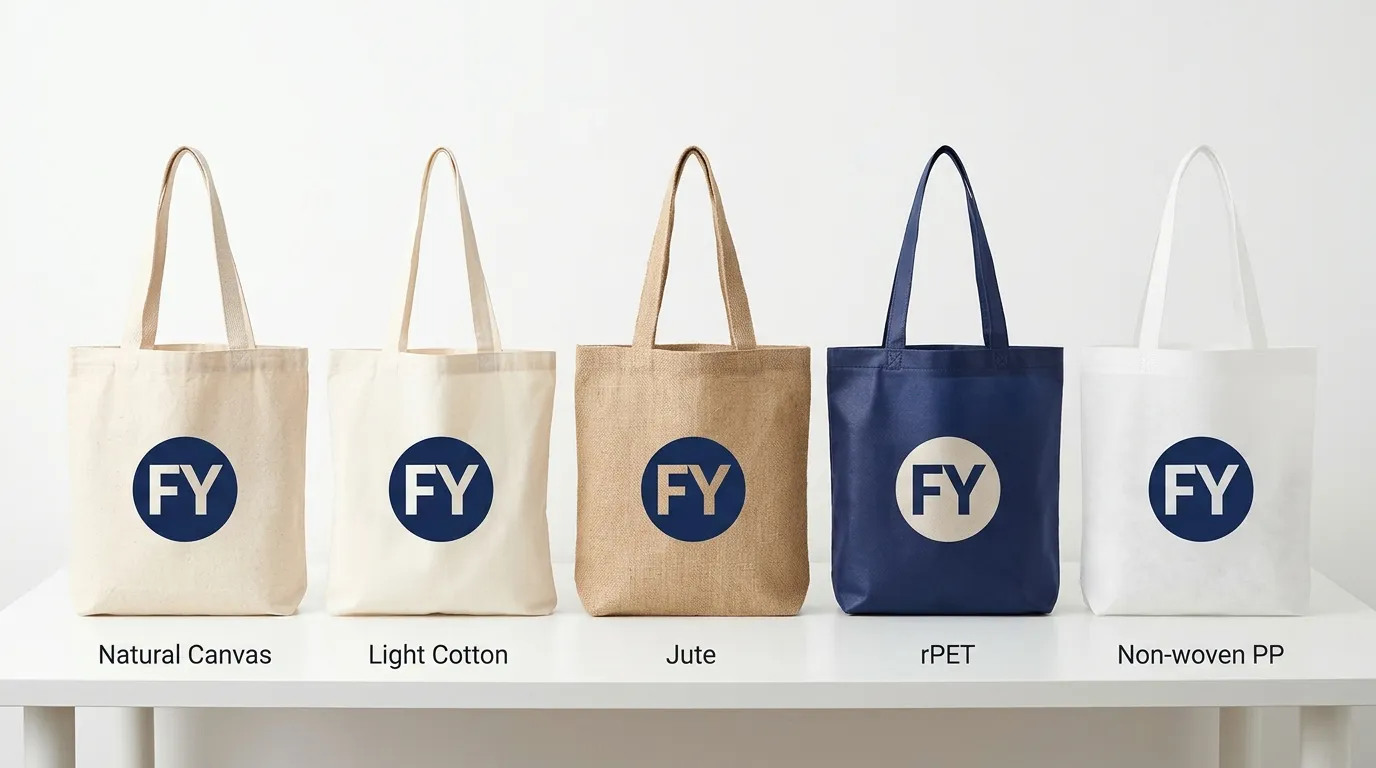
The best fabric for tote bags depends on what the bag has to do after your customer takes it home. A trade-show giveaway used twice, a retail tote sold at full price and a grocery bag that must survive a year of weekly shopping need different materials. Five fabrics cover most custom tote bag programs: cotton canvas, lightweight cotton, jute, rPET and non-woven polypropylene. Each one trades durability, print quality, cost and environmental story in its own way.
Quick answer: For most branded retail and merchandise totes, 10–12 oz cotton canvas is the best all-round fabric: strong, easy to print and embroider, and premium in the hand. Pick non-woven PP for the lowest-cost event giveaways, rPET for full-color sublimation and recycled-content claims, jute for a natural grocery or wine-bag look, and light cotton for budget promotional totes.
Suppliers quote tote fabrics in different units: cotton and canvas by weight per area, rPET by yarn denier, non-woven by grams per square meter. The profiles below put each one in plain terms. The custom bag fabrics overview lists the wider range a bag factory can source.
Canvas is a plain-weave cotton cloth woven from heavier, plied yarns. Most custom canvas totes fall between 8 oz (about 270 gsm) and 16 oz (about 540 gsm), with 10 oz or 12 oz covering most retail orders. Duck canvas has a tighter, flatter weave. Natural, or loomstate, canvas stays unbleached and shows small flecks of seed husk. Our canvas bag page covers weights and finishes in more depth.
Light cotton sheeting or drill runs from roughly 4 oz to 6 oz (about 135–200 gsm). It folds small, feels soft and costs less than canvas. Under heavy loads it stretches at the handle joins, and dark inks can strike through to the inside. Most conference totes use it, and few of them stay in use for long.
Jute is a bast fiber grown mainly in India and Bangladesh, coarse and open in weave. Most jute totes carry a thin polyethylene lamination inside to block dust, add some water resistance and hold shape, which turns a natural-fiber bag into a mixed-material one. Juco, a jute and cotton blend, gives a smoother print face. The jute and burlap bag page shows formats such as grocery totes, wine bags and gift pouches.
rPET is polyester made from recycled PET, most often post-consumer bottles. Tote versions include woven rPET (commonly 300D or 600D), cotton-look rPET canvas and rPET non-woven. As a polyester, rPET accepts sublimation printing, which cotton and PP cannot. Recycled-content claims rely on chain-of-custody paperwork from the mill, most often under the Global Recycled Standard (GRS).
Non-woven polypropylene is a spunbond sheet: the mill bonds fibers with heat instead of weaving them. Tote weights usually run 70–120 gsm, with 80 gsm the default promotional weight. Factories either sew it or weld it ultrasonically. Laminated non-woven adds a printed BOPP film to the face, which gives photographic graphics and a wipe-clean surface. See the non-woven bag page for format options.
The table compares the five fabrics on the points buyers raise most in tote quotes. Cost appears in relative terms only: size, gusset, handles, print colors and volume set the real figure, and on a simple tote, decoration and labor can move the price as much as fabric does.
| Fabric | Typical tote weight | Durability | Print surface | Washability | Relative cost | Best for |
|---|---|---|---|---|---|---|
| Cotton canvas | 8–16 oz (about 270–540 gsm) | High | Excellent for screen print, embroidery and DTG | Machine washable; shrinks a few percent unless pre-washed | Moderate to High | Retail merch, brand totes, premium gifts |
| Lightweight cotton | 4–6 oz (about 135–200 gsm) | Low to Moderate | Good for simple screen prints; ink can strike through | Washable; shrinks | Low | Conference bags, low-cost giveaways |
| Jute (laminated) | Medium to heavy cloth | High when dry | Coarse; suits bold one- or two-color prints | Spot clean only | Low to Moderate | Grocery totes, wine bags, gift packaging |
| rPET (woven) | 300D–600D | Moderate to High | Excellent for sublimation and screen print | Washable; holds shape | Low to Moderate | Recycled-content programs, full-color art |
| Non-woven PP | 70–120 gsm | Low to Moderate | Screen print; lamination for photo prints | Wipe or rinse by hand | Lowest | Events, trade shows, short-life promotions |
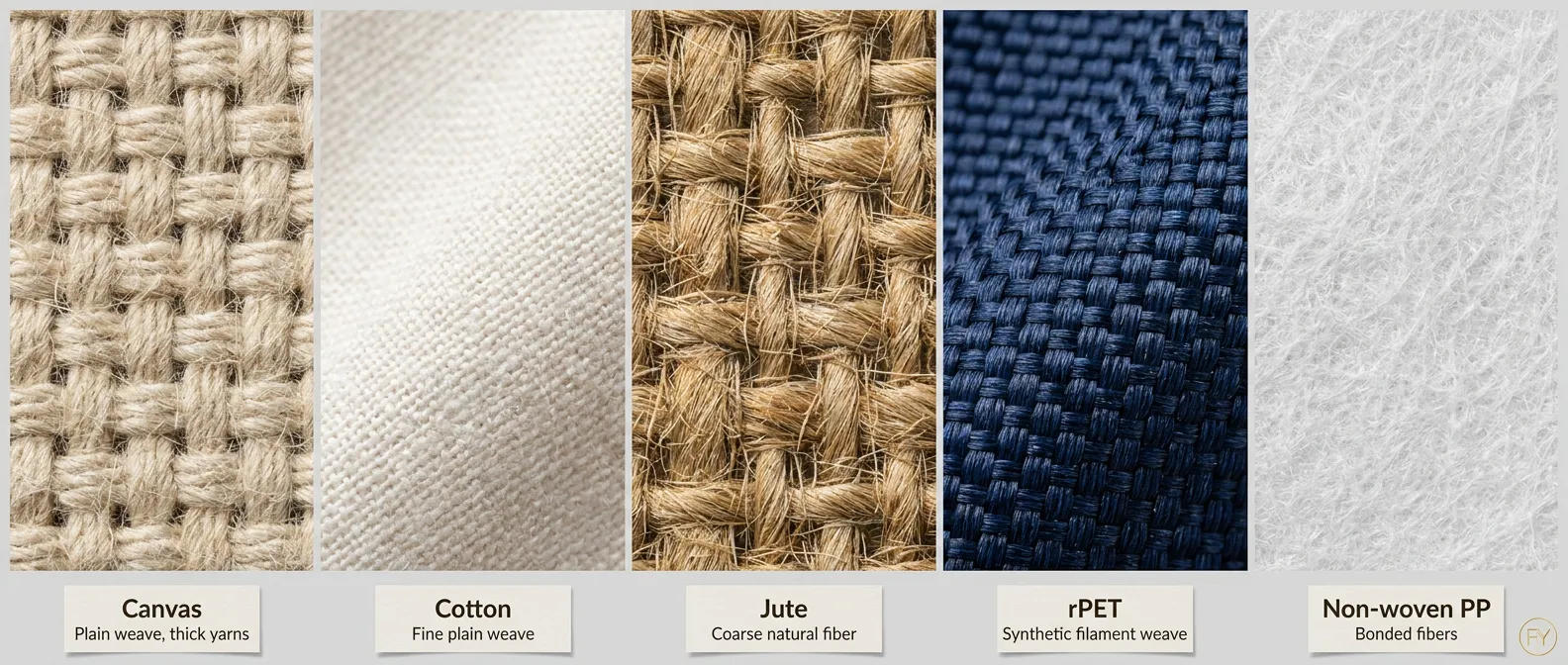
Canvas leads on perceived value and decoration range, so brands that sell totes at retail seldom pick anything else. Non-woven PP leads on unit cost and speed, so event planners keep ordering it despite its short life. rPET, jute and light cotton each earn a place through one feature: sublimation, a natural look, or a low price with a natural-fiber label.
Heavy cotton canvas gives the longest service life for general use, with woven rPET close behind. Fabric weight sets the ceiling, but construction decides where the bag fails first. A 12 oz canvas tote with handles attached by a single straight stitch will tear at the handle before a 10 oz tote with box-and-cross stitching and a reinforcement patch.
Each fabric has a typical first failure point:
| Fabric | Where it usually fails first | Construction fix to specify |
|---|---|---|
| Cotton canvas | Handle joins under heavy loads | Box-X stitching, inner reinforcement patch, bound or French seams |
| Lightweight cotton | Handle tears and seam slippage | Wider self-fabric handles, double-stitched hems, smaller bag size |
| Jute | Fiber breakage at folds; mildew if stored damp | Inner lamination, cotton webbing handles, dry storage and desiccant in cartons |
| rPET (woven) | Fraying at raw edges | Overlocked or bound seams, heat-cut edges where suitable |
| Non-woven PP | Welded handle points and side seams | Sewn handles instead of welded, higher gsm, cross-stitched handle attachment |
Jute feels tough and resists stretching, yet its fibers break under repeated folding and lose strength when wet. A jute tote left damp in a car trunk can grow mildew. Sea-freight cartons need desiccant packs too, since a month in a humid container can start mold on unlaminated jute.
For loads, ask your supplier for a static hang test that reflects real use. A full grocery load typically weighs somewhere around 5–10 kg. Hanging the filled bag by its handles for a fixed period, then checking seams and handle joins, tells you more than a fabric spec sheet. Agree on the method and pass criteria at sampling.
Print quality depends on matching fabric to decoration method. Canvas takes the widest range. rPET takes sublimation, which prints unlimited colors with no per-color setup. Jute and non-woven reward simple artwork.
| Decoration method | Canvas | Light cotton | Jute | rPET | Non-woven PP |
|---|---|---|---|---|---|
| Screen print | Excellent | Good | Fair (bold artwork only) | Good | Good |
| Embroidery | Excellent | Fair (needs backing) | Fair (patch preferred) | Good | Not recommended |
| DTG / digital | Good on light colors | Good | Poor | Fair | Poor |
| Heat transfer | Good | Good | Fair | Good | Fair (low-temperature films only) |
| Sublimation | Not suitable | Not suitable | Not suitable | Excellent on white or light fabric | Not suitable |
| Lamination | Rare | Rare | Common (inner film) | Common | Common (printed outer film) |
A few practical points help avoid reprints:
For a logo plus a full-color pattern, consider rPET with sublimated artwork and a woven label, or canvas with DTG on a small run.
No fabric wins outright, because the result depends on how many times the customer reuses the bag. Life-cycle studies compare reusable bags with a single-use plastic carrier. The UK Environment Agency’s 2011 life-cycle study estimated that a cotton bag needed roughly 131 uses to match the climate impact of one single-use HDPE carrier, against roughly 11 uses for a non-woven PP bag. A 2018 Danish EPA study that counted more impact categories reported even higher numbers for cotton.
A cotton tote earns back its footprint through years of use. Give customers a well-made canvas bag with artwork they want to carry, and it will replace several cheaper bags.
Each fabric’s eco story carries a caveat:
Claims also face tighter rules. In the United States, the FTC Green Guides govern environmental marketing. In the EU, Directive 2024/825 on empowering consumers for the green transition targets generic claims such as “eco-friendly” made without proof, with its rules applying from late September 2026. Print only claims you can document, and keep the supplier certificates on file.
Start from the bag’s expected life and carrying load, then pick the fabric.
| Program type | Expected life | Recommended fabric | Why it works | Watch out for |
|---|---|---|---|---|
| Trade show or event giveaway | A few uses | Non-woven PP (80–100 gsm) or 5 oz cotton | Lowest cost, fast production, prints well in one color | Weak handles; limited reuse |
| Grocery or reusable retail bag | Many uses, heavy loads | Laminated non-woven, woven rPET or laminated jute | Wipe-clean, holds shape, carries weight | Local rules on what counts as “reusable” |
| Retail merch sold at full price | Years | 12–16 oz canvas | Premium hand, embroidery-ready, washable | Higher fabric cost; shrinkage if not pre-washed |
| Corporate gift | Medium to long | 10–12 oz canvas or juco | Looks considered, takes tonal embroidery | Allow time for sampling and logo approval |
| Full-color artwork or collaboration | Medium | rPET with sublimation, or canvas with DTG | Unlimited colors, photographic detail | Sublimation needs white or pale fabric |
| Wine and bottle gift bags | One to a few uses | Jute with dividers | Natural look suits food and drink gifting | Mildew if stored damp |
| Beach or wet use | Seasonal | Woven rPET or laminated non-woven | Dries fast, does not rot | Avoid jute and unlined cotton |
For grocery programs, check local rules first. Several U.S. states, EU member states and retailers define a “reusable” bag by weight, thickness or rated number of uses. Confirm the rules in each selling market before you print “reusable” on a checkout bag. Brands building totes for shopping and grocery use should also plan a gusset of at least 10–15 cm so the bag stands up when packed.
A clear brief cuts sampling rounds. Before you request quotes, write down:
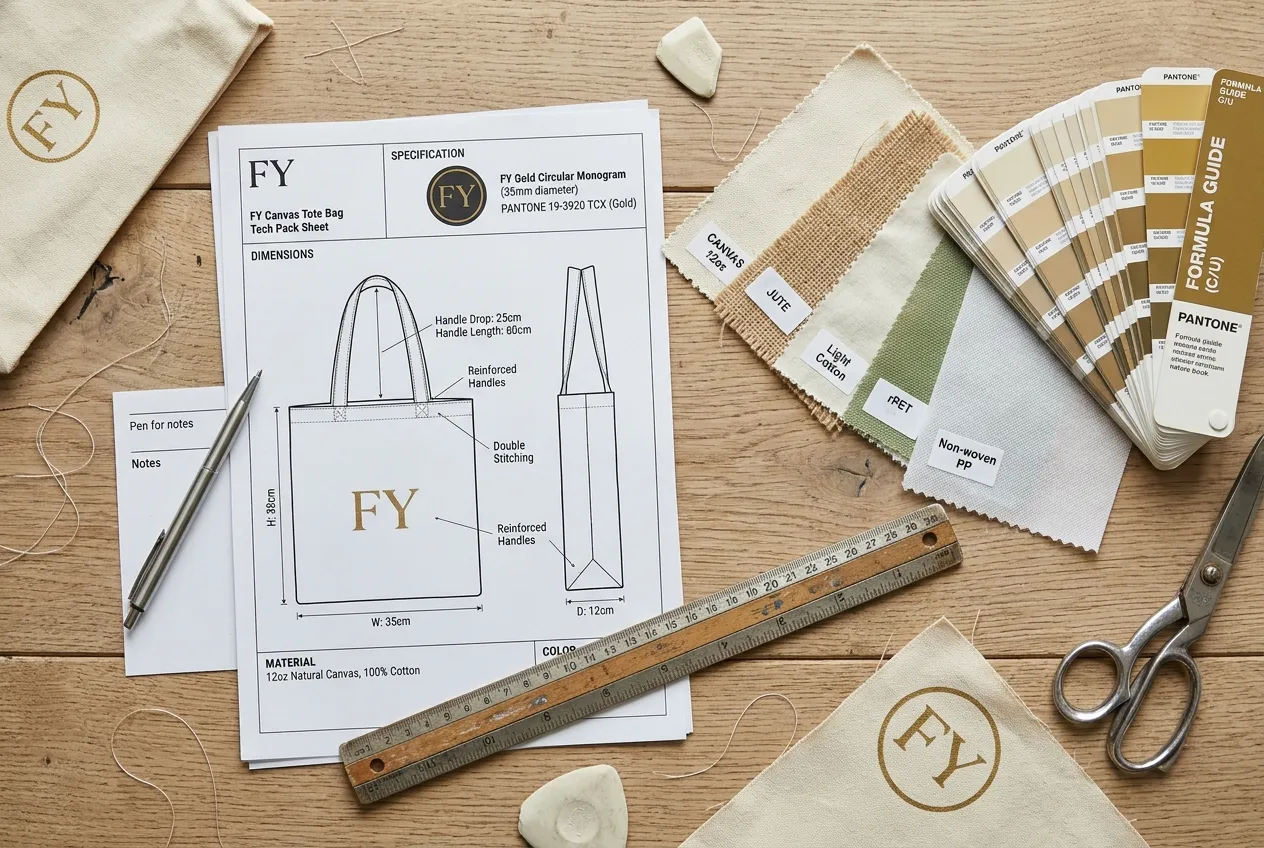
FYBagCustom is Your Trusted Custom Tote Bag Manufacturer in China, developing canvas, cotton, jute, rPET and non-woven totes for brands, wholesalers and promotional buyers through OEM, ODM and private label programs.
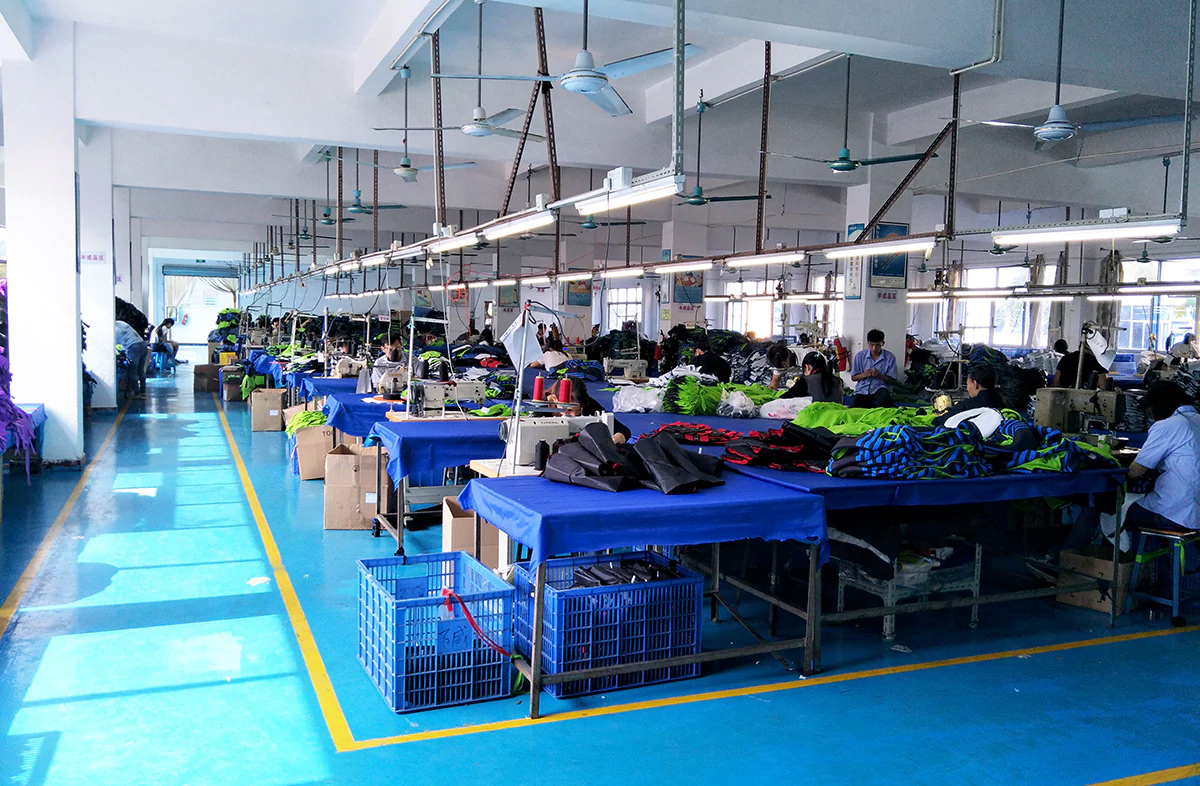
FYBagCustom, a custom bag factory in Huadu District, Guangzhou, brings 15+ years of bag production, a 5,000 m² facility, 500+ staff and 10+ production lines. We source fabric through 200+ verified suppliers, so our team can put two or three candidate fabrics side by side on the same tote pattern.
On a tote program, that means:
Planning a recycled or organic claim? Raise it at quotation so we can source fabric with the chain-of-custody documents the claim needs. To compare fabrics for your own program, send our team your tote brief with the target use, size and decoration.
Heavy cotton canvas in the 12–16 oz range gives the longest service life for everyday totes, with woven rPET a close second. Durability also depends on construction. Handles attached with box-X stitching and a reinforcement patch outlast thicker fabric sewn with a single straight stitch. Ask for a static load test on the sample before you approve bulk production.
Canvas is cotton, woven heavier and tighter. Choose canvas, usually 10–12 oz, for totes you sell at retail or give as premium gifts, because it holds shape and takes embroidery. Choose lightweight 4–6 oz cotton for low-cost promotional totes where unit cost matters more than lifespan. Light cotton folds smaller but stretches under heavy loads.
Unlined jute is not waterproof and can develop mildew if stored damp. Most commercial jute totes carry a thin polyethylene lamination inside, which adds water resistance and helps the bag keep its shape. Even laminated jute should be spot cleaned rather than machine washed. For beach or wet use, woven rPET or laminated non-woven performs better.
It depends on reuse and documentation. rPET reuses PET waste and needs less water than cotton, but it sheds microfibers and its recycled-content claim needs chain-of-custody paperwork such as GRS from the mill. Cotton is natural and biodegradable but resource-intensive to grow. The greener bag is the one customers keep using for years.
Most promotional non-woven PP totes use 80 gsm, which balances cost and strength for light loads. Step up to 100–120 gsm for grocery use or heavier items, and specify sewn handles instead of welded ones. Laminated non-woven suits full-color photographic artwork and wipe-clean use, though it mixes two plastics and complicates recycling.
FYBagCustom’s OEM/ODM team helps brand owners, promotional buyers and retail merchandisers compare canvas, cotton, jute, rPET and non-woven totes side by side. Get 5–7 day sampling, flexible MOQ blended across colors and sizes, and in-house embroidery, screen printing and sublimation.
Start Your Custom Bag Project →