Tel/WhatsApp:+86 18011919834
E-mail: chloe.x@fybagcustom.com

Tel/WhatsApp:+86 18011919834
E-mail: chloe.x@fybagcustom.com


Who this guide is for: handbag brand owners, product developers, sourcing managers, Amazon FBA sellers and DTC founders who are developing crossbody bags, slings or convertible styles and want the strap system right before bulk production.
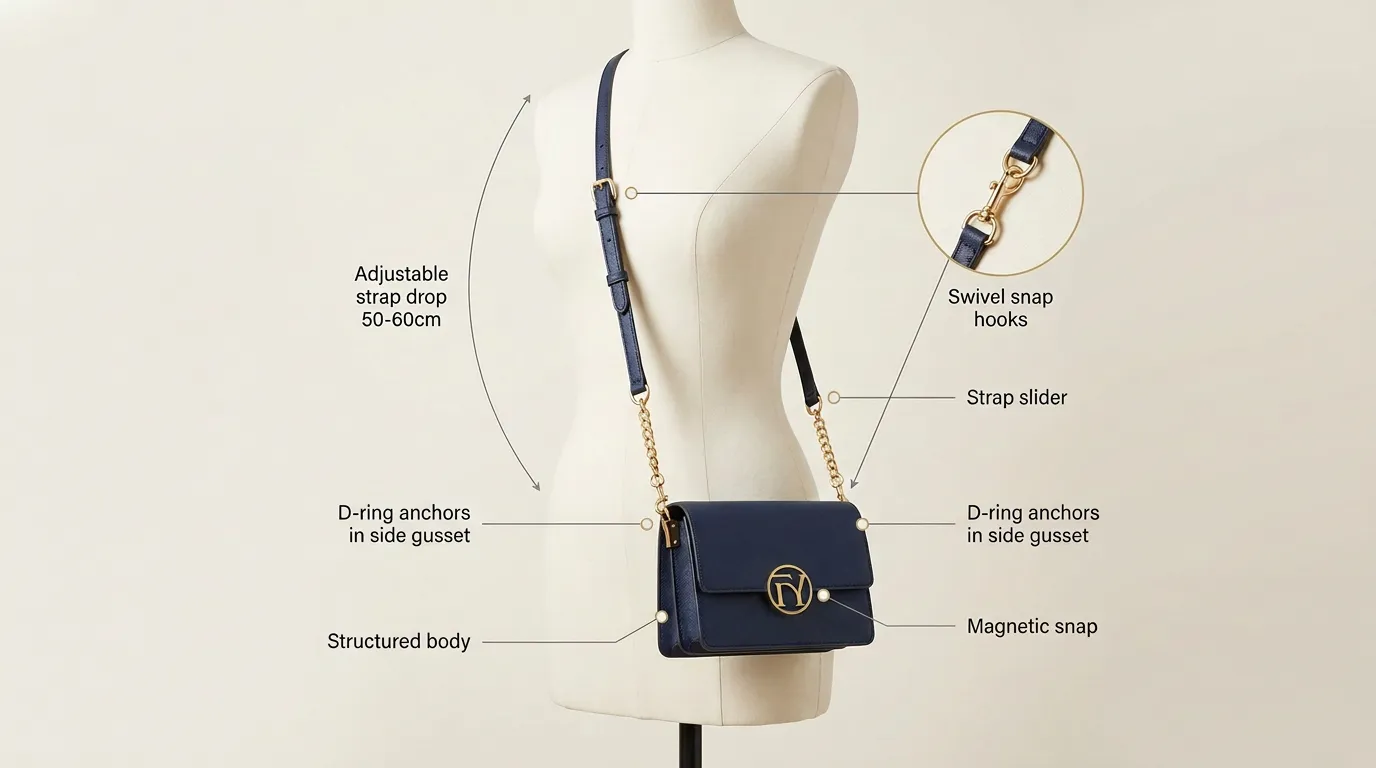
A crossbody bag spends its whole working life hanging from two small points. The customer wears it for hours, walks with it swinging against one hip, and judges it on details a flat lay never shows: whether the bag tips forward, whether the strap digs into the neck, whether the snap hook holds when someone grabs the bag in a crowd. Brands developing custom crossbody bags get most of these outcomes from four decisions made at the tech pack stage: strap length and drop, anchor placement, hardware strength and weight balance.
Quick answer: A good custom crossbody bag manufacturer sets the strap drop for hip-height carry (typically 50–65 cm on an adjustable strap), places D-ring anchors above and in line with the bag’s center of mass so it hangs flat, matches hardware width and strength to the strap, and load-tests the full strap assembly before bulk production.
A shoulder bag hangs straight down from one shoulder, close to the armpit. A crossbody strap runs diagonally across the torso, so the bag rests near the opposite hip and the strap crosses the collarbone, chest and back. That changes three engineering priorities.
Many current styles also convert between carry positions. A small bag with a detachable long strap can work as a top-handle, shoulder bag and crossbody, so the strap system has to cover all three without new hardware.
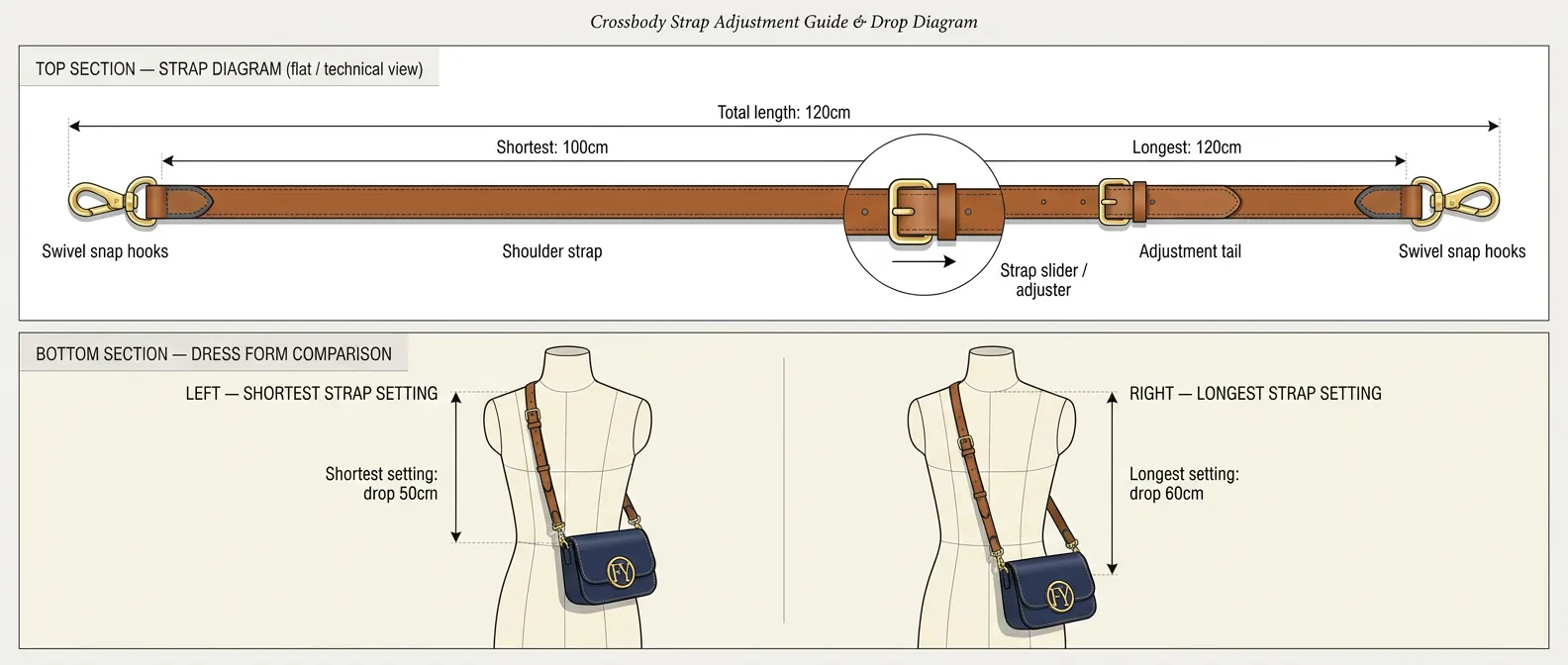
Two measurements matter, and tech packs often confuse them. Total strap length runs from the end of one hook to the end of the other, at maximum and minimum adjustment. Drop is the vertical distance from the top of the strap, hung from a single point, to the top edge of the bag. For long straps, the drop works out to roughly half the total strap length, minus a little for the distance between anchors.
| Carry position | Typical drop | Typical total strap length | Notes |
|---|---|---|---|
| Top handle | 10–15 cm | Fixed handle | Hand or forearm carry only |
| Shoulder | 20–30 cm | Roughly 50–70 cm | Bag sits at the waist under the arm |
| Crossbody, women’s styles | 50–65 cm | Roughly 100–130 cm adjustable | Bag sits at the hip |
| Crossbody, unisex and men’s styles | 55–70 cm | Roughly 110–145 cm adjustable | Messengers and camera-style bags run longest |
| Sling or belt bag worn across the chest | Varies | Roughly 85–120 cm adjustable | Short and adjustable, with a wide range |
Ranges are indicative and vary by market, body size and silhouette. Fit-test on real wearers before approval.
Set the adjustment range from measurements of your own customers. A strap that adjusts from 100 to 130 cm covers a wide range of adult women for crossbody wear, but it won’t reach shoulder carry. Fit a slider with enough travel, or add a second hole set on a pin-buckle strap, if you promise both positions. Brands with a broad size range should test on petite and plus-size wearers, and some sell a strap extender as an accessory rather than lengthening every strap.
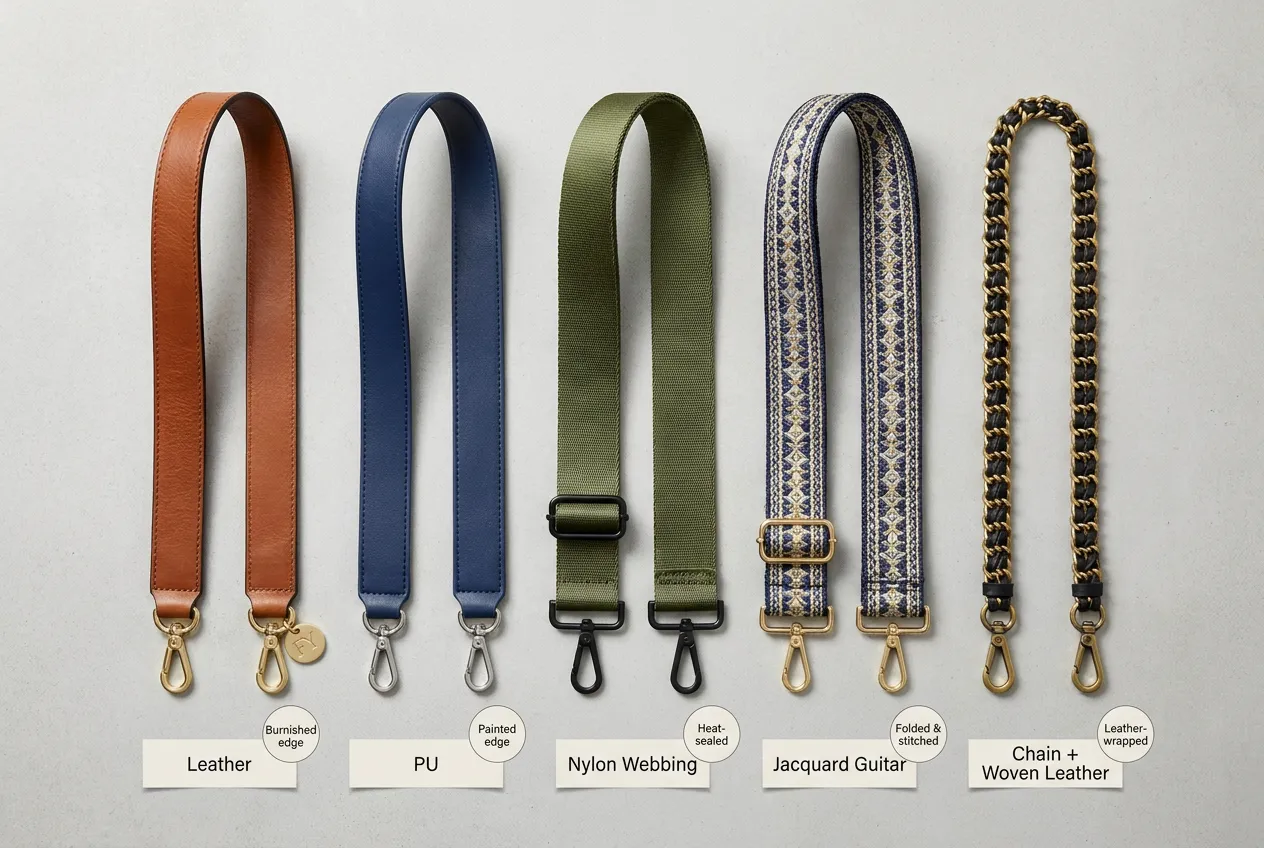
Our deep dive on adjustable strap systems compares sliders, pin buckles, chains and guitar straps component by component. The rest of this guide covers how those parts work together on a crossbody body.
Anchor placement decides how the bag hangs, and buyers often leave it to the pattern maker. A hanging bag settles with its center of mass directly below the line between its two anchors. Place the anchors badly and the bag rotates to find that position, whatever the design sketch shows.
Two rules cover most silhouettes:
| Anchor placement | How the bag hangs | Watch-outs | Best for |
|---|---|---|---|
| Top corners, centered in depth | Upright, opening faces up | Front-heavy flaps can still tip forward | Structured flap bags, camera bags |
| Upper third of the side gussets | Flat against the body, stable when walking | Gusset needs reinforcement behind the tab | Soft and semi-structured bags |
| Back panel loops | Very close to the body | Bag can tilt face-up; loops show wear | Slings, belt bags, phone bags |
| Through-body strap (wraps under the bag) | Most stable; load spreads across the bag | Adds webbing weight and visual bulk | Messenger and utility bags |
| Single swivel point | Bag can rotate freely | Spins and twists without a second anchor | Mini pouches, charms, phone holders |
Three adjustments fix most balance problems found at sampling:
Ask the factory to hang each sample empty and loaded (phone, wallet, keys) and photograph it from the side. Compare both side views with the design sketch before you approve.
The strap material sets weight, comfort and how the strap ages. Two failure modes recur: leather and PU straps that stretch after a few months, and stiff webbing edges that rub the neck.
| Strap material | Weight | Stretch over time | Comfort on the neck and shoulder | Relative cost | Best for |
|---|---|---|---|---|---|
| Genuine leather, folded and stitched | Moderate | Some; reduce with a nylon tape core | Good with rolled or painted edges | High | Premium leather crossbodies |
| PU leather with reinforcement core | Light to moderate | Low with core; high without | Good | Low to moderate | Fashion crossbodies at accessible price points |
| Nylon webbing | Light | Very low | Fair; edges can chafe | Low | Sport, travel and utility styles |
| Jacquard or polyester guitar strap, 3.8–5 cm | Moderate | Low | Very good; width spreads load | Moderate | Detachable statement straps, heavier bags |
| Cotton webbing | Light | Moderate | Good, soft hand | Low | Canvas and casual styles |
| Metal chain | Heavy | None | Poor without a leather shoulder pad | Moderate to high | Evening and occasion bags |
| Chain with woven leather | Heavy | None | Better than bare chain | High | Fashion statement straps |
Width matters as much as material. The same bag weight spread over a 4 cm strap puts roughly half the pressure on the shoulder that a 2 cm strap does. Skinny straps of 1–1.5 cm suit light evening bags. A crossbody that carries a phone, wallet, keys and a small bottle needs 2.5 cm or more, or a wide guitar strap.
Metal chains need their own engineering, from link geometry to plating and weight. See our chain strap bag manufacturing guide before you commit to a chain crossbody.
A crossbody strap system is a chain of parts: tab, D-ring, snap hook, strap end, slider and sometimes a buckle. The weakest part sets the strength of the whole system, and four weak points show up again and again.
Size the hardware to the strap. The inside width of a D-ring, slider or hook eye should match the strap width with a millimeter or two of clearance. Too tight and the strap bunches; too loose and it slides to one side and wears unevenly. Add swivel hooks on detachable straps so the strap untwists itself.
| Hardware base material | Weight | Strength and toughness | Finish options | Relative cost | Typical use |
|---|---|---|---|---|---|
| Zinc alloy, die-cast | Moderate | Good for decorative and moderate loads; porous castings can crack under shock | Wide range of plated finishes and custom logo shapes | Low to moderate | Most fashion D-rings, hooks, turn-locks |
| Brass, solid | Heavy | High | Polished, brushed, plated or natural | High | Premium hooks and buckles |
| Stainless steel | Moderate | High; resists corrosion | Polished, brushed, PVD color | Moderate to high | Rings and hooks on sport and travel styles |
| Steel or iron wire, welded | Light to moderate | High if welded; rusts if plating fails | Plated finishes | Lowest | Budget D-rings and rings |
| Aluminum | Very light | Moderate | Anodized colors | Moderate | Lightweight outdoor and tech slings |
Plating color matching, durability and nickel rules have their own considerations, so align finishes across hooks, rings and zipper pulls early. Our custom bag accessories and hardware service covers logo-engraved hooks, custom pulls and branded hardware.
Customers carry crossbodies all day, so weight shows up in reviews. As a rough reference, small nylon crossbodies often weigh under 300 g empty, while small leather styles with a lined interior and die-cast hardware often land in the 400–700 g range. A long metal chain can add a few hundred grams on its own.
Set a target empty weight in the brief and ask the factory to record actual weights on every sample, with hardware weighed piece by piece. When a sample comes in heavy, the hardware list usually shows where the grams went. Common savings include a lighter-gauge chain, hollow rather than solid hardware, a slimmer interfacing in the body, and a lighter lining fabric.
Test the full strap assembly as the customer uses it, with the bag loaded, rather than testing each part alone. Agree the method and pass criteria with your factory before sampling ends.
Write each pass criterion so anyone on the inspection team can check it. A final AQL inspection then confirms that bulk hardware and stitching match the approved sample.
Detachable straps let one bag body sell as several looks, and interchangeable straps can become a product line of their own. Standardize the hardware to make that work: fix one or two D-ring inside widths and one hook size across the whole collection, and every strap fits every bag. A customer who buys a guitar strap for one crossbody can then wear it on your shoulder bag and belt bag.
Convertible bag designs add more anchor points, such as top-corner rings for crossbody wear and gusset rings for shoulder wear. Each extra ring adds weight and a visual element, so place them where they serve at least two carry positions.
FYBagCustom is Your Trusted Custom Crossbody Bag Manufacturer in China, developing crossbody, sling, belt and convertible bags under OEM, ODM and private label programs. FYBagCustom, a custom bag factory in Huadu District, Guangzhou, brings 15+ years of bag manufacturing, a 5,000 m² facility, 500+ staff and 10+ production lines to each program.
To review strap length, anchors and hardware on your next style, share your crossbody brief with the FYBagCustom team.

Most women’s crossbody straps adjust across roughly 100–130 cm of total length, which gives a drop of about 50–65 cm and puts the bag at hip height. Unisex and men’s styles often run longer, up to about 145 cm. Treat these as starting ranges and fit-test samples on wearers of different heights before you freeze the strap length.
Forward tipping happens when the anchors sit behind or below the bag’s center of mass. Move the D-ring tabs forward or higher, often by just 1–2 cm, and shift weight toward the back panel by placing the phone pocket there. Lighter front hardware also helps. Hang each sample empty and loaded and photograph it from the side to confirm the fix.
Wider straps spread the load, so a 4 cm strap puts roughly half the pressure on the shoulder that a 2 cm strap does with the same bag. Straps of 1–1.5 cm suit light evening bags. Everyday crossbodies that carry a phone, wallet and keys work better at 2.5 cm or more, and wide guitar straps suit heavier bags.
Die-cast zinc alloy covers most fashion crossbody hardware because it takes detailed shapes and many plated finishes at a reasonable cost. Brass suits premium lines that can carry the extra weight. Stainless steel and aluminum suit sport and travel styles. Whatever the material, use welded or cast rings on load points and test snap hook gates under load.
Yes, if you standardize the hardware. Fix one or two D-ring inside widths and a single snap hook size across the collection, and every strap will fit every bag. That lets you sell straps as a separate product line and as add-ons. Confirm the standard with your manufacturer before sampling so every new body uses the same anchor hardware.
FYBagCustom’s OEM/ODM team helps handbag brands, DTC founders and Amazon sellers engineer crossbody bags with the right drop, balanced anchors and load-tested hardware, backed by 5–7 day sampling and flexible MOQ blended across colors and sizes.
Start Your Custom Bag Project →