Tel/WhatsAapp:+86 18011919834
E-mail: chloe.x@fybagcustom.com

Tel/WhatsAapp:+86 18011919834
E-mail: chloe.x@fybagcustom.com
Send Your Inquiry Today

Who this guide is for: brand owners, product developers, sourcing managers, DTC founders, and private label developers who specify custom handbags and treat the lining as a line item to fill in later — or who have never specified it at all and let the factory choose. If your tech pack says “lining: polyester” without specifying weight, weave, color, or finish — and if you have ever received a bag whose interior felt thin, scratchy, or “not right” compared to the exterior’s quality — this guide decodes every lining fabric available for handbag production, explains what each one contributes to the consumer’s perception, and provides the specification language that ensures your factory delivers the interior your retail tier demands.
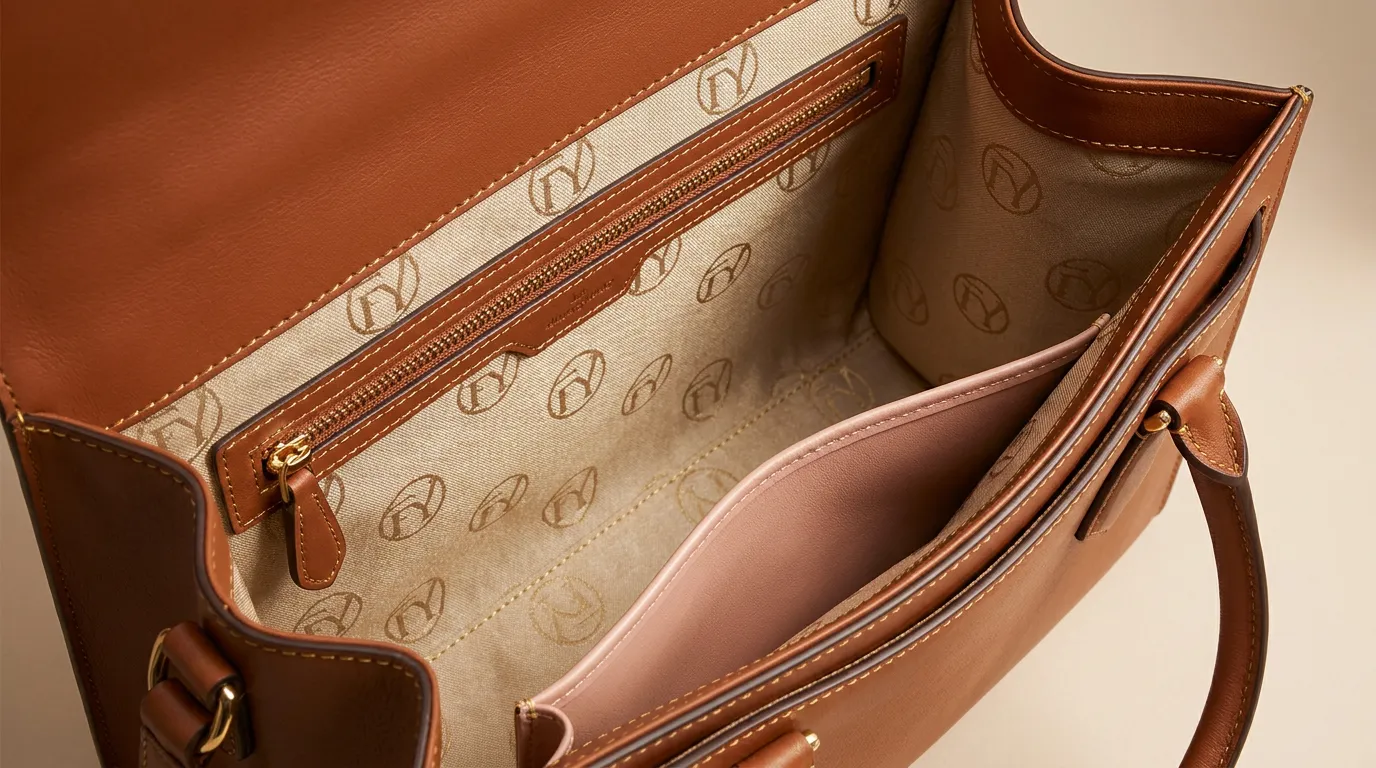
The lining is the most underspecified component in custom handbag development. It is the line item that brand founders fill in last, specify least, and question never — until the reviews arrive. “The bag is beautiful on the outside but the inside feels cheap.” “The lining is already pilling after two weeks.” “I expected a premium interior at this price point.” These reviews are not about the bag’s exterior, its hardware, or its silhouette. They are about the 30 × 40 cm of fabric inside the bag that the consumer’s hand touches every time she reaches for her phone, her wallet, or her keys.
The irony is that the lining is also the cheapest component to upgrade — and the upgrade with the highest return on perceived value. Swapping a generic 50 g/m² polyester taffeta for a branded 180 g/m² jacquard with a tonal logo weave adds a small fraction to the total production cost. The perceived-value increase is disproportionate: the same exterior, the same hardware, the same silhouette — but the consumer’s hand tells her this bag is worth twice as much because the interior feels considered, substantial, and branded.
This guide covers every lining fabric used in professional handbag manufacturing, from the budget polyester workhorses through the premium jacquard and Alcantara options, with the specification data (GSM, weave, width, edge treatment) that belongs in your tech pack.
Three reasons the lining is consistently under-specified in B2B handbag development:
| Reason | What Happens | Consequence |
|---|---|---|
| “The consumer doesn’t see it” — the founder focuses on the exterior (what photographs) and assumes the interior is secondary | The tech pack says “lining: polyester” with no further specification; the factory chooses the cheapest polyester available | The lining is thin, scratchy, wrinkled, or pilling — and the consumer DOES see it, every time she opens the bag |
| “The factory knows best” — the founder trusts the factory to select an appropriate lining without guidance | The factory optimizes for their margin, not for the buyer’s retail positioning; they select the lining that costs them the least | The exterior says “premium” but the interior says “budget” — a quality dissonance that generates 3-star reviews |
| “I don’t know the options” — the founder has never been educated on lining fabrics; the options feel overwhelming | The tech pack either omits the lining specification entirely or specifies by brand name rather than by performance characteristics | The factory substitutes a visually similar but materially inferior lining — and the buyer cannot detect the substitution because they do not know what to compare against |
The fix is simple: specify the lining with the same precision you specify the exterior material — by fabric type, weight (GSM), weave, color, and finish. This guide provides the knowledge to do that.
| Property | Specification |
|---|---|
| Composition | 100% polyester, plain weave (taffeta) |
| Weight range | 40–70 g/m² |
| Hand-feel | Thin, smooth, slightly slippery; “swishy” when handled — the fabric makes a rustling sound |
| Appearance | Smooth, flat, uniform color; available in any dye color; has a slight sheen |
| Durability | Moderate — resists tearing but pills at abrasion points (pocket openings, zip areas) after 6–12 months of regular use |
| Moisture behavior | Does not absorb moisture; dries quickly; does not stain easily |
| Best for | Budget to lower mid-market bags where the lining is purely functional; bags where the consumer rarely sees the interior (clutches, cosmetic bags) |
| Limitation | The thinness is perceptible — the consumer can feel the interlining or the back of the exterior material through the lining; reads as “insubstantial” |
When taffeta is the RIGHT call: for bags at the budget tier, bags with minimal interior exposure (zip-top crossbodies where the interior is rarely visible), and bags where weight minimization is the priority (cloud bags, ultra-lightweight travel bags where every gram matters).
| Property | Specification |
|---|---|
| Composition | 100% polyester, twill weave (diagonal ribbed structure) |
| Weight range | 70–120 g/m² |
| Hand-feel | Noticeably more substantial than taffeta; smooth but with a tactile “body” from the twill weave; does not feel thin or fragile |
| Appearance | Subtle diagonal rib texture; matte to semi-matte finish; cleaner, more “professional” look than taffeta’s sheen |
| Durability | Good — the twill weave is inherently stronger than plain weave; resists pilling significantly better than taffeta |
| Moisture behavior | Similar to taffeta — does not absorb; dries quickly |
| Best for | Mid-market to entry-premium bags; the “default upgrade” from taffeta that costs marginally more but feels dramatically better |
| Limitation | Still reads as “synthetic” to the touch — a trained hand can distinguish it from natural fibers or microfiber |
The recommended default for most programs: if your budget allows only one lining upgrade from taffeta, switch to polyester twill at 80–100 g/m². The cost increase is minimal; the perception increase is immediate.
| Property | Specification |
|---|---|
| Composition | 100% polyester, satin weave (floated warp threads create a smooth, lustrous surface) |
| Weight range | 60–100 g/m² |
| Hand-feel | Very smooth, silky, cool to the touch; the smoothest polyester option |
| Appearance | High sheen on the face; matte on the back; available in rich, saturated colors |
| Durability | Moderate — the floated threads that create the smooth surface are vulnerable to snagging; less durable than twill |
| Moisture behavior | Does not absorb; the smooth surface releases spills easily |
| Best for | Evening bags, clutches, luxury-positioned bags where the interior should feel “silky”; bags where the consumer’s hand slides in and out frequently |
| Limitation | Snagging — the smooth surface can catch on sharp objects (keys, jewelry) and pull threads; not ideal for everyday bags with heavy internal friction |
| Property | Specification |
|---|---|
| Composition | 100% cotton; canvas (plain weave, heavy) or drill (twill weave, lighter than canvas) |
| Weight range | 120–250 g/m² (significantly heavier than polyester options) |
| Hand-feel | Substantial, warm, slightly textured; reads as “natural” and “quality” to the touch; the weight is immediately perceptible |
| Appearance | Matte, natural texture; available in bleached white, natural ecru, or dyed colors; can be printed with brand logos or patterns |
| Durability | Very good — cotton is strong and resists pilling; however, cotton stains more easily than polyester and can absorb moisture |
| Moisture behavior | Absorbs moisture — spills soak in and can stain; dries slowly; can develop mildew if stored damp for extended periods |
| Best for | Premium bags, totes, heritage-positioned brands; bags where “natural fiber” aligns with the brand’s values (eco, organic, artisanal) |
| Limitation | Weight — cotton lining at 200+ g/m² adds noticeably more weight than polyester at 70–100 g/m²; moisture absorption is a care consideration |
The moisture caveat: cotton lining in a handbag is vulnerable to liquid spills — a water bottle that leaks, a cosmetic that opens, a coffee that tips. Cotton absorbs the liquid and may stain permanently. For bags that will carry liquids (everyday totes, diaper bags, gym bags), either avoid cotton lining or add a waterproof pocket (TPU-lined) for liquid-carrying items.
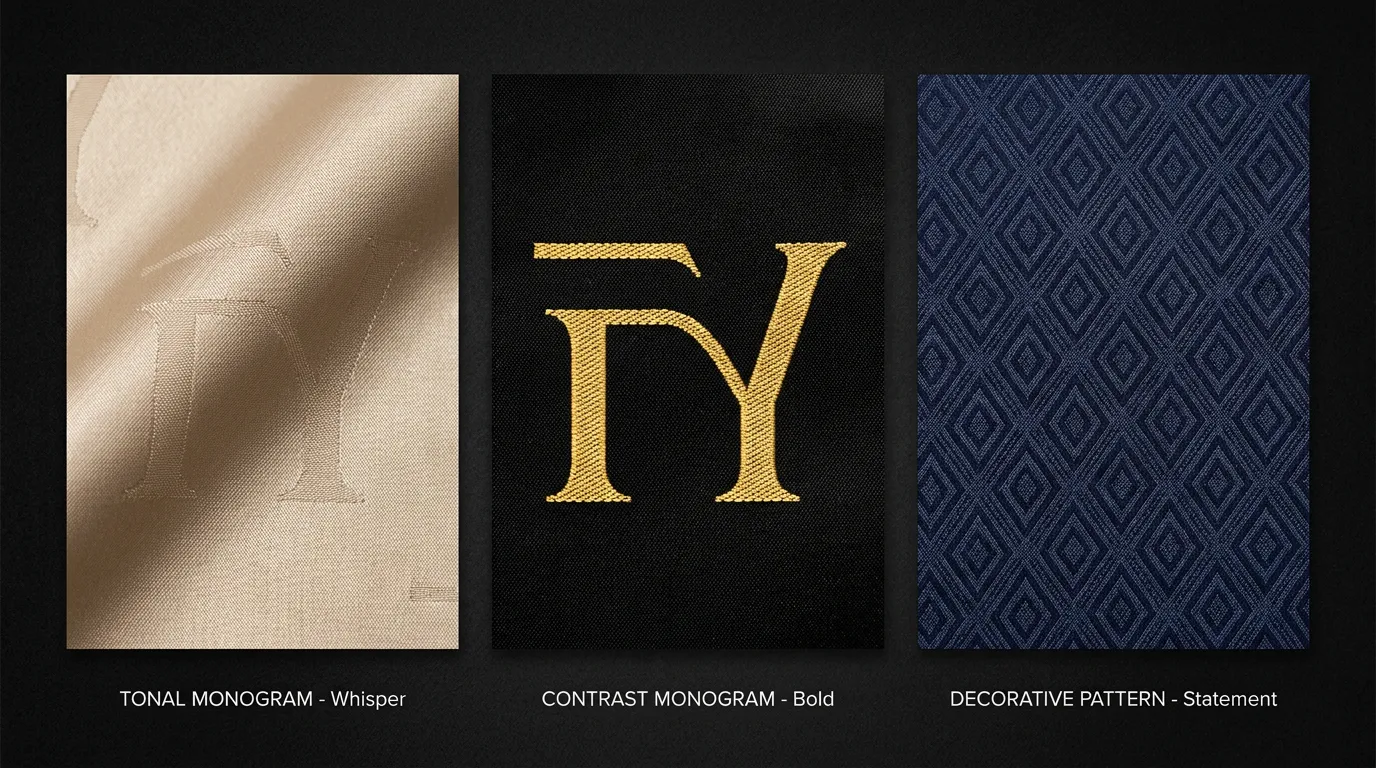
Jacquard lining is woven on a jacquard loom, which controls each warp thread independently — enabling patterns to be woven into the fabric structure itself, not printed on the surface. The pattern is three-dimensional (visible as a texture difference between the pattern and the background) and permanent (it cannot fade, wash off, or wear away because it IS the fabric).
| Property | Specification |
|---|---|
| Composition | Polyester, nylon, or polyester-cotton blend |
| Weight range | 140–280 g/m² (substantially heavier than plain polyester; the weight is part of the premium) |
| Hand-feel | Substantial, refined, smooth with tactile pattern depth; the consumer’s fingers can feel the woven pattern — a sensory confirmation of quality |
| Appearance | The woven pattern (typically a brand logo, monogram, or decorative motif) is visible as a tonal or multi-tonal texture on the fabric surface; the most visually sophisticated lining option |
| Durability | Excellent — the woven pattern does not fade, peel, or wear off; the heavy weight resists pilling and tearing |
| Moisture behavior | Similar to polyester (if 100% polyester base) — does not absorb; wipes clean |
| Best for | Premium to luxury bags — the single most impactful lining upgrade available; jacquard is the lining that luxury houses use as an interior brand signature |
| Limitation | Lead time — custom jacquard weaving requires a loom setup fee and a minimum fabric order (typically 300+ meters); the pattern development adds 2–4 weeks to the development timeline |
Jacquard lining is the one component upgrade that can move a bag’s perceived quality tier without changing anything visible from the outside. The consumer opens the bag and sees a woven logo pattern in the lining — the same detail she associates with luxury-house bags. The weight of the fabric in her hand confirms: this interior was not an afterthought. It was designed.
| Jacquard Pattern Type | Description | Brand Signal |
|---|---|---|
| Tonal monogram | The brand’s initials or monogram woven in a slightly different weave structure from the background — visible as a subtle texture difference in the same color | “Quiet luxury” — the most refined option; the consumer discovers the pattern by looking closely or running her fingers across the surface |
| Contrast monogram | The brand’s monogram woven in a different color from the background (e.g., gold monogram on black ground) | “Visible luxury” — the pattern is immediately apparent; the interior reads as a branded, designed space |
| All-over logo repeat | The brand’s logo repeated as a tile pattern across the entire lining surface | “Signature” — the lining becomes a branded element as recognizable as the bag’s exterior design; the approach used by the most established luxury houses |
| Decorative pattern | A non-brand pattern (geometric, floral, abstract) woven into the lining | “Design-forward” — the lining adds visual interest without explicit branding; suitable for brands that prefer pattern over logo |
| Element | Specification |
|---|---|
| Weave | Jacquard (specify satin-face, twill-face, or damask depending on the desired sheen and pattern definition) |
| Weight | 160–220 g/m² for most handbag applications (below 140 g/m² feels too light for jacquard; above 250 g/m² adds unnecessary weight) |
| Pattern | [Provide vector artwork of the monogram/logo/pattern]; specify tonal (same-color, texture-only) or contrast (multi-color) |
| Repeat | [Specify repeat dimensions in cm]; the repeat must tile seamlessly when cut into bag panel shapes |
| Color(s) | Background: Pantone [code]; Pattern: Pantone [code] or “tonal” (same color, different weave structure) |
| Minimum order | Confirm with factory — jacquard typically requires 300+ meters of fabric per colorway; this may influence how many lining colorways are economically viable |
| Property | Specification |
|---|---|
| Composition | Polyester, silk, or silk-polyester blend |
| Weight range | 100–180 g/m² |
| Hand-feel | Structured, crisp, with a pronounced horizontal rib texture; feels “architectural” — the ribs give the fabric a defined, directional character |
| Appearance | Matte, ribbed surface; the ribs run horizontally (perpendicular to the selvage); reads as “structured” and “considered” |
| Durability | Very good — the ribbed weave is inherently strong; resists pilling |
| Moisture behavior | Does not absorb (if polyester); silk blends may absorb slightly |
| Best for | Structured bags, top-handle bags, doctor bags, frame bags — bags where the interior should feel as crisp and structured as the exterior; the “old-house luxury” interior |
| Limitation | Cost — grosgrain and faille are more expensive than plain-weave polyester; availability in custom colors may be limited |
Grosgrain lining is the traditional choice for structured, heritage-positioned bags — the interior of a classic top-handle bag, a doctor bag, or a frame bag. The ribbed texture provides a visual and tactile “weight” that matches the architectural exterior. For softer, more contemporary bags, grosgrain may feel too stiff and formal.
| Property | Specification |
|---|---|
| Composition | Polyester-polyurethane microfiber (Alcantara is a specific brand; generic versions are “microfiber suede” or “ultrasuede”) |
| Weight range | 120–250 g/m² |
| Hand-feel | Soft, velvety, warm — the closest synthetic approximation to genuine suede; the consumer’s hand enters the bag and touches a surface that feels premium, warm, and unmistakably considered |
| Appearance | Matte, napped surface with a soft texture; available in a full color range; the nap creates subtle light-and-shadow effects |
| Durability | Excellent — microfiber suede is remarkably durable for its softness; it resists pilling, staining, and abrasion better than natural suede |
| Moisture behavior | Does not absorb readily (the synthetic fibers repel moisture); stains wipe off easily; machine-washable in most formulations |
| Best for | Premium to luxury bags — the lining that generates the “even the inside is luxurious” consumer reaction; particularly effective in bags where the consumer’s hand has prolonged interior contact (everyday totes, work bags) |
| Limitation | Cost — microfiber suede costs significantly more than polyester twill or jacquard; weight — at 200+ g/m², it adds noticeable mass |
| Dimension | Alcantara (branded) | Generic Microfiber Suede |
|---|---|---|
| Composition | Polyester (68%) + polyurethane (32%); proprietary manufacturing process | Similar polyester-polyurethane blend; manufacturing process varies by supplier |
| Hand-feel | The benchmark — consistently soft, dense, uniform nap | Varies — some generics approach Alcantara’s quality; others are noticeably coarser or thinner |
| Brand recognition | “Alcantara” is a recognized luxury material name; some brands include “Alcantara lining” in their marketing | No brand recognition; marketed as “microfiber suede lining” |
| Consistency | Extremely consistent — Alcantara’s controlled manufacturing produces uniform quality batch after batch | Variable — quality depends on the specific supplier; some are excellent, others are mediocre |
| Cost | Highest — the brand premium is significant | Moderate–High — less than Alcantara but more than jacquard or cotton |
| Recommendation | Specify by name if your brand markets the interior material as a selling point (“Alcantara-lined interior”) | Specify by performance: “microfiber suede, minimum 150 g/m², nap height 0.3–0.5 mm, Martindale abrasion 20,000+ cycles” |
Recycled lining fabrics — primarily RPET (recycled polyethylene terephthalate, made from post-consumer plastic bottles) and recycled nylon — provide a sustainability credential for the bag’s interior without compromising performance.
| Property | RPET Lining | Recycled Nylon Lining |
|---|---|---|
| Source material | Post-consumer PET plastic bottles, collected, cleaned, shredded, melted, and re-extruded into polyester fiber | Pre-consumer or post-consumer nylon waste (fishing nets, carpet fiber, industrial offcuts), reprocessed into nylon fiber |
| Performance vs. virgin | Virtually identical — RPET polyester has the same tensile strength, abrasion resistance, and dye-ability as virgin polyester | Virtually identical to virgin nylon |
| Available weaves | Taffeta, twill, satin — the same weaves as virgin polyester | Taffeta, twill, ripstop |
| Weight range | 50–150 g/m² (same as virgin polyester) | 50–120 g/m² |
| Visual / tactile difference from virgin | None perceptible — RPET and virgin polyester feel identical | None perceptible |
| Certification | GRS (Global Recycled Standard) — verifies recycled content and chain of custody; required for any “recycled” marketing claim | GRS or RCS (Recycled Claim Standard) |
| Marketing value | High — “made from recycled plastic bottles” is a compelling, consumer-understandable sustainability story | High — “made from recycled ocean plastics” or “recycled nylon” resonates with eco-conscious consumers |
| Best for | Any bag targeting eco-friendly positioning; the upgrade from virgin polyester to RPET is a zero-compromise sustainability improvement | Same — for nylon-lined bags (sport, travel, active) |
Critical: you cannot claim “recycled lining” or “made from recycled materials” in your marketing unless the lining fabric is GRS-certified (or certified under an equivalent standard like RCS). An unverified claim of “recycled content” is considered greenwashing under FTC Green Guides (U.S.) and EU green-claims regulations, and can result in legal penalties.
| What You Need | How to Get It |
|---|---|
| GRS-certified lining fabric | Source from a GRS-certified fabric supplier; the supplier provides a Transaction Certificate (TC) documenting the recycled content and chain of custody for each fabric lot |
| Your own GRS certification (if you want to display the GRS logo on your product) | Apply for GRS scope certification through a GOTS/GRS-accredited certification body; this certifies your supply chain from fabric to finished product |
| Marketing claim documentation | Retain the Transaction Certificate from your fabric supplier; this is the documentation that supports your “recycled lining” claim if challenged |
The practical recommendation: source GRS-certified RPET twill at 80–100 g/m² as a direct replacement for virgin polyester twill. The cost premium is modest; the performance is identical; and the sustainability claim is real, documented, and defensible.
Inside every handbag, behind the visible lining, there are additional fabric layers that serve structural functions — pocket bags, reinforcement patches, and interfacing. These “invisible” fabrics are never seen by the consumer but affect the bag’s durability and the pocket’s functionality.
| Fabric | Weight | Use | Why This Fabric |
|---|---|---|---|
| Polyester pocket lining (60–80 g/m²) | Light | The fabric “bag” that forms the interior of slip pockets and zip pockets — the pouch that holds the consumer’s phone, wallet, or keys | Lightweight enough to not add bulk; strong enough to hold the pocket’s contents without stretching or tearing |
| Cotton pocket drill (100–150 g/m²) | Medium | Higher-grade pocket bags for premium programs; the consumer feels a more substantial pocket when reaching inside | Cotton’s natural grip prevents smooth items (phone, sunglasses case) from sliding out of the pocket as easily as they would from slippery polyester |
| Reinforcement canvas (150–250 g/m²) | Heavy | Backing fabric behind pocket openings, zip areas, and areas where the lining is sewn to the bag’s body; provides structural support to prevent the lining from tearing at stress points | The canvas distributes the stress of repeated pocket access, zipper pulling, and contents weight across a wider area |
The pocket opening is the highest-wear zone on any lining. The consumer reaches into the slip pocket for her phone 30–50 times per day. Each reach applies stress at the pocket’s top edge — the seam where the pocket is sewn to the lining. If the pocketing fabric is too thin, this seam tears within months. If the pocket opening is not reinforced (a strip of interfacing or a bar-tack stitch at each corner of the pocket opening), the lining rips at the pocket corners — a common failure on budget bags that generates the “the inside is falling apart” review.
Specification: “All slip pocket openings: reinforced with a 2 cm strip of woven fusible interfacing along the top edge; bar-tack stitch at each pocket corner. Pocketing fabric: polyester twill, minimum 70 g/m².”
| Interior Color | Functional Advantage | Functional Disadvantage | Best For |
|---|---|---|---|
| Light (beige, cream, champagne, light gray) | Makes the interior visible — the consumer can see her belongings clearly; items do not “disappear” into a dark cavity | Shows stains, dust, and wear more quickly; requires a stain-resistant finish or careful consumer use | Premium and luxury bags where the interior is “designed to be seen”; bags where finding items quickly is important (work bags, diaper bags) |
| Dark (black, navy, dark brown, dark gray) | Hides stains, dust, and wear — the interior looks cleaner for longer; lower maintenance | Items are harder to see inside the bag — the consumer must rummage more, especially in low light | Budget to mid-market bags where longevity of appearance is prioritized; bags that will carry messy contents (cosmetics, food containers) |
| Bright / signature (red, orange, electric blue, brand-specific color) | Creates a brand-signature moment — the consumer opens the bag and sees a distinctive, memorable color that she associates with the brand; functions as a “surprise” detail | Does not hide stains (bright colors show marks); may limit the bag’s color range (a red lining may clash with a pink exterior) | Premium to luxury — the “signature interior” positioning; brands that want the lining to be a recognizable brand element (several major luxury houses use a specific interior color as their brand signature) |
Choosing a single, distinctive lining color that is used across your entire collection — regardless of exterior color — creates a brand asset: the consumer learns that “opening any bag from [your brand] reveals [this specific color].” The interior becomes a recognition signal, a quality marker, and a conversation point: “I love the [orange/red/blue] lining — it’s so unexpected.”
| Signature Color | Brand Association | Example Positioning |
|---|---|---|
| Warm orange | Energetic, bold, unexpected against neutral exteriors | The “surprise inside” — neutral exterior, vibrant interior |
| Deep red / burgundy | Classic, luxurious, rich | The “old luxury” interior — timeless, warm, indulgent |
| Electric blue | Modern, confident, distinctive | The “modern luxury” interior — contemporary, memorable, photographable |
| Dusty rose | Feminine, warm, gentle | The “soft luxury” interior — romantic, approachable, gift-worthy |
| Bag Type | Recommended Lining | Weight Range | Why |
|---|---|---|---|
| Everyday tote | Polyester twill (standard) or jacquard (premium) | 80–180 g/m² | The tote interior is the most-touched, most-seen lining in the collection; it must feel substantial and resist daily abrasion |
| Work / laptop bag | Cotton drill (premium) or polyester twill (standard) | 100–200 g/m² | The heavier weight provides a structured interior that supports laptop sleeves and organized pockets |
| Crossbody | Polyester twill or satin | 70–120 g/m² | Smaller interior surface — the lining should be smooth for easy item retrieval from the compact space |
| Clutch / evening bag | Polyester satin or microfiber suede | 60–150 g/m² | The clutch interior is visible every time the bag is opened in a social setting; the lining must read as “luxury” |
| Shoulder bag | Polyester twill (standard) or jacquard (premium) | 80–180 g/m² | Same considerations as the tote; the shoulder bag’s interior is regularly accessed |
| Backpack | Polyester twill or RPET twill (for eco positioning) | 80–120 g/m² | Durability is critical — backpack interiors experience more abrasion from books, water bottles, and hard objects |
| Diaper bag | Polyester twill with stain-resistant finish; TPU-lined bottom pocket | 80–120 g/m² | Must resist liquid spills and be easy to wipe clean; the stain-resistant finish is essential |
| Duffle / weekender | Polyester twill (standard) or nylon taffeta (lightweight) | 70–120 g/m² | The duffle interior contacts shoes, toiletries, and potentially wet items; the lining must be durable and wipeable |
The Martindale abrasion test (ISO 12947) is the standard method for measuring a fabric’s resistance to rubbing — the exact stress that a handbag lining experiences every time the consumer reaches inside. The test rubs a circular abrader against the fabric surface under standardized pressure, counting the number of cycles before the fabric shows visible degradation (pilling, thinning, or hole formation).
| Quality Tier | Martindale Cycles | What It Means | Approximate Real-World Equivalent |
|---|---|---|---|
| Budget | 5,000 cycles | The fabric begins to pill or thin after moderate use | 3–6 months of daily use before visible lining wear |
| Mid-market | 10,000 cycles | The fabric withstands regular daily use without visible degradation | 12–18 months |
| Premium | 20,000 cycles | The fabric resists abrasion through heavy daily use | 2–4 years |
| Luxury | 30,000+ cycles | The fabric shows no degradation even under intensive use | 5+ years — the lining outlasts the consumer’s interest in the bag |
Specification: “Lining fabric: Martindale abrasion test (ISO 12947-2), minimum [insert tier-appropriate cycle count] cycles to first sign of visible pilling or surface change. Test report required on incoming lining fabric and on PP sample.”
![Image placeholder: factory lining selection — a materials specialist comparing lining swatches: polyester taffeta, polyester twill, cotton drill, jacquard with a branded pattern, microfiber suede, and RPET twill. Each swatch is labeled with its type and weight. A tech pack is visible on the table with the lining specification section highlighted. Recommended size: 1200×675 px.]
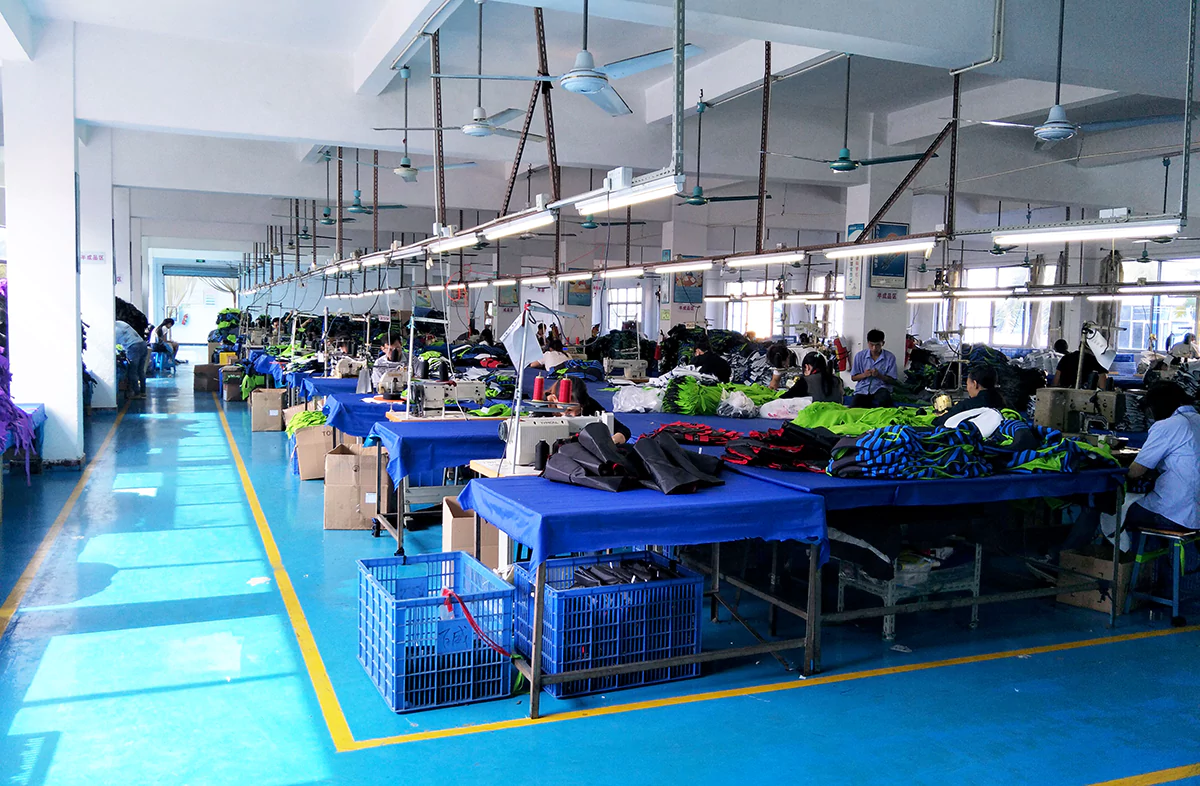
FYBagCustom is Your Trusted Custom Bag Manufacturer in China, with 15+ years of manufacturing experience and a lining fabric library spanning every family described in this guide. For brands specifying custom lining, our capabilities include:
Contact our materials team to discuss lining specifications, jacquard development, and recycled-content sourcing for your program.
The lining is not the part of the bag the consumer photographs. It is the part her hand touches 30–50 times per day — the part that confirms or contradicts the quality promise the exterior makes. For B2B buyers specifying custom handbags, three core takeaways:
If your bags’ interiors are an afterthought — or if your current lining generates complaints — now is the time to specify the lining fabric that your retail tier demands. Contact FYBagCustom to discuss lining options, jacquard development, and Martindale-tested fabric sourcing — and receive lining-upgraded samples, typically within 5–14 days.
FYBagCustom offers the full lining spectrum — from RPET twill to custom branded jacquard to Alcantara-equivalent microfiber suede — specified by weight, tested by Martindale, and matched to your brand’s signature color. Lining-upgraded samples in 5–14 days.
Start Your Custom Bag Project →