Tel/WhatsAapp:+86 18011919834
E-mail: chloe.x@fybagcustom.com

Tel/WhatsAapp:+86 18011919834
E-mail: chloe.x@fybagcustom.com
Send Your Inquiry Today

Who this guide is for: sourcing managers, brand founders, product developers, DTC entrepreneurs, and private label developers who specify leather for custom handbags and have encountered the terms “full-grain,” “top-grain,” and “genuine leather” in factory quotations — and who need to know, with precision, what they are actually buying. If you have ever been quoted “genuine leather” and assumed that meant “real, quality leather,” or if you have seen “top-grain” in a supplier’s spec sheet and assumed it was the best grade available, this guide decodes the leather grading system from the raw hide outward — explaining which layer of the animal’s skin each grade comes from, how that layer determines the leather’s performance, and which grade belongs at which retail tier.
The leather industry has a language problem. The terms used to describe leather quality — “full-grain,” “top-grain,” “genuine leather,” “real leather” — sound like a quality hierarchy, with “genuine” and “real” at the top. They are not. “Genuine leather” is not a quality endorsement; it is a legal minimum — the lowest grade of material that can legally be called “leather” in most markets. “Real leather” means nothing more than “this product contains animal hide” — it says nothing about which part of the hide, how it was processed, or how long it will last.
For B2B buyers sourcing leather for handbag production, this language gap creates real commercial risk. A factory that quotes “genuine leather” may be offering a material that is technically leather but that will crack, peel, and degrade within months of consumer use — not because the factory is dishonest, but because “genuine leather” encompasses a quality range so wide that it includes both acceptable mid-market material and unacceptable bottom-tier material. Without understanding the grading system, the buyer cannot distinguish between them.
This guide eliminates that risk. It starts with the physical anatomy of the cowhide — the actual cross-section of the animal’s skin — and traces how each layer of that cross-section produces a different leather grade with different performance characteristics. It then translates each grade into the commercial language B2B buyers use: which grade for which retail tier, which grade for which bag construction, and exactly what to write in a tech pack to ensure the factory delivers the grade you specified — not the grade that maximizes their margin.
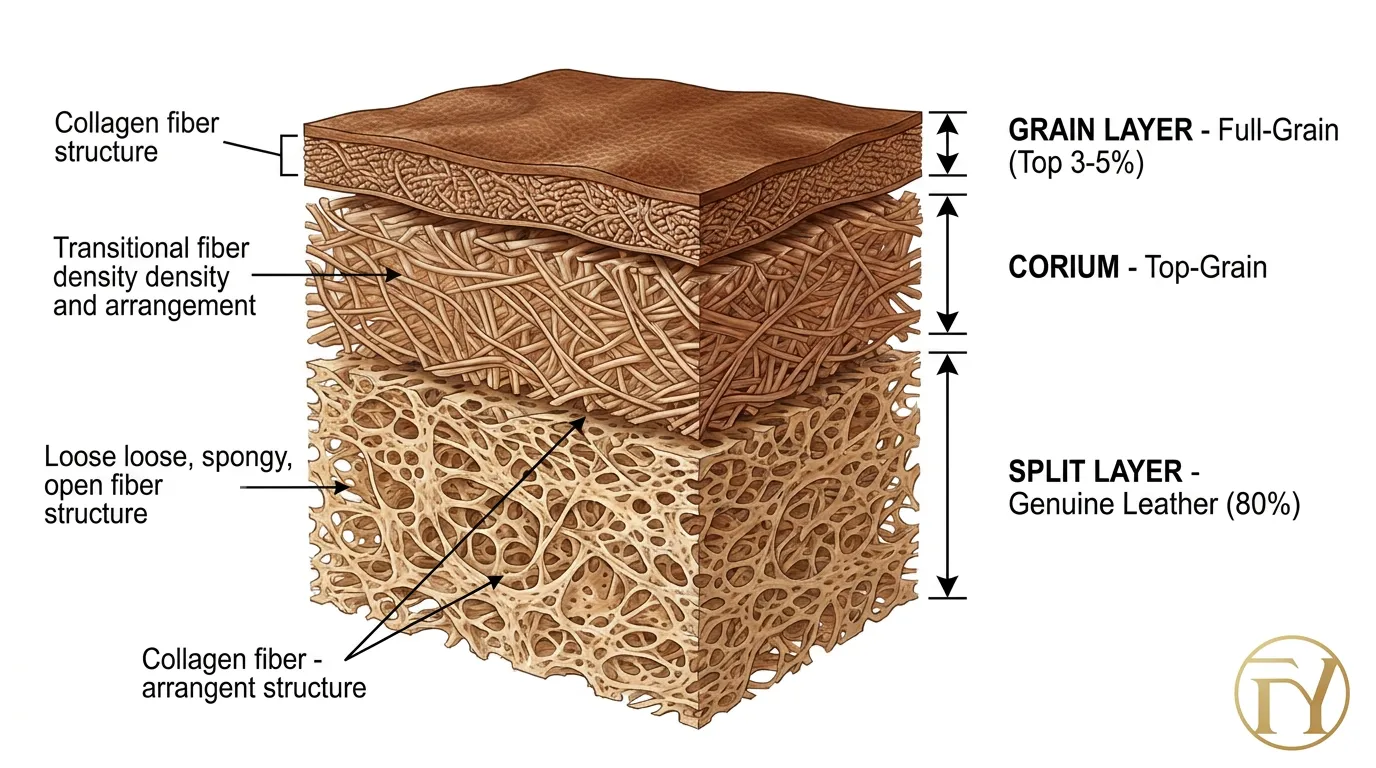
A cowhide — the raw skin removed from the animal — is not a uniform material. It has a layered structure, like plywood, where each layer has different fiber density, different mechanical properties, and different suitability for leather goods.
| Zone | Location in the Hide | Fiber Structure | Thickness | What It Becomes |
|---|---|---|---|---|
| Grain layer | The outermost surface — the side that faced the world; the side with the hair follicles and the natural grain pattern | Extremely tight, dense, interlocking collagen fibers — the tightest fiber structure in the hide | 0.3–0.8 mm (thin but extraordinarily strong) | Full-grain leather (if left intact); top-grain leather (if sanded or buffed) |
| Corium / junction layer | The zone immediately below the grain layer — a transitional zone where the grain’s tight fibers gradually loosen into the split’s open structure | Moderately dense — tighter than the split, looser than the grain | 0.3–0.5 mm | Part of full-grain or top-grain leather (included in the upper split) |
| Split layer (flesh side) | The lower portion of the hide — the side that faced the animal’s body (muscle, fat, organs) | Loose, open, spongy collagen fibers — significantly weaker and less durable than the grain layer | 1.0–3.0 mm (the thickest zone, but the weakest structurally) | Split leather; suede (if the split surface is napped); “genuine leather” (when coated with a finish to simulate a grain surface); bonded leather (when ground and reconstituted) |
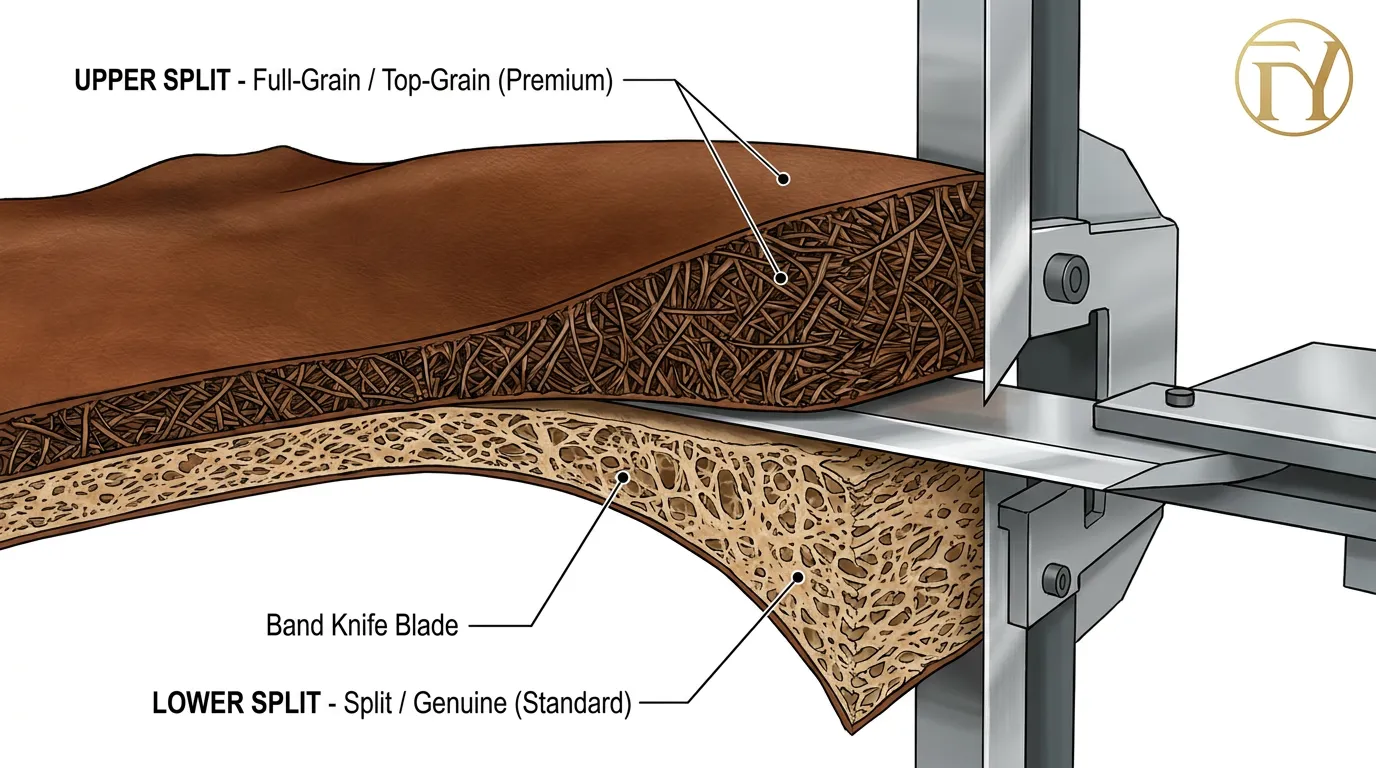
At the tannery, the hide is split horizontally — like slicing a loaf of bread — into an upper portion (containing the grain layer) and a lower portion (the split). This splitting is performed by a machine called a band knife splitter, which passes the hide between two rollers while a horizontal blade slices it at the desired thickness.
| Split | What It Contains | Commercial Name | Quality |
|---|---|---|---|
| Upper split (grain side) | The grain layer + the junction layer + a portion of the upper corium | This is what becomes “full-grain” or “top-grain” leather — the premium commercial product | Highest — the grain layer’s tight fiber structure provides strength, breathability, water resistance, and the natural grain pattern |
| Lower split (flesh side) | The remainder of the corium + the flesh layer — the loose, open-fibered lower portion | This is what becomes “split leather,” “suede” (if napped), or “genuine leather” (if coated) | Lowest — the open fiber structure is weaker, less durable, and less resistant to moisture and abrasion |
The critical insight: the split determines everything. A handbag made from the upper split (full-grain or top-grain) will behave fundamentally differently from a handbag made from the lower split (genuine/split leather) — even though both are legally “leather,” both come from the same animal, and both may look similar when new.
Full-grain leather is the upper split with the grain surface left completely intact — unsanded, unbuffed, uncorrected. The natural grain pattern (the texture created by the hair follicles, the pore structure, and the collagen fiber orientation on the hide’s surface) is preserved exactly as it grew on the animal.
| Property | Full-Grain Performance | Why |
|---|---|---|
| Durability | The highest of any leather grade — full-grain can last decades with proper care | The intact grain layer has the tightest, densest fiber structure in the hide; it resists tearing, abrasion, and stretching |
| Breathability | Very good — the natural pore structure allows air and moisture to pass through the leather | The unsanded grain retains its original pore structure — thousands of micro-openings that allow the leather to “breathe” |
| Water resistance | Good (naturally) — the tight grain surface resists water penetration better than any other grade | The dense, interlocking fibers at the grain surface create a natural barrier; water sits on the surface rather than soaking in immediately |
| Patina development | The signature quality — full-grain develops a rich, warm, deepening color over months and years of use | The natural surface absorbs skin oils, sunlight, and environmental exposure, developing a translucent surface layer (the “patina”) that is unique to each owner’s usage pattern |
| Natural character marks | Full-grain retains all natural marks — insect bites, scars, wrinkles, brand marks, vein patterns | Because the surface is not sanded or corrected, every imperfection on the hide is visible; these marks are considered features in the premium market — proof of authenticity |
| Hand-feel | Firm when new; softens progressively with use; develops a warm, slightly waxy quality over time | The intact grain has a natural firmness (from the tight fiber structure) that relaxes as the fibers are flexed through daily use |
Full-grain is the best leather — but it is not always the right leather. Three scenarios where full-grain is not the optimal choice:
| Scenario | Why Full-Grain Is Not Ideal | Better Alternative |
|---|---|---|
| The bag requires a perfectly uniform surface with zero visible marks | Full-grain retains natural imperfections — scars, insect bites, wrinkles; these cannot be removed without sanding (which would make it top-grain) | Top-grain (corrected grain) — the surface is sanded to remove imperfections, then refinished for uniformity |
| The bag is retailing at the mid-market tier and the budget does not support full-grain pricing | Full-grain is the most expensive leather grade; it may not be commercially viable for bags retailing below the premium tier | Top-grain or high-quality PU — both deliver a premium appearance at a lower material cost |
| The design requires a very specific texture (crocodile embossing, saffiano cross-hatch, etc.) | Embossing over full-grain is possible but is counterproductive — the embossing destroys the natural grain that makes full-grain premium | Top-grain (the sanding creates a smooth, uniform surface that accepts embossing cleanly) or PU (embossed textures are built into the PU during manufacturing) |
Specification language:
Top-grain leather comes from the same upper split as full-grain — but the outermost surface of the grain has been lightly sanded or buffed to remove natural imperfections (scars, marks, pore irregularities), and then a new surface finish (pigment, coating, or embossed pattern) has been applied to restore a uniform appearance.
The term “top-grain” sounds like “the top grade” — and many consumers (and some buyers) interpret it that way. It is not. “Top-grain” refers to the position of the material in the hide (the top/upper split), not its quality ranking. Full-grain is a subset of top-grain — all full-grain leather is technically from the top grain, but “top-grain” as a market term typically refers to leather that has been sanded and refinished (distinguishing it from full-grain, which is unsanded).
| Sub-Type | Process | Surface | Visual Result | Common In |
|---|---|---|---|---|
| Corrected-grain | The grain surface is sanded with 180–320 grit to remove imperfections; a pigmented finish (polyurethane or acrylic coating) is applied to create a uniform surface; the finish may be smooth or embossed with an artificial grain pattern | Coated — the consumer touches the applied finish, not the leather itself | Very uniform — no natural marks, no variation; the surface looks “perfect” and consistent across every unit | Mid-market to premium handbags; the most common top-grain treatment |
| Buffed-grain (nubuck-style) | The grain surface is lightly buffed (finer than corrected-grain sanding) to create a soft, velvety nap — similar to nubuck but on a lighter scale | Napped — the surface has a soft, slightly fuzzy texture | A matte, velvety surface with a refined texture; some natural character may still be visible through the light buffing | Premium — when a soft, matte surface is desired without the cost of full-grain nubuck |
| Property | Full-Grain | Top-Grain (Corrected) | Difference |
|---|---|---|---|
| Durability | Highest | High — slightly reduced because the sanding removes the outermost (densest) grain fibers | The difference is marginal for most handbag applications — top-grain is still highly durable |
| Breathability | Very good | Reduced — the applied surface coating partially blocks the pore structure | The coating seals the surface; the leather breathes less than full-grain |
| Patina development | Strong — the natural surface absorbs oils and light, developing a rich patina | Minimal to none — the coating prevents direct contact between the environment and the leather fibers; the patina develops on the coating, not on the leather | This is the most significant performance difference — top-grain does NOT develop the characteristic patina that full-grain is prized for |
| Surface uniformity | Variable — natural marks and character | Very high — the sanding + coating creates a consistent, defect-free surface | Top-grain’s uniformity is its commercial advantage — every unit looks identical |
| Scratch visibility | Moderate — scratches develop character and blend into the patina | Low — the pigmented coating hides light scratches; deeper scratches reveal the sanded leather beneath | Top-grain is more “care-free” than full-grain — light scratches are invisible |
| Water resistance | Good (natural) | Very good — the coating adds a barrier layer on top of the natural grain resistance | Top-grain’s coating provides better water protection than full-grain’s natural surface |
| Scenario | Why Top-Grain Works |
|---|---|
| The brand needs consistent, uniform appearance across large production runs | Top-grain’s corrected surface eliminates the hide-to-hide variation that full-grain inherently has; every bag looks the same |
| The bag will be embossed with an exotic or custom texture | The sanded surface provides the ideal smooth substrate for clean, deep embossing |
| The retail tier is mid-market to entry-premium | Top-grain delivers a genuinely “leather” product at a lower material cost than full-grain; it is real leather (upper split) with professional finishing |
| The consumer values low maintenance over patina | Top-grain’s coated surface resists scratches, water, and staining better than full-grain’s raw surface; it is the “easy care” leather |
Specification language:
“Genuine leather” is the term that causes the most confusion — and the most commercial damage — in B2B leather sourcing. The word “genuine” sounds like a quality endorsement: “this is genuinely leather, the real thing, authentic.” In reality, “genuine leather” is a grade designation that typically refers to the lower split of the hide — the bottom layer, after the valuable grain layer has been removed.
In the U.S. (per FTC guidelines) and in most international markets, “genuine leather” means “this product is made from animal hide.” That is the entirety of the claim. It does not specify:
Any material derived from an animal hide — including the lowest-quality split leather with an artificial grain coating — can legally be labeled “genuine leather.” The term is a floor, not a ceiling.
When a factory quotes “genuine leather” for a handbag, they are almost always referring to coated split leather — the lower split of the hide, with an artificial grain surface applied (usually a polyurethane or vinyl coating embossed with a grain pattern to mimic the appearance of full-grain or top-grain).
| Layer | What It Contains | What the Consumer Sees | What the Consumer Feels |
|---|---|---|---|
| Surface coating (PU or vinyl) | An artificial grain layer applied to the split surface — may be embossed with crocodile, pebble, or smooth grain | The coating — it looks like leather grain but is actually a plastic/polymer finish | Smooth, sometimes slightly “plasticky” — the coating does not have the warmth or organic variability of natural grain |
| Split leather beneath | The loose-fibered lower split of the hide | Nothing — the split is hidden beneath the coating | The thickness and weight of the leather — it feels like “leather” in terms of heft and substance |
| Property | Full-Grain | Top-Grain | Genuine (Coated Split) |
|---|---|---|---|
| Fiber density | Very high | High | Low — the split’s loose fibers are significantly weaker |
| Durability (years of daily use) | 5–15+ years | 3–8 years | 1–3 years — the coating cracks and peels; the loose fibers stretch and deform |
| Breathability | Very good | Moderate (coating reduces it) | Poor — the coating seals the surface; the loose split beneath retains moisture |
| Patina | Strong, beautiful | Minimal (coating blocks it) | None — the coating determines the appearance; the leather beneath does not develop patina |
| Surface cracking | Very rare (if properly cared for) | Rare (the coating protects) | Common — the coating is the structural surface; when it cracks (from flexing, UV, or temperature), the damage is catastrophic because the loose split beneath has no structural integrity |
| Delamination (coating separating from the base) | N/A (no coating) | Rare (the coating bonds to the dense grain fibers) | The #1 failure mode — the coating peels away from the loose split fibers over 6–18 months, creating the “my bag is peeling” consumer complaint |
| Appropriate retail tier | Premium to luxury | Mid-market to premium | Budget to lower mid-market — or not at all for any bag positioned as “quality” |
The trap works like this:
The prevention: never specify “genuine leather” or “real leather” in a tech pack. Always specify the grade: “full-grain,” “top-grain (corrected-grain),” or — if you intentionally want split leather — “split leather, [specify coating type].”
Split leather is the lower split of the hide — the material left after the grain layer has been removed. It is a legitimate material with legitimate applications — but exterior handbag panels is not one of them (at the premium or mid-market tier).
| Appropriate Uses for Split | Inappropriate Uses |
|---|---|
| Suede — the split surface is napped (buffed to create a soft, fuzzy texture); suede is the most commercially valuable use of the split | Exterior panels of bags marketed as “leather” quality — the split lacks the durability and structural integrity for this application |
| Lining leather — thin split used to line the interior of leather bags; provides a leather interior at lower cost than full-grain | Handles and straps — the split’s loose fiber structure will stretch and deform under the concentrated load of daily carry |
| Backing / reinforcement — split used as a backing material behind the grain layer for added thickness | Any application where the consumer expects the performance of grain leather — the split will disappoint |
Bonded leather is the lowest grade of material that contains any animal hide. It is manufactured by grinding leather scraps and fibers into a pulp, mixing the pulp with synthetic binders (polyurethane or latex), and pressing the mixture into a sheet — similar to how particle board is made from wood chips.
| Property | Bonded Leather |
|---|---|
| Leather content | Typically 10–20% leather fiber; the rest is synthetic binder and filler |
| Appearance | Can be embossed to look like full-grain leather — when new, it is difficult to distinguish visually |
| Durability | Very poor — 6–18 months before cracking, peeling, and disintegrating |
| Appropriate use in handbags | None — bonded leather should never be used in any handbag marketed as a quality product |
| Legal labeling | In many markets, bonded leather CANNOT be labeled as “leather” without qualification (e.g., “bonded leather” or “reconstituted leather” must be stated) |
The specification safeguard: include in your tech pack: “No bonded leather, reconstituted leather, or leather-fiber composite in any component of this product.”
The leather grade (full-grain, top-grain, split) determines the raw material quality. The tannage method determines how that raw material is processed into stable, usable leather — and the tannage significantly affects the leather’s performance, color behavior, environmental profile, and suitability for different bag constructions.
| Property | Chrome Tanning | Vegetable Tanning | Chrome-Free (synthetic / aldehyde) |
|---|---|---|---|
| Process agent | Trivalent chromium salts | Plant-derived tannins (mimosa, chestnut, quebracho, tara) | Synthetic tanning agents (glutaraldehyde, oxazolidine, or proprietary formulations) |
| Process duration | 1–2 days | 3–10 days (drum); 4–8 weeks (pit) | 2–5 days |
| Resulting leather color (undyed) | Blue-gray (“wet blue”) | Warm tan/brown (“vegetable tan”) | White or pale (“wet white”) |
| Softness | Very soft | Firmer initially; softens with use | Moderate–Soft (varies by formulation) |
| Patina development | Minimal — the chrome-stabilized surface does not evolve significantly | Strong — the most distinctive aging characteristic of veg-tan | Minimal |
| Color range | Unlimited — accepts any dye vibrantly | Limited by the warm tan base — earth tones excel; pastels are difficult | Wide — accepts dyes well |
| Heavy metal content | Contains residual chromium (Cr(III)); risk of Cr(VI) formation under adverse conditions | Zero heavy metals | Zero heavy metals (if truly chrome-free; verify with documentation) |
| Environmental profile | Chromium-containing wastewater requires specialized treatment | Biodegradable tannin wastewater; lower environmental impact | Varies by agent — some are environmentally benign; others require careful wastewater management |
| Regulatory status (EU/US) | Subject to REACH Cr(VI) limits (3 mg/kg); CPSIA restrictions for children’s products | Inherently compliant — no chromium to regulate | Compliant — no chromium; but the specific synthetic agent may have its own regulatory profile |
| Best for (handbags) | Most handbag applications — the industry standard; the widest range of colors and softnesses | Premium and eco-friendly positioning; patina-driven brands; mother-and-baby products | Brands that want chrome-free compliance without the warm color limitations and longer lead time of vegetable tanning |
For a deeper dive into vegetable tanning, chrome-free processes, and health/safety certification, see our comprehensive vegetable-tanned chrome-free leather guide.
This is the table that translates the entire guide into a single actionable framework. It matches each leather grade to the retail tier it supports, the bag types it is suitable for, and the consumer expectation it must meet.
| Retail Tier | Recommended Leather Grade | Tannage | Thickness | Finish | Consumer Expectation | What They Will Notice if the Grade Is Wrong |
|---|---|---|---|---|---|---|
| Luxury (highest retail tier) | Full-grain (vegetable-tanned or premium chrome-tanned) | Vegetable-tanned for patina brands; premium chrome-tanned for color-forward brands | 0.8–1.2 mm | Minimal — aniline or semi-aniline; the natural grain is the aesthetic | “This leather is alive — it has character, it breathes, it ages” | Coated surface (they will feel the plastic finish); lack of patina after 3 months; surface cracking |
| Premium (upper-mid to high retail) | Full-grain or top-grain (high-quality corrected) | Chrome-tanned (standard); vegetable-tanned (for differentiation) | 0.8–1.2 mm | Full-grain: light wax or oil finish; Top-grain: quality pigmented coating | “This is clearly real, quality leather — it feels substantial and well-finished” | Thin, hollow feel (split leather); peeling coating after 6 months; no heft or substance in the hand |
| Mid-Market (moderate retail) | Top-grain (corrected-grain, pigmented finish) | Chrome-tanned | 0.8–1.0 mm | Pigmented polyurethane or acrylic coating; embossed texture optional | “This feels like good leather — smooth, clean, well-made” | Plastic-like surface; stiff, cardboard-like hand-feel (over-corrected); visible cracking at flex points within the first year |
| Entry (lower retail) | High-quality PU leather (recommended) or top-grain split (if leather is required) | N/A for PU; chrome-tanned for split | 0.8–1.0 mm | PU: garment-grade soft finish; Split: heavy pigmented coating | “It looks nice for the price” | Peeling within 3–6 months (if low-quality split or PU is used); chemical odor; stiffness |
| Budget (lowest retail tier) | PU leather | N/A | 0.7–0.9 mm | Standard PU finish | “It looks like the picture” | Any defect — at this tier, the consumer has low expectations but zero tolerance for obvious quality failures |
A high-quality PU leather at the entry tier is a better product than low-quality split leather at the same tier. The PU will maintain its appearance for 2–3 years without cracking or peeling. The low-quality split will begin to delaminate within 6–12 months. The consumer does not care whether the material is “real leather” if it is falling apart — she cares whether the bag holds up.
The recommendation for entry-tier brands: use garment-grade PU leather and market it honestly as “premium vegan leather” or “engineered leather alternative” — do not use low-quality split leather and label it “genuine leather” in an attempt to claim the “leather” marketing advantage. The “genuine leather” claim invites the consumer to compare the product against her expectation of leather quality — an expectation the coated split cannot meet.
If you receive a sample or a production shipment and want to verify the leather grade independently (without relying solely on the factory’s declaration), three simple tests can distinguish full-grain from top-grain from split:
| What to Look For | Full-Grain | Top-Grain (Corrected) | Split (Coated) |
|---|---|---|---|
| Grain pattern | Natural, irregular, unique — pores, wrinkles, and character marks visible; no two spots look identical | Uniform, consistent — the corrected surface has an even texture; an embossed pattern may be present; the surface looks “perfect” | The coating’s embossed pattern is perfectly uniform and repeating — too regular to be natural; up close, the pattern has a “stamped” quality |
| Pore visibility | Natural pores visible (tiny, irregular openings in the surface) | Pores may be partially visible through the coating, or completely hidden | No natural pores — the coating covers them entirely |
Place a single drop of water on the leather surface. Wait 30 seconds.
| Result | What It Indicates |
|---|---|
| The drop absorbs slowly (10–30 seconds), leaving a temporary dark spot that fades as it dries | Full-grain with aniline or semi-aniline finish — the natural grain surface is porous and absorbs moisture; the dark spot is temporary |
| The drop beads on the surface and does not absorb within 30 seconds | Top-grain with pigmented coating — the coating creates a non-porous barrier; or split with heavy coating — same barrier effect |
| The drop absorbs immediately (under 5 seconds), leaving a dark, spreading spot | Unfinished full-grain or suede — the raw surface absorbs rapidly; this is a natural behavior, not a defect |
Look at the cut edge of the leather (where it was trimmed, not where it was painted). The cross-section reveals the fiber structure.
| What You See | What It Indicates |
|---|---|
| Dense, tight, uniform fibers throughout the cross-section — the fibers are so tightly packed that individual strands are hard to distinguish | Full-grain or high-quality top-grain — the dense grain-layer fibers are visible |
| A visible layer distinction: a thin, dense upper layer and a thicker, looser, fuzzier lower layer | Top-grain — the dense upper layer is the grain; the looser layer beneath is the upper corium |
| Loose, fuzzy, spongy fibers throughout — individual fiber strands are easily pulled from the edge | Split leather — the loose split-layer fibers are characteristic; no dense grain layer is present |
| A visible plastic/coating layer on top of loose fibers | Coated split / “genuine leather” — the coating is the surface; the loose fibers beneath are the split |
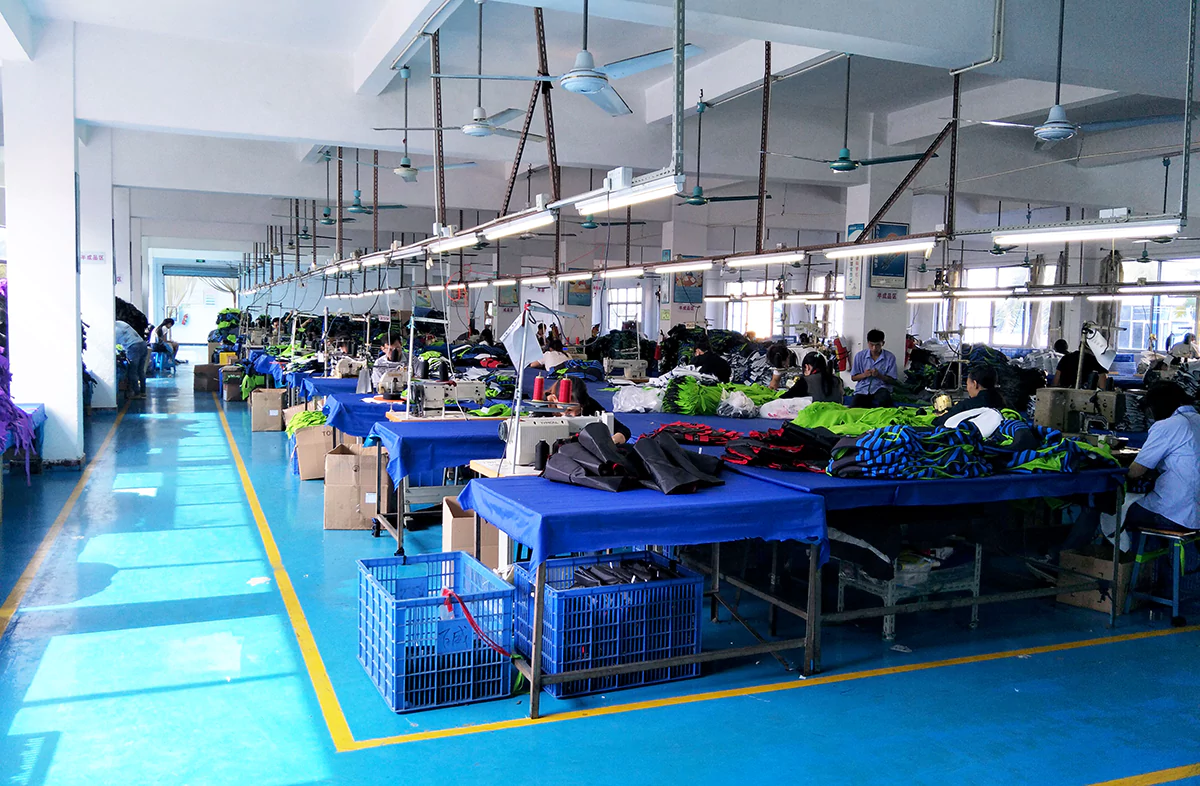
FYBagCustom is Your Trusted Custom Bag Manufacturer in China, with 15+ years of manufacturing experience and a leather sourcing network built on documented grade specifications — not marketing terms. For brands sourcing leather handbags, our capabilities include:
Contact our sourcing team to discuss leather grade specifications, tannage options, and grade-verified sampling for your program.
The leather grade — not the color, not the brand name, not the marketing term — determines how the bag will look, feel, and perform over its lifetime. “Genuine leather” is not a quality claim; it is a legal minimum. “Top-grain” is not the best; it is the middle. “Full-grain” is the standard by which all other grades are measured. For B2B buyers specifying leather handbags, three core takeaways:
If you are sourcing leather for your next handbag collection and want to ensure you receive the grade you specified — not the grade that maximizes the supplier’s margin — contact FYBagCustom to discuss grade-specific sourcing, tannery documentation, and chemical compliance testing. Grade-verified leather samples in 7–12 days.
FYBagCustom sources grade-documented full-grain and top-grain leather from verified tanneries — with chemical compliance testing, Pantone color matching, and the explicit guarantee: no split leather on any exterior panel. Grade-verified samples in 7–12 days.
Start Your Custom Bag Project →