Tel/WhatsApp:+86 18011919834
E-mail: chloe.x@fybagcustom.com

Tel/WhatsApp:+86 18011919834
E-mail: chloe.x@fybagcustom.com


Who this guide is for: brand owners, sustainability leads, sourcing managers, private label buyers and corporate gifting programs that want recycled bags with claims they can defend to retailers, regulators and customers.
Quick answer: GRS certified bag materials carry third-party proof of recycled content and an unbroken chain of custody. Before paying the green premium for rPET or recycled nylon, ask for the mill’s scope certificate, a transaction certificate covering your shipment, the exact recycled percentage, which components are recycled, and whether the factory sewing your bag is certified to carry the claim through.
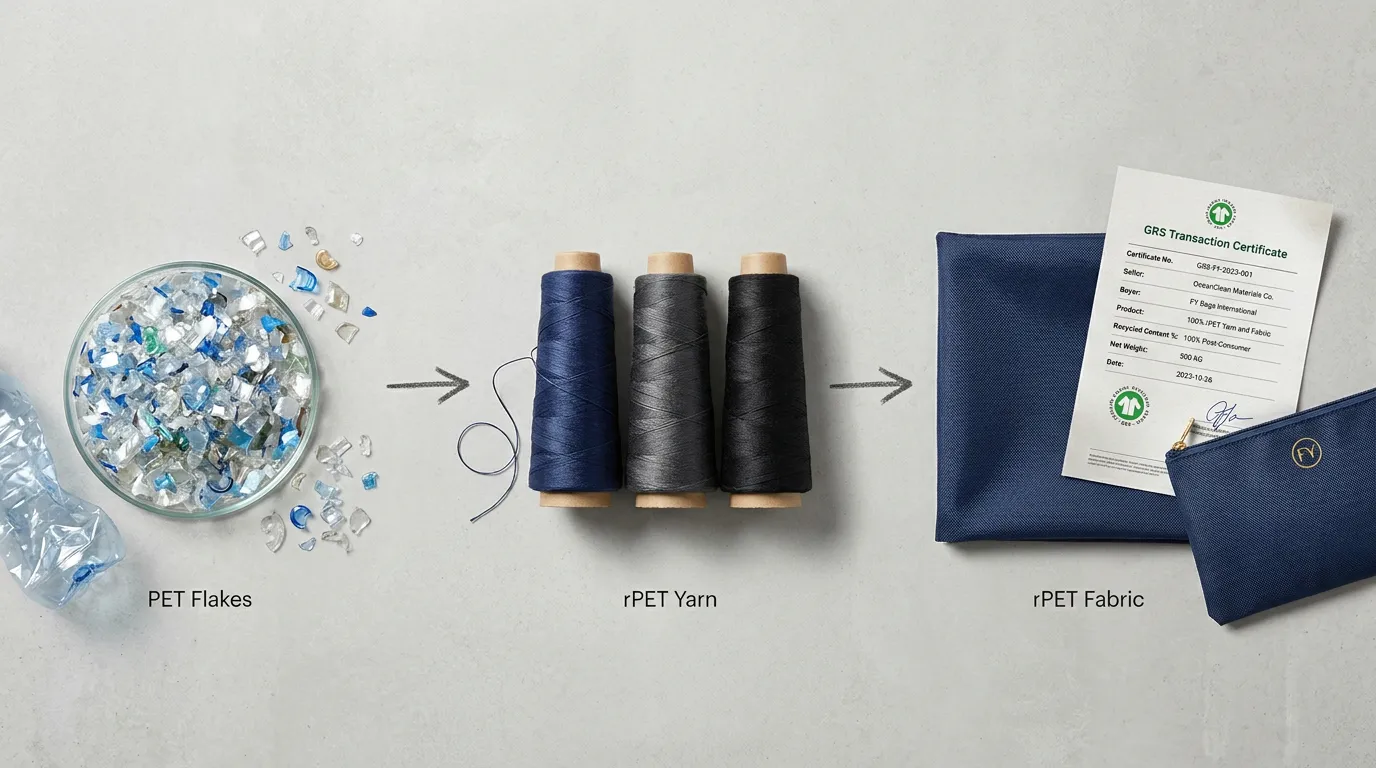
Recycled fabric costs more than virgin fabric, and buyers usually pay that premium to make a claim: “made with recycled materials”, a GRS logo on the hang tag, or a line in a retailer’s sustainability report. GRS certified bag materials are the most common way to back that claim with documents. The premium pays off only if the documents survive scrutiny, and recycled programs often fail at that step: the fabric was recycled, but the paperwork chain broke somewhere between the mill and the finished bag.
The Global Recycled Standard (GRS) is a voluntary standard owned by Textile Exchange. Independent certification bodies audit each company in the supply chain against it. GRS covers four areas:
Its sister standard, the Recycled Claim Standard (RCS), verifies recycled content and chain of custody only.
| Feature | GRS | RCS |
|---|---|---|
| Owner | Textile Exchange | Textile Exchange |
| Minimum recycled content for certification | 20% | 5% |
| Recycled content needed for on-product labeling | 50% or more | Labels: “RCS 100” (95%+) or “RCS Blended” (5% to under 95%) |
| Chain-of-custody tracking | Yes | Yes |
| Social and environmental site requirements | Yes | No |
| Chemical restrictions | Yes | No |
| Typical use in bags | Retailer programs, EU markets, brands with published targets | Lower-percentage blends, entry-level recycled claims |
Textile Exchange revises its standards periodically and has been working toward a consolidated standard, so confirm which version your suppliers’ certificates reference.
| Material | Typical feedstock | Where it goes in a bag | Relative premium vs virgin | Verification notes |
|---|---|---|---|---|
| rPET polyester | Post-consumer PET bottles; some textile waste | Shell fabric, lining, webbing, thread, zipper tape | Low to moderate | Widely available with GRS or RCS documentation |
| Recycled nylon | Pre-consumer industrial waste; post-consumer nets and carpet | Shell fabric for backpacks, travel and technical bags | Moderate to high | Post-consumer sources cost more and are rarer |
| Recycled cotton | Pre-consumer cutting waste, usually blended with virgin or rPET | Canvas totes, linings | Low to moderate | Fibers shorten in recycling, so blends are common |
| Recycled PP non-woven | Post-industrial PP | Promotional totes | Low | Check content claims carefully at low price points |
| Recycled-base PU | rPET backing fabric under a virgin PU coating | Vegan leather bodies | Moderate | Only the backing is recycled; the coating usually is not |
Two notes on rPET, the recycled form of polyester bag fabric. Most bag-grade rPET comes from bottles, which some critics argue diverts bottles from bottle-to-bottle recycling. Textile-to-textile recycled polyester exists but is a much smaller supply. If your customers or retail partners are sensitive to that debate, ask the mill about feedstock. For background on the fabric itself, see our rPET fabric guide for bag manufacturing.
GRS paperwork has two documents that do different jobs:
A typical sequence for a recycled bag program:
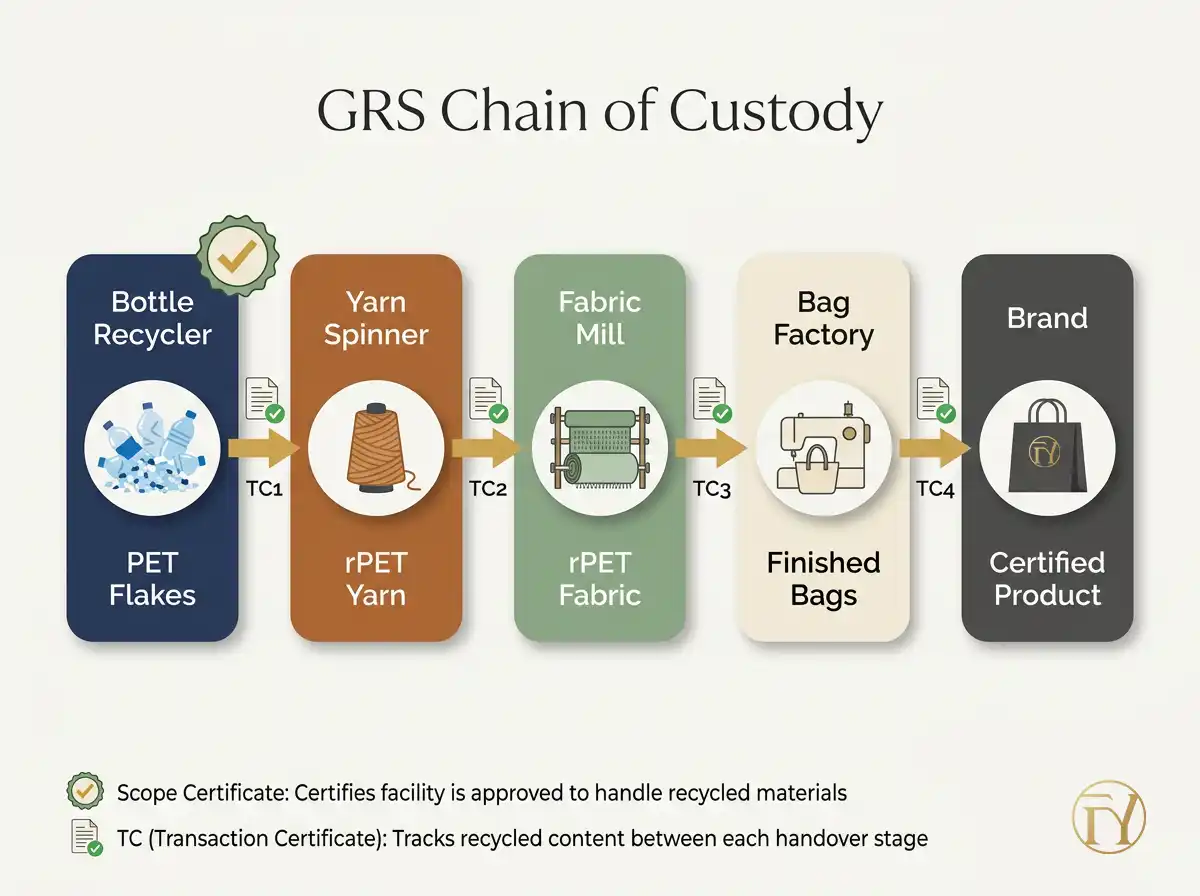
GRS works on an unbroken chain. Generally, every company that takes ownership of the material and processes or trades it, up to the last business-to-business seller, needs its own scope certificate. When one link is uncertified, the chain stops, and later companies cannot issue TCs for the finished product.
For a bag brand, this creates three realistic scenarios:
| Scenario | What you can claim | What you cannot claim |
|---|---|---|
| Mill and bag factory both GRS certified, TCs issued | GRS label on the bag (if content meets the threshold) and a documented recycled percentage | Claims beyond the certified content |
| Mill certified, bag factory not certified | A substantiated material claim such as “shell made with recycled polyester”, backed by the mill’s TC | A GRS logo or “GRS certified” on the finished bag |
| Mill uncertified, supplier declaration only | Little that a retailer audit will accept | Any certified claim |
The second scenario is common and fully usable if you only need a factual material claim. The mistake is paying for full GRS treatment and then discovering the finished-bag claim was never available. Decide which scenario you need before sampling, and ask both the mill and the factory for current certificates.
For polyester and nylon, generally not. Recycled and virgin PET are chemically the same polymer, so standard lab tests cannot reliably tell them apart in finished fabric. Some suppliers add tracer or marker technologies at the yarn stage that a lab can later detect, but these remain the exception and only work if the marker was added at the start.
This is why GRS relies on documentation. Lab tests still help with performance: tensile and tear strength, abrasion, colorfastness and coating adhesion. Recycled yarns can behave slightly differently from virgin yarns in dyeing and strength, so test a sample of the actual recycled fabric instead of assuming it matches the virgin version.
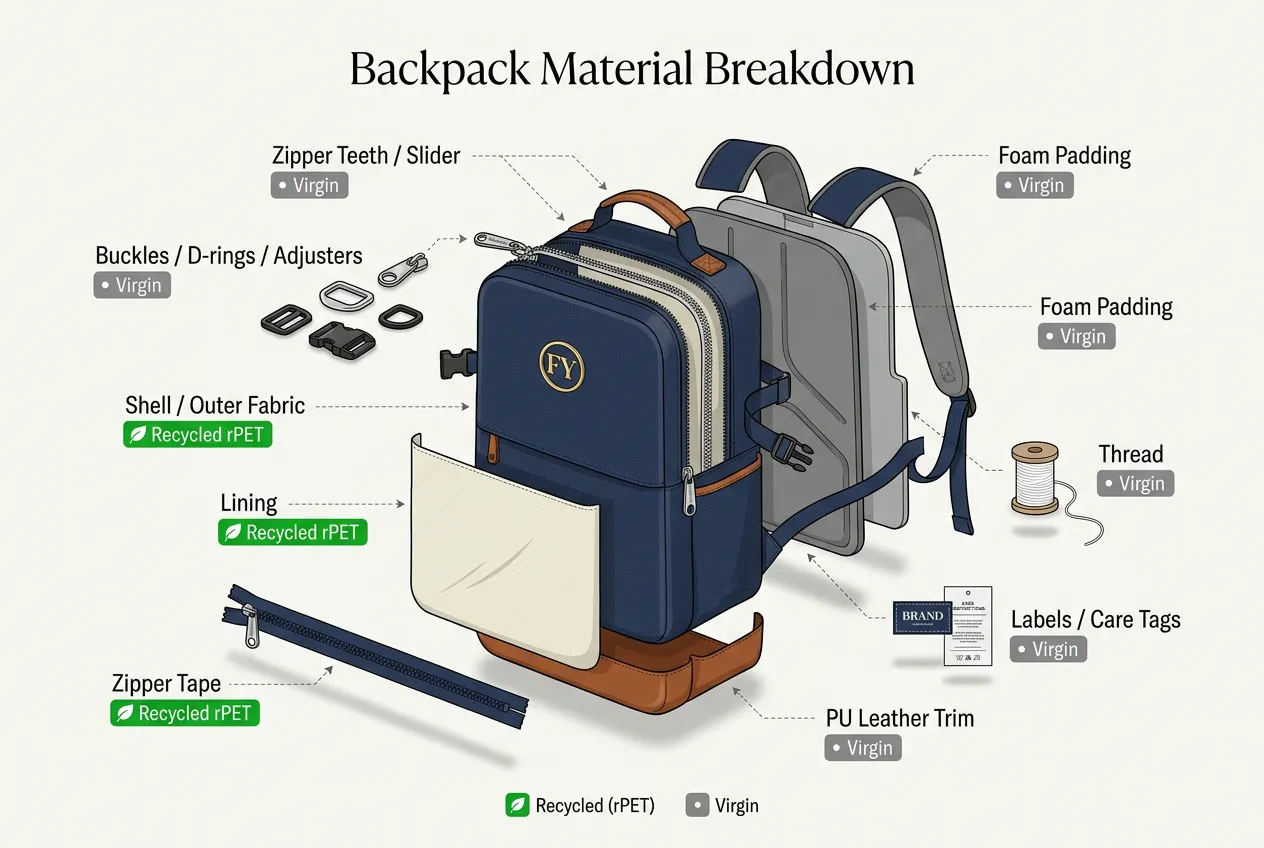
“100% recycled” usually describes the shell fabric. The finished bag carries many other components.
| Component | Recycled options | Availability | Share of bag weight (typical) |
|---|---|---|---|
| Shell fabric | rPET, recycled nylon, recycled cotton blends | Wide | Large |
| Lining | rPET taffeta or twill | Wide | Medium |
| Webbing and straps | rPET webbing | Good | Medium |
| Foam and padding | Some recycled-content foams | Limited | Small to medium |
| Zipper | Recycled polyester tape and coil from major zipper brands | Good | Small |
| Thread | Recycled polyester thread | Good | Very small |
| PU coating or laminate | Mostly virgin | Limited | Small to medium |
| Metal hardware | Some recycled zinc or brass content claims | Limited documentation | Small to medium |
Calculate recycled content by weight across the whole bag if you plan to state a single percentage. An rPET shell with virgin coating, foam and hardware might reach a much lower whole-bag figure than the “100% rPET” fabric suggests. State claims at the level you can document, for example “shell and lining made with recycled polyester”. Our eco-friendly bag range shows the constructions where recycled fabrics are most practical.
| Cost driver | Effect on the premium | How to manage it |
|---|---|---|
| Feedstock collection, sorting and cleaning | Moderate, ongoing | Choose widely available rPET over niche post-consumer nylon unless the story needs it |
| Smaller production scale for recycled yarns | Moderate | Use the mill’s stock recycled qualities and colors |
| Certification audits for each certified site | Low per unit, spread across volume | Work with suppliers already certified |
| Transaction certificate fees per shipment | Low to moderate on small orders | Consolidate shipments so fewer TCs are needed |
| Dye-lot minimums for recycled yarn | Moderate on small runs | Limit custom colors; blend colorways |
| Testing a new recycled fabric | One-off | Test once per quality, then reuse results for repeat orders |
At the fabric level, rPET usually carries a modest premium over comparable virgin polyester, and recycled nylon a larger one. At the finished-bag level the premium shrinks, because fabric is only one part of the bag’s cost alongside labor, hardware, trims and packaging.
The premium pays off when a retailer requires certified recycled content, when you sell into markets with strict green-claim rules, or when recycled content is central to your brand. It pays off less when you cannot carry the claim to the finished product, or when a longer-lasting virgin material would keep the bag in use for more years.
Get answers in writing and file them with the quote. If a supplier hesitates on questions 2, 4 or 5, assume the claim will be weaker than you are paying for.
Rules depend on where you sell:
Have claim wording checked for each market before printing hang tags. Our overview of sustainable bag materials beyond the buzzwords covers the wider material options.
FYBagCustom is Your Trusted Custom Eco-Friendly Bag Manufacturer in China, producing OEM, ODM and private label bags in recycled and lower-impact materials for brands that need claims they can document.
FYBagCustom, a custom bag factory in Huadu District, Guangzhou, sources fabrics through 200+ verified suppliers, including recycled polyester (rPET) and other recycled qualities for shells, linings and webbing. For programs that need GRS or RCS documentation, ask our team which certificates are available for the specific materials and the production route in your program, and check them against the Textile Exchange database before you approve the premium. Our sustainability page outlines our approach.
What we provide:
Tell us your recycled-content target and markets, and we will recommend materials that fit the claim you need, along with the documentation available for each.
Both are Textile Exchange standards that verify recycled content and chain of custody. GRS adds social, environmental and chemical requirements at certified sites and requires at least 20% recycled content for certification, with 50% or more for on-product labeling. RCS covers recycled content and chain of custody only, starting at 5% recycled content. Brands with retailer or EU requirements usually choose GRS.
Ask for the supplier’s scope certificate and check the company name, certification body, validity dates and listed products. Then search Textile Exchange’s public database of certified organizations to confirm it is active. For your order, request a transaction certificate naming your shipment, buyer and recycled content. A scope certificate alone proves capability; the transaction certificate ties the claim to your goods.
Good rPET fabrics perform close to comparable virgin fabrics in tensile strength, tear strength and abrasion for most bag uses. Quality varies with feedstock and yarn processing, and some recycled yarns dye slightly differently. Test the specific fabric quality you plan to use, including coating adhesion if the fabric is PU or TPU coated, instead of relying on results for the virgin version.
rPET usually carries a modest premium over comparable virgin polyester, while recycled nylon and post-consumer feedstocks cost more. Certification and transaction certificate fees add a small amount per unit, more on small orders. At the finished-bag level the premium is smaller, because fabric is only part of total cost. Using stock recycled colors keeps the premium down.
For a recycled program with documentation planned from the start, contact FYBagCustom.
FYBagCustom’s OEM/ODM team helps brand owners, sustainability leads and corporate gifting programs source rPET and recycled materials through 200+ verified suppliers, with 5–7 day comparison samples and flexible, blended MOQ.
Start Your Custom Bag Project →