Tel/WhatsAapp:+86 18011919834
E-mail: chloe.x@fybagcustom.com

Tel/WhatsAapp:+86 18011919834
E-mail: chloe.x@fybagcustom.com

Who this guide is for: brand owners, product developers, sourcing managers, private label buyers and corporate gifting leads who need a signature color to look the same on every part of a custom bag, and on every reorder.
Quick answer: Bag factories match Pantone colors by turning the Pantone reference into a physical standard for each material: lab dips for fabric, color swatches for leather and PU, dyed tapes for zippers and thread, and coated samples for hardware. Developers judge each submission side by side in a light booth under agreed light sources, often with a spectrophotometer reading against a Delta E tolerance.
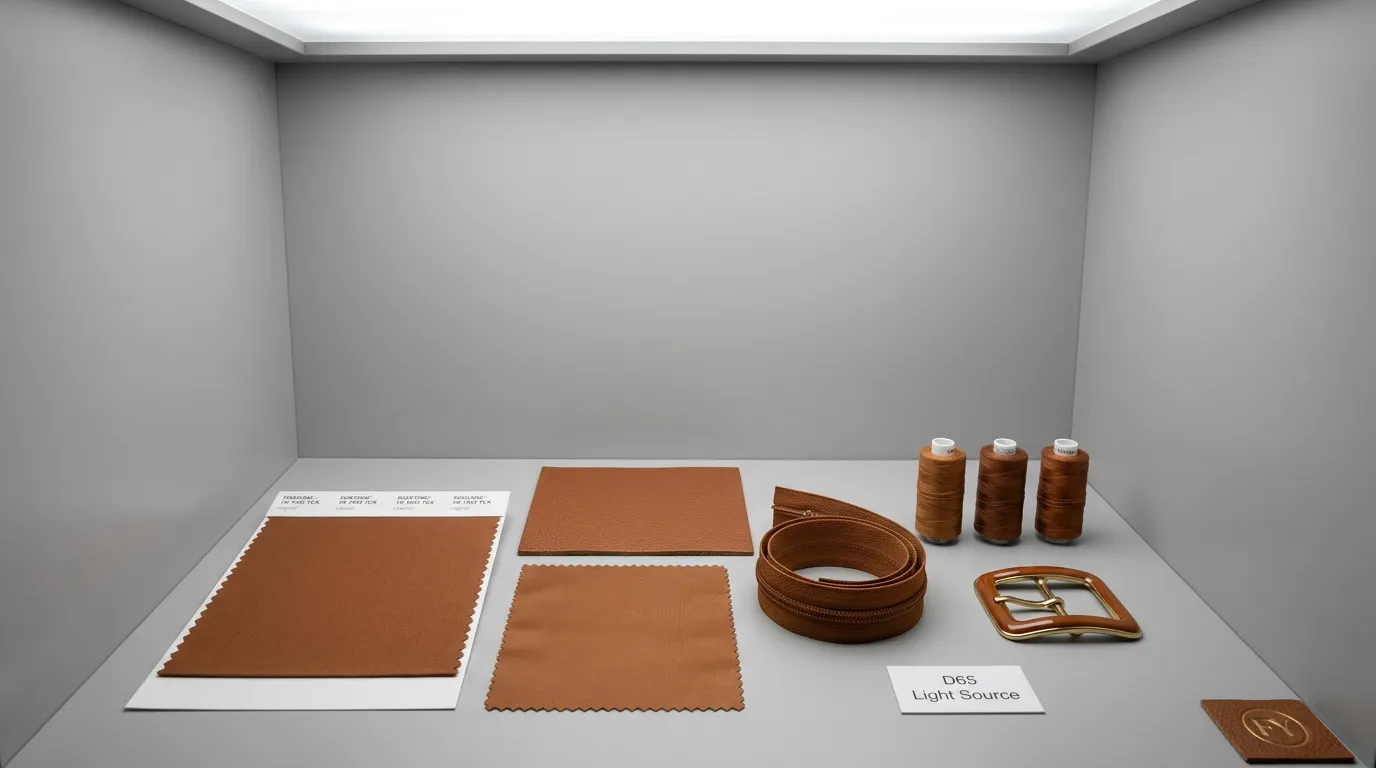
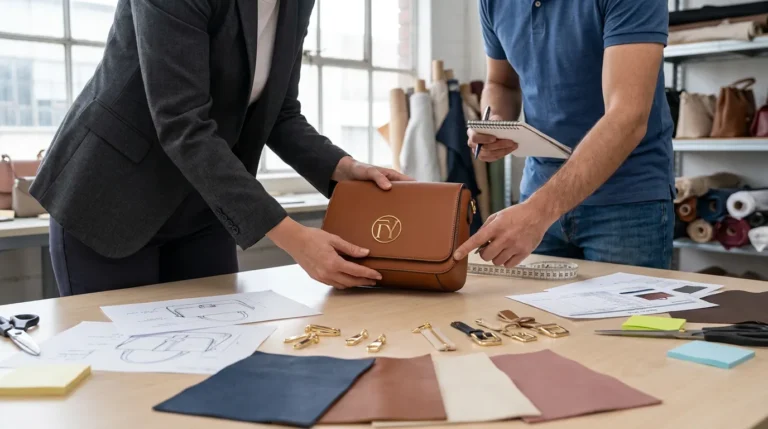
Bag color matching to a Pantone reference is harder than it looks on a mood board. A single tote can combine leather or PU on the body, nylon or polyester lining, cotton webbing, a zipper tape, thread, edge paint and metal hardware. Each of those materials gets its color from a different chemistry, and each one reflects light differently. Ask for “Pantone 19-4052 on everything” and you will receive seven slightly different blues unless someone manages the process.
FYbag factories treat color as an engineering target with three parts: a tolerance, a lighting condition and an approval trail.
Pantone publishes several systems, and they do not share the same reference colors. Sending the wrong guide is a common reason a first lab dip misses.
| Pantone system | Format | Best use in a bag program | Watch out for |
|---|---|---|---|
| Fashion, Home + Interiors TCX | Dyed cotton swatches | Fabric, webbing, lining, thread, zipper tape | Cotton reads differently from nylon, polyester and leather |
| Fashion, Home + Interiors TPG | Printed paper chips | Quick reference, artwork, tech pack color pages | Paper ink can look flatter than dyed textiles |
| Nylon Brights (TN) | Dyed nylon swatches | Bright and neon shades on nylon and polyester | Limited range; brights often fail light fastness |
| Pantone Matching System, Coated / Uncoated | Printed paper | Printed logos, hang tags, gift boxes, labels | Not a textile standard; do not use it for fabric dyeing |
| Your own physical sample | Fabric, leather or product | Brand colors already in production | Must be retained, labeled and protected from light |
Three habits prevent most problems:
A lab dip is a small swatch of your actual fabric, dyed by the mill to your color reference. Mills usually submit two or three options, labeled A, B and C, so you can choose the closest or comment on direction (“A is too red, B is too light, C approved”). Each round commonly takes about one to two weeks, depending on the mill and the shade. Deep blacks, reds and fluorescent shades often need extra rounds.
Other materials follow the same logic under different names:
| Material | How it gets its color | Approval sample | Relative matching difficulty |
|---|---|---|---|
| Polyester, rPET | Disperse dyes at high temperature | Lab dip | Moderate |
| Nylon | Acid dyes | Lab dip | Moderate; brights fade faster |
| Cotton canvas, webbing | Reactive or vat dyes | Lab dip | Moderate; heavy weights dye unevenly |
| Genuine leather | Drum dyeing plus surface finish | Tannery color swatch | High; natural hide variation |
| PU, microfiber | Pigment in the coating layer | PU color swatch | Moderate; gloss and grain shift the look |
| Zipper tape, thread | Dyed to the supplier’s color card or to a sample | Tape or thread card | Low to moderate |
| Coated or enamel hardware | Paint, enamel or powder coat | Coated sample piece | Moderate |
| Plated hardware | Electroplating finish | Plating card | Fixed palette; not Pantone-matchable |
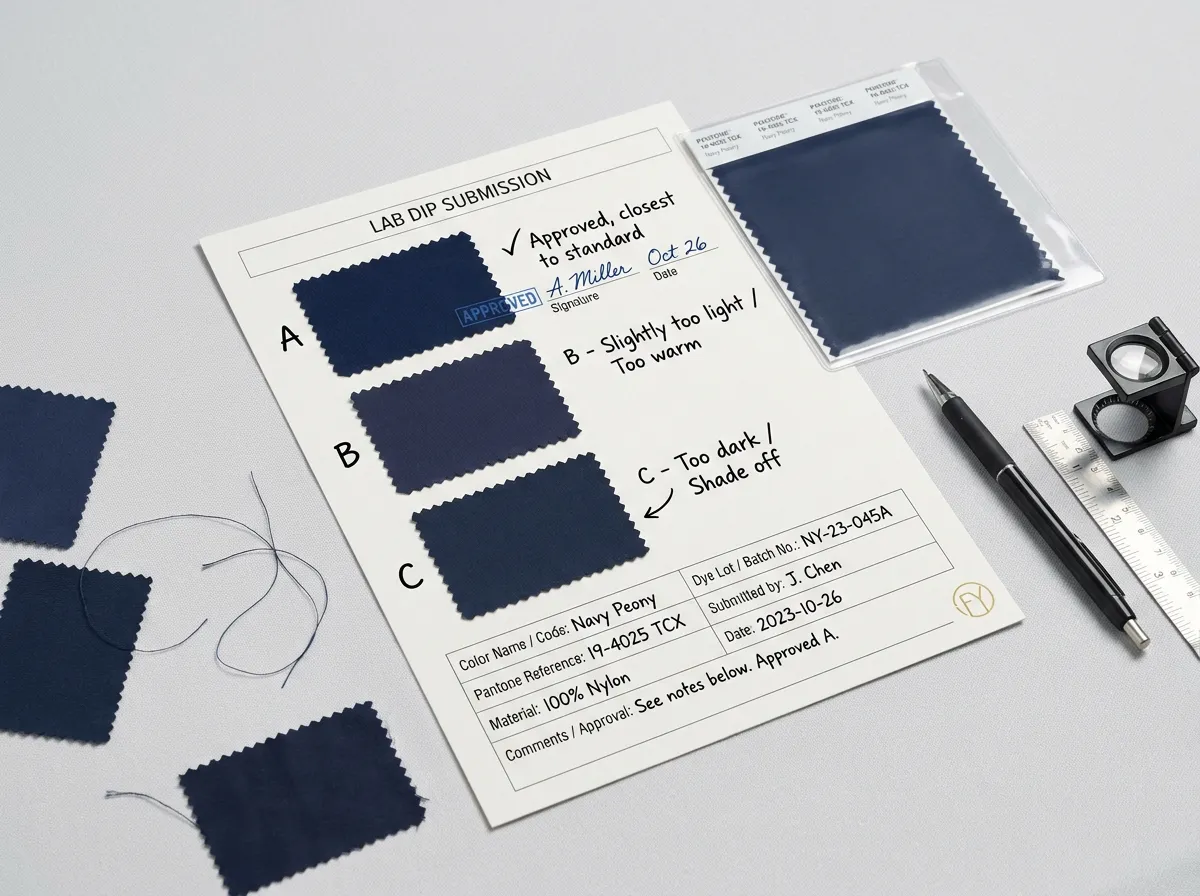
Printed fabrics add a strike-off, a short printed sample that shows color, registration and ink coverage before the full print run.
Approve every component against the master, under the same lights, on the same day. If you approve the lining in week two and the webbing in week four, each against a paper chip, you can end up with three blues that each passed alone.
“Close enough” needs a number and a lighting condition, or the factory, the inspector and your team will each judge it differently.
Instrumental measurement. A spectrophotometer reads color as CIELAB values (lightness, red-green, yellow-blue). Delta E (ΔE) expresses the difference between the sample and the standard. Textile programs commonly use the CMC (2:1) or CIEDE2000 formulas because they track human perception better than the original ΔE formula. Many apparel and accessory buyers set pass limits around ΔE CMC 1.0 for solid fabrics, with looser limits for leather and coated materials.
Visual assessment. Inspectors compare samples against the standard using the ISO 105-A02 grey scale for color change. Grade 5 means no visible difference, and grade 4 to 5 is a common approval level for visible components.
Light sources. Color changes with the light, so name your conditions:
A sample that matches under D65 but splits under TL84 shows metamerism. That happens when two materials reach the same color using different dyes or pigments, which is the normal situation on a multi-material bag.

A practical tolerance plan grades components by visibility:
| Component | Visibility | Suggested approach | Typical tolerance style |
|---|---|---|---|
| Main body (leather, PU or fabric) | High | Instrumental plus visual, primary and secondary light | Tight; around ΔE CMC 1.0 on fabric, grey scale 4–5 |
| Contrast panels, trims, handles | High | Visual against body, primary light | Grey scale 4–5 against the body |
| Webbing, zipper tape, thread | Medium | Nearest match from supplier color card | Visual; tone-on-tone acceptable |
| Lining | Low to medium | Visual against standard | Grey scale 4 |
| Coated hardware, edge paint | Medium | Visual against body in light booth | Agreed physical reference |
Each material starts from a different base color, absorbs color by a different mechanism and finishes with a different surface. Polyester takes disperse dyes, nylon takes acid dyes, cotton takes reactive dyes, and PU carries pigment in a coating. Leather adds natural variation from hide to hide, and its finish coat changes the reading again.
Surface matters as much as dye:
You cannot remove these differences, but you can decide how to handle them. Most brands choose one of three approaches:
Stating the approach in the brief saves rounds of comments that argue about intent instead of color.
Approve each colorway as one set. A workable sequence:
For leather bag programs, add one more step: ask the factory to sort hides by shade before cutting, so panels on the same bag come from hides in the same shade group.
A lab dip proves the mill can hit the color. Bulk dyeing happens in larger batches, and each batch (dye lot) lands slightly differently. Plan for it:
A perfect color match still fails if the color rubs onto clothing or bleeds into a pale lining. Write the tests and pass grades into your purchase order.
| Test | Common methods | What it catches | When it matters most |
|---|---|---|---|
| Rubbing (crocking), dry and wet | ISO 105-X12, AATCC 8; ISO 11640 for leather | Color transferring to clothing | Dark denim, suede, deep reds, crossbody straps |
| Light fastness | ISO 105-B02, AATCC 16.3 | Fading in sunlight or store windows | Brights, pastels, beach and outdoor bags |
| Water and perspiration | ISO 105-E01, ISO 105-E04 | Bleeding when wet or against skin | Handles, straps, summer bags |
| Migration and contact staining | Contact test under heat and pressure | Dark color moving into pale lining or trim | Contrast linings, two-tone leather |
Ask who ran each test (mill, factory or independent lab) and request the report. A pass for one color and lot says nothing about another color from the same mill.
Custom color adds dye rounds, approval time and, often, a minimum run per color at the material mill. The table shows the relative effect.
| Color route | Relative cost | Added lead time | Effect on minimums |
|---|---|---|---|
| Supplier stock colors | Lowest | None | None beyond the factory’s own MOQ |
| Custom-dyed fabric or webbing | Moderate | One to three lab dip rounds plus bulk dyeing | Mill minimum per color |
| Custom PU or microfiber color | Moderate | Color swatch rounds plus a coating run | Coating-run minimum per color |
| Custom leather color | Moderate to high | Tannery swatch rounds plus drum dyeing | Tannery minimum per color |
| Custom-dyed zipper tape and thread | Low | Short dye cycle | Small supplier minimums |
| Pantone-matched coated hardware | Moderate | Coating sample rounds | Coating batch minimum |
| Standard plating finishes | Lowest | None | None |
For small or first runs, the efficient move is to match your brand color to the closest stock color on the supplier’s card and reserve custom dyeing for hero colorways with proven demand. Stock colors also simplify reorders, because the mill keeps producing them.
FYBagCustom is Your Trusted Custom Bag Manufacturer in China, handling OEM, ODM and private label programs where color has to hold across leather, fabric, trims and hardware.
We sources materials through 200+ verified suppliers covering leather, PU, nylon, canvas, polyester, cotton, suede and specialty fabrics. That network gives developers a wide range of stock color cards to match against before anyone commits to a custom dye lot. Browse our custom bag color options to see the color families we work in.
How a color program runs with us:
You can start by requesting a sample in your nearest stock colors, or send your Pantone references to our team for a material and color feasibility review.
No factory can make every material identical to a Pantone chip. Fabric, leather, PU and hardware take color through different chemistry and surfaces, so each lands within a tolerance of the target. Good programs choose a master material, approve it first, and match every other component to that master under agreed light sources. Some shades, especially neons and very deep colors, carry extra fastness risk.
TCX swatches are dyed cotton, which makes them the better reference for dyeing textiles such as webbing, lining and canvas. TPG swatches are printed paper from the same Fashion, Home + Interiors system, useful for artwork and tech pack pages. Both share color codes, but TCX gives mills a physical textile to measure. Send TCX for dyeing and keep TPG for documents.
A single lab dip round commonly takes about one to two weeks, depending on the mill, fiber and shade. Most colors need one or two rounds, while difficult shades such as true black, deep red or fluorescents can take three. Build lab dip time into your calendar before sampling locks, or sample in a close stock color while the dips are in progress.
Many accessory programs set around ΔE CMC 1.0 for solid fabrics on visible panels, with looser limits for leather, coated materials and linings. Pair the number with named light sources, such as D65 primary and TL84 secondary, and a visual grey-scale grade of 4 to 5. Tighter limits mean more rejected lots, so tighten only where customers will see the difference.
The usual cause is metamerism. Two materials can match under daylight and separate under fluorescent or warm LED store lighting, because they reach the color through different dyes or pigments. Name your retail lighting as a secondary light source during approval, check samples in a light booth under both conditions, and be cautious with phone photos, which apply their own color correction.
To check how your brand colors translate across leather, fabric and hardware, contact FYBagCustom with your references and target materials.
FYBagCustom’s OEM/ODM team helps brand owners, private label buyers and corporate gifting leads match colors across leather, fabric and hardware, with materials from 200+ verified suppliers, 5–7 day sampling and blended MOQ across colorways.
Start Your Custom Bag Project →