Tel/WhatsAapp:+86 18011919834
E-mail: chloe.x@fybagcustom.com

Tel/WhatsAapp:+86 18011919834
E-mail: chloe.x@fybagcustom.com
Send Your Inquiry Today


Who this guide is for: brand founders, sourcing managers, Amazon FBA sellers, DTC entrepreneurs, wholesale buyers, and any B2B buyer who manufactures custom bags in China and ships them to the United States. If you have ever been confused by Incoterms, surprised by customs duties, unsure whether to choose sea or air freight, or uncertain how DDP service works — this guide demystifies the entire journey from your factory’s loading dock to your U.S. warehouse shelf, with real costs, real timelines, and real decision frameworks.
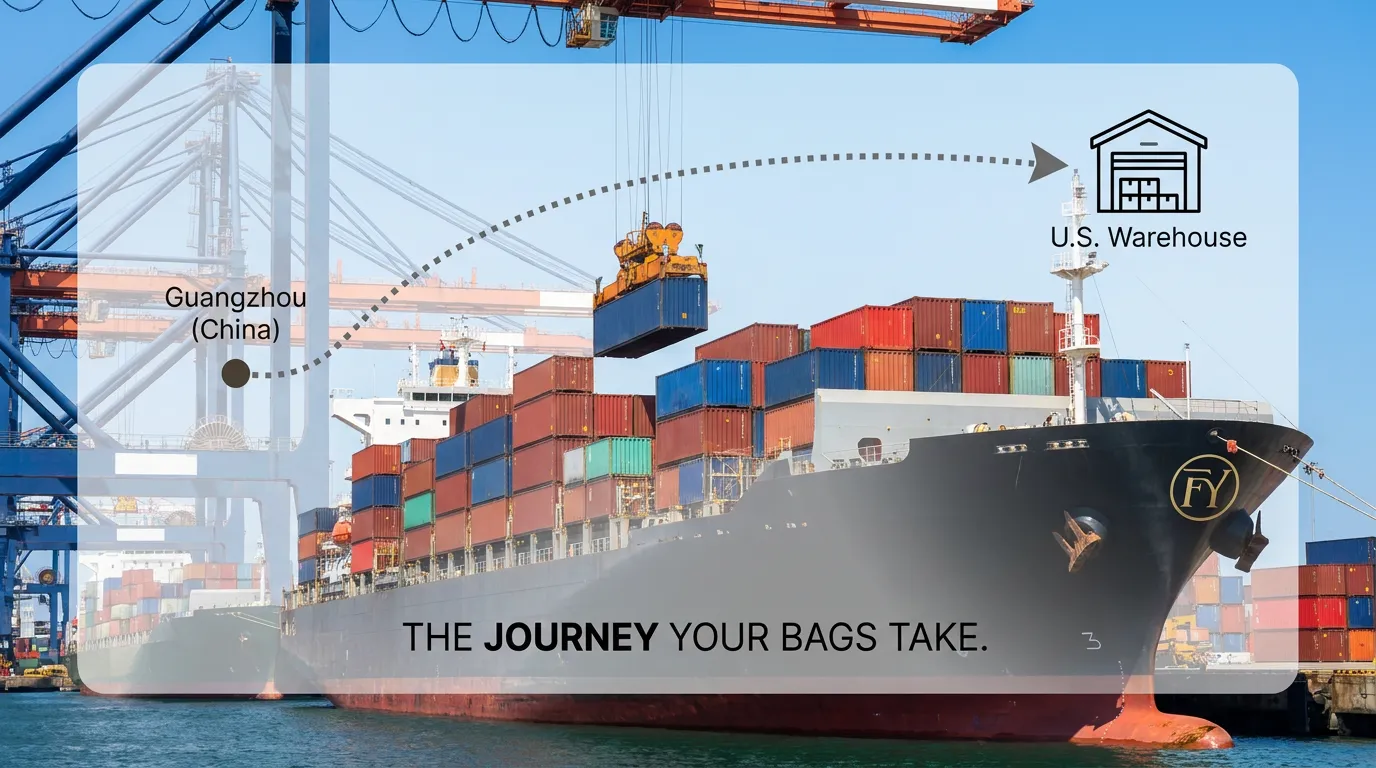
You have designed a bag, approved a sample, placed a production order, and passed QC inspection. The bags are boxed, palletized, and sitting on your factory’s loading dock in Guangzhou. Now what?
For many first-time importers, “now what” is the most stressful phase of the entire manufacturing process — more stressful than design, sampling, or production. The reason is simple: logistics is the only phase where you spend significant money on something you cannot see, touch, or control. The bags disappear into a shipping container, traverse an ocean, pass through customs, and (hopefully) appear at your warehouse 4–6 weeks later. Between the factory dock and your shelf, a dozen decisions determine whether your shipment arrives on time, on budget, and with the correct documentation — or late, over budget, and stuck at customs.
This guide eliminates the mystery. It covers every shipping method available, compares their costs and timelines with real 2026 numbers, explains U.S. customs duties for handbags (including the tariff codes that determine your rate), walks through Incoterms so you understand exactly what you are paying for, introduces DDP service as the simplest option for first-time importers, and provides the documentation checklist that prevents the most common customs delays.
Every shipment from China to the U.S. moves by one of three methods. The choice depends on your order volume, timeline urgency, and budget.
| Dimension | Sea Freight (FCL or LCL) | Air Freight | Express Courier (DHL, FedEx, UPS) |
|---|---|---|---|
| Transit time (Guangzhou → U.S. port/airport) | 18–30 days (West Coast) / 25–38 days (East Coast) | 5–8 days | 3–5 days |
| Total time (factory door → your warehouse) | 30–50 days (including customs + domestic delivery) | 10–18 days | 5–10 days |
| Cost per kg | 2.00 | 7.00 | 12.00 |
| Cost per CBM (cubic meter) | 400 (LCL) / 5,000 (20ft FCL) | N/A (charged by weight) | N/A (charged by weight) |
| Cost for a typical 200-bag order (~2 CBM, ~150 kg) | 800 (LCL) | 1,050 | 1,800 |
| Cost per bag (200-unit order) | 4.00 | 5.25 | 9.00 |
| Minimum shipment size | No strict minimum (LCL handles any size) | No strict minimum | 1 package (any size) |
| Best for | Orders over 2 CBM or 200+ bags; cost-sensitive; flexible timeline | Orders of 50–300 bags where timeline is 2–3 weeks; seasonal deadlines | Samples, urgent reorders under 50 bags; time-critical shipments |
| Customs handling | You arrange customs clearance (or your freight forwarder does) | You arrange customs clearance | Courier handles customs clearance automatically (included in service) |
| Your Situation | Recommended Method | Why |
|---|---|---|
| First production order, 100–300 bags, no urgent deadline | Sea freight (LCL) | Lowest cost per unit; timeline is manageable if you plan ahead |
| Seasonal deadline approaching (e.g., holiday inventory needed by October) | Air freight | 2–3 week delivery ensures you meet the deadline; moderate cost premium |
| Small urgent reorder, 30–80 bags, inventory running low | Express courier (DHL/FedEx) | Fastest possible delivery; higher cost is justified by avoiding stockout |
| Samples (1–5 bags) | Express courier | Only practical option for small, lightweight shipments |
| Very large order, 500+ bags, 5+ CBM | Sea freight (FCL — full container) | Lowest possible per-unit cost; full container eliminates LCL sharing risks |
Sea freight is the standard shipping method for bulk handbag orders. It is the cheapest per-unit option for any order over approximately 1 CBM (roughly 100–150 bags, depending on bag size and packing density).
| Option | What It Means | When to Use | Cost | Risk |
|---|---|---|---|---|
| FCL (Full Container Load) | You rent an entire shipping container (20ft or 40ft) exclusively for your cargo | Orders large enough to fill (or nearly fill) a container: 10+ CBM or 500+ bags | 5,000 for a 20ft container; 8,000 for a 40ft | Lowest per-unit cost; your cargo travels alone (no co-loading risk) |
| LCL (Less than Container Load) | Your cargo shares a container with shipments from other importers | Orders under 10 CBM (most first-time and small-brand orders) | 400 per CBM | Slightly longer transit (consolidation + deconsolidation adds 3–7 days); small risk of damage from co-loaded cargo |
For most B2B handbag buyers placing orders of 100–500 bags, LCL is the appropriate choice. Your shipment is typically 1–5 CBM — far below the 28 CBM capacity of a 20ft container. LCL allows you to ship exactly what you have without paying for empty container space.
| Route | Origin Port | Destination Port | Transit Time | Best For |
|---|---|---|---|---|
| Guangzhou → West Coast | Nansha, Yantian (Shenzhen) | Los Angeles, Long Beach, Oakland | 18–25 days | Brands with West Coast warehouses; Amazon FBA West Coast fulfillment centers |
| Guangzhou → East Coast (via Panama Canal) | Nansha, Yantian | New York/New Jersey, Savannah, Charleston | 28–38 days | Brands with East Coast warehouses; East Coast-based FBA sellers |
| Guangzhou → East Coast (via Suez Canal) | Nansha, Yantian | New York/New Jersey | 30–40 days | Alternative routing; sometimes cheaper; longer transit |
The West Coast advantage: 7–12 days faster transit. For time-sensitive shipments, routing through Los Angeles or Long Beach and then using domestic trucking or rail to an East Coast warehouse is often faster than direct East Coast sea freight — though domestic transport adds 1.50 per unit.
| Stage | Duration | What Happens |
|---|---|---|
| Factory packing + pickup | 1–3 days | Factory loads cartons; freight forwarder arranges truck pickup from factory to port |
| Export customs clearance | 1–2 days | China-side export documentation processed; shipment cleared for loading |
| Port loading + departure | 1–3 days | Cargo loaded onto vessel; ship departs Guangzhou/Shenzhen |
| Ocean transit | 18–38 days | Depends on destination coast and routing |
| U.S. port arrival + unloading | 1–3 days | Vessel docks; containers unloaded to port yard |
| U.S. customs clearance | 1–5 days | CBP (Customs and Border Protection) reviews documentation; may inspect cargo |
| Port to warehouse delivery | 2–5 days | Truck delivers cleared cargo to your warehouse or FBA receiving center |
| Total | 25–55 days | West Coast: 25–38 days / East Coast: 35–55 days |
Air freight costs 3–5× more than sea freight per unit but delivers in 10–18 days total (compared to 30–50 for sea). It is the right choice when missing a deadline costs more than the shipping premium — which is often the case for seasonal inventory, launch dates, and reorders to prevent stockouts.
| Component | Cost | Notes |
|---|---|---|
| Freight charge | 7.00 per kg (chargeable weight) | “Chargeable weight” is the HIGHER of actual weight and volumetric weight (L×W×H in cm ÷ 6000) |
| Fuel surcharge | Included in most quotes or +10–20% | Fluctuates with oil prices |
| Terminal handling (origin) | 80 per shipment | Fixed charge regardless of shipment size |
| Terminal handling (destination) | 100 per shipment | Fixed charge |
| Customs clearance (U.S. side) | 200 per shipment | Customs broker fee |
| Delivery to warehouse | 150 | Depends on distance from airport to warehouse |
| Total for 200 bags (~150 kg, 2 CBM) | 1,400 | |
| Per-bag cost | 7.00 |
| Stage | Duration |
|---|---|
| Factory packing + pickup to airport | 1–2 days |
| Export clearance + airline booking | 1–2 days |
| Air transit (Guangzhou → U.S. airport) | 1–3 days (direct) / 2–5 days (with connection) |
| U.S. customs clearance | 1–3 days |
| Airport to warehouse delivery | 1–3 days |
| Total | 5–15 days (typically 8–12 for most shipments) |
DHL, FedEx, and UPS offer door-to-door international express service that handles pickup from the factory, export clearance, air transport, import clearance, and delivery to your warehouse — all as a single integrated service. The courier manages every step; you provide the destination address and pay.
| Shipment Size | Approximate Weight | DHL/FedEx/UPS Cost | Per-Bag Cost | Transit Time |
|---|---|---|---|---|
| 5 bags (samples) | 5–8 kg | 150 | 30 | 3–5 days |
| 20 bags (small test order) | 15–25 kg | 350 | 17.50 | 3–5 days |
| 50 bags | 35–60 kg | 650 | 13.00 | 3–5 days |
| 100 bags | 70–120 kg | 1,200 | 12.00 | 4–6 days |
| 200 bags | 140–240 kg | 1,800 | 9.00 | 5–8 days |
Express courier includes customs clearance — the courier’s brokerage team handles the import documentation, calculates duties, and bills you (or the shipper) for the duty amount. This “all-in-one” service is why express is the preferred method for samples and small urgent orders: you do not need a customs broker, a freight forwarder, or any logistics expertise. You receive a tracking number, and the package arrives.
Incoterms (International Commercial Terms) define who is responsible for what — and who pays for what — at each stage of the shipment. The Incoterm your factory quotes determines whether shipping, insurance, and customs clearance are your responsibility or theirs.
| Incoterm | What It Means | What the FACTORY Covers | What YOU Cover | Your Risk Level | Best For |
|---|---|---|---|---|---|
| EXW (Ex Works) | You take responsibility from the factory’s door | Nothing beyond production | Everything: pickup, export clearance, freight, insurance, import clearance, duties, delivery | Highest — you manage the entire logistics chain | Experienced importers with their own freight forwarder |
| FOB (Free on Board) | Factory delivers to the ship; you take over once it is loaded | Inland transport to port + export clearance + loading onto vessel | Freight, insurance, import clearance, duties, delivery | Moderate — you manage from the ship onward | The most common Incoterm for China-to-U.S. bag orders |
| CIF (Cost, Insurance, Freight) | Factory pays for freight and insurance to your destination port; you handle import clearance | Inland transport + export clearance + freight + insurance to destination port | Import clearance, duties, port charges, delivery to warehouse | Lower — you handle only the U.S. side | Buyers who want the factory to manage shipping |
| DAP (Delivered at Place) | Factory delivers to your specified address; you handle import clearance and duties | Everything from factory to your door EXCEPT import clearance and duties | Import clearance + duties | Low — you only handle customs | Buyers who want minimal logistics involvement |
| DDP (Delivered Duty Paid) | Factory delivers to your address with ALL costs paid — including duties and taxes | Everything: production, transport, freight, insurance, export clearance, import clearance, duties, taxes, delivery | Nothing — the price you pay is the all-in, landed cost | Lowest — the factory handles everything | First-time importers; buyers who want zero logistics headaches |
| Your Experience Level | Recommended Incoterm | Why |
|---|---|---|
| First-time importer, no logistics experience | DDP | The factory (or their logistics partner) handles everything. You receive a single all-in price and your bags arrive at your door duty-paid. No surprises. |
| Some experience, has a freight forwarder | FOB | The standard in the industry. You control the shipping method, route, and carrier — giving you more flexibility and often lower total cost than DDP. |
| Experienced importer, wants maximum control | EXW or FOB | You manage every step with your own logistics team; maximum cost visibility and carrier flexibility. |
DDP (Delivered Duty Paid) deserves special attention because it solves the #1 anxiety of first-time importers: “I don’t know how to clear customs and I’m afraid my shipment will get stuck.”
Under DDP terms, the factory (or their logistics partner) handles:
You pay a single quoted price that includes everything. No surprises, no customs broker invoices, no duty bills arriving separately. The DDP price is higher than FOB (because the factory builds in shipping, duties, and their logistics margin), but the simplicity premium is well worth it for first-time importers or brands that want to focus on selling rather than logistics.
How to request DDP pricing: ask your factory: “Can you provide a DDP quote to [your U.S. address] by sea freight and by air freight?” Any manufacturer with export experience can provide this — they work with freight forwarders who specialize in China-to-U.S. DDP service.
When handbags enter the U.S., customs duties are assessed based on the HTS (Harmonized Tariff Schedule) code that corresponds to the bag’s material composition and construction. The duty rate varies significantly by material — meaning two bags that look identical can have different duty rates if one is PU and the other is genuine leather.
| HTS Code Range | Material Description | Duty Rate (% of declared value) | Example: Duty on a $15 FOB Bag |
|---|---|---|---|
| 4202.21 | Bags with outer surface of leather or composition leather | 8–9% | 1.35 |
| 4202.22 | Bags with outer surface of plastic sheeting (PU, PVC) | 8–20% (varies by construction) | 3.00 |
| 4202.29 | Bags with outer surface of other materials (canvas, nylon, polyester) | 6.3–20% (varies by fiber content) | 3.00 |
| 4202.31–.39 | Wallets, pouches, and similar small containers | 8–20% | Varies |
Since 2018, handbags imported from China have been subject to Section 301 additional tariffs on top of the standard duty rates. As of 2026, these additional tariffs apply to most bag categories:
| Category | Standard Duty | Section 301 Additional Tariff | Total Effective Duty |
|---|---|---|---|
| Leather bags (4202.21) | 8–9% | 7.5–25% (varies by specific sub-code and any exclusions) | 15.5–34% |
| PU/plastic bags (4202.22) | 8–20% | 7.5–25% | 15.5–45% |
| Textile bags (4202.29) | 6.3–20% | 7.5–25% | 13.8–45% |
Important disclaimer: tariff rates change. The Section 301 tariffs have been modified multiple times since their introduction, and exclusions, extensions, and adjustments are ongoing. Always verify the current rate with a licensed customs broker or the U.S. International Trade Commission’s HTS search tool (hts.usitc.gov) before calculating your landed cost. The rates above are illustrative of the range; your specific product’s rate depends on its exact HTS classification.
Duties are calculated as a percentage of the declared customs value — which is typically the FOB price (the factory’s invoice price for the goods). A lower FOB price means lower absolute duty. This is not a reason to under-declare (which is customs fraud and carries severe penalties); it is a reason to optimize your unit cost (see our cost optimization guide) so that the FOB price genuinely reflects efficient production.
| FOB Price Per Bag | Effective Duty Rate (example: 20%) | Duty Per Bag | Duty on 200 Bags |
|---|---|---|---|
| $12.00 | 20% | $2.40 | $480 |
| $18.00 | 20% | $3.60 | $720 |
| $25.00 | 20% | $5.00 | $1,000 |
The 12 and 1.20-per-unit duty difference — compounding the cost of higher FOB pricing beyond just the production cost itself.
Customs delays are caused by missing, incorrect, or inconsistent documentation — not by the product itself. A complete documentation package ensures smooth clearance. An incomplete one triggers holds, inspections, and penalties that can add days and hundreds of dollars to your shipment cost.
| Document | Who Provides It | What It Contains | Why Customs Needs It |
|---|---|---|---|
| Commercial invoice | Factory | Item description, quantity, FOB unit price, total value, Incoterm, origin country | Determines declared value for duty calculation |
| Packing list | Factory | Carton count, carton dimensions, weights (gross and net), contents per carton | Verifies quantity matches invoice; used for inspection targeting |
| Bill of lading (sea) or airway bill (air) | Freight forwarder / carrier | Shipment routing, container number, vessel/flight, shipper and consignee details | The “receipt” for the cargo; proves chain of custody |
| Certificate of origin | Factory or Chinese chamber of commerce | Confirms the goods were manufactured in China | Required for duty calculation; some trade agreements affect rates |
| HTS classification | You (or your customs broker) | The specific tariff code for your product | Determines which duty rate applies |
| ISF filing (sea freight only) | You or your customs broker | Importer Security Filing — advance data about the shipment, filed 24 hours before vessel loading | U.S. CBP requirement since 2009; failure to file results in $5,000+ penalty per shipment |
| Bond (customs bond) | You (purchased through customs broker) | A financial guarantee that you will pay all duties and comply with import regulations | Required for all commercial imports; can be single-entry (100) or continuous annual (600) |
| FDA/CPSC compliance (if applicable) | You | If the bag contains child-targeted products or food-contact materials, additional compliance may be required | Specific to certain product types — check with your customs broker |
| Error | What Goes Wrong | How to Prevent |
|---|---|---|
| Invoice value does not match the purchase order | Customs flags the discrepancy and may hold the shipment for investigation | Verify the commercial invoice matches your PO total before the factory ships |
| HTS code is incorrect or missing | Wrong duty rate applied; possible penalty; cargo held for re-classification | Have a licensed customs broker determine your HTS code BEFORE shipping — not at the port |
| ISF not filed 24+ hours before vessel departure | $5,000+ penalty per shipment; cargo may be held | Ensure your freight forwarder or customs broker files ISF as soon as the bill of lading is issued |
The landed cost is the total cost per unit delivered to your U.S. warehouse — the number that determines your actual margin. It includes every cost layer from factory to shelf.
Landed cost per unit = FOB cost + freight per unit + insurance + duties + customs brokerage + domestic delivery
For Amazon FBA sellers, the most efficient logistics path is shipping directly from the factory to Amazon’s fulfillment center — bypassing your own warehouse entirely. This eliminates one handling step, one delivery, and 3–7 days from your timeline.
| Requirement | What It Means | Who Handles It |
|---|---|---|
| FBA-compliant labeling | Each unit must have an Amazon FNSKU barcode label on the polybag or outer packaging | Factory applies labels during packing (provide FNSKU files to factory) |
| FBA-compliant packing | Carton dimensions, weight limits, and pallet configuration per Amazon’s guidelines | Factory packs to FBA specifications (provide Amazon’s current guidelines) |
| Shipment creation in Seller Central | You must create the inbound shipment in Amazon’s system before the cargo ships | You create the shipment and provide the shipping labels to your freight forwarder |
| Appointment at receiving center | Some FBA warehouses require delivery appointments | Your freight forwarder schedules the appointment |
| Method | Factory → FBA (Total) | Per-Unit (200 bags) | Transit Time | Best For |
|---|---|---|---|---|
| Sea freight (LCL) → FBA | 1,200 | 6.00 | 30–50 days | Standard replenishment; cost-optimized |
| Air freight → FBA | 1,500 | 7.50 | 10–18 days | Seasonal inventory; launch timing |
| Express (DHL/FedEx) → FBA | 2,000 | 10.00 | 5–10 days | Urgent restock; small quantities |
The FBA seller’s tip: create your Amazon shipment in Seller Central and obtain the designated fulfillment center address BEFORE your factory ships. Amazon assigns specific FBA warehouses — if you ship to the wrong one, Amazon will redirect the cargo at your expense (and add days to the receiving timeline).
Shipping insurance protects your financial investment if cargo is lost, damaged, or destroyed during transit. It is optional but strongly recommended for any shipment worth more than $1,000.
| Insurance Type | Coverage | Cost | When to Use |
|---|---|---|---|
| Carrier’s basic liability | Very limited — typically 20/kg (air) | Included in freight cost | Never rely on this alone for valuable cargo |
| All-risk marine cargo insurance | Full replacement value of goods; covers loss, damage, theft, weather, accidents | 0.3–0.8% of declared value (FOB + freight) | Every sea freight shipment over $1,000 in value |
| Air cargo insurance | Full replacement value | 0.3–0.5% of declared value | Air shipments over $2,000 in value |
For a 200-bag sea freight shipment with FOB value of 500, all-risk insurance costs approximately 30 — a negligible amount relative to the $3,700 at risk. There is no rational reason to skip insurance on a commercial shipment.
The most effective logistics planning works backward from the date you need inventory ready to sell, then maps each stage to ensure the factory ships early enough to meet the deadline.
| Milestone | Date | How Determined |
|---|---|---|
| Product sellable (inventory live on Amazon or Shopify) | October 1 | Your target launch or restock date |
| Inventory received at warehouse / FBA | September 24 (7 days buffer) | Allow 3–7 days for warehouse receiving and processing |
| Cargo arrives at U.S. port / airport | September 17 | Allow 5–7 days for customs + port-to-warehouse delivery |
| Cargo departs Guangzhou (sea freight, West Coast) | August 20 | Allow 25–28 days transit (Guangzhou → Los Angeles) |
| Factory ships (factory → port) | August 17 | Allow 2–3 days for inland transport + export clearance |
| Production complete + QC passed | August 14 | Allow 3 days for packing + shipping preparation |
| Production start | July 10 | Allow 25–35 days for bulk production |
| Bulk order placed (with deposit) | July 7 | Allow 3 days for material procurement to begin |
| PP sample approved | June 25 | This is your real deadline — everything flows from here |
The critical insight: your PP sample must be approved by June 25 to have sellable inventory by October 1 via sea freight. If the sample is delayed by two weeks, your entire timeline shifts — and you may need to switch to air freight (1,500 more) to hit the October 1 date.
A freight forwarder is the logistics company that manages the physical movement of your cargo from the factory to your warehouse. They book carrier space, handle documentation, coordinate with customs brokers, and track your shipment. For B2B importers, a good freight forwarder is as important as a good factory.
| Criterion | What to Look For | Red Flag |
|---|---|---|
| China-to-U.S. specialization | Extensive experience with the Guangzhou/Shenzhen → U.S. route | “We handle shipments worldwide” with no China-specific experience |
| Customs brokerage included or partnered | They either provide U.S. customs brokerage or have a dedicated broker partner | “You need to find your own customs broker” |
| Amazon FBA experience | They regularly deliver to Amazon fulfillment centers and understand FBA receiving requirements | “What is FBA?” |
| Communication responsiveness | They respond within 24 hours with tracking updates and proactive alerts about delays | Slow response; you have to chase for updates |
| Transparent pricing | All-inclusive quotes with no hidden surcharges | Vague quotes with “subject to adjustment”; surprise charges after shipment |
| Option | Pros | Cons | Best For |
|---|---|---|---|
| Factory’s freight forwarder | Convenient — factory handles the handoff; often included in DDP pricing | You have less control; pricing may include the factory’s markup | DDP shipments; first-time importers; convenience priority |
| Your own freight forwarder | Full control; competitive pricing; your forwarder works for you, not the factory | You manage the coordination between factory and forwarder | FOB and EXW shipments; experienced importers; cost priority |
For first-time importers, using the factory’s freight forwarder via DDP terms is the simplest path. As your volume grows and your logistics knowledge increases, transitioning to your own freight forwarder under FOB terms typically saves 10–20% on shipping costs.
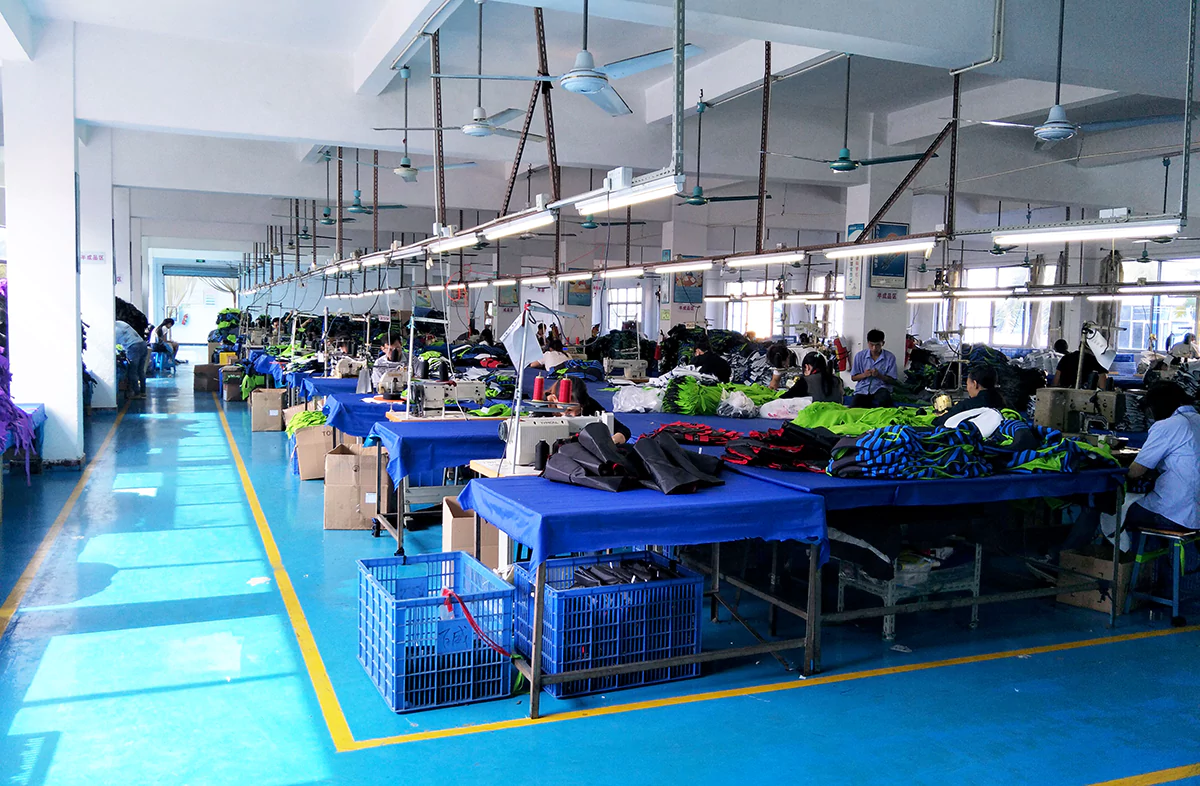
FYBagCustom is Your Trusted Custom Bag Manufacturer in China, and our logistics support extends beyond the factory floor to your warehouse door. For buyers who need seamless shipping from Guangzhou to the U.S., our logistics capabilities include:
Our 50,000 m² factory in Guangzhou — one of China’s primary export manufacturing hubs — is located within 30 km of Nansha Port and 90 km of Yantian Port, enabling fast and cost-efficient access to both major South China shipping terminals.
International shipping from China to the U.S. involves many moving parts — but every part is predictable, priceable, and manageable with the right knowledge and partners. For B2B buyers shipping custom bags from China, three core takeaways:
If you are preparing to ship your first (or next) handbag order from China to the U.S., contact FYBagCustom to discuss DDP pricing, FBA direct shipping, and logistics timelines — and receive a landed-cost estimate alongside your production quotation, typically within 48 hours.
FYBagCustom offers DDP door-to-door delivery, FOB shipping support, Amazon FBA direct preparation, and complete export documentation — so your bags arrive on time, on budget, and with zero customs surprises. Request a landed-cost quote alongside your production estimate.
Start Your Custom Bag Project →