Tel/WhatsAapp:+86 18011919834
E-mail: chloe.x@fybagcustom.com

Tel/WhatsAapp:+86 18011919834
E-mail: chloe.x@fybagcustom.com
Send Your Inquiry Today

Who this guide is for: brand owners, sourcing managers, wholesale buyers, Amazon FBA sellers, DTC founders, corporate gifting companies, travel accessories brands, and women’s professional lifestyle labels who are developing convertible garment bags that fold into totes, duffles, or weekenders. If you want to understand how to engineer a bag that keeps a blazer, dress, or suit wrinkle-free during travel while converting into a fashion-grade carry bag that a businesswoman would carry through an airport, hotel lobby, or client meeting — this guide covers the folding mechanism, the garment protection system, the dual-mode engineering, and the production considerations for this structurally complex but commercially compelling product category.
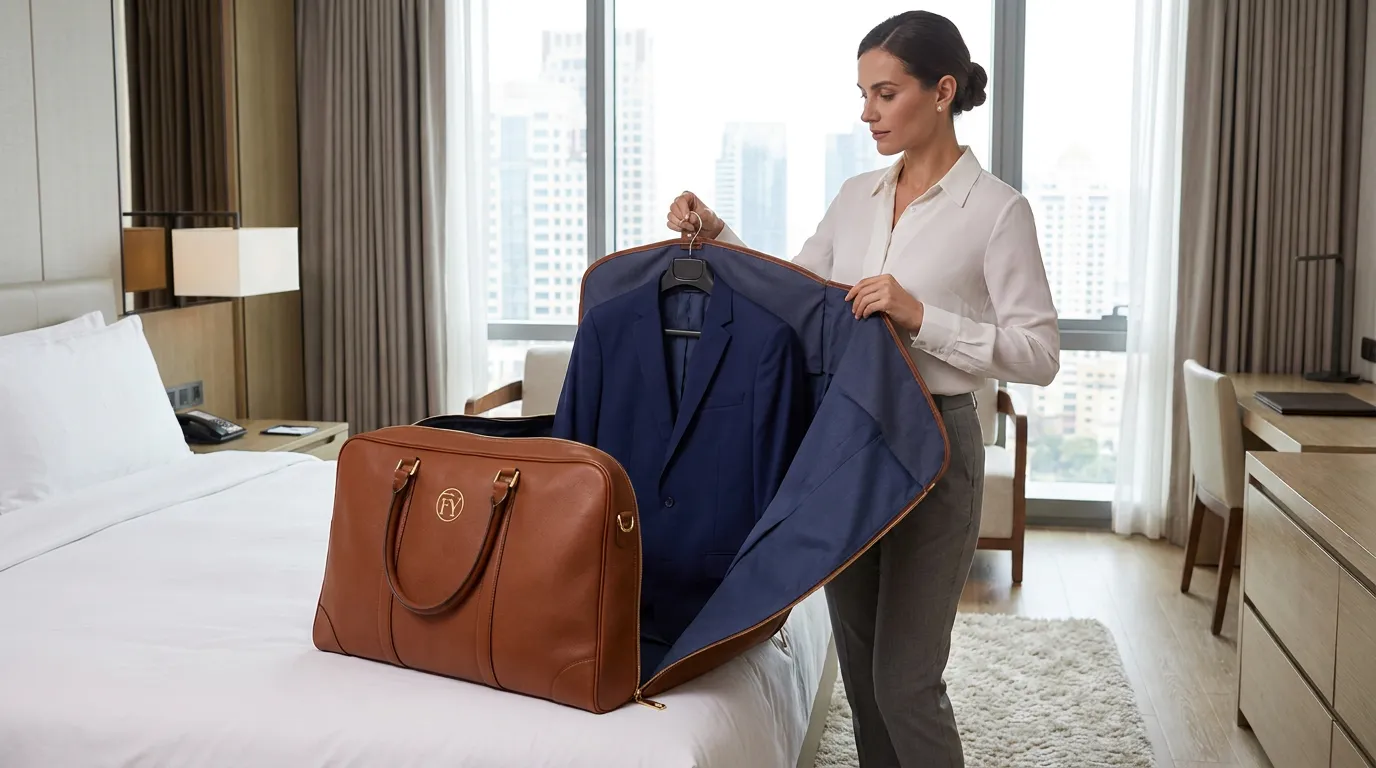
Every businesswoman who travels knows the problem. She has a meeting in another city. She needs to arrive in a pressed blazer, a crisp dress, or an unwrinkled suit — and she needs to get that garment from her closet to the meeting room without checking a suitcase, without using a traditional garment bag that screams “I just arrived from the airport,” and without the garment looking like it was balled up in a carry-on for three hours.
The traditional garment bag — a long, flat, zippered cover designed for hanging clothes — solves the wrinkle problem but creates three new ones. It is impossible to carry stylishly (it drapes over the arm like a dry-cleaning pickup), it cannot hold anything else (no laptop, no toiletries, no shoes, no personal items), and it announces “I am traveling” in every professional setting where appearing composed and local is an advantage.
The convertible garment bag tote — a bag that functions as a standard tote, duffle, or weekender when folded, and opens to reveal a flat garment compartment when unfolded — solves all four problems simultaneously. The garment travels flat and wrinkle-free. The bag holds everything else a businesswoman needs for a 1–2 night trip. The exterior looks like a fashion accessory, not travel equipment. And the conversion from “travel bag” to “meeting bag” takes 30 seconds in a restroom or taxi.
Search demand for “garment bag tote,” “suit bag for women,” and “convertible garment duffle” has grown steadily as the return-to-office movement and the rise of hybrid work have created a new travel pattern: the 1–2 night business trip that requires professional attire, a laptop, and personal items, all in a single carry-on-sized bag that a woman can manage independently without checking luggage. For B2B buyers, this category offers premium retail positioning, strong gifting potential (corporate gifting, executive welcome packages, conference swag), and a consumer who values function highly enough to pay a significant premium for a bag that genuinely solves her problem.
Understanding the specific pain points — not in abstract marketing terms but in the concrete daily reality of a woman traveling for work — is what makes the design brief actionable.
| Pain Point | What Happens | Current “Solution” | Why It Fails |
|---|---|---|---|
| Wrinkled garments | Blazers, dresses, and structured garments crease when folded into standard bags | Roll the garment; stuff tissue paper inside; use a packing cube; hope for the best | Rolling still creases structured shoulders; tissue shifts; packing cubes compress |
| Too many bags | One garment bag + one carry-on + one personal bag = three bags to manage through security, boarding, and arrival | Drape the garment bag over the carry-on handle | Still requires managing a separate, awkward, non-functional bag |
| The “just arrived” look | Carrying a visible garment bag into a meeting signals “I traveled here” rather than “I am here” | Leave the garment bag at the hotel; carry only a handbag to the meeting | Requires an extra stop at the hotel before the meeting — a luxury that tight schedules do not allow |
| No room for everything else | Traditional garment bags hold garments only — no laptop, no toiletries, no shoes | Pack everything else in a separate bag | Back to the three-bag problem |
| Gendered design | Most garment bags are designed for men’s suits (long, rectangular, dark, utilitarian) | Use it anyway | The bag clashes with the consumer’s personal aesthetic; she resents it |
The convertible garment bag tote must solve all five pain points in a single product. If it solves only four — say, it holds the garment flat but looks utilitarian — the businesswoman will not adopt it because the fifth pain point (aesthetic compromise) is the one she feels most personally.
The core engineering challenge of a convertible garment bag tote is the folding mechanism — how the bag transforms from a compact tote or duffle into a flat garment carrier, and back again. This mechanism determines the bag’s entire structural design.
| Approach | How It Works | Garment Capacity | Conversion Time | Complexity | Fashion Read When Folded |
|---|---|---|---|---|---|
| Bi-fold (the standard) | The bag’s main body unfolds flat along a center hinge; the garment lies flat on one half; the other half folds over it; the folded unit becomes the bag body | 1–2 garments (blazer + dress, or 2 dresses) | 20–30 seconds | Medium | Good — when folded, the bag reads as a structured duffle or weekender |
| Tri-fold (for longer garments) | The bag unfolds into three panels; garments lie across the full length; panels fold over sequentially | 2–3 garments (suit jacket + trousers + blouse) | 30–45 seconds | Medium–High | Good — slightly thicker when folded due to three-panel layering |
| Roll-fold (for maximum compactness) | The garment section rolls rather than folds; the rolled section is secured with internal straps and slides into the main compartment | 1 garment (optimized for a single blazer or dress) | 15–20 seconds | High | Very good — the most compact folded profile |
The bi-fold is the recommended default for most B2B programs because it balances garment capacity (1–2 garments is the most common business travel need), conversion speed (under 30 seconds), production complexity (moderate — manageable for experienced factories), and folded aesthetics (reads as a normal duffle or tote when closed).
| Element | Specification | Why |
|---|---|---|
| Fold line | Center of the bag’s longest dimension; reinforced with flexible interlining (not rigid — must allow a smooth fold) | The fold line is the most-stressed structural point; reinforcement prevents cracking or creasing at the hinge |
| Unfolded dimensions | 100–115 cm length × 55–60 cm width | Must accommodate a women’s blazer (shoulder span ~45 cm) with clearance; length accommodates dresses to knee-length |
| Folded dimensions | 50–58 cm × 55–60 cm × 18–22 cm | When folded, must read as a standard large tote or duffle — not an oversized garment bag |
| Garment retention | Internal fabric flap with Velcro or snap closure that folds over the garment, holding it flat against one panel | Prevents the garment from shifting during transit; the flap distributes gentle, even pressure |
| Hanger hook (interior) | Built-in fabric loop at the top of the garment panel that accepts a standard coat hanger | The consumer hangs the garment on a hanger, places the hanger hook in the loop, then folds the bag over the garment |
| Shoulder/lapel cushion | Padded area at the garment panel’s upper section where shoulders and lapels rest | 8–10 mm foam pad that prevents crush marks on structured garment shoulders — the #1 wrinkle complaint |
| Garment panel lining | Smooth, low-friction lining (polyester satin or nylon taffeta) on the garment-facing surfaces | Low-friction lining prevents fabric-on-fabric abrasion that causes pilling and static marks on wool and silk garments |
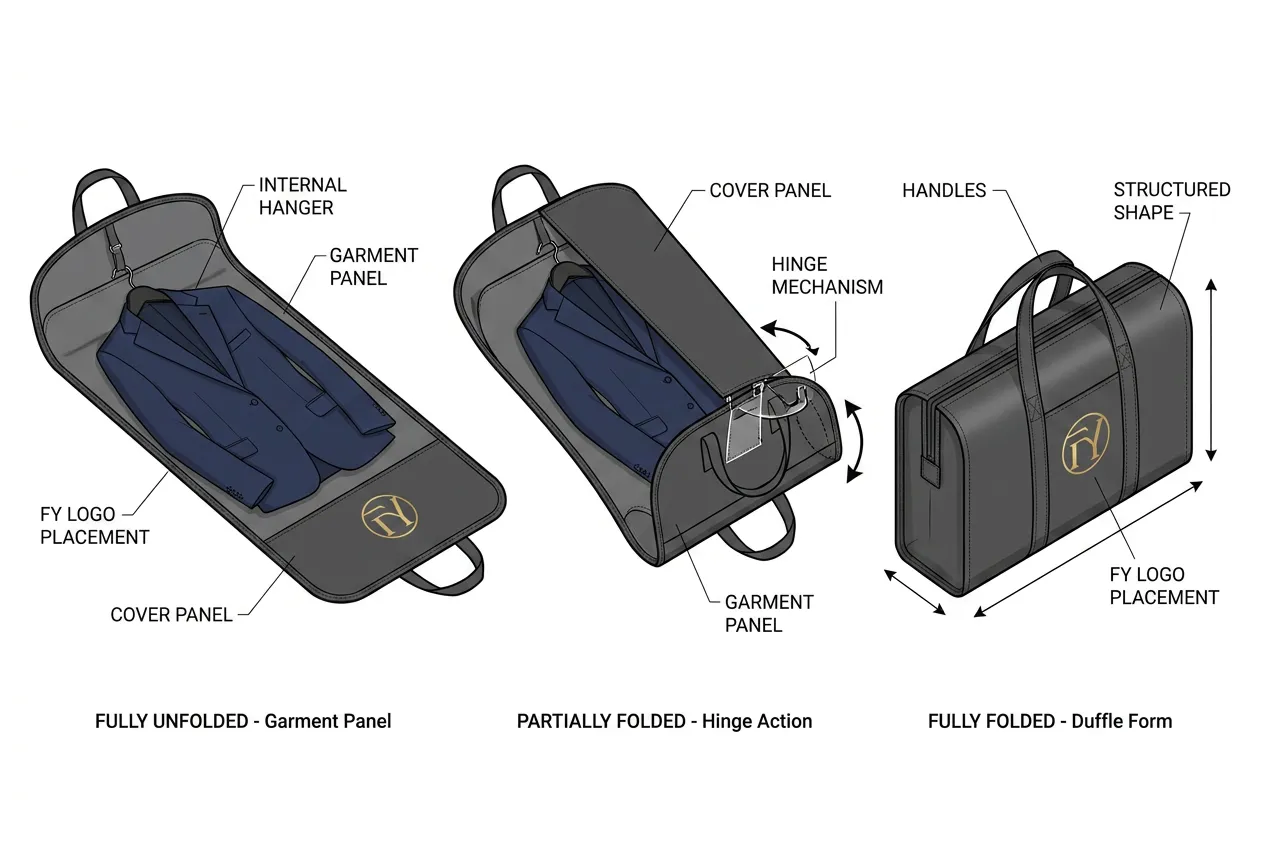
When the convertible bag is folded into its tote/duffle form, it presents two functional zones: the garment compartment (the folded garment panels) and the travel compartment (the space created above and around the folded garment section). Both zones must be independently accessible and intelligently organized.
| Zone | Location | Contents | Access | Construction |
|---|---|---|---|---|
| Garment zone (protected) | The folded garment panel, now forming the base and/or back of the bag | 1–2 hanging garments (blazer, dress, suit pieces) | Full-length zip along one side or the top — allows the garment section to be opened flat without fully unpacking the travel zone | Smooth lining; padded shoulder area; garment retention flap; hanger hook |
| Travel zone (active) | The space above and around the garment zone — the “main compartment” when the bag is folded | Laptop, toiletries, shoes, change of casual clothes, personal items | Top zip or magnetic closure — standard tote/duffle access | Organized with pockets: laptop sleeve, shoe pocket, toiletry pocket, personal items organizer |
| Location | Contents | Construction | |
|---|---|---|---|
| Padded laptop sleeve | Back wall of travel zone, against the garment zone | 13″–15″ laptop | Padded (10 mm foam), Velcro or elastic top closure |
| Shoe pocket | Bottom of travel zone or end panel | 1 pair of heels, flats, or dress shoes | Ventilated (grommets or mesh), waterproof lining, separate zip access |
| Toiletry pocket (zip mesh) | Interior side wall | Travel-size toiletries, cosmetics | Zip-closed mesh for visibility; waterproof backing to contain leaks |
| Personal items organizer | Interior front wall or top-access flap | Phone, wallet, keys, boarding pass, sunglasses | Structured pockets: phone sleeve, card slots, key clip, passport slip |
| Exterior quick-access pocket | Front panel exterior | Phone, transit card, boarding pass | Magnetic snap or zip — accessible without opening the main compartment |
The value proposition of the entire product rests on one promise: the garment arrives wrinkle-free. If the blazer comes out creased, the bag has failed its primary purpose — regardless of how beautiful, well-organized, or fashionable it is. Garment protection engineering is the technical foundation of the entire category.
| Principle | What It Means | Engineering Solution |
|---|---|---|
| 1. Minimize fold count | Every fold in the garment creates a potential crease. The fewer times the garment is folded, the fewer creases | The bi-fold mechanism folds the garment once (at the waist); the tri-fold folds twice. Bi-fold is inherently lower risk |
| 2. Distribute pressure evenly | Point pressure creates deep creases; distributed pressure prevents them | The garment retention flap covers the entire garment surface, applying gentle, even pressure across the full panel |
| 3. Protect structured areas | Shoulders, lapels, and collars are the most wrinkle-visible areas on blazers and suits | The padded shoulder cushion (8–10 mm foam) cradles shoulders and lapels, preventing compression |
| 4. Eliminate fabric-on-fabric friction | When two garment surfaces rub against each other, they generate friction that causes wrinkling and pilling | Smooth polyester satin lining on all garment-facing surfaces; the garment slides without catching |
| 5. Separate the garment from the travel contents | Shoes, toiletries, and hard objects pressing against the garment create localized crush marks | The garment zone is fully enclosed and separated from the travel zone by a padded divider panel |
The padded divider panel is the structural element that separates the garment zone from the travel zone. It serves three functions simultaneously:
Specification: 5–8 mm EVA foam, covered in smooth lining fabric, with the garment-facing surface in polyester satin (low friction) and the travel-facing surface in nylon twill (durable). The panel spans the full width and height of the bag’s interior when folded. It is permanently fixed (not removable) because removing it collapses the entire protective architecture.
The convertible garment bag tote must be large enough to hold a hanging garment plus 1–2 nights of travel contents, yet small enough to qualify as an airline carry-on and look like a fashion tote rather than a suitcase.
| Configuration | Folded Dimensions (W × H × D) | Unfolded Garment Panel | Total Volume | Garment Capacity | Travel Capacity | Airline Carry-On? |
|---|---|---|---|---|---|---|
| Compact (day trip / meeting) | 45 × 35 × 15 cm | 90 × 55 cm | 18–22 L | 1 blazer or dress | Laptop + personal items only | Yes — fits under seat |
| Standard (1-night trip) | 52 × 38 × 20 cm | 104 × 55 cm | 28–35 L | 1–2 garments | Laptop + toiletries + shoes + casual outfit | Yes — fits overhead bin |
| Extended (2-night trip) | 56 × 42 × 22 cm | 112 × 58 cm | 38–48 L | 2–3 garments | Full overnight + laptop + toiletries + shoes + 2 casual outfits | Borderline — check airline limits |
The Standard (1-night trip) at 52 × 38 × 20 cm is the commercial sweet spot. It fits within most airline carry-on size limits, holds the most common business trip loadout (blazer + laptop + shoes + toiletries + casual change), and reads as a large structured tote or weekender when folded — not as a suitcase.
Most U.S. domestic airlines allow carry-on dimensions of approximately 56 × 36 × 23 cm (22 × 14 × 9 inches). The Standard configuration at 52 × 38 × 20 cm fits within this limit with clearance. The Extended configuration at 56 × 42 × 22 cm exceeds the height limit on some airlines.
Product page recommendation: include the folded dimensions prominently, with the note “Meets most major U.S. airline carry-on size requirements. Please confirm with your specific airline.” This provides the compliance assurance the consumer needs while protecting against the handful of airlines with non-standard limits.
The material must serve two masters: the exterior must look like a fashion-grade tote (professional, polished, meeting-appropriate), while the interior must be functional, wipeable, and able to protect delicate garment fabrics.
| Material | Professional Setting Read | Durability (frequent travel) | Weight | Wipe-Clean | Best Format |
|---|---|---|---|---|---|
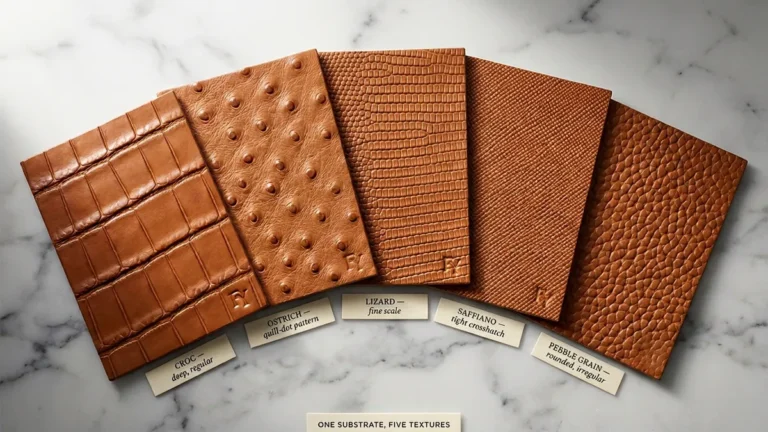
| Pebbled PU leather | Very high — boardroom-appropriate | Good — resists scuffing | Medium | Excellent | The premium default — strongest fashion read |
| Saffiano-texture PU | Very high — structured, editorial | Very good — texture hides wear | Medium | Excellent | Executive positioning — the most “briefcase-like” |
| Full-grain genuine leather | Premium — unmistakable quality | Excellent — ages with character | Heavy | Moderate — needs care | Luxury tier — adds weight, which matters in travel |
| Fashion-grade nylon (matte, 420D+) | Medium–High — modern, travel-professional | Excellent — lightest, most durable | Light | Excellent | The practical default — best for frequent travelers who prioritize weight |
| Canvas + leather trim | High — heritage, elevated | Very good | Medium | Good (canvas may absorb) | Heritage positioning; Tenniscore crossover |
| Surface | Material | Why This Material |
|---|---|---|
| Garment panel lining | Polyester satin or nylon charmeuse | Low friction — garments slide on/off without catching; no pilling on wool or silk |
| Garment retention flap (garment-facing side) | Polyester satin | Same low-friction requirement; the surface that presses against the garment |
| Travel zone lining | Nylon twill | Durable, wipeable, resists cosmetic stains and shoe marks |
| Shoe pocket | Nylon with TPU waterproof coating | Isolates dirty shoes from clean garments and contents |
| Laptop sleeve | Nylon twill + 10 mm foam padding | Protects the laptop; padding prevents hardware damage through the bag |
Travel bags are carried through airports, hotels, taxis, and offices — often for extended periods. Weight matters more here than in most bag categories.
| Configuration | Target Empty Weight | Why |
|---|---|---|
| Compact | Under 0.9 kg | Must feel light enough for a day trip — the consumer may carry it all day |
| Standard | Under 1.3 kg | The primary travel bag — loaded weight of 5–8 kg; the bag itself should be minimal overhead |
| Extended | Under 1.6 kg | Larger volume demands more material; 1.6 kg is the ceiling before the bag “feels heavy” empty |
To hit these targets, use lightweight hardware (zinc alloy, not brass), minimize rigid structural elements (use flexible interlining at the fold line, not rigid boards), and choose PU or nylon over genuine leather (leather adds 200–400 g).
The convertible garment bag tote must offer multiple carry modes to serve the businesswoman through every stage of her trip — airport, taxi, hotel lobby, office, meeting room.
| Mode | Hardware | When She Uses It | Professional Read |
|---|---|---|---|
| Tote carry (twin handles) | Padded rolled handles, 48–55 cm span, 26–30 cm drop | Walking through airports, hotel lobbies, office corridors — the “primary mode” | Very high — reads as a structured handbag or work tote |
| Shoulder carry (adjustable strap) | Wide padded strap (38–50 mm), adjustable 80–130 cm, detachable | Longer walks, hands-free transit, airport security | High — crossbody carry is standard professional travel |
| Trolley sleeve | Open sleeve on the back panel that slides over a rolling suitcase handle | When she also has a rolling suitcase — the bag rides on top | N/A — functional; invisible when not on a suitcase |
| Hand carry (meeting mode) | Same twin handles, shortened or folded to briefcase-length drop | Walking into a meeting — the bag must look like a briefcase or professional tote, not a travel bag | Highest — this is the “meeting mode” that justifies the product’s existence |
The trolley sleeve is a small but critically important feature for the frequent business traveler. It adds negligible cost (a simple open-top sleeve, 20 × 10 cm, sewn onto the back panel) but eliminates the need to actively carry the bag when she is also pulling a suitcase. Every competitive travel bag includes one; omitting it is a disqualifying oversight.
| Component | Specification | Why |
|---|---|---|
| Zippers | YKK or equivalent, metal teeth, matte gold or brushed silver finish | Professional hardware finishes signal quality; matte finishes resist fingerprints |
| Zipper pulls | Metal pulls with leather tabs — easy one-hand operation | The pull is the most-touched hardware; leather tab adds grip and visual warmth |
| Closure (main compartment) | Full-width zip — secure, clean line when closed | Magnetic snap closures risk opening during travel; zips are travel-mandatory |
| D-rings for strap | Welded zinc alloy, matching finish | Strap attachment points must be welded (not split rings) for travel-load security |
| Trolley sleeve | No hardware — a simple fabric sleeve, open top | No buckles or clips — the sleeve slides over the suitcase handle instantly |
| Base feet | 4 metal feet, matching finish, with anti-scratch pads | The bag will be placed on airport floors, hotel floors, and conference room floors — feet protect the base |
The convertible garment bag tote is one of the strongest products in the corporate gifting category: it is practical (every businesswoman who travels needs it), it is premium (the retail tier supports gifting budgets), and it is naturally personalizable (the large flat surfaces accommodate monograms, company logos, and custom finishes).
| Technique | Placement | Effect | Best For |
|---|---|---|---|
| Tonal debossed monogram (2–3 initials) | Front panel center or lower corner | Subtle, professional, “quiet luxury” | The businesswoman buying for herself — discreet, tasteful |
| Gold foil initials | Front panel or leather patch | Warm, visible, classic | Gifting — the recipient sees her initials immediately |
| Embroidered initials | Front panel or strap | Permanent, textured, collegiate | Heritage-positioned brands; club culture |
| Technique | Placement | Effect | Best For |
|---|---|---|---|
| Company logo (debossed or foil) | Front panel lower corner or interior | Brand presence without dominating the personal accessory aesthetic | Employee welcome gifts; executive onboarding |
| Company logo + recipient initials | Logo on front, initials on leather tag | Dual branding — corporate + personal | VIP client gifts; board member gifts |
| Event name + date | Embroidered or printed interior label | Commemorative — ties the bag to a specific moment | Conference gifts; retreat gifts; anniversary programs |
The corporate gifting angle: a convertible garment bag tote with a discreet company logo on the exterior and the recipient’s initials on a leather tag is one of the highest-perceived-value corporate gifts in the travel accessories category. It is used constantly (every business trip), it is visible to colleagues and clients (brand awareness), and the personalization prevents it from being re-gifted (the gift “sticks”). For B2B sellers, corporate gifting programs represent high-volume, recurring orders — companies that gift at onboarding, at annual events, and for client appreciation reorder every year.
| SKU | Format | Folded Dimensions | Garment Capacity | Target Consumer | Retail Tier |
|---|---|---|---|---|---|
| The Meeting Tote | Structured tote with bi-fold garment panel | 45 × 35 × 15 cm | 1 blazer or dress | Day trips, meetings, the “I need one wrinkle-free outfit” scenario | Mid–Premium |
| The Overnight Duffle | Duffle with bi-fold garment panel + full travel zone | 52 × 38 × 20 cm | 1–2 garments | 1-night business trips — the hero product | Premium |
| The Extended Weekender | Weekender with tri-fold garment panel + expanded travel zone | 56 × 42 × 22 cm | 2–3 garments | 2-night trips, conference travel, extended business trips | Premium–Luxury |
The Overnight Duffle is the hero product — it serves the most common use case (the 1-night business trip), hits the carry-on sweet spot, and offers the strongest garment protection at the most accessible size. Launch with this SKU; add the Meeting Tote and Extended Weekender as collection extensions once the hero product is validated.
Convertible garment bags are structurally more complex than standard totes or duffles because they require a fold mechanism, a garment retention system, and a dual-zone interior that all work together. For factories, this translates to more pattern pieces, longer assembly time, and more QC checkpoints.
| Challenge | Why It Happens | Specification to Prevent It |
|---|---|---|
| Fold-line fatigue | The center fold is flexed every time the bag converts; repeated folding can weaken the material and interlining at this line | Specify flexible interlining (not rigid board) at the fold; reinforce with herringbone or bias tape on both sides of the fold line |
| Garment panel wrinkling | If the garment panel’s lining is not taut and smooth, it transfers wrinkles to the garment | Specify smooth polyester satin lining, fully bonded (no loose sections) to the garment panel substrate |
| Folded-profile bulging | When the garment zone is folded around a garment, the bag may bulge asymmetrically | Specify the padded divider panel at the correct thickness (5–8 mm) to absorb the garment’s volume without allowing bulge |
| Travel contents pressing garments | Without adequate separation, shoes, toiletries, and hard objects compress against the garment zone | Specify the padded divider panel as a permanent (non-removable) structural element with 5–8 mm EVA foam |
| Excessive weight | The dual-zone construction, foam padding, multiple linings, and reinforced fold line can push weight above the target | Specify lightweight materials throughout: 210D–420D nylon for non-visible linings, EPE foam (lighter than EVA where padding is non-structural), zinc alloy hardware |
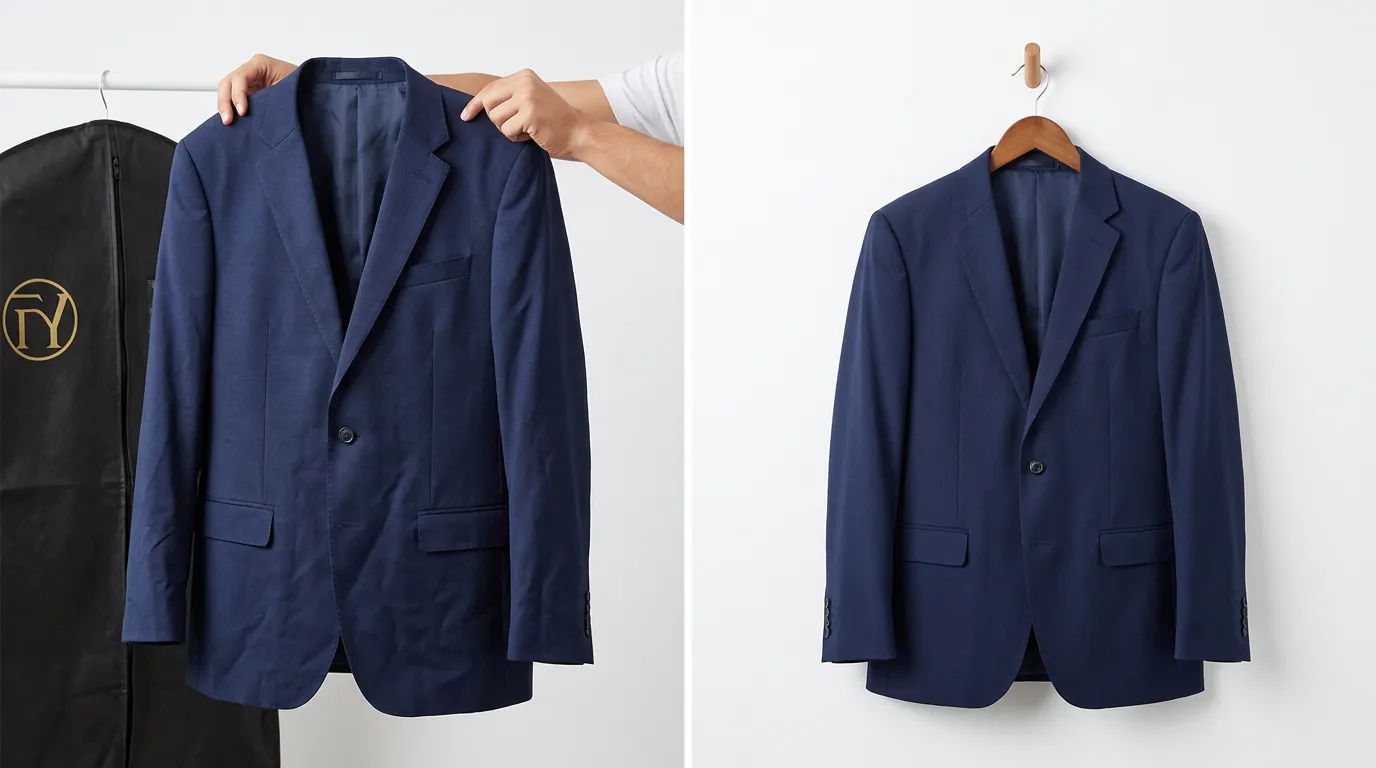
Before approving the PP sample for bulk production, perform the fold test:
Pass criteria: no visible creases on the blazer’s shoulders, lapels, or front panels. Light fold marks at the waist (where the bag folds over the garment) are acceptable and will release within 30 minutes of hanging. Deep creases or shoulder compression marks are a failure — adjust the shoulder cushion thickness and garment retention flap tension before approving for bulk.
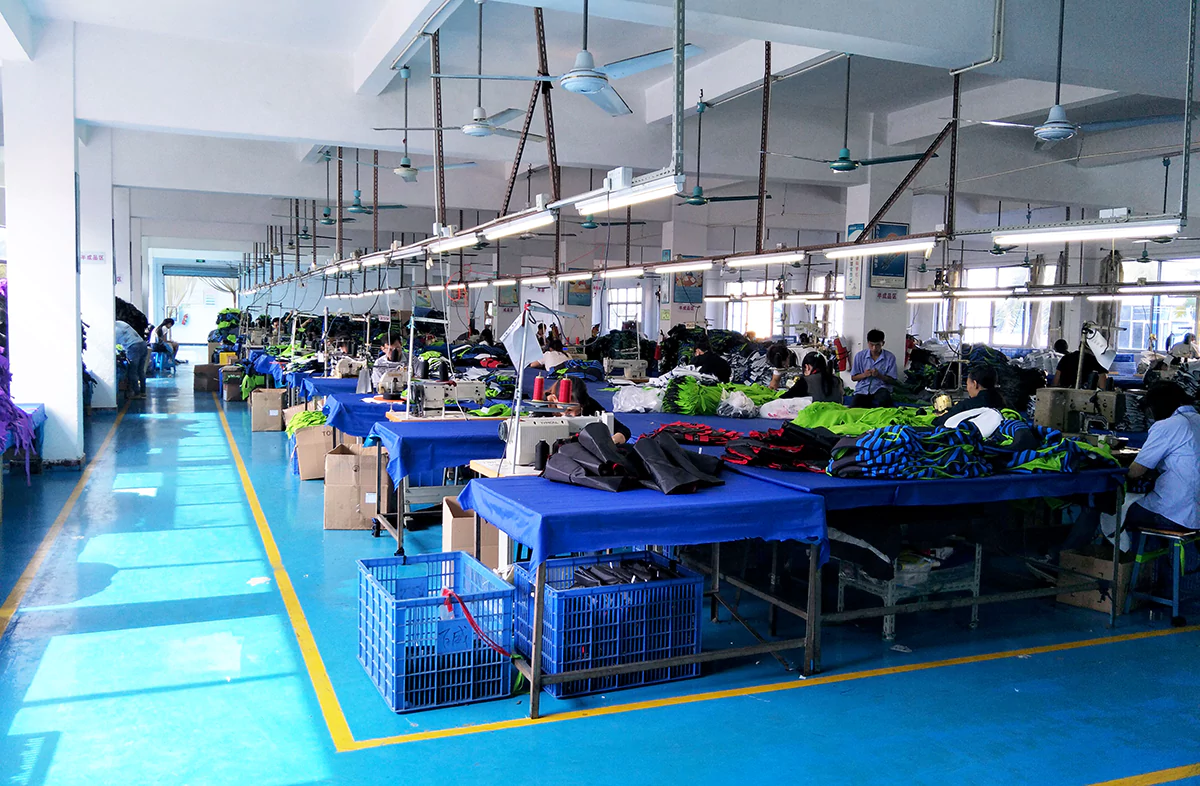
FYBagCustom is Your Trusted Custom Bag Manufacturer in China, with 15+ years of manufacturing experience producing multi-function bags, convertible travel products, and structurally complex accessories for brands worldwide. For buyers developing convertible garment bag totes, our capabilities include:
Our 50,000 m² factory in Guangzhou with 10+ production lines and 500+ professional staff produces convertible travel bags, multi-function bags, and structurally complex accessories for DTC brands, Amazon FBA sellers, corporate gifting companies, travel brands, and professional lifestyle labels across international markets.
The convertible garment bag tote solves the most persistent problem in businesswomen’s travel: how to arrive with a wrinkle-free blazer without carrying an ugly garment bag, checking a suitcase, or managing three separate bags. For B2B buyers developing convertible garment bags, three core takeaways:
If your 2026 product line includes travel bags for professional women, now is the time to finalize the fold mechanism, garment protection specifications, and dual-zone architecture. Contact FYBagCustom to discuss convertible construction, fold-line engineering, and corporate gifting programs — and receive a physical sample with garment wrinkle testing, typically within 7–12 days.
FYBagCustom’s OEM and ODM team develops convertible garment bag totes with bi-fold mechanisms, padded shoulder cushions, dual-zone interiors, and fashion-grade finishing — for DTC brands, travel labels, Amazon sellers, and corporate gifting programs. Samples with garment wrinkle testing in 7–12 days.
Start Your Custom Bag Project →