Tel/WhatsAapp:+86 18011919834
E-mail: chloe.x@fybagcustom.com

Tel/WhatsAapp:+86 18011919834
E-mail: chloe.x@fybagcustom.com
Send Your Inquiry Today

Who this guide is for: sport-luxe, beach, and transparent-trend brands producing mesh and perforated bags — the totes, market bags, and sport-luxe crossbodies that serve a specific set of use cases (beach, gym, produce shopping, the see-through aesthetic) and that share a construction challenge with macramé and knotted-cord bags: the primary material has no inherent structure and frays at every cut edge. Mesh is open — which is its whole point (you see through it, it breathes, it drains) — but open means floppy, and floppy means not a bag. And mesh frays: cut a piece of mesh and the raw edge unravels, which means every seam, every opening, and every border needs a binding or finishing treatment that solid fabrics don’t require. Perforated materials (leather, neoprene, synthetic) solve the structure problem (the base material is solid) but introduce their own challenge: the perforations weaken the material at the holes and require reinforcement at stress points. This guide covers both: mesh-bag construction (types, structure integration, edge binding, and the containment question) and perforated-material bag construction, plus the sport-luxe, beach, and see-through positioning each serves. It shares the no-structure engineering DNA of our macramé guide, applied to an industrial rather than a handcraft material.
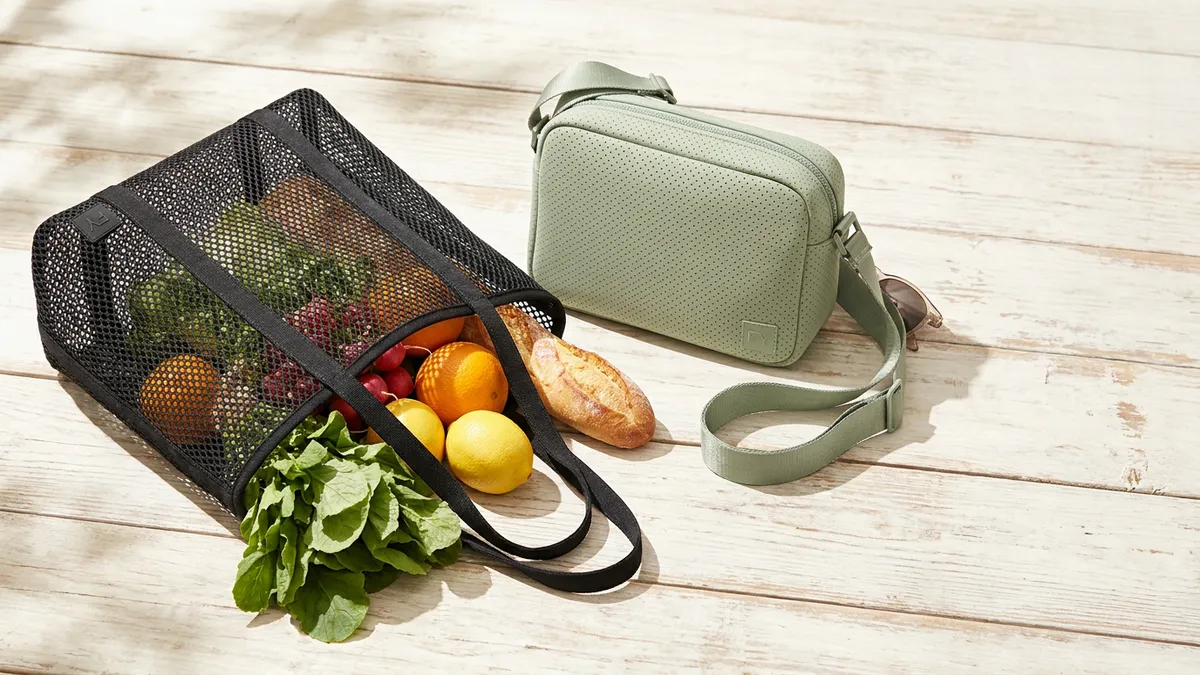
Mesh and perforated materials occupy the see-through, breathable corner of the bag market — the corner where the point of the material is what it isn’t: solid. The customer buying a mesh bag wants visibility (seeing the contents), ventilation (the gym bag that breathes, the beach bag that drains sand), or the aesthetic of transparency itself (the see-through trend that cycles through fashion and stays permanent in sport-luxe). The customer buying a perforated bag wants the suggestion of openness — the perforated-leather or perforated-neoprene surface that reads as light, sporty, and breathable without being fully transparent. Both are legitimate, growing, year-round categories with specific commercial audiences.
The manufacturing challenge is that these materials either lack structure entirely (mesh) or are weakened by their openings (perforated materials), and a bag, by definition, must hold things, hold its shape, and survive being carried loaded. Building a mesh or perforated bag that works means solving those problems — structure, edges, containment, and strength — while preserving the openness that is the material’s whole reason for being. Close the mesh up and you’ve made a solid bag. Over-reinforce the perforations and you’ve lost the lightness. The craft is in solving the structural problem without canceling the aesthetic. This guide covers how.
“Mesh” covers a range of open-structure materials, each with different properties and different construction demands.
| Type | Character | Best For |
|---|---|---|
| Woven mesh (polyester/nylon) | A woven fabric with an open grid — lightweight, flexible, and available in fine to coarse openings; the workhorse mesh for bags | Market totes, beach bags, gym bags, laundry bags — the high-volume mesh |
| Knit mesh (spacer mesh) | A dimensional knitted mesh with a structured, cushioned feel — the mesh used in shoe uppers and technical bags | Sport-luxe bags, ventilated panels, technical-aesthetic builds |
| Hardware cloth / rigid mesh | A stiff, open-grid material (metal or rigid plastic) — not flexible, used as a structural frame element rather than a body material | Market-bag frames, structured inserts |
| Tulle and fine net | Very fine, sheer mesh — transparent and delicate, fashion-forward | Fashion see-through bags, evening bags, the transparent-trend register |
| PVC/vinyl mesh | A coated or plastic mesh — wipeable, water-resistant, durable | Beach, pool, outdoor bags where cleanability matters |
| Recycled and eco mesh | Mesh made from recycled polyester or nylon | The sustainability-positioned line |
Mesh’s defining construction challenge is the same one macramé faces: the material is open and flexible, so it has no shape of its own. A mesh bag that isn’t given structure is a limp net — functional for carrying a few items by the drawstring but not recognizable as a designed bag.
| Solution | Specification | Best For |
|---|---|---|
| A structured base | A rigid or semi-rigid base panel (often solid fabric, leather, plastic, or a stiffened canvas) that gives the bag a footprint and lets it stand | Market totes and beach bags — the base is the structure, the mesh is the body |
| Solid-material framing | Solid-fabric or leather panels (sides, base, top border) that create the bag’s skeleton, with mesh filling the open areas between them | The hybrid that gives the most structure while keeping the mesh visible — the sport-luxe format |
| Internal framework | A lightweight internal frame (plastic boning, wire, or a rigid insert) that holds the mesh body’s silhouette | Where the mesh must hold a specific shape — structured totes, framed bags |
| Binding and border stiffening | The top edge and borders of the mesh bound with a stiff, finished binding (webbing, leather, grosgrain) that gives the opening structure | The simplest and most common structure approach for open-top mesh totes |
| The intentionally unstructured option | No structure — the mesh bag is a net, a drawstring sack, a produce bag — and its lack of shape is the design, for the use cases where containment is all that’s needed | Produce bags, laundry bags, the minimalist net-bag aesthetic |
The design principle: structure is added where it serves the bag’s function and silhouette, and omitted where the mesh’s openness is the point. The structured beach tote stands, carries, and looks designed; the drawstring market net folds flat and carries loose items by the gather. Both are valid — the design decides, and a brand determining how much structure its mesh program needs can discuss the format and base options with our team before committing a silhouette.
Mesh’s second defining challenge is that it frays at every cut edge. Unlike a woven fabric with a selvage, cut mesh unravels — the strands pull loose, the edge creeps, and the bag degrades from its borders inward. Every cut edge of a mesh bag must be bound, sealed, or captured in a border.
| Solution | Specification | Why |
|---|---|---|
| Binding tape | The raw mesh edge enclosed in a folded binding tape (grosgrain, twill, webbing, or a self-fabric bias strip) that captures and seals the edge | The standard solution — the binding hides the raw edge, prevents fray, and adds a clean finished look; the binding material is a design choice (webbing reads sporty, grosgrain reads refined) |
| Webbing borders | Webbing (nylon or cotton) used as both binding and structural border — the edge is bound AND the top opening is stiffened in one element | The sport and market-bag standard — the webbing does double duty: edge finishing and structure |
| Leather or fabric borders | Solid-fabric or leather panels that border the mesh, with the mesh’s edge captured and stitched inside the solid material’s seam | The premium approach — the mesh is framed by solid material, and the raw edge disappears inside a clean seam |
| Sealed / heat-cut edge | On synthetic mesh, the edge heat-cut (melted to seal) to prevent fray — fast and effective on polyester and nylon mesh | A production efficiency — works on synthetic mesh; the heat-sealed edge doesn’t have the finished look of binding but prevents fray on internal edges or concealed edges |
| Turned and stitched edge | The mesh edge folded under and stitched — a simple sewing approach, but mesh’s bulk and stiffness when folded make this less reliable than binding on heavy mesh | Works on light mesh; less clean on heavy or coarse mesh |
The binding principle: assume every edge of every mesh panel will fray unless it’s bound, sealed, or captured — and spec the binding as a design element, not an afterthought. The binding tape’s color, width, and material are part of the bag’s aesthetic, and a clean, even binding is a quality signal the buyer checks. Brands developing a mesh range can send their mesh sample and binding preferences to our team to see the binding options executed on the actual material before committing a full line.
Mesh is transparent and open, which means small items fall through the openings and everything inside is visible — both of which may or may not be problems depending on the use case.
| Approach | Detail |
|---|---|
| Designed for open containment | The mesh bag holds large items that won’t fall through (produce, a towel, shoes, a water bottle) — the containment is inherent to the intended use, and the mesh’s openness is the feature |
| A removable interior pouch | A smaller solid-fabric pouch carried inside the mesh bag for small items (phone, keys, wallet) — the same solution as the macramé drawstring liner, providing containment for the items that need it while the mesh carries the rest |
| An attached interior pocket | A solid-fabric pocket attached inside the mesh bag — a fixed version of the pouch, offering secure, concealed storage for essentials within the open bag |
| The privacy consideration | Everything inside a mesh bag is visible — so the design either embraces it (the see-through aesthetic, where visibility is the point) or provides a privacy solution (a solid-fabric insert, a colored liner) for the items the owner doesn’t want on display |
| The see-through-as-security | In some contexts (stadiums, offices, venues), the see-through quality is a security feature — the clear-bag concept served by mesh rather than PVC; where the venue’s policy accepts mesh as a compliant transparent material, the mesh bag serves the same function as the clear bag in our festival-bag guide |
Perforated bags use a solid material — leather, PU, neoprene, or coated fabric — with holes punched or laser-cut through it, creating an open, ventilated, or decorative surface that retains the base material’s structure. Perforated bags don’t share mesh’s limp-structure and fraying problems, but they have their own.
| Element | Detail |
|---|---|
| Why perforated | Perforation gives a solid material lightness, breathability, and a sporty or decorative aesthetic while retaining the material’s structure, body, and edge behavior — the material still holds shape and doesn’t fray |
| The weakness at the holes | Perforations weaken the material at the holes — each hole is a stress point, and a dense perforation pattern can significantly reduce the material’s tear strength in the perforated zone |
| Reinforcement | Perforated zones at stress points (handles, straps, seam lines) must be reinforced — either by keeping the perforated area away from the stress zone, or by backing the perforated panel at the anchor |
| Perforation pattern | The pattern (regular grid, random scatter, graduated density, decorative motif) is cut by laser or die, and the precision of the cut determines the cleanness of the holes — ragged or torn holes read as cheap |
| The materials | Perforated leather (the premium sport-luxe look), perforated PU (the accessible alternative), perforated neoprene (the athleisure-soft option), and perforated coated fabric |
| Element | Detail |
|---|---|
| Why neoprene | Neoprene is soft, flexible, water-resistant, and holds structure without rigidity — the ideal base for perforated sport-luxe bags; it wipes clean and handles gym, beach, and active use |
| The perforated neoprene bag | A structured, clean-silhouette bag in perforated neoprene — lightweight, washable, and with a sporty, premium hand; the bestselling sport-luxe bag format |
| Laser-cut precision | Neoprene takes laser-cutting cleanly, producing precise, sealed-edge holes with no fray |
| Weight and drape | Neoprene’s body means the perforated bag holds its shape without a frame — the perforation adds lightness without losing structure |
Mesh and perforated bags serve three distinct aesthetic markets, and the color and material choices differ by register.
| Register | Aesthetic | Materials | Palette |
|---|---|---|---|
| Sport-luxe | Clean, sporty, premium — the athleisure and active-lifestyle register | Perforated neoprene, knit mesh, technical mesh, perforated PU | Neutrals (black, grey, white, navy), muted sage, pale rose — the clean-sport palette |
| Beach and resort | Casual, water-friendly, sun-tolerant — the beach-bag register | Woven mesh, PVC mesh, straw-and-mesh combos | Bright and natural — coral, aqua, sand, natural |
| Fashion-transparent | The see-through trend — mesh as a fashion statement, visibility as the look | Fine mesh, tulle, organza-adjacent sheer materials | Fashion-forward — black for the editorial look, bold color for the statement |
The branding approach: mesh and perforated bags carry branding via solid-material borders (a leather-bordered mesh panel with the logo on the leather), hardware, woven labels, and — on perforated materials — embossed or embroidered branding on solid zones, plus digital printing and heat-transfer on solid panels. The multi-function and waterproof design-feature integration suits the beach and sport-luxe registers.
| SKU | Format | Spec Summary |
|---|---|---|
| Mesh market tote | Tote | Structured base, webbing-bound mesh body, webbing handles — the beach and market hero |
| Perforated neoprene crossbody | Crossbody | Laser-cut perforated neoprene, clean sport-luxe silhouette — the athleisure piece |
| Perforated leather shoulder bag | Shoulder bag | Perforated leather panels on a structured build — the premium sport-luxe SKU |
| Mesh drawstring / net bag | Drawstring | The minimalist net bag — the produce, gym, and open-carry bag |
| Mesh gym bag / duffel | Duffel | Ventilated mesh panels on a structured sport duffel — the breathable gym bag |
| Sheer/tulle fashion clutch | Clutch | Fine mesh or tulle, the fashion-transparent statement piece |
| Mesh backpack | Backpack | Mesh-paneled backpack — the see-through, ventilated, sport-school bag |
The application fit: mesh and perforated bags sit in the fitness and active-life program (gym, beach, sport-luxe), travel and adventure (beach and resort), daily commuting and work (the perforated neoprene commuter), and the gift and promotional vertical (branded mesh bags for events, beach programs, and sport-retail).
| Element | Detail |
|---|---|
| Mesh durability | Mesh is durable for its intended loads (produce, towels, gym kit) but is not a heavy-duty carrier — the design matches the mesh weight and opening size to the intended contents; overloading mesh stretches it and distorts the holes |
| Cleaning | Mesh washes easily (the openness lets water through); PVC mesh wipes clean; perforated neoprene is washable; perforated leather is spot-cleaned — the care matches the material |
| Edge-binding durability | The binding is the bag’s most-checked edge; binding that peels or frays undermines the whole build — the binding attachment is tested |
| Perforation-zone reinforcement | Perforated zones at stress points are reinforced or designed away from load paths — the bag survives its intended use without tearing at the holes |
| Sun and UV | Mesh and neoprene bags used outdoors are exposed to UV; materials are selected or treated for UV resistance where the use case demands it |
| Check | Method | Standard |
|---|---|---|
| Edge-binding security | All bound edges inspected for clean, secure attachment; binding pull-tested | No peeling, fraying, or raw-edge exposure |
| Structure and shape | The bag checked for shape retention (base, frame, borders) | Holds its silhouette as designed |
| Mesh integrity | Mesh checked for consistent openings, no tears, no distortion | Even, clean mesh; no damage |
| Perforation quality | Perforated holes checked for clean, precise cuts; no ragged or torn holes | Clean laser or die cuts |
| Stress-point reinforcement | Perforated zones at handles, straps, and seams checked | Reinforced; no tear risk at load paths |
| Handle and strap load | Handles and straps loaded and tested | Holds at rated load; anchors survive |
| Containment | Interior pouch or pocket function verified where present | Contains small items as designed |
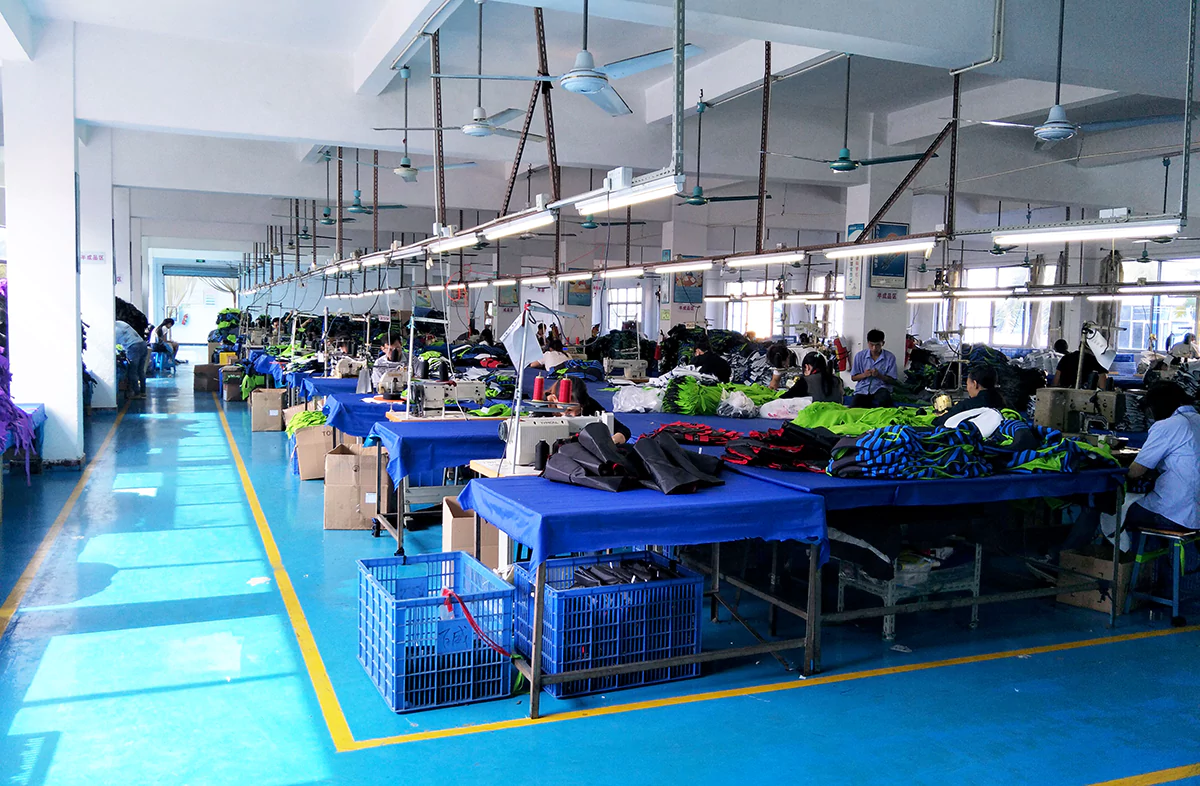
FYBagCustom is Your Trusted Custom Bag Manufacturer in China, with 15+ years of manufacturing experience spanning mesh, perforated-material, and sport-luxe bag construction. For sport-luxe, beach, and transparent-trend brands, our capabilities include:
Mesh and perforated bags serve the see-through, breathable, sport-luxe market — and they reward the manufacturer who solves the openness without canceling it. For sport-luxe, beach, and transparent-trend brands, three core takeaways:
If you are building a mesh or perforated-material bag program — sport-luxe, beach, transparent fashion, or a full range — contact FYBagCustom to brief your line, and receive a bound, structured, register-matched sample in 7–10 days.
FYBagCustom builds mesh and perforated bags with the structure, binding, and perforation engineering that make open materials work — sport-luxe neoprene, bound mesh totes, and fashion-transparent pieces. Structured, bound samples in 7–10 days.
Start Your Custom Bag Project →