Tel/WhatsAapp:+86 18011919834
E-mail: chloe.x@fybagcustom.com

Tel/WhatsAapp:+86 18011919834
E-mail: chloe.x@fybagcustom.com
Send Your Inquiry Today

Who this guide is for: brand owners, sourcing managers, product developers, quality directors, Amazon FBA sellers targeting the premium tier, DTC founders positioning against luxury brands, and boutique retailers who want to understand how to specify, verify, and achieve luxury-grade construction quality in custom-manufactured handbags — without the luxury-house price tag. If you need to understand what “boutique quality” actually means at the factory level — in terms of stitch count, edge finishing, hardware grade, and AQL inspection standards — this guide translates subjective quality perception into measurable, specifiable manufacturing standards.
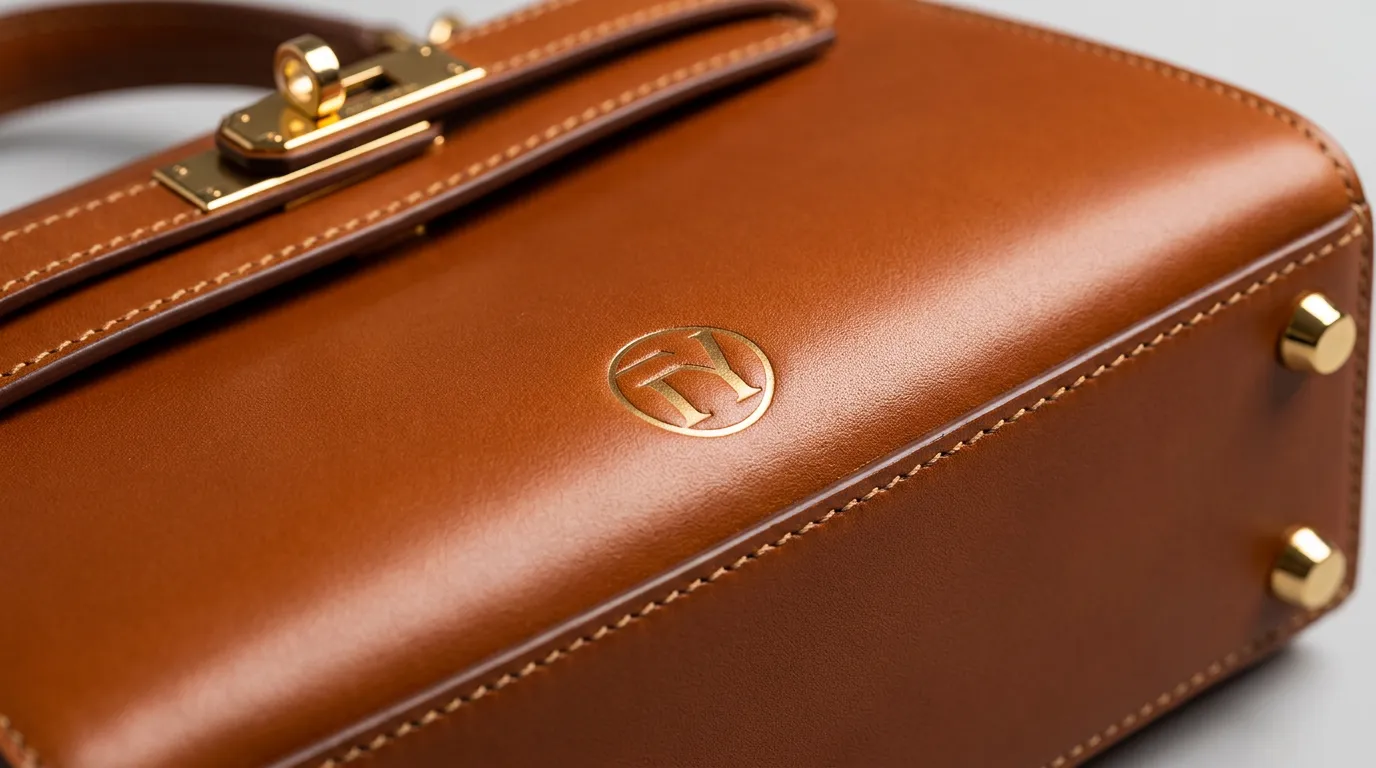
There is a 60 handbag from a private label brand — and when a consumer holds them side by side, she can feel the difference in three seconds. She may not be able to articulate what the difference is. She does not know the phrase “stitches per inch.” She has never heard of AQL inspection levels. But her hands know: the zipper is smoother on one. The edge is cleaner. The hardware has weight. The stitching is straighter. The leather — or the PU that mimics leather — has a consistency that the cheaper bag lacks.
That three-second tactile judgment is the entire competitive battleground for brands positioning between 200. You are not competing against the luxury house (her budget is not $1,500). You are competing against every other mid-to-premium brand for the consumer’s trust that your bag is worth the price you are asking. And that trust is built — or destroyed — by craftsmanship details that are invisible in product photography but immediately obvious in the hand.
This guide demystifies what “luxury-grade” quality actually means in handbag manufacturing. It translates the vague aspiration of “boutique quality” into specific, measurable, specifiable factory standards across six dimensions: stitching, edge finishing, hardware, material consistency, structural engineering, and quality control inspection. Every standard in this guide can be written into a tech pack and verified on a factory floor. Quality is not a feeling. It is a specification.
Quality in handbags is not a single attribute — it is the cumulative effect of precision across six distinct manufacturing dimensions. A bag can excel on five of six and still feel “cheap” if the sixth is weak. The consumer’s three-second judgment integrates all six simultaneously.
| Dimension | What It Governs | Consumer Perception | Where Flaws Are Most Visible |
|---|---|---|---|
| 1. Stitching | Thread quality, stitch density, straightness, tension consistency | “This looks carefully made” vs. “This looks machine-rushed” | Top edge, handle attachment, pocket edges, logo area |
| 2. Edge finishing | Treatment of cut material edges (painting, folding, burnishing) | “This feels expensive” vs. “This feels raw/cheap” | Flap edges, strap edges, gusset edges, handle edges |
| 3. Hardware | Zipper smoothness, closure engagement, metal weight and finish | “This feels substantial” vs. “This feels flimsy” | Main zipper, closure mechanism, strap hardware, D-rings |
| 4. Material consistency | Color uniformity, texture uniformity, surface quality across all panels | “This is one product” vs. “These pieces don’t match” | Front vs. back panel, left vs. right gusset, handle vs. body |
| 5. Structural engineering | Shape retention, base rigidity, handle attachment strength, load performance | “This bag holds itself together” vs. “This bag is floppy/saggy” | Bag standing upright on a surface, handle under load, base under weight |
| 6. Quality control | Defect detection, consistency across production run, inspection rigor | “Every bag I order is identical” vs. “Quality varies between units” | Batch-to-batch consistency, defect rates, customer return rates |
Stitching is the most immediately visible quality indicator on any handbag. A consumer may not consciously count stitches, but she registers stitch quality subconsciously within the first second of handling a bag. Straight, even, appropriately dense stitching reads as “made with care.” Uneven, loose, or sparse stitching reads as “mass-produced cheaply.”
| Quality Tier | SPI Range | Visual Effect | Where to Specify | Cost Impact |
|---|---|---|---|---|
| Budget / promotional | 4–5 SPI | Visible gaps between stitches; thread appears sparse | Low-visibility seams (internal, base) | Baseline |
| Standard mid-market | 6–7 SPI | Adequate — stitches are visible but not gaping | Acceptable for most seams on mid-price bags | +5–10% labor |
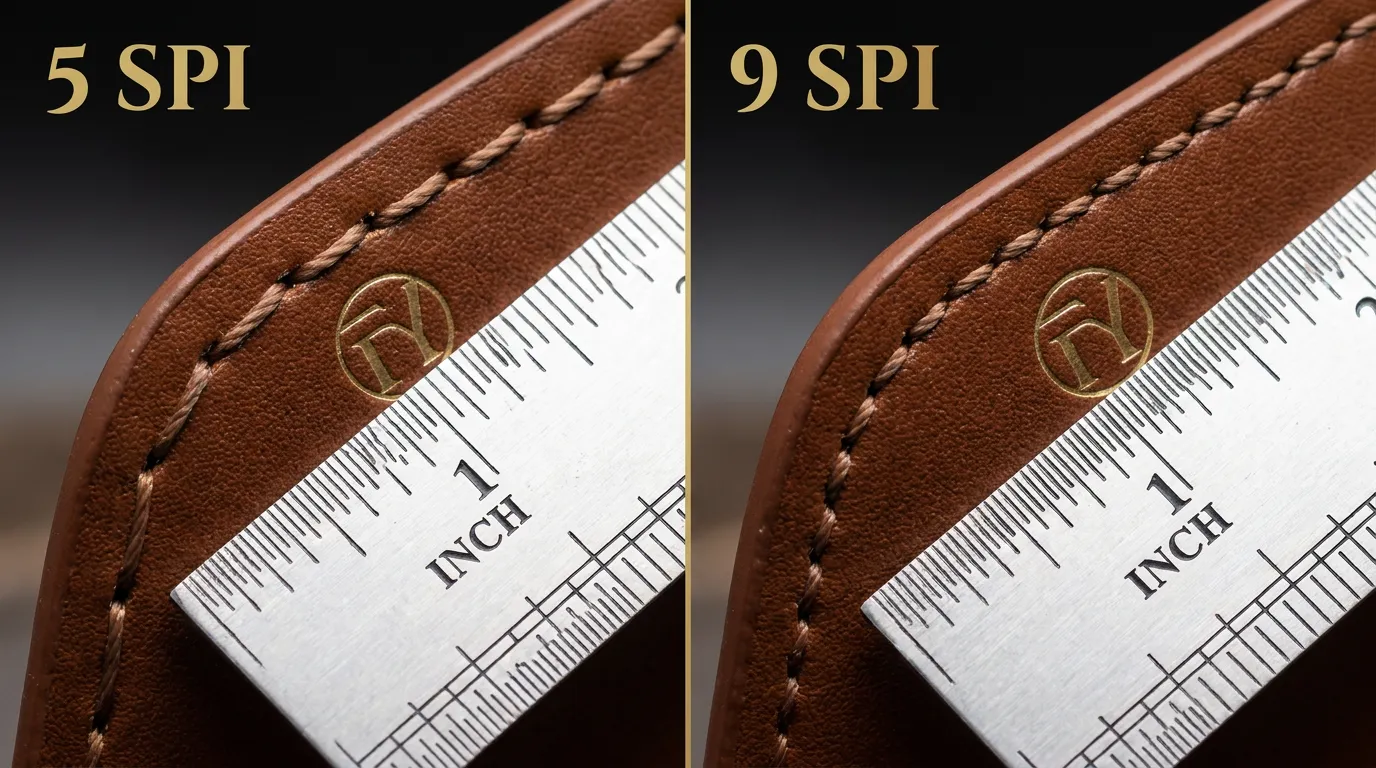
| Premium / boutique | 8–10 SPI | Clean, dense, refined — the “luxury look” | All visible exterior seams; all edge stitching | +15–25% labor |
| Ultra-luxury | 11–14 SPI | Near-invisible seam lines; thread appears as a continuous line | Every seam including interior; leather goods standard at luxury houses | +30–50% labor |
The recommended specification for boutique-quality bags: 8–10 SPI on all exterior and visible interior seams. This density produces the clean, refined appearance that consumers associate with premium products without the cost premium of ultra-luxury density. Specify the exact SPI in your tech pack — do not write “high quality stitching”; write “8 SPI minimum on all exterior seams, 6 SPI minimum on interior seams.”
SPI is necessary but not sufficient. Five additional stitch attributes must be specified:
| Attribute | What It Means | Boutique Standard | How to Check on Sample |
|---|---|---|---|
| Straightness | Stitch line follows the seam edge at a consistent distance | ±0.5 mm deviation from edge, maximum | Hold the bag at arm’s length; any wobble in the stitch line is a failure |
| Tension consistency | Each stitch is pulled to the same tightness | No loose stitches, no puckering | Run your finger along the seam — you should not feel individual stitch bumps |
| Backstitching at start/end | Thread is locked at the beginning and end of each seam to prevent unraveling | Minimum 3 backstitches at every start and stop point | Gently tug the thread at seam endpoints — it should not pull out |
| Thread color match | Thread matches the material color exactly (for tonal stitching) or is intentionally contrasting | ΔE < 2.0 for tonal stitching; contrast thread must be specified by Pantone | Compare thread to material under daylight — any mismatch is visible |
| No skip stitches | The machine did not miss a stitch (a gap in the stitch line) | Zero skip stitches on any visible seam | Inspect every visible seam under bright light at 30 cm distance |
Edge finishing is the treatment applied to cut material edges — the exposed cross-section visible when leather, PU, or fabric is cut. On an unfinished bag, these edges are raw: rough, fibrous, and visually obvious. On a boutique-quality bag, they are smooth, sealed, and either invisible or deliberately decorative.
| Technique | Process | Visual Result | Durability | Material Compatibility | Cost Impact |
|---|---|---|---|---|---|
| Raw / untreated | No treatment — cut edge left exposed | Rough, fibrous, visibly “unfinished” | Poor — edge frays, absorbs moisture | Canvas, nylon (acceptable on interior seams only) | Baseline |
| Heat-sealed | Nylon/polyester edge melted with a heat tool | Smooth but shiny — visible melt line | Moderate — seal prevents fraying | Nylon, polyester only | +2–5% |
| Serged / overlocked | Thread wraps around the edge via serger machine | Neat but visibly “sewn” — reads as garment construction | Good | Fabric, canvas, some PU | +5–10% |
| Edge paint (standard) | Pigmented sealant applied to the cut edge by machine | Smooth, colored, clean line | Good — single coat may chip | PU leather, genuine leather, microfiber | +10–15% |
| Edge paint (multi-coat, hand-finished) | 2–3 coats of edge paint, each dried and sanded between coats | Ultra-smooth, seamless, professional — the boutique standard | Excellent — multi-coat resists chipping | Genuine leather, premium PU | +20–35% |
| Edge folding (turned edge) | Material edge folded under and stitched or glued flat | No visible edge at all — cleanest possible finish | Excellent — edge is fully enclosed | Thin PU, thin leather, fabric | +15–25% |
| Burnishing | Edge heated and polished with friction; natural oils in leather create a smooth, sealed surface | Smooth, slightly glossy, organic — the traditional leather craft finish | Excellent — the edge is physically transformed | Genuine leather, vegetable-tanned leather only | +20–30% |
For bags retailing at 200, the recommended edge finishing specification:
| Application Zone | Recommended Technique | Why |
|---|---|---|
| Flap edges, strap edges (highest visibility) | Multi-coat edge paint (2–3 coats, hand-sanded between coats) or burnishing (for genuine leather) | These edges are what the consumer sees first and touches most |
| Handle edges | Edge folding or multi-coat paint | Handles are the primary touch point; rough edges cause discomfort |
| Gusset / side panel edges | Standard edge paint (single coat) or edge folding | Visible but secondary; single-coat is acceptable if neatly applied |
| Interior seam edges | Serged or binding tape | Not visible when bag is closed; neat finishing shows when bag is open |
| Base edges | Standard edge paint or hidden by piping/binding | Base takes the most abuse; paint protects the edge from moisture |
Run your thumbnail along every visible edge of the sample. If your nail catches on any roughness, bump, or gap in the edge paint — the edge finishing is not at boutique standard. A properly finished edge feels like a continuous, smooth surface with no perceptible transition between the material face and the edge treatment.
Hardware is the dimension where quality differences are most tangible — literally. The consumer touches, operates, and listens to hardware every time she uses the bag. A smooth zipper that glides without catching, a magnetic snap that closes with a clean “click,” a D-ring that has visible weight and substance — these tactile experiences accumulate into an overall quality impression that no amount of beautiful material can override if the hardware is cheap.
| Component | Budget Tier | Mid-Market Tier | Boutique / Premium Tier | How Consumer Notices the Difference |
|---|---|---|---|---|
| Main zipper | Generic brand, nylon coil, thin tape | Mid-grade metal teeth or nylon coil, moderate slider weight | YKK or equivalent, metal teeth, heavy slider, smooth pull | Glide smoothness; sound (premium zippers are near-silent); pull weight |
| Zipper pull | Stamped flat metal or plastic cord | Formed metal, basic shape | Cast or forged metal, weighted, engraved or custom-shaped | Weight in hand; tactile quality; visual refinement |
| Magnetic snap | Thin disc, weak magnet, 0.5–1.0 kg engagement force | Standard disc, moderate magnet, 1.0–1.5 kg force | Thick disc, neodymium magnet, 1.5–2.5 kg force, audible “click” | Closure firmness; the “click” sound; security (does the bag stay closed?) |
| D-rings | Wire-formed, lightweight, visible join line | Stamped, moderate weight, join visible | Cast or welded, heavy, no visible join | Weight; finish smoothness; structural feel |
| Rivets | Stamped, thin, flat head | Formed, moderate dome | Cast dome-head, substantial thickness, clean finish | Visual presence; permanence perception |
| Base feet | Plastic or thin stamped metal | Metal, moderate size | Cast metal, weighted, clean finish, anti-scratch pad | Sound when bag is set down; stability; scratch protection |
The zipper is the most frequently operated hardware on any bag. A boutique-quality zipper passes this test:
Specify YKK or equivalent branded zipper in your tech pack. Unbranded generic zippers are the #1 hardware quality complaint in handbag reviews.
Material consistency — the uniformity of color, texture, grain, and thickness across all panels of a single bag and across all bags in a production run — is the quality dimension that consumers cannot articulate but can absolutely feel. When a bag’s front panel is slightly different in shade from its back panel, or when the left gusset has a different texture than the right, the consumer perceives “something is off” without being able to identify what.
| Specification | What to Define | Boutique Standard | How to Verify |
|---|---|---|---|
| Color consistency (within one bag) | Maximum color difference between any two visible panels | ΔE < 1.5 (CIE Lab color difference) | Hold panels side by side under daylight; any visible difference is a failure |
| Color consistency (across production run) | Maximum color difference between any two bags in the same batch | ΔE < 2.0 | Compare the first and last bag off the line under identical lighting |
| Grain direction | All visible exterior panels cut with grain running in the same direction | 100% same-direction cutting for all visible panels | Tilt the bag under a single light source — panels should shift shade identically |
| Texture consistency | Surface texture (pebble size, emboss depth, weave density) uniform across panels | No visible texture variation between adjacent panels | Run hand across panel transitions — no perceptible texture change |
| Thickness consistency | Material thickness uniform across the bag body | ±0.1 mm for PU leather; ±0.2 mm for genuine leather | Use a thickness gauge on multiple points; verify that the bag sits symmetrically |
The most effective DIY test for material consistency: hold the bag under a single directional light source (a desk lamp or a window) and slowly rotate it. All panels should shift shade identically as the angle changes. If one panel catches light differently, the grain direction is mismatched or the material thickness varies — both are consistency failures.
A boutique-quality bag maintains its intended silhouette when empty, when loaded, and after months of daily use. A poorly engineered bag sags, collapses, or distorts within weeks — even if the material, stitching, and hardware are excellent.
| Element | What It Does | Boutique Standard | What Happens Without It |
|---|---|---|---|
| Interlining (fusible) | Adds body and rigidity to material panels | All exterior panels interlined; weight matched to material | Panels flex, wrinkle, and fail to hold shape |
| Base board | Rigid insert in the bottom panel | Fiberboard or HDPE, 1.5–2.0 mm, covered in lining material | Bag collapses and cannot stand upright; base sags under load |
| Handle reinforcement | Additional material layers where handles attach to the body | Webbing backing plate, bartack stitching + rivets | Handles pull through the body material under load (the #1 structural failure) |
| Seam reinforcement (stress points) | Extra stitching or bartacking at high-stress seam intersections | Bartack (20+ stitches in a tight zigzag) at every load-bearing junction | Seams open under stress; zipper ends pull apart |
| Edge wire or piping cord | Wire or cord inside the top-edge binding | Maintains the opening shape; prevents the top edge from folding inward | Top edge deforms when bag is loaded; looks used after one week |
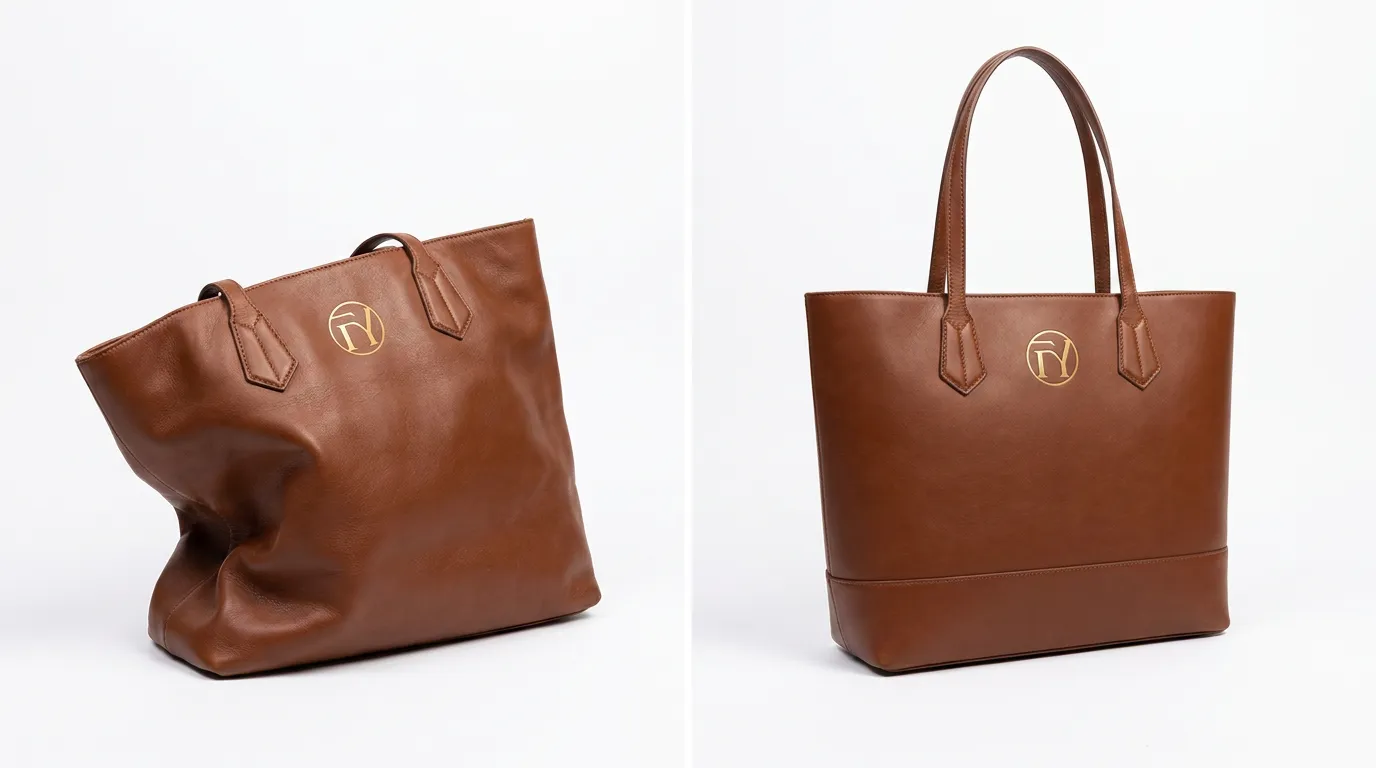
Place the empty bag on a flat surface. A boutique-quality structured bag should stand upright independently, maintaining its intended silhouette, without leaning, collapsing, or requiring support. If the bag lists, sags, or cannot stand, the base board, interlining, or both are insufficient.
Place 3 kg of evenly distributed weight inside the bag (books work well). Carry it by the handles for 60 seconds. Set it down. Remove the weight. The bag should return to its original shape within 30 seconds. Any permanent deformation — stretched handles, sagged base, distorted panels — indicates insufficient structural engineering.
All five previous dimensions can be perfectly specified in a tech pack — but they only matter if the factory’s quality control system ensures they are met on every single unit, not just the sample and the first few bags off the line. QC is the system dimension; it guarantees that what you approved is what you receive.
AQL (Acceptable Quality Level) is the internationally recognized statistical framework for product inspection. It defines how many units from a production batch must be inspected and what defect rate is acceptable. Understanding AQL levels helps buyers specify the right inspection rigor for their quality tier.
| AQL Level | What It Means | Defect Acceptance (for a 200-unit batch) | Appropriate For | Industry Context |
|---|---|---|---|---|
| AQL 4.0 | Lenient — accepts a higher defect rate | ~14 units inspected; accept batch if ≤3 defective | Budget / promotional products; fast fashion | Common for sub-$20 retail products |
| AQL 2.5 | Standard — the most common level in general manufacturing | ~20 units inspected; accept batch if ≤3 defective | Mid-market; standard commercial quality | The industry default for most bag production |
| AQL 1.5 | Strict — lower defect tolerance | ~32 units inspected; accept batch if ≤2 defective | Premium products; brands with strong quality reputation | Used by premium DTC and specialty retail brands |
| AQL 1.0 | Very strict — near-zero defect tolerance | ~50 units inspected; accept batch if ≤1 defective | Boutique / luxury-grade; brands where a single defect damages reputation | The standard for luxury-adjacent brands; what this guide targets |
| 100% inspection | Every unit inspected individually | All 200 units inspected; any defective unit is pulled | Ultra-premium; critical products; small batches | Recommended for batches under 200 units; standard at quality-focused small-to-mid factories |
For brands targeting the boutique-quality tier (200+ retail), the recommended QC specification combines two approaches:
| Critical Checkpoint | What to Check | Why 100% Inspection |
|---|---|---|
| Zipper function | Full open/close cycle; no catching or stiffness | Zipper failure is the #1 cause of customer returns in handbags |
| Logo/branding | Position, size, depth, clarity; centered and aligned | A misaligned logo is immediately visible and not correctable post-production |
| Handle attachment | Symmetry, attachment strength (light tug test) | Handle detachment is a safety issue and a catastrophic brand failure |
| Color consistency | Quick visual comparison to the approved reference sample | Color variation between units in the same order generates negative reviews |
| Closure function | Magnetic snap engagement, turn-lock operation, buckle closure | A closure that does not work is a non-functional product |
Not all defects are equal. AQL systems classify defects into three severity levels, each with different acceptance thresholds:
| Classification | Definition | Examples | AQL 1.0 Tolerance | Consumer Impact |
|---|---|---|---|---|
| Critical | Defect that makes the product unsafe or non-functional | Handle detached; zipper broken; sharp hardware edge; toxic material | Zero tolerance — any critical defect rejects the unit | Product return; potential injury; brand damage |
| Major | Defect that significantly affects appearance or function | Wrong color; misaligned logo; loose stitching on exterior; hardware scratched; edge paint peeling | AQL 1.0 on major defects | Product return; negative review; reduced perceived value |
| Minor | Defect that slightly affects appearance; does not impact function | Small thread end visible; minor color variation on interior; slight asymmetry on interior pocket | AQL 2.5 on minor defects (slightly more lenient than major) | Consumer may notice but is unlikely to return |
Whether your factory performs self-inspection or you engage a third-party inspector, the inspection report should document:
| Section | What It Contains |
|---|---|
| Order details | Style number, color, quantity, production date, inspection date |
| Sample size and method | Number of units inspected; AQL level applied |
| Dimensional check | 5+ units measured; all dimensions compared to PP sample tolerance |
| Visual inspection results | Defect count by classification (critical, major, minor); photos of any defects found |
| Function testing | Zipper cycle count (minimum 50 cycles on 10% of batch); closure testing; handle load testing |
| Packing verification | Correct packaging components (dust bag, hang tag, barcode); correct labeling |
| Overall result | PASS / FAIL / PENDING (conditional pass with corrective action) |
The difference between a founder who receives boutique-quality bags and one who receives inconsistent quality is often not the factory — it is the specificity of the tech pack. A tech pack that says “high quality stitching” gets whatever the factory considers high quality (which may differ from your expectation). A tech pack that says “8 SPI minimum, ±0.5 mm straightness tolerance, Madeira Rayon 40 thread, tonal color match ΔE < 2.0” gets exactly that.
| Dimension | What to Specify | Example Specification |
|---|---|---|
| Stitching density | SPI for exterior and interior seams | “Exterior: 8 SPI min. Interior: 6 SPI min.” |
| Stitch straightness | Maximum deviation from edge | “±0.5 mm from edge on all topstitching” |
| Thread | Type, weight, color reference | “Polyester 40-weight; tonal match to body material ΔE < 2.0” |
| Edge finishing | Technique by zone | “Flap and strap edges: 2-coat edge paint, sanded between coats. Interior: serged.” |
| Zipper | Brand, type, size, finish | “YKK #5 metal teeth, antique brass finish” |
| Hardware weight | Minimum weight for key pieces | “Main zipper slider: 10 g minimum. D-rings: cast, welded, 15 mm, antique brass” |
| Material consistency | Color and grain tolerance | “All exterior panels: ΔE < 1.5; same grain direction” |
| Structural elements | Base board, interlining, reinforcement | “2.0 mm fiberboard base; fusible interlining on all exterior panels; bartack at all load-bearing junctions” |
| QC level | AQL specification + critical checkpoints | “AQL 1.0 major; AQL 2.5 minor; 100% check on zipper function, logo, handle attachment, closure, color” |
Quality has a cost — but the cost is lower than most founders expect, and the return (in reduced returns, stronger reviews, and higher price tolerance) consistently exceeds the investment.
| Quality Upgrade | Per-Unit Cost Impact | Retail Price Impact (justified premium) | ROI Assessment |
|---|---|---|---|
| Stitching upgrade (6 SPI → 9 SPI) | +1.50 | +15 | Very high — the most visible quality signal per dollar |
| Edge finishing upgrade (single-coat → multi-coat) | +1.20 | +10 | High — the primary tactile quality signal |
| Zipper upgrade (generic → YKK) | +1.00 | +8 | Very high — reduces return rate by preventing the #1 hardware failure |
| Hardware upgrade (stamped → cast) | +2.00 | +15 | High — weight and finish create “feels expensive” perception |
| Material consistency upgrade (standard → ΔE-controlled) | +0.80 | +8 | Moderate — prevents the “panels don’t match” complaint |
| Structural upgrade (basic → full interlining + base board + bartack) | +1.50 | +10 | High — the bag holds its shape for years, not weeks |
| QC upgrade (AQL 2.5 → AQL 1.0 + critical 100%) | +0.80 | Prevents returns (10 per prevented return) | Very high — reduces return rate by 30–50% |
| Total boutique-quality upgrade | +8.80 per unit | +65 justified retail premium | Exceptional — 8.80 investment justifies 65 higher price |
The total cost of upgrading from standard to boutique-quality manufacturing is approximately 8.80 per unit. For a bag retailing at 120–25–$65 premium that is 3–7× the manufacturing cost increase. This is one of the highest-ROI investments available in handbag product development.
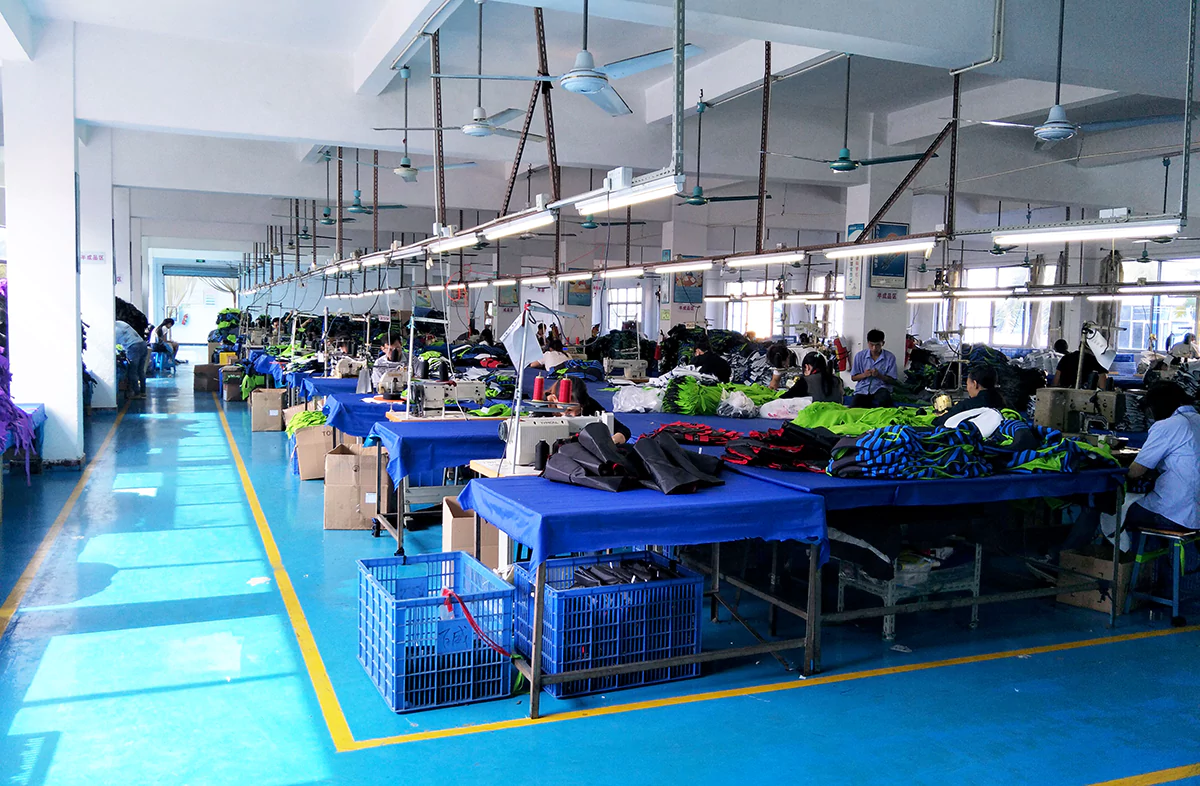
FYBagCustom is Your Trusted Custom Bag Manufacturer in China, with 15+ years of manufacturing experience and a quality control system structured for premium and boutique-grade production. For brands targeting the luxury-alternative tier, our quality capabilities include:
The difference between a “quality” bag and a boutique-quality bag is not intention — every factory intends to produce quality. The difference is specification precision: exact stitch counts, exact edge treatments, exact hardware grades, exact material tolerances, and exact inspection standards written into the tech pack and verified through AQL-standard inspection. For brands targeting the luxury-alternative tier, three core takeaways:
If your brand is positioning between 200 and competing on quality perception, now is the time to specify boutique-grade standards in your tech pack. Contact FYBagCustom to discuss quality specifications, request samples produced at premium standards, and see the difference that precise craftsmanship makes — typically within 5–7 days.
FYBagCustom’s quality system delivers 8–10 SPI stitching, multi-coat edge finishing, YKK hardware, AQL 1.0 inspection, and material consistency control — the specifications that transform a good bag into a boutique-quality product. Send us your tech pack and we’ll produce a sample at premium standards within 5–7 days.
Start Your Custom Bag Project →