Tel/WhatsAapp:+86 18011919834
E-mail: chloe.x@fybagcustom.com

Tel/WhatsAapp:+86 18011919834
E-mail: chloe.x@fybagcustom.com
Send Your Inquiry Today

Who this guide is for: brand owners, sourcing managers, wholesale buyers, Amazon FBA sellers, DTC founders, event merchandise companies, promotional product distributors, and sports licensing retailers who are developing clear bags that comply with U.S. stadium and event venue security policies. If you need to understand size regulations, material options, customization techniques that work on transparent surfaces, and how to turn a compliance product into a fashion-forward branded item with custom straps and decoration — this guide covers every development decision.
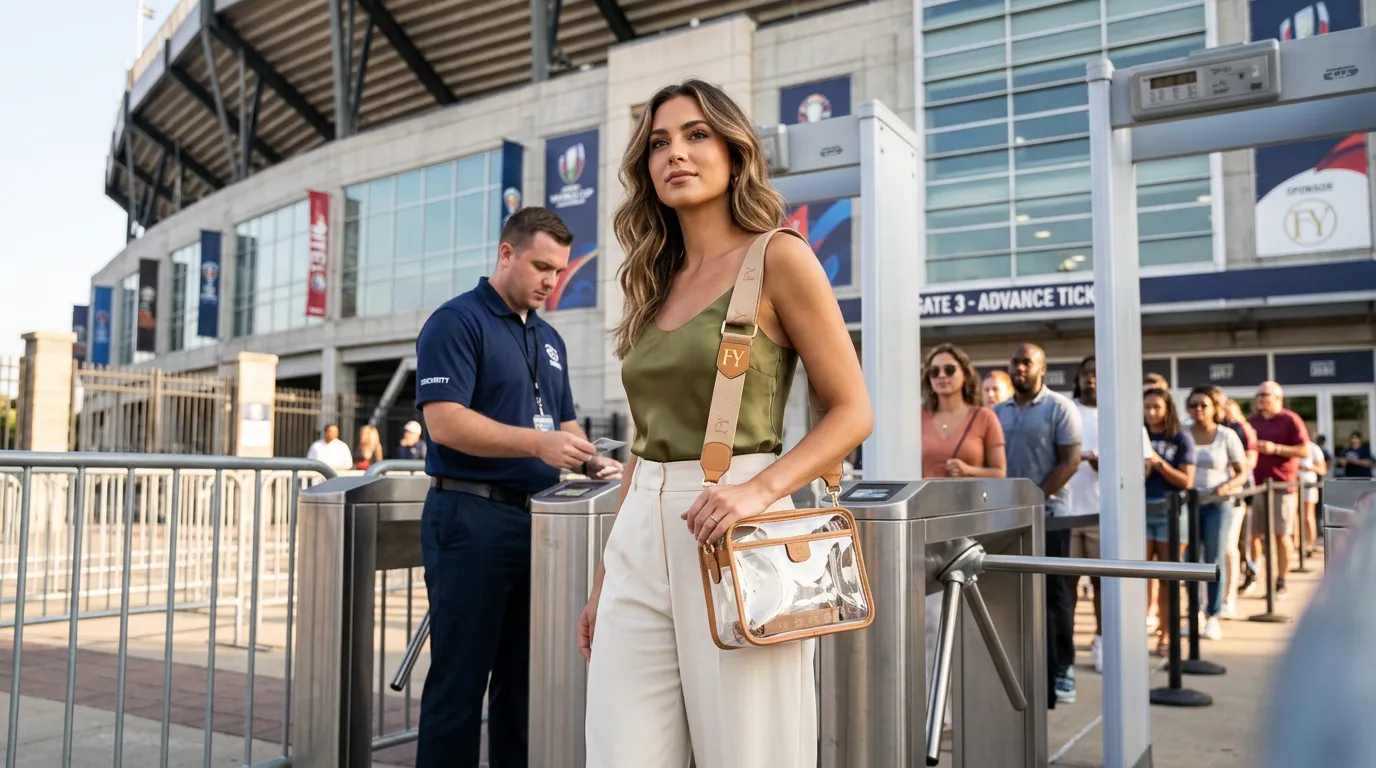
No other bag category in the U.S. market is driven as directly by regulation as the clear bag. Since the NFL introduced its clear bag policy in 2013, the rule has cascaded across virtually every major venue type — NFL, NCAA, NBA, NHL, MLB stadiums, concert arenas, music festivals, college campuses, and even some theme parks and government buildings. The policy is simple and non-negotiable: if your bag is not clear, you are not getting in.
For consumers, this creates a forced purchase occasion. Unlike fashion bags that are aspirational or discretionary, a clear bag is a functional must-have for anyone attending a live event. Search volume for “clear bags for stadiums” and “custom clear crossbody bag” spikes predictably around NFL season openers, college football kickoffs, major concert tours, and festival season — creating one of the most reliable seasonal demand patterns in the entire bag industry.
For B2B buyers, the opportunity goes far beyond selling compliance. The first generation of clear bags was purely utilitarian: cheap PVC pouches with generic straps. In 2026, consumers — particularly women — are rejecting the idea that “security-required” must mean “ugly.” They want clear bags with custom-colored trim, branded straps, team logos, personalized stickers, and fashion-grade hardware that meet every venue rule while looking intentional rather than institutional. The brands that bridge this gap between compliance and style are capturing outsized market share.
This guide covers the exact size regulations, material specifications, the customization techniques that transform a commodity clear bag into a differentiated brand product, and how to work with a manufacturer in China to produce stadium-compliant clear bags at scale.
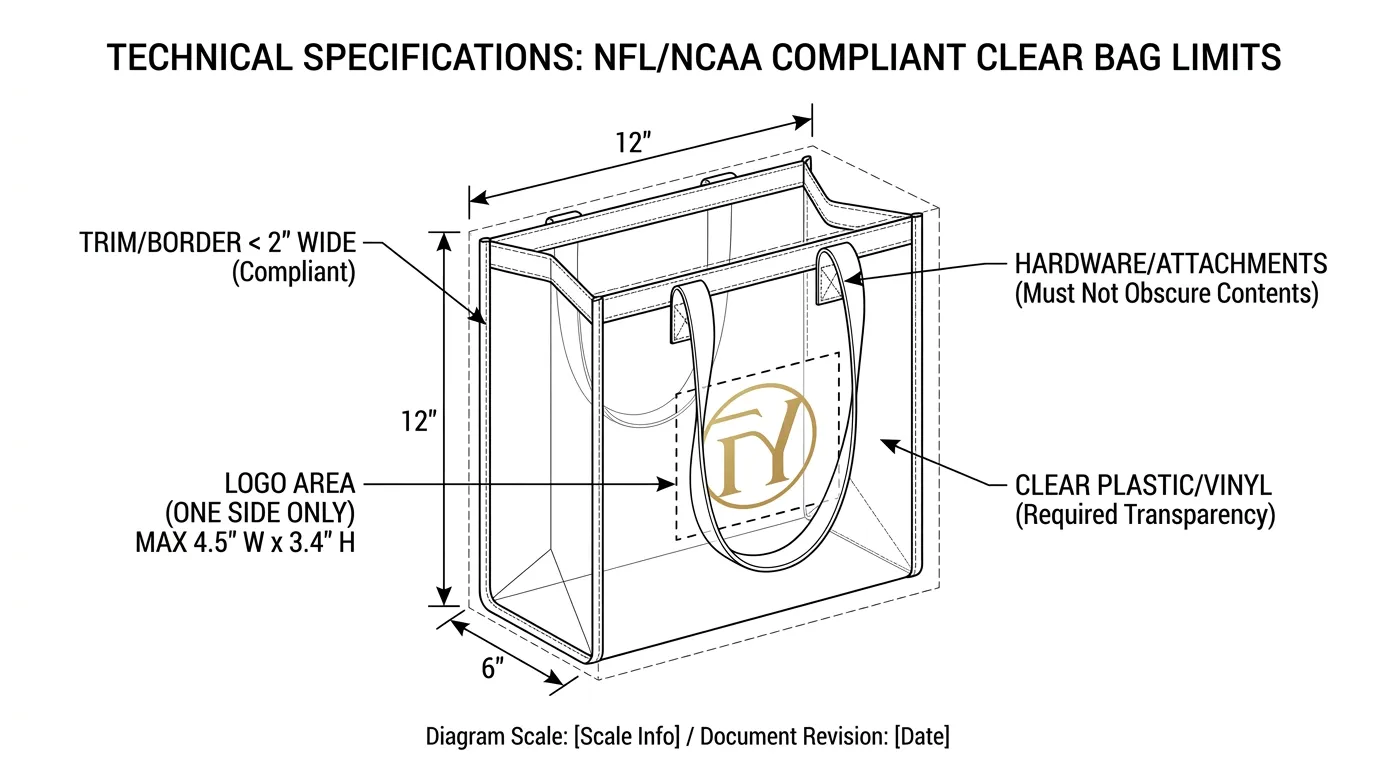
Before designing a single bag, you must understand the size limits. A clear bag that exceeds the allowed dimensions — even by one centimeter — will be turned away at the gate, generating returns, refund requests, and damaging reviews. There is zero tolerance at venue security checkpoints.
| Venue / Organization | Clear Bag Maximum Size | Non-Clear Exception | Clutch / Wallet Exception |
|---|---|---|---|
| NFL (all stadiums) | 12 × 6 × 12 in (30.5 × 15 × 30.5 cm) | One-gallon clear plastic freezer bag | Non-clear clutch ≤ 4.5 × 6.5 in |
| NCAA (college football, basketball) | 12 × 6 × 12 in (same as NFL) | One-gallon clear plastic bag | Non-clear clutch ≤ 4.5 × 6.5 in |
| MLB (most stadiums, varies) | 16 × 16 × 8 in (40.5 × 40.5 × 20 cm) | Varies by team — check specific venue | Small non-clear clutch (varies) |
| NBA / NHL (arena-specific) | Varies — commonly 14 × 14 × 6 in | Varies | Small clutch typically allowed |
| Major concert venues (Live Nation, AEG) | 12 × 6 × 12 in (NFL standard common) | Varies by venue and tour | Small clutch varies |
| Music festivals (Coachella, Lollapalooza, etc.) | Varies — commonly 12 × 12 × 6 in | Fanny packs sometimes exempt if clear | Small wallet |
| College campuses (gameday policies) | Follows NCAA — 12 × 6 × 12 in | One-gallon clear bag | Small clutch |
Given the variation across venues, the safest product dimensions for universal compliance are:
Critical note: the size limit includes trim, handles, and any protruding elements. A bag body that measures 30 cm but has a 2 cm leather border technically measures 32 cm at the widest point. Design the clear panel to the maximum dimension, with trim sitting within or flush to that boundary — not extending beyond it.
“Clear bag” covers several distinct product formats, each serving a different consumer need and retail price point. The right format depends on your brand positioning and target buyer.
| Sub-Type | Dimensions | Capacity | Carry Method | Retail Price Range | Best For |
|---|---|---|---|---|---|
| Clear tote | 30 × 15 × 30 cm (max) | Largest — fits wallet, keys, phone, jacket, snacks | Twin handles + optional shoulder strap | 45 | Families, tailgaters, maximum-capacity buyers |
| Clear crossbody | 22 × 7 × 18 cm | Moderate — phone, wallet, keys, lip balm | Adjustable crossbody strap | 35 | Women, hands-free, fashion-forward |
| Clear fanny pack / belt bag | 25 × 8 × 14 cm | Compact — phone, cards, keys | Waist / hip strap | 28 | Festival-goers, active fans, youth |
| Clear backpack | 30 × 15 × 40 cm (exceeds NFL; fits some venues) | Large — fits NCAA but NOT NFL limit often | Backpack straps | 40 | College campuses, schools, theme parks |
| Clear clutch / wristlet | 11.5 × 16.5 cm (4.5 × 6.5 in max) | Minimal — phone, cards, keys only | Wristlet strap or hand-carry | 22 | Minimalist carry, non-clear clutch exception size |
For brands entering the clear bag market, the clear crossbody and clear tote are the two highest-volume, highest-margin formats. The crossbody leads in the women’s and fashion-forward segment; the tote leads in the family and tailgating segment. Together, they cover the majority of event-goer needs.
The clear fanny pack is a strong third product for festival-focused and youth-market brands. The clear backpack has a narrower market (mainly students and theme parks) because its dimensions often exceed NFL/NCAA limits.
A commercially efficient entry strategy: launch with one crossbody + one tote in 3–4 trim colors, then add the fanny pack and clutch based on sell-through.
The transparent panel of a clear bag is subject to specific material requirements — both for venue compliance and for product durability. Using the wrong clear material results in bags that crack in cold weather, yellow within weeks, or fail security inspection because they are not transparent enough.
| Material | Transparency | Durability | Cold-Weather Performance | Yellowing Resistance | Environmental Profile | Cost |
|---|---|---|---|---|---|---|
| Standard PVC (0.3–0.5 mm) | High | Moderate — cracks at flex points after 6–12 months | Poor — becomes brittle below 0°C | Low — yellows within 3–6 months | Low — contains chlorine, not recyclable | Lowest |
| Premium PVC (0.5–0.8 mm) | High | Good — thicker gauge resists cracking | Moderate — better than standard | Moderate — yellows slower | Low | Low–Mid |
| TPU (thermoplastic polyurethane) | High | Excellent — flex-resistant, tear-resistant | Very good — remains flexible in cold | Good — significantly slower yellowing | Better — no chlorine, some formulations recyclable | Mid |
| PEVA (polyethylene vinyl acetate) | High | Good — softer feel | Good | Good | Better — chlorine-free | Mid |
| Recycled PVC / eco-PVC | High | Good | Moderate | Moderate | Moderate — recycled content but still PVC | Mid |
| Polycarbonate panel (rigid) | Very high | Excellent — near-unbreakable | Excellent | Excellent — minimal yellowing | Moderate | High |
For any brand positioning above the disposable/promotional tier, TPU is the recommended clear material. It outperforms PVC on every quality dimension: it resists cracking, remains flexible in cold outdoor temperatures (critical for late-season NFL and college football games in northern cities), yellows significantly slower, and avoids the environmental concerns around chlorine-based PVC.
The cost premium of TPU over standard PVC is approximately 30–50% on the clear panels — but the resulting product lasts 2–3× longer, generates fewer negative reviews about cracking or yellowing, and supports a “premium clear bag” retail price tier (45 vs. 15 for basic PVC).
If budget is the primary constraint (promotional programs, bulk giveaways), premium PVC at 0.5 mm or thicker is the minimum viable specification. Avoid standard 0.3 mm PVC for any product expected to survive more than two or three uses.
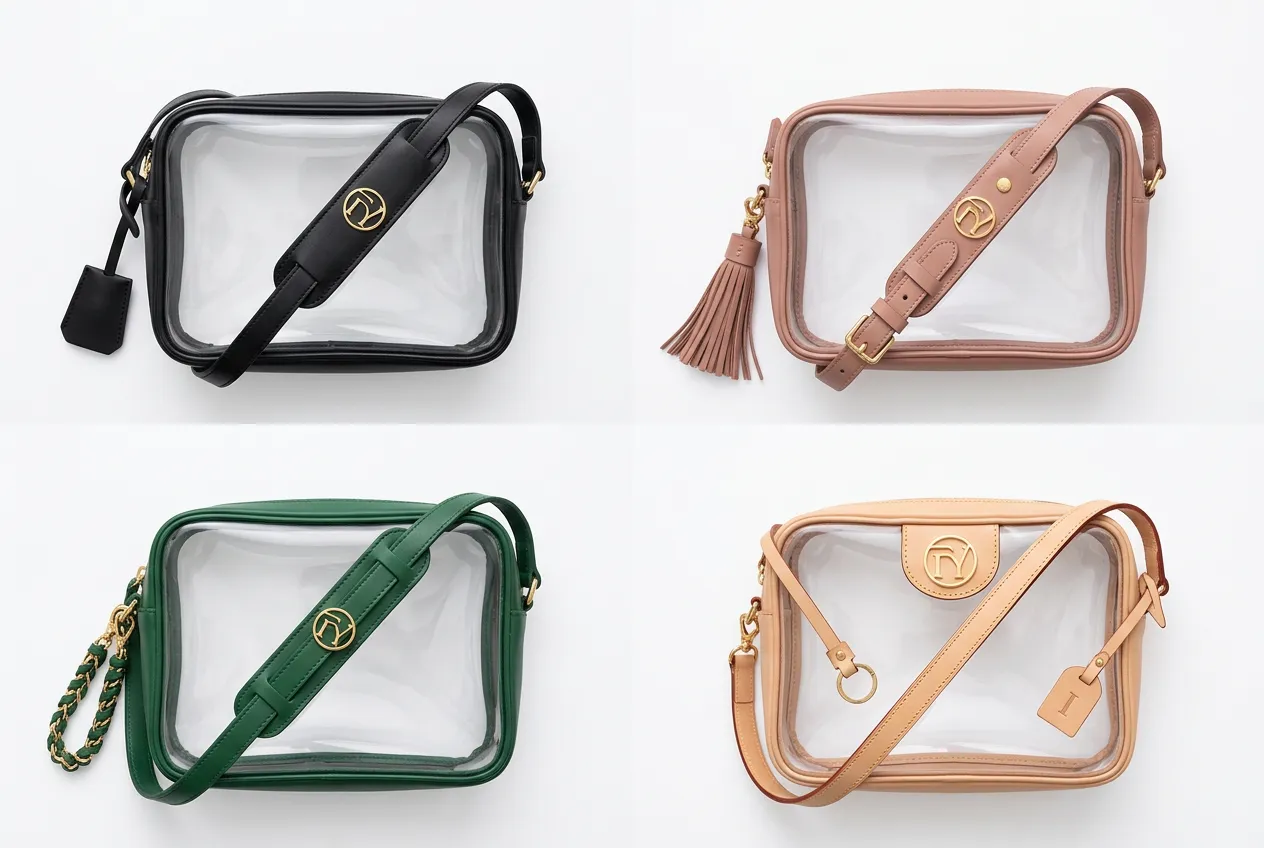
The clear panel itself cannot be decorated — it must remain transparent for security inspection. All customization opportunities sit in the trim, strap, hardware, and detachable accessories. This constraint is actually a design advantage: it forces brands to concentrate their identity into a small number of high-impact elements, creating a distinctive product with minimal decoration cost.
| Zone | What It Is | Customization Options | Visual Impact | Cost Range |
|---|---|---|---|---|
| 1. Trim / border | The opaque material framing the clear panels | Color (any PU, leather, nylon, canvas), width (15–30 mm), texture (smooth, pebbled, canvas) | Highest — defines the bag’s color identity | Baseline — trim is a structural component |
| 2. Strap | Shoulder, crossbody, or waist strap | Branded webbing (jacquard-woven), colored nylon, leather, chain, beaded, guitar-strap style | Very high — the most visible element when worn | 5.00 depending on material and branding |
| 3. Hardware | Zippers, D-rings, snap hooks, rivets | Color finish (gold, silver, matte black, rose gold), branded zipper pulls, engraved snaps | Medium–High — signals quality level | 2.00 |
| 4. Logo / brand mark | Brand identity on opaque elements only | Debossed on leather trim, foil-stamped on PU trim, woven label on strap, metal nameplate | Medium — concentrated brand signal | 3.00 |
| 5. Detachable accessories | Charms, stickers, patches, clips | Enamel pins, rubber charms, Velcro patches on strap, team-color carabiners, letter charms | High — consumer-customizable, shareable | 3.00 per accessory |
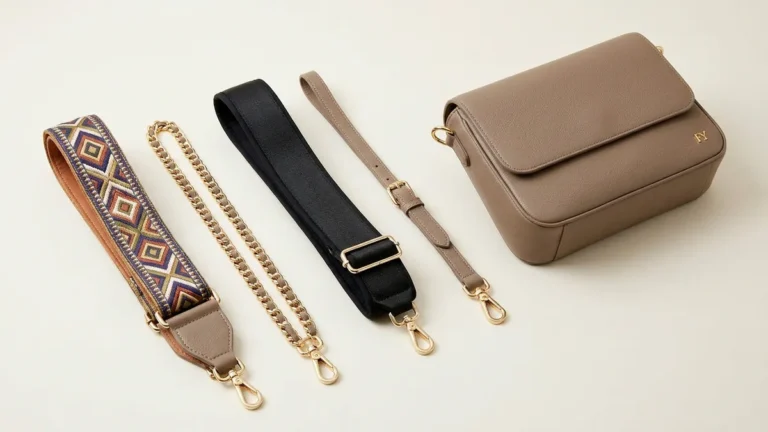
Because the bag body is transparent, the strap becomes the dominant visual element — it is the one component that every observer sees first. Investing in strap customization creates more brand differentiation per dollar than any other component.
| Strap Style | Visual Effect | Material | Width | Best For | Cost vs. Plain Webbing |
|---|---|---|---|---|---|
| Jacquard-woven brand name | Brand name repeating across strap — maximum visibility | Custom-woven polyester/nylon | 25–38 mm | Brand awareness, logo-forward programs | +2.50 (+ loom setup 500) |
| Guitar strap (woven pattern) | Bohemian, festival-ready, colorful | Jacquard cotton or polyester | 38–50 mm | Festival brands, lifestyle positioning | +3.00 |
| Team-color webbing | Simple, sports-aligned, clean | Dyed nylon webbing | 25–38 mm | Licensed sports, fan products | +0.50 |
| Chain strap (partial or full) | Fashion, evening, premium | Zinc alloy chain + leather shoulder pad | 10–15 mm chain | Fashion-forward, concert, nightlife | +5.00 |
| Beaded or braided strap | Artisanal, handcrafted, unique | Glass/acrylic beads, braided cord | 15–25 mm | Boutique, resort, gift market | +6.00 |
| Adjustable crossbody + detachable | Versatile, convertible | Nylon webbing with slider | 25–38 mm | Universal — recommended for all crossbody programs | Baseline |
For most B2B clear bag programs, offering 2–3 strap options per bag style (for example: plain team-color webbing, jacquard-woven branded, and guitar-strap pattern) creates a product line with enough variety to serve multiple buyer segments without multiplying the base bag SKU count.
Clear bags have spawned a secondary accessories market driven by consumers who want to personalize their transparent bag without permanently altering it. This represents a genuine revenue opportunity for brands:
The business model: sell the base clear bag at a competitive price (30), then sell accessories at high-margin add-on prices (8 per item). Over time, the accessory revenue can exceed the bag margin.
Clear bag demand follows a predictable, event-driven calendar that allows precise inventory planning.
Relative monthly search volume. Peak = 100. Indexed annual cycle.
| Month | Action | Target Events |
|---|---|---|
| January–February | Finalize designs, approve samples, place production order | Spring festival season prep |
| March | Receive inventory, stage in warehouse or FBA | Coachella (April), Stagecoach, spring concerts |
| April–June | Peak selling — festival season | Major festivals, MLB, summer concerts |
| June–July | Place second production order (if not already in bulk) | NFL/NCAA football season prep |
| August | Receive inventory for football season | NFL preseason, college football Week 1 |
| September–November | Peak selling — football season | NFL regular season, college football, NBA/NHL openers |
| December | Evaluate annual performance, plan next year’s trim colors/straps | Holiday gift potential (stocking stuffer for sports fans) |
Brands running a year-round clear bag program should plan for two production cycles — one for festival season (order placed Jan–Feb, delivered March) and one for football season (order placed Jun–Jul, delivered August).
Clear bags have unique quality vulnerabilities that do not apply to opaque bags. Because every surface is visible — inside and out — construction flaws that would be invisible in a leather tote are immediately exposed.
| Issue | Cause | Prevention | QC Check |
|---|---|---|---|
| Yellowing within 3 months | Low-grade PVC without UV stabilizers | Specify TPU or UV-stabilized PVC; request UV-resistance test data | Accelerated UV exposure test on material sample |
| Cracking at fold points | Thin PVC (0.3 mm) stressed by repeated folding | Use TPU or PVC ≥ 0.5 mm; avoid sharp fold lines in pattern | Flex test: 2,000+ cycles at room temperature |
| Cold-weather brittleness | PVC loses flexibility below 0°C | Use TPU (maintains flexibility to -20°C) or cold-rated PVC | Cold-chamber flex test at -10°C |
| Visible glue residue on seams | Excess adhesive during RF-welding or heat-sealing | Specify post-weld cleaning step; use RF welding over adhesive bonding | Visual inspection under bright light at 45° angle |
| Trim delamination | Poor bonding between opaque trim and clear panel | Use stitch-through attachment (not adhesive only); specify bartack at stress points | Pull test on trim-to-panel bond: 5 kg minimum |
Include these QC checks in your inspection protocol. Clear bags are unforgiving — a glue smear or a cloudy panel that would be invisible in a leather bag is front-and-center in a transparent one.
Because clear bags serve a regulatory purpose, product-page accuracy is unusually important. Incorrect size claims or ambiguous compliance language generates returns from consumers who are denied entry at venues.
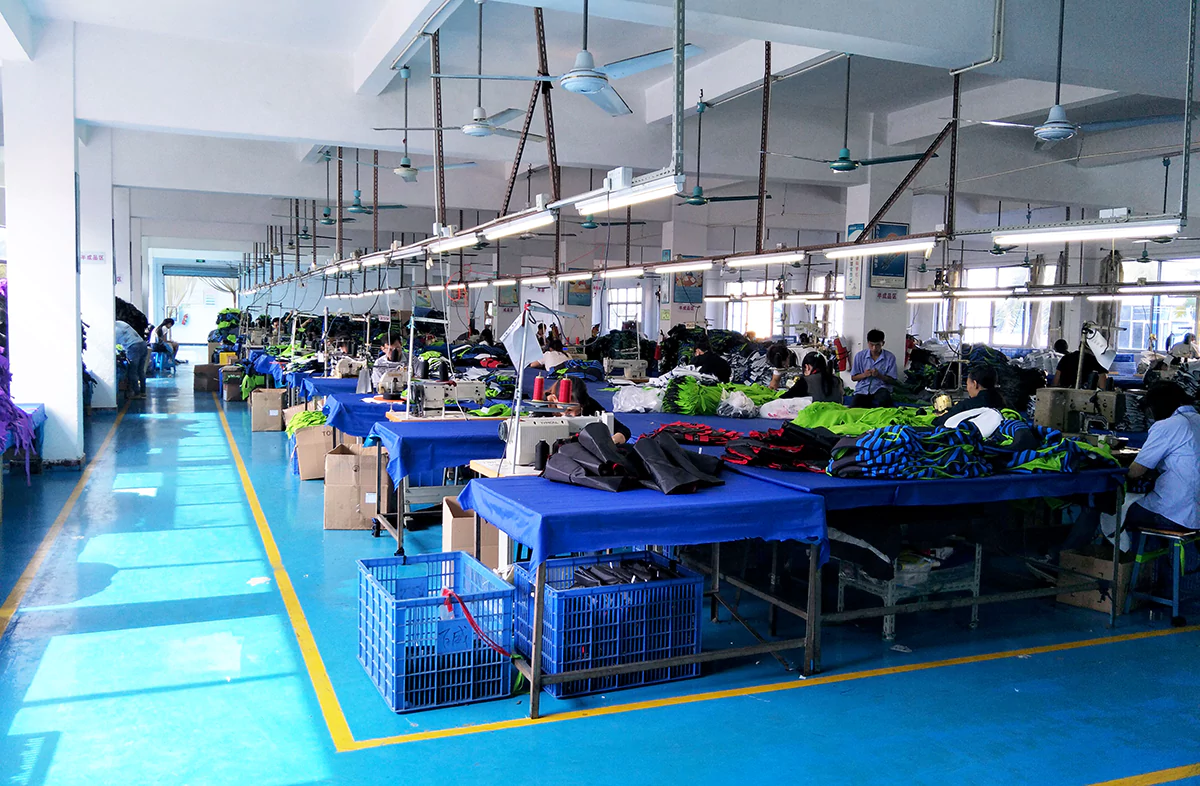
FYBagCustom is Your Trusted Custom Bag Manufacturer in China, with 15+ years of manufacturing experience and “Clear” as a confirmed design feature across our product categories. For buyers developing stadium-compliant clear bag programs, our capabilities include:
Our 50,000 m² factory in Guangzhou with 10+ production lines produces clear bag programs for event brands, sports licensing companies, Amazon FBA sellers, DTC fashion labels, promotional product distributors, and festival merchandise companies across international markets.
The clear bag market is unique in the accessories industry: regulation creates mandatory demand, and customization creates differentiation and margin within that demand. For B2B buyers developing clear bag programs in 2026, three core takeaways:
If your 2026 product line includes clear bags for stadiums, concerts, festivals, or campus events, now is the time to finalize trim colors, strap designs, and material specifications. Contact FYBagCustom to discuss TPU vs. PVC options, strap customization, and accessory programs — and receive physical samples and transparent quotations, typically within 48 hours.
FYBagCustom’s OEM and ODM team works with event brands, Amazon sellers, sports licensing companies, and DTC founders to produce custom clear bags with branded straps, team-color trim, premium TPU panels, and accessory programs — with low MOQ, 5–7 day sampling, and size-compliance verification.
Start Your Custom Bag Project →