Tel/WhatsAapp:+86 18011919834
E-mail: chloe.x@fybagcustom.com

Tel/WhatsAapp:+86 18011919834
E-mail: chloe.x@fybagcustom.com
Send Your Inquiry Today

Who this guide is for: brand owners, product developers, sourcing managers, DTC founders, and fashion designers who want to develop unstructured or minimally structured handbags — bags that feel weightless, drape against the body, and move with the wearer — without sacrificing the silhouette definition that makes a bag readable as a designed object rather than a fabric sack. If you are transitioning an existing structured design to a softer, deconstructed version, or developing a new collection in the “relaxed luxury” space using supple leather like lambskin or garment-grade calfskin, this guide documents the factory-level engineering process for systematically removing internal reinforcement while preserving silhouette integrity.
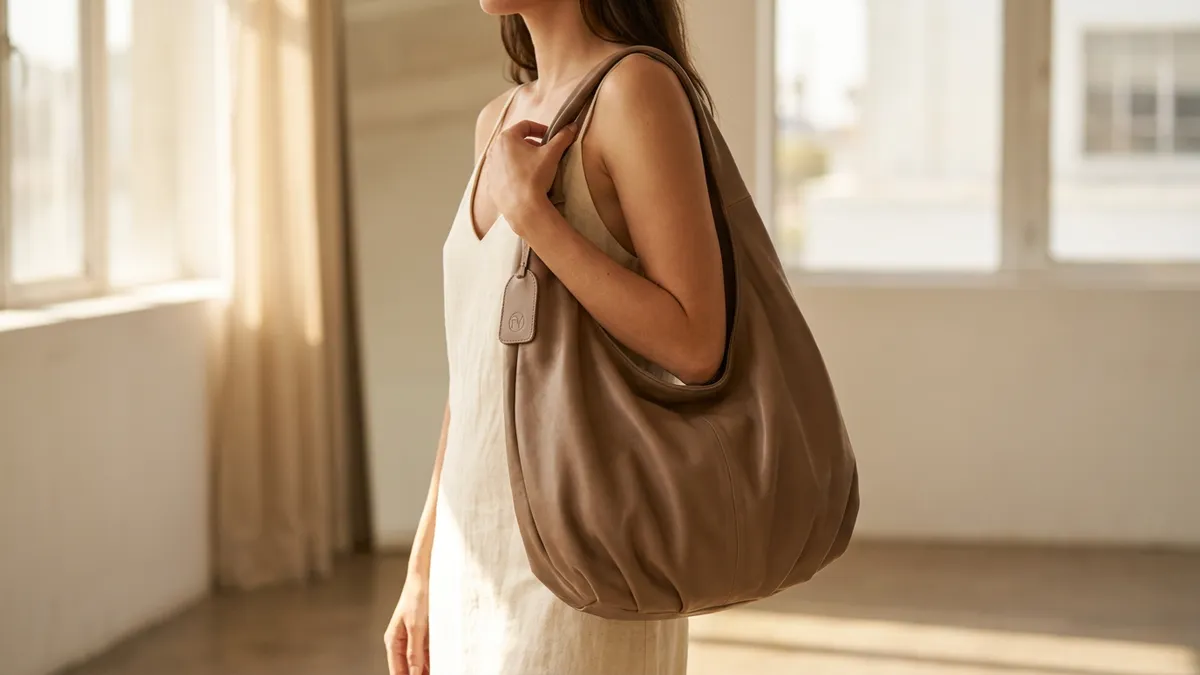
The most sophisticated bags in 2026 do not look engineered. They look inevitable — as if the leather simply fell into that shape on its own, guided by nothing but gravity and the body’s contour. There is no visible structure, no rigid edges, no cardboard stiffness. The bag folds when set down, drapes when carried, and conforms to the hip like a garment rather than an accessory.
This effect — which the industry calls “zero-weight” construction or deconstructed design — is paradoxically one of the most engineered outcomes in handbag manufacturing. Removing internal stiffening does not mean removing engineering. It means replacing mechanical structure (interlining, boards, wire) with material-based structure (leather weight, grain orientation, seam architecture, and gravity). The stiffening panels are gone, but the design intelligence that kept the bag readable as a silhouette must be preserved through other means — or the bag collapses into an amorphous lump that no consumer will carry.
This guide documents the systematic deconstruction process: how to evaluate which internal elements can be removed, which must be retained, and which must be replaced with softer alternatives. It covers the graduated removal methodology, the gravity-based pattern layout technique that uses the leather’s own weight to maintain shape, the seam architecture that provides structure without rigidity, and the QC protocols that verify the result. It is the manufacturing playbook for the most demanding silhouette trend of 2026.
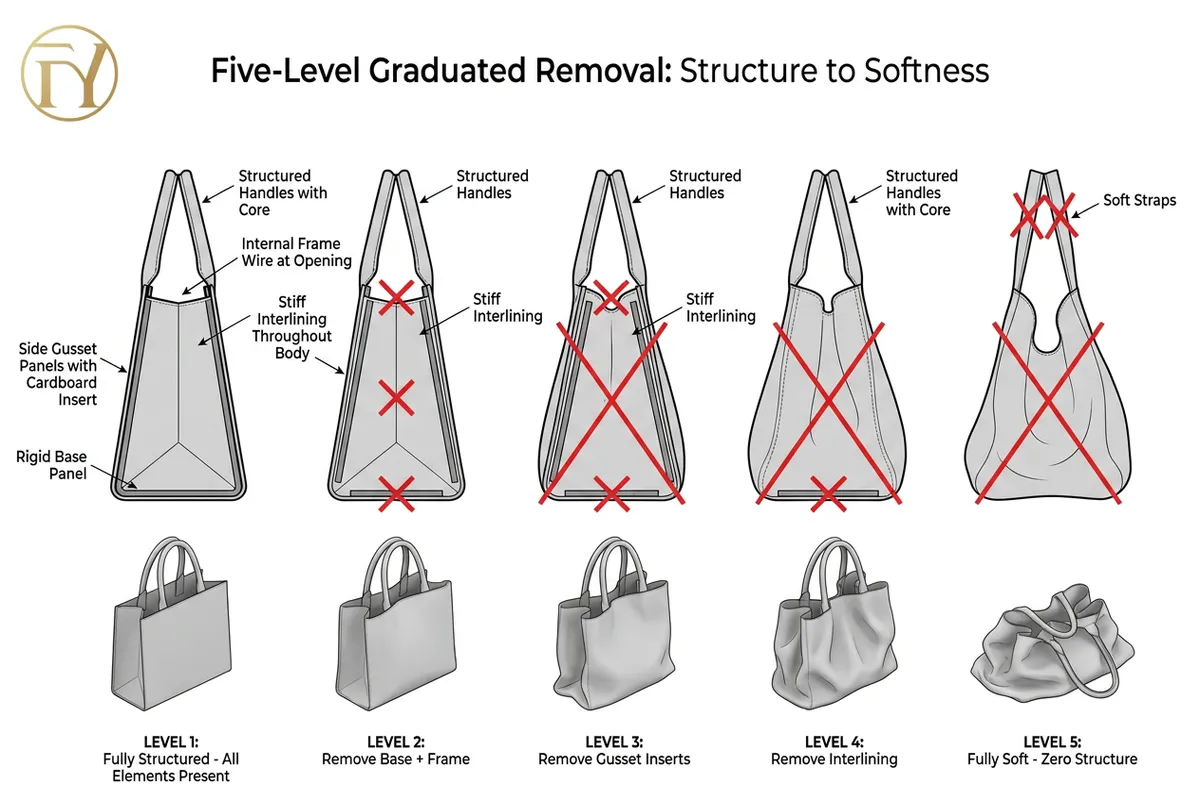
Bag construction exists on a spectrum from fully structured (every panel reinforced, rigid base, frame wire) to fully deconstructed (no reinforcement of any kind, the material alone defines the form). Most “relaxed luxury” bags in 2026 sit somewhere in the middle — not fully rigid, not fully limp, but in a controlled softness that the industry calls “soft structured” or “minimally reinforced.”
| Level | Internal Reinforcement | Feel | Silhouette When Empty | Silhouette When Loaded | Best For |
|---|---|---|---|---|---|
| Level 1: Fully structured | Microfiber backing on all panels + Salpa base board + edge wire | Firm, defined, architectural | Stands upright; holds its exact designed shape | Shape unchanged — the bag resists the contents’ weight | Doctor bags, box bags, structured totes |
| Level 2: Semi-structured | Microfiber backing on main panels only; Salpa base; no edge wire | Firm with slight give when pressed | Stands upright but panels have a gentle “settled” look | Slight rounding at the sides; top edge relaxes | Most commercial totes, work bags |
| Level 3: Soft structured | Lightweight fusible on main panels; thin base board; no gusset reinforcement | Noticeably soft but with detectable body | Stands upright but sides bow slightly outward | Visible settling; organic rounding; still reads as a defined shape | The “relaxed luxury” sweet spot — where most 2026 deconstructed bags live |
| Level 4: Minimally reinforced | No panel reinforcement; thin flexible base insert only; micro-zone stiffening at zippers and strap points | Soft — yields easily to pressure; the leather’s own weight provides all body | Stands with gentle leaning; or sits as a soft mound | Drapes and conforms to contents; shape is organic, not geometric | Soft shoulder bags, relaxed crossbodies |
| Level 5: Zero-weight (fully deconstructed) | No reinforcement anywhere — no interlining, no base, no stiffening of any kind | The bag feels like a leather garment — completely fluid | Does not stand; lies flat or puddles like fabric | Fully conforms to contents and body; shape is defined entirely by gravity and the body’s contour | Hobos, pouches, drawstring bags, draped clutches |
The overwhelming majority of “deconstructed” bags in the 2026 luxury and premium market sit at Level 3 (soft structured) or Level 4 (minimally reinforced). Level 5 (true zero-weight) is reserved for a narrow aesthetic niche. The commercial sweet spot is Level 3 — soft enough to feel luxurious and relaxed, structured enough to hold a recognizable silhouette when carried.
This guide focuses primarily on the engineering process for Levels 3 and 4 — the levels where the most commercial value exists and where the manufacturing challenges are greatest. Level 1 and 2 are covered in our reinforcement materials guide. Level 5 is covered in our slouchy hobo guide. Levels 3 and 4 are the middle ground that requires the most nuanced engineering.
The engineering error most commonly made by designers and buyers new to deconstructed bags is removing all reinforcement simultaneously — going from Level 1 directly to Level 5. The result is a bag that loses its identity: the silhouette disappears, the panels puddle, and the product looks like a random piece of leather rather than a designed object.
The correct approach is graduated removal — eliminating reinforcement elements one at a time, in a specific order, testing the structural effect of each removal before proceeding to the next. This systematic process ensures you find the exact level of deconstruction that achieves the desired softness while preserving the minimum structure needed for silhouette integrity.
| Removal Order | Element Removed | Structural Effect | Risk if Removed Prematurely | How to Test the Effect |
|---|---|---|---|---|
| 1st (remove first) | Edge wire / piping cord from the top opening | The top edge relaxes from a rigid oval to a soft curve — the bag’s mouth opens and closes organically | Minimal risk — edge wire is the least critical structural element in most designs | Make a sample with and without edge wire; compare the top-opening shape |
| 2nd | Gusset reinforcement (microfiber or fusible on the side panels) | The gussets soften, allowing the sides to bow outward and the bag to “breathe” — the silhouette becomes organic | Moderate risk — without gusset structure, the bag widens under load and the front/back panels lose lateral support | Load the sample with typical contents; check if the widening is controlled (organic settling) or excessive (shapeless bulging) |
| 3rd | Flap reinforcement (if the bag has a flap closure) | The flap drapes over the closure rather than projecting outward — a softer, more fluid look | Low–Moderate risk — the flap’s only job is to cover the opening; draping is acceptable for most deconstructed designs | Open and close the flap 20 times; verify it still covers the closure cleanly when draped |
| 4th | Front and back panel reinforcement (microfiber or fusible on the main body panels) | The panels yield to the hand and to the body’s contour — the bag “hugs” rather than “boxes” | High risk — without panel reinforcement, the silhouette depends entirely on the leather’s own body; wrong leather = shapeless collapse | The “gravity test” (see below) — hang the bag empty from its strap; the panels should fall into a recognizable shape, not a formless lump |
| 5th (remove last) | Base board / base reinforcement | The base softens, allowing the bag to sit as a soft mound rather than standing on a flat platform — the most extreme deconstruction | Highest risk — without a base, the bag cannot stand upright; contents press downward creating a sagging bottom | Only remove the base if the design intent explicitly does NOT require the bag to stand upright (hobos, pouches, draped styles) |
| Element | Why It Must Be Retained | What Happens Without It |
|---|---|---|
| Strap attachment reinforcement (webbing + localized stiffener) | The strap attachment points bear the full concentrated weight of the bag’s contents through two small areas of soft leather | The leather tears at the attachment points within weeks of daily use — a catastrophic structural failure |
| Zipper area stiffener (2 cm strip along the zipper tape) | Without stiffening, the zipper puckers the surrounding soft leather, creating visible waves and functional difficulty | The zipper becomes hard to operate; the puckered leather looks defective |
| Magnetic snap backing (3 × 3 cm localized patch) | The snap’s metal disc needs a stable substrate to engage cleanly; bare leather distorts under the snap’s pull | The snap closure does not engage reliably; the leather deforms around the snap creating a visible dimple |
These three elements are structural safeties — they must be present at every deconstruction level, including Level 5 (zero-weight). They are invisible, they add negligible weight, and they prevent the three most common failure modes of deconstructed bags.
When internal stiffening is removed, the leather must provide all of the bag’s body. The way the leather is oriented on the pattern — specifically, which direction the grain runs relative to the bag’s gravitational hang — determines whether the resulting bag drapes gracefully or sags inelegantly.
This technique is called gravity-based pattern layout — and it is the single most important engineering skill in deconstructed bag manufacturing.
Every piece of leather has a grain direction — the orientation of the collagen fiber bundles within the hide. Leather is stiffer along the grain (the fibers resist bending in this direction) and more flexible across the grain (the fibers spread apart more easily). This anisotropy — the property of having different characteristics in different directions — is the key to controlling drape.
| Grain Orientation on the Panel | Effect on the Panel’s Behavior | When to Use |
|---|---|---|
| Grain running vertically (top to bottom) | The panel is stiffer vertically, more flexible horizontally — it resists sagging downward but allows the sides to bow gently | Default for deconstructed bags — vertical grain uses the leather’s natural stiffness to fight gravity, maintaining the panel’s height while allowing organic side movement |
| Grain running horizontally (side to side) | The panel is stiffer horizontally, more flexible vertically — it resists widening but allows the panel to droop from the top | Rarely desired — creates excessive vertical droop (sagging) while the panel stays unnaturally rigid side-to-side |
| Grain running diagonally (45°) | The panel has moderate flexibility in all directions — it behaves more uniformly, with no axis of resistance | Specialized use — creates the most “fluid” drape with equal movement in all directions; suitable for Level 5 designs that want maximum liquidity |
For Level 3 and Level 4 deconstructed bags, specify vertical grain orientation on all body panels (front, back, gussets). This single specification — which costs nothing and requires no additional materials — provides free structural support: the leather’s own grain resists the downward pull of gravity, preventing the sagging that makes deconstructed bags look “cheap and floppy” rather than “luxuriously relaxed.”
The cutting floor must enforce this: every panel must be cut with the grain running in the same vertical direction. Mixing grain orientations between panels (front panel vertical, back panel horizontal) creates visible asymmetry — one side of the bag drapes differently from the other.
A leather hide is not uniform. Different zones of the hide have different thickness, flexibility, and grain tightness:
| Hide Zone | Location on the Animal | Characteristics | Suitability for Deconstructed Bags |
|---|---|---|---|
| Backbone / butt | Center of the hide, along the spine | Tightest grain, firmest, most consistent thickness | Too stiff for deconstructed body panels; best for handles, straps, and trim on soft bags |
| Shoulder | Upper area, around the neck/shoulder | Moderate grain tightness; good flexibility; some natural stretch | Good for body panels — moderate body with natural give |
| Belly / flank | Lower sides of the hide | Loosest grain; thinnest; most flexible; most stretch | Excellent for maximum drape but risk of over-softness; best for Level 4–5 designs; requires careful cutting to avoid thin spots |
| Side | Between the backbone and belly | Balanced — moderate grain, moderate flexibility | The best all-around zone for Level 3 deconstructed bags — balanced body with controlled drape |
Specification for deconstructed bags: “Cut all body panels from the side zone of the hide, with vertical grain orientation. Do not use belly or backbone for body panels. Backbone may be used for handles and strap.” This specification ensures consistent drape across all panels and avoids the extremes (too stiff from backbone, too floppy from belly).
When internal reinforcement is removed, the seams themselves become structural elements. Every seam adds a thin ridge of rigidity where two layers of leather overlap and are stitched together. In a fully reinforced bag, these seam ridges are imperceptible because the interlining dominates the structural behavior. In a deconstructed bag, seam ridges become the primary internal architecture — and their placement, type, and execution directly affect the silhouette.
| Seam Type | Structural Effect | Use in Deconstructed Bags |
|---|---|---|
| Vertical seams (running top to bottom) | Create vertical ridges that resist horizontal collapse — the bag maintains its width at the seam lines | Essential — vertical seams at the gusset-to-panel junctions define the bag’s width and prevent the sides from collapsing inward |
| Horizontal seams (running side to side) | Create horizontal ridges that resist vertical sagging — the panel stays taut at the seam line | Use strategically — a horizontal seam across the middle of a large panel breaks the panel’s droop, acting like an invisible shelf |
| Topstitching (additional stitch line parallel to a seam, 3–5 mm from the seam edge) | Doubles the rigidity of the seam ridge by adding a second stitch line | Powerful in deconstructed bags — topstitching on vertical seams adds structure exactly where needed without adding interlining |
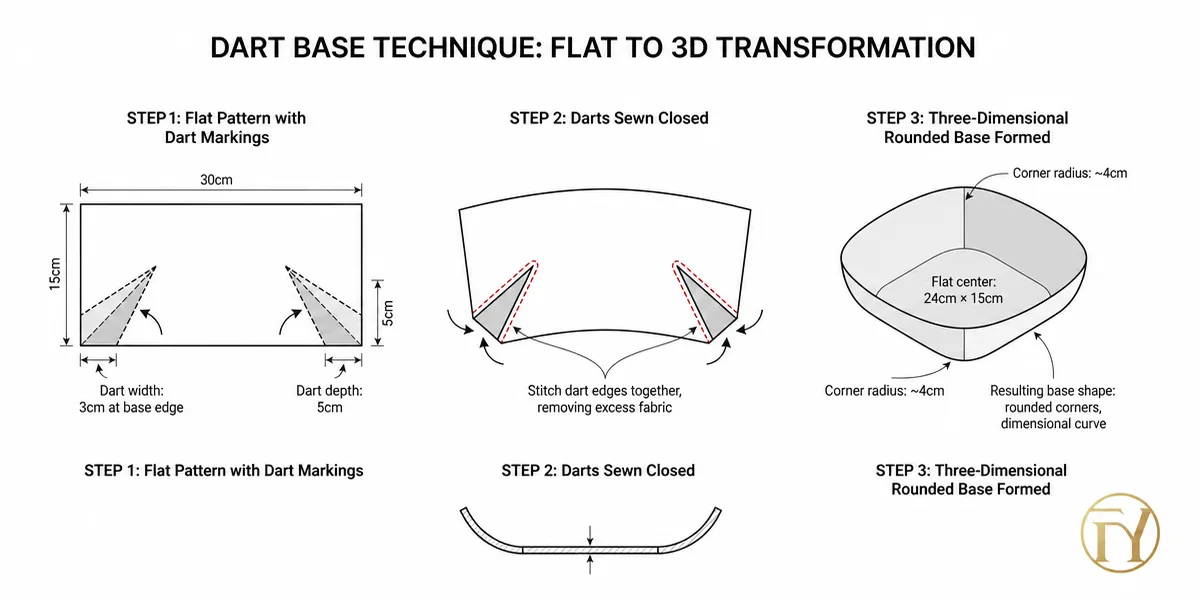
| Dart seams (small triangular seams that pinch material to create 3D shaping) | Create controlled curves in flat panels — the leather is “sculpted” into a three-dimensional form | The most advanced technique for deconstructed bags — darts at the base corners create a rounded bottom without a base board |
The base board (Salpa or HDPE) is the last reinforcement element removed in the graduated sequence because without it, the bag cannot stand upright. The dart base technique provides an alternative: instead of a rigid board, the base of the bag is shaped by two or four darts at the bottom corners that pinch the leather inward, creating a rounded or squared base from the material itself.
| Technique | How It Works | Structural Effect | Base Shape | Bag Standing Ability |
|---|---|---|---|---|
| No base board, no darts | The front and back panels simply meet at the bottom seam | The base is a flat seam — the bag sits as a flat pouch or puddles | Flat line (no defined base) | Cannot stand — lies flat or tilts |
| Two-dart base | Two darts at the bottom-front and bottom-back corners; each dart pinches 3–5 cm of material inward | The darts pull the bottom outward, creating a shallow, rounded base without rigidity | Soft oval — defined but not rigid | Sits upright with a gentle lean; does not stand rigidly |
| Four-dart base | Four darts — one at each bottom corner | More defined base; the darts create a roughly rectangular base footprint | Soft rectangle — defined, self-supporting | Stands upright with a soft, settled posture — the Level 3 sweet spot |
| Dart base + flexible insert | Four darts + a thin, flexible insert (0.5 mm microfiber or thin EVA, not rigid Salpa) | The insert adds just enough body to prevent the base from collapsing under load, while the darts define the shape | Defined rectangle with soft edges | Stands upright reliably; the base supports the contents’ weight without rigidity |
The four-dart base + flexible insert is the recommended technique for Level 3 deconstructed bags. It provides enough base definition for the bag to sit upright on a table, a shelf, or a restaurant floor — without the rigid, cardboard-like base that contradicts the deconstructed aesthetic.
In a reinforced bag, the leather is a surface — its structural contribution is secondary to the interlining. In a deconstructed bag, the leather IS the structure. Selecting the wrong leather for a deconstructed design is like selecting the wrong steel for a bridge — the structure fails because the material cannot support it.
| Leather Type | Thickness (recommended for deconstructed) | Weight | Flexibility | Body (self-support) | Recovery | Aging Behavior | Relative Cost | Best Deconstruction Level |
|---|---|---|---|---|---|---|---|---|
| Lambskin / sheepskin | 0.5–0.7 mm | Lightest | Extremely high — the softest common leather | Very low — cannot support its own weight over large panels | Moderate — thin leather has limited structural memory | Softens further; can stretch permanently at stress points; develops a “well-loved” character | High | Level 4–5 only — too soft for Level 3 without additional engineering |
| Garment-grade calfskin | 0.7–0.9 mm | Light | Very high — soft but with detectable body | Low–Moderate — enough body to maintain a gentle shape | Good — calfskin’s tighter grain provides better rebound than lambskin | Develops beautiful patina; softens slightly; retains structural integrity | High | Level 3–4 — the ideal material for the “relaxed luxury” sweet spot |
| Soft-tanned cowhide | 0.8–1.0 mm | Light–Medium | High — softer than standard cowhide but firmer than calfskin | Moderate — can support itself over medium-sized panels | Good — firmer fiber structure provides reliable shape memory | Ages well; develops patina; moderate softening over years | Moderate–High | Level 2–3 — for brands that want “soft” but not “fluid” |
| Suede (split calfskin) | 0.7–1.0 mm | Light | High — the napped surface has inherent flexibility | Low–Moderate — similar to calfskin but the split has less structural integrity than full-grain | Moderate — holds fold impressions slightly longer than full-grain | Nap direction changes develop character; wear marks appear at flex points | Moderate | Level 3–5 — suede’s matte aesthetic suits deconstructed design |
| Nubuck (top-grain, buffed) | 0.8–1.0 mm | Light–Medium | High — similar flexibility to suede but on the grain side | Moderate — slightly more structured than suede | Good — the grain layer provides better recovery than split | Similar to suede with slightly better structural longevity | Moderate–High | Level 3–4 — a refined alternative to suede |
| Soft garment-grade PU | 0.7–0.9 mm | Light | High — formulated for drape | Low–Moderate — PU backing provides some body | Good — synthetic backing recovers well | Does not develop patina; maintains original appearance for 2–4 years, then may peel | Low–Moderate | Level 3–4 — the accessible alternative for brands targeting mid-market |
Lambskin is the most luxurious — and the most challenging — leather for deconstructed bags. Its extreme softness (the quality that makes it desirable) is also its structural weakness: lambskin has almost no self-supporting body. A lambskin panel larger than approximately 25 × 25 cm will droop under its own weight, creating an uncontrolled sag rather than a controlled drape.
Engineering solutions for lambskin deconstructed bags:
| Challenge | Solution | Specification |
|---|---|---|
| Excessive droop on large panels | Reduce panel size by adding seams — divide a large front panel into two or three smaller sub-panels joined by vertical seams | Each sub-panel should be no wider than 20–25 cm; the vertical seams provide structural ridges that arrest the droop |
| Stretching at strap attachment | Reinforce the attachment zone with hidden webbing (never removed, per the “never remove” rule) | 25 mm cotton webbing, 8 × 8 cm patch, sandwiched between lambskin and lining at each attachment point |
| Loss of shape over time (permanent stretch) | Accept and design for it — lambskin bags evolve with use; communicate this to the consumer as a feature | Product page language: “This bag develops a unique, personal shape with use — your bag becomes more yours over time” |
| Thin spots and inconsistencies in the hide | Grade the hides carefully — reject any lambskin with visible thin patches, holes, or scarring that would create weak points | Specify “Grade A lambskin, minimum 0.5 mm thickness across the entire usable area; reject hides with belly-zone thinning below 0.4 mm” |
For most brands entering the deconstructed space for the first time, garment-grade calfskin at 0.7–0.9 mm is the recommended starting material — it provides enough body for Level 3 construction (the commercial sweet spot) while delivering the soft, luxurious hand-feel that defines the category. Lambskin is the advanced material — reserve it for Level 4–5 designs where the brand and the consumer understand and embrace the material’s evolving nature.
The “zero-weight” descriptor is aspirational rather than literal — no bag weighs zero grams. But the weight difference between a fully structured and a fully deconstructed bag of the same size is dramatic:
| Level | Exterior Material | Reinforcement | Lining | Hardware | Approximate Empty Weight |
|---|---|---|---|---|---|
| Level 1 (fully structured) | Calfskin 1.0 mm | Microfiber 0.7 mm + Salpa base 1.5 mm + edge wire | Full nylon twill | Standard set (zipper, snap, D-rings, feet) | 550–750 g |
| Level 3 (soft structured) | Calfskin 0.8 mm | Lightweight fusible 0.3 mm on panels + thin base insert 0.5 mm | Lightweight habotai | Minimal set (zipper, snap, 1 D-ring) | 300–400 g |
| Level 5 (zero-weight) | Lambskin 0.6 mm | None (webbing at strap only) | None or cotton jersey | Minimal (magnetic snap only) | 150–250 g |
The Level 5 bag weighs 50–65% less than the Level 1 bag — a difference the consumer feels immediately when she picks it up. At 150–250 g, a zero-weight lambskin bag weighs less than a smartphone — a tactile experience so unexpected that it generates the “how can a bag be this light?” reaction that drives word-of-mouth and social media sharing.
For brands targeting a specific weight range, allocate the weight budget across components:
| Component | % of Total Weight (Level 3) | % of Total Weight (Level 5) | Weight Reduction Levers |
|---|---|---|---|
| Exterior material | 45–55% | 55–65% | Thinner leather (0.7 mm vs. 1.0 mm); lighter material type (lambskin vs. cowhide) |
| Reinforcement | 15–25% | 0–5% | Graduated removal; thinner fusible; eliminate all panel reinforcement |
| Lining | 10–15% | 0–10% | Lighter lining fabric (habotai at 30–40 g/m²); partial lining; or no lining |
| Hardware | 10–20% | 10–25% (a larger proportion because there’s less of everything else) | Fewer hardware pieces; lighter hardware (nylon coil zippers instead of metal); eliminate base feet |
| Thread + seam allowances | 5–10% | 10–15% | Unavoidable — this is the fixed minimum |
Standard QC tests (standing test, load test, squeeze test) are designed for structured bags. Deconstructed bags need a different test — one that evaluates whether the bag’s gravity-dependent silhouette is correct.
| Criterion | What to Look For | Pass | Fail |
|---|---|---|---|
| Symmetry | Left and right sides of the bag mirror each other | Symmetrical within ±1 cm at every horizontal level | One side hangs lower, wider, or differently from the other |
| Crescent curve (if hobo/crescent design) | The bottom edge forms a smooth, continuous curve | Smooth curve with no flat spots, kinks, or abrupt angle changes | Flat sections, angular breaks, or asymmetric curve |
| Panel surface | The leather surface falls smoothly without wrinkling, bunching, or puckering | Smooth, continuous surface — no wrinkles except at natural drape lines | Visible wrinkles, pucker points, or material bunching that does not match the PP sample |
| Strap integration | The strap meets the bag body cleanly; no distortion at the attachment points | Clean transition from strap to body; no pulling, puckering, or stress marks at attachment | Visible stress marks, pulling, or deformation at attachment points |
| Overall silhouette | The bag reads as a recognizable, intentional shape — not a random leather form | A buyer 2 meters away can identify “this is a [hobo / shoulder bag / tote]” | The shape is ambiguous — it could be anything; the design intent is lost |
After the gravity test (empty), perform the carry test (loaded):
Rather than choosing between structured and deconstructed, the strongest commercial approach for 2026 is offering the same silhouette in both versions — giving the consumer the choice between the structured iteration (for professional settings, meetings, presentations) and the deconstructed iteration (for weekends, travel, casual days).
| Element | Structured Version | Deconstructed Version | What Stays the Same |
|---|---|---|---|
| Reinforcement | Microfiber 0.7 mm on panels + Salpa base | Lightweight fusible 0.3 mm on panels + flexible base insert (or dart base) | — |
| Leather | Calfskin 0.9–1.0 mm | Calfskin 0.7–0.8 mm (or lambskin 0.6 mm for maximum softness) | Same color, same finish |
| Hardware | Full set (zipper, closure, D-rings, base feet, strap hardware) | Minimal set (zipper or magnetic snap, strap hardware only, no base feet) | Same finish on shared hardware |
| Lining | Full nylon twill with organized pockets | Lightweight habotai with 1–2 flat pockets only | Same lining color |
| Silhouette | Architectural, defined, holds shape when empty | Organic, fluid, drapes when empty, conforms when carried | Same overall proportions (width, height) — recognizable as the same design |
| Empty weight | 450–650 g | 200–350 g | — |
| Retail position | “The Structured [Name]” | “The Soft [Name]” | Same brand, same collection, same naming convention |
This model doubles the SKU count but captures two distinct consumer preferences within one design — the woman who wants structure for Monday and softness for Saturday buys both and becomes a double-value customer.
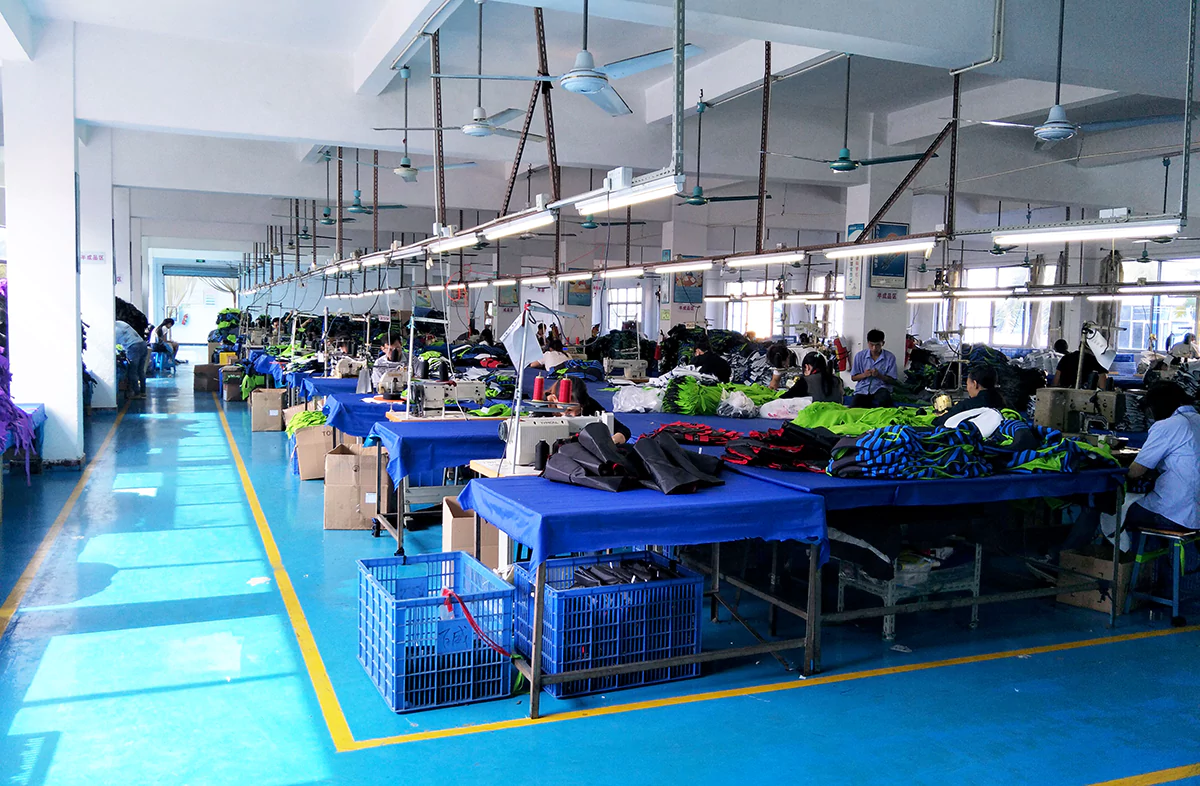
FYBagCustom is Your Trusted Custom Handbag Manufacturer in China, with 15+ years of manufacturing experience across the full deconstruction spectrum — from fully structured to zero-weight. For brands developing deconstructed, soft-structured, or minimally reinforced bags, our capabilities include:
Explore our custom bag collection or contact our engineering team to discuss your deconstructed bag project — from material selection through gravity-tested samples.
The deconstructed bag is the paradox of luxury manufacturing: the bag that looks least engineered is the one that demands the most engineering intelligence. Removing interlining is easy; replacing its function with material selection, grain orientation, seam architecture, and dart shaping is the skill that separates a luxuriously soft bag from a limp one. For B2B buyers developing deconstructed bags in 2026, three core takeaways:
If your 2026 collection explores deconstructed, soft-structured, or minimally reinforced handbags, now is the time to select your leather, define your target deconstruction level, and engineer the graduated removal plan. Contact FYBagCustom to discuss material options, gravity-based pattern layout, and dart base engineering — and receive gravity-tested samples, typically within 7–12 days.
FYBagCustom’s development team engineers deconstructed bags across the full softness spectrum — from soft-structured to zero-weight — using gravity-based pattern layout, graduated reinforcement removal, dart base construction, and soft leather sourcing. Gravity-tested samples in 7–12 days.
Start Your Custom Bag Project →