Tel/WhatsAapp:+86 18011919834
E-mail: chloe.x@fybagcustom.com

Tel/WhatsAapp:+86 18011919834
E-mail: chloe.x@fybagcustom.com
Send Your Inquiry Today

Who this guide is for: brand founders, product developers, sourcing managers, freelance designers, DTC entrepreneurs, and anyone who has a handbag design and needs to understand exactly what happens inside a factory between the moment you send a sketch and the moment a finished prototype arrives at your door. If you want to know how pattern making works, what determines sample cost, how to reduce revision cycles, and what a realistic timeline looks like — with real numbers, not marketing estimates — this guide walks you through every stage of the prototyping process from the manufacturer’s side of the table.
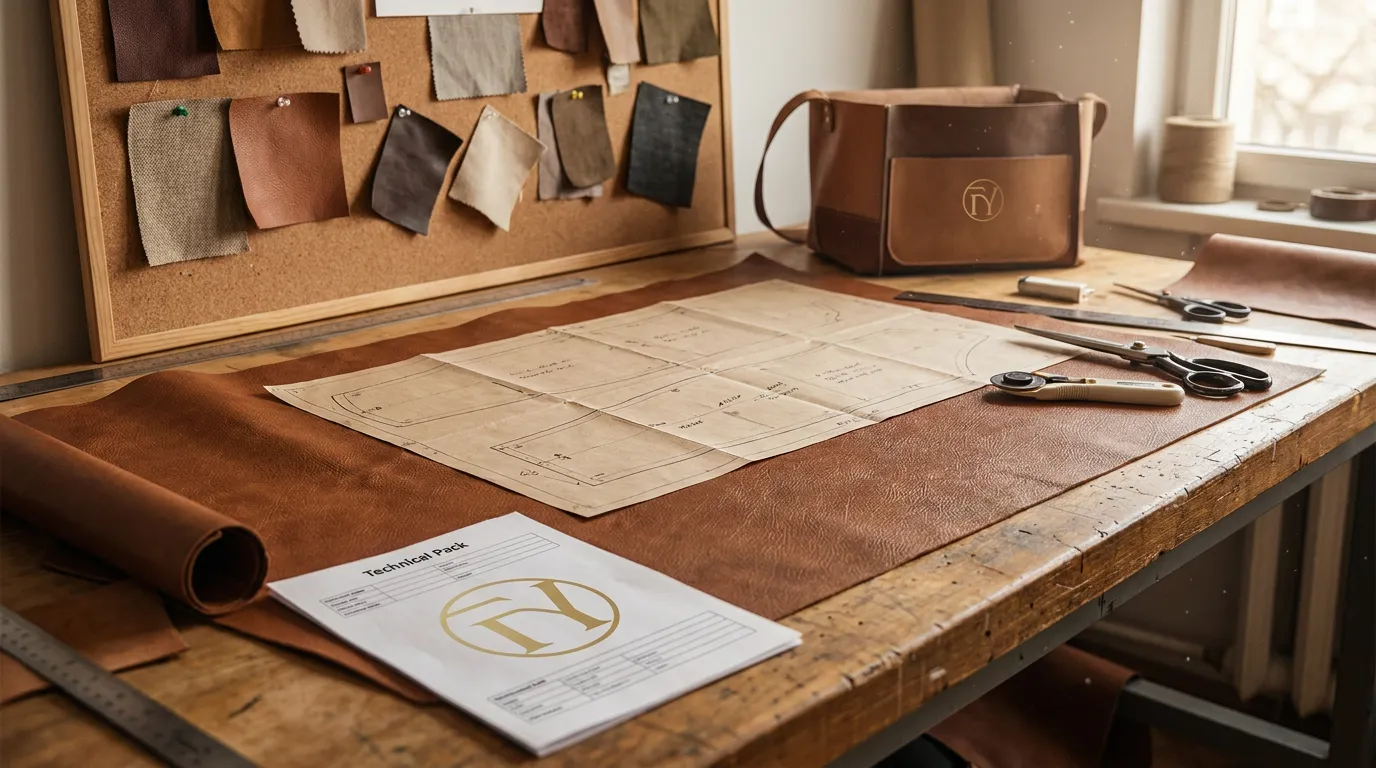
The prototype is the most important object in the entire handbag development process. It is more important than the tech pack (which is an instruction, not a product). It is more important than the bulk production order (which is a replication of the prototype). The prototype is the first physical translation of an idea into a three-dimensional object that can be held, opened, carried, photographed, and judged. If the prototype is right, everything that follows is replication. If the prototype is wrong, everything that follows amplifies the error.
Yet for most brand founders and designers, the prototyping process is a black box. You send a sketch and some material preferences. Weeks pass. A box arrives. Inside is either a bag that matches your vision or a bag that does not — and you are not entirely sure why either outcome occurred, or what you could have done differently to influence the result.
This guide opens the black box. It documents the seven stages of factory prototyping in the order they actually happen, explains what determines the cost of each stage, identifies the five most common reasons prototypes fail (and how to prevent each one), and provides the cost calculation formulas that factories use internally — so you can estimate your sampling investment before contacting a single manufacturer.
Every handbag prototype passes through seven sequential stages. Understanding the sequence — and what can go wrong at each stage — gives you the ability to provide the right inputs at the right moment and catch problems before they become expensive.
| Stage | What Happens | Duration | Your Role | Factory’s Role |
|---|---|---|---|---|
| 1. Brief interpretation | Factory reviews your tech pack, sketches, or reference images and confirms feasibility | 1–2 days | Provide the clearest possible brief | Ask clarifying questions; identify potential issues |
| 2. Pattern development | A pattern maker creates the flat paper or digital patterns for every panel of the bag | 1–3 days | Review pattern drawings if provided; confirm dimensions | Draft, adjust, and finalize the cutting patterns |
| 3. Material preparation | Factory selects, cuts, and prepares the materials specified for the prototype | 1–2 days | Confirm material choices; approve swatches if not pre-approved | Source, cut, prepare materials; apply interlining or treatment |
| 4. Construction | Sewing team assembles the prototype following the pattern and tech pack | 2–4 days | Wait (no input needed during construction) | Cut, sew, install hardware, attach lining, finish edges |
| 5. Finishing and QC | Factory inspects the finished prototype against the tech pack; applies branding | 1 day | Wait | Internal QC, branding application, photography |
| 6. Shipping | Prototype is packed and shipped to you | 3–7 days (express international) | Provide shipping address; choose carrier | Pack, label, ship, provide tracking |
| 7. Review and feedback | You evaluate the prototype and provide revision notes | 1–5 days (your time) | Inspect thoroughly; provide detailed written + photo feedback | Wait for your feedback; prepare for revision if needed |
| Total | 10–24 days (production + shipping; excluding your review time) |
The factory’s first action upon receiving your design is not to start cutting material — it is to interpret your brief. A pattern maker, a production manager, and sometimes a designer review your tech pack, sketches, and reference images to understand what you want and identify anything that is unclear, contradictory, or physically impossible.
| Evaluation Point | What They Look For | Common Problem | How to Prevent It |
|---|---|---|---|
| Dimensional feasibility | Can the specified dimensions physically work with the specified features? | “A 25 cm wide bag with a 14″ laptop compartment” — the laptop is wider than the bag | Measure your own items; verify that your specified dimensions fit everything you claim they will |
| Material-to-construction compatibility | Can the specified material be sewn, folded, and finished in the way the design requires? | “Debossed logo on ripstop nylon” — nylon does not hold debossing; PU or leather is needed | Ask the factory which materials work for your desired techniques before finalizing |
| Hardware availability | Are the specified hardware pieces available, or do they require custom tooling? | “Logo-engraved magnetic snap in antique brass” — this requires a custom die that adds 2 weeks and 200 | Specify standard hardware for prototypes; custom hardware for production |
| Construction sequence | Can the bag be assembled in the order the pattern implies? | A lining pocket that must be sewn after the main body is closed — physically impossible without ripping a seam | Trust the factory’s construction expertise; they may resequence your design for producibility |
| Cost alignment | Does the design match the budget the client has indicated? | Client expects $15 FOB but specifies genuine leather + custom hardware + 6 compartments | Be honest about your budget range upfront; the factory can suggest alternatives that hit your price target |
| Document | Minimum Viable | Ideal |
|---|---|---|
| Exterior sketch | Hand-drawn front + back view with basic dimensions | Digital drawing with front, back, side, top, and bottom views; all dimensions labeled in cm |
| Interior layout | Written description of pockets and compartments | Sketch of interior showing pocket positions, types (zip, slip, padded), and sizes |
| Material specification | “Pebbled PU leather, similar to [reference photo]” | Pantone color reference + material type + texture name + physical swatch if available |
| Hardware specification | “Gold zippers, magnetic snap closure” | Specific hardware type, size, finish, and function for every piece (main zip, pocket zip, closure, D-rings, feet) |
| Logo and branding | Logo file (any format) + “debossed on front” | Vector logo file (.AI or .EPS) + exact placement coordinates + technique + size in mm |
| Reference images | 2–3 photos of existing bags showing elements you like | 5–10 annotated photos: “shape of Bag A, handles of Bag B, closure of Bag C, color of Bag D” |
The quality of your brief directly determines the quality of the first prototype. A vague brief produces a prototype that requires 2–3 revisions to get right. A detailed brief produces a prototype that requires 0–1 revisions. Each revision cycle costs 5–10 days and 100. Investing 2–3 hours in a thorough brief saves 300 and 2–4 weeks.
Pattern making is the stage where a three-dimensional bag design is translated into flat two-dimensional pieces that can be cut from material and sewn together to create the intended shape. It is the most skilled, most intellectually demanding step in the entire process — and the one most invisible to clients.
A pattern maker takes your sketch (a picture of the finished product) and reverse-engineers it into the set of flat pieces that, when cut and sewn, will produce that shape. This involves:
| Method | How It Works | Accuracy | Speed | Cost | Best For |
|---|---|---|---|---|---|
| Manual pattern drafting | Pattern maker draws on paper by hand using rulers, curves, and experience | Good — depends on maker’s skill | Moderate (1–3 days) | Lowest | Simple designs; factories with experienced craftspeople |
| CAD pattern drafting | Pattern maker uses software (Gerber, Optitex, Lectra, or similar) to create digital patterns | Very good — mathematical precision, easy to adjust | Fast (0.5–2 days) | Moderate | Complex designs; designs requiring precise symmetry |
| 3D digital prototyping | Designer creates a 3D model of the bag in software; the software generates flat patterns from the 3D shape | Very high — the pattern is derived directly from the intended 3D form | Fastest for the pattern (hours); but requires 3D modeling skill | Highest (software + skill) | Brands with digital design capability; complex or organic shapes |
3D digital prototyping (using tools like CLO3D, Browzwear, or Rhino) has become a significant topic in handbag development. It offers real advantages — but it does not replace physical prototyping. Here is an honest assessment:
| Capability | What 3D Prototyping Does Well | What It Does Not Do |
|---|---|---|
| Shape visualization | Renders the bag in 3D from any angle; helps client visualize before cutting material | Does not simulate the exact drape, weight, and hand-feel of physical materials |
| Color and material simulation | Shows how different materials and colors will look on the shape | Color accuracy depends on screen calibration; texture simulation is approximate |
| Pattern generation | Automatically generates flat patterns from the 3D model | Generated patterns often need manual adjustment for producibility |
| Proportion testing | Quickly test different dimension ratios before committing to physical material | Does not account for material thickness, stiffness, or real-world sewing behavior |
| Client communication | A rendered image is easier for a non-designer client to evaluate than a flat sketch | Client may approve a render that cannot be produced exactly as shown |
| Physical prototype replacement? | No — 3D prototyping is a pre-prototype visualization tool, not a replacement for a physical sample | You still need a physical prototype to evaluate construction, tactile quality, hardware function, and real-world usability |
The honest recommendation: use 3D prototyping if your factory or designer offers it as a pre-prototype step. It catches proportion errors, color mismatches, and layout issues before material is cut — saving one revision cycle (5–10 days and 100). But do not skip the physical prototype based on a 3D render that “looks right.” The render cannot tell you how the zipper feels, whether the handle is comfortable, or whether the bag holds its shape when loaded.
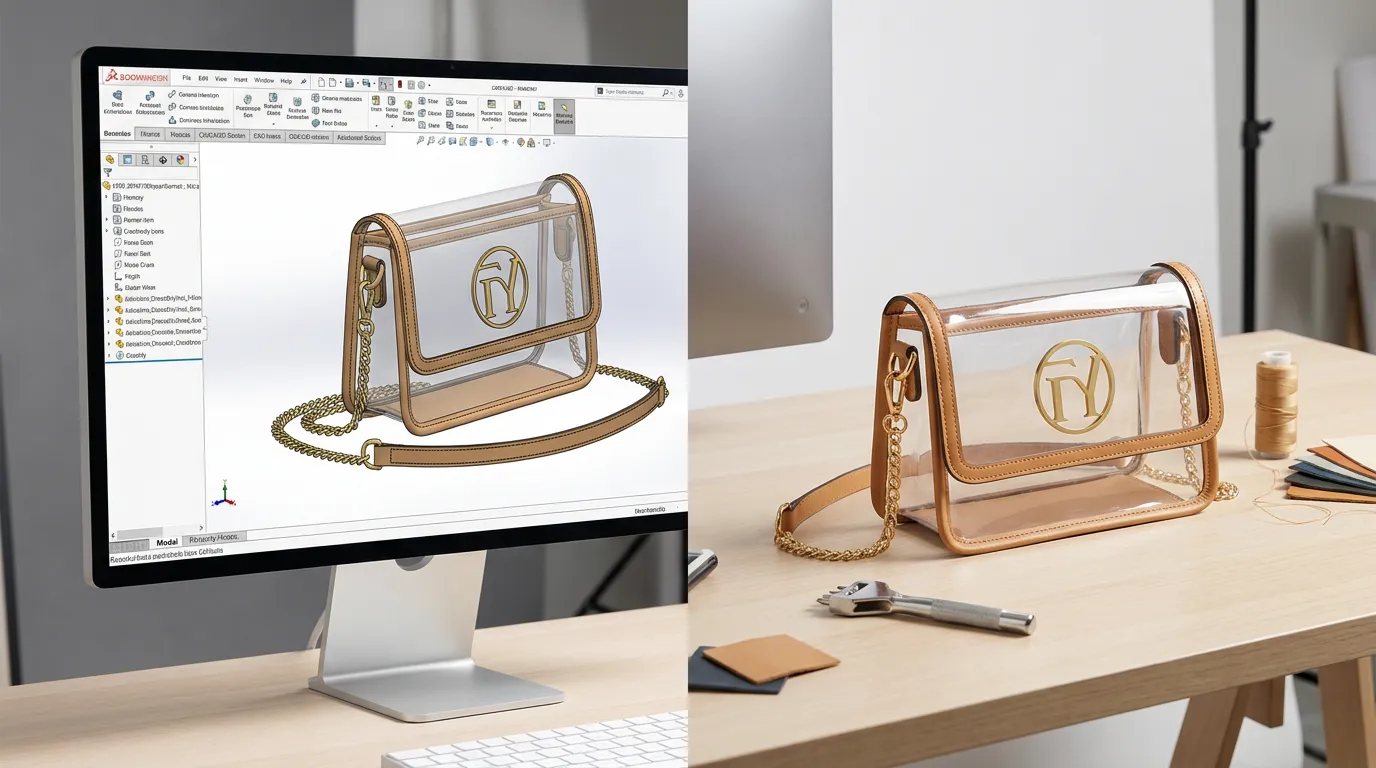
Once patterns are finalized, the factory prepares the materials: selecting the correct swatch from the approved reference, applying any required treatments (interlining, coating, pre-washing), and cutting the pattern pieces.
| Step | What Happens | Critical Detail |
|---|---|---|
| Material selection | Factory pulls the approved material from in-stock inventory or receives the custom-ordered material | Must match the approved swatch exactly — check under daylight and artificial light |
| Interlining application | For structured bags, a fusible interlining is ironed onto the back of body panels before cutting | Interlining weight and type affect the bag’s stiffness; specify “light,” “medium,” or “heavy” |
| Marking and cutting | Pattern pieces are laid onto the material and cut using manual shears or a die-cutting machine | Grain direction must be consistent across all visible panels — mismatched grain creates color variation |
| Edge preparation | Cut edges are either left raw (for internal seams) or pre-treated (painted, folded, or sealed) before sewing | For PU leather: edge painting or folding. For canvas: binding or serging. For nylon: heat-sealing |
| Hardware preparation | Zippers cut to length; snap components sorted; D-rings, feet, and rivets counted | All hardware should match the finish specified — mixing gold and “slightly different gold” from different batches is visible |
Every material has a grain — a directional quality created by the weave (fabric) or the embossing pattern (PU leather). When light hits the surface, grain direction affects the shade: panels cut in the same grain direction look identical; panels cut in different grain directions look like slightly different colors.
For prototypes — and for bulk production — all visible panels (front, back, flap, gussets) must be cut with the same grain direction. Specify this explicitly in your tech pack: “All exterior panels: same grain direction.” It is a standard practice at quality factories, but not universal — and omitting it leaves room for error.
This is the stage where flat pieces become a three-dimensional bag. A skilled sample sewer — often the factory’s most experienced craftsperson — assembles the prototype by hand and machine, following the pattern and tech pack.
| Step | Operation | Time (approx.) | Notes |
|---|---|---|---|
| 1 | Sew interior pockets to lining panels | 15–25 min | Pockets must be positioned before lining is assembled |
| 2 | Assemble lining body (front + back + gussets) | 15–20 min | Lining is a complete bag inside the bag |
| 3 | Attach interlining to exterior panels (if not already fused) | 10–15 min | Structural reinforcement layer |
| 4 | Sew exterior panels together (front + back + gussets + base) | 25–40 min | The bag takes shape; seam alignment is critical |
| 5 | Install zipper (main compartment) | 10–20 min | Zipper tape must align perfectly with the opening width |
| 6 | Attach hardware (D-rings, feet, magnetic snaps, turn-locks) | 15–25 min | Each piece is riveted or screw-posted through reinforced layers |
| 7 | Insert lining into exterior body | 10–15 min | Lining is turned and positioned inside the exterior shell |
| 8 | Attach top binding or turn-and-stitch the top edge | 15–20 min | This finishes the bag opening; clean binding or turned edge signals quality |
| 9 | Attach handles (riveted + stitched) | 10–15 min | Handles must be symmetrical and centered |
| 10 | Attach shoulder strap hardware (if applicable) | 5–10 min | Swivel hooks, strap adjusters |
| 11 | Apply branding (debossing, foil, label) | 5–15 min | Last step before final inspection |
| 12 | Final trim and clean | 10 min | Thread trimming, surface cleaning, sticker removal |
| Total construction time | 2.5–4 hours per prototype | Bulk production is faster due to assembly-line specialization |
A common client question: “If the prototype takes 3–4 hours, why does bulk production take 25–35 days for 200 bags?” The answer: in bulk production, each worker performs ONE operation repeatedly (one person sews pockets, another attaches zippers, another installs hardware). Each operation takes 2–5 minutes. On a line of 15–20 workers, a bag completes assembly in 30–45 minutes — roughly 5× faster than a prototype where one person does everything.
The prototype sewer does every operation herself, including figuring out the optimal sequence, testing stitch tension on the actual material, and checking dimensions at each stage. The prototype is where the factory develops the production method — the bulk run simply replicates it.
Before shipping the prototype to you, the factory’s QC team inspects it against your tech pack. A quality factory performs this self-check rigorously; a careless factory ships whatever came off the sewing table.
| Check | What They Measure | Tool | Pass Criteria |
|---|---|---|---|
| Overall dimensions | Width, height, depth | Tape measure | ±5 mm of specification (prototype tolerance is wider than bulk) |
| Symmetry | Left-right balance of handles, pockets, hardware | Visual + measure | Handles within ±3 mm of center; pockets mirror within ±2 mm |
| Stitching quality | Stitch length, straightness, consistency, no loose threads | Visual + ruler | 3–4 mm stitch length (unless specified otherwise); straight lines; no skipped stitches |
| Hardware function | Zippers, closures, snaps, turn-locks | Manual operation | Smooth operation; zippers glide without catching; magnetics engage cleanly |
| Material quality | Surface consistency, no scratches, no dye transfer, no peeling | Visual + touch | No defects visible under normal lighting at arm’s length |
| Logo/branding | Position, size, depth, clarity | Visual + measure | Matches specification; centered where specified; no smearing or misalignment |
| Color accuracy | Material color vs. approved swatch | Visual under daylight | Acceptable match — note that prototype tolerance is wider than bulk |
| Interior | Lining smooth, pockets functional, no exposed raw edges | Visual + function | Clean finish; all pockets accessible; no raw or fraying edges |
| Weight | Empty weight of the finished prototype | Scale | Within ±50 g of target (if weight target was specified) |
| Shipping Method | Transit Time | Cost (single prototype, China to U.S.) | Tracking | Best For |
|---|---|---|---|---|
| DHL Express | 3–5 business days | 60 | Full tracking, door-to-door | Standard — recommended for most prototypes |
| FedEx International Priority | 3–5 business days | 65 | Full tracking | Alternative to DHL |
| EMS (China Post Express) | 7–14 days | 30 | Basic tracking | Budget option when time is not critical |
| Regular airmail | 14–30 days | 15 | Limited tracking | Not recommended — too slow, risk of loss |
Standard recommendation: DHL or FedEx Express. The 60 cost is worth the 3–5 day delivery and full tracking. Waiting 2+ weeks for a prototype via economy shipping wastes more in lost development time than the 40 saved on shipping.
The prototype review is where your expertise matters most. The factory has done its best to interpret your brief — now you evaluate whether the interpretation matches your vision.
Pass 1 — First Impression (30 seconds). Before measuring anything, hold the bag at arm’s length and answer one question: “Does this look right?” Your gut reaction captures proportion, color, and overall feel more accurately than any measurement. Note your first impression before analyzing details.
Pass 2 — Technical Check (30–60 minutes). Use the QC checklist from Stage 5 to measure and evaluate every specification. Document every deviation in writing AND with annotated photographs (circle the problem area, add a note explaining what is wrong and what it should be).
Pass 3 — Functional Test (15–30 minutes). Load the bag with the items it is designed to hold (laptop, wallet, phone, bottles, etc.). Carry it for 10 minutes. Open and close every pocket, zipper, and closure 10 times. Does the bag work as intended? Are any pockets too small? Are any closures too stiff or too loose? Does the bag hold its shape under load?
| Do | Do Not |
|---|---|
| “Handle drop length is 23 cm; please adjust to 26 cm” | “Handles are too short” (too short by how much?) |
| “Front pocket zipper is 2 cm to the left of center — please center it” (include a photo with markup) | “Pocket is off-center” (which direction? by how much?) |
| “Material color is too warm/yellow compared to Pantone 7541C — please shift toward a cooler gray” | “Wrong color” (what specifically is wrong about it?) |
| “Magnetic snap closure force is too strong — I can barely open it with one hand. Please reduce magnet strength” | “Closure is hard to open” (is it the mechanism, the force, or the alignment?) |
Every revision note should contain three elements: what is wrong + what it should be + a photo showing the issue. The factory will execute your revisions most accurately when they can see both the problem and the solution.
Sample cost is one of the most frequently asked — and most frequently misquoted — questions in handbag development. The true cost depends on a formula with several variables.
Sample Cost = Material Cost + Labor Cost + Hardware Cost + Branding Cost + Overhead/Margin + Shipping
| Cost Component | Simple Bag (canvas tote, no hardware) | Standard Bag (PU leather, zip, pockets, hardware) | Complex Bag (multi-compartment, custom hardware, special features) |
|---|---|---|---|
| Material | 10 | 18 | 35 |
| Labor (3–6 hours of skilled sample sewer time) | 25 | 45 | 80 |
| Hardware | 3 | 8 | 20 |
| Branding (debossing die or logo application) | 5 | 15 | 25 |
| Factory overhead + margin (30–50% of direct costs) | 13 | 26 | 48 |
| Subtotal (FOB, before shipping) | 56 | 112 | 208 |
| Express shipping to U.S. | 60 | 60 | 65 |
| Total cost to receive one prototype | 116 | 172 | 273 |
| Factory Type | Sample Price Range | Why This Price |
|---|---|---|
| Factory subsidizing samples to win bulk orders | 60 (below actual cost) | They absorb the loss expecting to recoup on bulk production. |
| Factory charging fair cost recovery | 150 (at or near actual cost) | They charge what it actually costs to produce a one-off prototype. Most honest pricing; best quality motivation |
| Factory charging a premium for samples | 300+ (above cost, includes profit margin) | They treat sampling as a service with its own margin. Often the highest-quality samples; the price filters out non-serious inquiries |
| Factory offering “free samples” | $0 (factory absorbs 100%) | Retain customers by offering free samples to secure future business. This typically requires a special approval process. |
Many factories offer sample cost refunds — but the terms vary:
| Refund Policy | What It Means | How Common |
|---|---|---|
| Fully refundable against bulk order | 100% of sample cost deducted from your first production invoice | Common — the most buyer-friendly policy |
| Partially refundable | 50% of sample cost deducted from first bulk order | Common — factory recovers some sample cost |
| Non-refundable, but tooling is retained | Sample cost is not refunded, but any dies or molds created are kept for your future use | Less common — applies when custom tooling is involved |
| Non-refundable | Sample cost is a standalone fee; no deduction from bulk | Common at premium factories and for complex samples |
Recommendation: ask about the refund policy before ordering samples, but do not make it a deal-breaker. The most important factor is sample quality, not sample cost. A 50 sample that requires three revisions.
Every revision cycle adds 5–12 days (factory production + shipping) and 100 (labor + shipping) to your development timeline. Reducing revisions from three to one saves 10–24 days and 200. Here is how:
| Practice | What It Prevents | Time Saved |
|---|---|---|
| 1. Send a complete, detailed tech pack (see Stage 1 “ideal” column) | Misinterpretation of your intent | 5–10 days (one full revision cycle) |
| 2. Approve materials via physical swatch before sample production | Color and texture mismatches in the finished prototype | 5–10 days |
| 3. Specify standard hardware for prototypes; save custom hardware for bulk | Hardware-sourcing delays that push back sample delivery | 3–7 days |
| 4. Include a reference bag (send the factory a competitor’s bag that shows the quality and construction level you expect) | Quality expectation mismatch — the factory produces to a different standard than you imagined | 5–10 days |
| 5. Request a photo review before shipping | Factory photographs the finished prototype and sends images for your initial feedback before incurring shipping cost | 60 in shipping (if photos reveal a major issue, the factory can revise before shipping) |
The photo review before shipping is one of the most under-used practices in handbag sampling. Ask your factory to send 8–10 photos (front, back, sides, top, bottom, interior, hardware close-up, logo close-up) before they ship the prototype. If you spot a major issue (wrong color, mispositioned logo, incorrect hardware), the factory can fix it before you pay 60 for express shipping on a prototype you would have rejected.
| Stage | Best Case | Typical | Worst Case |
|---|---|---|---|
| Brief interpretation | 1 day | 1–2 days | 3–5 days (if clarification needed) |
| Pattern development | 1 day | 1–3 days | 5–7 days (complex or organic shapes) |
| Material preparation | 0.5 day | 1–2 days | 5–10 days (if custom material must be ordered) |
| Construction | 1.5 days | 2–4 days | 5–7 days (complex multi-compartment) |
| Finishing + QC | 0.5 day | 1 day | 1–2 days |
| Shipping (express) | 3 days | 3–5 days | 5–7 days |
| Subtotal (first prototype) | 7 days | 10–17 days | 24–38 days |
| Your review + feedback | 1 day | 2–5 days | 7–14 days |
| Revision sample (if needed) | 5–10 days | 7–12 days | 14–21 days |
| Total to final approved sample | 8–13 days (if no revision needed) | 19–34 days (one revision) | 45–73 days (two revisions) |
The single biggest variable is whether you need revisions — and the single biggest determinant of revision count is the quality of your initial brief. Invest time in the brief; save weeks in the timeline.
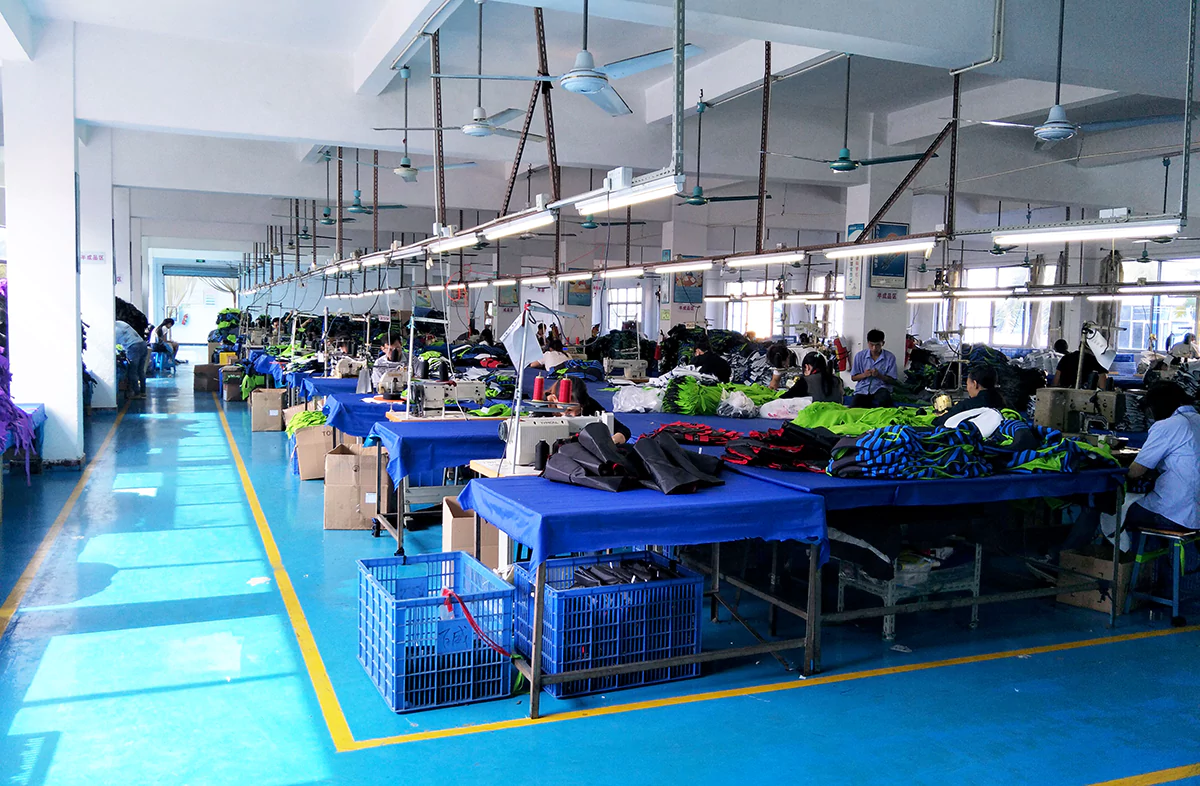
FYBagCustom is Your Trusted Custom Bag Manufacturer in China, with 15+ years of prototyping and sample development experience across all bag types. For designers, founders, and brands at the prototype stage, our capabilities include:
Our 50,000 m² factory in Guangzhou with dedicated sample rooms, experienced pattern makers, and 500+ professional staff produces prototypes for first-time founders, established brands, freelance designers, and product development agencies across international markets.
The prototyping process is where your handbag brand is built or broken. A good prototype — produced from a clear brief, evaluated thoroughly, and revised precisely — becomes the locked reference that ensures every bag in your bulk production matches the quality you approved. A rushed or carelessly reviewed prototype becomes the locked reference for a production run of bags that disappoint. For designers and founders at the prototyping stage, three core takeaways:
If you have a handbag design ready for prototyping — whether it is a polished tech pack or a sketch on the back of a napkin — contact FYBagCustom to start the development process. Send us your brief and we will respond with a feasibility assessment, material recommendations, and a sample quotation, typically within 48 hours. The prototype is where your brand becomes real. Let us help you get it right the first time.
FYBagCustom’s sample development team produces handbag prototypes in 5–7 days from your tech pack, sketch, or reference images — with CAD pattern development, in-stock materials, photo review before shipping, one free revision, and sample cost refundable against bulk production.
Start Your Custom Bag Project →