Tel/WhatsAapp:+86 18011919834
E-mail: chloe.x@fybagcustom.com

Tel/WhatsAapp:+86 18011919834
E-mail: chloe.x@fybagcustom.com
Send Your Inquiry Today

Who this guide is for: brand owners, sourcing managers, wholesale buyers, Amazon FBA sellers, DTC founders, sports accessories retailers, and athleisure labels who are developing multi-sport hybrid bags for the growing population of U.S. women who play both tennis and pickleball. If you need to understand how to engineer a single bag that holds a tennis racket AND a pickleball paddle simultaneously — plus shoes, balls, clothing, and personal items for both sports — while still looking like a lifestyle accessory, this guide covers the full product development blueprint.
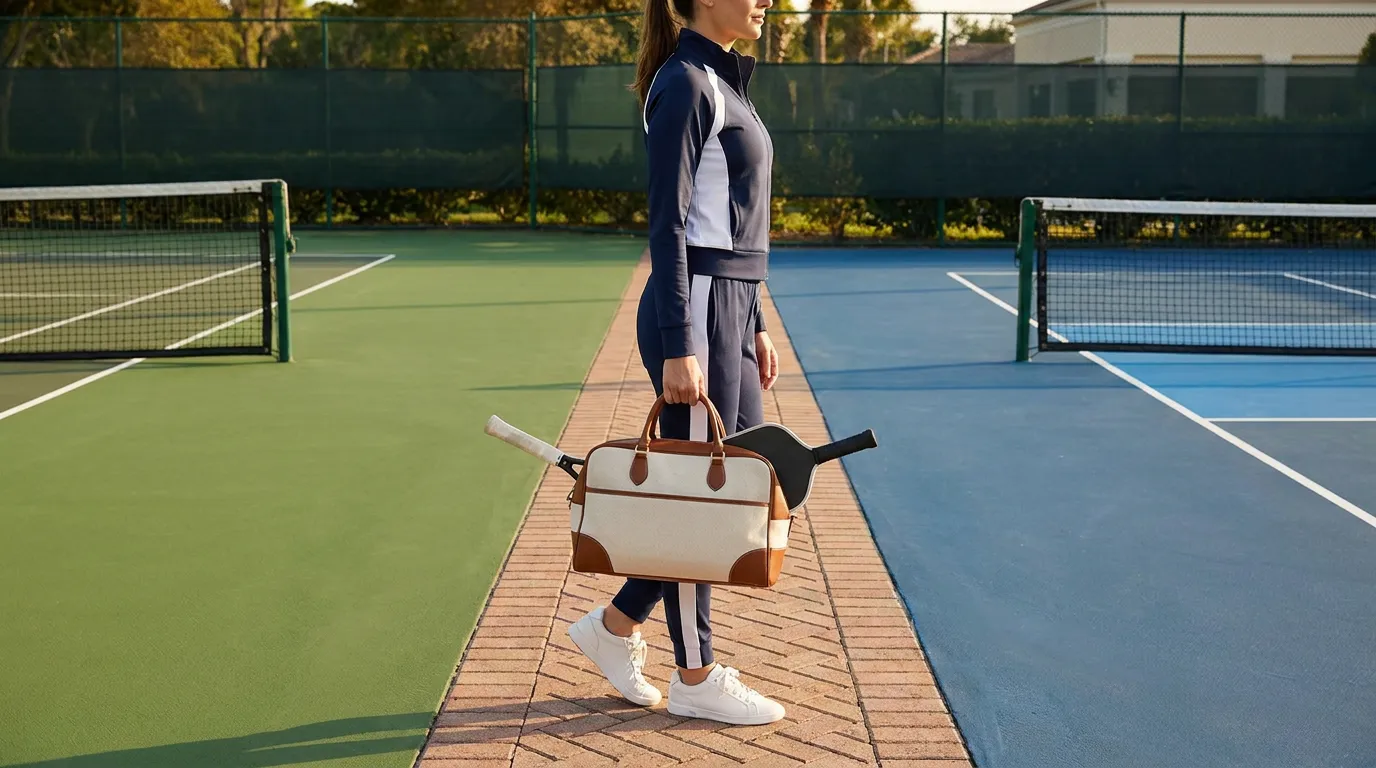
There is a new consumer at the intersection of two sports — and she is carrying two pieces of equipment that do not fit in the same bag. She played tennis at 7 AM, has a pickleball game at 10 AM, and lunch at noon. Her current solution: two sport bags, or one oversized duffle where everything crashes together. Neither is acceptable.
The dual-sport player — a woman who actively plays both tennis and pickleball — is no longer a statistical edge case. In 2026, an estimated 5+ million American women participate in both racket sports, and the overlap is growing faster than either sport individually. Multi-sport recreation complexes, country clubs offering both courts, and social groups that rotate between the two games have normalized the “I play both” identity. Yet the bag market has been slow to respond. Tennis bags hold rackets but not paddles. Pickleball bags hold paddles but not rackets. Neither is designed for the player who needs both.
Search volume for “tennis and pickleball bag” has exceeded 50,000 monthly searches — making it one of the highest-traffic keywords in the entire racket sport accessories category. The demand is specific and underserved: consumers are searching for a single bag that organizes equipment for both sports without compromise. For B2B buyers, this is a rare opportunity to create a category-defining product in a market that is actively searching and finding almost nothing.
This guide covers the engineering challenge of housing both equipment types simultaneously, the compartment architecture that keeps everything organized, the dimensional constraints, and how to produce a custom hybrid bag that serves the dual-sport player without looking like an equipment locker.
Before engineering the bag, it helps to understand the day in the life of the consumer it serves. Her usage patterns determine the compartment requirements.
| Scenario | What She Carries | Duration | Transition Need | Bag Requirement |
|---|---|---|---|---|
| Back-to-back sessions | 1 tennis racket + 1 pickleball paddle + shoes for both + 2 sets of balls + water + personal items | 3–5 hours (morning block) | Quick gear swap between courts | Both equipment types simultaneously; separate ball storage |
| Alternating-day play | Either tennis OR pickleball gear on a given day, but uses the same bag for both | Varies | No in-day transition; daily switching | Compartments that flex between equipment types; modular |
| Social sport + lifestyle | One racket sport + post-game social (brunch, errands, shopping) | Half-day | Court-to-café transition | Sport gear concealed; bag reads as lifestyle tote after game |
The back-to-back session is the most demanding scenario — and the one that defines the hybrid bag’s engineering requirements. If the bag can handle this use case (both equipment types at full loadout simultaneously), it automatically handles the other two.
| Category | Items | Dimensions / Volume | Weight |
|---|---|---|---|
| Tennis racket (1) | Standard or mid-size | 68–74 cm length, 23–27 cm head width | 280–340 g |
| Pickleball paddle (1) | Standard or elongated | 39–44 cm length, 16–21 cm width | 200–260 g |
| Tennis balls (3) | Standard pressurized | 6.5 cm diameter each | 170 g total |
| Pickleball balls (3–4) | Indoor or outdoor | 7.4 cm diameter each | 100–120 g total |
| Court shoes (1 pair) | Tennis shoes or court sneakers | 28 × 10 × 11 cm per shoe | 600–800 g pair |
| Change of clothes | Sports bra, shorts/skirt, socks, top | ~3 L volume | 300–500 g |
| Water bottle (1) | 32 oz / 1 L insulated | 8 × 8 × 25 cm | 400–600 g (full) |
| Towel (1) | Sport towel, compact | 30 × 60 cm folded | 150–250 g |
| Personal items | Phone, wallet, keys, sunscreen, sunglasses, lip balm | ~1.5 L volume | 400–600 g |
| Total | 20–28 L | 2.8–4.2 kg (gear only, excluding water) |
This inventory totals 20–28 liters and 3.5–5.0 kg when loaded with water — roughly the same volume as a weekender bag but with far more diverse item shapes and protection requirements. The engineering challenge is not simply capacity; it is organized capacity that separates a 74 cm racket from a 44 cm paddle from a pair of muddy shoes from a clean shirt.
The fundamental engineering challenge of a hybrid bag is that tennis rackets and pickleball paddles have incompatible form factors. A tennis racket is long, wide-headed, and rigid. A pickleball paddle is short, narrow, and flat. Designing a single compartment that fits both is possible (the tennis tote article demonstrated this), but designing a bag that carries both simultaneously requires either two separate equipment zones or a compartment system that can be reconfigured.
| Attribute | Tennis Racket | Pickleball Paddle | Design Implication |
|---|---|---|---|
| Length | 68–74 cm | 39–44 cm | Racket is 24–35 cm longer — paddle fits inside racket compartment but not vice versa |
| Head width | 23–27 cm | 16–21 cm | Racket head is wider — compartment width set by tennis |
| Thickness | 2.0–2.5 cm | 1.2–1.6 cm | Combined thickness (side by side): 3.2–4.1 cm — a single wide slot can hold both |
| Handle length | 18–22 cm | 12–14 cm | Racket handle protrudes further above any compartment |
| Weight | 280–340 g | 200–260 g | Combined: ~500–600 g — no structural concern |
| Protection need | High — strings and frame are fragile | Medium — face is durable but edge-sensitive | Padding required on racket side; adequate padding protects both |
Key insight: the paddle is dimensionally smaller in every axis. It fits wherever a racket fits, but not the reverse. This asymmetry creates two viable design strategies:
| Feature | Specification |
|---|---|
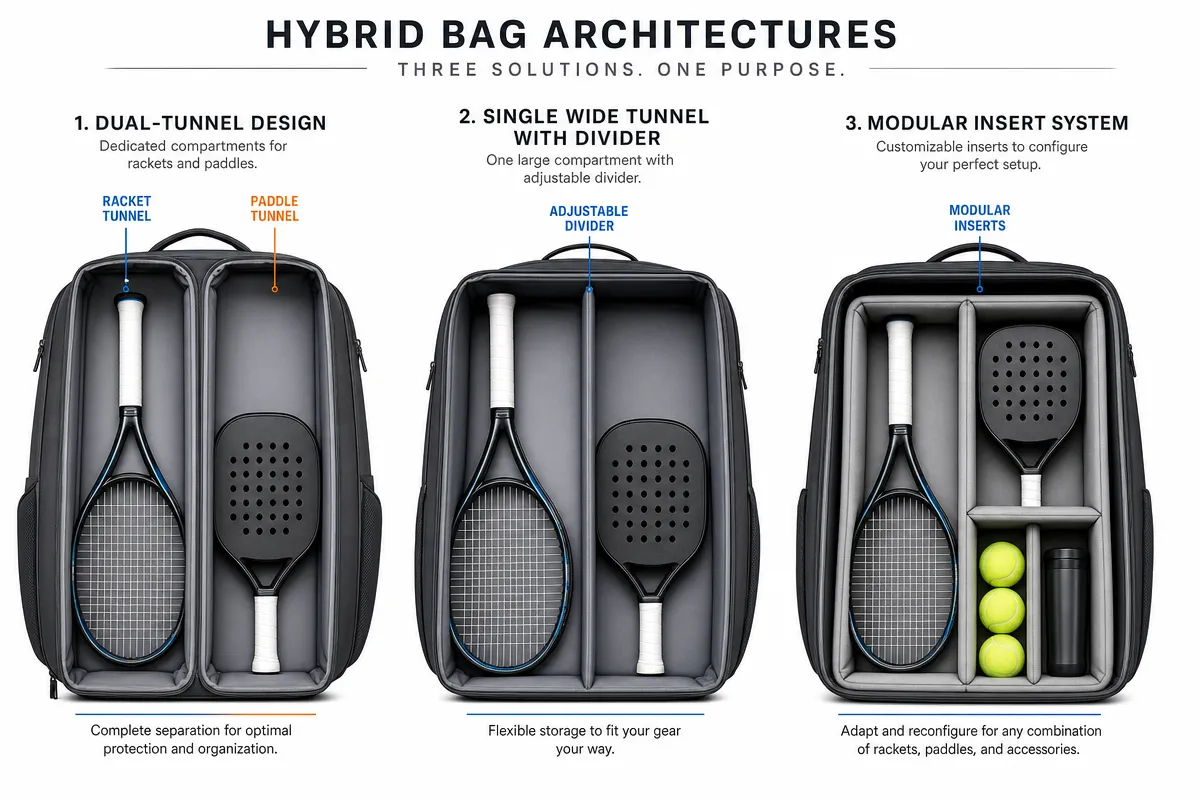
| Concept | Two separate equipment tunnels — one sized for the tennis racket on one side, one sized for the pickleball paddle on the other |
| Racket tunnel | 10–12 cm wide × full bag height + 15 cm, padded, with cover flap (identical to the tennis tote specification) |
| Paddle tunnel | 6–8 cm wide × 46 cm tall, padded, with magnetic or elastic closure at top |
| Advantages | Maximum organization — each piece has its own dedicated home; no equipment contact; both accessible independently |
| Disadvantages | Adds 8–12 cm to total bag width; two tunnels on the sides create a bulkier silhouette |
| Best for | Players who carry both every session; maximum-organization-focused consumers |
| Visual read | Reads as “sport bag” — dual tunnels are visible signals of sport function |
| Feature | Specification |
|---|---|
| Concept | One wide equipment tunnel (14–18 cm) on one side of the bag, with a removable padded divider that creates two sub-sections |
| With divider | Tunnel splits into a 10 cm racket section + a 6 cm paddle section — both items separated and padded |
| Without divider | Full-width tunnel holds either one racket, one paddle, or two paddles for doubles play |
| Advantages | More versatile — configurable for tennis-only, pickleball-only, or dual-sport; cleaner silhouette (single tunnel, not two) |
| Disadvantages | Slightly less organized than dual-tunnel; divider can shift if not Velcro-secured |
| Best for | Players who alternate between single-sport and dual-sport days; brands wanting one SKU for all scenarios |
| Visual read | Reads as “large tote with sport function” — more fashion-forward than dual-tunnel |
| Feature | Specification |
|---|---|
| Concept | The base bag has no built-in equipment tunnels; instead, padded inserts (racket sleeve and paddle sleeve) clip or Velcro into the main compartment as needed |
| Racket insert | Padded sleeve, 12 × 76 cm, with Velcro base and loop attachment to bag’s interior wall |
| Paddle insert | Padded sleeve, 8 × 46 cm, same attachment system |
| Advantages | Maximum flexibility — configure for tennis, pickleball, both, or neither (bag becomes a standard tote/weekender); cleanest silhouette when inserts are removed |
| Disadvantages | Higher unit cost (bag + 2 inserts); inserts can be lost; less instant access than dedicated tunnels |
| Best for | Multi-purpose lifestyle consumers who want one bag for sport AND travel AND daily carry; brands selling modular systems |
| Visual read | Without inserts, reads as a pure lifestyle bag — no sport signals visible |
| Buyer Profile | Recommended Architecture | Why |
|---|---|---|
| Amazon FBA / mass-market sport accessories | Architecture 2 (single wide tunnel + divider) | Most versatile single SKU; serves tennis-only, pickleball-only, and dual-sport with one product listing |
| Premium DTC / lifestyle-sport brands | Architecture 3 (modular inserts) | Highest perceived value; “configurable” is a strong premium selling point; bag converts to non-sport use |
| Dedicated racket sport brands | Architecture 1 (dual-tunnel) | Maximum organization signals “serious dual-sport player”; aligns with sport-specific brand positioning |
For the broadest commercial opportunity, Architecture 2 (single wide tunnel with removable divider) is the recommended default. It serves the largest number of use cases with a single SKU, has moderate manufacturing complexity, and the “with or without divider” versatility is a natural product-page selling point (“Carries your tennis racket AND pickleball paddle — or either one alone”).
Beyond the equipment tunnel(s), the hybrid bag must organize the full dual-sport inventory into zones that prevent cross-contamination and enable quick access during court transitions.
| Zone | Location | Contents | Construction | Access |
|---|---|---|---|---|
| Zone 1: Equipment tunnel(s) | Side panel(s) | Tennis racket + pickleball paddle | Padded, covered (Architecture 1, 2, or 3) | External — independent of main bag |
| Zone 2: Ball storage | Front panel, exterior | 3 tennis balls + 3–4 pickleball balls | Dual-section mesh pocket with elastic closure; or divided zip pocket | External — quick court-side access |
| Zone 3: Main compartment | Center body | Change of clothes, towel, warm-up layer | Open well with compression straps | Top zip |
| Zone 4: Shoe compartment | Bottom or end panel | 1 pair court shoes | Ventilated (grommets), waterproof divider | External zip — separate from clothes |
| Zone 5: Personal items pocket | Front exterior or interior organizer | Phone, wallet, keys, sunscreen, sunglasses | Organized: card slot, phone sleeve, zip pocket | External magnetic snap or zip |
| Zone 6: Insulated bottle pocket | Side panel (opposite equipment tunnel) | 32 oz / 1 L bottle | PEVA or foil-lined, elasticized | External — quick access |
| Zone 7: Wet/towel pocket | Interior side wall or exterior back | Damp towel, used sweatband | Mesh or waterproof-lined | Internal zip or external clip |
Tennis balls (6.5 cm) and pickleball balls (7.4 cm) are different sizes and are typically carried separately (tennis balls in a pressurized can or loose, pickleballs in a mesh bag or loose). A hybrid bag needs dual-section ball storage — either:
The divided single pocket is more production-efficient and creates a cleaner exterior. Size it at 20 × 14 × 8 cm total (10 × 14 × 8 cm per section) to hold 3 tennis balls and 4 pickleballs.
The dual-sport loadout totals 20–28 liters — pushing the bag into weekender territory. The dimensional challenge is fitting this volume into a silhouette that still reads as a sport-lifestyle bag rather than a travel duffle.
| Architecture | Width | Height | Depth | Volume | Equipment Accommodation | Visual Read |
|---|---|---|---|---|---|---|
| Arch 1: Dual-tunnel | 48–55 cm | 35–40 cm | 18–22 cm | 28–38 L | Both tunnels external; full capacity | Large sport bag — clearly dual-sport |
| Arch 2: Single tunnel + divider | 42–48 cm | 33–38 cm | 16–20 cm | 22–32 L | One external tunnel; divider inside | Large tote — sport-lifestyle crossover |
| Arch 3: Modular inserts | 40–45 cm | 32–36 cm | 15–18 cm | 20–28 L | Inserts inside main compartment | Standard large tote — most fashion-forward |
Architecture 2 at 44 × 35 × 18 cm is the dimensional sweet spot: large enough for the full dual-sport inventory, compact enough to read as a structured tote rather than a duffle, and compatible with car trunks, locker cubbies, and bench storage at court-side.
A loaded hybrid bag (gear + water) weighs 4–6 kg. The empty bag must not add excessive weight:
| Target | Why |
|---|---|
| Empty weight: under 1.4 kg | Total carry stays under 6.5 kg — manageable for shoulder carry across a parking lot |
| Padded tunnel weight: 200–350 g | EVA foam padding for equipment protection; EPE foam where weight savings needed |
| Use lightweight hardware | Zinc alloy, not brass or steel; plastic zipper teeth acceptable on interior compartments |
The material must bridge sport durability and lifestyle aesthetics — the bag touches court surfaces, sits on benches, gets tossed in car trunks, and is carried into restaurants. It needs to handle all of these without looking worn.
| Material | Sport Durability | Lifestyle Fashion Read | Weight | Wipe-Clean | Price Tier |
|---|---|---|---|---|---|
| High-denier nylon (420D–900D) + PU leather trim | Excellent | High — trim elevates the nylon | Light | Excellent | 100 retail |
| Pebbled PU leather (full body) | Good | Very high — reads as designer | Medium | Excellent | 150 retail |
| Canvas (14–16 oz) + leather trim | Very good | High — heritage sport aesthetic | Medium | Good — treat with DWR | 110 retail |
| Recycled nylon + WB-PU trim | Good | Medium–High + sustainability story | Light | Excellent | 120 retail |
| Neoprene | Good — flexible, resilient | Medium–High — sporty-modern | Light | Excellent | 95 retail |
For the broadest market, high-denier nylon body + PU leather trim delivers the best performance-to-fashion ratio at the most accessible price point. It handles court abuse, wipes clean, and the leather trim (handles, patches, zipper pulls, tunnel flap) elevates the overall aesthetic from “sport bag” to “sport-lifestyle.”
Personalization in the hybrid bag category follows the same principles as other sport-lifestyle products, with one unique addition: sport-identity markers that communicate “I play both.”
| Technique | Visual | Best Surface | Sport-Relevant Application | Cost |
|---|---|---|---|---|
| Embroidered monogram | Classic, premium | Canvas, nylon, PU patch | Initials on front panel or tunnel flap — identifies bag on court | 5.00 |
| Foil-stamped initials | Elegant, metallic | PU leather trim or patch | On leather handle wrap or tunnel flap | 3.50 |
| Dual-sport embroidered icon | Unique identifier | Canvas, nylon | Crossed racket + paddle icon — signals “I play both” | 5.00 |
| Team/club name | Group identity | Any material | Embroidered or printed club name + member name | 6.00 |
| Custom woven strap | Brand awareness | Strap | Brand or club name woven into shoulder strap webbing | 2.50 + setup |
The crossed racket + paddle embroidered icon is a personalization element unique to this category — a small motif showing a tennis racket and pickleball paddle crossed, with the owner’s initials below. It is a low-cost embroidery addition (5.00) that creates an immediately recognizable “dual-sport” identity signal and generates conversation at clubs and courts.
Multi-sport clubs, recreation centers, and racket sport leagues represent the highest-potential B2B channel for hybrid bags. A club offering both tennis and pickleball courts can order branded hybrid bags as:
| Program | Order Size | Branding | Personalization | Price Tier |
|---|---|---|---|---|
| Member welcome gift | 50–300 pcs | Club logo + “Tennis & Pickleball” | Member name | Mid–Premium (100) |
| Pro shop retail | 30–100 pcs | Club or pro shop brand | Optional name service | Mid (80) |
| League/tournament prize | 20–50 pcs | League name + event | Winner name / team | Mid–Premium (120) |
| Corporate sponsor gift | 50–200 pcs | Sponsor logo + club logo | Recipient name | Premium (150) |
A single multi-sport club ordering 100 hybrid bags at 6,500 order — and clubs that invest in branded bags typically reorder annually as membership grows, tournaments recur, and new programs launch.
| Stage | Duration | Key Deliverables |
|---|---|---|
| 1. Design brief / tech pack | 3–7 days | Architecture selection, dimensions, tunnel spec, zone layout, material |
| 2. Material + hardware sourcing | 5–10 days | Swatches, tunnel padding samples, divider prototypes |
| 3. First sample (proto) | 7–14 days | Dual equipment fit test, ball pocket capacity, shoe compartment check |
| 4. Revision sample | 5–10 days | Tunnel width, divider tension, flap closure, handle comfort |
| 5. PP sample | 5–7 days | Final locked reference |
| 6. Bulk production | 25–40 days | Volume-dependent |
| 7. QC + packing | 3–5 days | Dual equipment fit test on 10% of batch, handle load test, zip cycle test |
| 8. Shipment | 3–7 days | Sea/air/express, FBA prep |
Total: roughly 55–90 days. The dual-equipment fit testing adds approximately 3–5 days to the sample phase compared to a single-sport bag. Request that the factory test-fits at least three different racket sizes and two paddle sizes in the proto sample to verify universal compatibility.
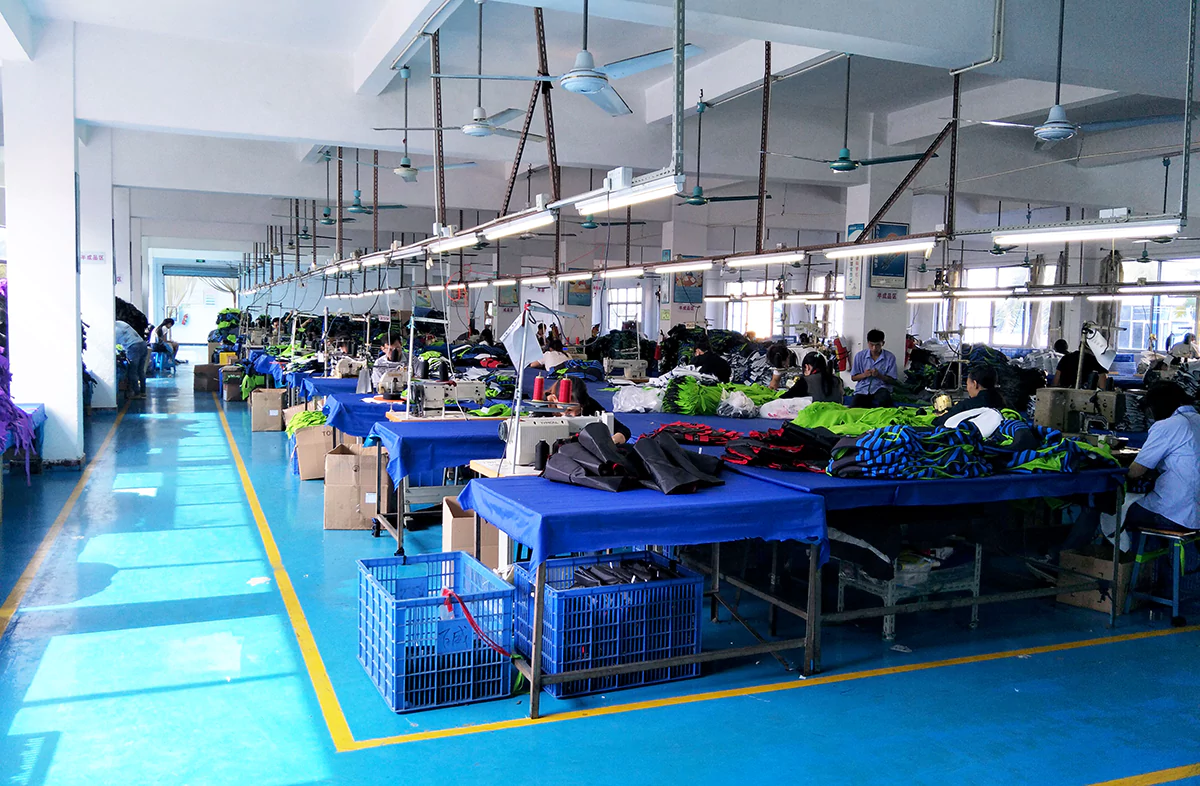
FYBagCustom is Your Trusted Custom Bag Manufacturer in China, with 15+ years of manufacturing experience producing multi-function sport bags, structured totes, and lifestyle accessories for brands worldwide. For buyers developing custom tennis and pickleball hybrid bags, our capabilities include:
Our 50,000 m² factory in Guangzhou with 10+ production lines produces sport-lifestyle bag programs for DTC brands, Amazon FBA sellers, country clubs, racket sport retailers, athleisure labels, and multi-sport recreation companies across international markets.
The custom hybrid tennis-pickleball bag addresses a 50K+ monthly search volume keyword by solving a genuine and growing consumer problem: the dual-sport player who has no single bag designed for her. For B2B buyers developing hybrid bags in 2026, three core takeaways:
If your 2026 product line targets the dual-sport racket player, now is the time to select your hybrid architecture, finalize compartment zones, and begin sampling. Contact FYBagCustom to discuss tunnel engineering, equipment compatibility testing, and material options — and receive physical samples with dual equipment fit verification, typically within 5–7 days.
FYBagCustom’s OEM and ODM team works with sport-lifestyle brands, DTC founders, Amazon sellers, country clubs, and multi-sport facilities to produce custom hybrid tennis-pickleball bags — with configurable equipment tunnels, seven-zone organization, dual-sport personalization, and fashion-grade finishing at low MOQ with samples in 5–7 days.
Start Your Custom Bag Project →