Tel/WhatsAapp:+86 18011919834
E-mail: chloe.x@fybagcustom.com

Tel/WhatsAapp:+86 18011919834
E-mail: chloe.x@fybagcustom.com
Send Your Inquiry Today


Who this guide is for: brand owners, sourcing managers, wholesale buyers, Amazon FBA sellers, DTC founders, retail merchandisers, athleisure labels, and outdoor/lifestyle brands who are developing custom crossbody bags or fanny packs for sport, commute, travel, and everyday carry in 2026. If you need to understand how strap systems, material choices, compartment layouts, and charm/accessory customization turn a basic crossbody into a differentiated brand product — this guide provides the development framework.
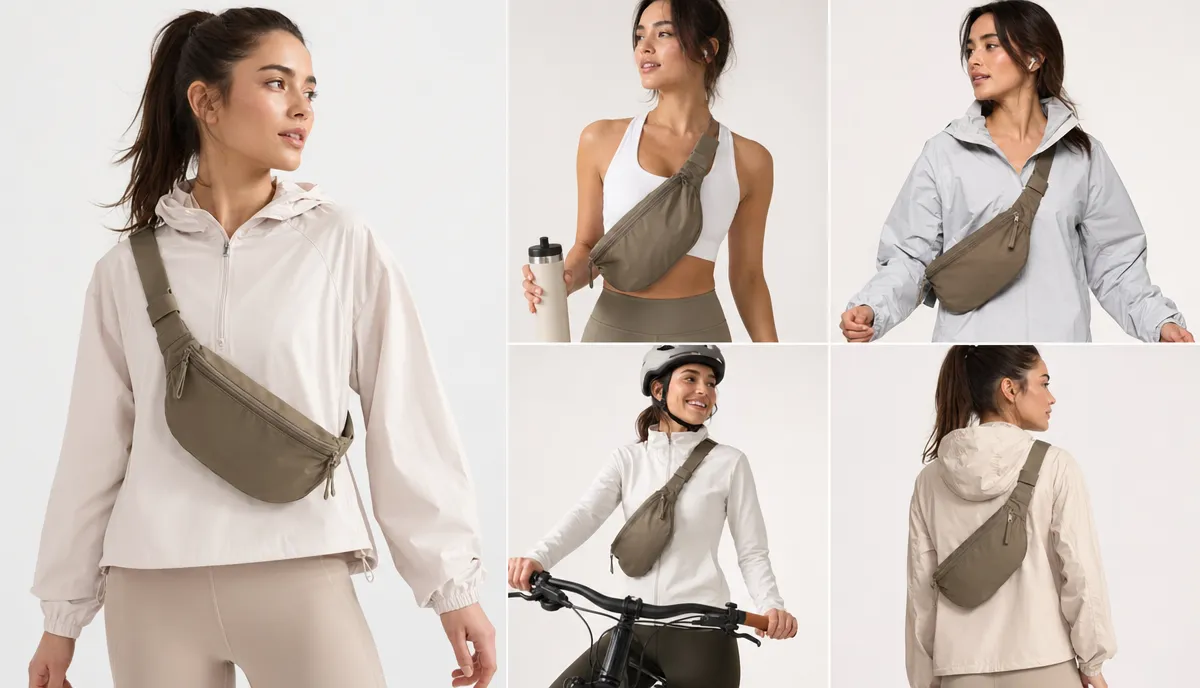
The crossbody bag has completed one of the most remarkable category transformations in the accessories industry. A decade ago, it was primarily a travel-security product — a flat, forgettable pouch strapped across the chest to deter pickpockets. Today, the crossbody is the default carry format for active lifestyles: outdoor recreation, urban commuting, gym-to-street transitions, festival going, weekend errands, and dog walking. Its close relative, the fanny pack (belt bag, bum bag, waist pack — the names vary by market), has undergone an equally dramatic reinvention from tourist cliché to streetwear essential.
For B2B buyers, the category’s commercial appeal is driven by two forces. First, the crossbody format solves a problem no other silhouette solves as well: true hands-free carry with the bag remaining secure and accessible at all times. Second, the compact body and prominent front-facing position make it one of the best surfaces in all of bag design for visible branding, decoration, and customization — every charm, patch, and logo placement sits directly in the wearer’s and viewer’s sightline.
This guide covers the crossbody and fanny pack landscape in 2026, the strap engineering that defines the carry experience, the compartment layouts that differentiate a functional bag from a frustrating one, how charms and detachable accessories create brand personality, and what to specify when working with a custom crossbody bag manufacturer in China.
“Crossbody bag” is an umbrella term that covers a surprisingly diverse range of silhouettes, each serving a different use case and demographic. Before developing a product, buyers need to choose which sub-category aligns with their brand and target consumer.
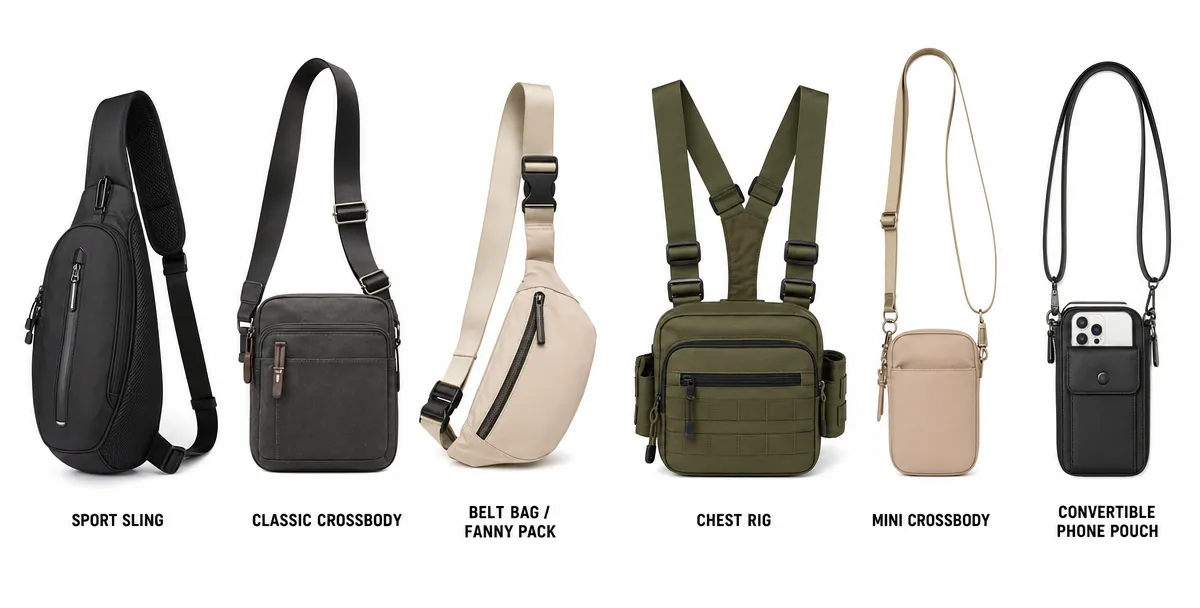
| Sub-Category | Typical Dimensions (W × H × D) | Carry Position | Primary Use Case | Target Consumer | 2026 Search Momentum |
|---|---|---|---|---|---|
| Sport sling | 30–38 × 16–20 × 8–12 cm | Diagonal across back or chest | Outdoor, cycling, hiking, gym | Active lifestyle, 20–40 | Strong growth |
| Classic crossbody | 22–28 × 16–20 × 6–10 cm | Hip or front-body, diagonal strap | Daily carry, commuting, travel | Broad female demographic, 25–50 | Stable, high volume |
| Belt bag / fanny pack | 25–35 × 12–16 × 5–8 cm | Waist, hip-slung, or crossbody | Festivals, errands, casual, sport | Youth, streetwear, athleisure, 18–35 | Very strong growth |
| Chest rig / utility vest | Multi-pocket front harness | Chest, distributed across torso | Urban outdoor, tactical, streetwear | Streetwear, male + unisex, 18–30 | Growing niche |
| Mini crossbody | 16–20 × 12–15 × 4–6 cm | Front body, close to torso | Phone + keys + cards only | Fashion-forward, going out, 18–35 | Moderate |
| Convertible phone pouch | 10–12 × 18–20 × 2–4 cm | Crossbody, neck lanyard, or belt clip | Phone-only, events, running | Minimal carry, runners, event-goers | Growing |
For brands entering the crossbody/fanny pack market in 2026, the sport sling and belt bag/fanny pack are the two highest-growth sub-categories. Together, they cover the majority of the active-lifestyle consumer base. The classic crossbody remains the largest volume category overall but is more competitive and harder to differentiate without a strong brand identity.
A commercially efficient entry strategy: develop one sport sling and one belt bag in your first collection, then expand to classic crossbody and mini crossbody based on sell-through data. This focuses your development budget on the two fastest-moving sub-categories while testing two distinct carry formats.
In no other bag category does the strap matter as much as in crossbody bags. The strap is not an accessory — it is the primary structural and experiential element. It determines comfort during hours of wear, security during movement, body-position versatility, and a significant portion of the bag’s visual identity.
| Variable | Options | Impact on Experience | Cost Impact |
|---|---|---|---|
| Width | 25 mm (slim), 38 mm (standard), 50 mm (wide) | Wider = more weight distribution, more comfort for heavier loads | Minimal — material use scales linearly |
| Padding | None, thin foam (3 mm), thick foam (5–8 mm), mesh-backed | Padding critical for bags carried 2+ hours; mesh prevents sweat buildup | +1.50 per strap |
| Length adjustment | Fixed, slider buckle, double-ring, quick-release | Adjustable is non-negotiable — body sizes vary enormously | Slider buckle is baseline, +$0.20 for quick-release |
| Adjustment range | 70–130 cm (minimum recommended) | Must span petite crossbody to tall over-shoulder wear | No cost impact — length of webbing |
| Material | Nylon webbing, polyester webbing, cotton, leather, elastic, chain | Material must match bag aesthetic and intended use intensity | Nylon baseline; leather +40–60%; chain +30–50% |
| Anti-slip backing | Silicone grip dots, rubberized strip, textured surface | Prevents strap sliding on jackets and activewear fabrics | +0.40 |
| Quick-release buckle | Magnetic snap, side-release clip, fidlock magnetic | Fastest on/off; essential for sport and commute use | +2.00 depending on mechanism |
The strongest commercial crossbody/fanny pack designs in 2026 allow the user to wear the same bag in three different positions without changing the strap:
This versatility is achieved through a strap with sufficient adjustment range (70–130 cm minimum), a smooth-glide slider buckle, and D-ring attachment points on the bag body that allow rotation. The engineering is straightforward but must be specified explicitly in the tech pack — many factories will default to a basic fixed-angle attachment unless instructed otherwise.
Recommended strap width, padding, and features mapped to primary use case.
The chart above is worth printing and pinning next to your tech pack when specifying strap details. It maps the three most impactful strap decisions (width, padding, key feature) to each major use case — preventing the common mistake of designing a one-size-fits-all strap that is mediocre for every activity rather than optimized for one.
The interior layout of a crossbody bag has a different design logic than a handbag or tote. Because the bag is worn on the body — not carried by hand and opened from above — access pattern matters as much as capacity. The user reaches for items while walking, cycling, or standing in line. Every pocket and compartment must be reachable without removing the bag, and the most frequently accessed items (phone, keys, transit card) must be in the fastest-access position.
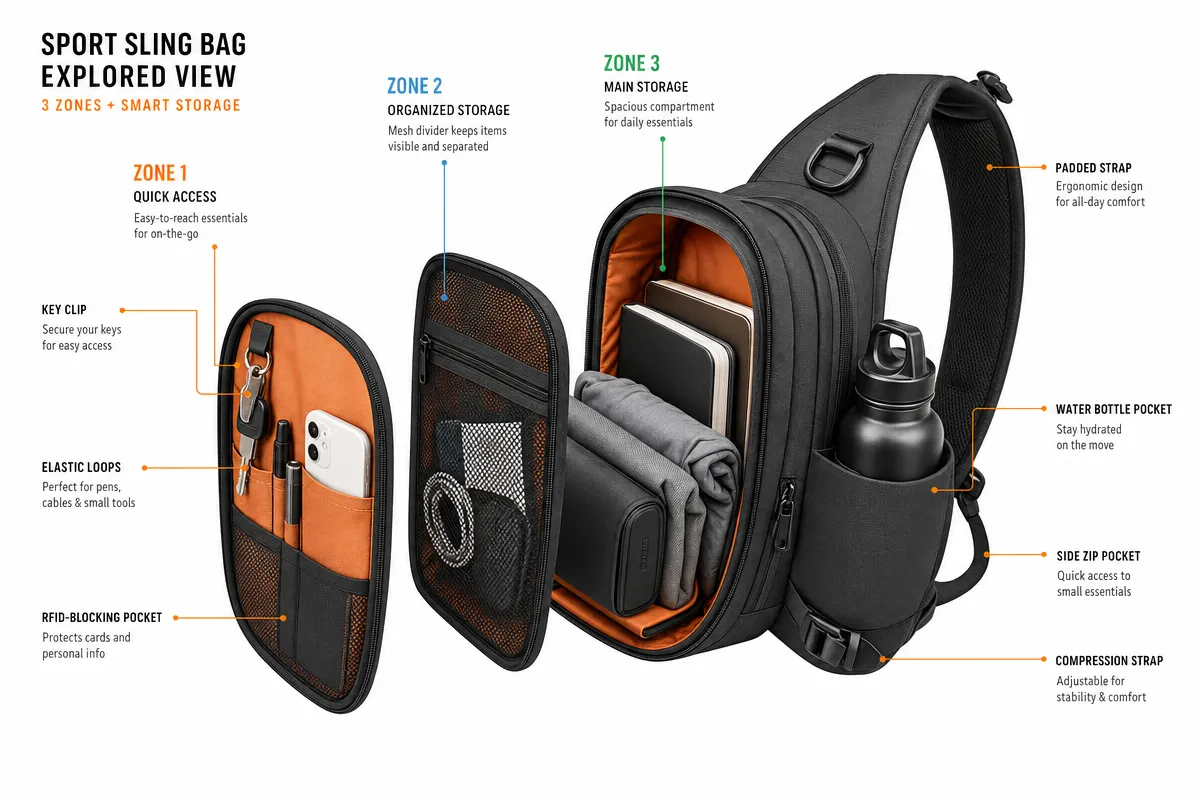
The most effective crossbody compartment design divides the bag into three access zones, ordered from fastest to slowest:
| Zone | Position | Closure | Contents | Access Speed |
|---|---|---|---|---|
| Zone 1: Quick-access | Front slip pocket or exterior zip pocket | Magnetic snap or no closure | Phone, transit card, earbuds | Instant — one-hand, eyes-free |
| Zone 2: Main | Central zip compartment | YKK or equivalent smooth zip | Wallet, sunglasses, keys, snacks, cosmetics | Fast — two-second zip |
| Zone 3: Secure | Back panel zip pocket (against body) | Hidden zip, anti-theft position | Cash, passport, cards, valuables | Deliberate — secure by design |
This three-zone structure is the industry standard for good reason: it maps to how people actually use crossbody bags in motion. Brands that deviate from this pattern (for example, putting the phone pocket behind the main compartment or eliminating the back security pocket) consistently generate negative product reviews citing poor organization.
Beyond the three-zone core, several additional features differentiate a well-designed crossbody from a basic one:
Crossbody bags endure more physical stress than most other bag types. They rub against clothing, compress during movement, get caught in rain, and are thrown onto gym floors. Material selection must prioritize durability and weather resistance while still achieving the aesthetic standard required for fashion-adjacent positioning.
| Material | Weight | Water Resistance | Abrasion Resistance | Fashion Perception | Best Sub-Categories |
|---|---|---|---|---|---|
| High-denier nylon (420D–1000D) | Light | Good — can be DWR-coated | Excellent | Modern, technical, sport-lux | Sport sling, belt bag |
| Ripstop nylon | Very light | Good — inherently tear-resistant | Very good — distributes stress | Technical, outdoor | Sport sling, hiking crossbody |
| Cordura or Cordura-type | Medium | Very good | Exceptional — military spec | Rugged, durable, utility | Outdoor, travel, EDC |
| Oxford polyester (600D–900D) | Light–Medium | Very good — PU or PVC coated | Very good | Clean, professional | Classic crossbody, commuter |
| Recycled nylon / rPET | Light | Good — varies by formulation | Good | Eco-modern, contemporary | Sustainability-focused brands |
| PU leather | Medium | Moderate — surface repels, seams vulnerable | Good | Fashion, premium everyday | Fashion crossbody, mini crossbody |
| Canvas (waxed or coated) | Medium–Heavy | Good when waxed/coated | Very good — improves with age | Heritage, artisanal, outdoor | Lifestyle, heritage brands |
| Neoprene | Light | Excellent — inherently waterproof | Good — flexible, soft | Sporty, modern, casual | Sport, beach, athleisure |
For the sport sling sub-category, high-denier nylon with DWR (durable water repellent) coating is the default material choice. It balances weight, durability, and weather resistance at the right cost point. For belt bags/fanny packs targeting the streetwear and fashion market, PU leather or recycled nylon provides the aesthetic upgrade needed to justify higher retail prices.
For any crossbody bag marketed for outdoor or commute use, specify the waterproofing level in your tech pack:
Clarify the claim on your product page: “water-resistant” for DWR-coated bags, “waterproof” only for welded-seam TPU-laminated bags. Mislabeling generates returns and negative reviews.
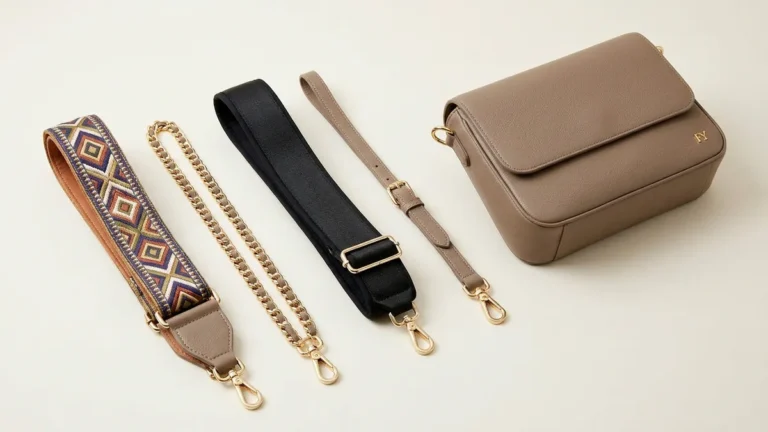
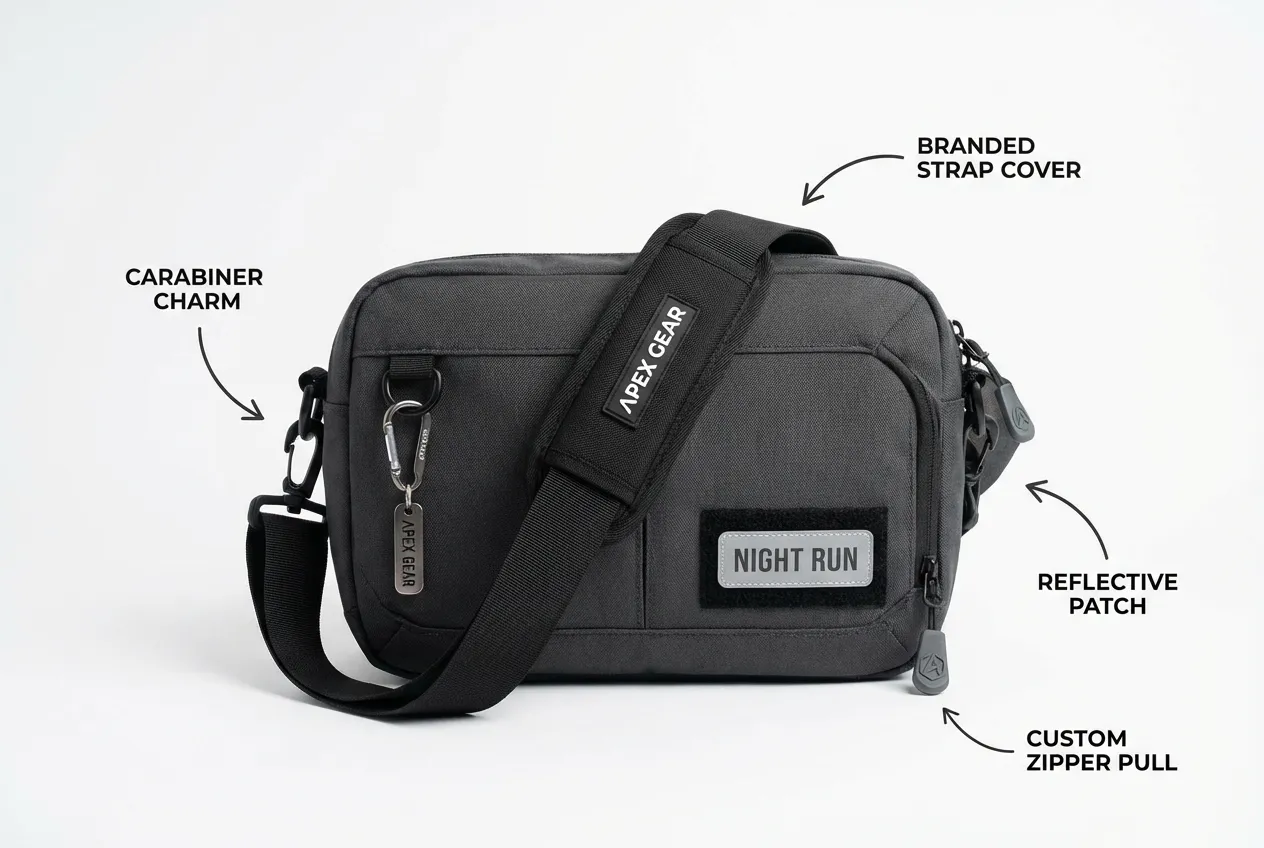
The front-facing position of a crossbody bag makes it the ideal platform for visible detachable accessories — charms, carabiner clips, decorative straps, patches, and keychains that consumers can add, swap, and collect. This is not just decoration; it is a customer engagement mechanic that drives repeat purchases, social media content, and brand community.
| Accessory Type | Attachment Method | Material Options | Price Point (retail, add-on) | Brand Strategy |
|---|---|---|---|---|
| Metal carabiner charm | Clip onto D-ring or strap loop | Zinc alloy, enamel-filled, stainless | 15 | Collectible series, seasonal drops |
| Woven or embroidered strap cover | Velcro wrap around main strap | Jacquard, nylon, cotton | 18 | Interchangeable “skins,” personalization |
| Rubber / PVC zipper pull | Replaces standard zipper pull | Injection-molded PVC, silicone | 8 | Brand identity, mascots, icons |
| Paracord / braided lanyard | Loop through D-ring or webbing | Paracord, braided nylon, leather | 12 | Outdoor, utility, camp-culture aesthetic |
| Reflective patch / badge | Velcro or snap-button onto designated zone | Reflective fabric, woven, embroidered | 10 | Safety (night visibility), self-expression |
For the charm and clip ecosystem to work, the base bag must include intentional attachment points — not just standard hardware. Specify in your tech pack:
These additions cost 0.80 per unit in materials and labor but create the infrastructure for an accessory revenue stream that can equal or exceed the margin on the base bag itself over time.
On a crossbody bag, the strap crosses the entire torso — making it the single largest visible surface when the bag is worn. For brands, this makes the strap itself a prime branding canvas.
| Technique | Visual Effect | Production Method | Cost Impact | Best For |
|---|---|---|---|---|
| Jacquard-woven brand name | Repeat brand name woven into the webbing | Custom jacquard loom setup | +2.00 (one-time setup + per-meter) | Brand awareness, logo-forward positioning |
| Printed webbing | Full-color logo or pattern on strap surface | Heat transfer or sublimation onto webbing | +1.50 | Graphic brands, seasonal patterns |
| Embroidered strap section | Small logo or icon stitched onto a section of the strap | Embroidery on strap before assembly | +1.80 | Subtle branding, premium positioning |
| Contrast color webbing | Brand’s signature color as the strap color | Standard webbing in custom dye | +0.30 (if MOQ for custom dye met) | Brand recognition through color |
| Woven edge stripe | Thin colored stripe along strap edges | Woven into webbing during production | +0.80 | Heritage-inspired, subtle detail |
Jacquard-woven straps are the highest-impact option: the brand name or pattern is literally part of the strap’s structure, visible from meters away, and impossible to remove or wear off. The one-time loom setup cost is typically 500, amortized across production volume. For brands planning crossbody bag programs of 500+ units or more, the per-unit cost becomes negligible and the branding impact is permanent.
| Your Brand Profile | Recommended Sub-Category | Material | Strap Spec | Key Features | Retail Price |
|---|---|---|---|---|---|
| Outdoor / active lifestyle | Sport sling | High-denier nylon, DWR-coated | 38 mm, padded, quick-release | Water bottle pocket, reflective details, 3-zone layout | 60 |
| Athleisure / streetwear | Belt bag / fanny pack | Nylon or recycled nylon | 25–38 mm, jacquard branded | Front zip + hidden back zip, charm D-rings | 50 |
| Fashion / contemporary | Classic crossbody | PU leather or microfiber | 25 mm, leather or chain accent | Minimal 2-compartment, tonal debossed logo | 80 |
| Travel / security | Classic crossbody (secure) | Oxford polyester, RFID-lined | 38 mm, wire-core cut-resistant | RFID pocket, hidden back zip, lockable zips | 70 |
| Premium DTC | Mini crossbody | Genuine leather or premium PU | 15–20 mm, leather, adjustable | Minimal, phone + cards only, foil monogram | 120 |
| Corporate gifting / promo | Belt bag or sling | Polyester or recycled PET | 38 mm, printed webbing | Logo-forward, single main compartment | 25 |
| Stage | Duration | Key Deliverables |
|---|---|---|
| 1. Design brief / tech pack | 3–7 days | Dimensions, strap spec, compartment layout, material, hardware, branding |
| 2. Material + hardware sourcing | 5–10 days | Swatches, buckle/clip samples, webbing color cards, charm proofs |
| 3. First sample (proto) | 5–10 days | Silhouette check, strap comfort test, compartment access test |
| 4. Revision sample | 5–7 days | Fine-tune strap length range, pocket dimensions, hardware feel |
| 5. PP (pre-production) sample | 5–7 days | Final locked reference for bulk |
| 6. Bulk production | 20–35 days | Crossbody bags are typically faster than structured handbags |
| 7. QC and packing | 3–5 days | Zip test (500+ cycles), strap stress test, waterproof spot-check |
| 8. Shipment | 3–7 days | Sea/air/express, FBA prep if applicable |
Total: roughly 50–75 days from brief to shipment-ready. Crossbody bags are among the fastest bag types to produce due to simpler construction and fewer components than structured handbags. Custom jacquard straps add 7–10 days for loom setup on first orders.
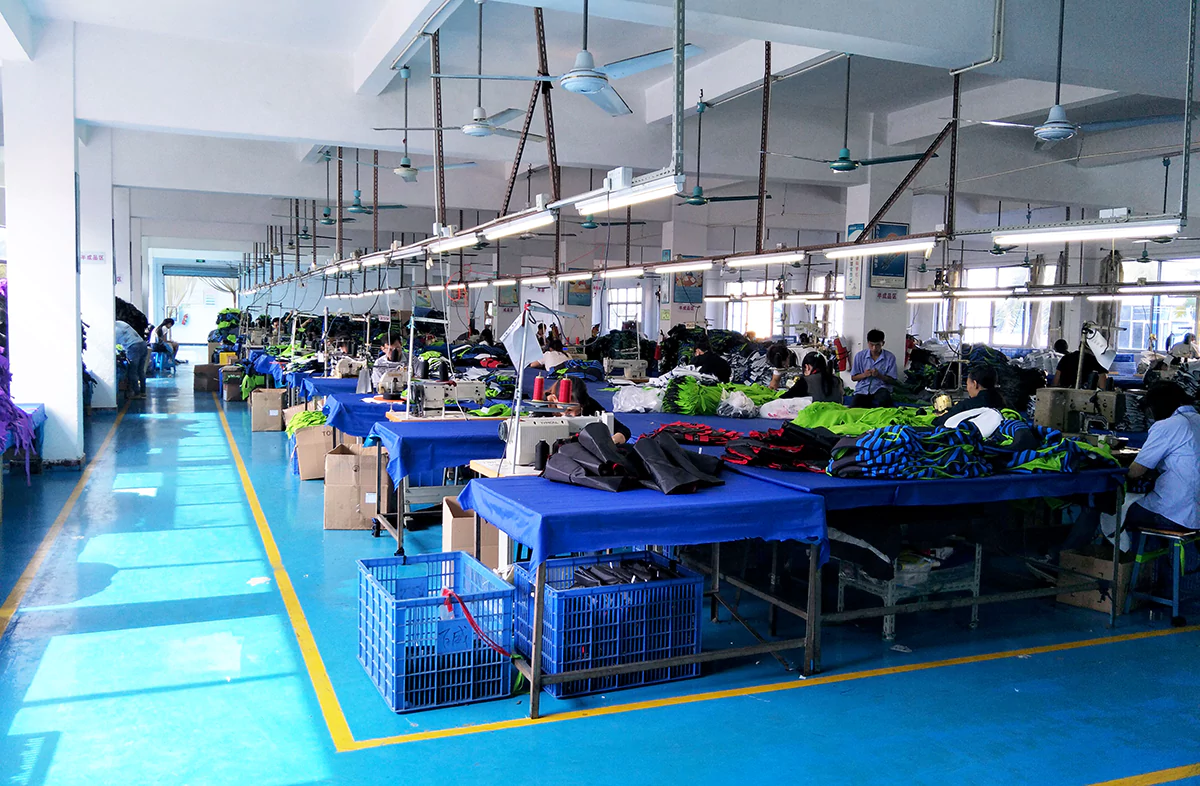
FYBagCustom is Your Trusted Custom Crossbody Bag Manufacturer in China, with 15+ years of manufacturing experience producing crossbody bags, fanny packs, sling bags, and belt bags for active lifestyle and fashion brands worldwide. For buyers developing custom crossbody and fanny pack programs, our capabilities include:
Our 50,000 m² factory in Guangzhou with 10+ production lines produces crossbody and sling bag programs for outdoor brands, athleisure labels, DTC sellers, Amazon FBA businesses, corporate gifting companies, and lifestyle brands.
The crossbody bag market in 2026 is not a single product — it is a diverse ecosystem of sub-categories, strap systems, and customization mechanics that serve vastly different consumers. For B2B buyers developing custom crossbody and fanny pack programs, three core takeaways:
If your 2026 product line includes crossbody bags, sling bags, fanny packs, or belt bags for sport, commute, travel, or fashion, now is the time to finalize tech packs and lock in production. Contact FYBagCustom to discuss strap systems, compartment layouts, charm accessories, and material options — and receive physical samples and transparent quotations, typically within 48 hours.
FYBagCustom’s OEM and ODM team works with outdoor brands, athleisure labels, DTC founders, Amazon sellers, and corporate programs to produce custom crossbody bags and fanny packs — with advanced strap engineering, waterproof construction, charm attachment systems, low MOQ, and samples in 5–7 days.
Start Your Custom Bag Project →