Tel/WhatsAapp:+86 18011919834
E-mail: chloe.x@fybagcustom.com

Tel/WhatsAapp:+86 18011919834
E-mail: chloe.x@fybagcustom.com
Send Your Inquiry Today

Who this guide is for: brand owners, sourcing managers, wholesale buyers, Amazon FBA sellers, DTC founders, sports lifestyle retailers, athleisure labels, and country-club pro shops who are developing personalized tennis totes and racket sport bags for the women’s market. If you want to understand how to engineer hidden racket slots, shoe compartments, and insulated pockets into a bag that looks like a luxury leather handbag — and why combining tennis and pickleball compatibility in a single product doubles your addressable market — this guide covers every development decision from concealed equipment storage to court-side fashion.
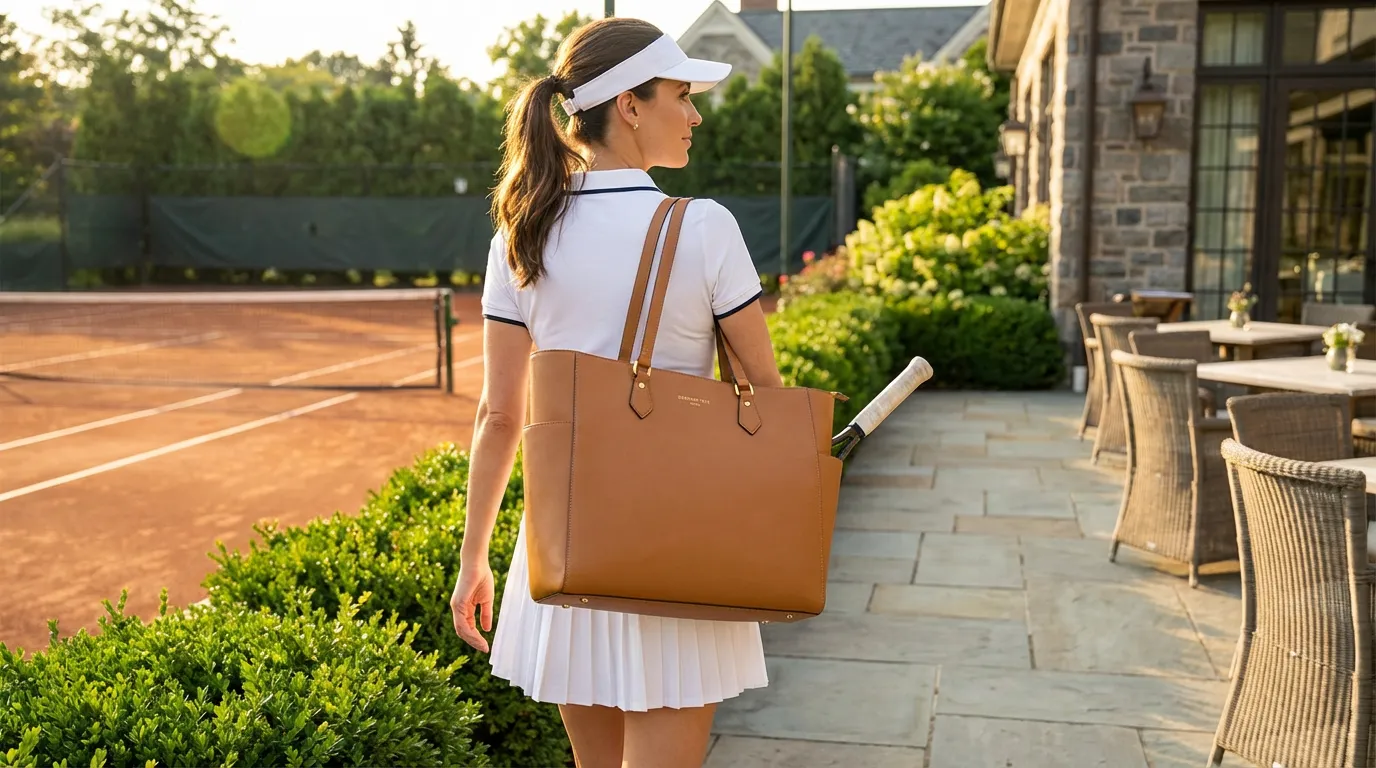
There is a moment in every recreational tennis or pickleball player’s week that exposes the limitations of traditional sports bags: the transition. She finishes a match, wants to meet friends for lunch or run errands, and realizes she is carrying a nylon sack covered in brand logos that clashes with everything she is about to do next. So she either goes home to change bags — wasting time — or carries the sports bag into a restaurant feeling underdressed at the accessories level.
The custom tennis tote exists to eliminate that moment entirely. It is a fashion-grade bag engineered to hold a racket (or a pickleball paddle), shoes, a change of clothes, a water bottle, and personal items — while looking, from every external angle, like a structured leather tote that belongs at a café table, a boutique, or a cocktail bar. The racket is hidden. The shoes are isolated. The sports equipment vanishes inside a bag that looks like it cost $300 at a designer boutique.
In 2026, this “court-to-cocktails” product category has exploded in search volume for three converging reasons: the sustained growth of women’s tennis participation, the parallel surge of pickleball (now the fastest-growing sport in America), and the broader athleisure-to-luxury consumer demand for gear that transitions seamlessly between sport and social contexts. For B2B buyers, the commercial opportunity is amplified by a critical insight: a tote designed to fit a tennis racket also fits a pickleball paddle — meaning a single product SKU can serve both the tennis and pickleball markets, doubling the addressable consumer base without additional development cost.
This guide covers the dual-sport engineering, the hidden compartment architecture, the materials that eliminate the “sports equipment” look, and how to produce a personalized tennis tote through a custom bag manufacturer in China.
Historically, tennis bags and pickleball bags were separate product categories serving separate consumers. In 2026, the two markets are converging at the player level — a significant percentage of pickleball players also play tennis, and vice versa — and at the product level: the equipment is dimensionally compatible.
| Dimension | Tennis Racket | Pickleball Paddle | Implication for Bag Design |
|---|---|---|---|
| Length | 68–74 cm (27–29 in) | 39–44 cm (15–17 in) | A compartment that fits a tennis racket fits a pickleball paddle with room to spare |
| Width (face) | 23–27 cm (9–10.5 in) | 16–21 cm (6–8 in) | Tennis requires the wider compartment; pickleball fits easily |
| Thickness | 2.0–2.5 cm | 1.2–1.6 cm | Tennis is slightly thicker; both fit in the same padded slot |
| Weight | 280–340 g | 200–260 g | No structural difference for bag engineering |
| Balls (size) | 6.5–6.7 cm diameter | 7.4 cm diameter (outdoor) | Both fit standard ball pockets; pickleball is marginally larger |
The commercial insight: a tote with a racket compartment designed to tennis specifications automatically accommodates pickleball paddles. By marketing the bag as compatible with both sports, a single SKU captures search traffic from “custom tennis tote bags” (45K+ monthly searches) AND “custom pickleball bags for women” (growing rapidly) — effectively doubling the product’s organic reach without any engineering changes.
Product-page strategy: use both sport names in the title, bullets, and backend keywords. “Custom Tennis & Pickleball Tote Bag” or “Personalized Tennis Tote — Also Fits Pickleball Paddles” captures both search streams.
Estimated active female players and premium bag search interest.
Twenty million active female racket-sport players is an enormous addressable base — and the segment most likely to purchase a premium, fashion-forward sports tote is the 30–60 age bracket with above-average household income, which describes the core of both sports’ growth demographics.
The hidden racket compartment is what separates a “tennis tote” from a “tote bag that you also use for tennis.” It must hold a full-size tennis racket securely, keep the racket handle from protruding visibly, and integrate into the bag’s silhouette so seamlessly that an observer cannot tell the bag contains sports equipment.
| Approach | How It Works | Racket Visibility | Bag Silhouette Impact | Complexity | Best For |
|---|---|---|---|---|---|
| Full-length internal sleeve | Padded vertical slot inside the bag body, running the full 70+ cm height | Zero — fully hidden, zip-closed | Bag must be at least 70 cm tall (limits the format to tall totes or garment-bag hybrids) | High | Maximum concealment, premium positioning |
| External side tunnel with cover flap | Racket slides into a side-panel sleeve; a material flap folds over the exposed handle | Minimal — handle covered by flap | Slight side bulge visible; flap adds 3–4 cm width | Medium | Best balance of concealment and versatility |
| Diagonal internal slot | Racket sits diagonally across the bag interior, secured by straps | Handle may protrude 5–10 cm at top corner | Bag dimensions must accommodate diagonal length (~58 cm for a 70 cm racket in a standard tote) | Medium | Works in wider totes; partial concealment |
For most B2B tennis tote programs, the external side tunnel with cover flap is the recommended approach. Here is why:
Tunnel specification:
| Element | Specification |
|---|---|
| Tunnel width | 10–12 cm (accommodates racket head width) |
| Tunnel depth | Full bag height + 15 cm (for handle extension above bag top) |
| Padding | 5–8 mm foam on racket-face side (protects strings and frame) |
| Closure | Magnetic snap or Velcro at bottom of tunnel (prevents racket from sliding out) |
| Cover flap | Matching material, 18–22 cm, folds over handle and secures with magnetic snap |
| Position | One side panel (right or left — right is conventional for right-handed players) |
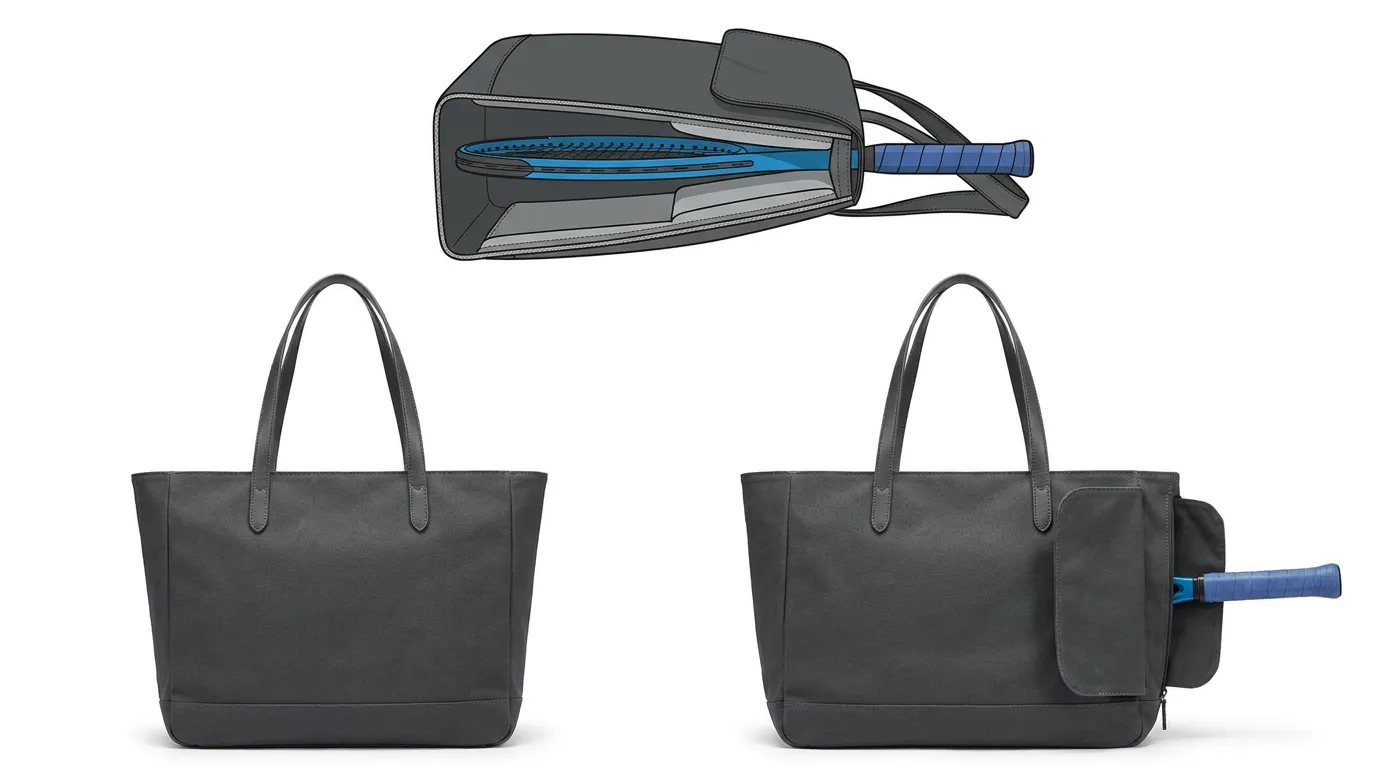
A court-to-cocktails tote must carry two entirely different loadouts — sports gear and personal items — without cross-contamination. The five-zone architecture separates these categories while keeping everything accessible.
| Zone | Location | Contents | Construction | Access |
|---|---|---|---|---|
| Zone 1: Racket tunnel | External side panel | Tennis racket or pickleball paddle | Padded tunnel + cover flap (see above) | External — does not require opening main bag |
| Zone 2: Main compartment | Center body, top-zip access | Personal items: wallet, phone, sunglasses, planner, cosmetics | Standard fashion tote interior with organizer pockets | Top zip or magnetic closure |
| Zone 3: Shoe compartment | Bottom or opposite end panel | Tennis shoes, court shoes, or sneakers | Ventilated (grommets), waterproof divider, separate zip access | External zip — separate from main and racket zones |
| Zone 4: Change-of-clothes section | Rear or internal divider section | Post-match outfit, sports bra, shorts | Breathable mesh divider separating from personal items | Internal access through main compartment or separate zip |
| Zone 5: Insulated bottle pocket | Side panel (opposite the racket tunnel) | 32 oz / 1 L water bottle or tumbler | PEVA or foil-lined, elasticized opening | External — quick access during and after play |
Tennis and pickleball balls need a home that keeps them from rolling around the main compartment. Two approaches:
The internal mesh pocket is recommended for fashion-forward positioning — it maintains the bag’s clean exterior while providing the function.
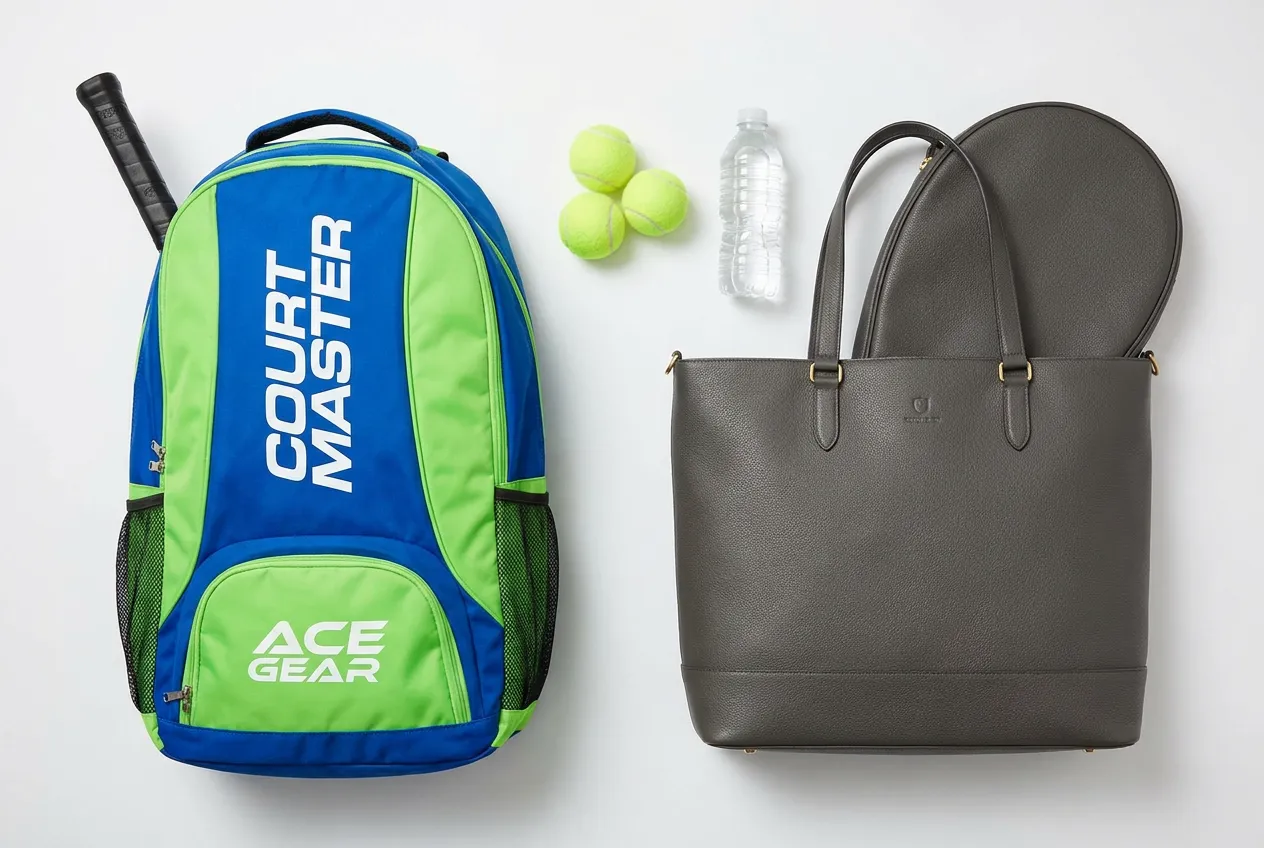
The material is what makes or breaks the “court-to-cocktails” proposition. If the exterior looks like sports equipment — nylon, mesh, bright polyester, reflective accents — the bag fails its primary mission regardless of how well the interior is engineered.
| Material | “Looks Like a Handbag” Score | Court-Side Durability | Weight (empty tote) | Wipe-Clean (post-match sweat, drink spills) | Price Tier |
|---|---|---|---|---|---|
| Pebbled PU leather | 9/10 — closest to designer tote | Good — resists scuffing | 0.9–1.3 kg | Excellent | 150 retail |
| Saffiano-texture PU | 9/10 — structured, editorial | Very good — texture hides wear | 0.9–1.3 kg | Excellent | 160 retail |
| Genuine leather (pebbled) | 10/10 — unmistakable luxury | Very good — ages well | 1.3–1.8 kg | Moderate — needs conditioning | 300+ retail |
| Canvas + leather trim | 8/10 — elevated casual | Excellent — canvas handles court use | 1.0–1.4 kg | Good — canvas may absorb | 120 retail |
| Neoprene | 7/10 — sporty-modern but recognizable | Very good — flexible, resilient | 0.7–1.0 kg | Excellent — water-resistant | 100 retail |
| Performance nylon (fashion-grade, matte) | 6/10 — reads as “elevated athleisure” not “handbag” | Excellent — lightest, most durable | 0.6–0.9 kg | Excellent | 90 retail |
For the “court-to-cocktails” positioning, pebbled PU leather or saffiano-texture PU is the recommended default. Both score 9/10 on “looks like a handbag,” wipe clean instantly (important after handling sweaty equipment), and support all premium branding techniques (debossing, foil, embroidery). They are available in the full fashion color range and photograph indistinguishably from genuine leather on e-commerce listings.
| Color | On-Court Appeal | Post-Match Versatility | Dirt/Scuff Visibility | Photography Performance | Recommendation |
|---|---|---|---|---|---|
| White / cream | Very high — classic tennis aesthetic | High — luxury, editorial | High — shows marks quickly | Excellent — bright, premium | Hero color for tennis-specific branding |
| Butter yellow | Very high — 2026 trend, pops on court | Very high — fashion-forward | Moderate | Excellent | Strong second color |
| Navy | High — classic, country-club | Very high — goes everywhere | Low — forgiving | Good | Safe staple — include in every collection |
| Black | Moderate — less tennis-coded | Universal — maximum versatility | Very low — hides everything | Good — classic | Reliable staple |
| Sage green | High — natural, wellness-aligned | High — trendy, modern | Moderate | Good — distinctive | On-trend complement |
| Blush / dusty rose | High — feminine, warm | High — matches most outfits | Moderate | Very good — Instagram-friendly | Strong for women’s-specific lines |
| Cognac / tan | Moderate — heritage, leather-coded | Very high — timeless | Low–Moderate | Very good — warm | Best for genuine leather programs |
Recommended launch palette: white or cream (hero) + navy (staple) + one trend color (butter yellow or blush) — three colorways that cover the classic tennis aesthetic, the universal neutral, and the 2026 fashion moment.
Every hardware element must reinforce the fashion identity. Sports-bag hardware (plastic buckles, velcro, carabiner clips, elastic bungees) destroys the positioning instantly. Fashion-bag hardware (metal zippers, magnetic snaps, brushed or matte finishes) maintains it.
| Component | Sports Bag Default | Fashion Tennis Tote Specification | Why It Matters |
|---|---|---|---|
| Main closure | Drawstring or open top | Full-width YKK metal zip or magnetic snap closure | Open-top reads as “gym bag”; closure reads as “handbag” |
| Zipper pulls | Plastic or rubber cord | Custom-engraved metal pulls | First tactile touchpoint; metal signals quality |
| Handle hardware | Plastic rings, velcro wrap | Zinc alloy riveted attachment + bartack stitching | Metal hardware signals permanence and investment |
| Shoulder strap attachment | Plastic snap hooks | Swivel snap hooks, zinc alloy, matching finish | Must match all other hardware; swivel prevents tangling |
| Base feet | None | 4–5 metal feet (matching hardware finish) | Protects base from court surface, locker room floors, restaurant floors |
| Interior D-ring | None | 1–2 welded D-rings for key clip or leash attachment | Small detail; signals intentional design |
A loaded tennis tote (racket + shoes + clothes + bottles + personal items) weighs 5–9 kg. The handle system must support this weight comfortably for shoulder carry across a parking lot, a clubhouse corridor, or a city block.
Include a removable adjustable shoulder strap (100–130 cm) for crossbody or long-shoulder carry. This adds 3.00 per unit and significantly broadens appeal for consumers who walk or bike to courts.
Personalization in the tennis tote category follows the same pattern as other premium lifestyle bags: the consumer wants the bag to feel like hers, with discreet branding that signals taste rather than volume.
| Technique | Visual Effect | Best Surface | Durability (sport use) | Per-Unit Cost | Best For |
|---|---|---|---|---|---|
| Tonal debossed monogram | Subtle, luxury, country-club | PU leather, genuine leather | Excellent — pressed into material | 2.50 | Premium positioning, club culture |
| Gold/silver foil initials | Elegant, visible, classic | PU leather, genuine leather | Good — resists outdoor conditions | 3.50 | Gifting, personal branding |
| Embroidered name + racket icon | Sporty-premium, identifiable | Canvas, nylon | Excellent — thread is permanent | 5.00 | Team orders, club merchandise |
| Custom leather patch with initials | Heritage, brand-building | Any material (patch attached) | Very good — leather is durable | 5.00 | Brand signature, collection-level |
| Engraved metal nameplate | Hardware-grade, minimal | All materials (riveted) | Exceptional | 6.00 | Ultra-premium, executive gifting |
Clubs, leagues, and team programs represent a significant B2B revenue stream for branded tennis totes. A country club or pickleball league ordering 20–100 matching totes with the club logo and each member’s name creates a high-AOV group order with strong reorder potential (new members, seasonal refreshes, tournament gifts).
| Program Type | Typical Order | Branding | Personalization | Price Tier |
|---|---|---|---|---|
| Country club member gift | 50–200 pcs | Club logo (debossed or embroidered) | Member name (foil or embroidery) | Premium (150) |
| League / team order | 10–30 pcs | League name + team color | Player name | Mid (90) |
| Tournament prize / gift | 20–50 pcs | Tournament name + sponsor logos | Winner’s name (if applicable) | Mid–Premium (120) |
| Pro shop retail | 30–100 pcs | Shop or club brand | Optional personalization service | Mid (100) |
A fashion tennis tote must be large enough to hold a racket internally or semi-internally, shoes, clothes, and personal items — but not so large that it looks like luggage. The dimensional balance is tighter than in most bag categories.
| Configuration | Width | Height | Depth | Internal Volume | Racket Solution | Visual Read |
|---|---|---|---|---|---|---|
| Compact (pickleball-optimized) | 38–42 cm | 30–33 cm | 15–18 cm | 17–22 L | External tunnel (paddle only) or diagonal slot | Fashion tote — barely reads as sport |
| Standard (tennis + pickleball) | 42–48 cm | 33–38 cm | 16–20 cm | 22–30 L | External tunnel with cover flap (fits racket) | Large tote — reads as structured work/travel bag |
| Oversize (multi-racket) | 48–55 cm | 36–42 cm | 18–22 cm | 30–40 L | Internal full-length sleeve or dual-tunnel | Approaches weekender territory — use with caution |
The standard configuration (42–48 cm wide, 33–38 cm tall) is the commercial sweet spot for a dual-sport tennis/pickleball tote. It accommodates a full-size tennis racket in the external tunnel, fits shoes and a change of clothes in the separated zones, and still reads as a large structured tote rather than a sports duffle. The compact configuration works for pickleball-only brands or consumers who do not carry a racket in the bag.
| Stage | Duration | Key Deliverables |
|---|---|---|
| 1. Design brief / tech pack | 3–7 days | Dimensions, racket tunnel spec, zone layout, material, hardware |
| 2. Material + hardware sourcing | 5–10 days | Swatches, zipper samples, magnetic closure samples |
| 3. First sample (proto) | 7–12 days | Racket-fit test, shoe compartment check, silhouette review |
| 4. Revision sample | 5–10 days | Fine-tune tunnel width, flap closure, handle comfort |
| 5. PP sample | 5–7 days | Final locked reference for bulk |
| 6. Bulk production | 25–40 days | Volume-dependent |
| 7. QC + packing | 3–5 days | Racket-fit test on 10% of batch, handle load test, zip cycle test |
| 8. Shipment | 3–7 days | Sea/air/express, FBA prep if applicable |
Total: roughly 55–85 days from brief to shipment. The racket-tunnel engineering adds approximately 3–5 days to the sample phase compared to a standard tote, primarily in fit-testing and flap-mechanism refinement.
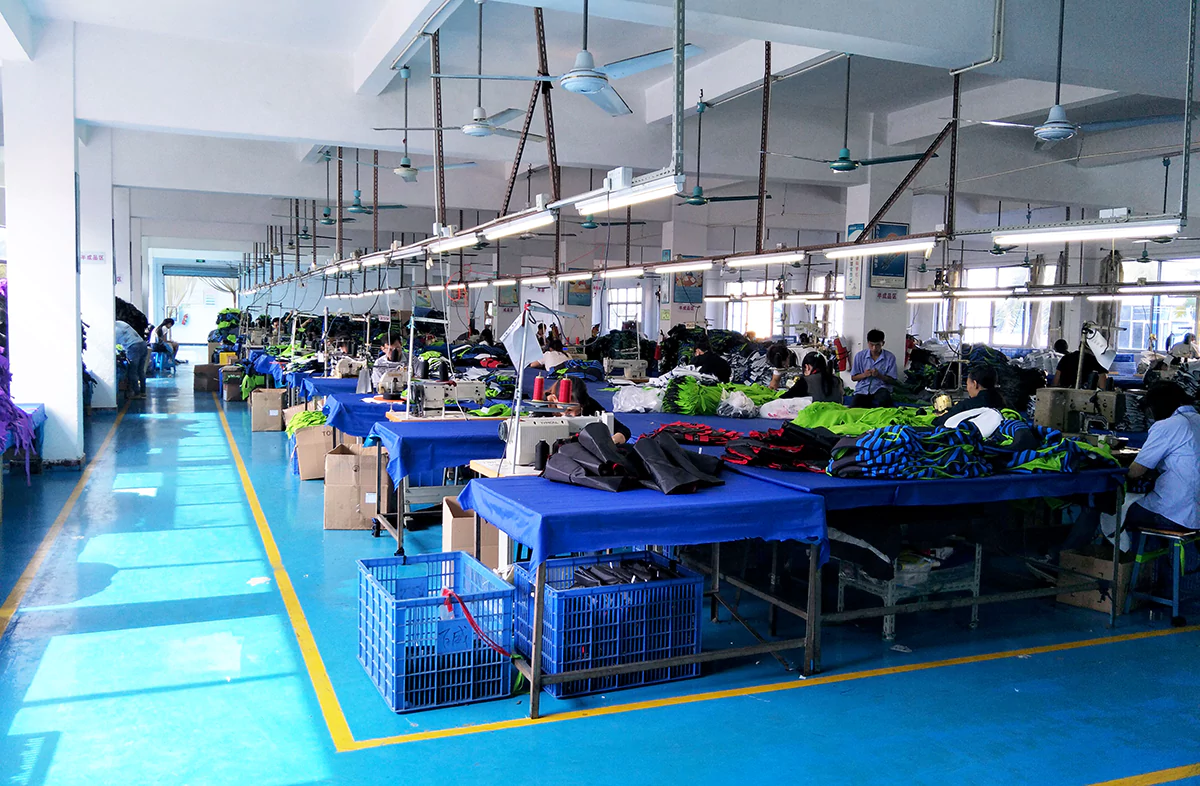
FYBagCustom is Your Trusted Custom Tote Bag Manufacturer in China, with 15+ years of manufacturing experience producing structured totes, multi-compartment bags, and sport-lifestyle accessories for brands worldwide. For buyers developing custom tennis and pickleball totes, our capabilities include:
Our 50,000 m² factory in Guangzhou with 10+ production lines produces sport-lifestyle tote and structured bag programs for DTC brands, Amazon FBA sellers, country clubs, tennis retailers, athleisure labels, and lifestyle brands across international markets.
The custom tennis tote is one of the few product categories where fashion and function are not in tension — they are the same value proposition. The bag must look like a designer handbag to succeed at “court-to-cocktails,” and it must hide a racket to succeed as sports gear. For B2B buyers developing tennis and pickleball totes in 2026, three core takeaways:
If your 2026 product line includes tennis totes, pickleball bags, or court-to-lifestyle accessories, now is the time to finalize racket tunnel engineering, zone architecture, and material selection. Contact FYBagCustom to discuss hidden compartment options, dual-sport compatibility, and personalization programs — and receive physical samples with racket-fit verification, typically within 5–7 days.
FYBagCustom’s OEM and ODM team works with sports lifestyle brands, DTC founders, Amazon sellers, country clubs, and athleisure labels to produce custom tennis and pickleball totes — with hidden racket tunnels, ventilated shoe compartments, fashion-grade leather, and personalized branding at low MOQ with samples in 5–7 days.
Start Your Custom Bag Project →