Tel/WhatsAapp:+86 18011919834
E-mail: chloe.x@fybagcustom.com

Tel/WhatsAapp:+86 18011919834
E-mail: chloe.x@fybagcustom.com
Send Your Inquiry Today

Who this guide is for: corporate procurement teams, HR and marketing leads, and promotional-products distributors running year-end gift programs — the branded bags a company gives its employees, clients, and partners as the year closes. Corporate holiday gifting is one of Q4’s largest and most deadline-intense verticals, and it runs on a calendar unlike any consumer program: budgets are approved in late September or October, recipients and quantities are finalized in stages, and delivery is immovable — before the holiday party, before the office closes, before the client’s own year-end. The entire program compresses into roughly eight weeks between decision and desk. This guide covers what is genuinely producible inside that window, the three-tier gift architecture that matches bags to hierarchy and compliance thresholds, the branding rules that determine whether the gift gets used or donated, and the kitting and delivery logistics that the distributed workforce has made mandatory. It complements our general corporate-gifting guide by focusing entirely on the holiday-specific timeline and tiers.
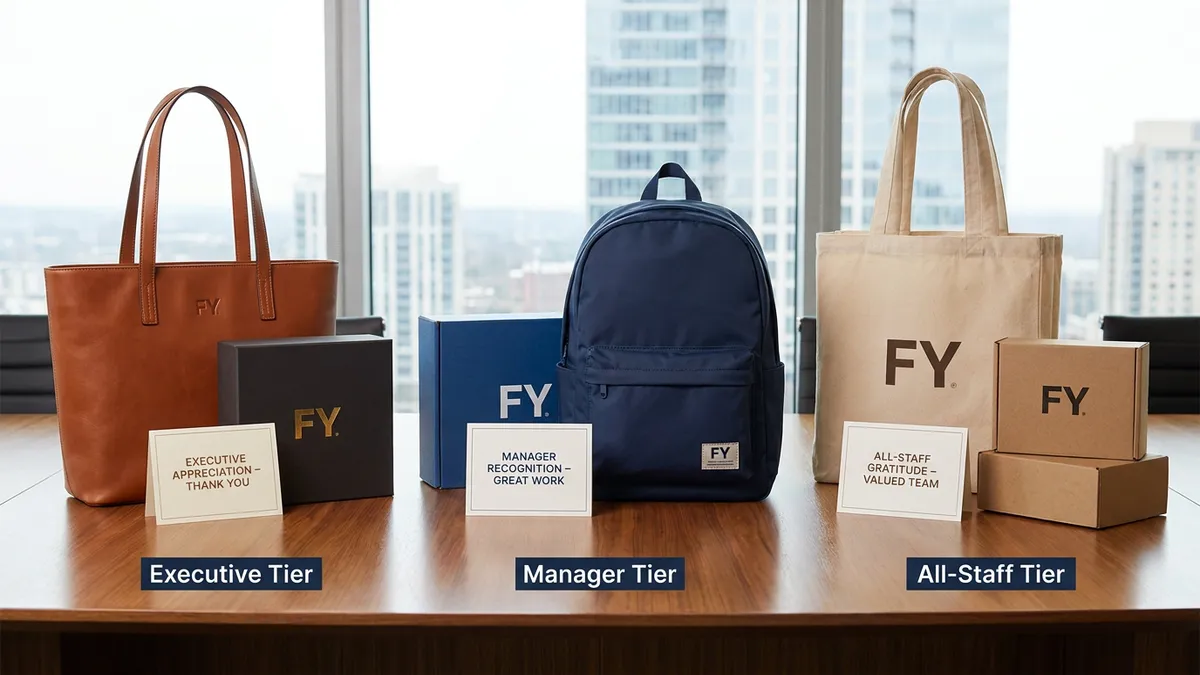
Every December, companies hand out bags. The laptop tote for the leadership team, the commuter backpack for the sales organization, the canvas tote in the all-hands gift kit — the bag is the corporate gift category’s most durable performer because it is the rare promotional product that recipients actually carry, and every carry is a brand impression the company did not pay media rates for. A well-chosen corporate bag delivers years of daily visibility; a badly chosen one goes to the back of a closet by January, taking the program’s entire budget with it.
The difference between those two outcomes is decided in an eight-week corridor. Corporate gifting budgets live inside fiscal-year planning, which means final approval routinely lands in late September or October — after the consumer holiday programs described in our production timeline guide have already sailed. Delivery, meanwhile, is fixed by the corporate calendar itself: gifts must land before the holiday party, before offices empty in the third week of December, and in many client-gifting programs before the client’s own fiscal close. Between approval and delivery sits a window of six to nine weeks in which the program must be specified, sampled or approved, produced, branded, shipped, kitted, and delivered — a compression that punishes indecision and rewards buyers who understand exactly what each production route can and cannot do inside it.
That is the purpose of this guide: not to describe the ideal corporate bag program (our general corporate-gifting guide does that), but to map the holiday version — the one that starts late, ends hard, and succeeds on tier architecture, branding restraint, and logistics discipline.
The first decision in a late-approved program is the production route, because the route determines everything downstream. Three routes exist, and the window admits them differently.
| Route | What It Is | Timeline (Production + Freight) | Customization Depth | When It Fits |
|---|---|---|---|---|
| Stock-adapted | An existing, proven pattern (a standard laptop tote, commuter backpack, or zip pouch) produced in stock or near-stock materials, with the company’s branding applied | 3–5 weeks by air; 7–9 weeks by ocean | Branding (deboss, print, embroidery, woven label), color selection from available articles, packaging | The late-approved program’s workhorse — an October approval can still deliver by early December via expedited production and air or fast-ocean freight |
| Semi-custom | A stock pattern modified — the company’s color on a lab dip, an added interior pocket, custom lining, upgraded hardware, full custom packaging | 6–8 weeks by air; 10–12 by ocean | Meaningful differentiation without new pattern development | The September-approved program, or the October program willing to pay air freight on the full order |
| Full custom | A new design: dedicated pattern, custom materials, bespoke construction | 12–18 weeks | Complete | Not a holiday-window route. Full-custom corporate programs are planned in Q2–Q3 for December delivery — which is the single most valuable planning lesson this vertical teaches, and the reason next year’s flagship program should be briefed in June |
The route decision rule: count backward from your hard delivery date (typically December 5–15 for domestic distribution), subtract kitting and last-mile time, and let the remaining weeks choose the route. An honest factory will tell you which routes have already closed; a dangerous one will accept a full-custom brief in October and deliver it in January.
Corporate gift programs are tiered by relationship, and the tiers carry two constraints consumer programs never face: internal equity (employees compare gifts, and the tiers must read as fair within each level) and compliance thresholds (most companies — and many of their clients’ procurement policies — cap the value of gifts that can be given to or accepted by business contacts; the client-facing tiers must sit safely under the applicable caps, which the buyer’s compliance team defines).
| Element | Specification |
|---|---|
| The bag | A premium leather or top-grade PU piece: a structured laptop tote, a slim portfolio, or a refined weekender — a bag the recipient would credibly have bought |
| Construction | The sweet-spot package and above: foam-backed panels, multi-coat beveled edges, twill or microsuede lining, matched hardware in one finish — this tier’s recipients own good bags and will benchmark the gift against them |
| Branding | Minimal to invisible (see the branding section) — blind deboss, interior label, or a branded charm; at this tier, visible logo size is inversely proportional to perceived value |
| Quantity | Typically 20–150 units — which makes this tier the natural candidate for the semi-custom route even in a compressed window, since small quantities produce and air-freight fast |
| Packaging | Full gift presentation: rigid or magnetic box, tissue, ribbon, and a space for the executive’s handwritten card |
| Element | Specification |
|---|---|
| The bag | The functional-premium middle: a commuter backpack with laptop protection, a structured work tote, a crossbody tech bag |
| Construction | Solid commercial-plus: reinforced anchors as always, organized interiors, quality zippers — the tier is judged on daily usefulness |
| Branding | Small and considered: a woven label, a small deboss on a leather trim patch, a subtle hardware mark |
| Quantity | Hundreds — the route math typically lands on stock-adapted with meaningful branding |
| Packaging | Gift box or premium sleeve with a program card |
| Element | Specification |
|---|---|
| The bag | The useful, durable, universal piece: a canvas or cotton tote, a nylon or polyester packable tote or tech pouch, a drawstring gym bag |
| Construction | Honest volume quality: the bag must survive real use, because a gift that fails in February is a worse outcome than no gift — reinforced handle attachments and clean seams are non-negotiable even at this tier |
| Branding | The most visible branding in the program lives here, and it still benefits from restraint: a well-designed one-color print or embroidery beats a full-wrap logo |
| Quantity | Thousands — this tier is where the ocean-vs-air math matters most, and where an early quantity commitment (even a range) buys the program weeks |
| Packaging | Efficient and kind: a branded band or sleeve rather than a full box; at volume, the box budget is better spent on the bag |
The equity note: tiers must differ by register, not by visible corner-cutting. An all-staff tote with fraying seams next to an executive leather tote reads as a statement about how the company values its people — the opposite of the program’s purpose. Every tier gets structural integrity; the tiers vary in material and refinement.
The corporate gift bag’s entire ROI depends on one behavior: the recipient carrying it. Every branding decision should be tested against that behavior, and the evidence of decades of promotional products is consistent — the larger and louder the logo, the shorter the bag’s life in circulation.
| Rule | Practice |
|---|---|
| The recipient-first test | Before approving any branding layout, ask: would the recipient carry this into a meeting with a competitor? On a weekend? If the answer is no, the branding has converted a gift into an advertisement — and people do not carry advertisements voluntarily |
| Deboss beats print at the top tiers | A blind deboss on leather or PU reads as craftsmanship; a printed logo reads as promotion. Tier 1 and 2 branding should be tonal, textural, and small |
| The interior is prime branding territory | A branded lining, an interior woven label, a logo on the inside slip pocket — the recipient sees it daily, guests see it occasionally, and the exterior stays carryable |
| The removable brand element | A branded charm, luggage tag, or twilly delivers the logo as a detachable accessory — the recipient who wants a plain bag keeps carrying the bag, and the tag lives on their luggage |
| Co-branding hierarchy | When the program celebrates a partnership or anniversary, the recipient’s usability still wins: dates and campaign marks belong inside or on the tag, not across the front panel |
| One brand application per surface | Logo on the front AND the strap AND the hardware AND the lining is a uniform, not a gift; choose the one placement per tier and execute it well |
The corporate gift’s logistics changed permanently when the workforce distributed. The program that once shipped ten pallets to one headquarters now splits across three delivery models — and the model must be chosen at briefing, because it changes the packing specification at the factory.
| Model | How It Works | Factory Packing Implication |
|---|---|---|
| Bulk to site | The full order ships to one or a few offices; internal teams distribute | Standard master cartons, tier-segregated and clearly marked; the simplest and cheapest model |
| Kitted to site | Each gift is individually boxed with its card and any kit items (the bag + a drinkware piece + a notebook is the classic corporate kit), then shipped in bulk for desk-drop distribution | Per-unit gift assembly at the factory or a kitting partner — box, tissue, card insertion, kit-item consolidation — specified as a packing operation with its own line time |
| Drop-ship to recipient | Each gift ships directly to an employee’s or client’s home address — the remote-workforce standard | Per-unit shipping cartons, address-file coordination, staggered dispatch, and (for client programs) discreet packaging with no price or PO documentation inside; the factory or 3PL needs the address file 2–3 weeks before dispatch, and the program needs an address-collection mechanism (a redemption page where recipients confirm their own address and, ideally, choose their color — which converts a logistics chore into a gift experience) |
| Personalization at scale | Hot-foil or embroidered initials per recipient | Feasible inside the window for Tier 1 and 2 quantities if the name file arrives with the PO; a per-unit operation that must be scheduled, not assumed — and the single highest-impact upgrade in the program, because a monogrammed gift cannot be regifted and will not be left in a closet |
| Milestone | Timing | Note |
|---|---|---|
| Budget approval + brief | Late September – mid October | The window opens; the route decision is made here — and every week of internal deliberation after approval is a week taken directly from production |
| Sample / pre-production approval | 1–2 weeks after brief | Stock-adapted programs approve from an existing sample with a branding proof (a photographic or physical strike-off of the deboss/print); semi-custom programs need a physical sample — build the courier days into the plan |
| Production | 2–4 weeks (stock-adapted, expedited) to 5–6 weeks (semi-custom) | Branding operations (deboss, print, embroidery) run inline; personalization files must arrive before this stage closes |
| Freight | Air: about a week door-to-door; expedited ocean/sea-air: 3–4 weeks | The route’s freight mode was decided at briefing; late programs are air programs, and the budget should have said so from day one |
| Kitting + dispatch | 1–2 weeks | Kitted and drop-ship models consume real calendar here; bulk-to-site consumes almost none |
| Delivery | December 5–15 | Before the parties, before the office closes, before the client’s year-end — the immovable line the whole calendar serves |
The two dates that save programs: commit quantities (even as a range) at briefing rather than after internal headcount confirmation — the factory can reserve materials and line time against a range; and deliver the personalization/address files within one week of PO — the files, not the production, are the most common cause of a missed December date.
| Approval Date | The Honest Options |
|---|---|
| September | All routes except full custom; semi-custom with lab-dip color and custom packaging by expedited ocean; the comfortable version of this program |
| Early October | Stock-adapted by fast ocean or semi-custom by air; Tier 1 semi-custom remains open (small quantities fly cheap) |
| Late October | Stock-adapted by air; branding limited to fast operations (print, deboss, embroidery on stock articles); packaging from the factory’s ready program |
| November | Stock-program bags with expedited branding, air-freighted; OR the graceful alternative — a January “New Year” program, which arrives when desks are less crowded with gifts and reads as considered rather than late; several of the best corporate programs are deliberately January programs |
| Any date, next year | Brief the flagship full-custom program in June; the companies whose December gifts get talked about are the ones that treated the holiday program as a Q2 project |
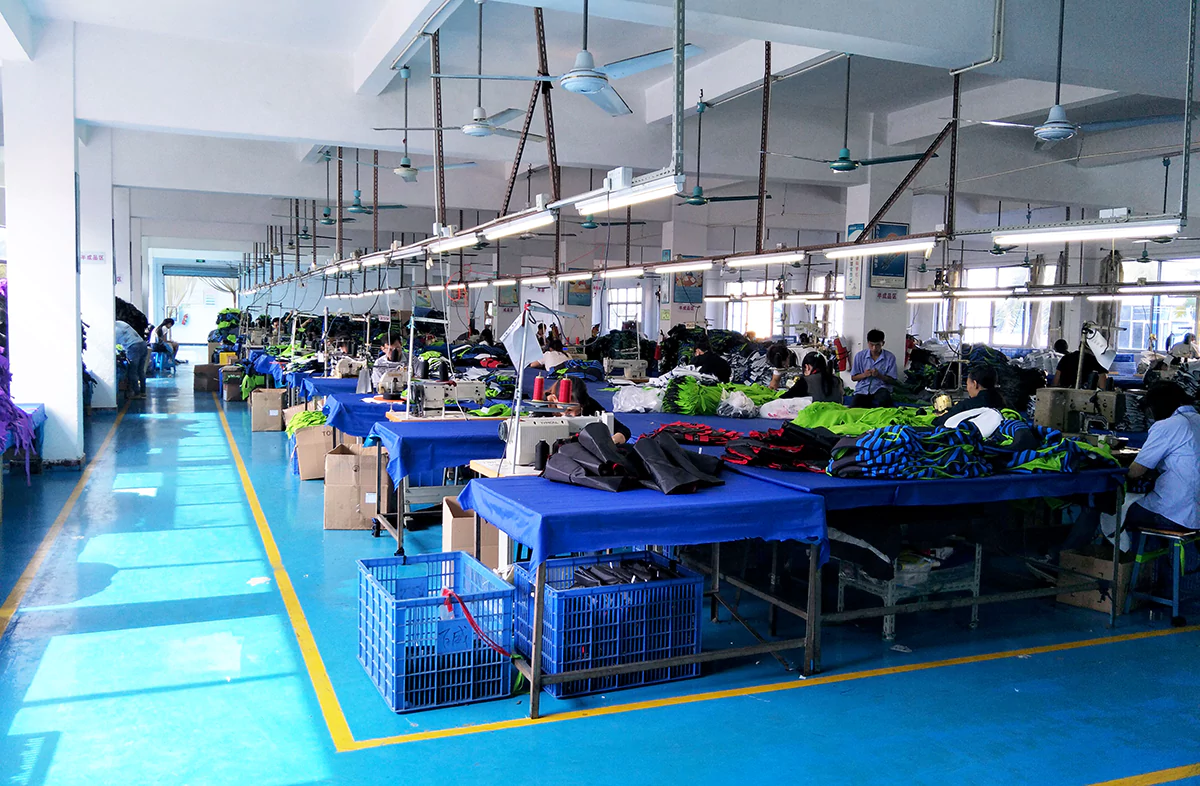
FYBagCustom is Your Trusted Custom Bag Manufacturer in China, with 15+ years of manufacturing experience, 500+ staff, and the parallel capacity that compressed corporate programs demand. For procurement teams and distributors running year-end programs, our capabilities include:
Contact our corporate program team to brief your year-end program — the tiers, the branding, the delivery model, and the route that still fits your calendar.
Corporate holiday gifting compresses a full production program into the space between budget approval and the office party — and it rewards the buyers who make the route, tier, and logistics decisions in the first week rather than the fourth. For procurement teams and distributors, three core takeaways:
If you are running a year-end gift program and the window is already open, contact FYBagCustom to brief the tiers, lock the route, and receive branded strike-offs in 5–7 days — while the routes you want are still on the table.
FYBagCustom runs three-tier corporate programs inside the 8-week window — executive leather to all-staff volume, debossed to embroidered, kitted to drop-shipped — planned backward from your delivery date with honest route counsel on day one. Branded strike-offs in 5–7 days.
Start Your Custom Bag Project →