Tel/WhatsAapp:+86 18011919834
E-mail: chloe.x@fybagcustom.com

Tel/WhatsAapp:+86 18011919834
E-mail: chloe.x@fybagcustom.com
Send Your Inquiry Today

Who this guide is for: DTC brand owners and inventory planners preparing for Black Friday–Cyber Monday — the five-day window that, for most direct-to-consumer handbag brands, concentrates the largest revenue of the year into a single long weekend. BFCM is usually discussed as a marketing problem: the offer, the creative, the email cadence, the ad budget. But by the time the first campaign email sends, the event’s outcome is already largely decided — by production and inventory choices made months earlier. How deep the hero SKU was bought. Whether the event runs on discounts, exclusives, or bundles — three models with three different production briefs. Whether a gift-with-purchase was manufactured in time to be free. And whether anyone understood the event’s defining constraint: a five-day sales window cannot be restocked. This guide covers BFCM from the production side — the inventory architecture, the exclusive-drop spec, the bundle and GWP manufacturing, and the depth math that separates a record weekend from a stockout on Saturday morning.
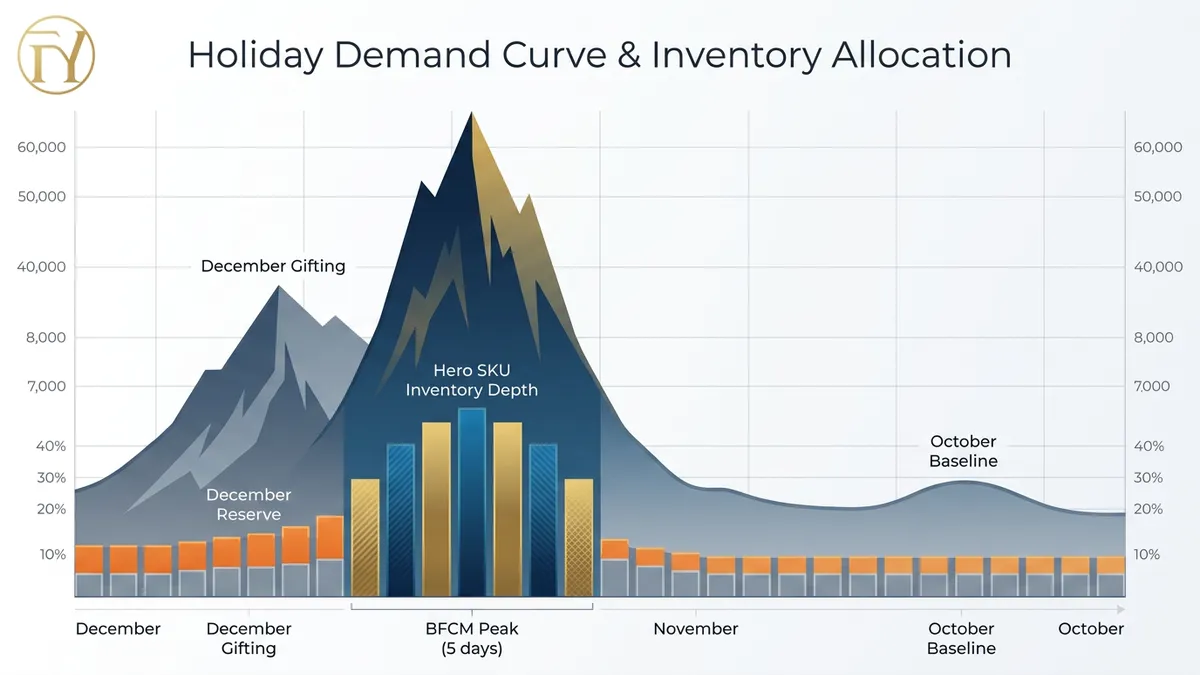
Black Friday–Cyber Monday compresses demand like nothing else in the DTC calendar. Traffic multiplies, conversion rates climb as purchase intent peaks, and daily sales velocity on a brand’s best-sellers runs at several times — often three to eight times — the normal November baseline. For a typical DTC handbag brand, the five days from Black Friday through Cyber Monday can produce more revenue than the entire preceding quarter’s average month, and the weekend’s performance sets the tone for December gifting, January cash flow, and the spring production budget.
The compression is also the trap. A demand spike this sharp and this short has a property that no other selling period shares: it cannot be resupplied. A hero SKU that sells out on Saturday afternoon is gone for the remainder of the event — no production restart, no expedited freight, no FBA transfer arrives inside a 72-hour window. Every unit the brand will sell during BFCM must exist, in the right warehouse, sellable, before the event begins. Which means every meaningful BFCM decision — depth, breadth, exclusives, bundles, gifts-with-purchase — is a production decision with a deadline months before the first countdown timer goes live. (The full backward calendar lives in our holiday production timeline guide; this article assumes the calendar and covers the strategy that fills it.)
The single most consequential BFCM inventory principle inverts normal assortment logic. Through the year, a brand grows by breadth — new silhouettes, new colorways, new categories. BFCM traffic behaves differently: discount-motivated and gift-motivated shoppers converge overwhelmingly on the proven best-sellers. The hero crossbody in black, the signature tote in cognac — the SKUs with the reviews, the social proof, and the “most popular” badges absorb a disproportionate share of event demand, while the long tail of the catalog barely accelerates.
| Principle | Practice |
|---|---|
| Concentrate the buy on the top 3–5 SKUs | The hero SKUs should carry the deepest inventory position of the year going into late November — this is the moment the whole year’s production planning exists to serve |
| Depth math, honestly done | Forecast per hero SKU: last year’s BFCM units × this year’s growth rate, sanity-checked against October’s daily velocity × the event multiplier (3–8×, weighted by how aggressive the offer is) × 5 days — then add the December reserve (below) on top |
| The long tail gets minimums, not depth | Secondary colorways and niche silhouettes hold normal stock; a stockout on the sage-green mini during BFCM is a shrug, a stockout on the black hero is the event’s headline failure |
| Waitlist and signup data are depth signals | Email captures on “notify me” flows, waitlist joins on the hero, and October add-to-cart rates are the best forward indicators the brand owns — read them in September, when the depth decision is still actionable |
The asymmetry that justifies over-buying the hero: an unsold hero unit after BFCM is not dead stock — it is December gifting inventory, January full-price inventory, and eventually, at worst, a modest markdown. An unmet hero order during BFCM is revenue that evaporated at the year’s highest-intent moment and a customer acquired by a competitor’s ad instead. For proven heroes, the cost of too much is weeks of carrying cost; the cost of too little is the event. Buy accordingly.
How a brand shows up for BFCM is a strategic choice among three models, and each one hands the factory a different brief.
The classic: a percentage off everything, or tiered discounts by spend.
| Dimension | Reality |
|---|---|
| Revenue mechanics | Maximum traffic conversion; the offer is simple and the shopper understands it in one second |
| The margin cost | The discount comes straight off the contribution margin of every unit — including units that would have sold anyway in December at full price |
| The brand cost | Repeated annual discounting trains the customer base to wait for November; premium-positioned brands pay this cost for years |
| The production brief | Pure depth: no new SKUs, no special packaging — just the hero-depth math above, executed early. The simplest brief and the most punishing if the depth is wrong, because the discount guarantees the demand spike arrives |
Instead of discounting the line, the brand releases something that exists only for the event: an exclusive colorway, a special edition, a bag that is itself the offer.
| Dimension | Reality |
|---|---|
| Revenue mechanics | Full margin on every unit; urgency comes from scarcity and exclusivity rather than price; the drop generates its own content and press |
| The brand benefit | No discount training; the premium position survives November intact — this is the model quiet-luxury and premium DTC brands increasingly run |
| The risk | An exclusive that misses (wrong color, weak creative) has no discount to fall back on mid-event |
| The production brief | The lowest-risk exclusive is an exclusive colorway of the proven hero: the same pattern, the same dies, the same construction — one new lab dip and a dedicated small-to-mid production run. No new pattern development, no new tooling, no fit risk; the newness is entirely in the color and the story. Development adds only the lab-dip cycle (3–5 days) to a standard reorder timeline. Deep-red, forest, or a metallic-hardware variation of the black hero are the archetypes — event-coded without being novelty |
| The scarcity spec | Produce the exclusive at a quantity designed to sell out on day two or three — the sellout IS the marketing, and it fuels the next event’s waitlist; but state the limited quantity honestly in the campaign, and never re-run the “exclusive” in January (the customers who bought the scarcity remember) |
The value-add model: order value raised and generosity signaled without touching the per-unit price of the hero.
| Dimension | Reality |
|---|---|
| Revenue mechanics | Bundles raise average order value; a gift-with-purchase (GWP) converts hesitant traffic with “free” — the most powerful word of the weekend — while the hero’s price integrity holds |
| The margin logic | The GWP item’s production cost is a fraction of an equivalent percentage discount on the hero; a small pouch gifted free “with any bag order” costs the brand far less than the discount that would generate the same conversion lift |
| The production brief | The GWP and bundle items are real products that must be manufactured, on the same calendar as everything else: a zip pouch or cardholder in the hero’s own material (cut from the bag program’s material buffer, per small-goods economics), a bag charm, a twilly, a dust-bag upgrade. The classic failure is deciding on the GWP in October — after the production window has closed — and gifting something generic from a promo catalog that undercuts the brand it is meant to flatter |
| The bundle spec | Bundles (bag + wallet; bag + pouch + charm) are packing configurations with their own SKU codes, assembled at the factory or 3PL before the event — a November warehouse assembling bundles during the event is a fulfillment bottleneck built by the September planning meeting |
Most strong BFCM programs blend Models 2 and 3: an exclusive colorway drop as the event’s centerpiece, a GWP threshold (“free pouch on orders over the threshold”) lifting AOV underneath it, and no sitewide discount at all — full margin, protected positioning, and a production brief that consists of one lab dip, one small-goods run, and hero depth.
Every other selling season has a recovery mechanism. Spring can restock. Even the December gifting window has the early-November air-freight option covered in our timeline guide. BFCM has nothing: the event is five days, and the fastest conceivable resupply — an air shipment of finished goods already sitting at the factory — takes longer than the event lasts.
| Consequence | Planning Response |
|---|---|
| Every sellable unit must be in position before day one | Inventory in the fulfillment location — not on the water, not in receiving, not in an FBA check-in queue — by mid-November at the latest; Q4 receiving delays (especially FBA) mean the physical arrival target is two-plus weeks earlier |
| Mid-event allocation is the only lever left | If the hero runs low on Sunday, the remaining choices are throttles: pause the ad spend driving that SKU, remove it from the sale, or let it sell out and redirect traffic to the second hero — decide the priority order before the event, in writing, so Sunday’s decision takes five minutes instead of a panicked meeting |
| Split inventory positions are a pre-event decision | Brands selling on both DTC and a marketplace must allocate hero depth between channels before the event; moving units between a 3PL and FBA mid-event is not a real option in Q4 |
| The “sold out” page is part of the plan | A hero sellout should land on a designed page: the waitlist capture, the second-hero redirect, the December restock date — turning the stockout into next season’s demand signal instead of a dead end |
BFCM’s second classic failure is quieter than the Saturday stockout: the event succeeds so well that it strips the inventory December needed. The gifting weeks between Cyber Monday and the shipping cutoffs are, combined, comparable in volume to the event itself for many brands — and they sell at full price. A BFCM plan that lets the weekend consume the entire hero position trades December’s full-margin units for November’s discounted ones.
| Practice | Mechanics |
|---|---|
| The December reserve | Decide, per hero SKU, the unit count December requires (gifting velocity from last year, plus the post-Christmas week), and treat it as untouchable in the BFCM forecast — the event’s sellable depth is the total position minus the reserve |
| The soft gate | Operationally, the reserve can be a simple inventory hold in the commerce platform, released December 1 — the event sells to its allocation and “sells out,” and the listing returns for gifting at full price two days later, which reads to customers as a restock rather than a rationing |
| The gift-configuration split | Per our gift assortment guide, the same production run packs in standard and gift-ready configurations; the December reserve is the gift-ready allocation, which also cleanly separates the two demand streams in inventory reporting |
The full calendar lives in the timeline guide; the BFCM-specific overlays:
| Milestone | Timing | BFCM-Specific Note |
|---|---|---|
| Event model decision + depth forecast | July–August | The exclusive-colorway lab dip and the GWP small-goods run must be IN the production order — they cannot be appended in October |
| Production complete | Late August – mid September | Hero depth, exclusive run, GWP items, and bundle components in one coordinated completion |
| Freight | September | One sailing carries the whole event |
| In fulfillment position | Late October – early November | Physically checked in and sellable — the FBA queue and 3PL receiving backlog are inside this date, not after it |
| Bundle assembly + gift configuration | Early November | Done before traffic arrives, not during it |
| Allocation decisions in writing | Mid November | Channel splits, December reserve, mid-event throttle priorities — decided while calm |
| The event | Late November | Execution only; every inventory decision already made |
| The January wave | Plan in November | Returns and exchanges spike after gifting season; the reverse-logistics and exchange-inventory plan is part of the BFCM plan, because the event’s volume is the wave’s source |
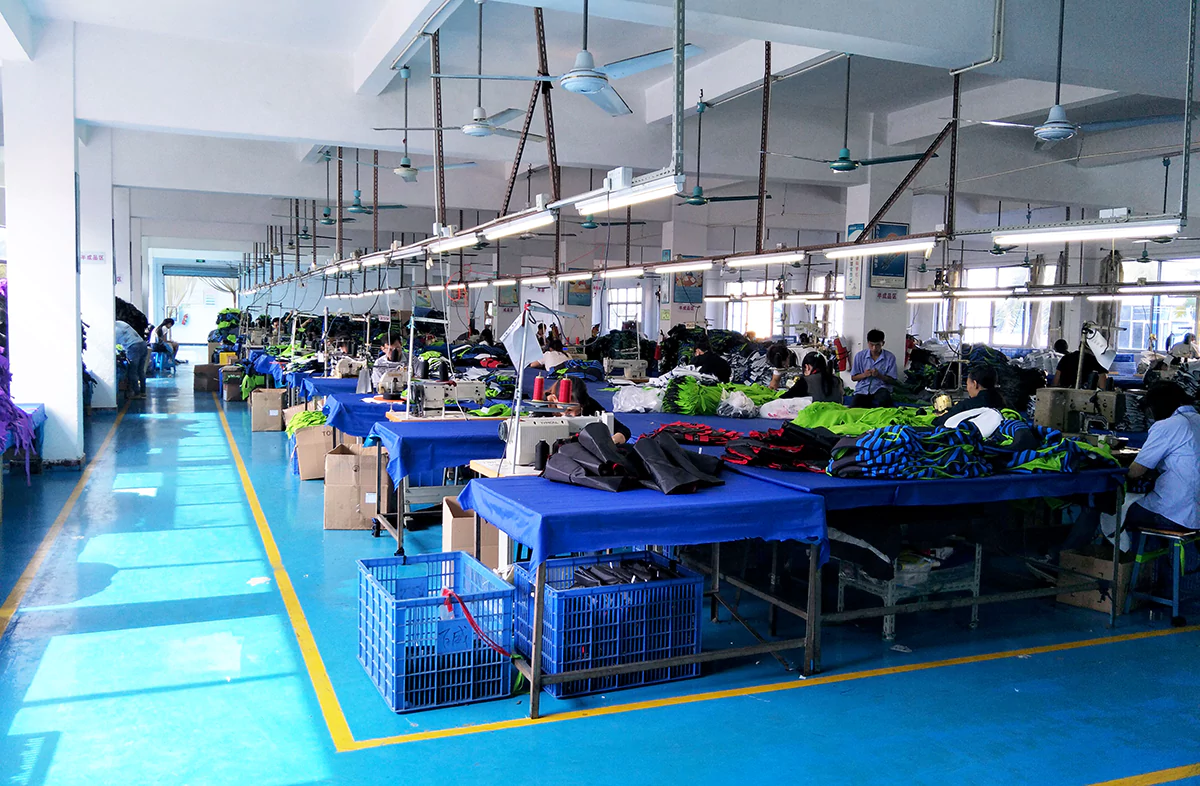
FYBagCustom is Your Trusted Custom Bag Manufacturer in China, with 15+ years of manufacturing experience and the coordinated-program capacity that a compressed commerce event demands. For DTC brands building BFCM programs, our capabilities include:
Contact our development team to brief your BFCM program — the depth, the exclusive, the GWP, and the calendar that gets all three into position before the countdown starts.
BFCM rewards the brands that finished deciding in September. For DTC handbag brands planning the year’s biggest window, three core takeaways:
If you are planning BFCM and want the depth, the exclusive drop, and the gift-with-purchase produced as one program on one calendar, contact FYBagCustom to brief the event — and receive the full product stack in samples, exclusive colorway included, in 5–7 days.
FYBagCustom produces the whole event in one window — hero depth on pre-booked materials, the exclusive colorway on a 3–5 day lab dip, brand-grade GWP small goods, and factory-assembled bundles — positioned before the traffic arrives. Full event samples in 5–7 days.
Start Your Custom Bag Project →