Tel/WhatsAapp:+86 18011919834
E-mail: chloe.x@fybagcustom.com

Tel/WhatsAapp:+86 18011919834
E-mail: chloe.x@fybagcustom.com
Send Your Inquiry Today

Who this guide is for: brand owners, promotional buyers, Amazon sellers, and beauty, tech, and travel brands sourcing zipper pouches — the most-ordered and least-considered product in the accessory catalog. A pouch is small, inexpensive, and reordered in volume, which is exactly why its material decision is under-thought: it looks like a fabric choice and a price point, when it is really a durability system with three parts — the fabric, the zipper, and the construction — in which the fabric is often the least likely to fail first. This guide answers the question buyers actually ask (“what material makes a durable zipper pouch?”) properly: the materials ranked by the job the pouch does rather than by a single toughness score, the failure sequence of a cheap pouch (what dies first, in order — and it is rarely the cloth), the zipper and construction specifications that decide lifespan more than the fabric does, and a decision matrix mapping each pouch type — makeup, tech, toiletry, promotional, travel organizer — to its right material system. Read it and the pouch line stops being a commodity reorder and becomes a product you can specify.
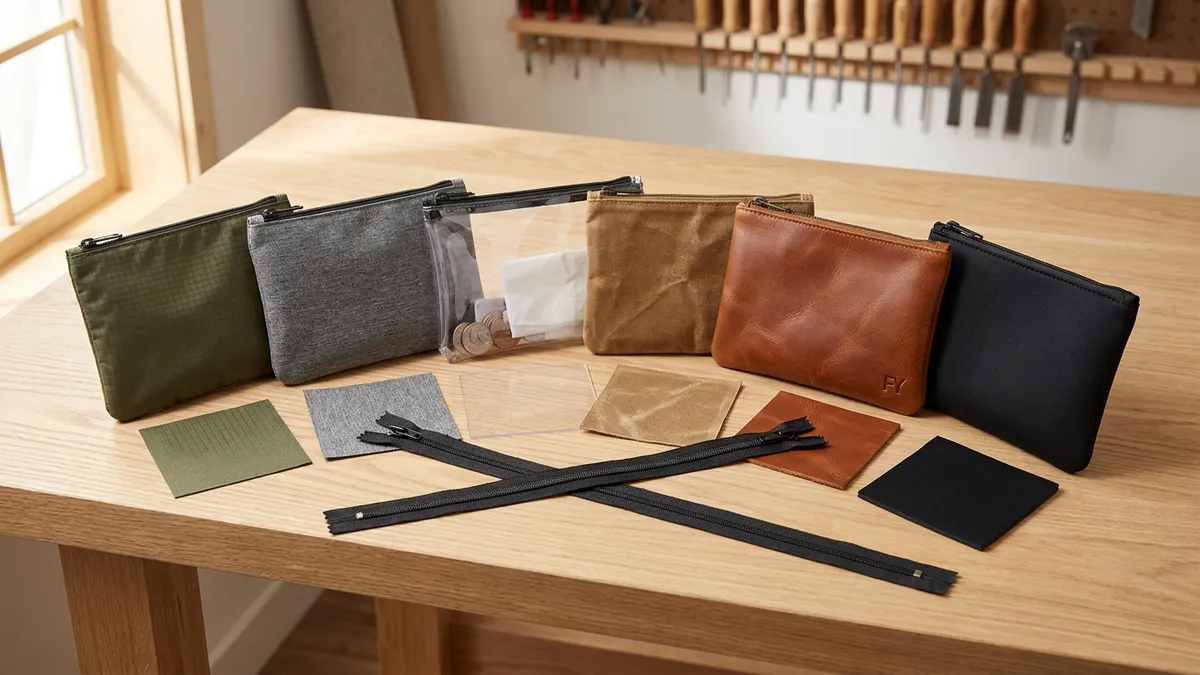
Ask what the most durable pouch material is and the honest first answer is: it depends on what will kill the pouch. A cosmetics pouch dies from spilled foundation and lipstick smears; a tech pouch dies from cable abrasion and the daily toss into a backpack; a promotional pouch dies from a print that cracks before the fabric wears; a toiletry pouch dies from moisture and a zipper that corrodes. Each has a best material, and the best material for one is a mediocre choice for another — which is why any ranking that produces a single winner is answering a question nobody is actually asking.
The second honest answer is more useful: in most cheap pouches, the fabric isn’t what fails first. The zipper end tears out of the seam. The PU coating peels. The corner frays from the inside where the raw seam allowance was never bound. The lining gives way at the zip tape. A buyer who upgrades the fabric while leaving those unchanged has paid for durability the pouch will never deliver. So this guide treats the pouch as the three-part system it is — fabric, zipper, construction — ranks the fabrics by job, and then spends deliberate attention on the two-thirds of the system the fabric conversation usually ignores.
| Material | Durability Profile | Where It Excels | Where It Disappoints |
|---|---|---|---|
| High-denier nylon (420D–1000D, ripstop) | The abrasion and tear leader per gram; ripstop grids stop punctures spreading; excellent flex life | Tech and cable pouches, EDC organizers, travel kits, anything tossed into larger bags daily | Costs more than polyester; standard nylon fades and weakens under prolonged UV; absorbs a little moisture uncoated |
| Polyester (600D+, including recycled RPET) | Roughly 85–90% of nylon’s abrasion performance at lower cost; superior UV and color stability; low moisture uptake | Volume and promotional programs, printed designs, sustainability-led lines via recycled polyester | Slightly stiffer hand; lower tear strength than equivalent nylon; low-denier versions (300D and under) wear fast |
| TPU film and TPU-coated fabric | Waterproof, wipe-clean, flexible, and far more crack-resistant than PVC — stays supple in cold; welds cleanly for stitch-free construction | Toiletry and wet kits, clear cosmetic pouches, swim and beach pouches, the clear-pouch register | Scratches show on clear versions; heavier per area than woven fabric; costs more than PVC |
| PVC (clear or coated) | Waterproof and cheap; the entry-tier clear material | Low-cost clear pouches, packaging-grade applications | Cold-cracks, yellows and clouds with age and UV, stiffens over time — the material behind most “clear pouch turned brittle” reviews |
| Waxed and heavy canvas (12 oz and up) | Very durable with a wear-in character — scuffs become patina; waxed finish adds water resistance and re-waxes | Heritage and premium registers, tool rolls, pencil and craft pouches, the natural-material cotton story | Heavier and bulkier; unwaxed canvas stains and holds moisture; light canvas (under 10 oz) frays at zips |
| Full-grain leather | The longest-lived material when maintained — scratches burnish rather than fail; edges and seams outlast fabric | Premium gift tier, executive tech pouches, luxury cosmetics cases | Highest cost; heavy; moisture-sensitive without treatment; unsuitable where wipe-clean matters |
| Quality PU (polyurethane) leather | Good in the first years — stain-resistant, wipeable, leather look at fraction of cost; quality varies enormously | Cosmetics pouches, mid-tier gift, vegan-positioned lines | Cheap PU peels and cracks within a year — the single most common pouch-material complaint; the hydrolysis-resistant grade is the spec that separates tiers |
| Neoprene | Moderate abrasion resistance but excellent cushioning, stretch, and water resistance; recovers from crushing | Tech and cable pouches, glasses and device sleeves, cosmetics that need padding | Bulky; can trap moisture against contents; edges need binding or the foam core shows |
| Denim and woven cottons | Durable in heavy weights with a casual register; prints and washes well | Lifestyle and fashion pouches, gift and promotional programs with a casual identity | Absorbs stains; frays at cut edges without binding |
Because “most durable” depends on the threat, the useful rankings are per threat:
| Threat | Best → Weakest |
|---|---|
| Abrasion (daily toss and rub) | 1000D nylon → 600D polyester → waxed canvas → full-grain leather → neoprene → PU → PVC |
| Liquid and stain exposure | TPU → PVC → quality PU → coated polyester → waxed canvas → neoprene → nylon → untreated canvas → leather |
| Flex and fold life (crushed, stuffed, folded) | Nylon → polyester → TPU → neoprene → canvas → leather → PU → PVC (cracks) |
| UV and color stability | Polyester → TPU → canvas → leather → nylon → PVC (yellows) |
| Longevity if cared for | Full-grain leather → waxed canvas → high-denier nylon → polyester → TPU → PU |
| Cost per unit at volume | PVC → polyester → PU → nylon → canvas → TPU → neoprene → leather |
The reading: nylon wins most toughness contests, TPU wins every wet one, polyester wins the value-and-print race, canvas and leather win on longevity and register, and PVC and cheap PU sit at the bottom of nearly every list but price — which is precisely where a buyer sourcing “durable” pouches should stop choosing them.
This section exists because the fabric conversation hides the real story. Take a low-cost pouch through a year of use and its failures arrive in a predictable order — and note where the fabric appears in it.
| Order | The Failure | The Mechanism | The Fix (Part Three) |
|---|---|---|---|
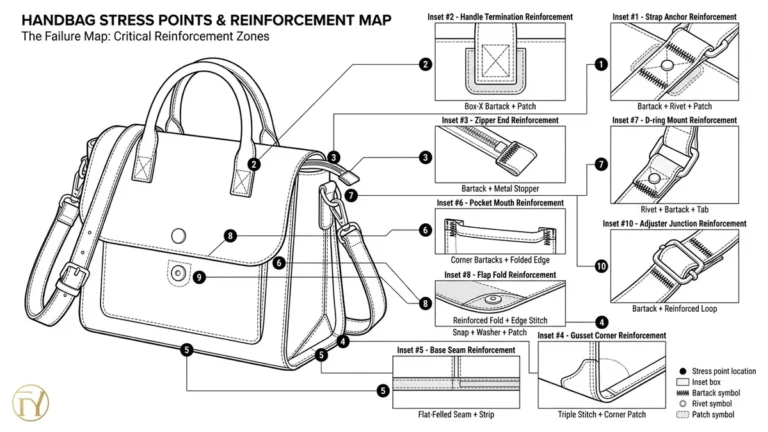
| 1st | The zipper end tears from the seam | Every closing pull on a full pouch peaks at the zip end; a zip tape merely stitched into the seam, unreinforced, works loose | Reinforced tacks or end-tabs at both zip ends — per our stress-point reinforcement map |
| 2nd | The slider fails or the coil splits | A low-grade zipper with a stamped slider and a thin coil; grit and cosmetic residue accelerate it | A quality coil zipper with a cast slider; the zip spec’d before the fabric is upgraded |
| 3rd | The coating peels (PU/PVC) or the print cracks | Cheap PU hydrolyzes; low-grade PVC stiffens; unsuitable ink cracks at fold lines | Hydrolysis-resistant PU grades; TPU over PVC; print methods matched to material and flex |
| 4th | The corners fray from the inside | Raw seam allowances at the corners abrade against contents and each other until threads release | Bound interior seams and graded corner allowances |
| 5th | The lining separates at the zip | The lining’s attachment to the zip tape is the pouch’s most-worked interior seam | Lining seamed into the zip properly and reinforced at the ends |
| 6th | The base wears through | The pouch sits on its base in every bag and drawer; this is where the fabric finally matters | Heavier fabric, doubled base panel, or a wipe-clean base material on pouches that live on surfaces |
The point: the fabric is sixth — and the first five are fixed by zipper and construction decisions that cost cents. A buyer who spends the durability budget on a fabric upgrade and skips the zipper and edge construction has bought a pouch that dies at step one in a better cloth.
The zipper is the pouch’s only moving part, its most-operated component, and its most common failure point, and it deserves the specification attention usually spent on fabric swatches.
| Element | Specification | Why |
|---|---|---|
| Coil vs. molded vs. metal | Coil (nylon spiral): flexible, self-healing when split, smooth, quiet — the pouch default. Molded plastic: chunky, strong, the sport register. Metal: premium look and heaviest wear on fabric edges | Coil is the right answer for nearly every pouch — its flexibility suits the small radius of a pouch’s corners, and a split coil re-seats when the slider passes back over it |
| Gauge | #3 for small cosmetic and coin pouches, #5 for standard and tech pouches, #8 for large organizers | Under-gauged zips on large pouches fail at the slider; over-gauged zips on small ones bulk the corners |
| The slider | Cast (die-cast) sliders over stamped; the pull sized for one-handed use; auto-lock where contents must stay closed | The slider is the wear part — stamped sliders round off and jump the coil |
| Zip tape material | Polyester tape for wash and moisture resistance; the tape is often the first thing to rot on a toiletry pouch | The tape is a fabric too, and the wettest one on the pouch |
| Corrosion and grit | Nylon coil and plated or nylon sliders for wet-use pouches; the zip cycled after grit and residue exposure in test | Cosmetic residue and sand are the pouch zipper’s daily diet |
| Zip ends | End-tabs (leather, fabric, or webbing) capping both ends, or dense reinforcing tacks across the tape | The number-one failure in Part Two, solved for the cost of a tab |
| Zip placement | Top-run for flat pouches; three-side (clamshell) for organizers that open flat; the zip’s path kept away from the corner radius where possible | The zip’s geometry decides the pouch’s access and its corner stress |
| Water-resistant and reverse-coil zips | Coated or reverse-coil zippers for wet kits — sealing the pouch’s biggest opening | A waterproof TPU body with a standard zipper is a bowl with a hole in the lid |
| Element | Specification | Why |
|---|---|---|
| Bound interior seams | Seam allowances enclosed in binding — per our piping-and-binding guidance — rather than left raw or merely overlocked | Stops the from-inside fray that kills pouch corners; also the difference between a pouch that looks finished open and one that doesn’t |
| Boxed or gusseted corners | Depth created by boxed corners or a small gusset, with the corner junctions graded and tacked | The corners take the abrasion; clean grading removes the bulk that wears first |
| Lining choice | Wipe-clean lining (coated polyester, TPU) for cosmetics; smooth lining for tech; no lining (self-finished, bound seams) for the honest premium canvas pouch | The lining is the surface the contents actually touch; it is chosen for the contents, not the exterior |
| Interior organization | Slip pockets, elastic loops, and mesh dividers for tech and toiletry formats — each pocket’s corners tacked per the stress-point standard | Organization is what turns a pouch into an organizer, and each added seam is a potential failure that reinforcement neutralizes |
| Stitch and thread | Bonded polyester thread; stitch density set by seam class; backtacks at every termination | The invisible half of construction durability — cheap pouches skip the backtacks first |
| Edge finishing on coated materials | TPU and PVC welded rather than sewn where the design allows — no needle holes in a waterproof body | Sewn seams in waterproof film are lines of holes; welding is the construction the material was made for |
| Structure | Light textured or padded body for cosmetics and tech; flat and soft for promotional flat pouches | Structure protects contents and holds the pouch’s shape open on a counter — a feature customers notice and can’t name |
| Pouch Type | The Threat Profile | The Material System (Fabric + Zip + Construction) |
|---|---|---|
| Cosmetics / makeup pouch | Liquid, pigment, daily wipe-down, counter-standing | Wipe-clean exterior (TPU-coated, quality PU, or coated polyester) + wipe-clean lining + #3–#5 coil zip with end-tabs + light structure; the makeup bag standard |
| Toiletry / wet kit | Moisture, leaks, hotel-counter puddles, travel crush | TPU body (welded where possible) + water-resistant zip + drainage-aware lining + a hanging hook for the travel register |
| Tech / cable pouch | Cable abrasion, hard edges of chargers, the daily backpack toss | Ripstop or 600D+ nylon + smooth lining + elastic loops and divided interior + #5 coil zip + padding on the device-facing panel; often the clip-out module in our convertible and modular programs |
| Promotional / event pouch | Print durability, volume cost, mixed use | 600D recycled polyester + print method matched to flex (screen or heat-transfer on flat panels) + #5 coil zip + bound seams — the gift and promotional workhorse that survives past the event |
| Clear pouch (stadium, TSA, cosmetics) | Visibility, cold, flex, scratch | TPU over PVC every time + welded seams + colored or holographic binding + end-tabbed zip; per our clear-bag guidance, PVC only at the packaging tier |
| Pencil / craft pouch | Sharp points, daily open-close, school-bag life | Heavy canvas or 1000D nylon + molded or #5 coil zip + bound seams + reinforced base — the highest cycle count of any pouch type |
| Premium gift pouch | Longevity, register, unboxing | Full-grain leather or waxed canvas + metal or premium coil zip + leather end-tabs + self-finished bound interior; the purse-and-wallet register’s construction standards apply |
| Diaper / wipes pouch | Moisture, wipe-clean, one-handed operation, constant cycles | TPU or coated polyester + wipe-clean lining + easy-pull #5 zip, for the mom and baby program |
| Insulated snack / lunch pouch | Thermal, condensation, food-safe interior | Coated polyester or nylon shell + food-safe insulated lining per our insulated-bag construction + wipe-clean seams, the lunch bag family’s small format |
| Gym / swim pouch | Wet and dry separation, chlorine, sweat | TPU or coated nylon + ventilation or drainage + corrosion-resistant zip, for the fitness and active life register |
The matrix principle: every row pairs a fabric with a zipper and a construction — never a fabric alone. That is the answer to “what material is best”: the system that matches the pouch’s job, in which the fabric is the visible third.
Pouches are ordered in volumes that make material sustainability a visible program decision:
| Option | The Durability Truth |
|---|---|
| Recycled polyester (RPET) | Performance-equivalent to virgin polyester at the same denier — the default sustainable pouch fabric, with the GRS-certified supply chain as the credibility spec |
| Recycled nylon | Available at high-denier weights; carries nylon’s abrasion advantage into the recycled program |
| Organic and recycled cotton canvas | The natural-material story with canvas’s longevity; heavier weights for durability |
| TPU over PVC | Beyond durability, TPU avoids PVC’s chlorine chemistry — the material swap that improves both the pouch and its story |
| The durability argument itself | The most sustainable pouch is the one that isn’t replaced in a year — the failure-sequence fixes in Parts Two through Four are a sustainability program as much as a quality one |
The EU’s evolving green-claims rules mean any sustainability statement on a pouch program should be specific and substantiated — “made with GRS-certified recycled polyester” rather than a bare eco-badge — and a brand can confirm the certified material options with our team before the claim goes on the product.
Because most pouches are branded, the print’s lifespan is part of the product’s lifespan:
| Method | Best Materials | Durability Notes |
|---|---|---|
| Screen printing | Polyester, nylon, canvas | The volume method; durable when ink is matched to the fabric’s coating; flat panels only |
| Heat transfer | Polyester, coated fabrics, PU | Full-color detail; the transfer must be flex-rated for a pouch that’s stuffed and folded |
| Digital printing | Polyester, canvas, cotton | All-over and photographic; wash- and abrasion-tested per material |
| Embroidery | Canvas, nylon, leather | The longest-lived branding — it wears with the fabric rather than off it; backed to prevent print-through on thin materials |
| Debossing / embossing | Leather, PU, TPU | Permanent by nature; the premium mark |
A print that cracks or fades before the pouch wears out is a durability failure the customer attributes to the pouch — so the print method is chosen against the material and the pouch’s flex life, never against artwork alone. The multi-function organizer formats and waterproof wet-kit builds each carry their own print constraints, which a brand can work through with our team at artwork stage.
| Check | Method | Standard |
|---|---|---|
| Zip cycle test | Zipper cycled to rated count, including after grit and residue exposure | Smooth, no slider jump, no coil split |
| Zip-end pull | Zip ends pulled as a full pouch would load them | Tabs and tacks hold; no tape separation |
| Fabric abrasion | Exterior panels rub-tested to the material’s rating | Meets rating; no coating loss |
| Coating integrity | PU and TPU flexed and aged | No peel, crack, or clouding |
| Interior inspection | Pouch turned out; seams and corners examined | Bound, graded, no raw allowances |
| Wipe and liquid test | Cosmetic and liquid residues applied and wiped | No staining or coating damage on wipe-clean specs |
| Print durability | Branded panels abrasion- and wash-tested; flexed at fold lines | No cracking, fading, or transfer |
| Base wear | The pouch base rub-tested | Meets the heaviest-wear rating on the pouch |
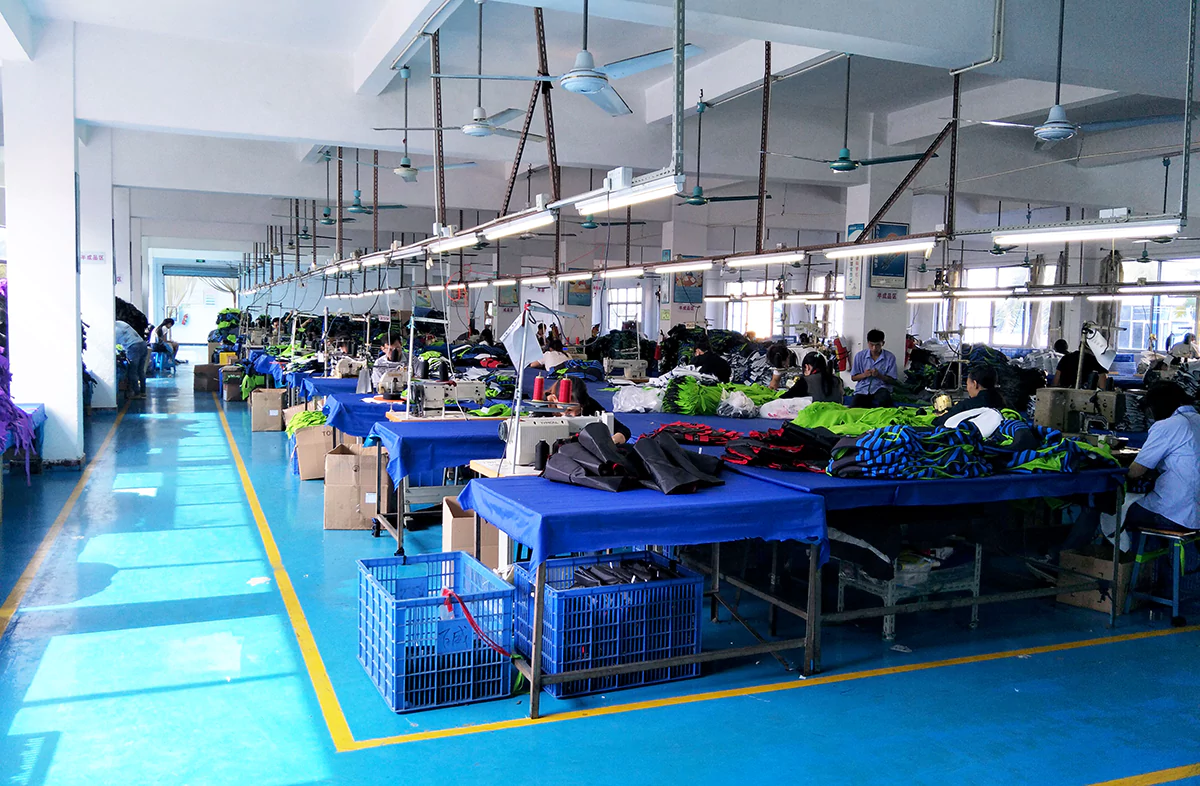
FYBagCustom is Your Trusted Custom Bag Manufacturer in China, with 15+ years of manufacturing experience across every material system in this guide. For brands sourcing pouches at volume, our capabilities include:
The durable zipper pouch is a fabric, a zipper, and a construction working together — and the fabric is the part least likely to fail first. Three core takeaways:
If you are sourcing pouches — cosmetics, tech, toiletry, promotional, or a coordinated set — contact FYBagCustom with the pouch type and its use case, and receive a material-system sample, zipped and tested, in 5–7 days.
FYBagCustom builds pouches as material systems — the right fabric for the threat, a cast-slider coil zip with tabbed ends, bound seams and graded corners — across cosmetics, tech, toiletry, promotional, and premium programs. Tested samples in 5–7 days.
Start Your Custom Bag Project →