Tel/WhatsAapp:+86 18011919834
E-mail: chloe.x@fybagcustom.com

Tel/WhatsAapp:+86 18011919834
E-mail: chloe.x@fybagcustom.com
Send Your Inquiry Today

Who this guide is for: brand owners, product developers, sourcing managers, DTC founders, and private label developers who want to produce custom handbags in premium raw denim — the heavyweight, original-indigo, selvedge, and jacquard denim that major luxury houses are returning to in 2026. If you need to understand how factories solve the indigo color-bleeding problem, how to manage sewing tension at the denim-to-leather splice junction, and how to elevate denim from “casual fabric” to “luxury material” through construction technique — this guide covers the material science, the factory engineering, and the QC protocols that separate a premium denim bag from a craft-market afterthought.
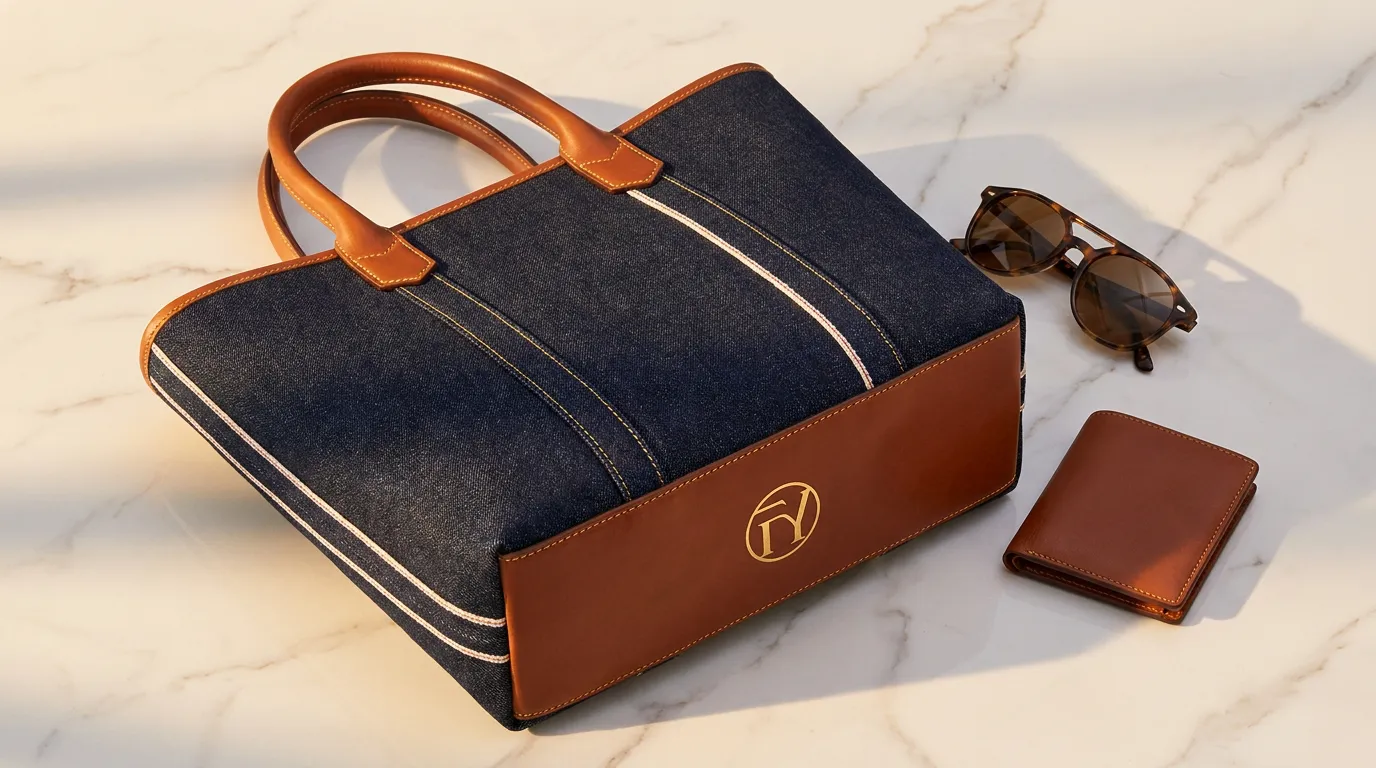
Denim in handbags has a perception problem. For most of the last two decades, “denim bag” meant one of two things: a repurposed pair of jeans stitched into a tote at a craft workshop, or a lightweight chambray pouch printed with a brand logo and sold as a promotional item. Neither version qualified as fashion. Neither version was taken seriously by premium consumers. Denim, despite being one of the most iconic and emotionally resonant fabrics in the world, was excluded from the accessories market above the mid-tier.
In 2026, that exclusion is ending. The luxury sector’s full-circle return to raw, unprocessed materials — part of the broader “honest craft” movement that values visible texture, natural aging, and material authenticity — has brought premium denim back to the runway and, critically, to the accessories counter. The denim now being specified for luxury bags is not the faded, pre-washed, garment-weight fabric of casual fashion. It is raw, unwashed, heavy-weight original-indigo denim: 12–16 oz selvedge, jacquard-woven with textured patterns, or bull denim with the deep, almost-black indigo that fades to personal-signature wear patterns over months and years of use. It is denim treated as a premium material — sourced, cut, and constructed with the same precision that a factory would apply to calfskin.
For B2B buyers, premium denim bags occupy a compelling market position: the material itself carries massive cultural equity (everyone understands denim; everyone has an emotional connection to it), the raw-denim aesthetic is trending across fashion categories, and the material is significantly less expensive than leather — enabling strong margins at premium retail positioning. The challenges are technical, not commercial: indigo bleeds, heavy denim resists standard sewing techniques, and the junction between denim and leather trim demands specialized tension management that most bag factories have never engineered.
This guide solves those challenges.
Not all denim is suitable for handbag construction. The lightweight chambrays and pre-washed denims used in garments lack the body, weight, and structural integrity that a bag requires. Premium bag denim starts at 10 oz and extends to 16 oz — heavy enough to provide its own structure, dense enough to resist abrasion, and raw enough to develop the patina that denim enthusiasts value.
| Denim Type | Weight (oz/yd²) | Weave | Indigo Treatment | Texture | Structural Suitability for Bags | Relative Cost |
|---|---|---|---|---|---|---|
| Raw selvedge denim | 12–16 oz | Traditional shuttle-loom, visible selvedge edge | Rope-dyed indigo — deepest, richest color; unfaded | Dense, slightly rough, with visible slub texture | Excellent — heavy enough to self-support; the prestige material | Highest |
| Raw bull denim | 11–14 oz | Standard loom, dense twill weave | Vat-dyed or rope-dyed indigo | Smooth, uniform, very dense | Excellent — the most structurally consistent; less textured than selvedge | Moderate–High |
| Jacquard denim | 10–14 oz | Jacquard loom — pattern woven into the fabric structure | Indigo warp + undyed weft (traditional) or multi-color | Textured pattern visible in the weave — logos, geometric patterns, florals | Very good — the pattern adds visual complexity; structural properties match standard denim | High (jacquard loom setup) |
| Stretch denim | 10–12 oz | Twill weave with 2–5% elastane | Usually pre-washed or treated | Smooth, slightly elastic | Poor — stretch undermines structural rigidity; the bag deforms under load | Low–Moderate |
| Chambray | 4–7 oz | Plain weave (not twill) | Light indigo or overdyed | Soft, light, shirt-weight | Poor — too light for bags; collapses without heavy reinforcement | Lowest |
| Pre-washed / distressed denim | 8–12 oz | Any weave, then washed and sometimes sanded or treated | Faded, softened, often with contrast wear marks | Soft, varied, pre-aged | Moderate — the washing weakens the fibers; less structural integrity than raw | Low–Moderate |
The raw (unwashed) state of premium denim provides three structural advantages that washed denim lacks:
| Property | Raw Denim | Washed Denim | Why This Matters for Bags |
|---|---|---|---|
| Fiber integrity | Maximum — fibers have never been mechanically stressed | Reduced — washing tumbles, stretches, and weakens fibers | Raw denim maintains its body and resists deformation under the weight of bag contents |
| Surface starch (sizing) | Present — the original starch sizing remains in the fabric | Removed — washing strips the sizing | Sizing gives raw denim a natural stiffness that functions as built-in interlining; washed denim requires added reinforcement to match |
| Indigo depth | Maximum — full indigo load on every fiber | Reduced — washing removes surface indigo | The deep, saturated indigo of raw denim is what reads as “premium” and what develops the personalized fade patterns that denim enthusiasts value |
The implication: raw denim at 12–14 oz provides enough inherent structure that many bag designs require reduced or no interlining on body panels — the sizing and the fabric weight do the structural work that interlining does in lighter materials. This is a rare advantage: the material provides free structure while simultaneously delivering the aesthetic that consumers are searching for.
Indigo — the dye that gives denim its signature blue — is inherently not colorfast. Unlike reactive dyes (which bond chemically to fiber) or vat dyes used on other fabrics, indigo sits on the surface of cotton fibers rather than penetrating them. This surface-sitting quality is what creates denim’s famous fade patterns over time — but it also means that indigo transfers to anything it touches: hands, clothing, leather trim, lining fabric, and the consumer’s white shirt.
For a handbag that contacts clothing, skin, and other accessories on every use, indigo bleeding is a product-killing defect if not addressed. A premium denim bag that leaves blue marks on a white blazer will generate returns, negative reviews, and brand damage regardless of how beautifully it is designed.
Solving the indigo bleeding problem requires a three-stage treatment process applied to the denim before cutting and construction:
| Stage | Process | What It Does | Duration | Equipment |
|---|---|---|---|---|
| Stage 1: Fixative bath | The denim is immersed in a color-fixative solution (typically a cationic fixative agent that bonds to the indigo molecules) | The fixative creates a chemical bridge between the indigo and the cotton fiber, converting the surface-sitting dye into a more permanently anchored one | 20–40 minutes immersion at 40–60°C | Dyeing vat or pad-mangle application |
| Stage 2: Rinse + excess removal | The treated denim is rinsed in clean water to remove unbound fixative and any loose indigo that did not accept the fixative | Removes the “free” indigo — the molecules that would have transferred to other surfaces | 10–20 minutes, cold water | Rinse tank |
| Stage 3: Heat-set (curing) | The denim is dried at elevated temperature (120–150°C) to permanently cure the fixative bond | The heat activates the fixative’s permanent bonding mechanism; after curing, the treatment is irreversible | 3–5 minutes in a drying oven or tenter frame | Industrial dryer or heat press |
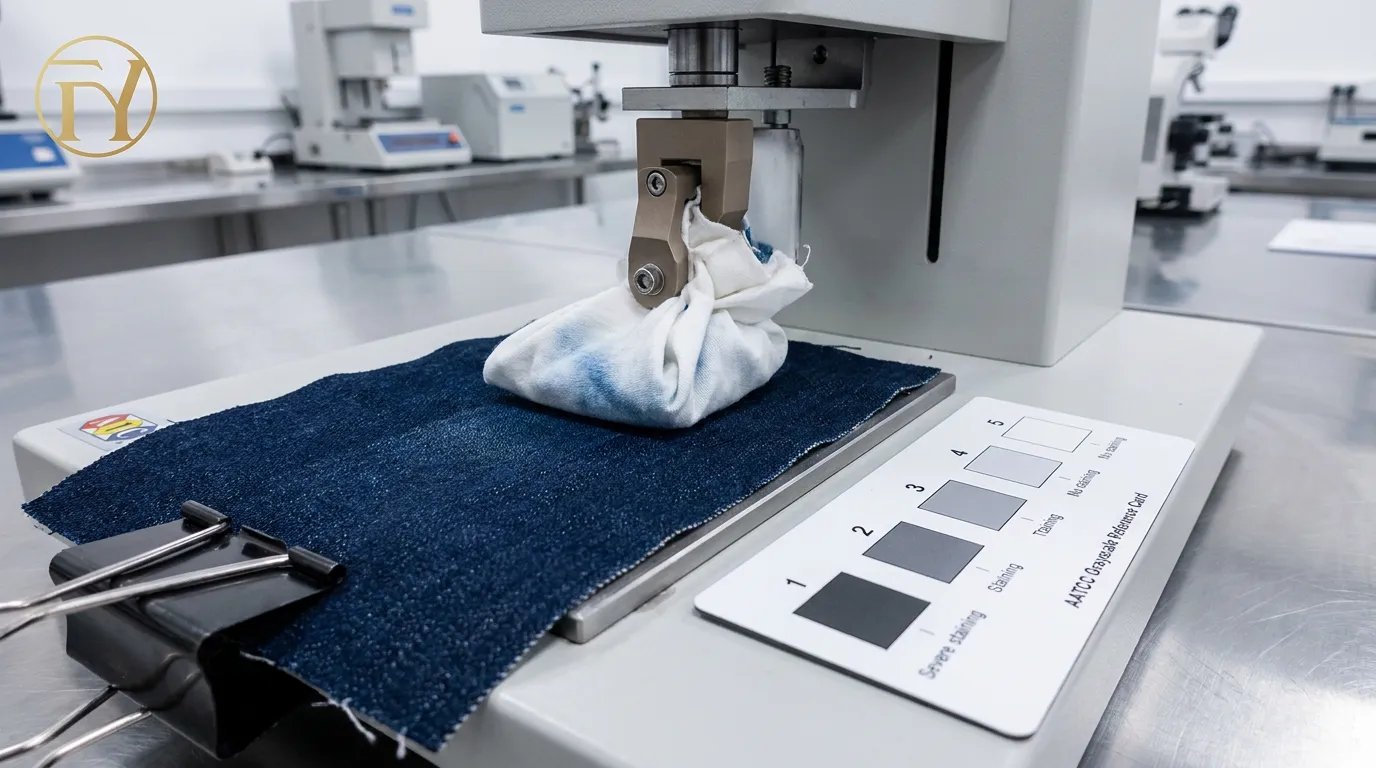
After treatment, the denim must be tested to confirm that the color-fix was effective. The standard test is the crockmeter rub test (ISO 105-X12 or AATCC 8), which quantifies how much color transfers from the denim to a white test fabric under controlled rubbing conditions.
| Test Condition | Method | Pass Standard for Premium Bags | What the Rating Means |
|---|---|---|---|
| Dry crocking | A dry white cotton cloth is rubbed against the denim surface for 10 cycles under standardized pressure | Rating 4 minimum (on the 1–5 grayscale) | 4 = slight, barely visible color transfer; 5 = no transfer |
| Wet crocking | A damp white cotton cloth is rubbed under the same conditions | Rating 3 minimum (wet crocking is always more severe) | 3 = noticeable but moderate transfer; 4 = slight transfer |
Specify in your tech pack: “All denim panels must pass crockmeter dry crocking at rating 4 minimum and wet crocking at rating 3 minimum per ISO 105-X12. Test report required before production cutting.”
Color-fix treatment dramatically reduces indigo transfer, but it does not make raw denim perfectly colorfast like a printed polyester. Over extended periods of friction (a denim bag pressing against a white linen blazer for eight hours), minimal transfer may still occur. This is inherent to the material — and it is part of what makes raw denim authentic.
Product-page language: “This bag is crafted from raw indigo denim that has been professionally treated to minimize color transfer. As with all premium raw denim, slight indigo transfer to light-colored fabrics may occur with extended direct contact. This is a natural characteristic of authentic raw denim.”
This language manages consumer expectations honestly while preserving the premium positioning. It is the same language luxury denim brands use for jeans — and denim-savvy consumers understand and accept it.
The defining aesthetic of a premium denim bag — the detail that elevates it from “denim tote” to “luxury accessory” — is the splice junction where denim meets leather. Cognac leather handles on an indigo body. A leather base panel beneath denim sides. Leather corner guards on denim gussets. These material transitions are where the bag’s premium identity lives — and where the most challenging manufacturing problems occur.
Denim and leather have fundamentally different mechanical properties. Sewing them together requires the machine and the operator to manage two materials that behave differently under the needle:
| Property | Denim (12–14 oz raw) | Leather (1.0–1.2 mm calfskin or PU) | The Problem at the Junction |
|---|---|---|---|
| Thickness | 0.8–1.2 mm (dense, uniform) | 1.0–1.5 mm (varies by location on the hide) | Combined thickness at the splice: 1.8–2.7 mm — this is very thick for a standard sewing machine; the needle must penetrate both layers cleanly |
| Stiffness | Moderate–High (raw denim with sizing) | Moderate (depends on leather type) | Two stiff materials meeting create a rigid junction that does not want to fold or curve — the seam resists bending |
| Stretch behavior | Low stretch along the warp; moderate bias stretch | Low stretch (for leather); moderate stretch (for PU) | If one material stretches under sewing tension and the other does not, the seam puckers — the less-stretchy material bunches while the more-stretchy one is pulled flat |
| Needle hole behavior | Denim fibers close around the needle hole; the hole is nearly invisible after sewing | Leather fibers do not close — the needle hole is permanent and visible | On the leather side of the junction, every stitch hole is permanent; misaligned stitching cannot be ripped and re-sewn without leaving visible marks |
| Feed behavior | Cotton denim feeds reliably through machine feed dogs | Leather can slip, stick, or feed unevenly due to surface friction | The two materials may feed at different rates through the machine, creating uneven stitch spacing or material bunching at the splice |
The single most critical manufacturing parameter at the denim-leather junction is sewing tension — the tightness with which the thread is pulled through both materials. Incorrect tension produces visible and structural defects:
| Tension Problem | What Happens | Visual Defect | Root Cause |
|---|---|---|---|
| Upper thread too tight | The top thread (visible on the denim side) pulls the bobbin thread up through the leather, creating visible thread dots on the leather surface | Thread dots on the leather side; the leather puckers along the seam line | Tension disc pressure too high for the combined material thickness |
| Upper thread too loose | The top thread loops on the surface rather than sinking into the seam | Visible thread loops on the denim side; the seam looks “messy” | Tension disc pressure too low; the thread is not being pulled into the material |
| Uneven tension (fluctuating) | Tension varies stitch by stitch due to the needle passing through varying combined thicknesses | Alternating tight and loose stitches — the seam looks inconsistent | The presser foot pressure is not high enough to feed the materials at a consistent rate; or the materials have inconsistent combined thickness |
Experienced factories address the denim-leather junction with a specific sewing protocol:
| Protocol Element | Specification | Why |
|---|---|---|
| Needle type | Leather-point needle (cutting point), size 110/18 or 120/19 | The cutting point penetrates leather cleanly without tearing; the large size handles the combined material thickness |
| Thread | Bonded nylon or polyester, Tex 70–90 | Bonded thread resists abrasion from the dense denim weave; the heavier tex handles the structural load at the junction |
| Stitch length | 3.0–3.5 mm (slightly longer than standard bag stitching at 2.5–3.0 mm) | Longer stitches reduce the number of needle holes in the leather per centimeter — critical because each hole is permanent |
| Presser foot | Roller foot or Teflon-coated foot | Prevents the leather from sticking to the foot surface and feeding unevenly; the roller provides consistent feed pressure |
| Presser foot pressure | Increased 20–30% above standard bag settings | The combined denim + leather thickness requires more downward pressure to feed both materials evenly |
| Feed system | Walking foot (dual-feed) or integrated feed | Walking foot feeds the top material (usually leather) at the same rate as the bottom material (usually denim), preventing differential slip |
| Sewing speed | Reduced to 60–70% of normal operating speed | Slower speed gives the operator more control and reduces the risk of needle deflection, skipped stitches, and uneven tension at the junction |
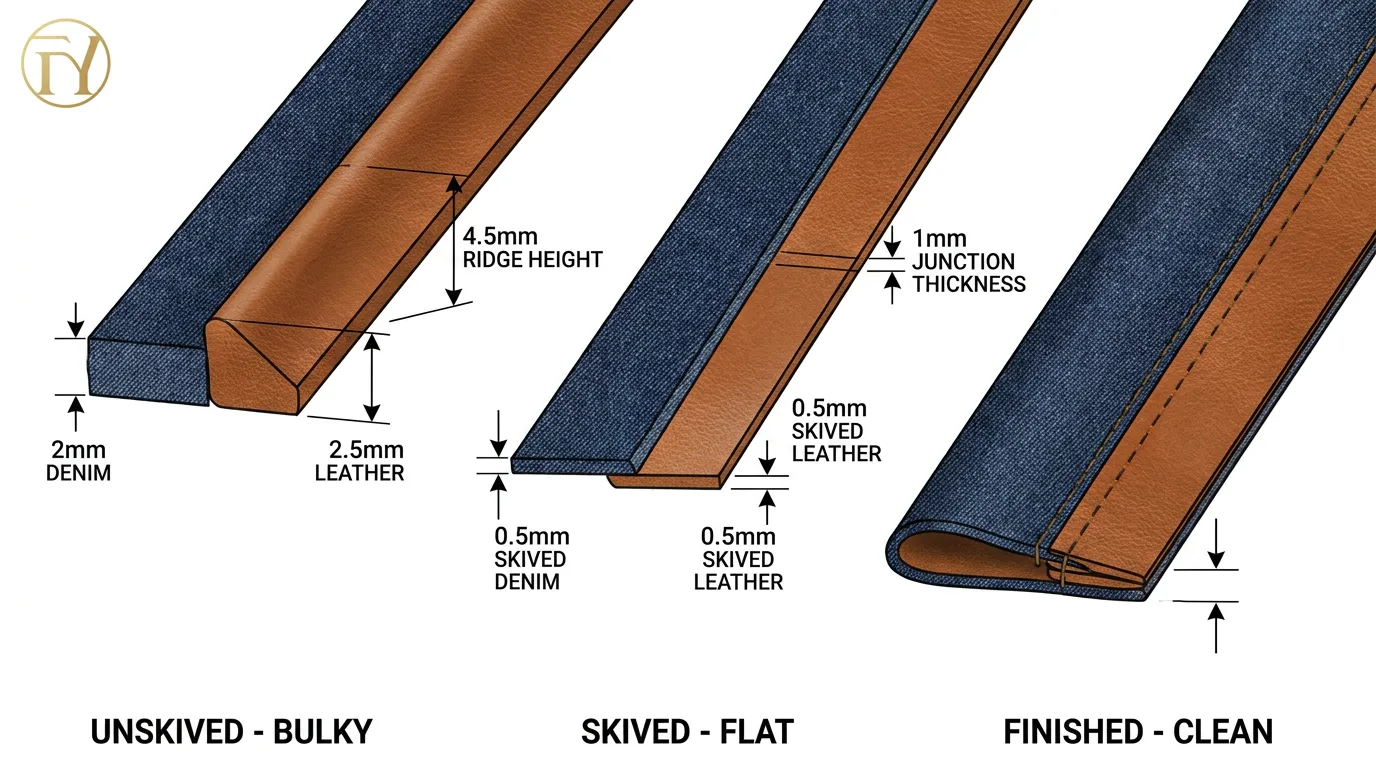
| Edge preparation | Both materials’ edges are skived (thinned) at the overlap zone — denim skived 50% and leather skived 50% at the seam allowance | Skiving reduces the combined thickness at the junction from 1.8–2.7 mm to approximately 1.3–1.8 mm, making the seam manageable and the fold line clean |
Skiving — thinning the material’s edge at the seam allowance — is the most important prep step for a clean denim-leather splice. Without skiving, the combined thickness at the seam is so great that the seam creates a visible ridge on the exterior, the fold does not lie flat, and the sewing machine struggles to penetrate both layers.
| Material | Original Thickness | Skived Thickness (at seam allowance) | Skiving Width | Tool |
|---|---|---|---|---|
| Denim (12 oz raw) | 0.9–1.1 mm | 0.4–0.6 mm | 8–12 mm from the edge | Bell knife skiver or manual skiving knife |
| Leather (1.0 mm calfskin) | 1.0 mm | 0.4–0.5 mm | 8–12 mm from the edge | Leather skiving machine or manual |
| Combined at junction | 1.9–2.1 mm (unskived) | 0.8–1.1 mm (skived) | — | — |
The skived junction (0.8–1.1 mm) sews as easily as a single layer of standard bag material — eliminating the thickness-related tension problems and producing a seam that lies flat and folds cleanly.
Topstitching — the visible decorative stitch line that runs parallel to a seam, typically 3–5 mm from the seam edge — is the construction detail most closely associated with denim. On jeans, the gold or orange topstitching against indigo is one of the most recognizable visual signatures in all of fashion. On a denim bag, topstitching serves the same dual purpose: structural reinforcement (the additional stitch line strengthens the seam) and aesthetic declaration (“this is a denim product, and we are celebrating the craft”).
| Element | Specification | Why This Specification |
|---|---|---|
| Thread color | Gold (Gutermann shade 968 or equivalent) for traditional denim aesthetic; tonal indigo for “stealth denim” / quiet luxury positioning | Gold on indigo is the visual signal that reads as “premium denim” to every consumer; tonal stitching reads as “subtle luxury” |
| Thread weight | Tex 50–70 (heavier than standard bag topstitching at Tex 30–40) | Heavier thread is visible and fills the stitch holes; it also withstands the abrasion that heavy denim creates on thread over time |
| Thread type | 100% polyester, bonded | Polyester resists UV fading (indigo fades, but the topstitching should not); bonded thread resists fraying |
| Stitch length | 3.5–4.0 mm | Longer than standard topstitching (2.5–3.0 mm) because: (1) the heavier thread needs more space between stitches to read cleanly, and (2) fewer penetrations per centimeter preserves the denim’s structural integrity |
| Distance from seam edge | 3–5 mm, consistent throughout | Must be absolutely uniform — topstitching inconsistency is the most visible defect on denim because the thread color contrasts with the fabric |
| Number of rows | Single row (standard) or double row (heritage / reinforced) | Single row is the default; double row (two parallel lines, 2 mm apart) is the premium / heritage treatment |
| Straightness tolerance | ±0.5 mm from the specified edge distance | On indigo denim, topstitching wobble is impossible to hide — the contrast thread against the dark fabric reveals every deviation |
Double topstitching — two parallel stitch lines running 2 mm apart along the same seam — is the detail that most powerfully signals “premium denim construction.” It is the detail found on the inseams of selvedge jeans, on the waistbands of heritage denim brands, and on the pocket edges of workwear jackets. Applied to a denim bag, it communicates “this bag was made by people who understand denim” with more authority than any marketing copy.
The additional stitch line adds minimal production time (one extra pass at the same seam) and zero material cost. Its impact on perceived quality is disproportionate — product reviews of denim bags consistently mention topstitching detail as a quality indicator.
Raw denim at 12–14 oz has a weight advantage: it is heavy enough (350–500 g/m²) to provide significant self-structure. This means denim bags can achieve semi-structured and even structured silhouettes with less internal reinforcement than leather or PU bags of the same design.
| Panel | Leather Bag (standard) | Denim Bag (equivalent structure) | Why Less Reinforcement |
|---|---|---|---|
| Front panel | Microfiber backing 0.7 mm | Lightweight fusible 0.3 mm or none (raw denim’s sizing provides body) | 12 oz+ raw denim with sizing is inherently stiffer than most PU leather; the fabric IS the structure |
| Back panel | Microfiber backing 0.7 mm | Same as front | Matching stiffness front-to-back |
| Gussets | Microfiber 0.5–0.6 mm | None or lightweight fusible 0.2 mm | Gussets in heavy denim hold shape without backing |
| Base | Salpa 1.2 mm | Salpa 1.0 mm or HDPE 1.0 mm | Still needed — denim alone cannot create a rigid flat base |
| Flap | Microfiber 0.5 mm | None | Heavy denim flaps drape beautifully under their own weight |
This reinforcement reduction is a cost and weight advantage — the denim bag achieves comparable structure at lower reinforcement investment and lower empty weight than its leather equivalent.
The aesthetic success of a premium denim bag depends on where and how much leather is used in combination with the denim. Too little leather and the bag reads as casual / craft. Too much leather and the denim becomes secondary — the bag reads as a leather bag with a denim accent. The balance determines the positioning.
| Leather Allocation | % of Bag Exterior | Denim Reads As… | Leather Reads As… | Positioning |
|---|---|---|---|---|
| Minimal (trim only) | 5–10% of surface — handles, zipper pulls, brand patch | The primary material — dominant visual | Functional accent — present but secondary | Denim-forward; casual-premium; the “denim bag” identity |
| Balanced (trim + base + corners) | 15–25% — handles, base panel, corner guards, piping | Co-primary — shares the visual stage with leather | Structural accent — protects wear points and defines the silhouette | The sweet spot — reads as “designed” rather than “casual” or “leather” |
| Leather-dominant (denim accent) | 30–50% — panels in leather, denim used on one or two panels or as a pocket detail | Accent material — the “denim touch” on a leather bag | Primary material — the bag’s identity is leather, not denim | Leather bag with denim detail; less relevant to the “premium denim bag” trend |
For brands developing a premium denim bag collection, the balanced allocation (15–25% leather) is the recommended default. This configuration:
| Zone | Material | Why |
|---|---|---|
| Body panels (front, back, gussets) | Raw denim | The denim IS the identity — it must dominate the visual |
| Handles | Leather (rolled or flat, cognac or tan) | Leather handles signal quality and provide comfortable grip; denim handles would fray and feel rough |
| Base panel | Leather | Protects the highest-abrasion surface; the leather base allows the bag to sit on floors without denim abrasion |
| Corner guards (optional) | Leather | Heritage detail that protects the four most vulnerable corners; references workwear/military heritage |
| Piping (optional) | Leather | Defines the seam lines and creates visual contrast between denim and air; a “frame” for the denim |
| Brand patch | Leather with debossed or foil logo | The most recognizable placement for denim product branding — the leather patch on the back panel |
| Zipper pull tabs | Leather strips, knotted through metal pulls | Replaces metal pulls with leather for a cohesive material story |
| Leather Color | Pairing with Indigo Denim | Aesthetic Read | 2026 Relevance |
|---|---|---|---|
| Cognac / tan | Warm contrast — the classic denim + leather combination | Heritage, Americana, workwear-elevated | Very high — the hero combination |
| Natural / veg-tan | Lighter, rawer contrast — the leather will darken and patina with the denim over time | Artisanal, authentic, “both materials age together” | High — appeals to the raw-denim enthusiast |
| Black | High contrast — graphic, modern | Urban, contemporary, editorial | Moderate — a modern alternative to warm tones |
| Cream / off-white | Very high contrast — the lightest leather against the darkest denim | Bold, striking, editorial | Moderate — dramatic but risky (cream shows indigo transfer most visibly) |
The indigo-transfer warning for cream leather: if using cream or light-colored leather trim adjacent to raw denim, the color-fix treatment on the denim must be verified at crockmeter rating 4+ (dry) before approving the material combination. Light leather adjacent to indigo is the highest-risk scenario for visible color transfer. Consider a barrier strip — a thin strip of clear lacquer or wax applied to the leather edge that contacts the denim — as an additional protective measure.
Hardware on denim bags should complement the material’s heritage, craft, and workwear origins. The hardware palette is different from the “jewelry-grade” hardware used on leather handbags — it should feel utilitarian-elevated rather than decorative.
| Finish | Denim Read | Examples | Best For |
|---|---|---|---|
| Antique brass | Heritage, workwear, Americana — the default denim hardware | Zippers, rivets, D-rings, buckles | The recommended default — antique brass on indigo denim is one of the most recognizable material-hardware pairings in fashion |
| Brushed copper | Warm, industrial, artisanal | Rivets, snap buttons, accent hardware | Heritage-forward brands; craft positioning |
| Matte black | Modern, urban, graphic | Zippers, D-rings, closures | Contemporary positioning; all-dark aesthetics |
| Brushed silver / nickel | Clean, modern, slightly industrial | Zippers, snaps, D-rings | Modern-minimalist denim designs |
| Raw / unplated brass | The most “authentic” — raw brass tarnishes and patinas alongside the denim | Small accent hardware (rivets, snaps) | Ultra-heritage positioning; the “everything ages together” story |
As discussed in our retro bag guide, dome-head rivets are the hardware detail most associated with denim heritage — they have appeared on denim goods since the 1870s. On a premium denim bag, copper or brass dome-head rivets at the leather corner guards and handle attachments serve as both structural reinforcement (they mechanically fasten the leather to the denim) and heritage signal (they reference the original denim workwear tradition).
Specify visible dome-head rivets — not hidden or flat rivets — at every denim-leather junction. The visible rivet head is part of the design language, not a construction compromise.
Raw denim’s most powerful commercial attribute is the one that no other bag material can replicate: personalized aging. Over months and years of daily use, the indigo fades in the specific patterns created by that individual consumer’s usage — where her hand grips the strap, where the bag presses against her hip, where the flap folds, where the base contacts surfaces. No two bags age identically. After six months, every raw denim bag is unique — a wearable record of its owner’s daily life.
| Messaging Element | What to Say | What NOT to Say |
|---|---|---|
| The aging promise | “Crafted from raw, unwashed indigo denim that develops unique fade patterns with daily use. Your bag becomes more personal — more yours — over time.” | “This bag will fade” (sounds like a defect, not a feature) |
| The timeline | “First fade patterns appear after 2–3 months of regular use. Full character develops over 6–12 months.” | Do not over-promise speed — some consumers expect instant fading |
| The care instruction | “To preserve the indigo depth, avoid prolonged contact with water or direct sunlight during storage. For the best fade development, simply carry the bag daily.” | Do not instruct consumers to “wash” the bag — washing removes indigo and is not recommended for raw denim bags |
| The comparison | “Like raw selvedge jeans, this bag is designed to age with you. The denim will soften, the leather will patina, and the hardware will develop character. Every element evolves.” | Do not compare to “distressed” or “pre-faded” — raw denim enthusiasts consider pre-aging a compromise |
For DTC brands and Amazon sellers, the raw denim bag’s aging process creates an unparalleled content engine. A brand can photograph the same bag at purchase, at 3 months, at 6 months, and at 12 months — showing the indigo fade progression and the leather patina development. This “before and after” content:
Jacquard denim — denim woven on a jacquard loom that creates a pattern within the fabric structure — is the most technically advanced and visually distinctive denim option for bag manufacturing. The pattern is not printed or embroidered; it is woven into the fabric itself, making it inherently permanent and three-dimensional.
| Application | How It Works | Visual Effect | Production Consideration |
|---|---|---|---|
| All-over brand logo pattern | The brand’s logo or monogram is woven as a repeating pattern across the entire fabric | The bag’s surface is a textured, tonal pattern of the brand mark — similar to a luxury house’s coated-canvas monogram, but in denim | Jacquard loom setup requires a minimum fabric order (typically 300+ meters); best for brands with sustained volume |
| Geometric or abstract pattern | Non-branded geometric patterns (herringbone, diamond, chevron) woven into the denim | Textured, sophisticated, adds visual complexity without branding | Standard jacquard patterns may be available from the mill without custom setup |
| Selvedge-style detail | A narrow jacquard pattern woven only at the selvedge (self-edge) of the denim — visible when the edge is exposed as a design detail | A subtle branded or decorative detail visible only at the bag’s edge — a “hidden” luxury touch | Requires the bag design to expose the selvedge edge (which is non-standard — most bags hide the selvedge inside seams) |
Jacquard denim transforms a bag from “made of denim” to “made of THIS denim” — a proprietary material that no competitor can replicate without commissioning the same weave from the same mill. For brands seeking the maximum differentiation in the premium denim space, jacquard is the path.
Not every bag silhouette translates well to denim. The fabric’s weight, stiffness, and texture favor certain shapes and resist others.
| Silhouette | Denim Suitability | Why | Best Denim Weight |
|---|---|---|---|
| Tote bag (large structured) | Excellent — the hero denim format | Heavy denim provides self-structure; the large flat panels showcase the fabric’s texture and any topstitching detail | 12–14 oz |
| Crossbody (medium) | Very good — the everyday option | Moderate size lets the denim drape against the body; the leather strap provides comfort | 10–12 oz |
| Shoulder bag (medium–large) | Very good | Similar advantages to the tote at a slightly smaller scale | 12–14 oz |
| Duffle / weekender | Good — the heritage travel option | Denim + leather duffle is a classic Americana format; heavy denim withstands travel abuse | 14–16 oz |
| Clutch / pouch | Moderate — requires softer denim | Heavy raw denim is too stiff for a clutch; lighter (10 oz) or washed denim works better | 8–10 oz |
| Backpack | Moderate — heavy denim adds significant weight | A fully denim backpack can weigh substantially more than a nylon equivalent; use denim panels on a nylon body for weight management | 10–12 oz (or denim + nylon hybrid) |
| Bucket bag | Good | The cylindrical shape works well with denim’s stiffness; the wide opening showcases the fabric | 10–12 oz |
The recommended launch collection: structured tote (hero) + medium crossbody (everyday) + a small accessory (pouch or cosmetic bag for entry-level purchase). This three-product launch covers the daily carry, the going-out option, and the accessible gateway product.
| QC Check | What to Evaluate | Pass Criteria | Why This Is Denim-Specific |
|---|---|---|---|
| Crockmeter test (color fix) | Indigo transfer to white test fabric | Dry: rating 4+; Wet: rating 3+ | Indigo bleeding is denim’s unique defect — not applicable to other materials |
| Topstitching uniformity | Thread line distance from seam edge, stitch length, consistency | ±0.5 mm edge distance; ±0.3 mm stitch length | Contrast topstitching on dark denim makes any inconsistency immediately visible |
| Splice junction quality | Denim-leather seam flatness; no puckering, no thread dots on leather | Seam lies flat; no visible tension artifacts; leather surface unblemished | The junction between two different materials is unique to multi-material bags |
| Denim grain direction | All panels cut with twill grain running consistently | Twill lines run in the same direction on all visible panels | Mismatched twill direction creates visible pattern inconsistency on denim |
| Indigo depth consistency | All panels match in indigo saturation | No visible shade difference between panels | Raw denim shade can vary within a roll; panels must be cut from the same dye-lot section |
| Leather-adjacent indigo transfer | Check for blue marks on leather trim after 24-hour contact in sample | No visible indigo transfer to leather | Even with color-fix treatment, leather adjacent to denim must be verified |
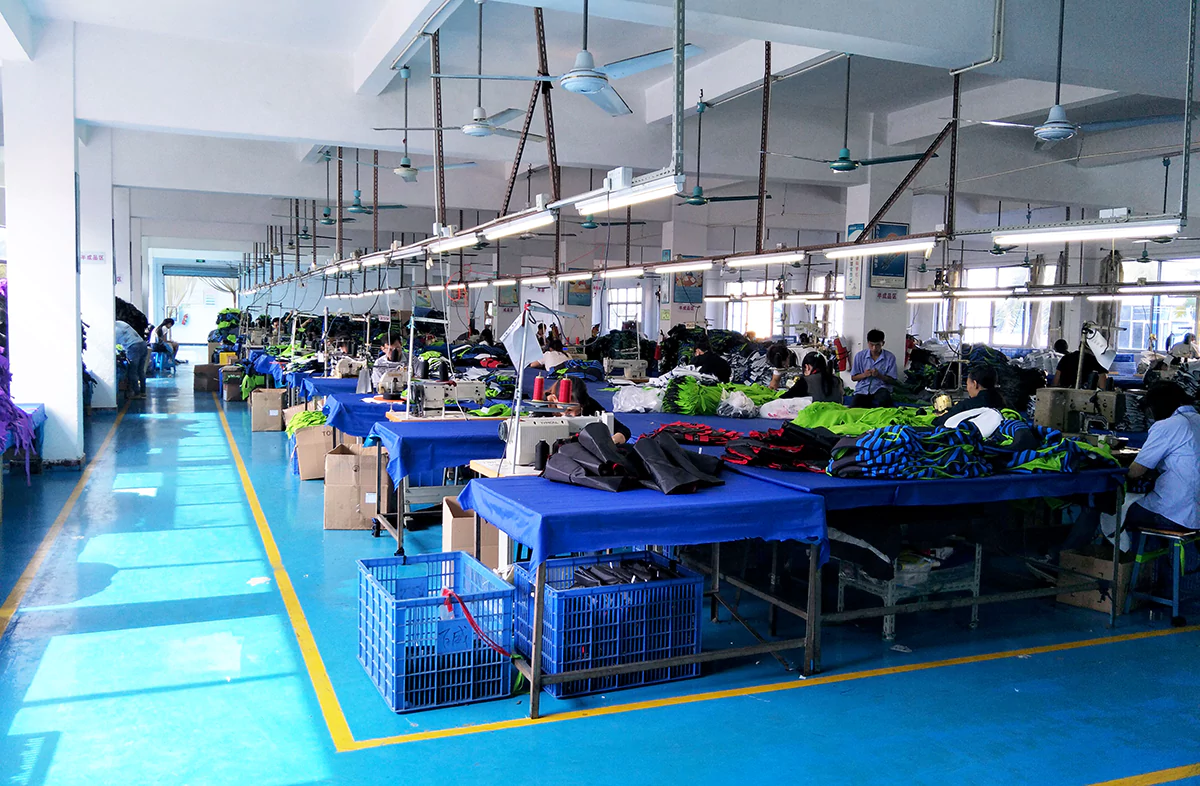
FYBagCustom is Your Trusted Custom Bag Manufacturer in China, with 15+ years of manufacturing experience and dedicated multi-material construction capability. For brands developing premium denim handbags, our capabilities include:
Contact our development team to discuss denim sourcing, color-fix treatment, and splice engineering for your premium denim bag collection.
The prejudice against denim in premium accessories is based on a misunderstanding: the assumption that denim belongs in the same category as canvas or polyester — a commodity fabric chosen for its low cost. Premium raw denim — selvedge, jacquard, heavy-weight, rope-dyed — is a heritage material with cultural depth, tactile richness, and an aging story that no other material can match. For B2B buyers developing denim bags in 2026, three core takeaways:
If your 2026 collection includes premium denim bags with leather trim, now is the time to source color-fixed denim, approve denim-leather splice samples, and finalize topstitching specifications. Contact FYBagCustom to discuss denim options, color-fix treatment, and multi-material construction — and receive splice-tested samples, typically within 5–10 days.
FYBagCustom’s multi-material engineering team produces premium denim bags with three-stage color fixing, skived denim-leather splice junctions, heritage topstitching, and antique brass hardware — from raw selvedge totes to jacquard crossbodies. Splice-tested samples in 5–10 days.
Start Your Custom Bag Project →