Tel/WhatsApp:+86 18011919834
E-mail: chloe.x@fybagcustom.com

Tel/WhatsApp:+86 18011919834
E-mail: chloe.x@fybagcustom.com

Who this guide is for: brand owners, sourcing managers, wholesale buyers, Amazon FBA sellers and DTC founders holding two or more quotes for the same bag and trying to work out which one is the real best offer.
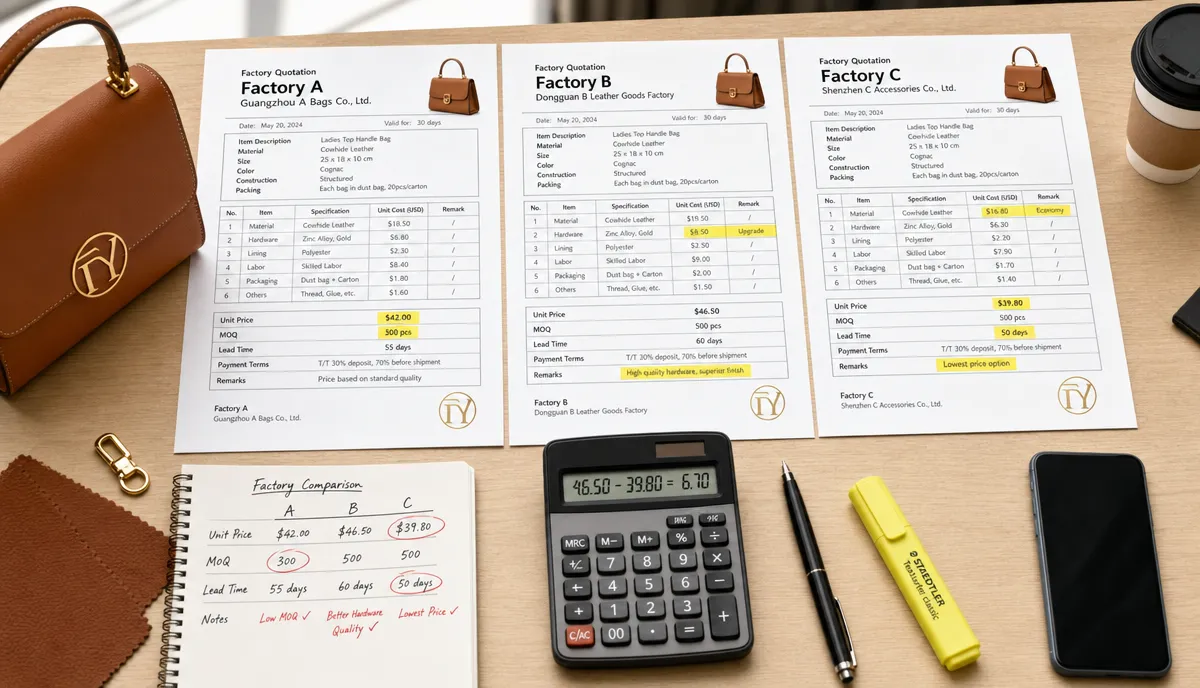
Three quotes for the same bag rarely look alike. One factory sends a single unit price, another sends a table with six quantity levels, a third sends a proforma invoice with a sample fee and a mold charge you didn’t expect. Reading a bag manufacturer quotation well means looking past the unit price to the assumptions underneath it: material grade, quantity per color, shipping basis, one-time charges and validity. Once those match, the quotes become comparable, and the cheapest one is often not the one with the lowest number.
Quick answer: Compare bag factory quotes only after you put them on the same basis: same specification and material grades, same quantity per color, same Incoterm and same packaging. Then add one-time charges such as molds, plates and sample fees, plus freight, to reach a landed cost per bag. Check validity and payment terms, and ask each factory to list the assumptions behind its price.
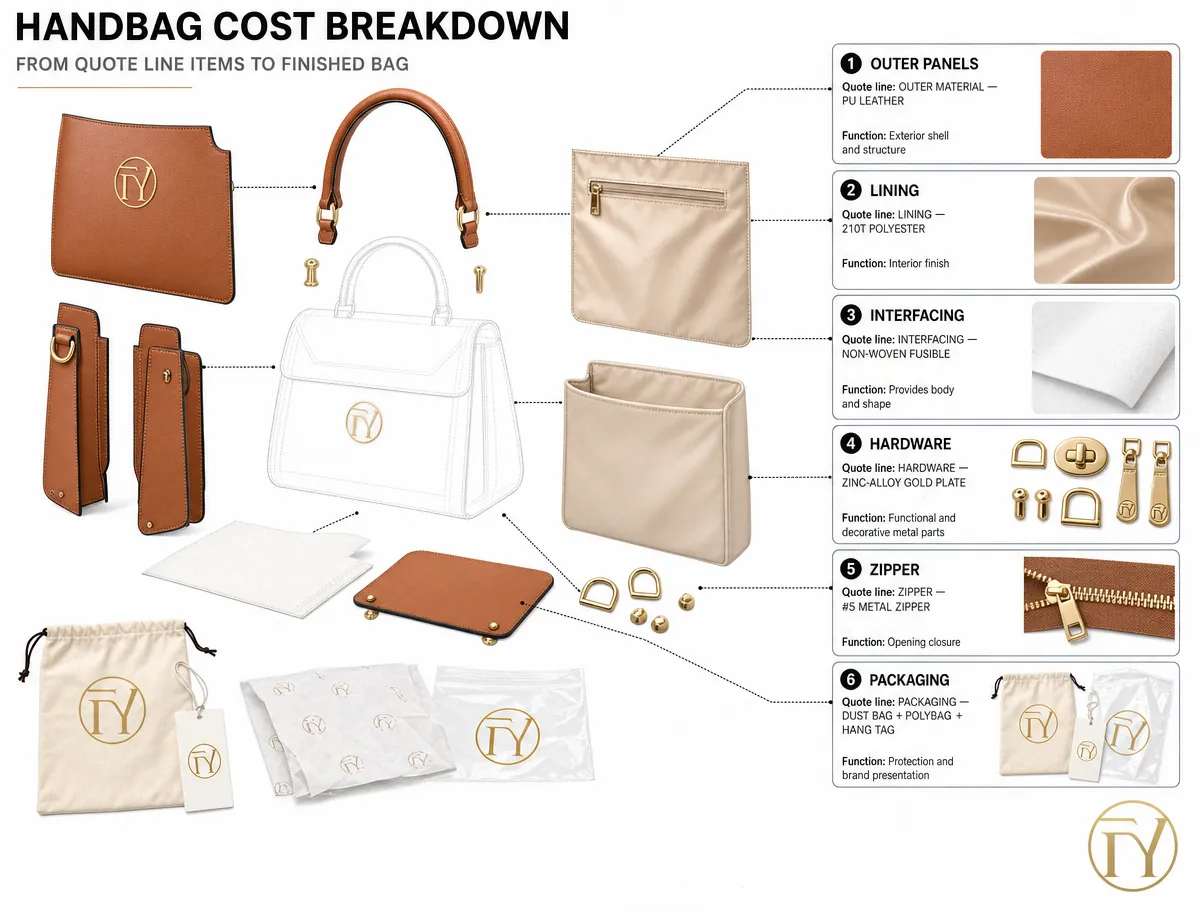
Most quotes show a unit price per style at one or more quantities, with notes on materials, lead time and terms. Behind that unit price sits a cost build-up that looks roughly the same in every bag factory. Some factories will itemize it; others will itemize only options and extras. Either way, knowing the structure tells you which lines to question.
| Line item | What it covers | Relative share of unit cost | What to check |
|---|---|---|---|
| Outer material | Leather, PU, nylon, canvas or other face fabric, including cutting waste | Often the largest | Grade, thickness, backing, finish and supplier |
| Lining and reinforcement | Lining fabric, interfacing, foam, base board, edge tape | Low to moderate | Whether the quote includes the interlining shown on your sample |
| Hardware and zippers | Rings, buckles, feet, locks, zipper chain and pullers | Low to high, depending on custom parts | Stock or custom, finish, zipper brand and size |
| Labor | Cutting, sewing, edge finishing, assembly, trimming | Moderate to high for handbags | Construction complexity matches your sample |
| Decoration | Logo plate, embossing, hot foil, embroidery or print | Low to moderate | Method, size, position and colors |
| Packaging | Polybag, dust bag, tissue, hang tag, box, export carton | Low to moderate | Exactly which items are included |
| Overhead and margin | Factory running costs and profit | Built into the price | Rarely itemized; compare totals instead |
| One-time charges | Molds, plates, screens, cutting dies | Separate from unit price | Amount, ownership, refund or amortization |
| Freight and terms | What the Incoterm includes | Depends on Incoterm | Named port or place, and who clears customs |
Our breakdown of what it costs to manufacture a handbag explains how each of these lines moves with materials, labor, hardware and order size.
Every quote rests on assumptions, and most disagreements after sampling come from assumptions nobody wrote down. Read each quote for the phrases below, and turn every one into a written question.
| Assumption | How it often appears on a quote | Question to ask |
|---|---|---|
| Material grade | “PU leather”, “nylon”, “metal hardware” | Which grade, thickness, backing and finish? Can you name the supplier? |
| Quantity per color | “Price based on total quantity” | Does the price hold if the order splits across four colors? |
| Size and construction | “As per picture” | Which dimensions and construction did you price? |
| Logo method | “With logo” | Which method, what size, and is there a setup charge? |
| Packaging | “Standard packing” | Which items are included per unit and per carton? |
| Shipping basis | “FOB” with no port, or no term at all | Which Incoterm and which named port or place? |
| Quantity tolerance | Rarely stated | How many units over or under the order quantity may you ship? |
| Testing | Not mentioned | Does the price assume materials that pass our lab tests? |
| Validity | “Price subject to change” | Until what date does this price hold? |
| Lead time | “30 days” | From which event to which event? |
Quantity tolerance deserves a note. Many factories cut a few extra pieces to cover defects, and some ship slightly over or under the ordered quantity. Agree an acceptable range in the purchase order so the invoice matches what you planned to pay for.
Incoterms are the International Chamber of Commerce’s standard trade terms, currently Incoterms 2020. The term on a quote decides which costs and risks sit inside the price. Two quotes with different terms cannot be compared until you convert one of them.
| Incoterm | What the factory covers | Where risk passes to you | When it suits bag buyers |
|---|---|---|---|
| EXW (Ex Works) | Goods ready at the factory | At the factory door | Rarely ideal from China, because you must handle export clearance |
| FOB (Free On Board) [port] | Export clearance and loading on the vessel at the named port | Once goods are on board | The most common basis for sea freight with your own forwarder |
| CIF (Cost, Insurance and Freight) [port] | FOB plus ocean freight and minimum insurance to the destination port | Once goods are on board at origin | When you want the factory to book freight but will handle import yourself |
| DDP (Delivered Duty Paid) [place] | Everything to your door, including import duties and clearance | At your door | Small shipments and buyers without a customs broker, with less cost visibility |
The International Chamber of Commerce recommends FCA (Free Carrier) rather than FOB for container cargo, because the factory hands containers to the carrier before they reach the ship. In practice, FOB remains the most common term in China’s bag trade, so ask your forwarder which term your quotes should use and request it from every factory. For freight options from Guangzhou, see the FYBagCustom shipping solution.
One-time charges cover tools and setup that the factory creates only for your design. Factories handle them in three ways: a separate charge, a charge refunded after a certain order volume, or a cost spread into the unit price. Ask which approach each factory uses, because it changes the comparison.
| One-time charge | When it applies | Relative cost | Questions to ask |
|---|---|---|---|
| Sample fee | Every new style; often per round | Low to moderate | Is it credited against the bulk order? |
| Custom hardware mold | Logo plates, custom buckles or zipper pullers | Moderate to high | Who owns the mold? Can it be reused for other styles? |
| Emboss, deboss or hot-foil plate | Logos pressed into leather or PU | Low | Is one plate enough for every logo size? |
| Screen setup | Screen printing, per color | Low | How many colors and positions are included? |
| Cutting dies | High-volume cutting of fixed shapes | Low to moderate | Does the factory need dies at this quantity? |
| Embroidery digitizing | New embroidery artwork | Low | Is it charged once or per size? |
| Lab testing | Third-party tests your market or retailer requires | Moderate | Who books the lab, and who pays for a retest? |
In your comparison, spread every one-time charge over the quantity you expect to order in the first year, not just the first order. A mold that looks expensive on a test order becomes small once reorders run on it. Our article on how MOQ influences production cost and lead time shows how quantity changes the per-unit share of these costs.
Use a single comparison sheet and work through it in order.
The table below shows how the ranking can change once quotes are on the same basis. It uses relative terms only.
| Factor | Factory A | Factory B | Factory C |
|---|---|---|---|
| Quoted unit price | Lowest | Middle | Highest |
| Incoterm | EXW | FOB Guangzhou | FOB Guangzhou |
| Material grade | “PU”, unspecified | PU with microfiber backing as specified | As specified |
| Logo plate and mold | Charged separately | Charged separately, refunded on reorder | Included in unit price |
| Sample fee | Not credited | Credited on bulk | Credited on bulk |
| Validity | Not stated | Stated date | Stated date |
| Result on the same basis | Rises once freight, export clearance and grade are corrected | Best value | Close to B; simplest paperwork |
After you accept, the factory usually issues a proforma invoice confirming the price, terms and bank details for the deposit, and you issue a purchase order with the agreed specification. Check that both documents match the quote you compared.
FYBagCustom is Your Trusted Custom Bag Manufacturer in China, quoting OEM, ODM and private label programs across handbags, totes, crossbody, shoulder, clutch, backpack and specialty bags. FYBagCustom, a custom bag factory in Huadu District, Guangzhou, has 15+ years of experience, a 5,000 m² factory, 500+ staff and 10+ production lines. Browse the full FYBagCustom product range to see the bag types and materials the team quotes.
Ask FYBagCustom for a quotation with your spec, quantities and preferred Incoterm.
Put every quote on the same basis first: identical specification and material grades, the same quantity and color split, the same Incoterm and the same packaging. Then spread one-time charges over your expected first-year volume, add freight and duties to reach landed cost, and weigh payment terms, lead time and validity. Ask outliers to explain their assumptions.
Factories often price different versions of the same bag. One assumes a cheaper material grade, another includes interfacing or upgraded hardware, and a third quotes a different Incoterm or packaging. Labor rates, overhead and order priorities also vary between factory types. Send everyone the same detailed RFQ and ask for assumptions in writing to narrow the gap.
EXW means the factory makes goods available at its premises, and you handle loading, export clearance and all transport from there. FOB means the factory clears export and loads the goods onto the vessel at a named port, where risk passes to you. From China, FOB is usually simpler, because export clearance is handled by the seller.
Either approach works if you know which one the factory uses. Separate charges keep the unit price clean for reorders. Amortized charges simplify a one-off order but inflate later unit prices if nobody removes them. Ask who owns the tooling, whether any charge is refunded after a set volume, and whether sample fees are credited against bulk.
Validity varies by factory and by material, and it is often a few weeks, because leather, PU, hardware and exchange rates move. A quote without a validity date gives the factory room to reprice at the proforma invoice stage. Ask for a stated expiry date and the conditions that would change the price, such as a material supplier increase.
FYBagCustom’s OEM/ODM team quotes custom bags for brand owners, sourcing managers and Amazon sellers, with named material options from 200+ verified suppliers, 5–7 day sampling and flexible MOQ blended across colors and sizes.
Start Your Custom Bag Project →