Tel/WhatsApp:+86 18011919834
E-mail: chloe.x@fybagcustom.com

Tel/WhatsApp:+86 18011919834
E-mail: chloe.x@fybagcustom.com

Who this guide is for: brand owners, sourcing managers, wholesale buyers, Amazon FBA sellers and private label founders who are deciding where in China to source handbags, backpacks, luggage or mixed bag ranges.
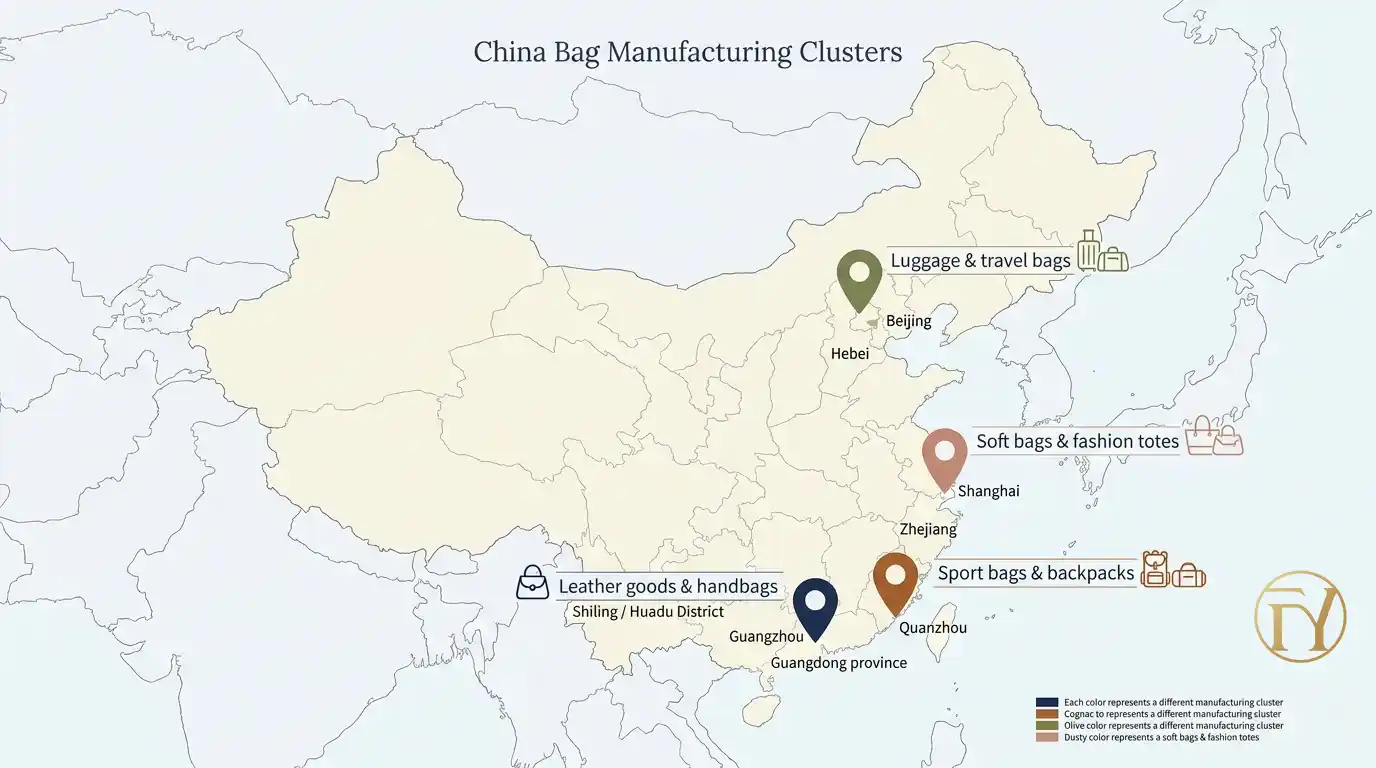
Search for a bag supplier in China and you will find thousands of factories with near-identical profiles. The country’s output is concentrated, though. A handful of bag manufacturing regions in China produce most of the handbags, backpacks and suitcases sold worldwide, and each region grew around a different product, material base and type of buyer. Knowing which cluster fits your range narrows a long supplier list to a short one before you send a single inquiry.
This guide compares the four clusters that bag buyers meet most often: Guangzhou, with the Shiling leather goods town in Huadu District; Quanzhou in Fujian; Baigou in Hebei; and Pinghu in Zhejiang. It covers what each one makes, where each one is strong, what to watch for, and how to verify a factory inside any of them.
Quick answer: Most bags made in China come from four clusters. Guangzhou, especially Shiling Town in Huadu District, leads in women’s handbags and leather or PU goods. Quanzhou in Fujian is known for backpacks and sports bags. Baigou in Hebei runs a large wholesale market for value bags. Pinghu in Zhejiang focuses on suitcases and travel luggage. Pick the cluster that matches your product first.
Bag making depends on a long list of inputs: leather, PU, nylon, canvas, linings, foam, zippers, buckles, webbing, thread, edge paint, labels and packaging. A factory that can buy most of these within an hour’s drive samples faster, fixes problems faster and holds less stock. Over decades, suppliers settled near the factories that bought from them, and the factories settled near the suppliers. The result is a set of towns where an entire bag supply chain sits in a few square kilometers.
Clusters also concentrate skills. Pattern makers, sample sewers and edge painters move between factories in the same town, so techniques spread. A town that has built women’s handbags for two decades has a deep bench of people who understand structured construction. A town built on luggage has engineers who understand wheel housings and shell molding.
For a buyer, three practical effects follow:
The table below summarizes the four clusters. Treat it as a starting map: individual factories inside each cluster vary widely, and many make products outside their region’s core.
| Cluster | Province | Core products | Typical buyers | Development strength | Watch-outs | Main export gateways |
|---|---|---|---|---|---|---|
| Guangzhou (Shiling, Huadu District) | Guangdong | Women’s handbags, leather and PU goods, totes, crossbody bags, small leather goods, fashion backpacks | Fashion brands, DTC labels, private label programs | Fast sampling, dense leather, PU and hardware markets, pattern makers with fashion experience | Wide quality range between workshops; labor costs at the higher end within China | Guangzhou Nansha and Huangpu ports, Shenzhen ports, Hong Kong |
| Quanzhou (including Jinjiang) | Fujian | Backpacks, school bags, sports and outdoor bags, travel duffles | Sportswear, outdoor and school-supply brands, large retailers | Technical fabric, webbing and foam supply; high-volume sewing lines | Less depth in leather fashion handbags | Xiamen and Quanzhou ports |
| Baigou | Hebei | Value handbags, backpacks, luggage, ready-made designs | Wholesalers, market traders, budget e-commerce sellers | Very large wholesale market, quick turnaround on existing designs | Many small workshops, uneven traceability and consistency, design originality varies | Northern ports on the Bohai Bay |
| Pinghu | Zhejiang | Suitcases, trolley luggage, soft luggage, travel bags | Luggage brands, travel retailers, corporate programs | Hard-shell molding, wheel and handle systems, luggage assembly | Handbags and leather goods sit outside the core | Shanghai and Ningbo-Zhoushan ports |
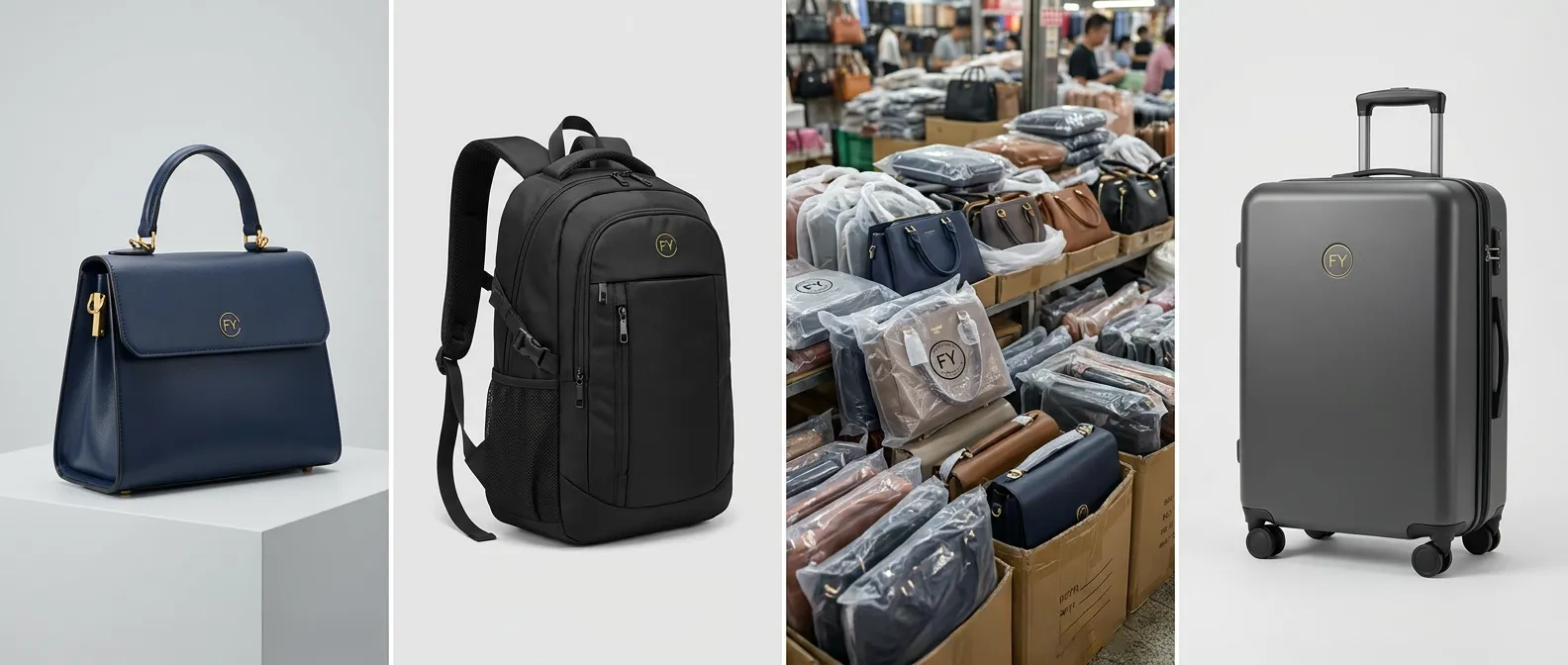
Shiling Town, in Guangzhou’s Huadu District, is widely described as China’s leather goods capital. The town holds bag factories of every size alongside markets for leather, PU, linings, hardware, zippers and trims, so a sample maker can source most components without leaving town. Closer to central Guangzhou, the wholesale leather goods district around Guihuagang serves domestic and export traders, which keeps designers and buyers moving through the region.
The cluster’s strength is women’s fashion bags: structured and soft handbags, totes, shoulder and crossbody bags, clutches and small leather goods, in genuine leather, PU and coated fabrics. Factories here are used to seasonal collections, short development windows and frequent spec changes. For a deeper look at how the town works, read our guide to Guangzhou’s Shiling leather goods cluster.
Where Guangzhou fits best:
Watch-outs: Shiling holds everything from large export factories to family workshops, and the quality gap between them is wide. Labor costs in Guangdong sit at the higher end within China, so Guangzhou factories compete on development skill and speed more than on the lowest price.
Quanzhou, including the Jinjiang area, grew alongside one of China’s largest sportswear and footwear industries. Several major Chinese sportswear brands are headquartered in Jinjiang, and that ecosystem pulled in suppliers of technical polyester and nylon, webbing, foam, mesh and molded components. Bag factories in the region tend to run large sewing lines set up for repeat styles.
Typical Quanzhou products include school backpacks, laptop backpacks, sports and gym bags, outdoor packs and travel duffles. The cluster suits programs where durability standards, consistent volume and functional details (padded straps, ventilated back panels, water-resistant zippers) matter more than fashion detailing.
Watch-outs: leather fashion handbags fall outside the region’s core, and some large lines prefer bigger runs per style. A brand that wants a few fashion backpacks inside a handbag range may find a Guangzhou factory a better fit, since many Shiling factories also build custom backpacks in PU, nylon and canvas.
Baigou, in Hebei province south of Beijing, is often called China’s bag capital. Its trading city hosts a very large wholesale market for handbags, backpacks, luggage and accessories, fed by thousands of small and mid-sized workshops in the surrounding area. Buyers can walk the market, pick from ready-made designs and arrange quick turnaround on repeat orders.
The model works well for wholesalers and resellers who buy existing designs at value price points, and for sellers testing many styles fast. It is a weaker fit for brands that need original development, tight specs and documented quality control. Traceability can be uneven: the stall that sells you a bag may not be the workshop that sews it, and the workshop may change from one order to the next.
Watch-outs to manage in Baigou:
Pinghu, a city in Jiaxing near Shanghai, is one of China’s main luggage production centers and is often described as the country’s travel luggage capital. Its factories specialize in hard-shell suitcases in ABS, polycarbonate and aluminum, soft-sided trolley luggage, and travel bags. The supply base around them covers wheels, telescopic handles, locks and shell molds.
A brand launching a suitcase line, or a corporate program that needs branded trolley cases, should look at Pinghu first. The engineering in luggage (wheel durability, handle cycling, shell impact resistance) differs from handbag construction, and Pinghu factories have built their testing and tooling around it.
Watch-outs: handbags and small leather goods sit outside Pinghu’s core, and hard-shell luggage needs molds, which raises development cost and lengthens lead time compared with soft bags.
Three other places come up in bag sourcing conversations. They play different roles from the four main clusters.
| Location | Role in bag sourcing | When a buyer meets it |
|---|---|---|
| Dongguan and Shenzhen (Guangdong) | Export-oriented bag and luggage factories, including large contract manufacturers for international brands | Large, compliance-heavy programs with audited factories |
| Yiwu (Zhejiang) | Wholesale trading hub for small commodities, including promotional bags and pouches | Buying through trading companies, mixed-product orders |
| Hong Kong | Trading offices, sourcing agents, finance and export services | Buyers working through an agent or a trading company |
Many Yiwu suppliers are trading companies. That can suit a buyer who wants many product types in one container, but it adds a layer between you and the sewing line.
Start from the product, then the buyer model. A brand developing its own designs needs a development-strong cluster. A reseller buying ready-made styles needs a market cluster. The decision table below maps common product types to the first cluster worth checking.
| Product type | First cluster to check | Why |
|---|---|---|
| Women’s leather or PU handbags | Guangzhou (Shiling) | Material markets, hardware, fashion pattern makers |
| Small leather goods and wallets | Guangzhou (Shiling) | Edge finishing and skiving skills, leather supply |
| Fashion totes, crossbody and shoulder bags | Guangzhou (Shiling) | Short development cycles, mixed-material experience |
| Technical backpacks and school bags | Quanzhou, or Guangzhou for fashion backpacks | Technical fabric and webbing supply, large lines |
| Sports duffles and gym bags | Quanzhou or Guangzhou | Both build them; choose by design style and volume |
| Hard-shell suitcases | Pinghu | Shell molding, wheels and handle systems |
| Ready-made value handbags for resale | Baigou | Market access to existing designs |
| Mixed private label range (handbags, totes, backpacks, pouches) | Guangzhou (Shiling) | One factory can cover several silhouettes and materials |
Relative cost depends on the buyer model as much as on location. Baigou’s market prices sit low because buyers select existing designs and share development cost with many other buyers. Guangzhou development factories price higher per unit for original work, because the unit price carries pattern making, development and quality control. For a comparison across countries, see our total landed cost comparison of China, Vietnam, India and Mexico.
Cluster strengths describe a region, and each company still has to prove its own capability. Run the same checks wherever the factory sits:
FYBagCustom is Your Trusted Custom Handbag Manufacturer in China, working from inside the Shiling leather goods cluster for brands that develop their own designs. FYBagCustom, a custom bag factory in Huadu District, Guangzhou, has 15+ years in the trade, a 5,000 m² facility in Shiling Town, 500+ staff, 10+ production lines and a network of 200+ verified material and component suppliers. You can read more about the team and facility on our About FYBagCustom page.
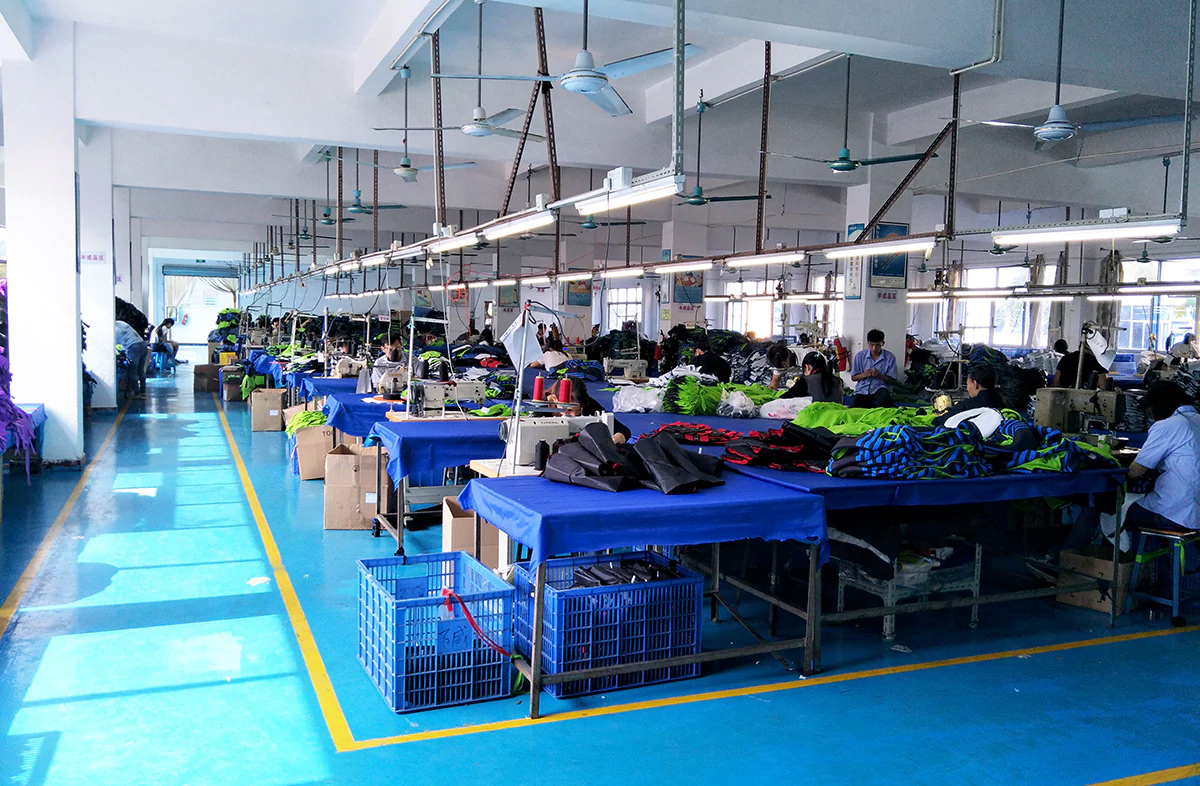
Being in Shiling shapes how we work:
If you are comparing clusters for a new range, tell our team what you plan to make. We can say whether your product fits our lines, and ask about a factory visit or a live video walk-through if you want to see the floor first.
Most bags come from a few clusters. Guangzhou, centered on Shiling Town in Huadu District, leads in women’s handbags and leather goods. Quanzhou in Fujian is known for backpacks and sports bags. Baigou in Hebei runs a large wholesale market for value bags. Pinghu in Zhejiang specializes in suitcases. Dongguan and Shenzhen host many export-oriented contract factories.
It depends on your buyer model. Guangzhou, and Shiling in particular, suits brands that develop original designs and need sampling, material control and documented inspection. Baigou suits wholesalers who buy ready-made designs at value price points with fast turnaround. Brands building their own label usually find Guangzhou development factories a better fit, while resellers often start in Baigou.
Quanzhou in Fujian, including the Jinjiang area, is one of the best-known regions for backpacks, school bags and sports bags, supported by a large sportswear supply chain. Guangzhou also produces many fashion backpacks in PU, nylon and canvas, which suits brands that sell backpacks alongside handbags. Baigou supplies value backpacks through its wholesale market.
Pinghu in Zhejiang, near Shanghai, is one of the main centers for suitcases and trolley luggage, with suppliers for shells, wheels, handles and locks. Baigou also trades luggage at value price points, and Dongguan hosts export-oriented luggage factories. Soft travel bags and duffles are made across most clusters, including Guangzhou and Quanzhou.
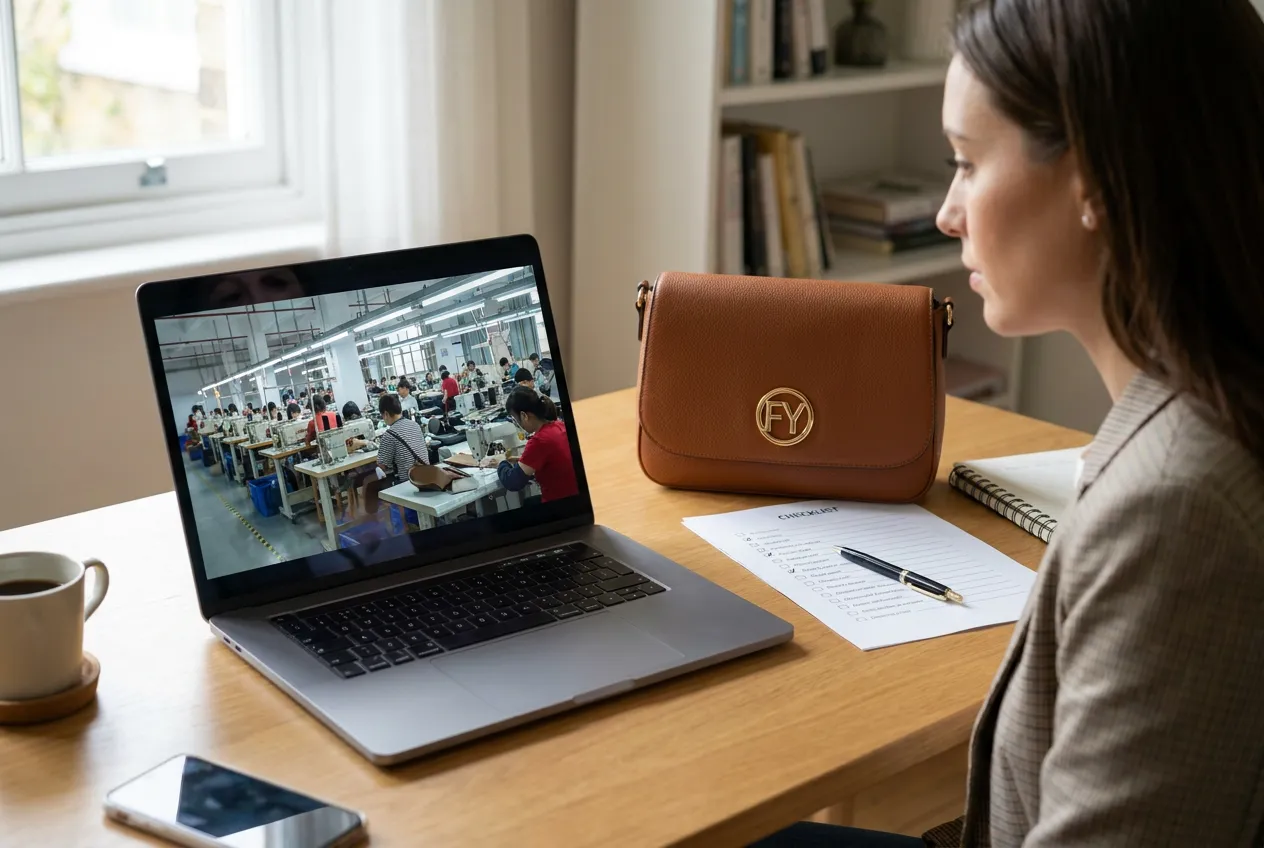
No. A cluster tells you which products a region knows well and how close the supply chain sits, but quality depends on the individual factory. Watch the production line on video or in person, request a sample from the factory’s own sample room, and book an AQL inspection before final payment, regardless of the region.
FYBagCustom’s OEM/ODM team in Shiling, Guangzhou works with brand owners, private label founders and Amazon sellers on handbags, totes, backpacks and small leather goods. Expect 5–7 day sampling, flexible MOQ blended across colors and sizes, and 100% pre-shipment inspection.
Start Your Custom Bag Project →