Tel/WhatsApp:+86 18011919834
E-mail: chloe.x@fybagcustom.com

Tel/WhatsApp:+86 18011919834
E-mail: chloe.x@fybagcustom.com

Who this guide is for: brand owners, sourcing managers, wholesale buyers, Amazon FBA sellers and DTC founders who have bag orders in sampling or production between December 2026 and March 2027.
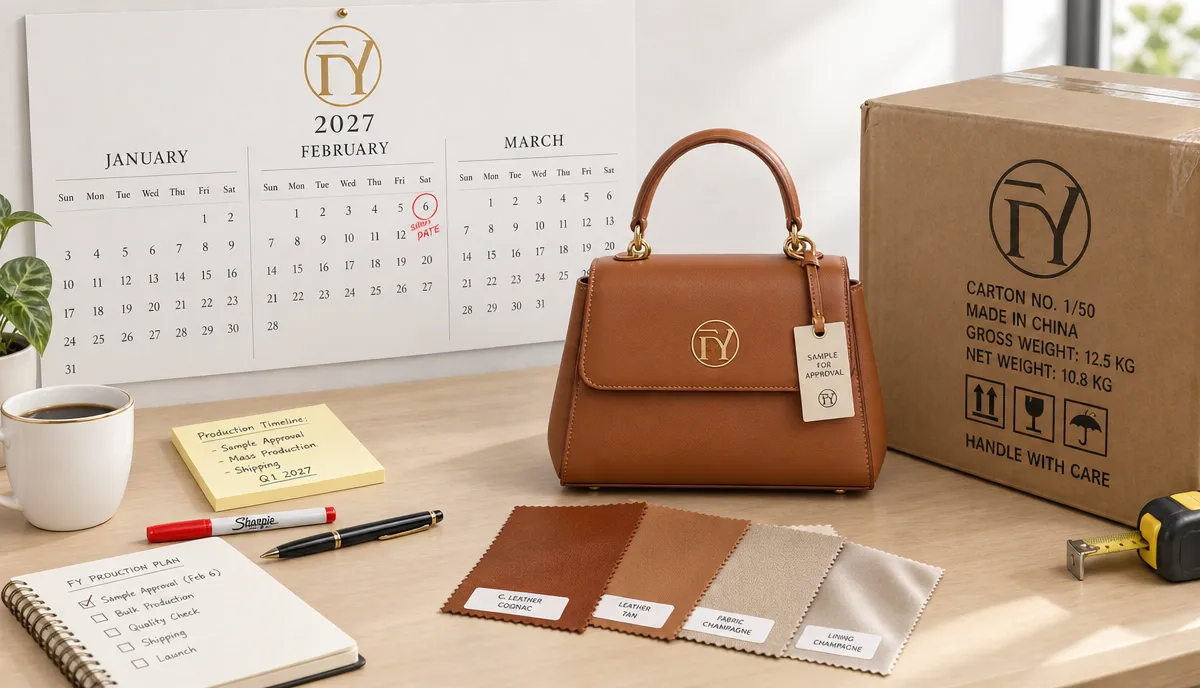
Chinese New Year 2027 falls on Saturday 6 February. The statutory holiday lasts little more than a week, but the Chinese New Year factory shutdown that affects your bags runs far longer. Material suppliers stop shipping first, sewing workers leave early to travel home, freight space tightens through January, and output takes weeks to recover after the Lantern Festival on 20 February. If your spring stock, Valentine’s Day gift sets or Amazon restock depend on a factory in China, the decisions you make in December set your arrival dates for the whole first quarter.
Quick answer: Chinese New Year 2027 is on 6 February. Most Chinese bag factories close for one to two weeks, but output drops for four to six weeks: workers leave one to two weeks before the holiday and return gradually over one to three weeks after it, many after the Lantern Festival on 20 February. To ship before the break, finish bulk production by mid-January.
Chinese New Year follows the lunar calendar, so it moves between late January and mid-February. In 2027 it lands on Saturday 6 February, the start of the Year of the Goat. China’s State Council sets the statutory Spring Festival holiday each year, typically eight or nine days, often with make-up working days on nearby weekends. Check the official 2027 schedule, because it decides when offices and ports run full service.
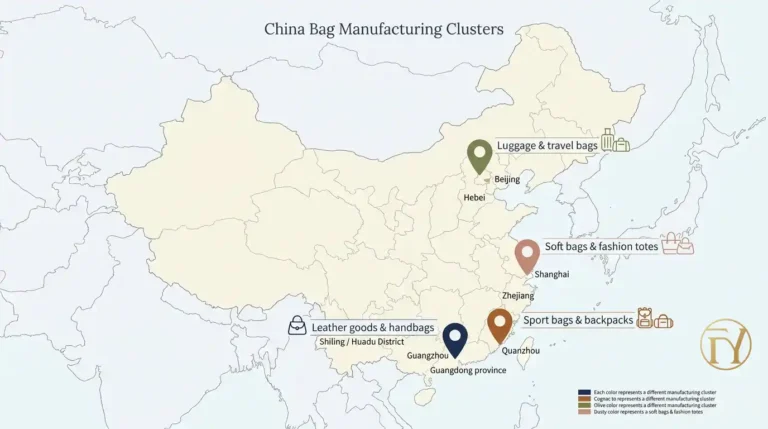
Factories set their own closure dates, well outside the statutory window, because a Guangdong bag factory plans its break around workers who travel several days to reach their home provinces.
| Date (2027) | Event | What it means for your bag orders |
|---|---|---|
| Early to mid-January | Upstream suppliers start closing | Last practical deliveries of fabric, PU, leather, hardware, zippers and printed packaging |
| Around 22 January | Spring Festival travel season (chunyun) begins | Workers from other provinces start leaving; tickets sell out |
| Late January | Lines thin out | Factories focus on finishing and packing orders already cut |
| 5 February (Friday) | New Year’s Eve | Factories closed; ports and customs on reduced service |
| 6 February (Saturday) | Chinese New Year | Statutory holiday; almost every factory closed |
| Mid-February | Statutory holiday ends (date set by the State Council) | Office staff return; production restarts slowly |
| 20 February (Saturday) | Lantern Festival | Many workers return after this date |
| Late February to mid-March | Ramp-up | Output climbs back toward normal while new hires train |
Typical timings for South China bag factories; each factory sets its own dates.
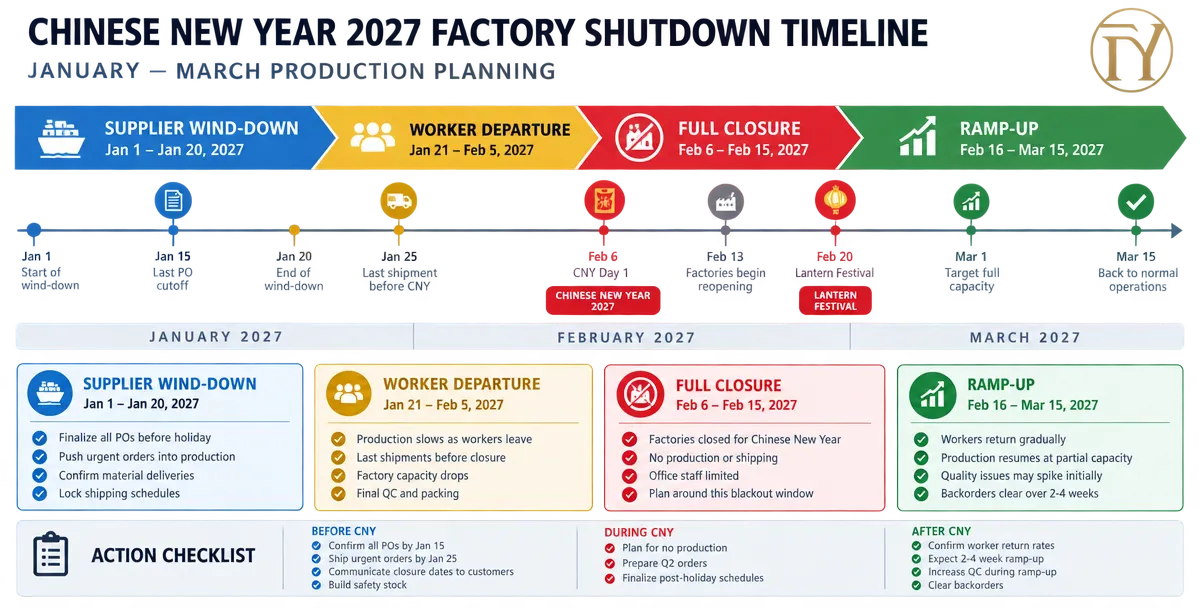
The shutdown has three phases, and each carries a different risk for your order.
Wind-down (one to two weeks before). Workers with long journeys leave first, from around 23 January in 2027. Lines keep running with fewer operators, and production managers spend these weeks finishing orders already cut. Few start a new bulk order in late January.
Full closure (around one to two weeks). From New Year’s Eve until the statutory holiday ends, nearly all bag factories, material suppliers and logistics providers stop. Smaller workshops whose staff share a home region often close longer.
Ramp-up (one to three weeks after the holiday). Office staff return first, then sewing workers, many after the Lantern Festival on 20 February. Some workers change jobs or stay home, so factories hire and train new operators. Full output often returns in early to mid-March.
Added together, a typical bag factory loses roughly four to six weeks of normal output.
| Phase | Typical 2027 timing | Factory status | Risk to your order |
|---|---|---|---|
| Supplier wind-down | Early to mid-January | Mills, dyehouses and platers stop taking new orders | Materials for late orders can’t be bought until March |
| Worker departure | About 23 January to 5 February | Short-staffed lines; packing prioritized | Half-sewn orders stall until after the holiday |
| Full closure | About 5 February to mid-February | Closed | No production; slow replies |
| Return and ramp-up | Mid-February to mid-March | Partial lines; new operators in training | Slower output and a higher defect risk on first runs |
A finished bag draws on a long chain of upstream suppliers: fabric mills, PU and leather suppliers, dyehouses, lining weavers, zipper makers, hardware casters and electroplaters, label weavers and packaging printers. Most close earlier than the sewing factory. A dyehouse needs full batches, so it stops accepting small custom-color orders as January volume falls. Platers and trim workshops close when their own workers leave, and printers fill up with every brand’s pre-holiday packaging.
Your materials deadline therefore falls in December, even if your factory sews until late January. Stock materials give you more room than custom ones.
| Material or trim | Typical lead time in a normal month | Pre-holiday risk | What to do |
|---|---|---|---|
| Stock PU, nylon, polyester or canvas in standard colors | A few days to about a week | Low to moderate | Confirm stock and reserve rolls by early January |
| Custom-dyed fabric or PU | Roughly 2 to 4 weeks | High | Approve lab dips and release the order by early December |
| Custom logo hardware from a new mold | Roughly 3 to 5 weeks including plating | High | Approve the hardware sample in November or early December |
| Zippers with custom pullers | Roughly 2 to 3 weeks | Moderate to high | Order with the hardware, not after the bag sample closes |
| Woven labels, hang tags and printed boxes | Roughly 1 to 2 weeks | Moderate | Send final artwork before Christmas |
Lead times are typical ranges; confirm each item with your factory.
Every exporter in China tries to ship before the holiday, so January brings a freight rush: carriers add surcharges, vessels fill, and late bookings can roll to the next sailing. Book ocean space three to four weeks before your cargo-ready date and confirm the vessel cut-off with your forwarder.
After the holiday, export volume drops and carriers often cancel (“blank”) sailings. A second surge follows in March as factories ship what they finished during ramp-up. Couriers slow down too: a sample sent in late January may not move until mid-February.
For transit planning from South China ports such as Nansha (Guangzhou), Yantian or Shekou (Shenzhen), allow roughly two to three weeks port to port to the US West Coast and roughly four to six weeks to the US East Coast or Northern Europe. Door to door, add one to two weeks for customs clearance, trucking and receiving. Our 2026 guide to shipping custom bags to U.S. warehouses covers routes and modes in detail, and the FYBagCustom shipping solution page covers freight options from the factory.
Start with the date your bags must be sellable (a store shelf, a wholesale customer’s warehouse or an Amazon fulfillment center) and subtract each stage:
Now lay the Chinese New Year window over the result. In 2027 the effective disruption runs from about 23 January to early March. If your bulk production window falls inside it, you need one of the plans in the next section. Our backward calendar for holiday handbag production uses the same method for Black Friday.
The table below runs three common in-store dates through that calendar, assuming sea freight to the US West Coast.
| Milestone | Sellable by 1 March 2027 | Sellable by 15 April 2027 | Sellable by 15 May 2027 |
|---|---|---|---|
| Goods land at your warehouse | Mid-February | Early April | Early May |
| Goods leave the factory | Mid-January | Early March | Early April |
| Bulk production window | December to mid-January | Falls inside the shutdown | Late February to late March |
| Materials in the factory | Early December | Before mid-January, held for later | Before mid-January, held for later |
| Samples approved | Late November | Mid-December | Early January |
| Verdict | Only orders already approved can make it | Ship before the holiday and hold stock, or split with air freight | Workable if samples and materials close before the break |
Add two to three weeks for the US East Coast or Europe.
The middle column is the hard case. Goods needed between mid-March and mid-April would need February production, exactly when factories are closed or restarting. You either ship before the holiday and carry the stock longer, or move part of the order to air freight. US Mother’s Day falls on 9 May 2027, so gift-focused bag lines usually sit in the right-hand column.
Most brands choose one of three approaches, depending on the in-store date, cash position and confidence in the design.
| Plan | Key deadline | When you pay | Main risk | Best for |
|---|---|---|---|---|
| Ship before the holiday | Bulk finished and inspected by mid-January | Deposit in November or December; balance in January | December is a peak month, so line space is tight and production is rushed | Repeat styles and Valentine’s or early-spring stock |
| Produce after the holiday | Samples and PO closed in January; bulk from late February | Deposit in January or February; balance in March | Ramp-up delays, new operators and a March freight surge | New styles, summer lines and brands without a hard March date |
| Split the order | Materials bought and reserved before suppliers close; sewing after | Deposit early so materials can be bought | Storage, and keeping material lots consistent across two runs | Brands that need stock in March and want to be first in line at restart |
A split can also divide quantity: ship your fastest-selling colors before the holiday and the rest after it. A blended MOQ across colors makes this easier, because each run doesn’t need to reach a full order quantity alone.
Use December to close every decision that would otherwise wait until March.
The first weeks after the break carry the highest quality risk of the year. New operators join the lines, returning workers need a few days to reach their usual pace, and supervisors juggle every delayed order at once.
FYBagCustom is Your Trusted Custom Bag Manufacturer in China, running OEM, ODM and private label programs for handbags, totes, backpacks, crossbody bags and specialty bags. FYBagCustom, a custom bag factory in Huadu District, Guangzhou, has worked with brands for 15+ years from a 5,000 m² facility with 500+ staff and 10+ production lines.
Send your in-store date with your tech pack and the team will map the calendar backward from it. Talk to FYBagCustom about your Chinese New Year plan.
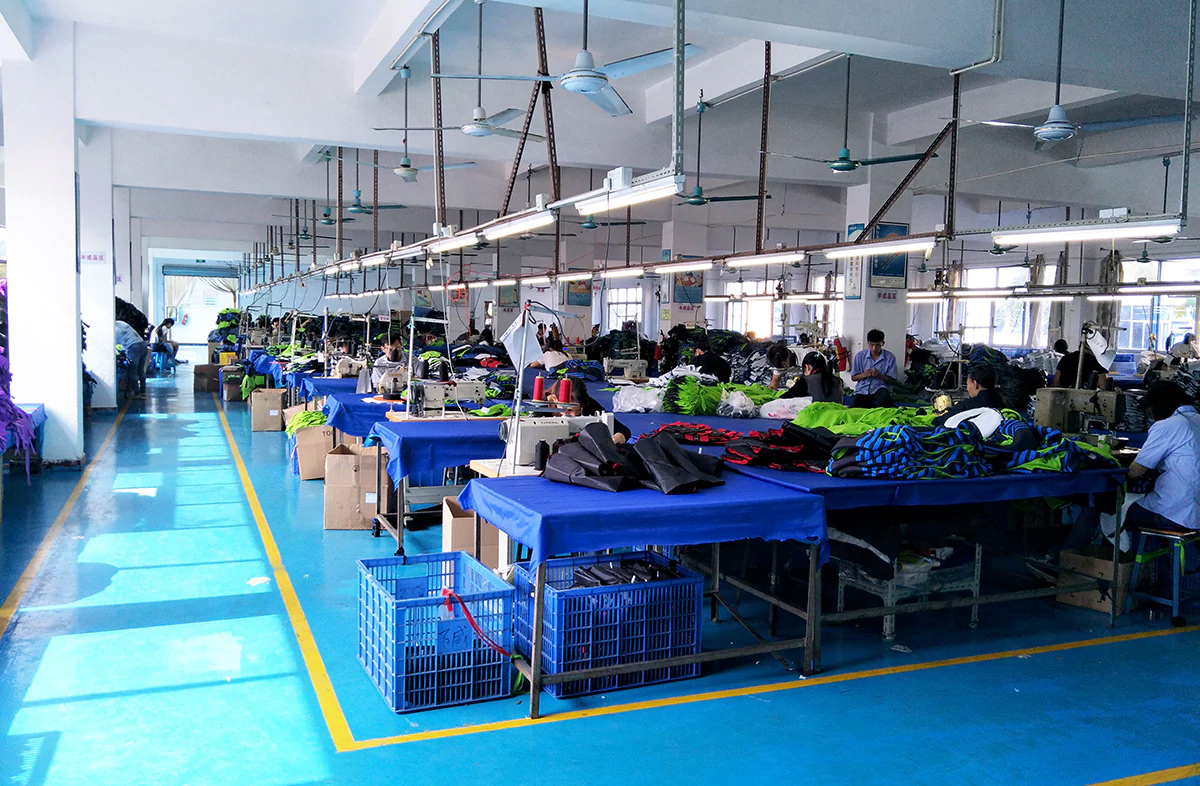
Chinese New Year 2027 is on Saturday 6 February. Most bag factories in South China start losing workers around 23 January, close fully from New Year’s Eve on 5 February until the statutory holiday ends in mid-February, and return to normal output in early to mid-March. Ask each supplier for its own closure and reopening dates in writing, because they vary.
The doors are typically shut for one to two weeks, but production capacity drops for roughly four to six weeks in total. Workers leave one to two weeks before the holiday and return gradually over one to three weeks after it, often after the Lantern Festival on 20 February. Upstream suppliers such as dyehouses and platers often close earlier than the factory itself.
Ports keep operating on a reduced basis, but factories, trucking firms and customs brokers slow down or stop, so little cargo leaves during the holiday week. To ship before the break, have goods packed and inspected by mid-January and book ocean space three to four weeks ahead. Otherwise plan a cargo-ready date in March.
Close samples before the holiday if you can. An approved sample in December lets the factory buy materials before suppliers shut and puts your order at the front of the post-holiday queue. If you start sampling in late January, expect the process to pause for three to four weeks and plan bulk production for March at the earliest.
They can. Freight rates often rise in the pre-holiday rush and dip during the quieter weeks that follow, while some material suppliers revise their prices after the break. Ask your factory how long its quote stays valid and whether that validity covers the holiday, and get freight quotes close to your booking date.
FYBagCustom’s OEM/ODM team helps brand owners, wholesale buyers and Amazon sellers plan production around Chinese New Year, with 5–7 day sampling, flexible MOQ blended across colors and sizes, and 100% pre-shipment inspection before every shipment leaves Guangzhou.
Start Your Custom Bag Project →