Tel/WhatsAapp:+86 18011919834
E-mail: chloe.x@fybagcustom.com

Tel/WhatsAapp:+86 18011919834
E-mail: chloe.x@fybagcustom.com
Send Your Inquiry Today


Who this guide is for: brand owners, product developers, sourcing managers, DTC founders, and luxury-adjacent label creators who want to understand the acoustic and tactile engineering of handbag hardware — why some zippers glide in silence while others grind and catch, why some clasps close with a satisfying whisper while others clunk like cheap plastic, and how to specify “silent-grade” hardware that transforms the daily act of opening and closing a custom handbag into a sensory experience that communicates luxury through touch and sound.

Close your eyes and open a luxury handbag. You hear — or rather, you do not hear — the zipper. There is no grinding. No clicking. No metallic scraping. The slider moves through the teeth with a resistance so even and so minimal that the sensation is closer to drawing a finger across silk than operating a mechanical device. Then close the flap. The magnetic snap engages with a single, clean, muted “click” — not a sharp metallic clack, not a dull thud, but a precisely damped contact sound that confirms closure without announcing it.
Now open a mid-market handbag. The zipper catches at the second centimeter. The slider requires a corrective tug. The teeth make a ch-ch-ch sound, each tooth audibly separating and re-engaging. The magnetic snap hits with an uncontrolled metallic clap — too loud, too sharp, too aggressive. Every hardware interaction broadcasts: “this bag is not premium.”
The difference between these two experiences is not subjective. It is the result of measurable, specifiable, controllable engineering decisions made at the hardware sourcing and production stage. The silent zipper and the damped clasp are not magical properties that some hardware possesses and others lack — they are the outcome of specific material compositions, surface treatments, tolerance grades, and assembly specifications that a buyer can write into a tech pack and a factory can verify on the production floor.
This guide documents the engineering behind the sensory experience: what makes hardware silent, smooth, and satisfying — the three adjectives that consumers use, consistently, to describe the hardware on bags they perceive as “luxury.”
The consumer’s perception of handbag quality is formed through multiple senses simultaneously — but the hierarchy of those senses is not what most designers assume. Visual quality (how the bag looks) sets the expectation. Tactile and acoustic quality (how the bag feels and sounds) confirms or betrays that expectation.
| Sequence | Sense | Consumer Action | What She Evaluates | Quality Signal |
|---|---|---|---|---|
| 1st | Visual | Sees the bag (in a store, online, at unboxing) | Material, color, shape, proportions, hardware finish | “This looks premium” — expectation set |
| 2nd | Tactile | Touches the exterior material | Material softness, weight, grain texture | “This feels premium” — expectation supported |
| 3rd | Tactile + Acoustic | Opens the zipper; closes the clasp; operates the turn-lock | Smoothness of zipper glide; force required; sound of closure | “This IS premium” — expectation confirmed (or betrayed) |
| 4th | Tactile | Reaches inside; touches the lining | Interior lining quality, pocket accessibility | “Every detail is considered” — expectation deepened |
The third step — hardware operation — is the confirmation moment. A bag that looks and feels premium but produces a grinding zipper sound or a cheap-sounding snap fails the confirmation. The consumer’s subconscious registers the inconsistency: “the outside says luxury, but the hardware says otherwise.” This dissonance reduces perceived value, increases return probability, and generates the review comment that damages conversion most: “looks expensive but feels cheap.”
Conversely, a bag with hardware that operates in near-silence, with buttery resistance and a precisely damped closure sound, over-confirms the visual and tactile expectations. The consumer’s subconscious registers: “even the parts I cannot see are perfect.” This over-confirmation is what creates the “this bag is worth every penny” perception that drives the highest review ratings and the lowest return rates.
A zipper that operates in silence is not simply a “good zipper.” It is a zipper where every component — teeth, slider, tape, pull — has been specified to minimize friction, eliminate vibration, and produce controlled resistance rather than uncontrolled noise.
| Noise Source | What Produces It | Technical Cause | How It Sounds |
|---|---|---|---|
| Tooth engagement friction | Each tooth scraping against the slider’s internal channel as it is opened or closed | Rough tooth surfaces; burrs from casting; insufficient polishing; incorrect tooth geometry | Ch-ch-ch — a rhythmic clicking or scraping with each tooth |
| Slider binding | The slider encountering resistance and then releasing suddenly (stick-slip) | Slider channel too tight for the tooth profile; debris in the channel; misaligned teeth | A series of micro-catches — the zip moves, stops, moves, stops |
| Tape flutter | The fabric zipper tape vibrating as the slider moves | Tape that is too thin or too loosely woven; tape not properly tensioned by the sewing | A faint buzzing or fluttering sound alongside the tooth noise |
| Pull swing | The metal pull tab swinging and striking the slider body during operation | Pull tab too heavy or too loosely attached; no damping between pull and slider | A metallic tinking or rattling that accompanies every zip motion |
| End-stop impact | The slider hitting the top or bottom stop at the end of the zip’s travel | No damping at the stops; slider arrives at full speed | A sharp metallic “click” at the end of each zip motion |
| Noise Source | Solution | Specification Language for Tech Pack |
|---|---|---|
| Tooth engagement friction | Polished teeth — after casting or stamping, the teeth are individually tumble-polished to remove burrs and create smooth engagement surfaces | “Zipper teeth: tumble-polished to mirror or satin finish; no casting burrs; tooth engagement must be continuous without audible friction” |
| Slider binding | Precision slider-to-tooth fit — the slider’s internal channel is machined to a tolerance that matches the tooth profile with 0.05–0.1 mm clearance | “Slider: precision-machined channel; 0.05–0.1 mm clearance to teeth; no stick-slip binding across the full zip travel” |
| Tape flutter | Woven tape with integrated stiffening — tape that is dense enough to not vibrate when the slider moves | “Zipper tape: minimum 120 threads/cm density; no flutter or vibration during slider operation” |
| Pull swing | Damped pull attachment — a silicone or rubber micro-gasket between the pull tab and the slider body that absorbs the swing energy | “Pull: damped attachment; no audible contact between pull tab and slider body during normal handling” |
| End-stop impact | Cushioned end-stops — end-stops with a micro-rubber insert or an extended deceleration channel that slows the slider before contact | “End-stops: cushioned or deceleration-channeled; no audible impact when slider reaches full travel” |
| Component | Silent-Grade Specification |
|---|---|
| Brand / grade | YKK Excella or equivalent premium grade (YKK Excella is the industry benchmark for silent, polished-tooth zippers) |
| Tooth material | Brass (for warm gold finish) or zinc alloy (for silver/gunmetal) — individually polished |
| Tooth finish | Mirror-polished or satin-polished; no matte or raw-cast teeth |
| Tooth size | #5 (standard bag zipper) — #3 for lightweight / clutch applications |
| Slider | Precision-machined with tight-tolerance channel; auto-lock (holds position when the pull is released) |
| Slider finish | Matching tooth finish (polished brass or satin); no exposed casting marks |
| Pull | Shaped pull (teardrop, rectangular, or custom) with damped attachment; leather pull tab optional for additional damping |
| Tape | Matching-color woven tape, ≥120 threads/cm, pre-shrunk |
| End-stops | Cushioned or deceleration-channeled |
| QC test | Full open/close cycle, 50 repetitions at moderate speed; zero audible friction, zero binding, zero pull rattle |
YKK Excella is a specific product line from YKK (the world’s largest zipper manufacturer) designed for luxury applications. Each tooth is individually polished after stamping — a step that standard YKK zippers do not receive. The polishing removes the micro-burrs that standard teeth retain, creating a surface so smooth that the slider-to-tooth engagement produces almost no friction sound.
Specifying “YKK Excella or equivalent” in your tech pack communicates to the factory that you require polished-tooth, precision-slider, premium-grade zippers — not standard commercial-grade. Not every factory stocks Excella; the factory may need to special-order it. Confirm availability and lead time when quoting.
For brands where Excella is not available or cost-prohibitive: the next tier is standard YKK brass or zinc zippers with post-production tumble polishing. The factory’s hardware supplier tumble-polishes the zipper teeth after manufacturing — a process that costs less than Excella (which is polished at the YKK factory) but produces 80–90% of the smoothness improvement. Specify: “Standard YKK brass zipper, #5, with post-production tumble polishing of all teeth to satin finish.”
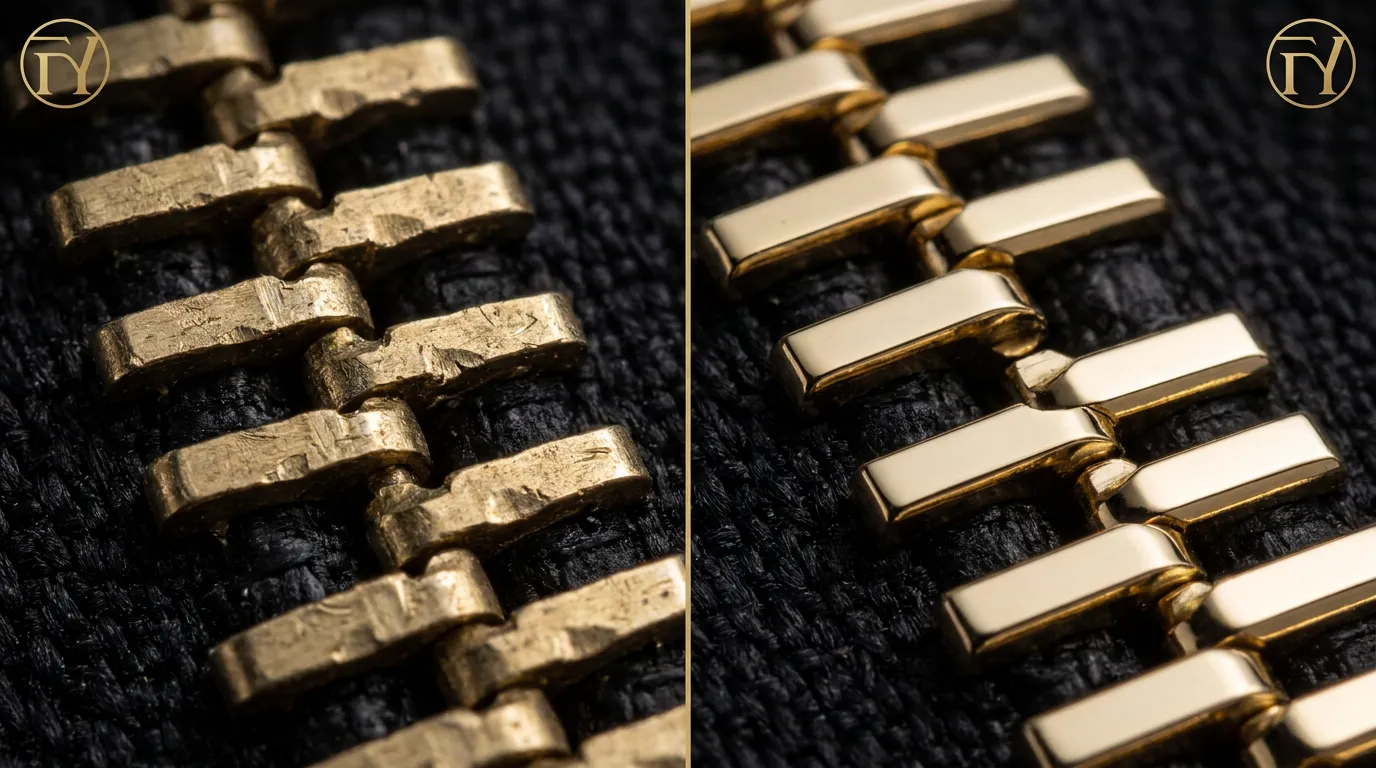
Beyond silence (the absence of unwanted sound), the premium zipper must produce a specific tactile sensation during operation — what the industry calls “glide feel.” Glide feel is the sensation of controlled, even, minimal resistance throughout the entire zip travel.
| Component | What the Consumer Feels | Engineering Cause | How to Specify |
|---|---|---|---|
| Resistance magnitude | How hard she must pull — should be very light, requiring minimal force | Determined by slider-to-tooth clearance and tooth surface finish; tighter clearance and rougher surfaces = more resistance | “Maximum pull force: 10 N for a #5 zipper” (standard zippers are 15–25 N; premium is under 12 N) |
| Resistance uniformity | Whether the resistance stays constant across the entire zip, or fluctuates (catches, eases, catches) | Determined by tooth alignment precision and consistency; any tooth that is higher, lower, or angled differently than its neighbors creates a local resistance spike | “Pull-force variation: ±2 N maximum across full zip travel” (standard zippers may vary ±5–8 N) |
| Damping | Whether the motion feels “cushioned” rather than “mechanical” — the difference between sliding a finger across silk vs. across a washboard | Determined by the presence of micro-lubrication on the teeth and within the slider channel | “Teeth and slider channel: lubricated with silicone or paraffin micro-coating” |
The single most impactful — and most commonly omitted — upgrade for zipper glide feel is micro-lubrication: a thin, invisible coating of silicone oil or paraffin wax applied to the zipper teeth and the slider’s internal channel. This coating reduces metal-on-metal friction by 40–60%, transforming a standard zipper into one that glides with the buttery smoothness consumers associate with luxury.
| Lubricant | Application Method | Friction Reduction | Durability | Feel | Specification |
|---|---|---|---|---|---|
| Silicone oil (polydimethylsiloxane) | Dip or spray application on finished zipper before bag assembly | 50–60% reduction vs. unlubricated | Good — lasts 6–12 months of daily use; re-applicable by the consumer (silicone spray) | Ultra-smooth; slightly slippery | “All zippers: silicone micro-lubricated post-assembly” |
| Paraffin wax (micro-coating) | Wax applied to teeth in a thin film via warm application | 40–50% reduction | Very good — wax adheres to tooth surfaces and lasts 12–24 months | Smooth; slightly waxy but not sticky | “All zippers: paraffin micro-coated teeth and slider channel” |
| Graphite powder | Dry lubricant brushed onto teeth | 30–40% reduction | Moderate — graphite migrates off the teeth over time | Smooth; can leave faint gray residue on fingers | Not recommended for light-colored bags — graphite residue is visible |
Recommended default: paraffin wax micro-coating. It provides excellent friction reduction, lasts longer than silicone oil, and does not leave any residue on the consumer’s hands. Specify it in your tech pack as a standard finish on all zippers.
The closure sound — the acoustic event when a magnetic snap engages, a turn-lock rotates into position, or a push-lock clicks — is the second most important sensory element after zipper glide. It is the punctuation mark on the act of closing the bag: a confirmation that the bag is secure, rendered as sound.
| Attribute | Luxury Closure Sound | Cheap Closure Sound | What Causes the Difference |
|---|---|---|---|
| Volume | Quiet — audible only to the user at arm’s length | Loud — audible across a room | Luxury closures have damped contact surfaces (rubber gaskets, felt pads); cheap closures are bare metal-on-metal |
| Pitch | Low to mid — a muted “thock” or a soft “click” | High — a sharp “clink” or tinny “tick” | Lower pitch comes from heavier, denser metal (zinc alloy or brass) with larger contact surfaces; high pitch comes from thin, lightweight metal with small contact points |
| Duration | Short — the sound does not ring or reverberate | Extended — the metal rings or buzzes after contact | Ringing occurs when the metal vibrates after impact; damping materials absorb the vibration immediately |
| Cleanness | Single event — one “click,” no secondary rattles or bounces | Multiple events — the closure bounces or rattles into position | Clean engagement comes from precision fit; the closure mates in one motion with no secondary contact |
| Element | Standard (Undamped) | Silent-Grade (Damped) |
|---|---|---|
| Magnet strength | Standard neodymium | Same — magnetic force does not affect sound |
| Contact surfaces | Bare metal-on-metal — disc hits disc | Micro-felt or silicone pad on one disc face (0.3–0.5 mm); the pad cushions the contact, absorbing impact energy and reducing the “clack” to a soft “thock” |
| Housing | Thin stamped metal | Heavier cast metal — the added mass lowers the pitch and absorbs vibration |
| Engagement speed | Uncontrolled — magnets accelerate the discs toward each other at full force | Graduated engagement — a slightly recessed mounting positions one disc 1–2 mm below the surface, creating a brief deceleration zone as the leather compresses before the magnets fully engage |
Specification: “Magnetic snap: neodymium, cast zinc alloy housing, micro-felt damper pad on female disc face, graduated engagement with 1–2 mm fabric compression zone.”
| Element | Standard | Silent-Grade |
|---|---|---|
| Rotation resistance | Variable — may be loose (rattly) or tight (stiff) | Calibrated spring tension — the lock rotates with smooth, even resistance and seats into position with a single, clean detent |
| Detent (the “click” when the lock seats) | Sharp metallic click | Damped detent — a nylon or Delrin detent ball instead of steel; the softer material produces a muted click that confirms closure without the metallic sharpness |
| Metal-on-metal contact | Bare metal rotation surfaces | Lubricated rotation surfaces — silicone or PTFE (Teflon) micro-coating on the internal rotation surfaces eliminates the scraping sound during rotation |
| Backplate | Thin stamped metal | Cast zinc alloy backplate with increased mass — heavier backplates absorb vibration and lower the pitch of any residual sound |
Specification: “Turn-lock: cast zinc alloy, calibrated spring tension (smooth rotation, no loose play), nylon detent ball, silicone-lubricated rotation surfaces, damped engagement.”
| Element | Standard | Silent-Grade |
|---|---|---|
| Engagement mechanism | Metal tongue slides into a metal receiver with a spring catch | Nylon-tipped tongue — the metal tongue has a nylon cap that contacts the spring catch, producing a softer engagement sound |
| Spring catch sound | Metallic “click” as the tongue engages the catch | Damped spring — a silicone sleeve around the spring absorbs vibration; the engagement produces a soft “thud” rather than a metallic click |
| Release sound | Sharp metallic snap as the tongue is pulled past the catch | Graduated release — the nylon tongue tip slides past the catch with lower friction; the release is smooth rather than sudden |
The definitive QC test for closure sound is the blindfold test: without looking at the bag, operate the closure 10 times and evaluate the sound purely by ear.
| Rating | Sound Character | Quality Level |
|---|---|---|
| 5 (silent-grade) | Barely audible; a soft “thock” or “click” that confirms closure without announcing it | Luxury / haute couture |
| 4 (quiet) | Audible but muted; clearly a closure sound but not sharp or metallic | Premium — acceptable for most high-end bags |
| 3 (standard) | Clearly audible; metallic but not offensive; a normal closure sound | Mid-market — the industry default |
| 2 (noisy) | Loud metallic clack; rings briefly after contact | Budget — undermines any premium positioning |
| 1 (disruptive) | Harsh, grinding, rattling, or multiple-contact sounds | Unacceptable at any tier |
Target for premium bags: rating 4 minimum. Target for luxury positioning: rating 5.
Beyond sound and smoothness, hardware weight is a critical tactile signal. When the consumer picks up a zipper pull, rotates a turn-lock, or swings a clasp, the weight of the metal component registers subconsciously. Heavy hardware signals density, quality, and permanence. Lightweight hardware signals thinness, cost-cutting, and fragility.
| Hardware Piece | Budget Weight | Premium Threshold | Silent-Grade Recommendation | Why Heavier Is Better for Sound |
|---|---|---|---|---|
| Zipper slider (#5) | 4–6 g | 8 g minimum | 10–14 g | Heavier sliders have more mass to absorb vibration; they produce lower-pitched, shorter-duration sounds |
| Zipper pull (decorative) | 2–3 g | 5 g minimum | 6–10 g | A heavier pull swings with more inertia but less frequency — producing a slower, more controlled motion rather than a rattly jingle |
| Turn-lock (complete) | 8–10 g | 15 g minimum | 18–25 g | Heavier turn-locks absorb the rotational energy at the detent; the engagement sound is muted and brief |
| Magnetic snap (pair) | 5–6 g | 8 g minimum | 10–14 g | Heavier snap housings absorb impact energy; the engagement sound is a low “thock” rather than a high “click” |
| D-ring (20 mm) | 3–4 g | 6 g minimum | 8–10 g | Heavier D-rings do not vibrate or ring when contacted |
| Buckle (strap adjuster) | 4–6 g | 8 g minimum | 10–15 g | Heavier buckles sit still rather than rattling during movement |
The weight-sound relationship: heavier hardware components naturally produce lower-pitched, shorter-duration sounds because the additional mass absorbs vibrational energy more quickly. This is the same physics that makes a solid brass door handle produce a muted “thud” while a hollow stamped-metal handle produces a tinny “clang.” Specifying minimum weights in your tech pack is a simple way to improve the acoustic quality of every hardware interaction.
For brands targeting silent-grade or damped hardware performance, the following template can be inserted into a tech pack:
| Component | Material | Finish | Weight | Silent-Grade Feature | QC Test |
|---|---|---|---|---|---|
| Main zipper | YKK Excella (or equivalent polished-tooth), brass, #5 | Mirror or satin polish | Slider: 10+ g | Paraffin-lubricated teeth; damped pull attachment; cushioned end-stops | 50 open/close cycles: zero audible friction; pull force under 10 N; variation ±2 N |
| Pocket zipper | YKK Excella (or equivalent), brass, #3 | Matching main zipper | Slider: 6+ g | Paraffin-lubricated; damped pull | 50 cycles: same criteria |
| Magnetic snap (main closure) | Neodymium, cast zinc alloy housing | Matching finish | 12+ g (pair) | Micro-felt damper pad; graduated engagement (1–2 mm compression zone) | 20 close/open cycles: blindfold test rating 4+ |
| Turn-lock (if applicable) | Cast zinc alloy | Matching finish | 20+ g (complete) | Nylon detent ball; silicone-lubricated rotation; calibrated spring | 20 rotation cycles: smooth, even resistance; blindfold test rating 4+ |
| D-rings | Cast welded zinc alloy | Matching finish | 8+ g each | N/A (no moving parts) | No ring or vibration when tapped |
| Strap hardware (buckle/adjuster) | Cast zinc alloy | Matching finish | 10+ g | N/A (verify smooth adjustment without grinding) | Adjust strap 10 times: zero grinding, smooth slide |
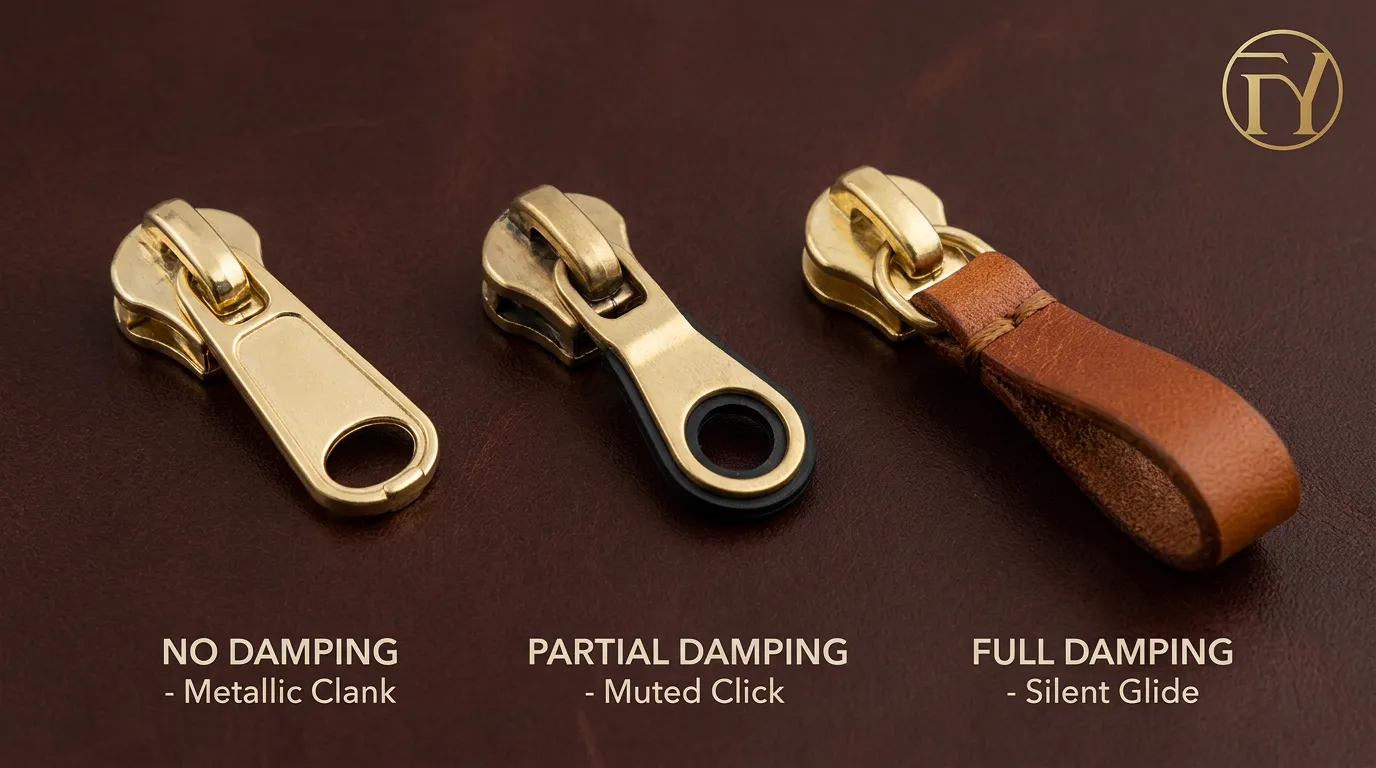
A leather pull tab — a strip of leather looped through or knotted onto the zipper pull — serves a dual function in silent-grade zipper systems:
| Element | Specification |
|---|---|
| Material | Same leather as the bag body (for visual consistency) or complementary leather (for contrast) |
| Width | 8–12 mm — wide enough to grip comfortably; narrow enough to not overwhelm the slider |
| Length | 25–40 mm (measured from the slider ring to the pull tab’s tip) |
| Attachment | Looped through the slider’s pull ring and folded over; stitched or riveted closed |
| Edge treatment | Edges painted or burnished — raw leather edges fray and look unfinished within weeks |
| Damping function | The leather strip contacts the slider body during swing, absorbing the kinetic energy silently; no metal-on-metal contact occurs |
A leather pull tab adds negligible weight and negligible production cost but transforms the acoustic profile of the zipper from “metallic” to “silent.” It should be specified on every zipper of a premium bag as standard — not as an upgrade.
A truly silent-grade bag requires attention to every hardware element that moves, contacts, or swings — not just the primary zipper and closure.
| Hardware Element | Potential Noise Source | Silent-Grade Solution |
|---|---|---|
| Strap D-rings when bag is carried | D-ring vibrates against the strap attachment tab during walking | Wrap the D-ring attachment point in leather or use a silicone O-ring buffer between the D-ring and the metal attachment loop |
| Chain strap links | Links click against each other during movement | Specify welded links (not open links) with tight tolerances; or use a leather-threaded chain where leather ribbon woven through the links separates metal from metal |
| Strap buckle / adjuster | Metal tongue clicks against the buckle frame during adjustment | Specify nylon-tipped tongue on the buckle; or use a slide adjuster (no tongue — the strap slides through a smooth channel) |
| Base feet (when bag is set down) | Metal feet strike the surface with an audible click | Specify rubber or silicone pads on the bottom of each foot — the pad contacts the surface, not the metal |
| Interior D-ring (for key clip) | The clip and keys rattle against the D-ring during handling | Use a fabric loop instead of a metal D-ring for the key attachment; the fabric absorbs rattle |
| Decorative hardware (plates, logos, charms) | Loose decorative elements vibrate or swing against the bag body | Ensure all decorative hardware is flush-mounted or secured — no loosely hanging elements unless intentional (and damped with felt backing) |
Hold the bag by one handle and shake it gently for 5 seconds (simulating the motion of walking). Listen for any metallic rattling, clicking, clinking, or vibration. A silent-grade bag produces zero hardware noise during the shake test — the only sound should be the contents inside the bag, not the bag itself.
Specify in your tech pack: “All hardware: shake test — zero audible hardware noise during 5 seconds of moderate shaking with the bag empty.”
Certain bag materials naturally complement the silent hardware philosophy by absorbing rather than transmitting sound:
| Material | Sound Absorption | Vibration Damping | Why It Matters for Silent Bags |
|---|---|---|---|
| Soft leather (calfskin, lambskin) | Very high — leather’s fiber structure absorbs sound | Excellent — leather dampens hardware vibration at every contact point | The ideal exterior for a silent bag — every hardware-to-material contact is naturally muted |
| PU leather (garment-grade soft) | High — the PU + fabric backing absorbs sound similarly to leather | Good | The accessible alternative — nearly as effective as genuine leather |
| Canvas (heavy, 14+ oz) | Moderate–High — dense cotton absorbs moderate sound | Moderate | Acceptable — heavier canvas absorbs more than light canvas |
| Nylon (lightweight, under 100D) | Low — thin nylon transmits sound rather than absorbing it | Low — the thin fabric vibrates rather than dampening | Lightweight nylon amplifies hardware sounds — silent-grade hardware is even more important on nylon bags because the material provides no natural damping |
| Stiff PU / PVC | Low — rigid surfaces reflect sound rather than absorbing | Low | The worst-case scenario for hardware noise — stiff PU/PVC amplifies every metallic contact |
The implication: on bags made from soft materials (calfskin, lambskin, garment-grade PU), the material itself provides significant acoustic damping — hardware noise is naturally muted by the soft surface. On bags made from stiff or thin materials (stiff PU, lightweight nylon), hardware noise is amplified — making silent-grade hardware specification even more critical. If you are producing a lightweight nylon tote or a structured PU crossbody, the hardware must compensate for the material’s lack of natural damping.
Silent-grade hardware costs more than standard hardware — but the premium is smaller than most buyers expect, and the perceived-value return is disproportionately high.
| Component | Standard Grade | Silent Grade | Cost Increase |
|---|---|---|---|
| Main zipper (#5, 30 cm) | Baseline | Polished teeth + lubrication + damped pull + cushioned stops | Roughly 2–3× the baseline — the largest single hardware upgrade |
| Magnetic snap (pair) | Baseline | Cast housing + micro-felt damper + graduated engagement | Roughly 1.5–2× the baseline |
| Turn-lock | Baseline | Calibrated spring + nylon detent + lubricated surfaces | Roughly 1.5–2× the baseline |
| Leather pull tabs (2) | N/A (not present on standard bags) | Added component | A modest addition — leather strip + attachment labor |
| D-ring buffers (silicone O-rings, 2–4) | N/A | Added component | Negligible — silicone O-rings are among the least expensive hardware components |
| Base foot pads (rubber, 4) | N/A | Added component | Negligible |
| Total hardware upgrade | Baseline | Silent-grade complete system | Typically adds 8–15% to total hardware cost — which is itself only 8–15% of total FOB, so the net impact is 1–2% of total bag production cost |
A 1–2% increase in total production cost that produces the “this feels luxury” confirmation in the consumer’s third sensory evaluation step — and that prevents the “looks expensive but feels cheap” review comment that destroys conversion — is among the highest-ROI investments in handbag product development.
Standard hardware QC tests function (does the zipper open? does the snap close?). Silent-grade QC must also test sensory performance — smoothness, sound, and damping.
| Test | Method | What It Evaluates | Pass Criteria (Silent-Grade) |
|---|---|---|---|
| 1. Zip glide test | Open and close the main zipper at moderate speed, 10 times, in a quiet environment | Smoothness, resistance uniformity, and sound | Zero audible friction; no binding; consistent resistance throughout travel |
| 2. Closure blindfold test | Close and open the main closure (snap, turn-lock, or push-lock) 10 times without looking, evaluating only the sound | Acoustic quality of the closure engagement | Blindfold rating 4 minimum (quiet, muted, single clean event) |
| 3. Pull force measurement | Use a spring scale to measure the force required to draw the zipper slider across 10 cm of travel | Resistance magnitude | Under 10 N maximum; under 8 N preferred |
| 4. Shake test (empty bag) | Hold by one handle, shake gently for 5 seconds, listen for hardware noise | Hardware rattle, ring, or vibration | Zero audible hardware noise |
| 5. Drop test (closure security) | Drop the closed bag from 30 cm onto a padded surface; verify all closures remain engaged | Whether damped closures sacrifice security for quietness | All closures remain engaged after drop — damping must not reduce closure security |
Perform all five tests on every PP sample and on 10% of production units (or the first 5 units off the line + periodic spot checks). Document results with audio notes if possible — a video recording of the zip glide test, played back to the buyer, is more convincing than any written description.

FYBagCustom is Your Trusted Custom Handbag Manufacturer in China, with 15+ years of manufacturing experience and a hardware engineering approach that treats sensory performance with the same precision as visual finishing. For brands targeting silent-grade or damped hardware, our capabilities include:
Contact our development team to discuss silent-grade hardware specifications, sensory QC protocols, and premium zipper options for your collection.
The sensory experience of operating a handbag’s hardware — the zip, the close, the click — is the moment where perceived quality is confirmed or betrayed. No amount of beautiful leather, precise stitching, or elegant design can overcome the dissonance of a grinding zipper or a clanking clasp. For B2B buyers developing premium handbags, three core takeaways:
If your brand’s positioning depends on the consumer’s perception of luxury at every touchpoint — including the invisible, acoustic, tactile touchpoints that happen between the eyes and the brain — now is the time to specify silent-grade hardware. Contact FYBagCustom to discuss polished zippers, damped closures, and sensory QC — and receive samples that you can hear the difference on, typically within 5–14 days.
FYBagCustom’s hardware team specifies silent-grade zippers, damped magnetic snaps, lubricated turn-locks, and full sensory QC — because the sound of your hardware is the sound of your brand. Samples with sensory verification in 5–14 days.
Start Your Custom Bag Project →