Tel/WhatsAapp:+86 18011919834
E-mail: chloe.x@fybagcustom.com

Tel/WhatsAapp:+86 18011919834
E-mail: chloe.x@fybagcustom.com
Send Your Inquiry Today

Who this guide is for: brand owners, sourcing managers, product developers, DTC founders, Amazon FBA sellers, and private label developers who specify custom handbag interiors. If you have ever treated the lining as an afterthought — selecting “standard polyester lining” because the exterior is where the money goes — this guide will change how you think about interiors. The lining is where the consumer’s hand goes every single time she uses the bag. It is what she sees when she opens the flap. It is what determines whether her bag’s interior stains, tears, smells, or pills within six months — or performs flawlessly for five years. The lining is the secret. This guide reveals it.
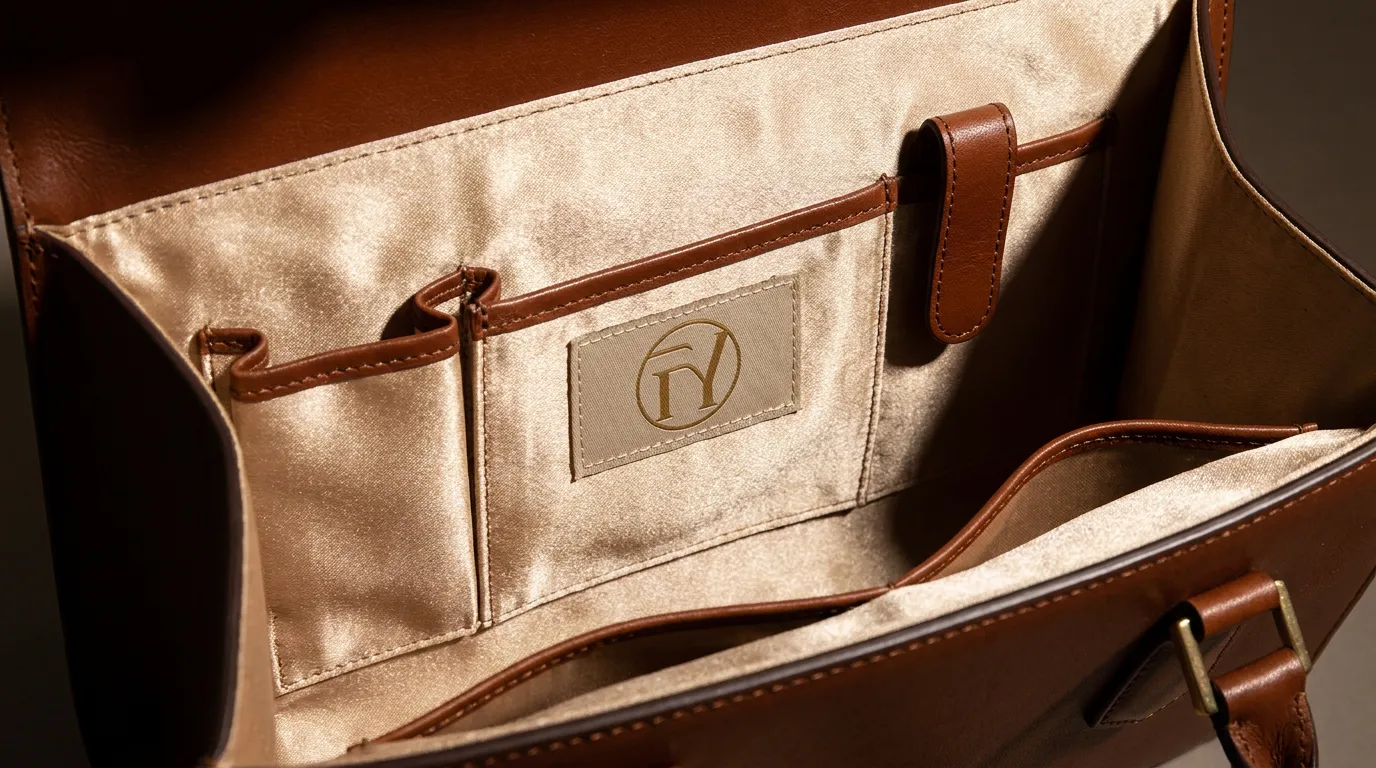
Open any luxury handbag — any bag from a house that charges $500 or more — and look inside. The lining is not an afterthought. It is a signature color, often trademarked. It is a specific material chosen for its feel against the fingertips. It is printed or woven with a brand pattern. The pockets are edged. The label is centered. The stitching is tonal. The interior is designed with the same intention as the exterior.
Now open a mid-market bag — a bag priced at 150. In most cases, the interior is generic black or gray polyester, loosely gathered into an unstructured cavity, with one or two haphazard pockets sewn wherever the factory found it convenient. The label is off-center. The lining wrinkles after two weeks. A pen mark from month one is there permanently. The interior smells faintly synthetic.
The difference in material cost between these two interiors is 4.00 per bag. The difference in perceived value to the consumer is 100. No other component of a handbag offers this ratio of quality impact to cost investment. The lining is the single most underinvested element in mid-market bag production — and therefore the single greatest opportunity for brands to elevate perceived quality without significantly increasing the price.
This guide covers every lining material available for custom handbag production, evaluates each on the dimensions that actually matter to the consumer and to the product’s lifespan, and provides the specification framework for turning the interior of your bag from an afterthought into a competitive advantage.
The lining interacts with the consumer more frequently and more intimately than any exterior surface. She touches the exterior when she picks the bag up. She touches the interior every time she retrieves or stores an item — which, across a typical day, is 15–30 interactions. The lining is what her fingers brush against when she reaches for her phone, her wallet, her keys, her lipstick. It is the tactile surface that defines her micro-experience of the product across thousands of interactions over the bag’s lifespan.
| Function | What It Does | Why It Matters | What Happens Without It |
|---|---|---|---|
| 1. Protection | Shields the exterior material’s backside from abrasion by contents | Prevents the interior of PU, leather, or canvas from being scratched or worn by keys, hardware, and sharp objects | Interior surface degrades; the bag develops internal wear marks that eventually show through to the exterior |
| 2. Structure | Adds body and weight to the bag’s panels; helps maintain shape | The lining + interlining system provides the structural foundation that keeps the bag from collapsing | A bag without lining feels hollow, cheap, and collapses under its own weight |
| 3. Tactile quality | Provides the surface that hands touch on every interior interaction | Smooth, clean lining = “this bag is well-made.” Rough, static-y, pilling lining = “this bag is cheap” | The consumer’s daily micro-experience of the product is negative |
| 4. Branding surface | Carries the brand label, signature color, printed pattern, and interior messaging | The interior is a private branding space — visible only to the owner, creating an intimate brand relationship | Missed opportunity for brand reinforcement at the most personal touchpoint |
| 5. Stain and damage barrier | Prevents pen ink, cosmetic spills, food residue, and moisture from reaching the exterior material | Protects the bag’s structural integrity and appearance | Stains soak through to the exterior; the bag develops permanent damage from interior spills |
| Material | Hand-Feel | Durability (years of daily use) | Stain Resistance | Pill Resistance | Static Resistance | Weight (g/m²) | Color Range | Cost (per m²) | Quality Tier |
|---|---|---|---|---|---|---|---|---|---|
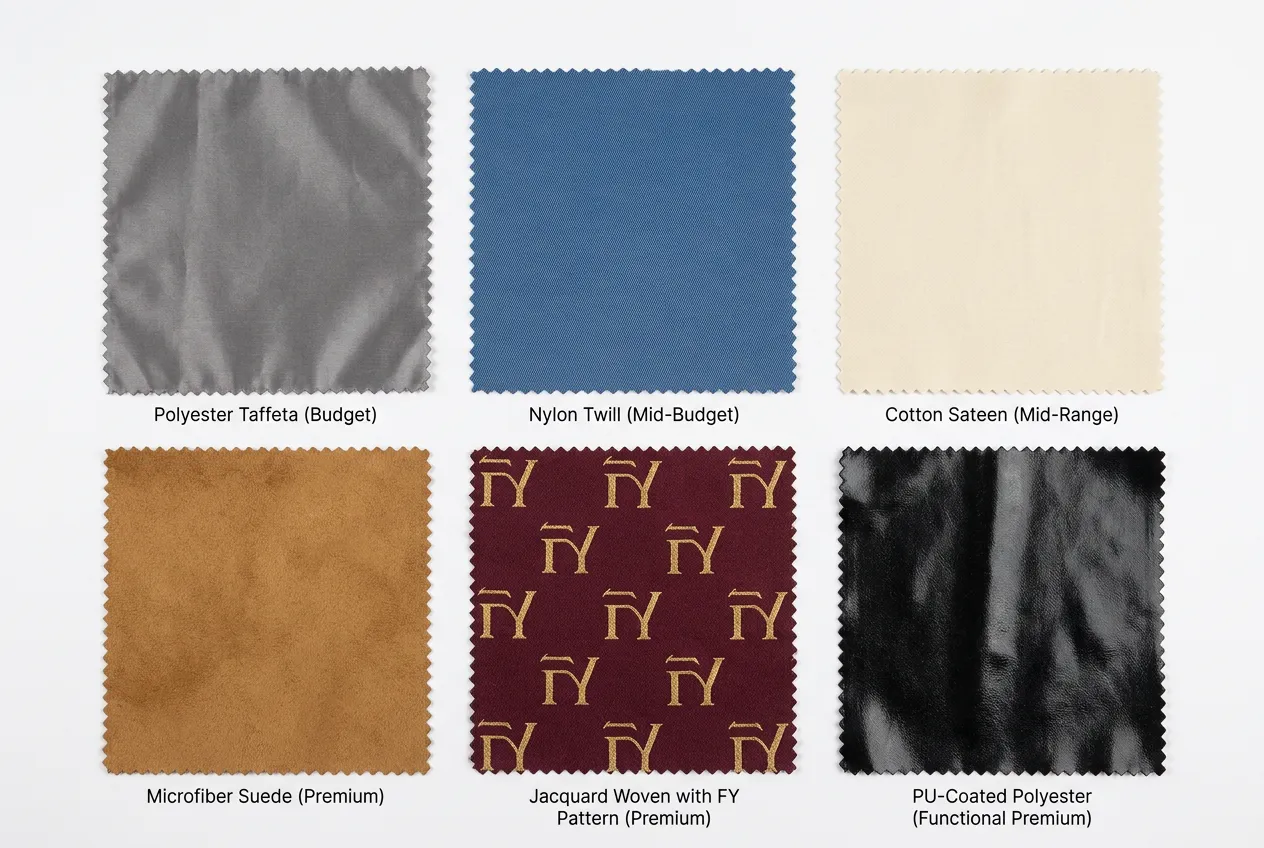
| Polyester taffeta | Smooth, thin, slightly slippery | 2–3 years | Low — absorbs stains easily | Low — pills after 6–12 months | Low — generates static cling | 40–60 | Excellent — any color | 1.50 | Budget |
| Polyester twill | Smooth, slightly heavier, more structured | 3–4 years | Low–Moderate | Moderate | Low–Moderate | 60–90 | Good | 2.00 | Budget–Mid |
| Nylon taffeta | Smooth, light, crisp | 3–5 years | Moderate — resists some stains | Good — less prone to pilling than polyester | Moderate | 40–70 | Good | 2.50 | Mid |
| Nylon twill | Smooth, sturdy, professional | 4–6 years | Moderate | Very good | Moderate | 70–100 | Good | 3.00 | Mid–Premium |
| Cotton twill | Soft, natural, breathable | 3–5 years | Low — absorbs everything | Good — natural fiber resists pilling | Excellent — no static | 80–120 | Good | 3.00 | Mid |
| Cotton sateen | Soft, lustrous, luxurious feel | 3–4 years | Low — absorbs stains; but the sateen finish resists better than plain cotton | Good | Excellent | 70–100 | Good — best in light/pastel shades | 4.00 | Premium |
| Microfiber suede | Ultra-soft, velvety, tactile luxury | 5–8 years | Good — tight fiber resists penetration | Excellent — near-zero pilling | Good | 80–120 | Excellent | 6.00 | Premium |
| Jacquard woven (polyester or cotton) | Textured, branded pattern visible in the weave | 3–5 years | Moderate | Good | Moderate | 80–120 | Limited — pattern is woven, not printed | 7.00 | Premium — the “luxury signature” lining |
| Silk charmeuse | Ultra-smooth, lustrous, cool to the touch, unmistakably luxury | 2–3 years (delicate) | Very low — stains immediately and permanently | Low — delicate fiber | Moderate | 40–60 | Excellent — beautiful in all colors | 15.00 | Ultra-luxury |
| PU-coated polyester | Smooth, wipeable, slightly plastic feel | 4–6 years | Excellent — coated surface repels liquids | N/A — coated surface does not pill | Good | 80–120 | Good | 3.50 | Mid — best for functional applications |
| PEVA-coated fabric | Smooth, waterproof, clinical feel | 3–5 years | Excellent — fully waterproof | N/A | Good | 100–140 | Limited | 3.00 | Functional — for food, wet, or cosmetic compartments |
| Recycled polyester | Similar to virgin polyester (varies by grade) | 2–4 years | Low–Moderate | Low–Moderate | Low–Moderate | 40–90 | Good | 2.50 | Budget–Mid + sustainability story |
The table reveals several clear positioning matches:
Budget bags (50 retail): Polyester taffeta is the industry default. It is the cheapest, lightest, and most widely available lining — but it pills, generates static, and stains permanently. For bags at this tier, it is adequate. For bags priced above $50, it undermines the quality perception.
Mid-market bags (100 retail): Nylon twill or cotton twill. Both are significantly more durable and tactilely superior to polyester taffeta, at a cost increase of 1.50 per bag. Nylon twill is the more practical choice (better stain resistance, lighter); cotton twill is the more natural-feeling choice (breathable, zero static).
Premium bags (200 retail): Microfiber suede or cotton sateen. These are the materials that produce the “this feels expensive inside” reaction. Microfiber suede is the strongest all-around choice: ultra-soft, highly durable, pill-resistant, and stain-resistant. Cotton sateen offers a lustrous, silky quality at a lower cost but with less stain resistance.
Luxury and ultra-luxury bags ($200+ retail): Jacquard woven (for branded pattern linings) or silk charmeuse (for pure tactile luxury). Jacquard woven linings are the luxury industry standard — a brand pattern woven directly into the fabric creates an unmistakable interior signature. Silk is the ultimate hand-feel material but is too delicate for daily-use bags; it is best reserved for clutches, evening bags, and collector pieces.
Functional compartments (cosmetic pockets, food zones, wet sections): PU-coated polyester or PEVA-coated fabric. These materials prioritize cleanability and waterproofing over hand-feel, which is appropriate for compartments that will contact cosmetics, food, or moisture.
Pilling — the formation of small fiber balls on a fabric surface — is the most visible and most complained-about lining defect. It occurs when short fibers on the fabric surface tangle together through friction (from hands, contents, and daily use). Polyester taffeta, the most common budget lining, is the most pill-prone material because its short synthetic fibers have a low resistance to surface tangling.
| Material | Time to First Visible Pilling (daily use) | Pill Severity After 12 Months | Consumer Perception |
|---|---|---|---|
| Polyester taffeta | 2–4 months | Moderate to severe — visible pills cover high-contact areas | “This bag is already wearing out” — triggers return consideration |
| Polyester twill | 4–8 months | Mild to moderate | Acceptable for budget tier; noticeable in mid-market |
| Nylon taffeta | 6–12 months | Mild | Acceptable for most tiers |
| Nylon twill | 12–24 months | Minimal | Rarely noticed by consumers |
| Cotton twill | 12+ months | Minimal — natural fiber pills less | Rarely noticed |
| Cotton sateen | 8–12 months | Mild — sateen finish eventually wears | Noticeable on light colors |
| Microfiber suede | 24+ months | Near-zero — tight fiber structure resists pilling | Never noticed — the gold standard for pill resistance |
| Jacquard woven | 12–18 months | Mild — depends on fiber composition | Acceptable; the pattern masks mild pilling |
| Silk | 3–6 months | Moderate — delicate fiber | Expected at the ultra-luxury level; accepted as “natural” |
The recommendation for any bag above $50 retail: eliminate polyester taffeta lining. Replace it with nylon twill (minimum cost increase, significant quality improvement) or microfiber suede (moderate cost increase, maximum quality improvement). This single substitution removes the #1 interior quality complaint and extends the bag’s perceived lifespan by 2–3 years.
Pill resistance can be tested objectively using the Martindale pilling test (ISO 12945-2). The fabric is rubbed in a figure-eight pattern against a standard abrasive surface, and the degree of pilling is rated on a 1–5 scale after a specified number of cycles.
| Rating | Description | Acceptable For |
|---|---|---|
| 1 | Severe pilling — dense, large pills covering the surface | Not acceptable for any commercial product |
| 2 | Moderate pilling — noticeable pills on the surface | Budget tier only (sub-$30 retail) |
| 3 | Moderate pilling — pills visible but not dense | Mid-market (60) |
| 4 | Slight pilling — few small pills, not immediately noticeable | Premium (150) — minimum acceptable |
| 5 | No pilling — surface unchanged after testing | Luxury / boutique — the target for all bags above $100 |
Specify in your tech pack: “Lining must achieve Martindale pilling rating of 4 minimum (5 preferred) at 5,000 cycles.” This specification eliminates polyester taffeta (which typically rates 2–3) and ensures the factory selects an appropriate material.
The lining color is a branding decision, not a material decision. When a consumer opens your bag for the first time — and every time thereafter — the interior color creates a visual “reveal” that reinforces (or undermines) the brand’s identity.
| Strategy | What It Looks Like | Brand Signal | Best For |
|---|---|---|---|
| Contrast color | Interior is a deliberately different color from the exterior (e.g., black exterior + blush interior; sage exterior + champagne interior) | “This bag was designed, inside and out.” | Premium and luxury positioning; any brand wanting the “open it and say wow” moment |
| Tonal match | Interior is the same color family as the exterior, in a lighter or darker shade | “This bag is cohesive and considered.” | Quiet luxury; minimalist brands; tonal color philosophy |
| Branded pattern | Interior features a printed or jacquard-woven pattern unique to the brand (logos, monograms, geometric repeat) | “You know exactly whose bag this is.” | Established brands building recognition; luxury-adjacent positioning |
| Exterior Color | Recommended Lining Color | Why This Pairing Works |
|---|---|---|
| Black | Blush pink, champagne gold, burgundy, emerald | High-contrast “reveal”; warmth against cool black |
| Navy | Cream, coral, powder blue, sand | Nautical elegance; light interior makes contents visible |
| Cognac / tan | Cream, ivory, dusty rose | Warm-on-warm; classic luxury pairing |
| Sage green | Champagne, cream, warm taupe | Earth-tone harmony; feels organic and intentional |
| Butter yellow | Off-white, soft gold, warm gray | Tonal warmth; luminous interior |
| Cream / off-white | Blush, sage, soft lavender | Delicate contrast; feminine, editorial |
| Burgundy | Champagne, gold, cream | Rich contrast; heritage luxury |
Beyond aesthetics, a light-colored lining (cream, champagne, blush) has a functional advantage: it makes the bag’s contents visible. In a black-lined bag, the interior is a dark cavity where items disappear — consumers routinely struggle to locate keys, lipstick, or earbuds. In a cream-lined bag, every item is visible immediately. This reduces “rummaging” frustration, a micro-experience that registers negatively over thousands of daily interactions.
The trade-off: light linings show stains more readily. The mitigation: use a stain-resistant lining material (nylon twill, microfiber suede, or PU-coated fabric for high-risk compartments) with a light color. The combination delivers both visibility and durability.
A custom-branded lining transforms the bag’s interior from generic to signature. It is the branding element that only the owner sees — creating an intimate, exclusive relationship between the consumer and the brand.
| Technique | How It Works | Visual Effect | Cost Impact | Durability | Minimum Order for Custom |
|---|---|---|---|---|---|
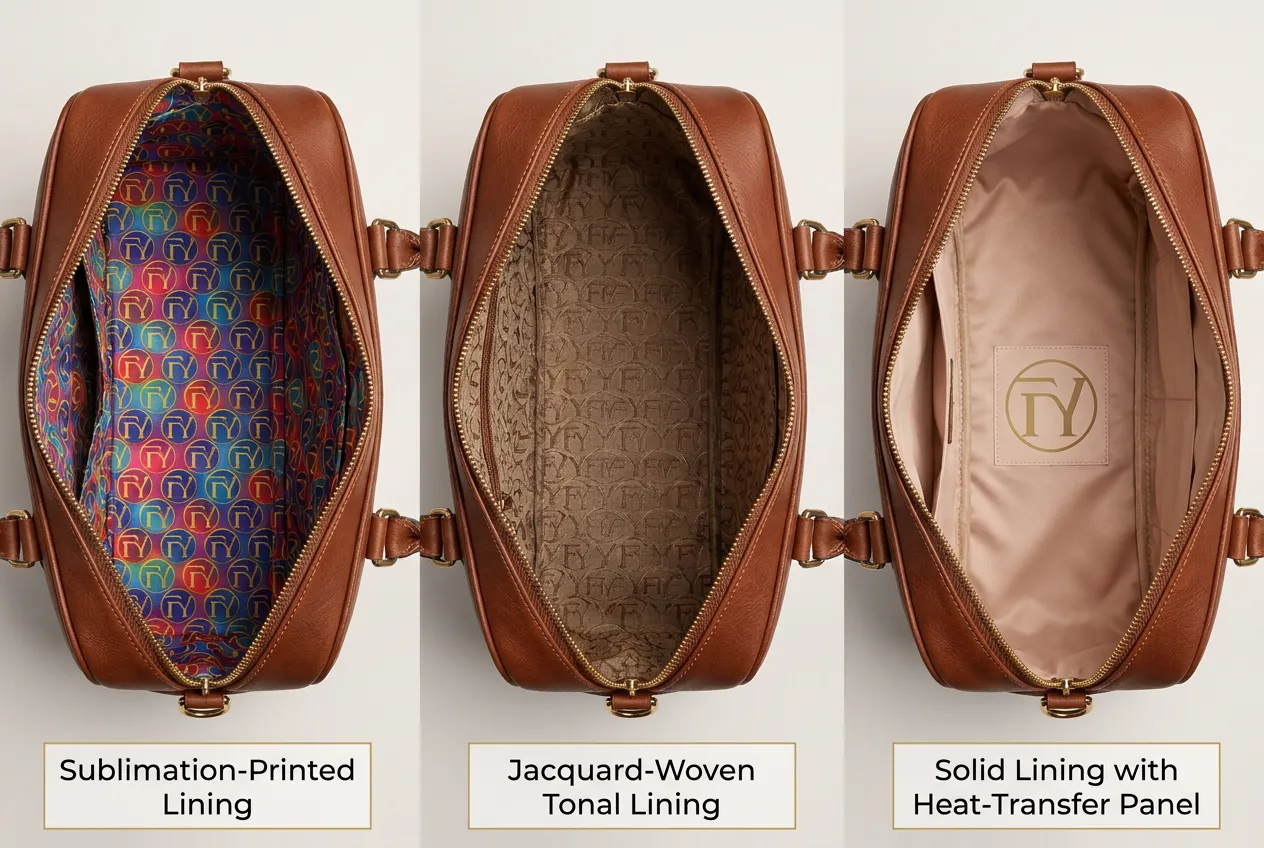
| Sublimation printing on polyester | Brand pattern is heat-transferred onto polyester fabric in full color | Full-color, photographic detail; any pattern or image | +2.00 per bag | Good — printed into the fiber, not onto the surface | Low — can print as few as 50 meters (enough for 100+ bags) |
| Screen printing on cotton or polyester | Brand pattern is screen-printed in 1–4 colors onto the fabric | Clean, graphic, bold; limited to flat colors (no gradients without multiple screens) | +1.50 per bag (plus screen setup: 80 per color) | Good — ink bonds with fiber | Moderate — screen setup makes very small runs expensive per unit |
| Jacquard weaving | Brand pattern is woven directly into the fabric structure | Textured, tonal, unmistakably “luxury” — the pattern IS the fabric | +5.00 per bag (plus jacquard loom setup: 500 one-time) | Excellent — the pattern cannot wear off because it is structural | Higher — jacquard loom setup requires minimum 300–500 meters of fabric |
| Heat-transfer label (pattern zone) | A printed panel is heat-transferred onto a specific zone of the lining (not the entire lining) | A branded “window” or “panel” within a solid-color lining | +0.80 per bag | Good | Low — can be applied to any quantity |
| Brand Stage | Budget | Recommended Technique | Why |
|---|---|---|---|
| Launching / testing | 0.80 per bag | Heat-transfer branded panel on solid lining | Lowest cost; no minimum; adds branding to a specific visible zone |
| Growing (100–500 units/order) | 2.00 per bag | Sublimation-printed full lining | Full-coverage branded interior at moderate cost; any pattern or color |
| Established (500+ units/order) | 5.00 per bag | Jacquard-woven branded lining | The luxury standard; the pattern is woven into the fabric; unmistakable brand signature |
For brands at the growth stage, sublimation printing on polyester is the sweet-spot technique. It produces a full-color, full-coverage branded lining at 2.00 per bag — a fraction of jacquard cost — with low minimum quantities and fast turnaround. The printed pattern (brand logo repeat, monogram grid, geometric signature, or any custom artwork) covers the entire interior, creating the “open it and know exactly whose bag it is” effect at a price accessible to mid-market brands.
The lining is not simply glued or draped inside the bag — it is a second bag constructed independently and then inserted into the exterior shell. The quality of the lining construction determines whether the interior sits smoothly, whether pockets are accessible, and whether the lining bunches, twists, or separates from the body over time.
| Method | How It Works | Quality Level | Cost | Best For |
|---|---|---|---|---|
| Drop-in lining (loose) | Lining is a fabric bag that sits inside the exterior, attached only at the top edge | Lowest — lining shifts, bunches, and can pull away from the body | Baseline | Budget bags only — not acceptable above $40 retail |
| Attached lining (tacked at seams) | Lining is stitched to the exterior at major seam points (gussets, base, and top) | Moderate — stays in position but can pucker between attachment points | +5–10% labor | Mid-market — acceptable for most 80 bags |
| Fully bonded lining (stitched at all seams) | Lining is stitched to the exterior at every seam and every pocket attachment point | High — sits smoothly and permanently; the “one-piece” interior feel | +15–25% labor | Premium and luxury — required for bags above $80 |
| Glued + stitched lining | Lining is adhesive-bonded to the exterior panels AND stitched at seams | Highest — completely smooth, no shifting possible | +20–35% labor + adhesive cost | Ultra-premium — the construction method of luxury houses |
For bags retailing above $80, fully bonded lining (stitched at all seams) is the minimum acceptable construction. It ensures the interior sits flat against the exterior, pockets do not shift position, and the lining does not bunch or twist after weeks of daily use. Specify this in your tech pack: “Lining fully stitched to exterior at all seam points; no loose or floating lining sections.”
The number, type, and placement of interior pockets signal design intentionality to the consumer. A bag with a single generic slip pocket reads as “the factory added the minimum.” A bag with a dedicated phone pocket, a zippered valuables pocket, a pen loop, and a key clip reads as “someone thought about how I actually use this bag.”
| Type | Placement | Dimensions | Purpose | Cost Impact | |
|---|---|---|---|---|---|
| Phone slip pocket | Open-top, padded sides | Center of back wall (most accessible position) | 9 × 17 cm (fits all current smartphones including cases) | Phone retrieval is the most frequent bag interaction — it must be instant | +0.30 |
| Zippered security pocket | Zip closure, flat | Back wall, above or beside phone pocket | 18 × 14 cm | Cash, cards, medication — items that must not fall out if the bag tips | +0.50 |
| Slip pocket (dual) | Two open-top pockets side by side | Front wall | 10 × 14 cm each | Sunglasses, hand sanitizer, earbuds case, lip balm | +0.40 |
| Pen loop | Elastic loop stitched to the pocket panel | Beside the slip pockets | 2.5 cm diameter | Pen — a small detail that prevents the “pen rolling around the bottom” problem | +0.10 |
| Key clip | Retractable cord (15–20 cm) with snap hook, stitched to the lining | Side wall, near the top opening | N/A | Key retrieval without rummaging; the cord extends so the key reaches the lock without removing from the bag | +0.40 |
Total cost for the complete pocket system: 1.70. For a bag retailing at 150, this investment adds approximately 15 of perceived value — a 3–9× return. Every pocket demonstrates intentional design; together, they transform the interior from a generic cavity into a functional system.
For bags marketed to women (which includes virtually all handbags), a dedicated cosmetic pocket with wipeable lining is one of the highest-impact functional upgrades available:
| Specification | Detail |
|---|---|
| Location | Interior side wall or a separate zip-closed section |
| Dimensions | 18 × 12 × 4 cm (fits lipstick, compact, concealer, hand cream) |
| Lining | PU-coated polyester or PEVA — wipeable, stain-resistant |
| Lining color | Light color (cream, blush) for content visibility |
| Closure | Zip or magnetic snap — contains spills if a product leaks |
| Edge treatment | Bound or serged — no raw edges that could catch on cosmetic packaging |
This pocket adds 0.80 per unit and addresses the most common source of interior staining: cosmetic leaks and powder residue. It also creates a natural product-page bullet point (“dedicated wipeable cosmetic pocket”) that resonates with the target demographic.
The lining’s lifespan often determines the bag’s lifespan — not because the exterior wears out, but because the interior degrades to the point where the consumer replaces the bag. A bag with a beautiful exterior but a pilled, stained, torn lining is a bag the consumer stops carrying. The exterior has years of life remaining, but the interior experience has been ruined.
| Material | Time to First Visible Wear | Functional Lifespan | End-of-Life Failure Mode |
|---|---|---|---|
| Polyester taffeta | 3–6 months (pilling, staining) | 1.5–3 years | Pilling + permanent stains + fraying at pocket edges |
| Nylon twill | 8–14 months (light wear marks) | 4–6 years | Eventual fabric softening and thinning at high-contact areas |
| Cotton sateen | 6–12 months (staining, sateen dulling) | 3–5 years | Loss of sateen sheen + staining if untreated |
| Microfiber suede | 18–30 months (barely perceptible) | 5–8+ years | Gradual compression of suede nap in high-contact areas (not pilling) |
| Jacquard woven (polyester) | 12–18 months (mild pilling in solid areas) | 4–6 years | Mild pilling + pattern fading if low-quality dye |
| PU-coated polyester | 12–24 months (coating wear at edges) | 4–7 years | PU coating peeling at fold points and pocket edges |
The mismatch problem: a PU leather exterior rated for 3–5 years daily use paired with a polyester taffeta lining rated for 1.5–3 years means the interior fails 1–2 years before the exterior. The consumer replaces the bag because of the interior, while the exterior still looks good. This is a waste — of material, of the consumer’s investment, and of the brand’s opportunity to build long-term loyalty through a bag that lasts.
The lifespan-matching principle: the lining material should be rated for at least the same durability as the exterior material. A bag with a 5-year exterior deserves a 5-year interior. This alignment is what luxury brands achieve and what mid-market brands consistently fail to do — precisely because the cost difference is only 4.00 per bag.
| Specification | What to Define | Example |
|---|---|---|
| Material | Fiber type, weave, weight | “Nylon twill, 90 g/m², matte finish” |
| Color | Pantone reference or brand-standard name | “Pantone 7527C (champagne)” |
| Brand pattern (if applicable) | Pattern file, repeat dimensions, technique | “Brand logo repeat, sublimation-printed, 5 cm repeat” |
| Pill resistance | Martindale pilling rating | “Minimum rating 4 at 5,000 cycles” |
| Construction method | How the lining attaches to the exterior | “Fully stitched at all seams; no loose sections” |
| Pocket layout | Number, type, dimensions, placement of each pocket | “Phone pocket: 9 × 17 cm, center back wall. Zip pocket: 18 × 14 cm, back wall upper. Dual slip: 10 × 14 cm each, front wall. Pen loop: left of slip pockets. Key clip: right side wall.” |
| Cosmetic pocket (if applicable) | Dimensions, lining type, closure | “Zip-closed, 18 × 12 × 4 cm, PU-coated interior, light cream” |
| Stain resistance | Any treatment or coating required | “Scotchgard treatment on main lining” or “PU-coated for cosmetic compartment” |
| Woven label | Size, placement, attachment | “40 × 20 mm woven label, centered on back wall interior, 30 mm below top edge, four-corner stitched” |
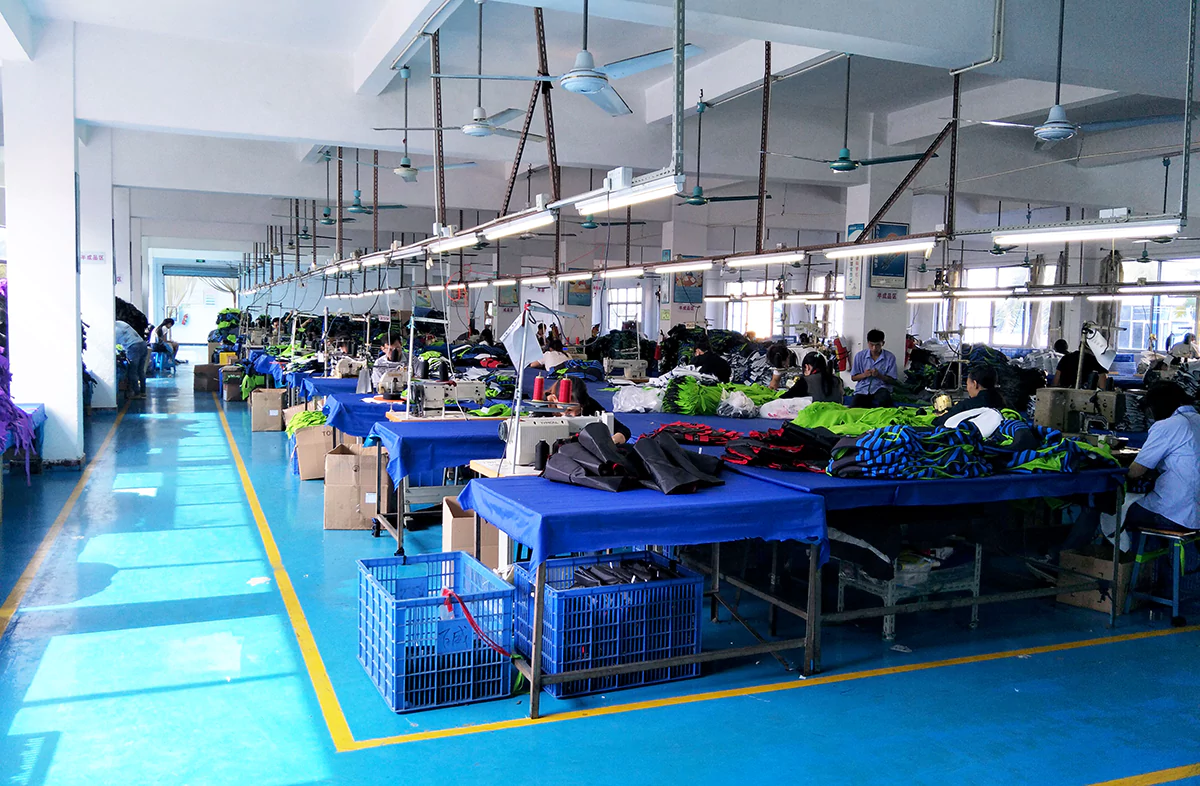
FYBagCustom is Your Trusted Custom Bag Manufacturer in China, with 15+ years of manufacturing experience and dedicated interior construction capabilities. For brands that understand the lining is not an afterthought, our capabilities include:
Our 50,000 m² factory in Guangzhou with 10+ production lines and 500+ professional staff produces bags with custom-engineered interiors for DTC brands, Amazon FBA sellers, premium retailers, and fashion labels worldwide.
The lining is where the consumer’s relationship with your bag becomes personal. The exterior is what the world sees; the interior is what she touches, opens, organizes, and lives with every day. For B2B buyers specifying custom handbag interiors, three core takeaways:
If your next handbag collection deserves an interior as considered as its exterior, contact FYBagCustom to discuss lining materials, branded interior options, and pocket system specifications — and receive a sample with the complete interior built to your specification, typically within 5–7 days.
FYBagCustom’s production team builds custom bag interiors with branded linings, microfiber suede, organized pocket systems, and wipeable cosmetic compartments — because the inside of your bag is where your customer’s loyalty lives. Samples in 5–7 days, low MOQ, branded linings from 100 bags.
Start Your Custom Bag Project →