Tel/WhatsAapp:+86 18011919834
E-mail: chloe.x@fybagcustom.com

Tel/WhatsAapp:+86 18011919834
E-mail: chloe.x@fybagcustom.com
Send Your Inquiry Today

Who this guide is for: brand owners, sourcing managers, wholesale buyers, Amazon FBA sellers, DTC founders, retail merchandisers, and independent e-commerce sellers who are developing shoulder bags for their 2026 collections. If you are planning custom shoulder bags that tap into the Y2K revival — and want to understand how embroidery, patches, and other decoration techniques turn a retro silhouette into a modern product — this guide is your development playbook.
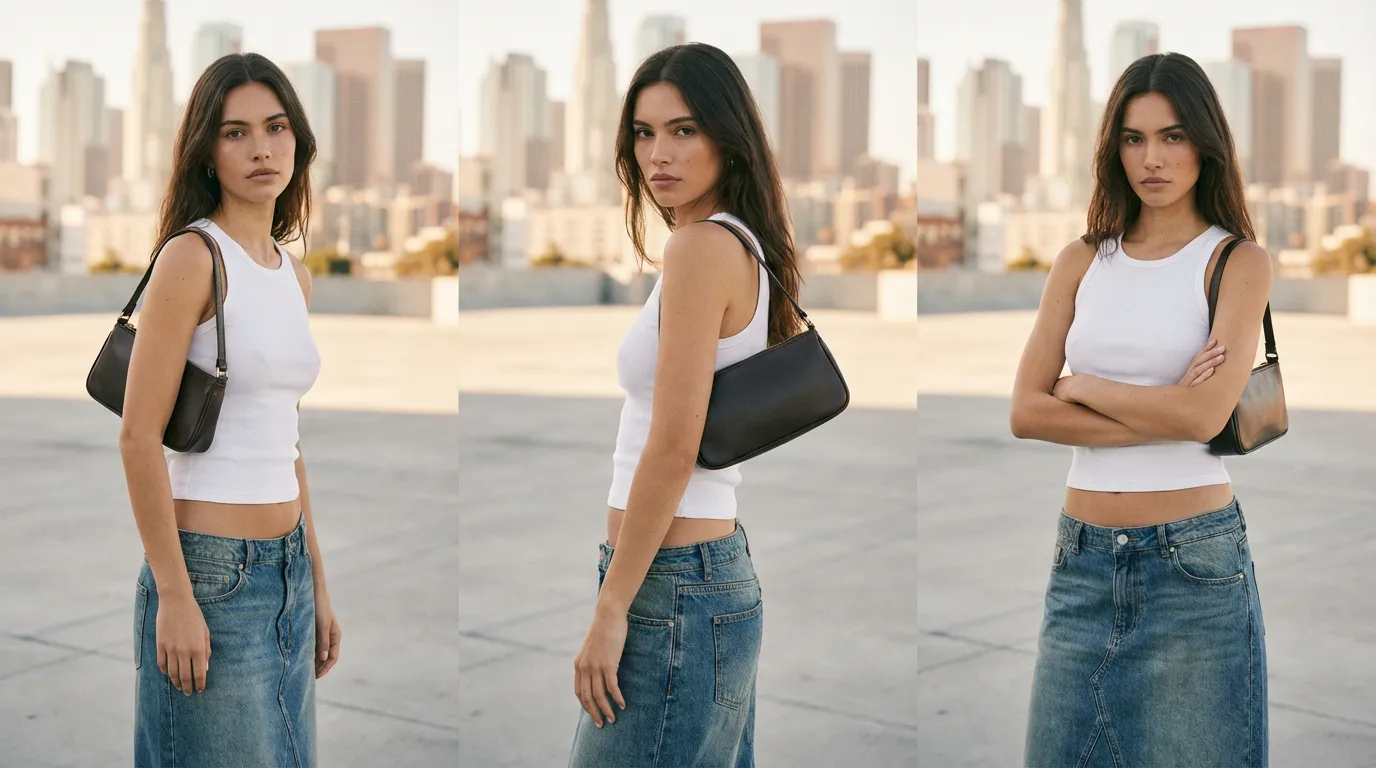
The underarm bag — that compact, short-strapped shoulder bag designed to sit snugly between the armpit and the ribcage — has returned with a commercial velocity that even its strongest advocates did not predict. Originally a signature of late-1990s and early-2000s styling, this silhouette spent more than a decade in storage while crossbody bags and oversized totes dominated the market. In 2026, it is back as one of the highest-search-volume custom shoulder bag categories in both wholesale channels and consumer queries.
For B2B buyers, the opportunity is layered. The Y2K revival is not simply about reproducing what existed twenty-five years ago — it is about fusing a retro silhouette with modern custom design techniques that did not exist or were not commercially viable in the original era. Embroidery, custom patches, digital printing, mixed-material panels, and detachable hardware systems allow today’s brands to take a familiar shape and make it feel entirely new. The result is a product category where nostalgia drives initial consumer interest, but customization drives purchase decisions and repeat orders.
This guide covers the anatomy of the underarm shoulder bag, why the Y2K revival has endured long enough to become a stable category, which custom decoration techniques create the strongest differentiation, and how to specify a production-ready program with a shoulder bag manufacturer in China.
Fashion tends to cycle retro trends through a predictable arc: nostalgia sparks → runway adoption → mass-market peak → rapid decline. The Y2K underarm bag has broken this pattern. Rather than fading after a two-season burst, it has settled into the market as a durable silhouette with sustained consumer demand. Understanding why helps buyers assess how much inventory depth and collection breadth to commit.
1. Body-proportion compatibility. The underarm position creates a clean horizontal line at the ribcage that flatters a wide range of body types — an advantage that consumers discovered through social media try-on content. Unlike crossbody bags (which bisect the torso) or clutches (which occupy one hand), the underarm bag integrates into an outfit silhouette almost invisibly.
2. Hands-free without a long strap. The short-strap shoulder carry keeps the bag secure without requiring a crossbody strap. For consumers who dislike the across-the-chest look but still want both hands free for a phone, coffee, or a child’s hand, the underarm position is the most natural compromise.
3. Social media framing. In mirror selfies and short-form video — the dominant formats for fashion content in 2026 — a compact underarm bag reads more clearly than a crossbody (which often gets lost across the torso) or a tote (which hangs below the frame). The bag sits at a visually prominent position and occupies minimal screen space while still registering as a styling choice.
4. The “small bag” macro-trend. Consumer preference has been shifting toward smaller, edited bags for several seasons. The underarm silhouette is inherently compact — it must fit under the arm — which naturally limits it to the phone-wallet-keys capacity that aligns with minimalist carry habits.
Relative search volume indexed to 2021 = 100. Covers B2B and consumer queries.
The growth line is not a single-season spike — it is five consecutive years of acceleration, now at roughly 3.5× the 2021 baseline. This pattern is characteristic of a silhouette that has been absorbed into the permanent market vocabulary rather than functioning as a passing trend. For buyers, this means investment in tooling, patterns, and branding for underarm shoulder bags carries lower risk of obsolescence than typical trend-driven development.
The 2026 underarm bag inherits its basic silhouette from the Y2K original but has evolved in several key construction details. Understanding the anatomy helps buyers write accurate tech packs and evaluate supplier samples.
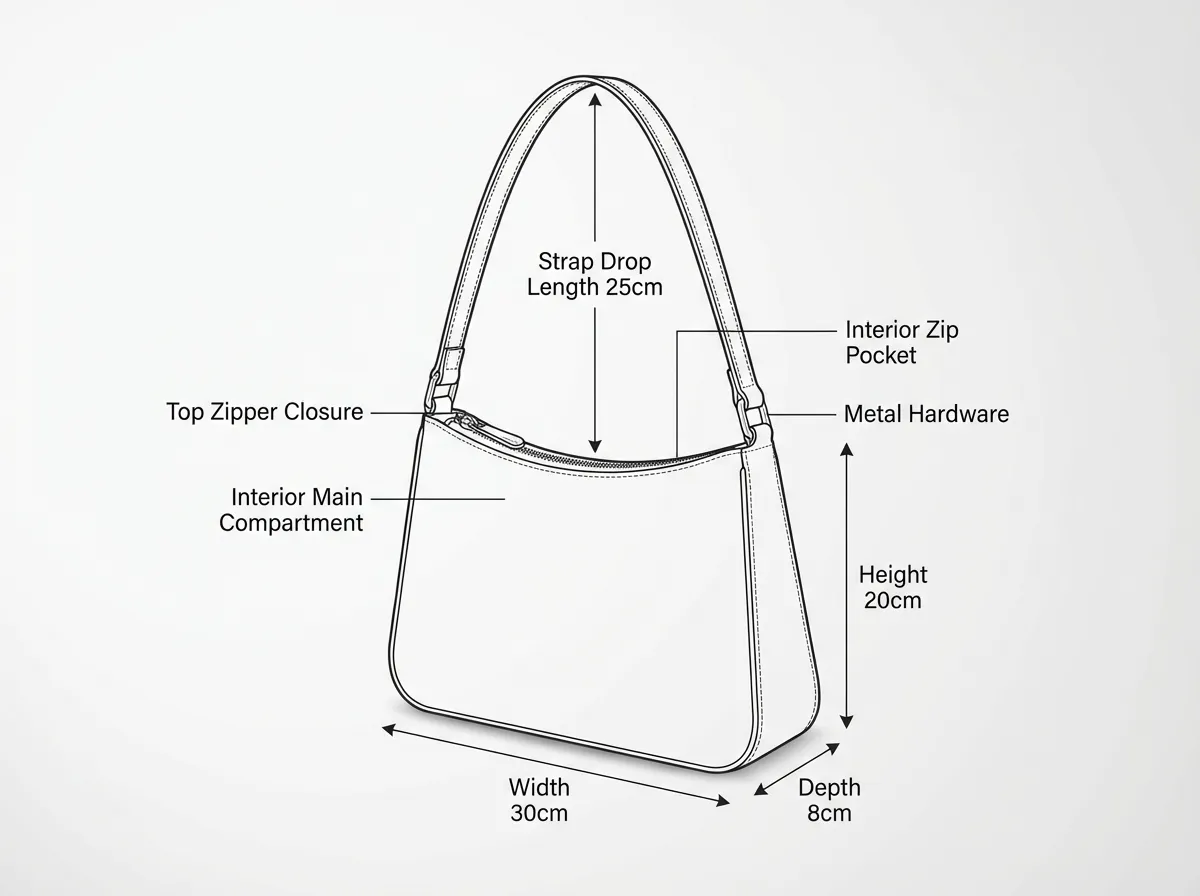
| Component | Y2K Original (circa 2000) | 2026 Modern Interpretation |
|---|---|---|
| Strap drop | Fixed, 15–18 cm | Adjustable, 15–25 cm range via buckle or link system |
| Strap width | Thin (10–15 mm), often chain | Wider options (15–25 mm), leather, webbing, or removable chain |
| Body width | 22–28 cm | 24–32 cm (slightly larger to fit modern smartphones) |
| Body height | 12–16 cm | 13–18 cm |
| Depth / gusset | Minimal (3–5 cm) | Expanded (5–9 cm) for more usable capacity |
| Closure | Magnetic snap or flap | Zip, magnetic snap, flap, or turn-lock — multiple options |
| Interior | Single compartment, no pockets | Divided compartments, card slots, phone pocket |
| Hardware | Polished silver or gold | Brushed, matte, tonal, or mixed-metal finishes |
| Material | Smooth leather or nylon | Full range — PU, genuine leather, nylon, canvas, suede, recycled |
| Decoration | Logo plate or brand charm only | Embroidery, patches, digital print, mixed materials, detachable elements |
The single most consequential evolution is in the decoration column. The Y2K original was essentially a blank canvas in smooth leather with a metal logo plate. The 2026 version treats the compact front panel as a prime decoration surface — and this is where customization creates the strongest brand differentiation.
The compact East-West front panel of an underarm bag (typically 24–32 cm wide × 13–18 cm tall) is an ideal canvas for decoration. It is large enough to carry visual detail, flat enough for clean application, and positioned at a height where decoration is immediately visible to both the wearer and onlookers. The techniques below represent the strongest options for brands building Y2K-inspired shoulder bags in 2026.
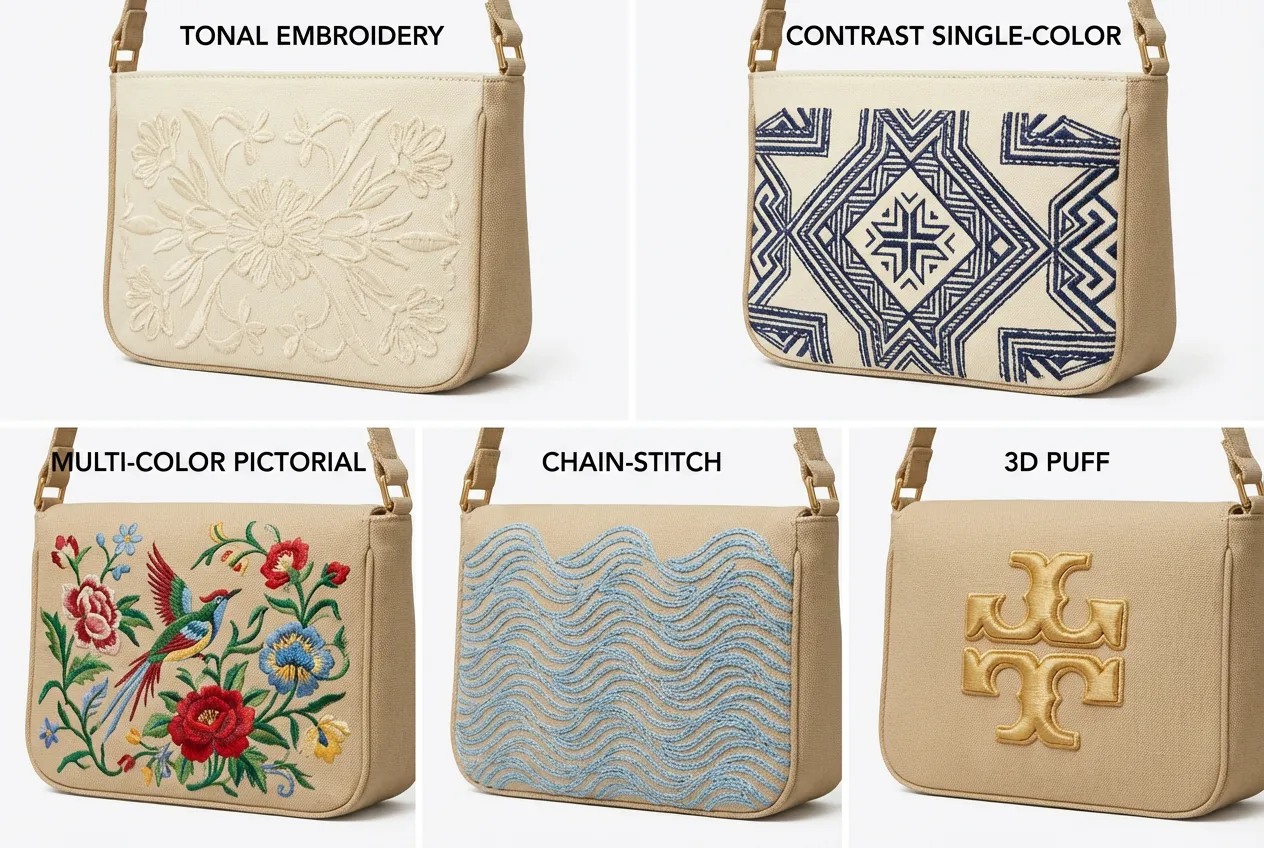
Embroidery is the single most effective technique for converting a plain underarm bag into a premium, collectible product. Thread creates a raised surface with light-catching texture that no print method can replicate. On the compact front panel of a shoulder bag, even a small embroidered motif becomes visually dominant.
| Embroidery Style | Visual Effect | Thread Count Range | Best On | Cost Impact |
|---|---|---|---|---|
| Tonal / tone-on-tone | Subtle, luxurious, “quiet” texture | Low–Medium (2,000–6,000 stitches) | Smooth PU, genuine leather | +8–15% per unit |
| Contrast single-color | Bold, graphic, logo-forward | Medium (4,000–10,000 stitches) | Canvas, nylon, denim | +10–18% per unit |
| Multi-color pictorial | Illustrative, artisan, collectible | High (10,000–30,000+ stitches) | Canvas, cotton, structured PU | +20–40% per unit |
| Chain-stitch (vintage feel) | Retro, handmade texture, Y2K-authentic | Medium (varies by area) | Denim, canvas, heavy cotton | +15–25% per unit |
| 3D / puff embroidery | Raised, dimensional, tactile statement | Medium–High | Canvas, nylon, structured bags | +18–30% per unit |
For Y2K-inspired lines specifically, chain-stitch embroidery is worth particular attention. Chain stitch was the dominant decorative embroidery technique of the 1990s and early 2000s (featured on denim jackets, varsity patches, and souvenir bags). Using it on a 2026 underarm bag creates an immediately recognizable retro reference that resonates with the target consumer without requiring explanation.
Patches occupy a unique position in the Y2K revival: they are both a decoration technique and a consumer participation mechanic. Brands can sell bags with a base set of patches pre-applied and offer additional patches for purchase — creating an add-on revenue stream and encouraging social media sharing as consumers customize and re-customize their bags.
| Patch Type | Production Method | Visual Effect | Attachment Method | Best For |
|---|---|---|---|---|
| Woven patches | Jacquard loom, fine thread | Detailed, fabric-like, durable | Sewn or iron-on + stitch | Brand logos, detailed graphics |
| Embroidered patches | Embroidery on a twill base | Textured, tactile, classic | Sewn, iron-on, or Velcro | Motifs, icons, letters |
| PVC / rubber patches | Injection-molded | 3D, waterproof, modern | Sewn, riveted, or adhesive | Streetwear, sport-lux, youth |
| Leather patches | Die-cut, debossed or printed | Premium, heritage, understated | Sewn or riveted | Premium lines, artisanal |
| Chenille patches | Tufted chenille yarn on felt | Retro varsity, soft texture | Sewn | Y2K-specific, collegiate, playful |
The most commercially interesting play for Y2K shoulder bags is a Velcro-attachment system: the bag features a defined “patch zone” on the front panel with a Velcro base, and each patch has a matching Velcro backing. Consumers can swap patches to match their outfit or mood. This mechanic drives repeat purchases, generates user-generated content on social media, and differentiates the product from competitors selling static-decoration bags.
When specifying a Velcro patch system in your tech pack, define the exact patch zone dimensions, the Velcro hook-and-loop specification (standard or low-profile), and the edge treatment around the zone (stitched border, piping, or raw-edge — stitched border is the cleanest).
Beyond embroidery and patches, two additional decoration approaches are particularly effective on underarm bags:
Digital printing on panel allows photographic-quality, full-color artwork on the front panel — ideal for brands with strong graphic identities or artist collaboration programs. On PU leather and coated canvas, digital printing produces sharp results that hold up well to daily use. On uncoated canvas or nylon, a pre-treatment step is required for ink adhesion and vibrancy.
Mixed-material panels combine two or more materials on the bag body — for example, a nylon body with a suede front panel, or a PU body with a woven leather accent strip. This technique creates visual contrast and tactile variety without any print or embroidery. The Y2K original sometimes featured nylon-and-leather combinations; the 2026 version expands this to include canvas, denim, recycled nylon, and microsuede options.
| Technique | Visual Effect | Material Compatibility | Cost Impact | Best For |
|---|---|---|---|---|
| Digital print on front panel | Full-color graphic, photographic detail | PU leather, coated canvas, nylon (with pre-treatment) | +10–20% | Artist collabs, graphic brands, limited editions |
| Mixed-material (2 materials) | Contrast, texture play, depth | Any compatible material pair | +15–25% | Premium positioning, brand signature |
| Mixed-material (3+ materials) | Complex, editorial, statement | Requires careful pattern engineering | +25–40% | Limited editions, designer-inspired |
| Hardware-as-decoration (chains, charms, rings) | Retro-modern, Y2K-authentic, eye-catching | All materials | +10–30% depending on hardware | Y2K nostalgia, evening/going-out, influencer-driven |
For brands developing a Y2K-inspired underarm bag line, the number of decisions can feel overwhelming. The framework below simplifies the process into a five-step sequence that covers the choices in the right order — material first, silhouette second, decoration third.
| Material | Y2K Authenticity | Modern Appeal | Price Tier | Best Target Buyer |
|---|---|---|---|---|
| Smooth PU leather | High — closest to original | Versatile, wide color range | Low–Mid | Amazon FBA, fast fashion, mass-market |
| Nylon (matte or satin) | High — original sport-lux variant | Technical, lightweight | Low–Mid | Streetwear, athleisure, youth |
| Genuine leather | Medium — premium Y2K interpretation | Luxury, ages well | High | Boutique, premium DTC |
| Denim | Medium — original workwear crossover | Casual, customizable | Mid | Indie brands, vintage-inspired |
| Canvas | Low — not traditional Y2K | Eco-friendly, printable | Low–Mid | Sustainability-positioned brands |
| Recycled nylon | Low — modern material, retro shape | Sustainability + trend | Mid | Eco-conscious DTC, contemporary brands |
For underarm carry, body width should be between 24–32 cm, height between 13–18 cm, and depth between 5–9 cm. Within this range:
For most B2B programs, the short + detachable long strap configuration is the safest choice. It adds modest cost (typically +3.00 per unit for the additional strap and hardware) but significantly broadens the addressable customer base.
Match decoration to brand positioning:
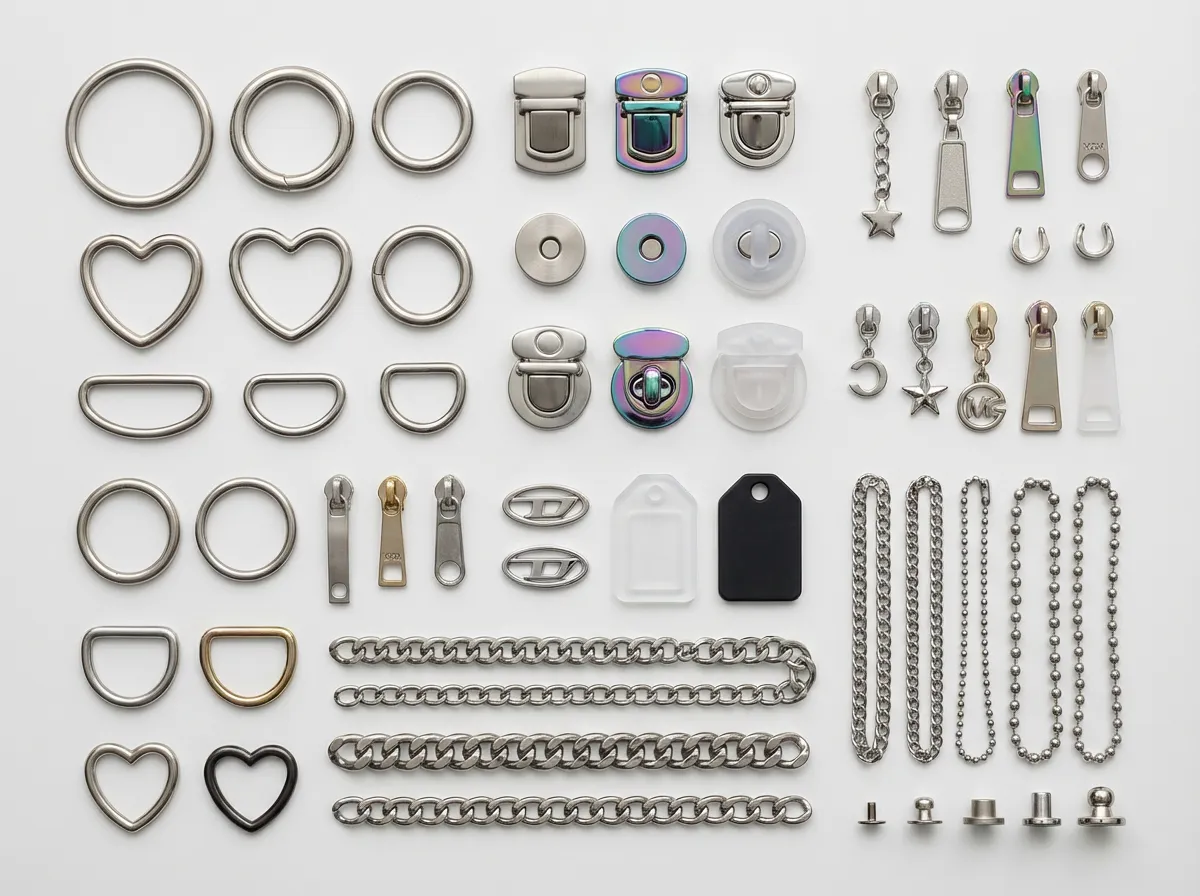
| Hardware Element | Y2K Authentic Option | 2026 Modern Option | Recommendation |
|---|---|---|---|
| Strap rings | Polished silver O-rings | Brushed silver or matte black D-rings | Brushed/matte reads more current |
| Closure | Magnetic snap under flap | Concealed magnetic snap or branded turn-lock | Turn-lock for premium; magnetic for everyday |
| Zipper pull | Standard nylon pull | Custom-engraved metal pull with brand logo | Engraved pull adds perceived value at low cost |
| Chain detail | Thin polished chain strap | Chunky matte chain or chain-link accent | Chunky matte is 2026’s read on Y2K chain |
| Feet | None (original Y2K had none) | Small metal base feet | Add feet — protects base, signals quality |
For buyers new to shoulder bag development, here is the realistic timeline for a Y2K underarm bag program with custom decoration (embroidery, patches, or print). Times reflect standard production with in-house sampling capability.
| Stage | Duration | Key Deliverables |
|---|---|---|
| 1. Design brief / tech pack | 3–7 days | Dimensions, material, strap config, decoration artwork, hardware |
| 2. Material + decoration sourcing | 5–10 days | Swatches, embroidery thread cards, patch proofs, hardware samples |
| 3. First sample (proto) | 7–12 days | Silhouette check, decoration placement, strap fit |
| 4. Revision sample | 5–10 days | Adjust decoration size/position, hardware, strap length |
| 5. PP (pre-production) sample | 5–7 days | Final locked reference for bulk |
| 6. Bulk production | 25–40 days | Volume-dependent; patch/embroidery adds 3–5 days vs. plain |
| 7. QC and packing | 3–5 days | 100% inspection, polybag or dust bag, barcode if FBA |
| 8. Shipment | 3–7 days | Booking, docs, FBA prep if applicable |
Total: roughly 55–85 days from brief to shipment-ready. Embroidery and patch programs add approximately 5–8 days to the timeline compared to a plain-surface bag, primarily in stages 2 and 6. Plan accordingly if targeting a specific retail launch date.
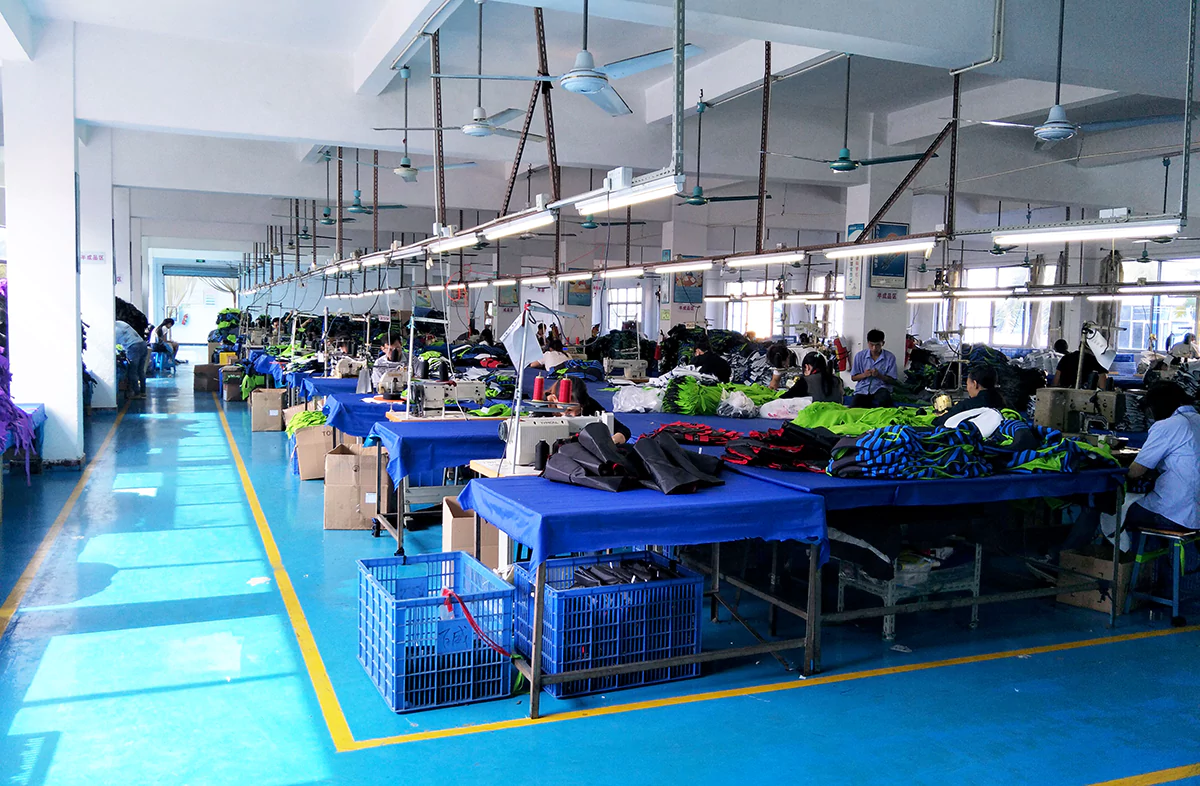
FYBagCustom is Your Trusted Custom Shoulder Bag Manufacturer in China, with 15+ years of manufacturing experience producing shoulder bags across PU leather, genuine leather, nylon, canvas, denim, and recycled materials for brands worldwide. For buyers developing Y2K-inspired underarm bags with custom decoration, our capabilities include:
Our factory in Guangzhou produces underarm and shoulder bag programs for DTC brands, Amazon FBA sellers, influencer-driven labels, retail boutiques, and corporate gifting clients across international markets.
The Y2K underarm bag has moved past revival into permanence — five years of sustained search growth, broad demographic appeal, and a silhouette that is structurally suited to both fashion styling and practical daily carry. For B2B buyers developing 2026 shoulder bag programs, three core takeaways:
If your 2026 collection includes Y2K-inspired shoulder bags, now is the time to finalize decoration artwork, lock strap configurations, and secure production capacity. Contact FYBagCustom to discuss embroidery options, patch systems, and hardware details — and receive physical samples and transparent quotations, typically within 48 hours.
FYBagCustom’s OEM and ODM team works with global brands, Amazon sellers, influencer-driven labels, and DTC founders to produce custom shoulder bags with embroidery, patches, mixed materials, and bespoke hardware — with low MOQ, 5–7 day sampling, and full in-house decoration capabilities.
Start Your Custom Bag Project →