Tel/WhatsAapp:+86 18011919834
E-mail: chloe.x@fybagcustom.com

Tel/WhatsAapp:+86 18011919834
E-mail: chloe.x@fybagcustom.com
Send Your Inquiry Today

Who this guide is for: brand owners, sourcing managers, wholesale buyers, Amazon FBA sellers, DTC founders, baby product retailers, and lifestyle brands who are developing custom diaper bags for the premium and luxury-adjacent market in 2026. If you want to understand how to engineer bottle insulation, changing pad compartments, wet-dry separation, and multi-child organization into a bag that is visually indistinguishable from a designer handbag or weekender — and why “luxury diaper bag” is one of the fastest-growing search categories in baby products — this guide covers every design decision from compartment architecture to fashion-grade finishing.
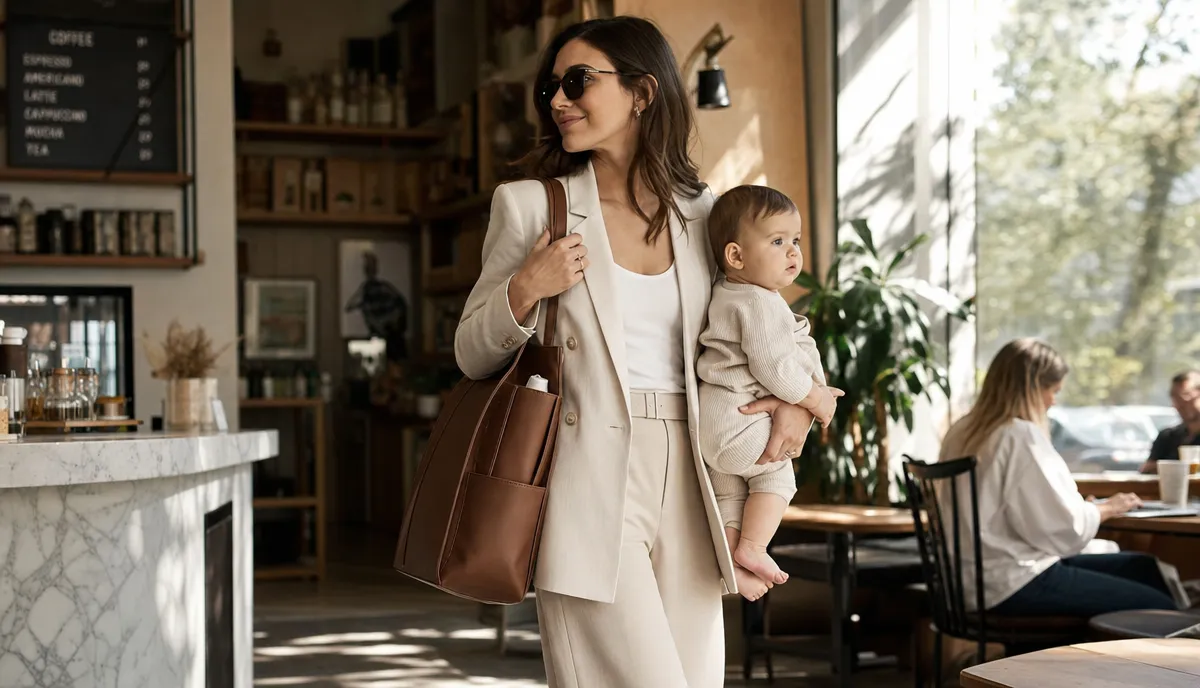
The diaper bag market has undergone a generational shift. The consumers driving this category in 2026 — millennial and Gen-Z mothers aged 25–40 — grew up in a fashion culture where every accessory is photographed, coordinated, and evaluated as a component of personal style. They reject the premise that becoming a parent requires surrendering aesthetic standards. They reject the quilted, pastel, cartoon-printed, obviously-a-diaper-bag aesthetic that defined the category for decades. They want a bag that carries everything their baby needs and looks like it belongs at a restaurant, a business meeting, or a weekend getaway — not a pediatrician’s waiting room.
The data confirms the shift. “Custom luxury baby bags” and “designer diaper bag” are among the fastest-growing search terms in baby products, with average retail prices climbing as consumers demonstrate willingness to pay 300+ for bags that meet the dual standard of parental function and fashion credibility. Return rates for premium diaper bags are among the lowest in the baby category — because when the bag genuinely solves both the organizational and the aesthetic problem, the consumer keeps it for years and often repurposes it after the diaper phase ends.
For B2B buyers, the premium diaper bag represents one of the strongest product opportunities in baby accessories: high retail prices, strong consumer loyalty, significant gifting potential (baby showers are the #1 gifting occasion in America), and a product lifecycle that extends well beyond the 2–3 year diaper window — because a well-designed luxury diaper bag transitions seamlessly into a work tote, travel bag, or everyday carry bag once the baby grows up.
This guide covers the organizational architecture that makes a diaper bag functional for parents, the material and finishing standards that make it look like a luxury handbag, and how to engineer both into a single product through a manufacturer in China.
The first three months postpartum — the “fourth trimester” — is when new mothers form their deepest product loyalties. They are making dozens of purchasing decisions simultaneously (car seat, stroller, bottles, clothing, bags), and the products they choose during this period define their identity as parents. A mother who carries a luxury-grade diaper bag is signaling — to herself and her social circle — that parenthood has not replaced her pre-baby identity. It has expanded it.
Modern parenting is documented constantly. The “hospital bag flat-lay,” the “first outing outfit,” the “diaper bag dump” — these are established content formats with millions of views. A diaper bag that photographs well generates organic marketing every time a mother shares her setup. A diaper bag that looks clinical or generic is never photographed — and therefore never marketed for free.
Baby showers in the U.S. generate billions in retail spending annually, and the diaper bag is among the top three most-gifted items (alongside strollers and car seats). A luxury diaper bag priced at 250 sits in the sweet spot for gift registries: expensive enough to feel significant, practical enough to guarantee use, and beautiful enough that the gift-giver feels proud of the selection. For B2B sellers, this means a significant portion of sales come through gift registries and gift-card purchases — a channel where price sensitivity is lower than self-purchase.
Before designing a luxury diaper bag, you must understand the functional demands with the same rigor applied to any technical product. A diaper bag that looks beautiful but cannot hold four bottles upright, has no changing pad compartment, and leaks when a sippy cup spills is a failed product — regardless of the material quality.
| Category | Items | Quantity | Volume | Storage Requirement |
|---|---|---|---|---|
| Diapers | Disposable or cloth diapers | 4–6 | 2–3 L | Dedicated section; accessible without rummaging |
| Wipes | Travel wipe pack or wipe case | 1 | 0.5 L | Quick-access pocket, preferably exterior or top-layer |
| Bottles / sippy cups | Filled bottles or sippy cups | 2–4 | 1–2 L | Insulated, upright pockets that prevent tipping |
| Changing pad | Portable, foldable | 1 | 0.5–1 L (folded) | Dedicated sleeve or pocket; quick-deploy without removing from bag |
| Change of clothes (baby) | Onesie, pants, socks | 1 complete set | 0.5–1 L | Separate section or zip pouch to keep clean |
| Burp cloths / bibs | Cloth or disposable | 2–3 | 0.3 L | Accessible pocket; replaced frequently |
| Pacifiers / teethers | With case | 1–2 | 0.1 L | Small dedicated pocket — must not touch other items for hygiene |
| Creams / ointments | Diaper cream, sunscreen | 1–2 tubes | 0.2 L | Wipeable pocket (creams leak) |
| Snacks (6+ months) | Puffs, pouches, crackers | 2–3 items | 0.5 L | Accessible, preferably in a separate food section |
| Parent’s essentials | Phone, wallet, keys, sunglasses | Standard | 1–1.5 L | Organized personal pocket — separate from baby items |
| Toys / comfort items | Small toy, lovey, book | 1–2 | 0.5 L | Exterior clip or accessible pocket |
| Total | 7–12 L |
The total volume (7–12 liters) is comparable to a medium handbag — the challenge is not capacity but organization. Twelve liters of mixed baby and parent items thrown into a single compartment produces chaos. Twelve liters organized across dedicated zones produces a bag that a parent can navigate one-handed, in the dark, while holding a baby.
A premium diaper bag divides its volume into eight functional zones, each designed for a specific category of items with appropriate access speed, protection, and containment.
| Zone | Location | Contents | Construction | Access Priority |
|---|---|---|---|---|
| Zone 1: Insulated bottle pockets | Side panels (2–4 pockets) | Bottles, sippy cups | PEVA or foil-lined, elasticized, upright | Highest — one-hand, while holding baby |
| Zone 2: Wipes quick-access | Exterior front panel, dedicated opening | Wipe pack or wipe case | Magnetic snap or zip with one-hand pull tab | Highest — needed at diaper change speed |
| Zone 3: Changing station | Back panel or base, integrated pad + zip pocket for diapers | Changing pad + 4–6 diapers + cream | Waterproof lining; pad slides out as a unit | High — deployed at every change |
| Zone 4: Main compartment | Center body | Burp cloths, toys, snacks, extra bottles, overflow | Open well with compression straps or dividers | Moderate — general access |
| Zone 5: Clean clothes | Interior zip section or removable pouch | Baby change of clothes (clean) | Zip-closed to keep clean; identifiable by color or label | Moderate — needed 1–2 times per outing |
| Zone 6: Dirty / wet section | Bottom or end panel, separate access | Soiled clothes, used bibs, wet items | Waterproof lining (TPU or PEVA); ventilation grommets; separate exterior zip | Moderate — contains messes |
| Zone 7: Parent’s pocket | Interior organizer section or front panel zip | Phone, wallet, keys, sunglasses | Organized: phone sleeve, card slots, key clip | High — parent’s items must be independently accessible |
| Zone 8: Pacifier / hygiene pocket | Small dedicated interior pocket with cleanable lining | Pacifiers, teethers, medication | Wipeable PU or silicone-lined; zip-closed | Moderate — hygiene-critical |
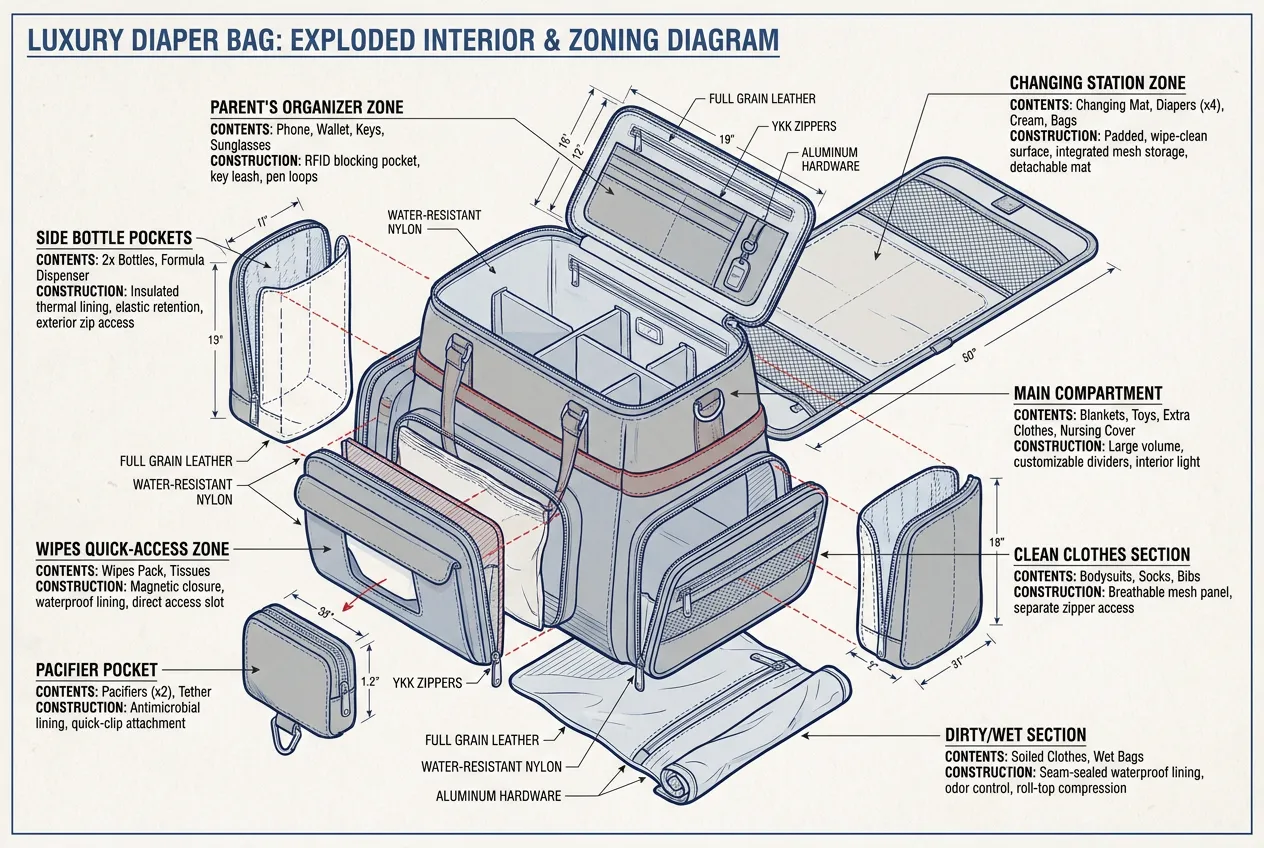
Not all eight zones carry equal weight in the consumer’s purchase decision. Three zones — bottle insulation, wipes quick-access, and the changing station — are the category-defining features that separate a diaper bag from a generic tote:
Zone 1: Insulated bottle pockets. Bottles must stay upright and at temperature. Specify PEVA or aluminum-foil lining with elasticized openings sized for standard baby bottle diameters (60–75 mm). Four pockets (two per side) accommodate the typical parent’s bottle count. Without insulated bottle pockets, the consumer does not recognize the bag as a diaper bag — and will not purchase it in the diaper bag category.
Zone 2: Wipes quick-access. The speed at which a parent can access wipes during a diaper change is a genuinely critical functional requirement. A dedicated exterior wipe pocket — with a one-hand magnetic snap or zip pull — that allows the parent to pull a wipe while holding the baby with the other hand is the #2 most-mentioned feature in positive diaper bag reviews.
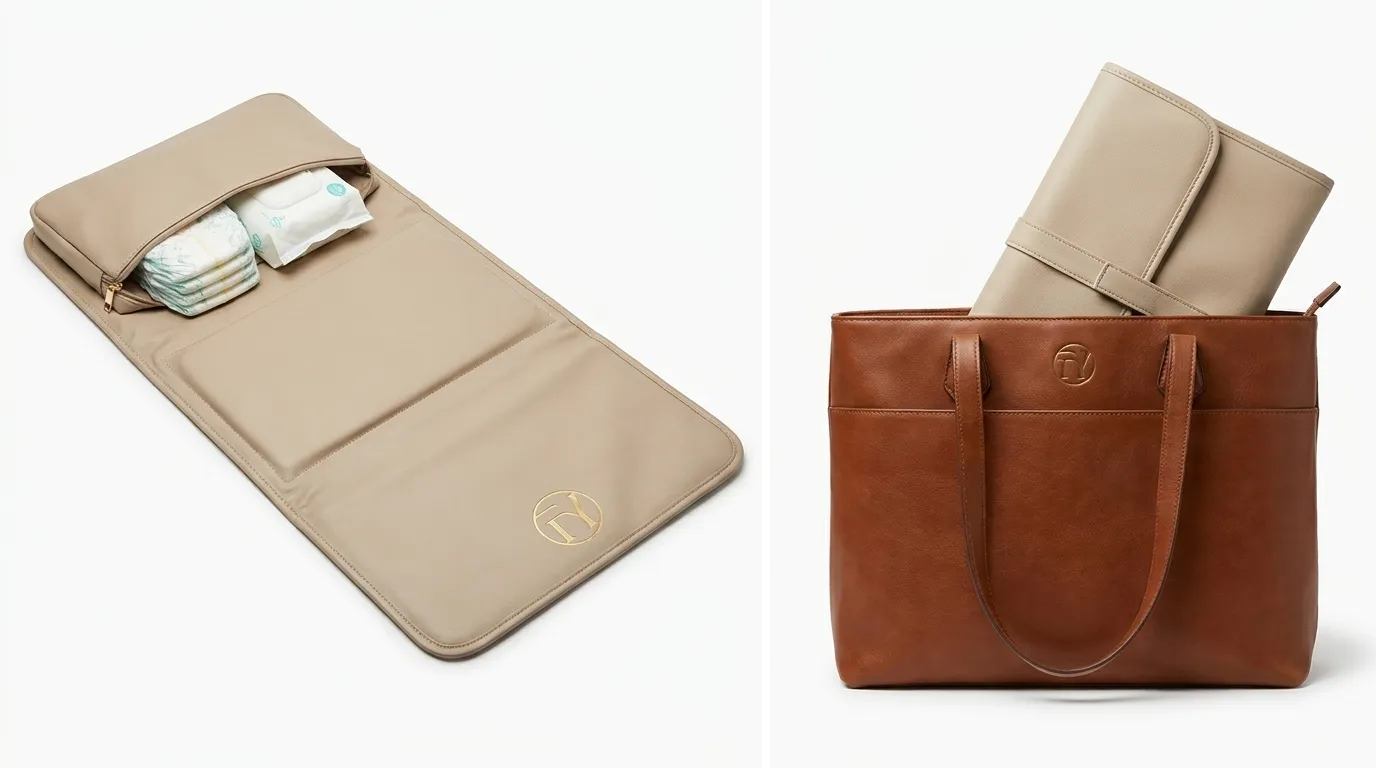
Zone 3: Changing station. A built-in changing pad that slides out from a dedicated back-panel compartment — already paired with 4–6 diapers and cream in an attached zip pouch — allows the parent to deploy a complete changing station by pulling a single element from the bag. The changing pad should be wipeable (PU or coated polyester), fold to approximately 25 × 15 cm when stored, and unfold to approximately 60 × 35 cm for use.
The material must achieve two contradictory-seeming standards simultaneously: fashion-grade appearance (smooth, lustrous, structured, photogenic) and parental-grade durability (wipe-clean, stain-resistant, water-resistant, able to survive formula spills, spit-up, sunscreen, and the general chaos of life with a baby).
| Material | Fashion Perception | Wipe-Clean Ability | Stain Resistance | Weight | Durability | Price Tier |
|---|---|---|---|---|---|---|
| Pebbled PU leather | Very high — reads as designer | Excellent — damp cloth cleans instantly | Very good — PU surface resists most liquids | Medium | Good (3–5 years daily use) | 180 retail |
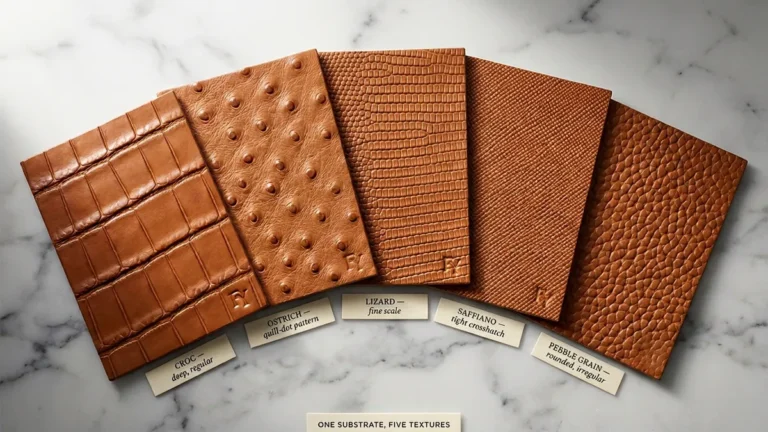
| Saffiano-texture PU | Very high — structured, editorial | Excellent — embossed texture hides minor marks | Excellent — textured surface resists visible staining | Medium | Very good — texture resists scratching | 200 retail |
| Microfiber leather | Very high — closest to genuine | Very good — surface resists penetration | Good — absorbs some liquids if not wiped quickly | Medium | Excellent (5–8 years) | 220 retail |
| Genuine leather (pebbled or grained) | Premium — unmistakable luxury | Moderate — requires quick wiping; absorbs oils | Moderate — leather absorbs and stains | Heavy | Excellent — ages well if maintained | 350+ retail |
| Nylon (fashion-grade, 420D+, matte) | Medium–High — modern, clean | Excellent — the most practical wipe-down material | Excellent — nylon resists almost everything | Light | Excellent — the most durable option | 140 retail |
| Canvas + PU leather trim | High — heritage, elevated casual | Good — canvas resists most spills; PU trim wipes clean | Moderate — canvas can absorb deep stains | Medium | Very good | 160 retail |
| Neoprene | Medium–High — sporty, modern | Excellent — machine-washable (the ultimate parent material) | Excellent — resists everything; fully washable | Light | Good | 150 retail |
For the luxury diaper bag market, saffiano-texture PU is the optimal default material. The cross-hatch embossing achieves three things simultaneously:
For brands targeting the 180 retail tier — the commercial sweet spot for premium diaper bags — saffiano PU is the material that delivers the strongest perceived quality at the most accessible cost.
For brands positioning at the “modern parent” rather than “luxury parent” tier, neoprene offers a uniquely compelling advantage: it is fully machine-washable. After a particularly messy day, the parent can remove the changing pad, empty the pockets, and put the entire bag through a gentle wash cycle. No other material listed above offers this capability — and it is an increasingly powerful product-page selling point as parents discover (through negative experience with other bags) how difficult it is to clean a conventional diaper bag’s interior after a significant spill.
The changing pad is the single most functionally important component of a diaper bag. It is what transforms a bag with baby pockets into a portable changing station — and it is what justifies the “diaper bag” category designation in consumer search.
| Element | Specification | Why |
|---|---|---|
| Material (top surface) | Wipeable PU or TPU-coated polyester | Must be cleaned instantly after every change — absorbent materials are not acceptable |
| Material (bottom) | Waterproof barrier + soft cushion (3–5 mm foam) | Protects the surface the pad is laid on; foam provides comfort for the baby |
| Folded size | 25 × 15 × 2 cm | Must fit in a dedicated back-panel pocket without consuming main compartment volume |
| Unfolded size | 60 × 35 cm minimum | Must accommodate a baby up to 12–15 months lying fully extended |
| Attachment to bag | Dedicated pocket in the back panel OR integrated as a fold-out from the bag’s base panel | Must be accessible without removing other contents; dedicated pocket is the standard |
| Head cushion (premium) | A raised, padded section at one end of the pad | Provides a soft headrest for the baby during changes; a premium detail that competitors often omit |
| Diaper/wipe pocket on the pad | A zip pocket or elastic strap on the pad that holds 2–3 diapers + a travel wipe pack | Allows the parent to pull out the pad fully loaded — no need to separately retrieve diapers and wipes |
The most commercially successful changing pad designs in 2026 are self-contained stations: the pad, when pulled from the bag, already contains 2–3 diapers, a travel wipe pack, and a small tube of diaper cream in attached pockets or elastic straps. The parent grabs one element from the bag and has everything needed for a change — no rummaging, no forgetting the wipes, no going back to the bag mid-change.
This “grab-and-go” concept is the single strongest selling point for premium diaper bags. Product pages that lead with “built-in changing station that deploys in seconds” consistently outperform pages that list features separately (“includes changing pad,” “has diaper pockets,” “wipes pocket included”).
A diaper bag that cannot attach to a stroller is a diaper bag the parent carries, sets down, picks up, sets down, and picks up again — dozens of times per outing. Stroller straps that clip the bag securely to the stroller handlebar or frame eliminate this cycle and are the #3 most-mentioned feature in diaper bag reviews.
| Element | Specification |
|---|---|
| Strap type | Two adjustable webbing straps with snap-hook or carabiner clips at the ends |
| Strap length | Adjustable 10–25 cm (to accommodate various handlebar circumferences and frame widths) |
| Clip type | Swivel snap hooks (lobster clasps), zinc alloy, matching bag hardware finish |
| Attachment to bag | D-rings on the back panel, positioned 20–25 cm apart (aligns with standard stroller handlebar spacing) |
| Detachability | Fully detachable — clips onto D-rings when needed; removes completely when the bag is used without a stroller |
| Load rating | 8 kg minimum (bag weight + contents when hanging from stroller) |
The detachable design is essential. The stroller straps should clip on and off via the same D-rings used for the shoulder strap. When the parent is using the bag as a shoulder carry (no stroller), the stroller straps are stored in a pocket or left at home. When she clips the bag to the stroller, the shoulder strap may remain attached as a backup carry option. This versatility means one bag serves both stroller and non-stroller outings without looking like it has extra hardware dangling.
The premium diaper bag must accommodate multiple carry modes because the parent’s hands are perpetually occupied. Switching from one carry mode to another must be fast and intuitive.
| Mode | Hardware | When She Uses It | Ergonomic Consideration |
|---|---|---|---|
| Shoulder carry (twin handles) | Padded rolled handles, 48–56 cm span, 25–30 cm drop | Walking short distances; in and out of cars; indoors | Handle drop must allow over-the-shoulder carry over a coat/jacket |
| Crossbody carry (adjustable strap) | Wide padded strap (38–50 mm), adjustable 80–130 cm, swivel hooks | Longer walks; airports; outings where both hands must be free | Wide strap distributes weight; padded shoulder section prevents neck/shoulder strain |
| Backpack carry (convertible straps) | Hidden backpack straps that deploy from a back-panel pocket | Active outings; hiking with baby carrier; hands-free maximum | Padded, adjustable, with sternum clip for stability |
| Stroller mount | Stroller straps (see above) | Stroller-based outings — mall, park, zoo, neighborhood walks | Must hang at handlebar height without dragging or tipping stroller |
The convertible backpack mode is the 2026 differentiator in premium diaper bags. Traditional diaper bags offer shoulder and crossbody only. The convertible backpack-tote — with hidden backpack straps that deploy from a pocket in the back panel — allows the parent to switch to hands-free backpack carry during outdoor activities. This carry mode is especially valued by parents who use front-facing baby carriers (Ergobaby, BabyBjorn), where a shoulder bag or crossbody would interfere with the carrier’s straps.
Specify hidden backpack straps — straps that tuck completely into a back-panel zip pocket when not in use. Visible backpack straps permanently attached to the bag destroy the “looks like a luxury handbag” positioning; they make the bag look like a diaper bag at every angle.
| Format | Fashion Read | Capacity | Baby Function Coverage | Best For |
|---|---|---|---|---|
| Structured tote | Very high — the most handbag-like format | 12–18 L | All 8 zones achievable | The hero format — best luxury positioning |
| Convertible backpack-tote | High — dual-mode versatility | 15–22 L | All 8 zones; backpack mode adds hands-free | Active parents; outdoor outings |
| Messenger / crossbody (large) | Medium–High — modern, unisex | 10–15 L | 6–7 zones (changing station may be simplified) | Second bag or single-child minimalists |
| Weekender-style | Medium — reads as travel bag | 20–30 L | All 8 zones + overnight capacity | Overnight trips, hospital bag, extended outings |
| Mini diaper bag / crossbody | Medium — modern, compact | 5–8 L | 3–4 zones (essentials only: diapers, wipes, bottles, phone) | Quick errand runs; the “I don’t need the full bag” option |
For a launch collection, the structured tote (hero) and the convertible backpack-tote (versatile secondary) create a two-product line that covers 80%+ of premium diaper bag buyers. Add the mini crossbody as a third SKU for the quick-errand occasion.
The smartest design decision in premium diaper bags is ensuring the bag transitions seamlessly into a non-diaper bag after the child outgrows the diaper phase (typically age 2–3). This extends the product’s useful life from 2–3 years to 5–10+ years, justifies the premium retail price, and prevents the bag from being discarded or donated — keeping the brand in the consumer’s daily carry for years.
| Element | During Diaper Phase | After Diaper Phase | Design Implication |
|---|---|---|---|
| Insulated bottle pockets | Hold baby bottles | Hold water bottles, travel mugs | Size for standard 750 ml water bottles (not just baby bottles) |
| Changing pad pocket | Houses changing pad | Becomes a slim laptop sleeve or document pocket | Size at 25 × 35 cm — fits a folded changing pad now and a slim 13″ laptop later |
| Wipes quick-access pocket | Holds wipe pack | Becomes a phone or sunglasses pocket | Size at standard phone dimensions (9 × 17 cm) |
| Dirty/wet section | Contains soiled items | Becomes a shoe compartment or gym clothes zone | Waterproof lining remains useful; ventilation grommets serve both purposes |
| Stroller straps | Attach to stroller | Removed entirely; D-rings remain for decorative clips or charms | Detachable design ensures clean hardware when straps are not needed |
| Parent’s organizer | Holds parent’s items alongside baby items | Becomes the primary organizer for a regular tote | No change needed — the organizer already works for non-baby use |
Product page messaging: explicitly communicate the post-baby transition. “Designed for the diaper years. Built for the decade after.” This framing transforms the purchase from a temporary baby expense into a long-term accessory investment — which justifies the 250 price point in the consumer’s mind and differentiates from $40 disposable diaper bags.
| Color | Fashion Versatility | Stain Forgiveness | Gift Appeal | 2026 Demand |
|---|---|---|---|---|
| Black | Maximum — matches everything | Excellent — hides most marks | Strong — safe choice for any parent | Stable — the baseline |
| Taupe / warm gray | Very high — the “elevated neutral” | Very good — warm tone forgives minor marks | Very strong — modern, gender-neutral | Growing — the hero color for premium diaper bags |
| Cognac / camel | High — warm, heritage | Good — warm tone camouflages | Strong — classic, timeless | Stable |
| Sage green | High — trendy, wellness-aligned | Good | Good — on-trend | Growing |
| Navy | High — classic, professional | Very good | Strong — unisex, classic | Stable |
| Dusty rose | Moderate–High — feminine | Moderate — shows dark marks | Very strong — the #1 baby shower gift color | High — gifting-driven |
Recommended launch palette: taupe (hero) + black (staple) + dusty rose (gift-driven) — three colors that cover the practical buyer, the safe buyer, and the gift buyer.
| Technique | What It Personalizes | Appeal | Cost |
|---|---|---|---|
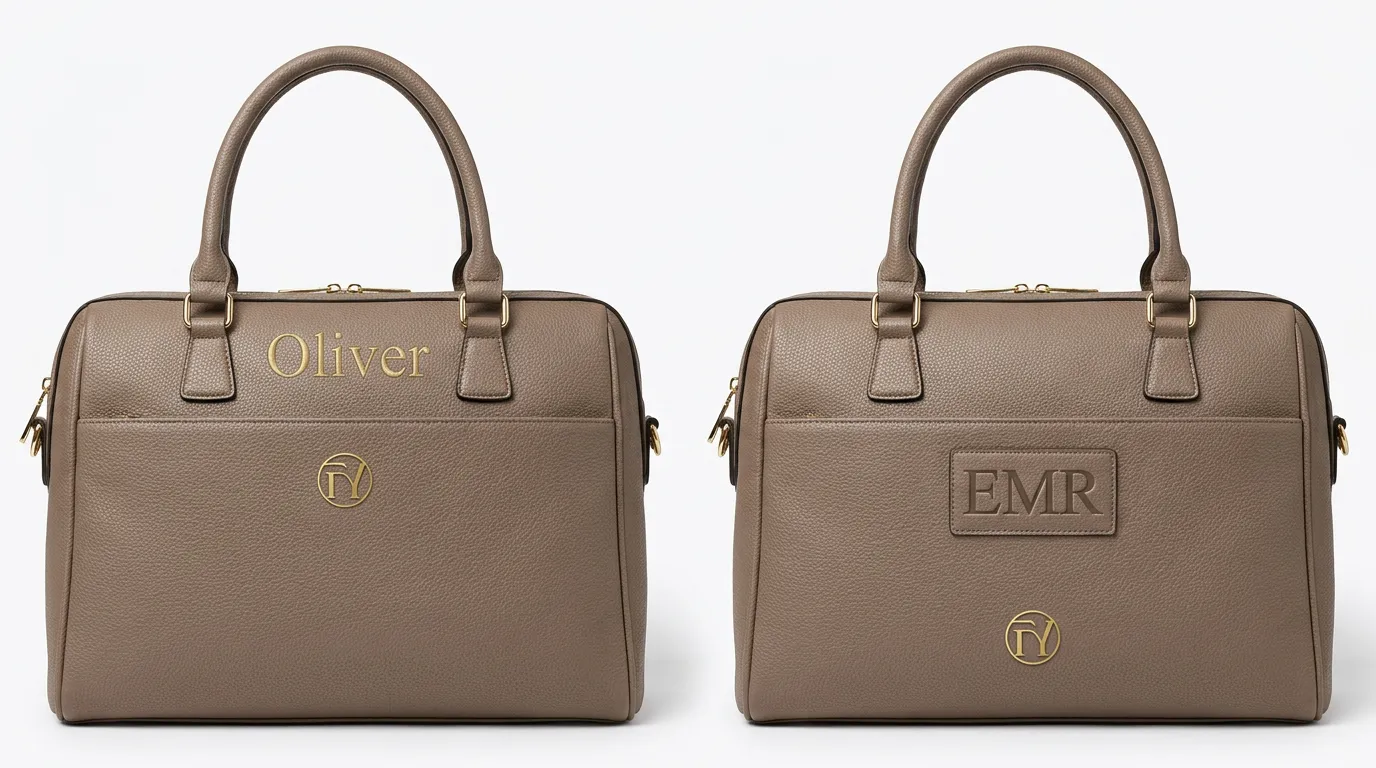
| Baby’s name embroidered | Front panel or end panel — “Oliver’s Bag” | Very high for gifts — the name makes it personal | 5.00 |
| Mom’s monogram (foil or debossed) | Front panel or leather patch — identifies the bag as the parent’s, not generic | High — reinforces the “this is MY bag, not a baby product” positioning | 3.50 |
| Birth date / weight inside | Embroidered on interior lining — a hidden commemoration | Very high for sentimental value; drives gifting | 3.00 |
| Family crest / custom icon | Embroidered or printed | Moderate — niche, meaningful for some families | 6.00 |
The baby’s name on the exterior is the highest-demand personalization for gifted diaper bags. The mom’s monogram is the highest-demand personalization for self-purchased bags. Offering both options (and allowing the consumer to choose which one during purchase) captures both market segments.
| Tier | Retail Price | Material | Zones Included | Changing Pad Quality | Carry Modes | Target Consumer |
|---|---|---|---|---|---|---|
| Mass-market | 60 | Polyester, basic nylon | 4–5 zones, basic insulation | Thin, PVC, no attached pockets | Shoulder + crossbody | Price-conscious, first-time parents |
| Premium (sweet spot) | 160 | PU leather, saffiano, fashion-grade nylon | 7–8 zones, quality insulation | Padded, PU surface, grab-and-go system | Shoulder + crossbody + stroller | Style-conscious, registry-listed, gift-eligible |
| Luxury | 350+ | Microfiber, genuine leather | 8 zones, premium insulation | Premium padded, head cushion, integrated pouches | All 4 modes including convertible backpack | Design-driven, investment-minded, brand-loyal |
The premium tier (160) is the largest and fastest-growing segment — where the consumer expects all eight functional zones AND fashion-grade appearance. This is the tier where the “luxury diaper bag” search intent lives, and where the ROI on quality materials and engineering is highest.
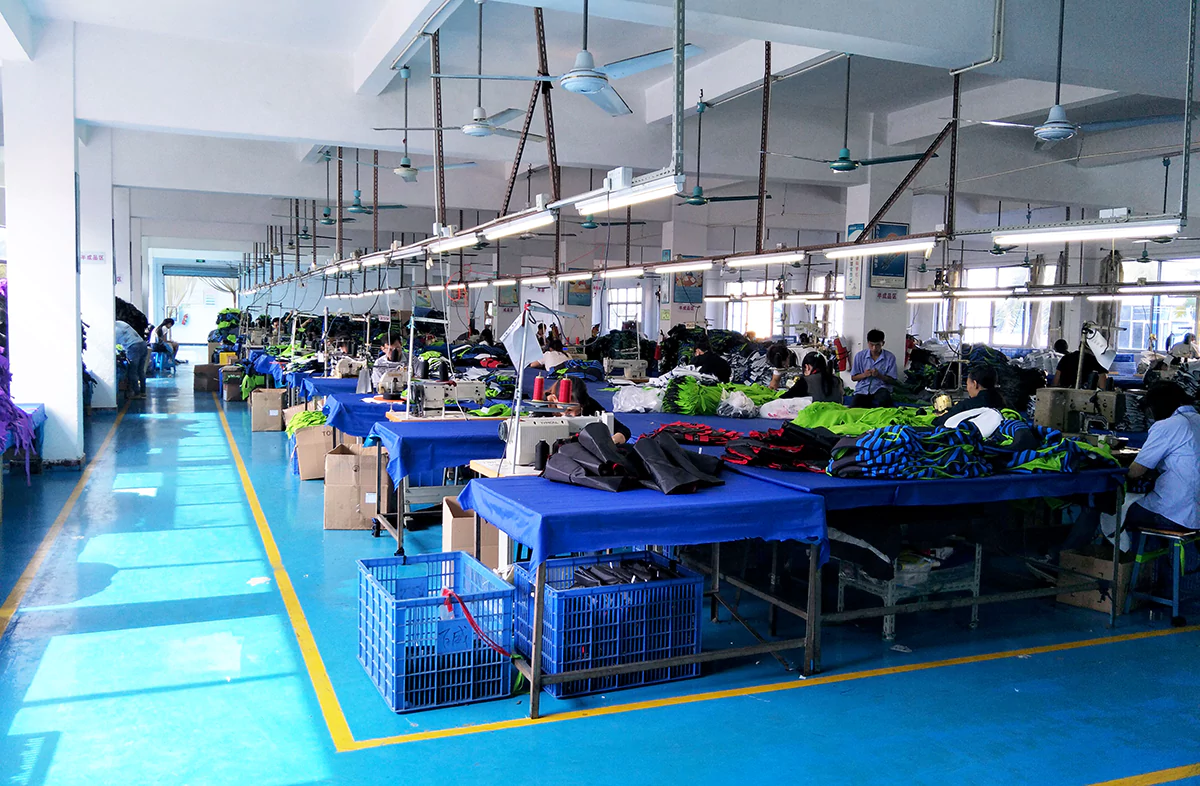
FYBagCustom is Your Trusted Custom Bag Manufacturer in China, with 15+ years of manufacturing experience producing diaper bags, baby accessories, and multi-function bags for brands worldwide. “Diaper Bag” is a confirmed product category in our manufacturing portfolio. For buyers developing luxury-grade diaper bags, our capabilities include:
Our 50,000 m² factory in Guangzhou with 10+ production lines and 500+ professional staff produces diaper bag and baby accessory programs for DTC brands, Amazon FBA sellers, baby product retailers, premium lifestyle brands, and gifting companies across international markets.
The luxury diaper bag is not a fashion bag with baby pockets added — it is a precision organizational tool with fashion-grade materials and finishing applied over the top. The function is invisible; the fashion is all anyone sees. For B2B buyers developing premium diaper bags in 2026, three core takeaways:
If your 2026 product line includes diaper bags for the premium market, now is the time to finalize zone architecture, changing pad specifications, and carry system configurations. Contact FYBagCustom to discuss insulated compartment engineering, stroller strap systems, and fashion-grade finishing — and receive physical samples, typically within 5–7 days.
FYBagCustom’s OEM and ODM team works with baby brands, DTC founders, Amazon sellers, and gift retailers to produce luxury-grade diaper bags with eight-zone interiors, grab-and-go changing stations, convertible carry systems, and fashion-grade finishing — at low MOQ with samples in 5–7 days.
Start Your Custom Bag Project →