Tel/WhatsAapp:+86 18011919834
E-mail: chloe.x@fybagcustom.com

Tel/WhatsAapp:+86 18011919834
E-mail: chloe.x@fybagcustom.com
Send Your Inquiry Today


Who this guide is for: wellness brands, yoga and pilates studios, and athleisure labels producing mat carriers — the deceptively simple product that most factories treat as a drawstring tube and that the wellness market has quietly turned into a considered, retail-worthy accessory. A yoga mat bag looks like the easiest thing in the category to make and is one of the easiest to make badly: get the mat-diameter tolerance wrong and the bag either won’t close or swallows the mat loosely; skip the wet-pouch and the sweaty mat soaks the strap; engineer the strap as an afterthought and the bag digs into the shoulder on the ten-minute walk from the car to the studio. This guide covers the three mat-carrier formats and when each wins — the sling, the full-zip carrier, and the combo tote — the mat-diameter tolerances that decide whether a bag fits the mats it’s built for, wet-pouch integration, and the cross-body strap engineering that makes a yoga or pilates mat bag genuinely comfortable to carry. It complements our wellness-studio buyer guide by focusing on the mat-carrier product specifically, format by format.
The yoga mat bag occupies a strange place in the accessory market. Functionally it solves a trivial problem — carry a rolled mat from A to B — and for years the default solution was a cheap nylon drawstring tube given away with a mat purchase. But the wellness market has matured into a premium, design-conscious category, and its customers now treat the yoga bag the way they treat the mat, the water bottle, and the outfit: as an expression of a considered practice and a brand they’ve chosen. That shift turned a throwaway tube into a genuine product opportunity — one where material, silhouette, strap comfort, and thoughtful details command a real price and carry a wellness brand’s identity out into the world every time a member walks to class.
For a manufacturer, the yoga mat bag rewards exactly the competence that its throwaway reputation obscures. The mat is an awkward object — a dense, heavy roll of a specific diameter — and carrying it comfortably is a real strap-engineering problem. The mat is often damp — from sweat or cleaning — and keeping that moisture off everything else is a real construction problem. And the modern practitioner carries more than a mat — a water bottle, a towel, blocks, a change of clothes — which is a real capacity-and-organization problem. Solve those three well, in a silhouette a wellness brand is proud to put its name on, and the humble yoga bag becomes one of the most repeatable, brandable products in the wellness accessory range. This guide is how to solve them.
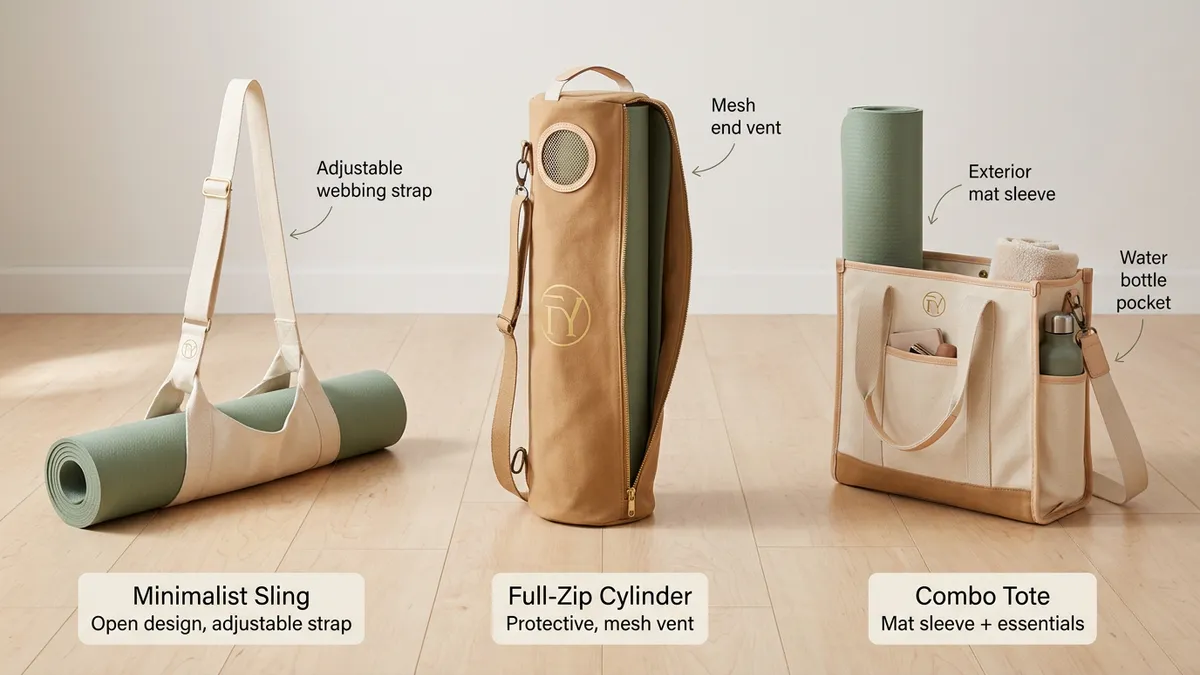
The category has settled into three formats, each serving a different practitioner and a different price point. A full wellness-brand range often carries all three.
| Dimension | Detail |
|---|---|
| What it is | An open carrier — typically an adjustable strap with end cradles or a partial cinch that holds the rolled mat exposed, worn across the body |
| The appeal | Minimalist, fast (the mat slides in and out in a second), lightweight, and visually clean — the mat itself is part of the look; the format the design-conscious studio-goer favors |
| Construction | The simplest build: a strap system with mat-retention cradles (webbing loops, elastic cinches, or a partial sleeve) and often a small integrated pocket; the strap IS the product, so the strap engineering (below) carries the entire experience |
| The limits | No weather protection for the mat, minimal storage; a warm-climate, fair-weather, studio-close format |
| The buyer | The premium minimalist wellness brand; the studio selling a lifestyle as much as a class |
| Price position | Deceptively premium — a well-made sling in a beautiful material and a comfortable strap commands more than its material cost, because the design and the strap are the value |
| Dimension | Detail |
|---|---|
| What it is | An enclosed cylindrical or tapered carrier with a full-length zip, fully containing the rolled mat, usually with pockets |
| The appeal | Protection (the mat is enclosed from weather, dirt, and the subway floor), organization (integrated pockets for keys, phone, blocks), and a finished, structured look |
| Construction | A tube or tapered body with a full-length or U-shaped zip for easy mat loading, end caps, ventilation (below), internal or external pockets, and a carry system (strap and/or handles) |
| The mat-diameter tolerance | This format lives or dies on the diameter fit (below) — the enclosed body must fit the target mats with the right margin |
| The buyer | The commuting practitioner, the all-weather carrier, the studio wanting a durable branded product; the broad-market format |
| Price position | The mid-range volume format — more construction than the sling, more function, a straightforward value story |
| Dimension | Detail |
|---|---|
| What it is | A tote,duffel, or largeshoulder bagwith integrated mat-carrying — the mat secured in an exterior sleeve, a bottom cradle, or straps, while the main bag holds everything else |
| The appeal | One bag for the whole practice — mat, water bottle, towel, blocks, change of clothes, work things; the practitioner who goes straight from class to the day carries one bag, not two |
| Construction | A full bag build (structured tote or duffel) PLUS a mat-integration system: an exterior mat sleeve, a base cradle with straps, or side straps, engineered so the mat’s weight doesn’t unbalance the bag |
| The mat-attachment engineering | The mat is heavy and off-center; the attachment (sleeve or straps) is reinforced and positioned so the loaded bag carries level, not listing — the failure mode is a bag that pulls sideways under the mat’s weight |
| The buyer | The busy, multi-tasking practitioner; the premium wellness brand’s flagship; the “commute, work, and practice in one bag” customer — and the highest-value SKU in the range |
| Price position | The flagship — a full bag plus mat integration, at the top of the mat-carrier price ladder |
The range logic: the sling captures the minimalist premium buyer, the full-zip carrier is the protective volume workhorse, and the combo tote is the flagship for the practitioner who wants one bag for everything — three formats, three price points, one brand identity across them.
The single most common yoga-mat-bag failure is a fit problem: the bag doesn’t accommodate the mat it was bought for, or holds it so loosely it flops. Yoga and pilates mats vary enormously in thickness, and therefore in rolled diameter — and the bag must be dimensioned to a defined mat range, not guessed.
| Mat Type | Thickness | Rolled Diameter (approx.) | The Bag Implication |
|---|---|---|---|
| Travel / thin mats | ~1–2 mm | Small roll | Slim carriers; a bag sized for these swims on nothing else |
| Standard yoga mats | ~4–6 mm | Medium roll | The mainstream target diameter — most carriers are built here |
| Premium / cushioned mats | ~6–8 mm | Larger roll | Needs a roomier carrier; the popular thick premium mats are what “won’t fit” cheap bags |
| Pilates / extra-thick mats | ~8–15 mm+ | The largest roll | A distinct, larger-diameter carrier category; pilates mats often need their own bag |
| Mat width (length of the roll) | Standard ~61 cm; longer/wider mats exist | The carrier’s length dimension | The bag’s length is dimensioned to mat width, with margin |
| Tolerance Principle | Specification |
|---|---|
| Define the target mat range | Every carrier is designed to a stated mat range (thickness and width), not “a yoga mat” — the spec names the diameters and lengths it fits |
| The margin | Enough internal diameter that the target mat loads and unloads easily (a mat is rolled and stuffed in, often slightly springy), but not so much that a mid-range mat rattles loosely — the full-zip format especially needs this dialed |
| The adjustable-accommodation trick | Slings and open carriers with adjustable cinches/straps accommodate a wider mat range than fixed-diameter zip tubes — a design lever where the brand wants one SKU to fit many mats |
| The retail honesty | The product listing states the mat sizes the bag fits, so the customer’s premium thick mat isn’t a return; “fits mats up to X mm thick / Y cm wide” is a specification, not marketing. Brands unsure which diameter classes to build canshare their target mats with our teamand we dimension the carriers to them |
| Pilates as a separate SKU | Extra-thick pilates mats generally need a dedicated larger carrier — a program serving both yoga and pilates plans two diameter classes, not one stretched to cover both badly |
The mat comes off the floor damp — from sweat in a hot class, or from the spray-and-wipe cleaning that hygiene now demands — and that moisture is the yoga mat bag’s second defining problem. A bag that lets a wet mat soak its strap, its pockets, and its contents fails the practitioner who uses it most.
| Element | Specification | Why |
|---|---|---|
| The moisture-tolerant mat compartment | The mat compartment (the sleeve, tube interior, or cradle) lined or constructed in a wipe-clean, moisture-tolerant material that tolerates a damp mat and cleans easily | The mat compartment is a wet zone by design; treating it as one is the core of the solution |
| Ventilation | Mesh end vents or ventilation panels on enclosed carriers so a damp mat can breathe and dry rather than sealing in moisture and odor | A sealed tube around a wet mat is a mildew incubator; ventilation is the enclosed format’s non-negotiable |
| The dedicated wet pocket | A separate sealed/water-resistant pocket for a sweat towel, damp clothes, or a wet swimsuit — isolated from the dry pockets (phone, keys, wallet) | The practitioner’s sweaty towel needs somewhere that isn’t next to their phone; the wet/dry separation is a real feature buyers value |
| Isolation of the dry zone | The valuables and dry-kit pockets sealed off from both the mat compartment and the wet pocket | The whole point is that the phone and keys stay dry while the mat and towel are wet |
| Antimicrobial options | Antimicrobial liner treatments in the mat and wet zones where market rules permit | Addresses the odor-and-hygiene concern the category cares about |
| Cleanability | Every wet-zone surface wipe-clean and reachable | The bag that can’t be cleaned becomes the bag that smells, and a wellness customer replaces a smelly bag fast |
For a yoga mat bag — the sling especially — the strap is not an accessory; it is the product’s entire comfort experience. A rolled mat is dense and heavy, it’s carried across the body, and the walk from car to studio to class is exactly long enough for a bad strap to become the thing the customer remembers.
| Element | Specification | Why |
|---|---|---|
| Width and load distribution | A strap wide enough to distribute the mat’s weight across the shoulder — narrow webbing concentrates a dense mat’s load into a pressure line and cuts in | The mat is heavier than it looks; strap width is the primary comfort lever |
| The shoulder pad | A padded, slip-resistant shoulder section (integrated pad or a slide-positioned sleeve) on carriers meant to be walked any distance | Distributes load and stops the strap sliding off — the single most-felt comfort upgrade |
| Adjustability | An adjustable strap spanning cross-body and shoulder carry, accommodating different body sizes and layering (over a coat in winter) | Cross-body is the yoga bag’s signature carry; the strap must reach across the body comfortably on every wearer |
| Cross-body geometry | The strap length and anchor positions engineered so the bag rides at the right height and angle across the back, mat lying diagonally and stably, not swinging or slipping | The mat should sit like a quiver — stable, diagonal, out of the way; bad geometry makes it swing into the arm |
| Anchor reinforcement | The strap anchors reinforced for the mat’s real weight plus the dynamic load of walking and the mat’s leverage | A dense mat on a long strap generates real anchor stress; the anchor is built for it, because a strap that tears at the anchor is the bag’s worst failure |
| The detachable/convertible option | Detachable straps (swivel clasps) for versatility, or a strap-plus-handle combination on carriers and totes | Lets the bag convert between cross-body, shoulder, and hand carry; the clasps gauge-matched to the load |
| Comfort on the combo tote | The combo tote’s strap system carries bag AND mat weight combined — specified to the total loaded weight, with backpack-strap options on the larger flagship bags for genuine all-day comfort | The flagship carries the most weight and must be the most comfortable, not the least |
Yoga and pilates bags carry a specific aesthetic — calm, natural, considered — and the material choice serves both function and that wellness identity.
| Material | Application | The Read |
|---|---|---|
| Cottoncanvas andcanvas | Slings, totes, combo bags | The natural, earthy, artisanal wellness aesthetic — the category’s signature look |
| Organic and recycled cotton | The sustainability-positioned line | The values-aligned material the wellness buyer actively seeks |
| Nylonandpolyester(incl. recycled) | Full-zip carriers, technical builds, linings, wet pockets | The durable, water-resistant, easy-clean option; recycled content for the eco-positioned brand |
| Neoprene | Premium sleeves and combo elements | The soft, cushioned, athleisure-premium hand |
| Cork and natural-fiber accents | Trim, base panels, detail | The premium-wellness material signal (paired with the natural aesthetic) |
| Coated cotton / water-resistant finishes | The wet-tolerant surfaces | Function inside the natural look |
The finish and branding: the wellness aesthetic favors restraint — a tonal woven label, a small embroidered logo, or a subtle screen or digital print in the brand’s palette, rather than loud branding; the studio’s identity carried quietly. Textured natural materials and multi-function design features suit the register.
| SKU | Format | Spec Summary |
|---|---|---|
| Minimalist mat sling | Sling | Adjustable padded strap, mat cradles, small pocket, natural material — the premium minimalist SKU |
| Full-zip mat carrier | Full-zip | Cylindrical, U-zip, mesh vent, pockets, adjustable padded strap — the volume workhorse |
| Pilates mat carrier | Full-zip (large diameter) | Sized for extra-thick pilates mats — the dedicated diameter class |
| Combo mat tote | Combo tote | Structured tote with exterior mat sleeve, wet pocket, full organization — the flagship |
| Combo matduffel | Combo duffel | Larger combo for the commute-and-practice buyer, backpack-strap option |
| Mat-carrierbackpack | Combo backpack | Mat secured to a wellness backpack — the hands-free crossover |
The application fit: yoga and pilates mat bags sit at the center of the fitness and active-life program, cross into daily commuting and work for the combo formats (practice-to-office), the travel segment (retreats and travel practice), and the gift and promotional vertical, where studio-branded yoga bags are a high-repeat retail and member-welcome-kit order.
| Test | Method | Standard |
|---|---|---|
| Mat-fit verification | Actual mats of the target range loaded and unloaded | Fits the stated range with correct margin; loads and unloads easily; no loose flop on the mid-range mat |
| Strap load and comfort | The loaded carrier (mat at real weight) carried and the strap anchors pull- and cycle-tested | Comfortable across the body; anchors survive the mat’s weight plus dynamic load |
| Wet-zone isolation | The wet pocket / mat compartment checked for moisture isolation from dry pockets | No migration to the valuables/dry zones |
| Ventilation | Enclosed carriers checked for real end-vent airflow | Genuine ventilation, not a token panel |
| Cleanability | Wet-zone surfaces wipe-tested | Clean easily; moisture-tolerant |
| Colorfastness and durability | Crocking, and abrasion on the base and strap contact zones | To standard; the bag survives daily carry |
| Combo balance | The combo tote loaded with mat plus kit and checked for level carry | Carries level, not listing under the off-center mat |
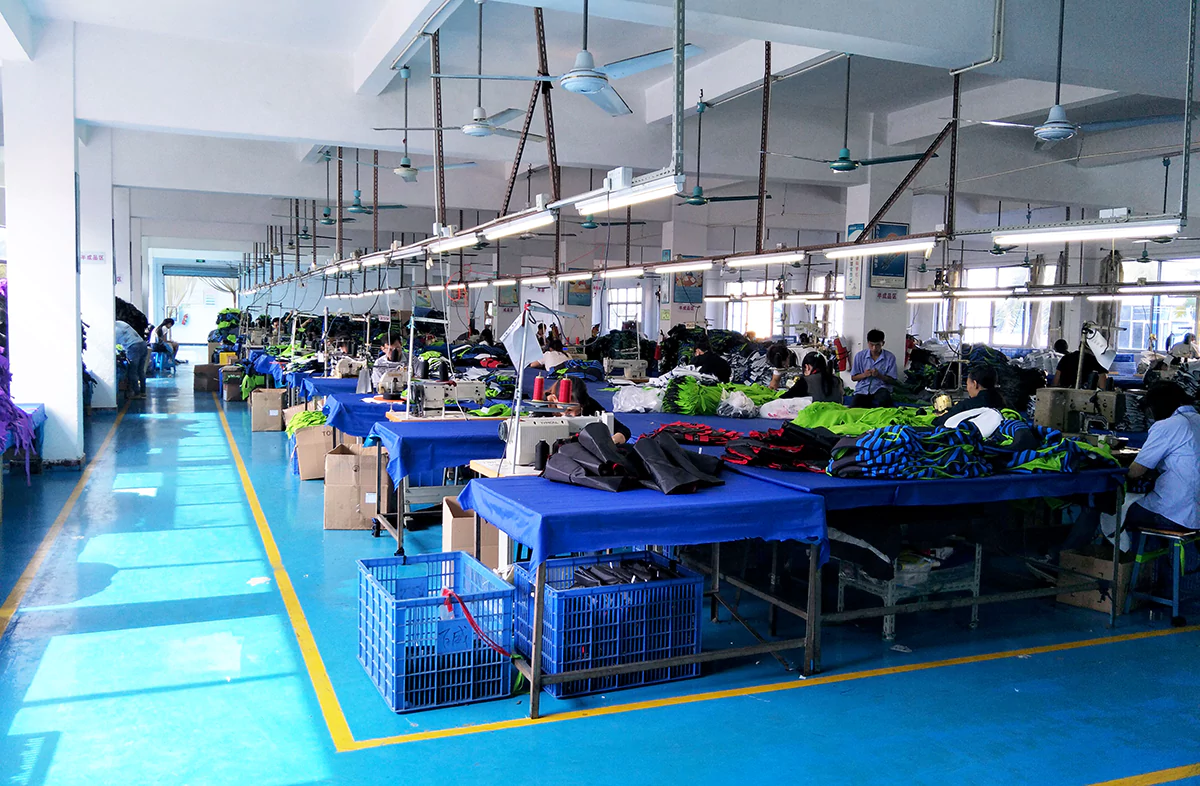
FYBagCustom is Your Trusted Custom Bag Manufacturer in China, with 15+ years of manufacturing experience across wellness, athleisure, and lifestyle bags. For brands and studios building mat-carrier programs, our capabilities include:
The yoga mat bag looks like the easiest product in the wellness range and quietly rewards the factory that takes its three real problems seriously. For B2B buyers building mat-carrier programs, three core takeaways:
If you are building a yoga or pilates mat-carrier program — sling, full-zip, combo, or a full range — contact FYBagCustom to brief your line, and receive a fit-verified, strap-tested sample in 7–10 days.
FYBagCustom builds the full mat-carrier range — minimalist slings, protective full-zip carriers, and flagship combo totes — dimensioned to your mats, with wet-pouch integration and cross-body strap engineering that makes them genuinely comfortable to carry. Fit-verified samples in 7–10 days.
Start Your Custom Bag Project →