Tel/WhatsAapp:+86 18011919834
E-mail: chloe.x@fybagcustom.com

Tel/WhatsAapp:+86 18011919834
E-mail: chloe.x@fybagcustom.com
Send Your Inquiry Today

Who this guide is for: product developers and buyers spec’ing handles across a handbag assortment — the component that customers touch first, judge fastest, and complain about most. Handle complaints lead the category’s comfort and durability feedback for a simple reason: the handle concentrates the bag’s entire loaded weight into the few square centimeters of a palm or a shoulder, does it for every minute of every carry, and attaches at the single highest-stress point on the product. Most handle specs are written backwards — a construction picked for its look, then rationalized for the load. This guide runs the spec in the correct order, as four questions answered in sequence: what will the bag weigh loaded (the comfort spec), how will it be carried (the geometry spec — lengths and drops by carry mode), what register does the line speak (the construction and material catalog: rolled, padded, wrapped, flat, and the specialty family of bamboo, acrylic, resin, and chain), and how does it attach (the anchor engineering that decides whether any of the above survives). Answer them in order, and every handle in the assortment specs itself.
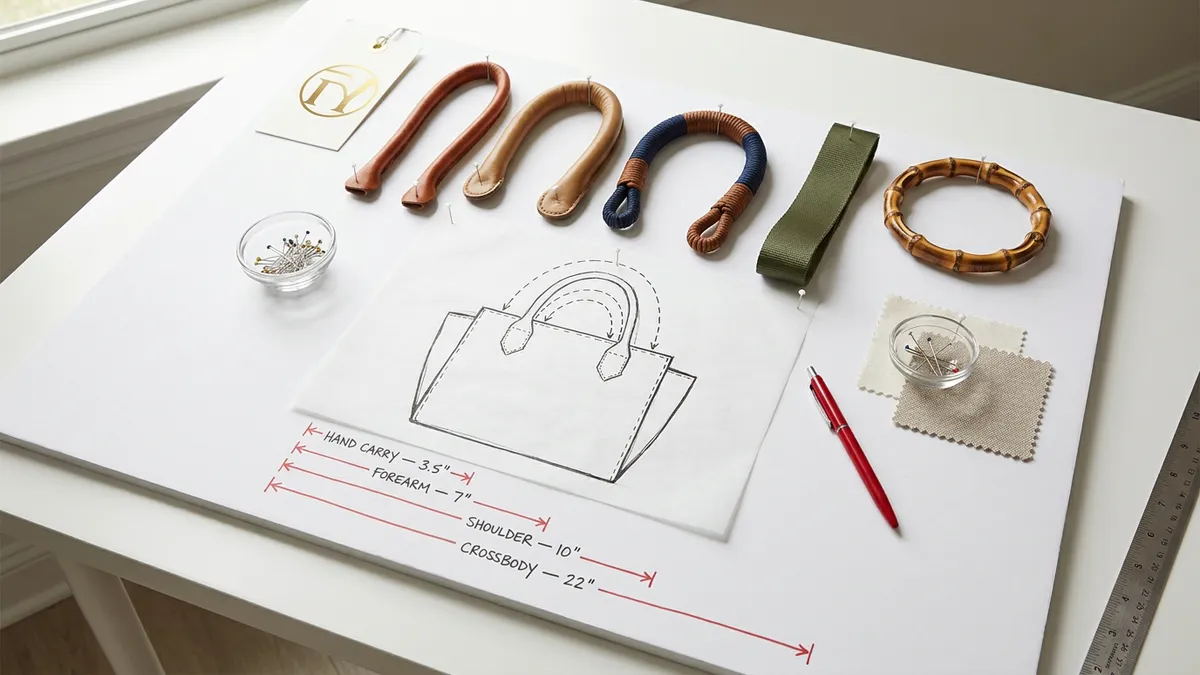
Pick up any bag and the hand reports before the eye finishes looking: too thin, digs; too stiff, fights the palm; just right, disappears. That verdict arrives in under three seconds, it is delivered on the sales floor before price is considered, and it is renewed on every carry for the life of the product — which is why the handle, the smallest major component on the bag, does outsized work in both the purchase decision and the review section. A line can survive a mediocre lining. It does not survive handles that hurt.
Yet handles are chronically under-spec’d, because they look simple and because the aesthetic decision (a bamboo ring, a slim rolled top-handle) is more fun than the engineering one (what does this bag weigh with a laptop in it, and what does that weight do to a 12-millimeter grip). The fix is procedural: spec the handle as a sequence of four questions in which the load comes first and the look comes third. What follows is that sequence, with the full construction catalog in its proper place inside it.
The comfort spec starts with arithmetic, not aesthetics. Handle discomfort is pressure, and pressure is load divided by contact area — which gives the developer exactly two levers: reduce the load (not the developer’s call; the customer packs the bag) or increase the area and cushioning that receive it.
| Loaded Weight Class | Typical Bags | The Comfort Spec |
|---|---|---|
| Light (under ~1.5 kg loaded) | Clutches, small evening bags, mini bags | Comfort is nearly free — slim rolled handles, chains, and rigid specialty handles all work; the grip can be a design gesture |
| Medium (~1.5–3 kg loaded) | Everyday handbags, mid-size shoulder bags, small crossbodies | Width and mild give matter — rolled with a resilient core, or flat leather at sufficient width; sharp-edged or under-width grips begin to dig at this class |
| Heavy (~3–6 kg loaded) | Work totes with laptops, diaper bags, school and commuter bags | Comfort must be engineered: padded handles or wide, soft rolled constructions; strap versions need shoulder pads; this is the class where handle complaints concentrate |
| Very heavy (6 kg+) | Duffels, gym bags, travel and weekender bags | Wide padded wraps, doubled handles that marry into a single padded grip, and load-rated anchors — the handle here is load equipment, spec’d like it |
The class-first rule: identify the silhouette’s realistic loaded weight before any construction talk, because the weight class eliminates most options on its own. A bamboo ring on a laptop tote and a heavy padded grip on an evening clutch are both category errors, and both are caught by asking this question first. Where a silhouette straddles classes — a tote sold to both light and laptop carriers — ask our team about spec’ing to the heavier realistic case, since the customer who overloads is the one who reviews.
Carry mode sets the handle’s length and drop — the vertical distance from the top of the handle’s arc to the bag’s top edge — and getting drop wrong ruins a handle no construction quality can save: the tote that won’t stay on a shoulder, the top-handle that knocks the bag against the forearm.
| Carry Mode | Typical Drop | The Geometry Notes |
|---|---|---|
| Hand carry (top-handle) | ~7–12 cm (3–4.5″) | Short and structured; the hand slips in, the bag hangs just below the fist; the handle often stands up on its own as part of the silhouette |
| Forearm carry | ~12–18 cm (4.5–7″) | The classic ladylike carry; the drop clears the forearm with the bag riding just below the elbow |
| Shoulder carry | ~20–30 cm (8–12″) | The drop must clear a clothed shoulder and let the bag sit under the arm; too short and the bag won’t stay up — the most common drop error in the category |
| Crossbody | Adjustable, roughly 50–60 cm drop at full length | Always adjustable — bodies differ; the slide adjuster’s smoothness and hold-under-load are part of the geometry spec |
| Dual-carry (handles + strap) | Short handles (~10–15 cm) plus a detachable/stowable strap | The two systems must not tangle; the handles lie flat when the strap carries, per our convertible-bag stow principles |
Two geometry details that separate professional specs from guesses: handle spacing (anchors set too close pinch the bag’s mouth and tip a loaded tote forward; spacing is set relative to the bag’s width and load balance) and arc shape (a handle pre-shaped with a gentle arc sits in the hand and on the shoulder better than a straight strap that must fold itself into an arc under load). A developer can send silhouette drawings to our team for drop and spacing recommendations against each carry mode before patterns are cut.
Only now — load known, geometry set — does the construction catalog enter, chosen for the register the line speaks and filtered by the first two answers.
| Element | Specification |
|---|---|
| The build | A leather strip rolled around a core and closed with a run of stitching — the smooth tubular grip that is the tactile signature of fine leather goods |
| The core decides the hand | Cord core: slim, firm, structured — the dressy top-handle. Padded core: resilient give — the comfort choice for daily loads. Rolled-leather core: dense, substantial — the double-rolled premium standard |
| The stitch line | Tight, straight, recessed or tone-matched — this seam is held in the palm and inspected at zero distance; it is the most closely-examined stitching on the entire bag |
| The ends | Where the roll meets its anchors, the transition is finished clean — collapsed, wrapped, or capped — because ragged roll-ends betray the construction |
| Edge finish | Any visible leather edges painted or burnished to fine-goods standard |
| Variations | Braided rolls (textural, artisanal-premium) and tapered rolls (slim at the arc, wider at the anchors) extend the family |
| Element | Specification |
|---|---|
| The build | A cushion core — foam, memory foam, or gel on premium builds — wrapped in leather, nylon, or fabric |
| The two comfort levers together | Padding supplies give; width supplies area — a padded handle that stays narrow re-concentrates the load it meant to spread; the two are spec’d together against the weight class |
| The wrap surface | Soft-touch, non-slip, and durable — this surface takes the most sustained skin contact on the product |
| Where it belongs | Weight classes heavy and above: laptop totes, diaper bags, duffels, and every bag whose reviews would otherwise say “cuts into my hand” |
| Element | Specification |
|---|---|
| The build | A core — tube, dowel, or flat base — wound in cord, ribbon, leather lace, raffia, or thread; the winding is the design |
| The register range | Waxed cord reads artisanal; ribbon reads refined; leather lacing reads premium-craft; raffia reads resort — the wrap material sets the bag’s voice |
| The security spec | Wrapping locked at both ends and at intervals so it cannot unwind, slide, or gap with use — unwinding is this construction’s one failure mode and the QC target |
| Where it belongs | Bucket bags, resort and boho lines, and anywhere the handle should read as handwork |
| Element | Specification |
|---|---|
| The build | A finished strip — leather with painted or turned edges, or cotton/nylon webbing — sewn flat |
| The width rule | Flat handles have no padding to spread load, so width does all the comfort work: the heavier the class, the wider the strap, and the edges must never be sharp |
| The register | Leather flat: heritage, structured, honest. Webbing: sport, utility, canvas-tote casual |
| Where it belongs | Structured totes, market and gift bags, gym and utility formats |
| Type | The Build & The Register | The Engineering Notes |
|---|---|---|
| Bamboo | Steam-bent, laminated, or carved natural bamboo, then sanded and finished — the heritage-resort icon | Confirm the bamboo construction, moisture condition, surface coating, and dimensional stability before approval. Check for cracks, splinters, coating damage, and sharp transitions after handling and impact. The bend radius affects both ergonomics and break risk; mount the handle into reinforced zones rather than relying on the bamboo alone |
| Acrylic / resin | Cast or machined, polished — clear, marbled, tortoise, or custom color; the modern-editorial statement | Rigid and cold in the hand, with cracking risk at holes, corners, and connector seats. Specify the actual material, thickness, edge radius, and temperature or impact limits; use load-spreading bushings or connectors and inspect for whitening, crazing, chips, and stress marks |
| Metal frame | Rigid bars and shaped frames — the structured evening register | Confirm alloy, wall thickness, bend geometry, edge safety, and total component weight. Skin contact, low temperatures, sweat, and repeated rubbing can affect comfort and finish; approve plating or coating against a physical reference and test high-contact areas for wear and tarnishing |
| Chain | Link chain, or leather-woven chain used as a luxury signature | Chain alone can pinch or concentrate pressure under load. Specify link size, wire or alloy construction, connector retention, plating, and total chain weight. Use leather weaving or a shoulder pad where required, then inspect for sharp edges, opening links, snagging, and finish loss after repeated loading |
The register principle: the specialty family is chosen when the handle is the design, but the first two questions still govern. Bamboo and acrylic or resin handles are often better suited to light and medium bags carried by hand; they should not be assigned to heavy daily carriers until the material, mount, load, and impact performance have been validated. Chain handles require the same review of comfort, connector security, total weight, and surface wear.
Every answer above survives or dies at the anchor — the junction where the handle meets the bag body, the highest-stress square centimeters on the product, and the site of most real-world handle failures. The anchor is not a detail after the handle; it is the other half of the handle.
| Anchor Method | The Build | Matched To |
|---|---|---|
| Bartack / box-stitch | Dense reinforced stitching, usually through a reinforcement tab | Soft handles — rolled, padded, webbing — on fabric and leather bodies; the workhorse |
| Riveted | Metal rivets through handle, body, and backing washer | Heavy loads and heritage builds — the rivet spreads point load and reads as honest hardware |
| D-ring / connector | The handle clips or loops to a welded ring fixed to the body | Detachable and adjustable systems; the ring must be welded closed and gauge-matched to the load — an open or thin ring is the hidden weak link |
| Sewn-through with internal backing | The handle base passes through the body and stitches to a concealed backing panel inside | The clean-exterior premium method — load spread across the backing’s whole area |
| Screw-post | Decorative posts through handle, body, and internal plate | Rigid handles — bamboo, acrylic, metal — where the visible hardware is part of the design |
| Wrap-and-lash | The body’s material wraps around the handle and is lashed or stitched closed | Ring and bamboo handles — the bag grips the handle; the wrap zone is reinforced against the sawing action of a rigid handle under load |
| Element | Specification | Why |
|---|---|---|
| Load rating with margin | Static load at the weight class’s maximum plus a dynamic margin for lifting, swinging, and the yank off a café chair | The anchor’s worst moment is not the carry — it’s the snatch; the margin covers it |
| Cycle life | Thousands of pick-up/set-down cycles at rated load | The anchor is loaded and unloaded more times than any component is operated; fatigue, not overload, is the usual killer |
| Backing and reinforcement | Every anchor backed — tab, washer, patch, or panel — so load spreads into the body instead of tearing at a point | Point load through unreinforced material is the classic tear-out failure; the backing is non-negotiable at medium class and above |
| Body material at the anchor | Thin or soft body materials locally reinforced with leather, webbing, or an extra ply at the anchor zone | The anchor is only as strong as what it’s sewn into |
| Alignment and balance | Anchor positions set so the loaded bag hangs level and the handles meet the hand as a matched pair | A bag that lists when carried reads as defective even when it’s merely mis-anchored |
Run the sequence for each silhouette and the assortment’s handle plan writes itself:
| Silhouette | Q1 Load Class | Q2 Geometry | Q3 Construction | Q4 Anchor |
|---|---|---|---|---|
| Work tote | Heavy | Shoulder drop 22–28 cm | Padded-core rolled leather, wide | Sewn-through with internal backing |
| Top-handle handbag | Medium | Hand drop 8–10 cm, standing arc | Double-rolled leather or bamboo | Screw-post (rigid) / bartack (rolled) |
| Shoulder bag | Medium | Shoulder drop 20–25 cm | Flat leather or slim rolled | Bartack with tab |
| Bucket bag | Medium | Hand/shoulder hybrid | Wrapped cord or braided roll | Wrap-and-lash to ring |
| Evening clutch | Light | Wristlet or chain drop | Chain (leather-woven) or acrylic | D-ring / screw-post |
| Crossbody | Medium | Adjustable 50–60 cm | Webbing or flat leather + pad | D-ring with welded rings |
| Duffel / gym | Very heavy | Hand + detachable shoulder | Doubled flat handles with padded wrap marry | Riveted + bartack, full backing |
| Backpack grab handle | Heavy (brief lifts) | Top drop ~5–8 cm | Short padded or rolled grab | Bartack into reinforced crown |
The application read-across: the heavy and very-heavy rows serve the daily commuting and work and fitness and active-life programs where comfort engineering earns reviews; the light specialty rows serve the gift and promotional occasion register; and the dual-carry and adjustable rows serve travel and adventure, where one bag meets several carry modes in a single journey.
The handle is prime branding territory precisely because it’s the touchpoint — but it tolerates only restrained execution: an embossed mark on a rolled handle’s anchor tab, tonal embroidery on a webbing strap, a heat-transfer logo on a wrap’s end-cap, engraved hardware on screw-posts and chain. Anything that adds texture under the grip subtracts comfort, so branding sits at the handle’s ends and anchors, never under the palm. The multi-function and convertible design features extend the handle system where dual-carry formats demand it.
| Check | Method | Standard |
|---|---|---|
| Loaded grip test | The bag loaded to its weight-class maximum and carried in each mode | No dig, pinch, edge-bite, or slip; the hand verdict is the standard |
| Drop verification | Drops measured against the geometry spec per carry mode | On-spec; shoulder drops clear a clothed shoulder |
| Construction inspection | Roll seams, padding symmetry, wrap tightness, edge finish examined at hand distance | Fine-goods standard at zero distance |
| Wrap security | Wrapped handles twisted and stressed | No unwinding, sliding, or gapping |
| Rigid-handle integrity | Bamboo lacquer, acrylic polish, and mount zones inspected; mounts stressed | No cracks, rough spots, or mount-point stress marks |
| Anchor static + margin | Anchors loaded to class maximum plus dynamic margin | No tear, pull, or deformation |
| Anchor cycle test | Thousands of loaded pick-up/set-down cycles | Full integrity at rated cycle life |
| Pair and balance | Handle pairs matched; the loaded bag checked for level hang | Matched, centered, level |
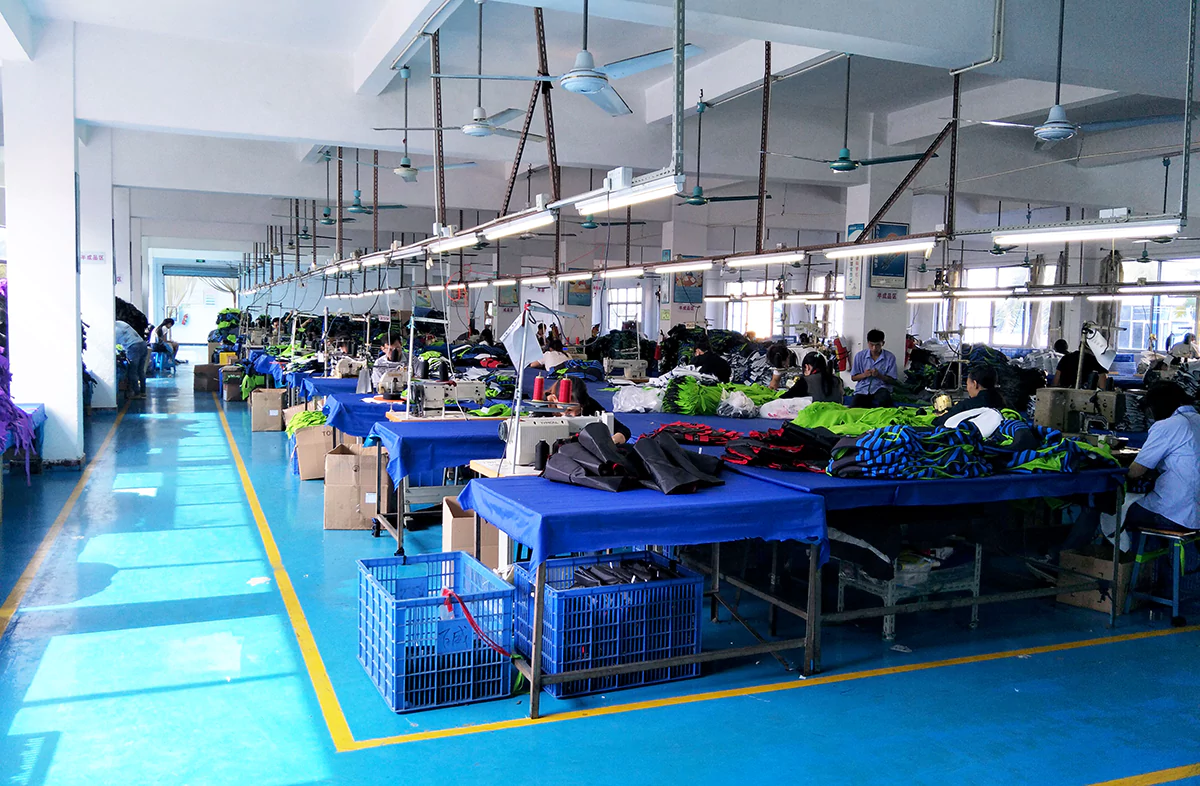
FYBagCustom is Your Trusted Custom Bag Manufacturer in China, with 15+ years of manufacturing experience across every construction and anchor method in this guide. For developers spec’ing handles across an assortment, our capabilities include:
The handle is the bag’s first impression and its most repeated experience, and it rewards a spec written in the right order. For product developers, three core takeaways:
If you are spec’ing handles across an assortment — rolled, padded, bamboo, acrylic, chain, or the full catalog — contact FYBagCustom to brief your line, and receive handle-built, anchor-tested samples in 7–10 days.
FYBagCustom runs the four-question handle spec across your assortment — load class, carry geometry, construction, anchor — and builds rolled, padded, wrapped, bamboo, acrylic, and chain handles with load-rated, cycle-tested anchoring. Samples in 7–10 days.
Start Your Custom Bag Project →