Tel/WhatsAapp:+86 18011919834
E-mail: chloe.x@fybagcustom.com

Tel/WhatsAapp:+86 18011919834
E-mail: chloe.x@fybagcustom.com
Send Your Inquiry Today

Who this guide is for: brand owners and product developers producing statement embellished bags — the category that owned the FW26 runways. The season’s evidence is unambiguous: beaded and embellished bags ruled fashion month from Loewe to Gucci, embellished purses were the stars of Maria Grazia Chiuri’s Fendi debut, floral embroidery defined Valentino’s accessories, and the studded-and-embellished story ran on through Miu Miu — all of it part of a season the trend press summarized as the end of quiet luxury and the return of bags that demand to be seen. Embellishment is also the most labor-intensive work in bag manufacturing, with its own MOQ logic, its own lead-time reality, and one dominant quality risk — bead loss — that decides whether a statement bag survives its first season. This guide covers the embellishment method families and what each can and cannot do, the panel-based production architecture the industry actually uses, the durability engineering that keeps beads on bags, and the honest MOQ and calendar math for embellished programs. It extends the embellishment-security section of our occasion-clutch guide into a full manufacturing playbook for the handbag category’s most expressive tier.
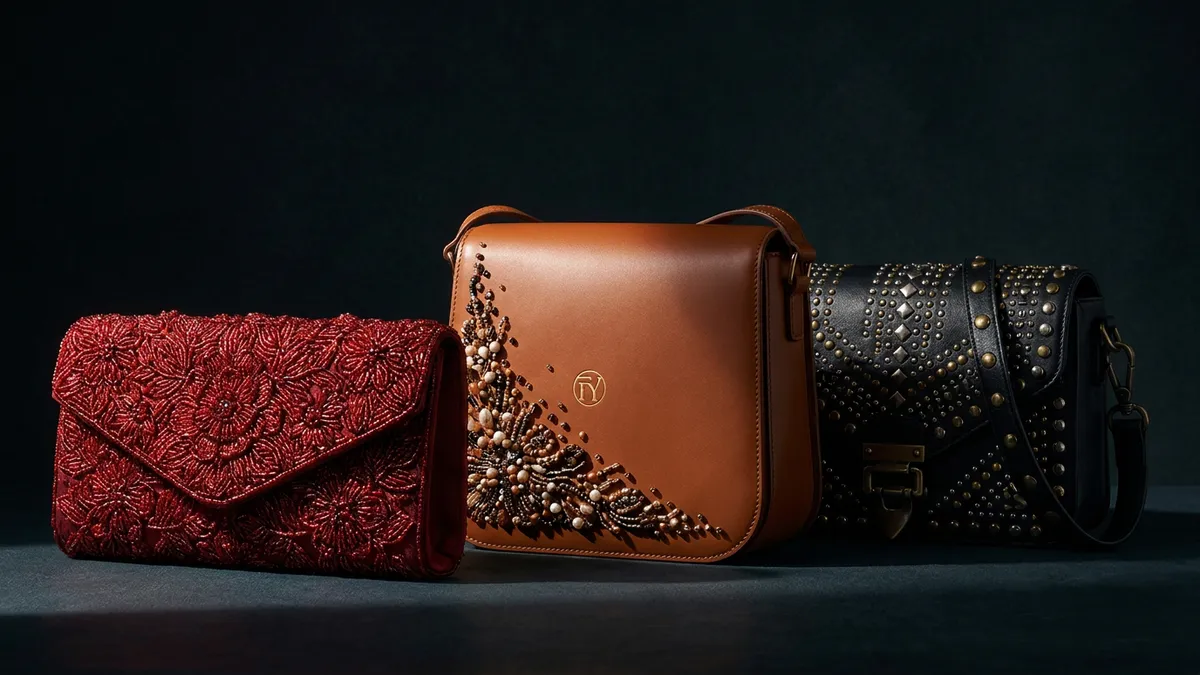
The FW26 season made a decision about surfaces. After years of quiet luxury’s smooth, logo-less restraint, the runways swung hard toward decoration: beads, sequins, embroidery, studs, and crystal moved from eveningwear onto day bags, and the embellished purse became — at Fendi’s debut most visibly — the accessory story of the season. The trade coverage caught the structural detail that matters most for production planning: the embellishment is frequently asymmetric and partial — a motif spilling across one corner, a beaded panel against plain leather — rather than the uniform all-over coverage of traditional evening goods. That shift is a manufacturing shift, and a merciful one: partial embellishment brings statement surfaces into day-bag construction, day-bag price points, and day-bag durability requirements.
It also raises the stakes on execution. An embellished bag carries hundreds to thousands of individually attached components, every one of which is a potential defect: a bead that falls, a sequin that lifts, a stud that rotates, a thread that shines where it should hide. The category’s dominant complaint — embellishment loss — is not a material failure but an attachment failure, and attachment is entirely within the factory’s control. The brands that win this trend are the ones whose factories treat every bead as a fastener with a specification, not a decoration with a glue dot.
Five method families cover the commercial territory. Most FW26-register bags combine two or three.
| Dimension | Profile |
|---|---|
| What it is | Beads, sequins, and crystals applied by hand — either standard needle-and-thread beading or tambour (Lunéville) work, where a fine hook chains the thread from beneath the fabric at speed |
| Capability | The unrestricted method: any bead type, any density gradient, dimensional stacking (beads on beads), mixed media within one motif, and the organic irregularity that reads as couture |
| Look | The luxury standard — depth, dimension, and the subtle variation of the human hand |
| Labor | The heaviest in the industry: a densely beaded panel represents hours of skilled handwork; a fully beaded evening bag can carry a full working day or more of beading labor per unit |
| Where it fits | Hero pieces, dense focal motifs, the top of the line — and the fill-in work at seam margins that every embellished program needs (below) |
| Dimension | Profile |
|---|---|
| What it is | Multi-head embroidery machines fitted with sequin feeders and bead-dropping devices, stitching embellishment in programmed patterns |
| Capability | Flat sequin work, single-bead runs, cord and taping, and thread embroidery combined in one program; consistent, repeatable, fast |
| Limits | Bead size range is constrained by the feeding mechanism; no dimensional stacking; density has a practical ceiling; the perfect regularity reads machine-made at close range — a feature for some designs, a limit for others |
| Labor | Machine hours instead of hand hours: a panel that needs a day by hand runs in minutes to tens of minutes by machine once programmed |
| Where it fits | The volume engine — day-bag motifs, repeating patterns, sequin fields, and the mid-tier of the line; the method that makes the FW26 trend producible at commercial price points |
| Dimension | Profile |
|---|---|
| What it is | Beaded and sequined fabrics purchased by the yard or panel from specialist embellishment mills, then cut and assembled like any material |
| Capability | All-over coverage at the lowest cost per embellished area; wide pattern libraries |
| Limits | The motif cannot respect the bag’s pattern pieces — coverage runs into seam allowances (a construction problem, addressed below) and cannot concentrate at focal points; quality varies enormously between mills, and the attachment method of the bought-in fabric (often chain-stitched runs that unravel from one cut thread) must be verified, not assumed |
| Where it fits | All-over sequin and bead looks at accessible tiers — with the mandatory edge-securing steps in the construction section |
| Dimension | Profile |
|---|---|
| What it is | Hot-fix rhinestones and crystals bonded by heat-activated adhesive, placed by hand, template, or machine |
| Capability | Precise placement, high sparkle, no needle holes |
| Limits | Adhesive bonds fail on flexing substrates — the rule from our occasion-clutch guide stands: hot-fix belongs on rigid surfaces (minaudière shells, stiff panels) only; on anything that flexes, crystals must be prong-set, cup-set, or sewn |
| Where it fits | Rigid statement pieces and accents on structured builds |
| Dimension | Profile |
|---|---|
| What it is | Metal studs, spikes, eyelets, and decorative hardware set through the material — the Valentino rock register of FW26 |
| Capability | The most durable embellishment family (metal fasteners, mechanically set), bold at distance, and the fastest to apply of the decorative methods |
| The spec | Per the suede-program standard: every stud backed with a reinforcement layer, spacing jig-controlled to ± 1 mm, finish matched to the program hardware — a studded line is a ruler test the eye runs automatically |
| Where it fits | The edge-and-attitude register; the embellished look with day-bag durability built in |
Embellished bags are not built like plain bags with decoration added at the end. The industry architecture embellishes flat panels before assembly — and the sequence is the difference between a producible program and a fight.
| Stage | What Happens | Why This Order |
|---|---|---|
| 1. Panel preparation | Pattern pieces cut oversize with the motif area marked; the panel backed with an embroidery stabilizer bonded or hooped behind the embellishment zone | Embellishment loads (thousands of stitches, the weight of beads) distort unstabilized material; the stabilizer is the embellishment’s foundation and stays in the bag as part of the composite |
| 2. Embellishment flat | Hand frames or machine hoops work the flat panel — full access, correct tension, motif registered to the marked pattern | A machine head cannot reach inside an assembled bag; a hand beader working a flat frame is several times faster and more accurate than one working a curved, assembled surface |
| 3. Inspection before assembly | Every embellished panel inspected against the motif standard — density, coverage, registration, loose elements | A defective panel rejected here costs a panel; the same defect found after assembly costs a bag |
| 4. The clear margin | Embellishment stops 8–10 mm short of every seam line (designed into the motif, enforced at embellishment) | Beads under a presser foot break needles, lump seams, and shatter — the margin is non-negotiable for machine assembly |
| 5. Assembly | The embellished panels join the build like any panel — with handling controls (padded surfaces, no stacking under weight) | — |
| 6. Hand fill-in | Where the design demands edge-to-edge coverage, hand beaders fill the seam margins on the assembled bag | The one stage that must be hand work; budget it in the labor plan |
| 7. Final embellishment QC | The full battery on the finished bag (below) | — |
Bead loss is the category’s defining failure, and it decomposes into specific, preventable mechanisms.
| Mechanism | What Happens | The Engineering Control |
|---|---|---|
| The strung-run unravel | Beads threaded in long continuous runs — one thread break releases an entire row; the classic failure of cheap beadwork and unverified pre-embellished fabric | Lock-stitched attachment: each bead or small cluster (2–3 beads) independently knotted or lock-stitched, so a break loses one cluster, not a row; on machine work, specify the lock-stitch program; on bought-in fabric, verify the attachment method on a cut-and-tug test before committing — cut one thread mid-panel and pull: if more than a cluster releases, the fabric fails |
| Thread failure | The attachment thread itself abrades against bead edges (glass and metal beads are microscopically sharp) and snaps | Bonded nylon or high-tenacity polyester thread specified for all bead attachment — never standard sewing thread; thread color matched to the base material so the attachment disappears |
| Flex fatigue | Embellishment on zones that fold and flex works loose as the substrate moves beneath rigid elements | Density mapping (the design-for-durability rule): dense embellishment on stable zones (front panel center, flap face, gusset panels); sparse or zero embellishment on flex zones (fold lines, strap roots, top edges that get gripped) and abrasion zones (base, base corners, back panel that rides against the body). The FW26 asymmetric-motif aesthetic is an ally here — the trend’s partial placement maps naturally onto the durability map |
| Abrasion loss | Beads at contact points grind against surfaces until attachments fail | The same density map: the base and corners stay smooth; where the design insists on embellishment near wear zones, specify recessed elements (flat sequins, low-profile beads) rather than proud dimensional work |
| Snag extraction | Knitwear, scarves, and coat linings catch raised elements and pull | Snag-test the motif (fine-knit swatch pressed and dragged); dimensional stacks and wire-cored elements get anchor stitching at multiple points, not one |
| The missing-repair problem | The consumer loses three beads and perceives a ruined bag | The repair kit: a small envelope of spare beads and sequins from the production lot, packed with the care card — a near-zero-cost inclusion that converts an inevitable minor loss into a serviceable moment and signals confidence |
| Test | Method | Pass Standard |
|---|---|---|
| Rub test | 20 firm passes, cotton cloth, over each embellished zone | No element loss; trace thread fuzz at most |
| Snag test | Fine-knit swatch pressed and dragged across the motif | No element lifted; no pulled floats |
| Shake count | Finished bag shaken 15 seconds over dark paper | Zero elements released |
| Flex cycle | Embellished panels flexed through natural range, 50 cycles | No loss, no thread exposure |
| Cut-and-tug (incoming, pre-embellished fabric) | One thread cut mid-field, pulled | Release contained to a single cluster |
| Seam-margin check | Visual at panel inspection | 8–10 mm clear at every seam line |
Embellishment changes the program math in three places, and the brands that plan around the real numbers avoid the two classic failures — the underpriced hero and the missed season.
| Work Type | Time Scale | Cost Behavior |
|---|---|---|
| Machine-embellished motif (day bag accent) | Minutes to tens of minutes per panel, after programming | Setup (digitizing, programming, sampling the program) amortizes across the run — machine embellishment rewards volume |
| Hand-beaded accent motif | 1–4 hours per bag | Scales linearly with units — hand work has no volume discount curve beyond modest learning effects |
| Fully hand-beaded evening piece | A working day or more per bag | The couture end; priced as such or not produced at all |
| Hand fill-in at seams | 15–45 minutes per bag on edge-to-edge designs | The hidden line item most briefs forget; it belongs in the quote |
| Program Type | Realistic MOQ | Why |
|---|---|---|
| Machine-embellished program | 300–500 units | The programming and sampling investment needs a run to amortize; below this, the setup dominates the unit cost |
| Hand-beaded accent program | 100–300 units | Hand work has no setup floor, but skilled-beader capacity is scheduled in blocks; small runs are possible at honest per-unit labor pricing |
| Pre-embellished fabric program | Governed by the fabric mill’s minimums (often meaningful yardage) | The bag factory’s flexibility inherits the textile supplier’s floor |
| Mixed program (the FW26 norm) | Blend across SKUs toward 300–500 total | Machine motifs on the volume SKUs, hand work on the hero — one embellishment program, two labor modes |
| Stage | Added Time vs. Plain Program | Note |
|---|---|---|
| Sampling | +1–2 weeks | The embellishment sample is the longest sample in the industry: motif digitizing or bead-plan drafting, a stitched/beaded trial, a revision round on density and registration — and the PP must carry the full QC battery before approval |
| Production | +2–4 weeks | Embellishment is a serial stage before assembly; hand-work throughput is the constraint, and embellished SKUs are sequenced first in any seasonal plan (per our holiday calendar guidance) |
| Component procurement | Beads, sequins, and crystals have their own suppliers and lead times | Specify components at sampling and book them with the PP approval; a bead style that goes unavailable mid-program is a motif redesign, not a substitution |
| SKU | Register | Embellishment Spec | Role |
|---|---|---|---|
| The embellished day shoulder bag | The season’s headline move — decoration on a daily silhouette | Machine-embroidered + beaded asymmetric motif on the front panel’s stable zone; smooth leather or PU everywhere the durability map demands | The trend hero at a commercial price |
| The beaded evening piece | The full-coverage statement | Hand-beaded over stabilized polyester satin or velvet; frame or clutch format per the occasion program | The campaign image and the price ceiling |
| The studded piece | The Valentino-signal rock register | Jig-set backed studs on pebbled leather/PU; crossbody or East-West format | The durable embellishment — day-bag toughness with statement attitude |
| The embroidered floral | The Valentino-and-Fendi romantic register | Machine thread embroidery (densest, most durable of the decorative surfaces) with optional bead accents at the motif’s heart | The gothic-romantic palette carrier — embroidery in the season’s bottle green and scarlet on chocolate or black grounds |
| The sequin field mini | The party accent | Pre-embellished sequin fabric, edge-secured, on a mini or pouch format | The accessible entry; small format contains both the cost and the wear exposure |
The mixed-media note: the strongest FW26 motifs combine thread embroidery (the durable base layer), sequins (the light-catching mid layer), and beads (the dimensional top layer) — built in that order, each layer anchoring the one above. The combination reads couture and engineers sensibly: the most vulnerable elements (dimensional beads) are the sparsest, and the most durable (embroidery) carries the coverage.
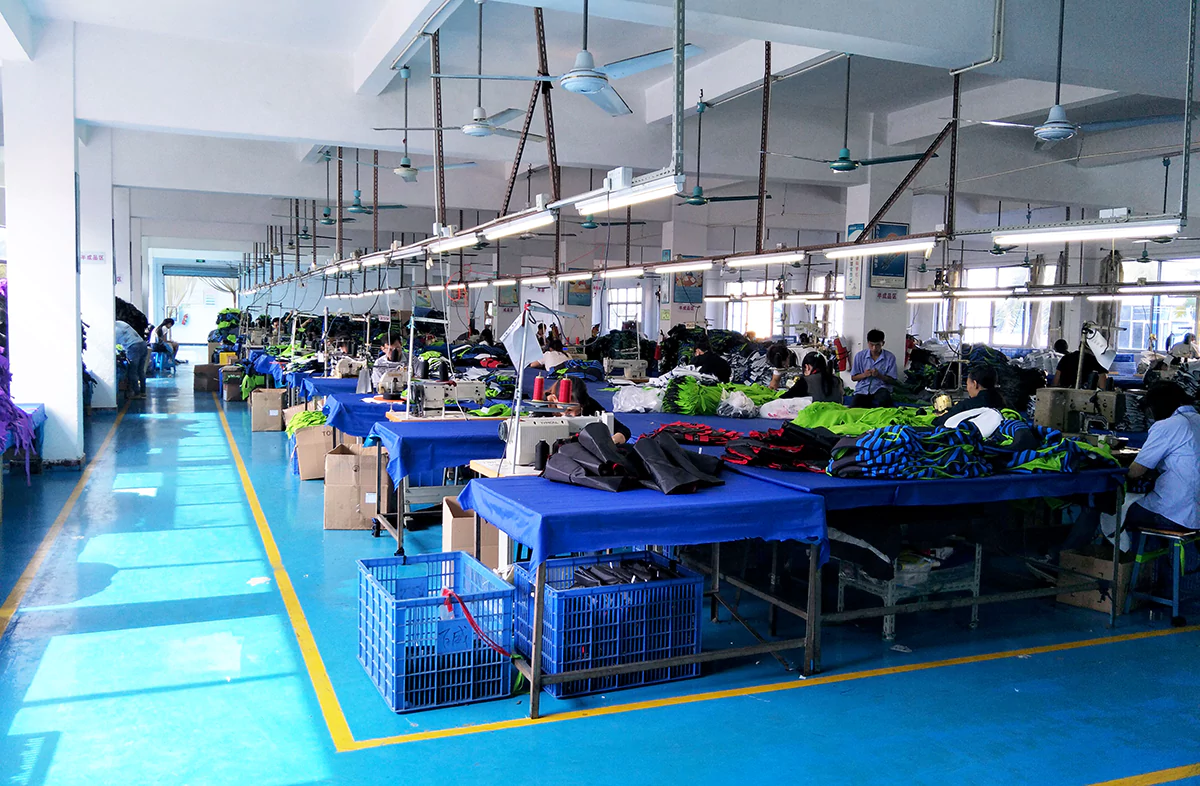
FYBagCustom is Your Trusted Custom Bag Manufacturer in China, with 15+ years of manufacturing experience, 500+ staff, and both embellishment labor modes under one roof. For brands producing FW26 statement programs, our capabilities include:
Contact our development team to brief your embellished program — the motif, the method mix, the durability map, and the calendar.
The FW26 embellishment wave rewards the brands that treat decoration as engineering. For B2B buyers producing statement bags, three core takeaways:
If you are producing the FW26 statement story and need both labor modes, the durability engineering, and the honest math, contact FYBagCustom to brief your embellished program — and receive a motif-executed, battery-tested sample in 10–14 days.
FYBagCustom runs machine and hand embellishment under one roof — lock-stitched beadwork, jig-set studs, density-mapped durability, and the full QC battery on every unit, with the real MOQ and calendar math quoted up front. Embellished samples in 10–14 days.
Start Your Custom Bag Project →