Tel/WhatsAapp:+86 18011919834
E-mail: chloe.x@fybagcustom.com

Tel/WhatsAapp:+86 18011919834
E-mail: chloe.x@fybagcustom.com
Send Your Inquiry Today


Who this guide is for: brand owners and product developers producing the FW26 statement-hardware look. The trend call came from PurseBlog’s runway wrap in three words — 2016 is back — as studs, dominant in the 2010s, returned to the fall runways: studded straps on Hermès’ mini icons, stud details across Miu Miu’s Arcadie and new styles, and, at the statement end, Valentino’s rock-and-roll edge surfacing in studded bags with chunky hardware that, as one trend report put it, does not whisper. The 2026 version splits into two distinct production registers — the detail register (small, precise studding on straps and trims) and the statement register (heavy, chunky hardware fields) — and each is an engineering assignment: studs are through-material metal fasteners whose weight, backing, alignment, and plating decide whether the bag reads as rock-and-roll or as damaged. This guide is the FW26 application of our studs-and-rivets fundamentals guide, focused on what the season specifically demands: heavy hardware on a handbag body, the weight and balance math, the substrate stacks that keep dense fields flat, the jig systems that keep them aligned, and the plating specs that keep them bright.
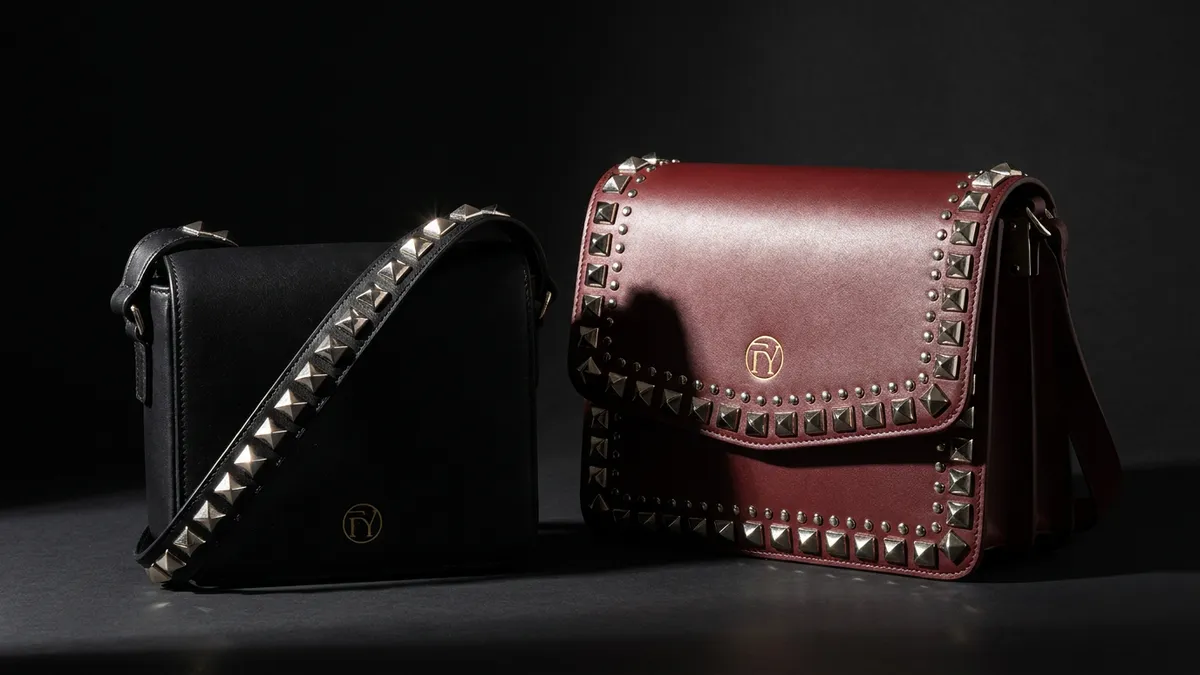
The stud came back with a decade of hindsight. Its 2010s heyday — the rock-stud era that put pyramid hardware on every silhouette from clutches to sneakers — ended in saturation, and its FW26 return arrives edited: PurseBlog’s runway report describes the comeback honestly as measured rather than everywhere, concentrated in details (Hermès applying studded straps to minis, Miu Miu studding its signifiers) with the full-statement expression carried by Valentino’s chunky-hardware pieces and echoed at Miu Miu’s subversive end. The styling consensus completes the picture: the studded bag is the season’s contrast tool — the edge against a floral midi and cashmere, or the centerpiece of full rock mode — and the embellishment-into-daywear shift documented across the broader FW26 trend coverage means studded bags now sell as daily carries, not costume pieces.
For production, the two registers are two different jobs. Detail studding is a precision exercise: small hardware, perfect alignment, set through load-bearing components like straps where the engineering must not compromise the strap’s function. Statement studding is a structural exercise: fields of heavy hardware whose cumulative weight, panel-stiffening demands, and plating exposure change the bag’s construction beneath them. A factory that treats either register as “decoration applied at the end” produces the two classic studded-bag failures — the wandering stud line and the dimpled, sagging panel — both visible from across a room, both unrepairable after assembly.
| Dimension | The Detail Register (Hermès / Miu Miu signal) | The Statement Register (Valentino signal) |
|---|---|---|
| Hardware scale | Small: 4–8 mm studs, fine rivets | Large: 10–20 mm studs, chunky cast pieces, oversized pyramids and domes |
| Quantity per bag | A row, a border segment, an accent cluster — 10–40 pieces | Fields, full borders, all-over panels — 60–200+ pieces |
| Where it lives | Straps, trim lines, flap edges, handle roots | Front panels, flaps, gussets, full perimeters |
| The production challenge | Alignment precision and through-strap engineering | Weight, panel support, plating durability at scale |
| Added weight | Negligible: 15–60 g | Real: 100–400+ g, enough to change the bag’s carry and balance |
| The consumer read | Refined edge — the quiet nod to the trend | The full statement — the bag that roars |
| Line role | The volume SKU — the trend at daily-carry stakes | The hero SKU — the campaign image and the price ceiling |
Most FW26 programs need both: the statement piece to own the trend image, the detail pieces to sell it at volume.
| Stud Type | Profile | FW26 Read | Setting Note |
|---|---|---|---|
| Pyramid | The four-sided square-base classic — the 2010s signature | The heritage reference; the “2016” callback made literal | Square base = rotation is visible; alignment tolerance ± 2° or the field reads scrambled (below) |
| Dome / round | Smooth hemisphere | The softer, more wearable statement — dominant in the daywear expression | Rotation-immune (no orientation); the forgiving choice for dense fields |
| Cone / spike | The pointed rock piece | The full Valentino-register edge; use where the attitude is the product | Height creates snag exposure — keep cones off zones that ride against the body or knitwear |
| Flat rivet / disc | Low-profile metal dot | The minimalist stud — edge without protrusion | The most abrasion-tolerant profile; correct for base-adjacent and back-panel placements |
| Chunky cast hardware | Oversized decorative pieces — outsize pyramids, rings, plates | The statement register’s center of gravity | The heaviest pieces; each one needs the full backing stack and contributes real grams |
| Ring / grommet | Open circles, set through | The hardware-utility crossover; doubles as functional lacing or strap points | Through-hole setting with washer backing, per eyelet standards |
The single-finish rule holds: one plating finish across every stud, rivet, and functional hardware piece on the bag — silver-tone, gunmetal, or antique brass per the program — because a studded bag multiplies the visible hardware count by an order of magnitude, and a finish mismatch multiplies with it.
Chunky hardware carries cumulative weight that must be budgeted like any material. A statement field of 100–150 large studs adds several hundred grams to a bag whose target empty weight, per category norms, may be under a kilogram — the hardware can consume a third of the entire weight budget.
| Engineering Decision | Specification |
|---|---|
| The weight budget line | Compute the hardware mass at design stage: stud count × per-piece weight, summed per panel; hold the finished empty weight to the category target (a statement crossbody past 1.1–1.2 kg empty gets returned for heaviness, statement or not) |
| Hollow-back and alloy choices | Chunky visual scale does not require solid mass: hollow-backed cast studs and zinc-alloy pieces deliver the statement profile at a fraction of solid brass weight — specify by visual sample AND per-piece weight, not by photo |
| The balance problem | A dense front-panel field makes the bag front-heavy: it tips forward when set down and rotates on the shoulder. Counter it with placement (borders and perimeters distribute mass better than center fields), base engineering (a slightly deeper base footprint), or deliberate back-panel counterweight in the construction stack |
| The strap consequence | Every added hardware gram passes through the strap anchors — a statement build carries tote-grade anchor reinforcement (webbing patches, bartacks through all layers) regardless of the bag’s size class |
The statement register’s defining failure is the dimpled panel: studs set through unsupported material pucker the surface at every post, the field’s cumulative weight drags the panel into a sag, and the bag looks melted within weeks. Dense hardware needs a panel engineered as a mounting surface.
| Layer | Specification | Function |
|---|---|---|
| Face material | Full-grain or pigmented leather 1.2–1.6 mm, or heavy PU 1.2 mm+; pebbled and smooth both work — the material must have body of its own | The stud’s visual ground; thin, soft materials telegraph every post |
| Structural interlining | Woven fusible 100–120 g/m² minimum under any studded zone; step up to a bonded stiffener (0.4–0.6 mm Salpa or equivalent) under dense statement fields | Distributes each stud’s clamping force and the field’s weight across the panel — the anti-dimple, anti-sag layer |
| Per-stud backing | Every stud set through a reinforcement: the interlining/stiffener layer itself for spaced studs; individual backing washers for chunky pieces and any stud in soft or slouchy zones | Prevents pull-through — the stud that rips out of soft material under a snag load takes a hole with it |
| The lining barrier | Stud backs (prongs, posts, washers) concealed behind the full lining, with a smooth interior guaranteed | Exposed prongs shred interiors and snag contents; on unlined designs, every stud back must be capped or covered with a bonded facing strip |
| The flex rule | Dense fields on stable, structured zones only; on soft and slouchy silhouettes, studding stays in supported territory — trim lines, strap roots, reinforced borders — never across a panel designed to collapse | A stud field fights a slouch: the rigid points crease the soft panel around them in radiating lines; the FW26 slouchy trend and the stud trend combine only at the details, not across the body |
A studded field is a geometry the eye audits automatically — spacing, rows, and (on square-based studs) rotation. Hand-eye placement fails at this reliably; the jig system is what makes studding a production process rather than a craft gamble.
| Element | Specification |
|---|---|
| Layout jigs | A drilled or laser-cut template per studded panel, registering every stud position off the panel’s pattern edges; positions marked or punched through the jig before setting — never measured stud-by-stud on the line |
| Spacing tolerance | ± 1 mm stud-to-stud, ± 1.5 mm cumulative across a row — drift compounds, and a row that starts true and ends crooked reads worse than uniform slight error |
| Rotation tolerance (square-base studs) | ± 2° from the reference axis; pyramid fields are set with an orientation-keyed jig or square-drive setting tools — a pyramid field with random rotation is the single most common studded-bag defect and the fastest “cheap” signal in the register |
| Edge distances | Stud centers no closer than 1.5× stud width to any seam line or edge — crowded edge studs interfere with assembly and stress the material bridge |
| Curved-line layouts | Borders following flap curves and panel radii are drafted in the pattern system and transferred by jig, with spacing adjusted along the curve so the visual rhythm stays constant (equal arc spacing, not equal chord spacing) |
| The setting QC | Per-stud: seated flat (no rock under fingertip pressure), correct torque/crimp (screw studs thread-locked, rivet posts peened to spec), rotation checked on square bases; per-panel: the jig overlay re-applied as an inspection gauge before the panel joins assembly |
Studs live proud of the surface — which means they, not the material, take the bag’s contacts: table edges, doorframes, the adjacent bag in the closet. Plating that survives on a recessed zipper fails visibly on a proud pyramid corner.
| Risk | Specification |
|---|---|
| Edge and corner abrasion | Salt-spray standard raised to the program’s strap-hardware level (48-hour minimum); on the statement register, specify plating thickness at the upper commercial band and confirm with an abrasion test — a wear wheel or controlled rub cycle on sample studs, checked for base-metal exposure |
| The high-contact map | Studs on base-adjacent rows, back panels, and flap edges take the most contact — either keep those zones to flat rivets (the abrasion-tolerant profile) or accept and design for wear (below) |
| The intentional-patina option | Antique and brushed finishes wear gracefully — the exposed high points reading as character rather than failure; bright polished finishes wear visibly and read as damage. For the rock register specifically, antiqued gunmetal and brass are both the aesthetic and the durability strategy |
| Nickel compliance | Studded bags multiply skin-contact hardware; the nickel-release limits that apply to strap hardware apply to every stud the hand or arm touches — specify compliant plating systems and retain the test reports |
The Hermès-signal move — the studded strap — is the season’s most copied detail and its most engineering-sensitive, because the strap is a load-bearing component before it is a canvas.
| Element | Specification |
|---|---|
| Through-strap setting | Studs set through the strap’s full construction (face + reinforcement + backing layer), with the strap’s structural layer intact between stud positions — stud holes are material removed from a load path, so spacing keeps a continuous uncut margin of at least 40% of strap width along both edges |
| The load test stands | A studded strap passes the same load standards as a plain strap (per anchor-reinforcement norms) — tested after studding, since the holes are the new weak points |
| The back of the strap | The strap’s underside rides on the wearer’s shoulder and clothing: every stud back capped or covered by a bonded facing layer, smooth to the fingertip — a strap that chews knitwear is a return |
| Comfort geometry | Studs on the shoulder-contact zone of a shoulder strap create pressure points under load; on straps meant to carry weight, stud placement stays on the drop sections, leaving the shoulder zone clean or padded |
| The mini-bag application | The Hermès read — studded straps on small bags — is the engineering sweet spot: mini-bag loads are light, the strap is jewelry-adjacent, and the detail carries maximum trend signal at minimum structural consequence; the natural first SKU for a brand testing the register on a crossbody or mini shoulder bag |
| SKU | Register | Spec Summary | Role |
|---|---|---|---|
| Statement flap shoulder bag | Valentino-signal | Chunky dome/pyramid border framing the flap on a stiffened panel stack; oxblood or black; antiqued hardware | The hero — the campaign image |
| Studded-strap mini crossbody | Hermès-signal | Small pyramid row on the strap drop sections; clean body | The volume entry — the trend at daily stakes |
| Stud-trim clutch | Detail register | A single edge row along the foldover line | The occasion crossover — the rock note in the evening program |
| Studded tote or bucket | Statement-lite | Flat-rivet field or handle-root clusters on a structured body | The functional statement — abrasion-tolerant profiles on the workhorse silhouettes |
| The contrast texture play | Either | Studs on canvas or nylon with leather trim | The gear-adjacent register — hardware edge on utility materials |
Colorways: black and oxblood carry the rock register; the season’s chocolate browns take antiqued brass studding for the heritage read; one clean neutral (bone or taupe) with gunmetal for the contrast-styling play the editors recommend.
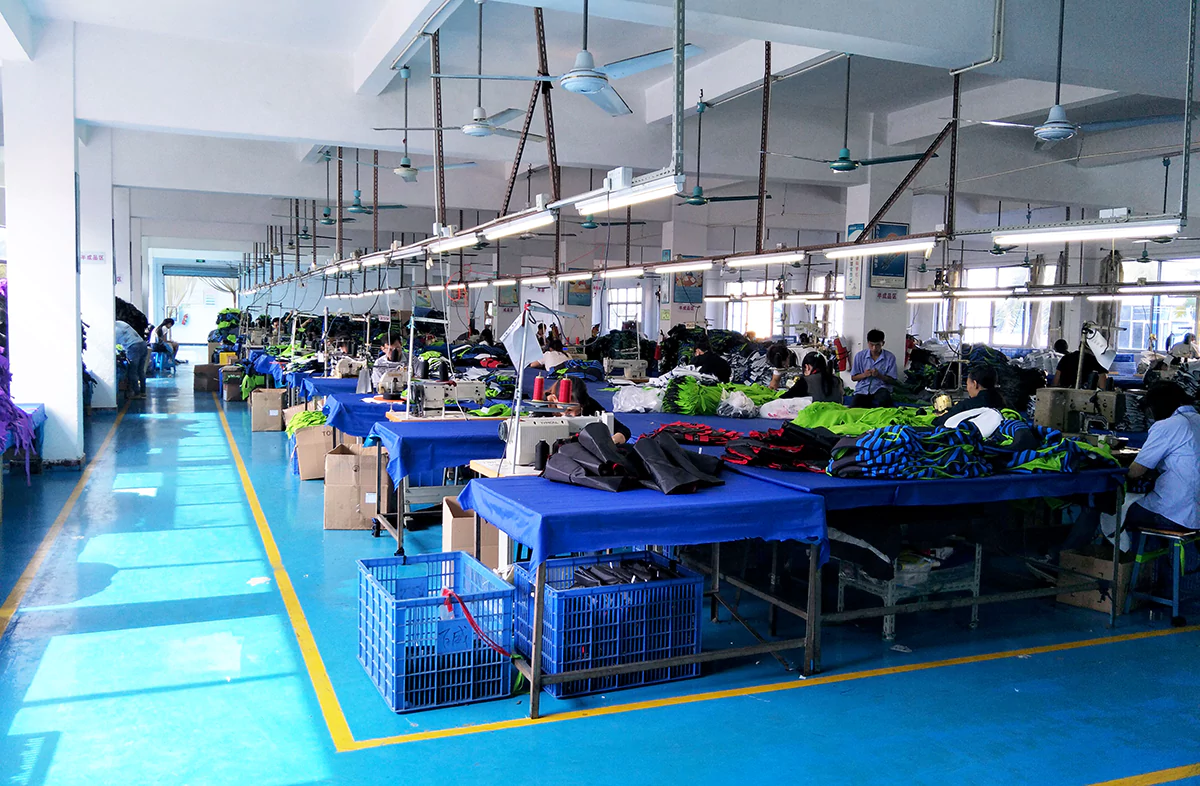
FYBagCustom is Your Trusted Custom Bag Manufacturer in China, with 15+ years of manufacturing experience and the hardware-setting discipline the studded registers demand. For brands producing FW26 statement-hardware programs, our capabilities include:
Contact our development team to brief your studded program — the registers, the layouts, the weights, and the finishes.
The FW26 statement-hardware trend rewards factories that engineer the metal before styling it. For B2B buyers producing the studded story, three core takeaways:
If you are producing the FW26 studded story and need the jigs, the stacks, and the weights engineered from the first sample, contact FYBagCustom to brief your program — and receive a jig-set, pull-tested sample in 7–10 days.
FYBagCustom engineers both studded registers — jig-aligned detail rows on load-tested straps and chunky statement fields on stiffened, weight-budgeted panels — with contact-grade plating and every stud backed. Pull-tested samples in 7–10 days.
Start Your Custom Bag Project →