Tel/WhatsAapp:+86 18011919834
E-mail: chloe.x@fybagcustom.com

Tel/WhatsAapp:+86 18011919834
E-mail: chloe.x@fybagcustom.com
Send Your Inquiry Today

Who this guide is for: brand owners and product developers building multi-texture embossed programs — the handbag and accessory lines that use embossed patterns to create the look and hand of exotic and luxury textures on accessible substrates, across a full library of patterns rather than a single croc-emboss. This guide extends our croc-emboss article into the complete embossed-texture vocabulary: ostrich (the quill-follicle pattern that is the hardest emboss to execute convincingly), lizard and python (the fine-scale and large-scale reptile prints), saffiano (the crosshatch that resists scratches and defines a different luxury register), and pebble/litchi grain (the workhorse texture that gives smooth leather durability and grip). Each pattern requires its own emboss plate, its own depth and pressure calibration, and its own substrate — and a multi-texture program that runs several patterns across a coordinated line needs a manufacturer who owns or sources the right plates, can calibrate each one, and can match the textures across colorways and silhouettes. This is the emboss-plate and depth reference for buyers building varied textured programs on leather and PU.
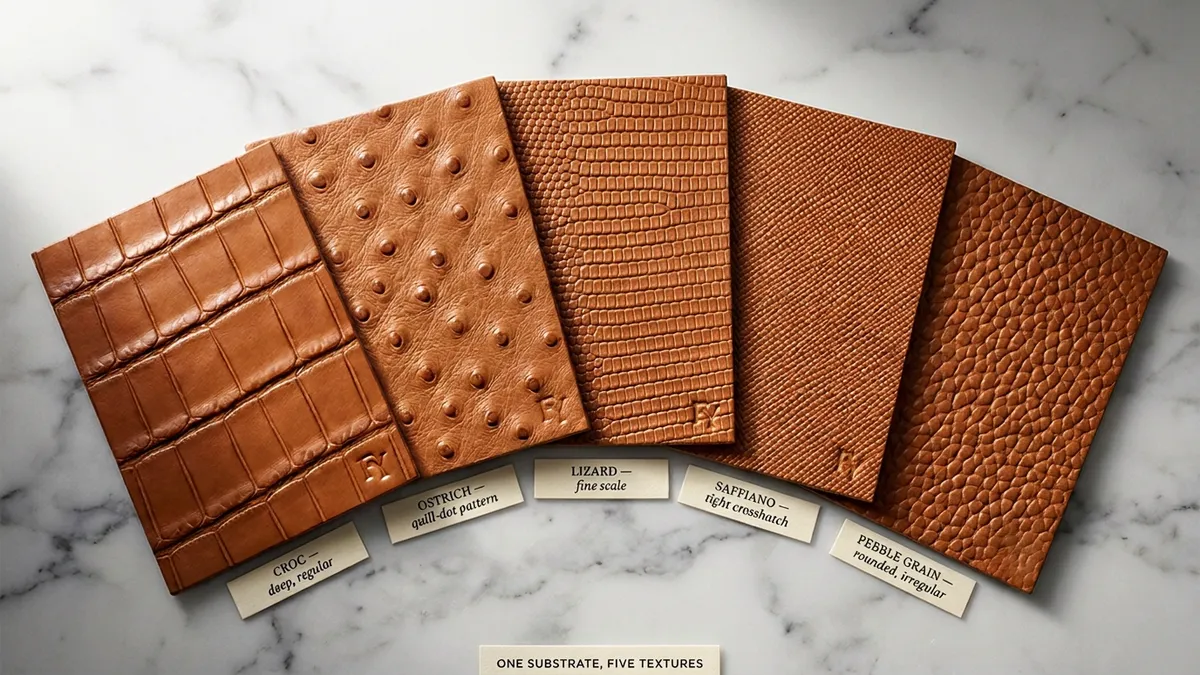
Embossing is the process of pressing a pattern into a material under heat and pressure — an engraved plate is pressed into the surface, and the pattern transfers as a permanent, three-dimensional texture. It is one of the most commercially important processes in the bag industry, because it lets a brand create the visual and tactile character of exotic and specialty leathers — croc, ostrich, lizard, python, saffiano — on a standard substrate (cowhide, split leather, or PU) at a fraction of the exotic’s cost and without the ethical and supply-chain complications of real exotics.
The result is a surface that looks and feels like the target texture, and the gap between a good emboss and a bad one is the gap between a bag that reads as premium and one that reads as cheap imitation. The emboss plate, the depth, the pressure, and the substrate together determine whether the texture is convincing — whether the faux ostrich actually catches light like ostrich or looks like a flat dotted print, whether the saffiano has the crisp crosshatch or a blurred suggestion of one. This guide covers the texture library, the emboss-plate and depth engineering that makes each one convincing, and the multi-texture program strategy that builds a varied line from a shared substrate.
| Element | Detail |
|---|---|
| The plate | A steel or copper engraved plate carrying the negative of the target pattern — the croc plate has the negative of croc scales, the ostrich plate has the negative of quill follicles, and so on; the plate’s engraving quality determines the emboss quality |
| Heat and pressure | The substrate passes between the emboss plate and a backing roller under controlled heat and pressure — the heat softens the material, the pressure imprints the pattern, and the combination sets the texture permanently |
| The substrate | The material being embossed — leather (full-grain, corrected-grain, split), PU/faux leather, or coated fabric; the substrate’s softness, thickness, and composition affect how well it takes the emboss |
| Depth | How deeply the pattern is pressed — deeper emboss creates more dramatic, dimensional texture; shallower emboss creates subtler, more refined texture; the depth is controlled by pressure, heat, and the plate’s engraving depth |
| The finish | After embossing, the surface is often finished (glazed, matte-coated, color-tipped, or antiqued) to enhance the texture’s visual depth and realism |
| Element | Detail |
|---|---|
| The pattern | Regular, geometric tile scales — the signature luxury-reptile pattern; the most widely-used emboss in the bag industry |
| Scale size | Ranges from fine (belly-scale, smaller tiles) to large (back-scale, bolder tiles) — the scale size sets the look from refined-formal to bold-casual |
| Depth | Deep — croc emboss needs pronounced depth to create the dimensional, shadowed tile effect that reads as real; a shallow croc emboss looks flat and printed |
| The quality markers | Regular, clearly-defined tiles with crisp edges and visible depth between scales; a high-quality croc emboss catches light across the raised tiles and shadows in the valleys |
| The common failure | A blurred, shallow, or inconsistent emboss that reads as a stamped print rather than a dimensional texture — the “cheap croc” look |
| Element | Detail |
|---|---|
| The pattern | The distinctive raised quill-follicle dots (the “bumps” where feathers were rooted) on a smooth or lightly textured ground — the most recognizable and sought-after exotic pattern after croc |
| Why it’s the hardest emboss | Real ostrich leather’s quill pattern is three-dimensional — the bumps are raised, rounded, and irregular in a natural-looking way, not flat dots printed on a surface. Replicating that raised, rounded, irregular quality in an emboss is the hardest emboss challenge in the library: a plate that merely presses flat circles creates a dotted surface that looks nothing like ostrich |
| The plate engineering | The ostrich emboss plate must produce raised bumps (not depressions) with rounded, slightly irregular tops — which may require a reverse emboss approach (pressing from behind, or using a plate designed to push material upward into the bump shape) or a very specifically engineered plate-and-substrate combination |
| The substrate matters most | Ostrich emboss is the pattern where the substrate makes the biggest difference — a soft, compressible substrate (soft PU, supple split leather) takes the bump more convincingly than a stiff, thin one; the substrate and the plate are matched |
| Depth and finish | The bumps need genuine height and a smooth, rounded top — and a finish (often a slight sheen on the bumps, matte in the ground) that enhances the contrast between bump and background |
| The quality marker | Bumps that are visibly raised, rounded, and tactile — the buyer runs a hand over the surface and feels the bumps, not a flat print with a dot pattern |
| The common failure | Flat, uniform, printed-looking dots with no height and no irregularity — the “stamped” ostrich that the market dismisses immediately |
| Element | Detail |
|---|---|
| The pattern | Fine, small, irregular scales — a delicate, organic, tight-scale texture that reads as refined and dressy |
| Scale | Small — the smallest scale pattern in the library; the detail is fine and demands a precisely engraved plate |
| Depth | Moderate — the scales are small, so the depth per scale is shallow, but the edges must be crisp for the pattern to read; a lizard emboss that’s too shallow blurs into a vaguely textured surface |
| The quality marker | Clearly-defined, individually-visible small scales with crisp edges — the viewer sees the individual scale shapes, not a blurred texture |
| The common failure | Blurred, indistinct small texture that reads as generic “texture” rather than lizard — usually from a worn plate or insufficient pressure |
| Element | Detail |
|---|---|
| The pattern | Large, clearly-defined, somewhat irregular scales — the bold, graphic, large-scale reptile pattern; visually the most dramatic emboss |
| Scale | Large — the largest individual scale elements in the library; each scale is a visible shape |
| Depth | Deep — like croc, the large scales need pronounced depth and edge definition to read as dimensional |
| The color opportunity | Python emboss is frequently color-enhanced — multi-color effects, gradient finishes, and painted or printed details on the embossed surface to mimic python’s natural color variation; this is where printing-on-emboss (below) adds the most value |
| The quality marker | Large, clearly-shaped scales with defined edges and dimensional depth; on color-enhanced versions, the paint or finish sits naturally in the embossed texture |
| The common failure | Scales that are too regular (python’s natural scales are somewhat irregular), or color application that ignores the embossed relief |
| Element | Detail |
|---|---|
| The pattern | A fine, diagonal crosshatch — not a natural-animal pattern but a proprietary-developed texture associated with Italian luxury; the pattern is a tight, regular cross-hatched grid |
| Why it matters | Saffiano is the most scratch-resistant, most durable emboss in the library — the crosshatch physically resists scratches, fingerprints, and marks, which is why it is the default for everyday-use bags in the structured-luxury register |
| Depth | Shallow-to-moderate — the crosshatch lines are fine and crisp rather than deep; the quality is in the regularity and crispness of the lines |
| The quality marker | Even, regular, crisp crosshatch lines covering the surface uniformly — the viewer sees a consistent, precise grid; the hand feels a fine, grippy texture |
| The common failure | Blurred, uneven, or too-shallow crosshatch that reads as a vague diagonal texture rather than a precise grid |
| The functional advantage | The texture itself is the product advantage — the crosshatch makes the bag practically unscratchable in daily use, which is a real selling point beyond the aesthetic |
| Element | Detail |
|---|---|
| The pattern | Rounded, irregular pebbled bumps — a natural-looking, organic texture that mimics the grain of shrunk or tumbled leather; the most “neutral” texture in the library |
| Why it’s the workhorse | Pebble grain is the most forgiving, most versatile, most commercially-used emboss — it hides surface imperfections in the substrate, resists showing scratches and marks, and reads as a quality leather finish without making a specific exotic or luxury statement |
| Depth | Moderate — the bumps are rounded and soft, not deep and dramatic; the texture is felt and seen but doesn’t dominate |
| The quality marker | Natural-looking, irregular bumps with a consistent-but-not-mechanical feel — the surface reads as a real-leather grain, not a stamped repeating pattern |
| The common failure | Too regular (looks mechanical and printed) or too flat (loses the pebbled dimension) |
The emboss plate is the tool that creates the texture, and plate quality determines emboss quality — a worn, poorly-engraved, or wrong-scale plate cannot produce a convincing texture regardless of the press operator’s skill.
| Element | Specification | Why |
|---|---|---|
| Plate engraving quality | The plate’s engraving must be precise, detailed, and sharp — the croc’s tile edges, the lizard’s fine scale lines, the saffiano’s crosshatch, the ostrich’s bump shapes — all reproduced with the precision the pattern demands | A blurred or worn plate produces a blurred emboss; plate quality IS emboss quality |
| Pattern scale and design | The plate’s pattern scale matched to the intended look — fine croc vs. bold croc, small pebble vs. large pebble, the ostrich’s bump density and distribution | The plate determines the scale, so the scale is chosen at the plate stage |
| Plate material | Steel or copper — steel is more durable (long-run production), copper is easier to engrave (shorter runs, custom patterns); the choice is run-length vs. setup-speed | The plate material trades durability for engraving flexibility |
| Plate inventory vs. custom | A manufacturer’s existing plate library covers the standard patterns (croc scales, saffiano, pebble) in standard scales; custom plates are engraved for proprietary or non-standard patterns — custom plates have a setup cost and lead time; ask our team which patterns are available from the existing library and when a custom plate makes sense | A wide plate library lets a program choose from established patterns; a custom plate creates a proprietary texture — the brand decides |
| Plate maintenance | Plates wear over time and use; a worn plate loses edge sharpness, and the emboss degrades — plates are monitored and replaced on a schedule | The emboss quality fades as the plate wears; plate-life management is part of production discipline |
Depth — how deeply the pattern is pressed — is the variable that most directly determines whether an emboss reads as dimensional-premium or flat-cheap.
| Element | Specification |
|---|---|
| The depth-quality relationship | Deeper emboss creates more shadow, more dimension, and more visual drama — critical for croc, python, and ostrich where the texture’s depth IS its luxury signal; shallow emboss creates subtler, finer texture — correct for saffiano and fine-grain |
| Pressure calibration | The press pressure is calibrated to the plate, the substrate, and the target depth — too much pressure over-compresses and thins the material; too little pressure under-impresses and the pattern is shallow |
| Heat calibration | The heat is matched to the substrate — too hot damages the surface, too cool doesn’t soften the material enough for the pattern to take and hold |
| Substrate-plate matching | The substrate’s softness, thickness, and composition must work with the plate’s pattern — a thick, soft substrate takes a deep emboss well; a thin, stiff substrate takes a shallow emboss better; the wrong pairing produces either a shallow impression on thick leather or a crushed-through impression on thin material |
| Consistency across the run | Heat, pressure, and feed speed held constant across the production run so every piece of embossed material matches — inconsistent emboss within a batch means bags of varying texture, which breaks a coordinated program |
| Recovery and permanence | Some substrates relax after embossing (the pattern partially springs back); the heat-and-pressure protocol is tuned for permanent, non-recovering depth |
The emboss creates the texture’s shape; the finish makes it look real and luxurious.
| Finish | Detail | Best For |
|---|---|---|
| Glaze and sheen | A glaze applied to the raised surfaces to add a subtle sheen — the light catches the high points and deepens the valleys, enhancing dimension | Croc, ostrich bumps — the luxury-shine look |
| Matte and soft-touch | A matte coating for an understated, contemporary finish | Saffiano, pebble — the quiet-luxury register |
| Color-tipping and antiquing | A contrasting color rubbed or wiped onto the raised areas (or into the valleys), enhancing the depth and adding a vintage or hand-finished look | Croc (dark valleys, lighter tiles), python (multi-tone), pebble (tonal depth) |
| Two-tone and multi-color | Heat-transfer or painted color effects on the embossed surface, using the texture’s relief to create multi-color dimension | Python (gradient and natural-pattern effects), croc (contrast colors) |
| Print-on-emboss | Printed patterns (digital or screen) applied over the embossed surface — adding color, pattern, or branding on top of the dimensional texture | Multi-color python, branded textures, fashion-print-on-texture effects |
| Metallic and foil | Metallic or foil finishes on the embossed surface — the light-catching luxury-statement look | Fashion-forward croc, python — the party and statement register |
The commercial power of embossing is that a brand can build a whole coordinated line — multiple textures, multiple silhouettes — from a shared substrate and color palette, with the emboss plate creating the variety.
| Element | Specification |
|---|---|
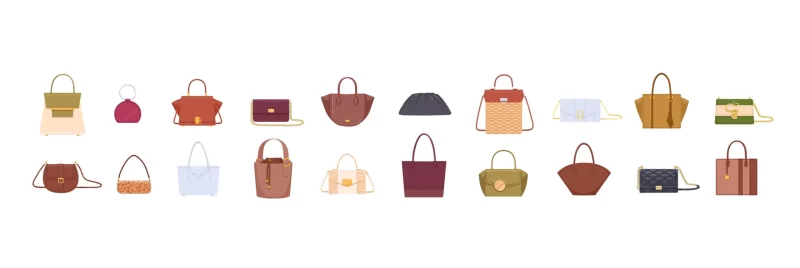
| One substrate, many textures | The same base leather or PU, dyed to the same color, embossed with different plates — so a croc clutch, an ostrich shoulder bag, a saffiano tote, and a pebble crossbody all share a colorway and coordinate as a family |
| Texture-to-silhouette matching | Each texture paired with the silhouette and use case it serves best — saffiano for the everyday tote (scratch-resistant), croc for the evening clutch (dramatic), pebble for the daily crossbody (forgiving), ostrich for the statement shoulder bag (distinctive) |
| Color consistency across textures | The same dye lot embossed with different plates — so the textures differ but the color matches across the program |
| Coordinated finishing | The same finishing approach (glaze level, matte level) across textures so the program reads as one coherent line, not a collection of unrelated materials |
| PU and vegan options | The same texture library available on quality PU / vegan leather — embossed PU takes the same plates and can match the same colorways, serving the accessible-price and vegan-positioning markets; discuss the substrate options with our team to compare leather and PU emboss side by side |
| Material | Application |
|---|---|
| Corrected-grain and split leather | The emboss substrate — corrected-grain has a sealed surface that takes emboss cleanly; split leather is softer and takes deeper emboss (especially ostrich) |
| PU / faux leather / PVC | The accessible and vegan substrate — takes emboss from the same plates |
| Canvas and cotton trim | Contrasting-material trim and lining where the design calls for it |
| Nylon and polyester linings | Interior linings |
Construction non-negotiables: embossed material handled carefully (the texture crushes under improper handling), structured construction to hold the embossed surface’s shape, reinforced stress points, premium edge finishing on leather trim, and coordinated hardware. Branding via embossed monograms on the textured surface, tonal embroidery, and embellished and multi-function design features.
| SKU | Texture | Format | Role |
|---|---|---|---|
| Saffiano everyday tote | Saffiano | Tote | The scratch-resistant daily workhorse |
| Croc evening clutch | Croc | Clutch | The dramatic dressy piece |
| Ostrich statement bag | Ostrich | Shoulder bag | The distinctive premium statement |
| Pebble daily crossbody | Pebble | Crossbody | The forgiving everyday carry |
| Python accent bag | Python | Bucket bag | The bold, graphic accent piece |
| Lizard compact bag | Lizard | Handbag | The refined-scale dressy piece |
| Multi-texture backpack | Mixed panels | Backpack | The mixed-texture fashion-forward statement |
The application fit: embossed-texture programs sit in daily commuting and work (saffiano and pebble everyday bags), gift and promotional (the croc and ostrich gift pieces), and travel and adventure (the durable, scratch-resistant travel bag) — with the fitness and active-life segment served by the saffiano and pebble workhorse textures that resist daily wear.
| Check | Method | Standard |
|---|---|---|
| Pattern clarity and depth | The embossed surface inspected for crisp, defined pattern with the specified depth | Clear, dimensional, convincing — not flat, blurred, or shallow |
| Consistency within the piece | The emboss checked for uniform depth and clarity across the whole panel | No thin spots, no faded zones — consistent across the surface |
| Consistency across the run | Embossed panels across the production run compared for match | Every piece matches — the coordinated program holds |
| Ostrich bump dimension | On ostrich emboss specifically, the bumps checked for genuine raised height and rounded shape | Raised, rounded, tactile bumps — not flat dots |
| Saffiano crosshatch crispness | The crosshatch inspected for even, regular, sharp lines | Precise grid; not blurred or uneven |
| Finish quality | Glaze, matte, color-tip, or print-on-emboss finishes checked for quality and consistency | Even, accurate, enhancing the texture |
| Color matching | Embossed surfaces color-matched under controlled light, especially across textures within a multi-texture program | All textures in the same colorway match |
| Emboss permanence | The embossed surface flex- and pressure-tested for pattern retention | The emboss holds; no relaxation or flattening |
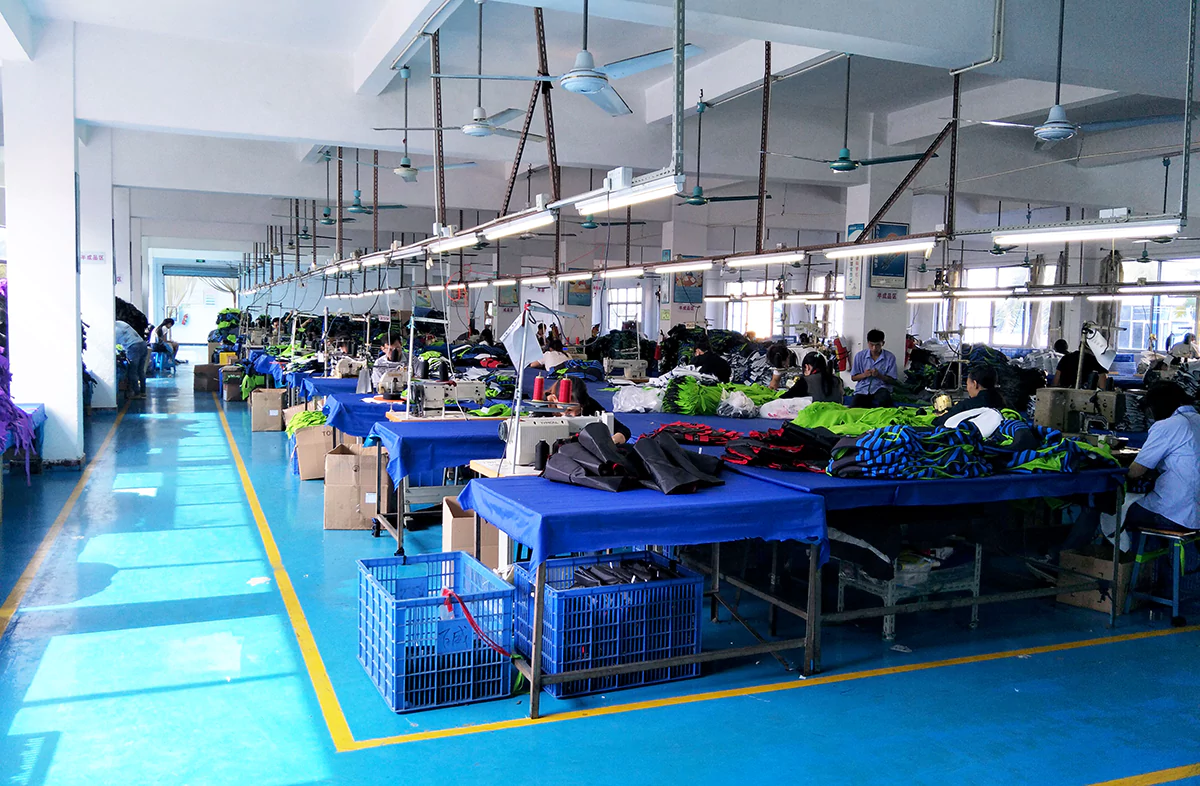
FYBagCustom is Your Trusted Custom Bag Manufacturer in China, with 15+ years of manufacturing experience and a deep emboss-plate library covering the full texture vocabulary. For brands building multi-texture embossed programs, our capabilities include:
Embossed texture is the most commercially efficient way to build a varied, premium-looking line — and it rewards the manufacturer with the plate library, the calibration skill, and the finishing range to make each pattern convincing. For brand owners building multi-texture programs, three core takeaways:
If you are building a multi-texture embossed program — croc, ostrich, saffiano, or a full coordinated line — contact FYBagCustom to brief your program, and receive embossed swatches on the actual substrate in 7–10 days.
FYBagCustom produces the full embossed-texture library — croc, ostrich, lizard, python, saffiano, and pebble — with precision plates, calibrated depth, and the finishing range that makes each pattern convincing. Embossed swatches on the actual substrate in 7–10 days.
Start Your Custom Bag Project →