Tel/WhatsAapp:+86 18011919834
E-mail: chloe.x@fybagcustom.com

Tel/WhatsAapp:+86 18011919834
E-mail: chloe.x@fybagcustom.com
Send Your Inquiry Today

Who this guide is for: brand owners, sourcing managers, event merchandise companies, stadium vendors, corporate gifting buyers, Amazon FBA sellers, and wholesale distributors who produce or resell clear bags — transparent totes, crossbodies, and stadium-approved bags made from PVC, TPU, or other clear materials. If you have ever received a bulk shipment of clear bags that arrived yellowed, cloudy, or reeking of chemical odor — or if you want to understand how to specify clear bag production that avoids these defects from the start — this guide covers the material chemistry behind yellowing and odor, the manufacturing controls that prevent them, and the stadium-compliance standards that define the category’s dimensional and policy requirements.
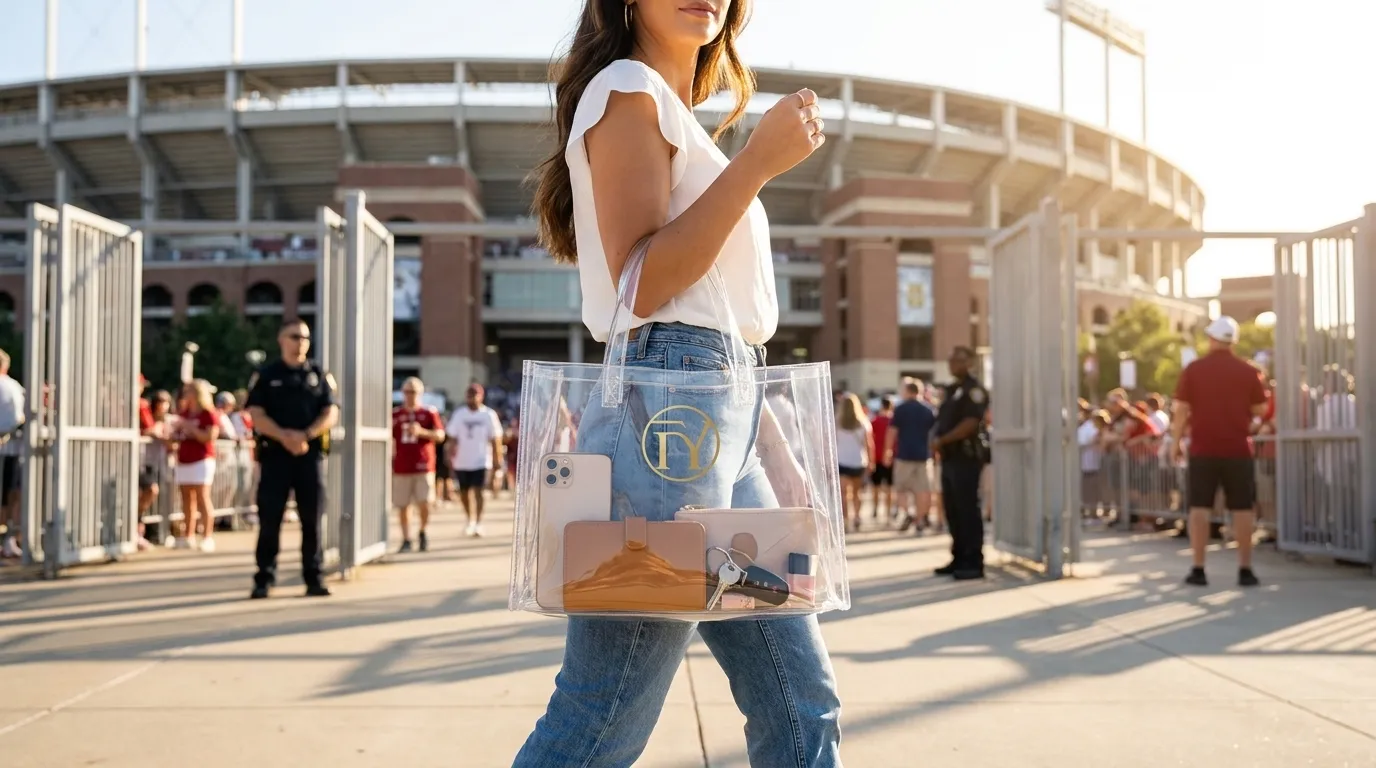
The clear bag is one of the simplest products in the handbag category — and one of the hardest to manufacture at consistent quality. The simplicity is visual: a clear bag is transparent walls joined at the seams, with a zipper or snap closure and minimal hardware. There is no complex pattern, no interlining, no multi-layer construction. The difficulty is chemical: the transparent material that makes the bag “clear” is inherently unstable over time, vulnerable to UV degradation, heat-accelerated yellowing, plasticizer migration, and volatile off-gassing — all of which turn a crystal-clear bag into a yellowed, odorous product that consumers reject on sight.
For buyers in the stadium-bag and event-bag market — where clear bags are not a fashion choice but a policy requirement (NFL, NCAA, music festivals, concert venues, and an expanding list of public spaces mandate transparent bags for security screening) — the quality standard is absolute. The bag must be clear. Not “mostly clear.” Not “clear-ish with a slight yellow tint.” Clear. And it must remain clear through weeks of retail shelf time, months of consumer use, and the temperature extremes of sitting in a car on a summer gameday.
This guide addresses the two manufacturing defects that destroy clear bag quality most often — yellowing and chemical odor — and documents the material selection, production controls, and testing protocols that prevent them. It also covers the stadium-compliance dimensional standards that define what “stadium-approved” means and how to produce bags that meet every venue’s clear-bag policy.
PVC (polyvinyl chloride) is the most common material for clear bags because it is inexpensive, easily formed, heat-sealable, and naturally transparent. But PVC has a chemical weakness: the plasticizers that make rigid PVC flexible (and therefore suitable for bags) are unstable under certain conditions.
| Chemical Process | What Happens | Visible Result | Primary Trigger |
|---|---|---|---|
| Plasticizer migration | The plasticizer molecules (typically phthalates: DEHP, DINP, or alternatives) gradually migrate from the interior of the PVC matrix to the surface, leaving the PVC behind | The PVC becomes stiffer, less flexible, and — critically — the migrated plasticizer on the surface oxidizes, turning yellow | Heat and time — the higher the temperature, the faster the migration; a bag stored at 40°C (e.g., a warehouse in summer) yellows 3–5× faster than one stored at 20°C |
| UV degradation | Ultraviolet light breaks the chemical bonds in the PVC polymer chain, producing hydrochloric acid (HCl) as a byproduct; the degraded polymer turns from transparent to yellow-brown | The bag develops a progressive yellow tint that deepens over time; eventually the material becomes brittle | Sunlight or fluorescent lighting — any UV source; direct sunlight is the most aggressive trigger |
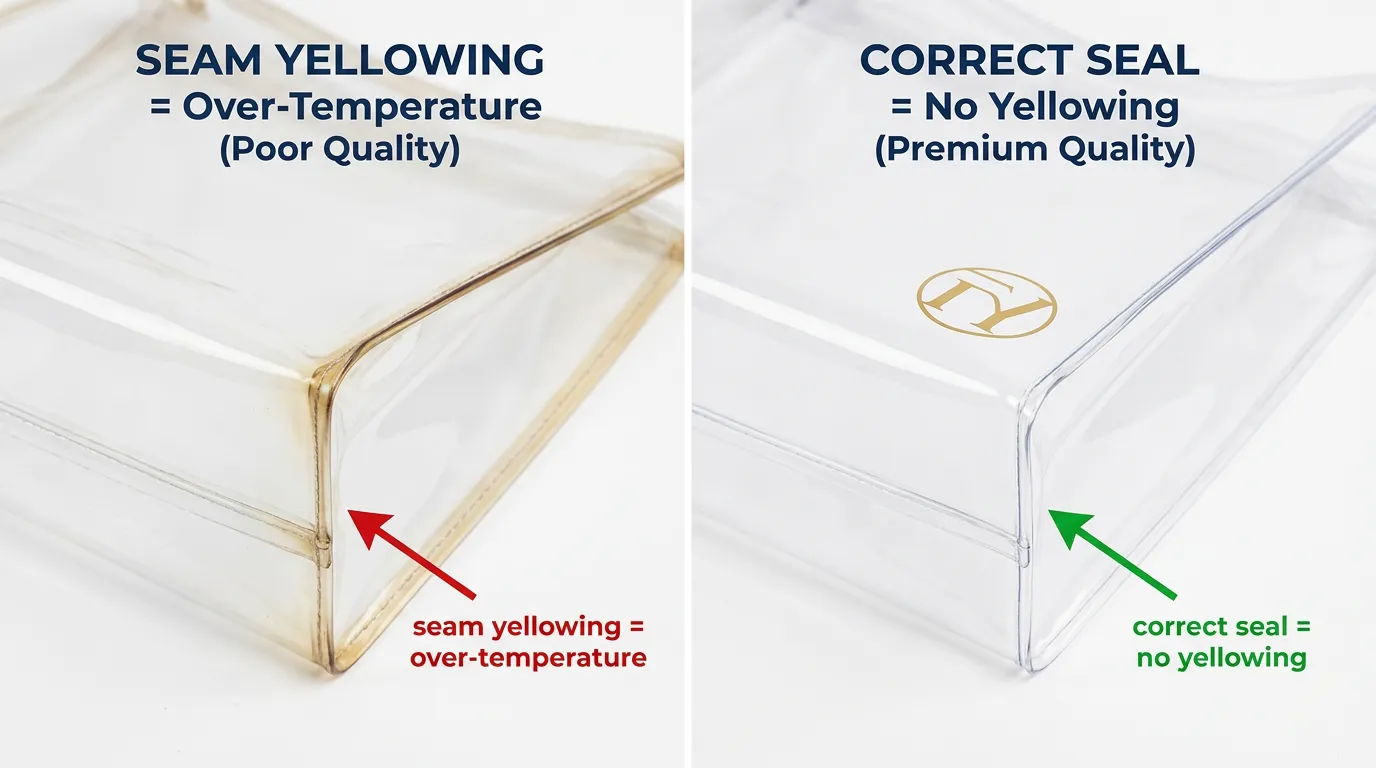
| Thermal degradation (during manufacturing) | If the PVC is heated too high during the heat-sealing or welding process, the polymer partially degrades at the seal zone, producing localized yellowing and HCl gas | Yellow discoloration along the heat-sealed seams — the seams are more yellow than the clear panels | Excessive heat-sealing temperature or duration during bag production — a factory process control issue |
The “new PVC smell” — the sharp, plasticky, sometimes acrid odor that consumers associate with cheap clear bags — is caused by volatile organic compounds (VOCs) released from the PVC material.
| VOC Source | What It Smells Like | When It Is Strongest | Health Concern |
|---|---|---|---|
| Residual plasticizer volatiles | Sweet, slightly chemical, “plastic” odor | When the bag is first opened from its packaging (the VOCs accumulate in the sealed package) | Low — at the concentrations in a consumer bag, the odor is unpleasant but not hazardous at typical exposure levels |
| Residual solvent from manufacturing | Sharp, acrid, “factory” odor | Immediately after production; dissipates over days to weeks if the bag is aired out | Low — but the odor creates a strong negative consumer impression (“this smells toxic”) |
| HCl from thermal degradation | Pungent, acidic, sharp — noticeably different from the “normal” PVC smell | If the bag was heat-sealed at excessive temperature; the odor may be localized near the seams | Moderate — HCl is a respiratory irritant; thermal degradation during manufacturing should be prevented |
Yellowing and odor are the two clear-bag defects that generate the most product returns and negative reviews:
| Defect | Consumer Reaction | Review Language | Business Impact |
|---|---|---|---|
| Yellowing (arrived yellow) | “This is not clear — it’s yellow/tinted” | “Not as pictured,” “looks dirty,” “arrived yellowed” | Returns; negative reviews mentioning the product photographs vs. reality mismatch |
| Yellowing (developed after purchase) | “It turned yellow after a few weeks” | “Doesn’t hold up,” “cheap material,” “yellowed quickly” | Negative reviews that damage long-term listing performance |
| Strong chemical odor | “It smells terrible — like chemicals” | “Horrible smell,” “had to air it out for days,” “smells toxic” | Returns on arrival; negative reviews that specifically alarm other buyers (“don’t buy this for your kids”) |
| Odor + yellowing combined | “Cheap, smelly, and already turning yellow” | The most damaging review profile — both defects compound into a “zero quality” impression | Listing potentially unsalvageable; brand reputation damage |
The most impactful decision for clear bag quality is the material choice. PVC is the industry default, but it is not the only option — and for premium or health-conscious programs, it is not the best option.
| Property | PVC (standard) | PVC (premium/phthalate-free) | TPU (thermoplastic polyurethane) | EVA (ethylene-vinyl acetate) |
|---|---|---|---|---|
| Clarity (initial) | Very good — highly transparent | Very good | Excellent — the clearest option; glass-like transparency | Good — slightly less optically clear than PVC or TPU; may have a subtle matte quality |
| Yellowing resistance | Low–Moderate — standard PVC yellows within 3–12 months depending on UV and heat exposure | Moderate — phthalate-free plasticizers are more stable but the PVC polymer is still UV-sensitive | Very good — TPU is inherently more UV-stable than PVC; yellowing onset is delayed to 12–24+ months | Good — EVA is moderately UV-stable; yellowing is slower than standard PVC but faster than TPU |
| Odor (initial) | Moderate–Strong — phthalate plasticizers produce noticeable VOC off-gassing | Low–Moderate — phthalate-free formulations produce significantly less odor | Very low — TPU has minimal VOC off-gassing; the “new bag smell” is barely perceptible | Low — EVA has a mild, non-offensive odor |
| Chemical safety | Concerns — standard PVC with phthalate plasticizers (DEHP) is restricted in children’s products under CPSIA (U.S.) and REACH (EU) | Improved — phthalate-free PVC eliminates the restricted phthalate concern | Good — TPU does not contain phthalate plasticizers; it is inherently compliant with children’s product safety standards | Good — EVA does not contain phthalates or chlorine; widely used in children’s products |
| Flexibility | Very good — PVC with plasticizer is soft and flexible | Good — some phthalate-free plasticizers produce slightly stiffer PVC | Very good — TPU is naturally flexible without plasticizers | Good — EVA is soft but slightly less flexible than PVC |
| Heat-sealing compatibility | Excellent — PVC heat-seals cleanly at relatively low temperatures | Excellent | Good — TPU requires higher sealing temperatures and more precise control | Good — EVA heat-seals at moderate temperatures |
| Durability / tear resistance | Moderate — PVC can crack at flex points over time as plasticizer migrates | Moderate | Very good — TPU has superior flex-crack resistance; it bends without fatiguing | Moderate — EVA is soft but can tear under sharp stress |
| Environmental / end-of-life | Poor — PVC is not recyclable in most curbside programs; incineration releases dioxins; the chlorine content is environmentally problematic | Same | Better — TPU is recyclable in some programs; does not contain chlorine | Better — EVA is chlorine-free; more environmentally benign than PVC |
| Relative cost | Lowest | Low–Moderate | Moderate–High | Low–Moderate |
| Best for | Budget clear bags; high-volume promotional products; price-sensitive programs | Mid-market clear bags; children’s products requiring phthalate-free compliance; brands seeking PVC with reduced health concerns | Premium clear bags; brands prioritizing clarity, durability, low odor, and chemical safety; health-conscious positioning | Budget–mid-market; soft, flexible clear bags; children’s products |
| Segment | Recommended Material | Why |
|---|---|---|
| Budget stadium bags (highest volume, lowest price) | Premium PVC (phthalate-free) | Balances cost with reduced yellowing and odor; meets CPSIA/REACH requirements for phthalate-free |
| Mid-market branded clear bags | Premium PVC or EVA | Good quality-to-cost ratio; adequate yellowing resistance for 6–12 months of use |
| Premium branded clear bags | TPU | Superior clarity, minimal odor, best yellowing resistance, strongest chemical safety profile — worth the material premium for brands that want reviews saying “crystal clear” rather than “smells like chemicals” |
| Children’s / family products | TPU or EVA | Must be phthalate-free by law (CPSIA); TPU and EVA are inherently compliant without special formulation |
| Eco-positioned brands | TPU (or bio-based EVA) | PVC’s environmental profile is problematic for eco-friendly brand positioning; TPU is recyclable and chlorine-free |
Even the best material will yellow if the manufacturing process introduces degradation. The following factory-level controls prevent process-induced yellowing.
| Control | What It Prevents | How It Works | Specification Language |
|---|---|---|---|
| 1. UV stabilizer in the material formulation | UV-triggered polymer degradation (the primary long-term yellowing cause) | A UV-absorbing additive (typically a benzotriazole or HALS — hindered amine light stabilizer) is blended into the PVC/TPU during material production; the additive absorbs UV energy before it can break the polymer chains | “Clear material must contain UV stabilizer (benzotriazole or HALS class) at minimum 0.5% by weight. UV stabilizer type and concentration must be documented on the material data sheet.” |
| 2. Heat-seal temperature control | Thermal degradation at the seam zones (causes localized yellowing and HCl off-gassing) | The heat-sealing machine is calibrated to the material’s optimal sealing window — hot enough for a strong seal, cool enough to avoid degradation. For PVC: 130–150°C; for TPU: 150–180°C. Temperature is monitored with a thermocouple at the sealing surface. | “Heat-seal temperature: [material-specific range]. Temperature monitored with contact thermocouple; maximum deviation ±5°C. Seal-zone yellowing is a reject criterion.” |
| 3. Seal dwell time control | Over-exposure to heat during sealing (a few extra seconds at sealing temperature can cause thermal degradation) | The sealing dwell time (how long the heated die contacts the material) is controlled to the minimum duration that produces a full-strength seal — typically 2–5 seconds for PVC, 3–7 seconds for TPU | “Seal dwell time: [material-specific range]. Timer-controlled; no manual estimation. Audit seal times on the first 5 units of each production run.” |
| 4. Post-production ventilation | VOC accumulation in sealed packaging (the off-gassing intensifies when bags are sealed in polybags or cartons immediately after production) | After production, bags are aired in an open, ventilated area for 24–48 hours before being packed in polybags or cartons. This allows the initial burst of residual solvents and volatiles to dissipate. | “Post-production ventilation: minimum 24 hours in a ventilated area before packing. Bags must not be sealed in polybags or cartons within 24 hours of heat-sealing.” |
| 5. Cool, dark storage before shipment | Heat-accelerated yellowing during factory and warehouse storage | Finished bags are stored away from direct sunlight, heat sources, and high-temperature zones. Ideal storage: 15–25°C, below 65% relative humidity, no UV exposure. | “Storage conditions: 15–25°C, below 65% RH, no direct sunlight or fluorescent UV exposure. Bags stored for more than 30 days must be re-inspected for yellowing before shipment.” |
The #1 factory-caused yellowing defect in clear bag production is seam yellowing — the heat-sealed seams are visibly more yellow than the clear panels. This happens when the sealing temperature is too high or the dwell time is too long, causing thermal degradation of the PVC/TPU at the seal zone.
Prevention:
| Parameter | PVC | TPU |
|---|---|---|
| Sealing temperature | 130–150°C (varies by thickness; thicker material needs higher temperature) | 150–180°C |
| Dwell time | 2–4 seconds (for 0.3–0.5 mm PVC) | 3–6 seconds (for 0.3–0.5 mm TPU) |
| Pressure | Moderate — enough for full contact but not so high that the material thins at the seal | Moderate–High |
| Verification | After sealing, inspect the first 5 units under a white background — any visible yellowing at the seams vs. the clear panels is a failure; reduce temperature by 5°C and re-test | Same protocol |
The most effective and simplest odor-reduction method is post-production ventilation — allowing the bags to off-gas in open air before packaging.
| Ventilation Duration | Odor Reduction | Practical for Mass Production? |
|---|---|---|
| 0 hours (packed immediately) | 0% — full VOC concentration trapped in sealed packaging | Yes, but produces the worst odor experience for the consumer |
| 12 hours | 40–50% — initial burst of volatiles released | Marginal — some improvement but still noticeable odor |
| 24 hours | 60–70% — most volatile compounds have released | Yes — the recommended minimum for all clear bag programs |
| 48 hours | 80–90% — nearly all detectable odor eliminated | Recommended for premium programs and children’s products |
| 72+ hours | 90–95% — residual odor is at or below the detection threshold for most consumers | Ideal but requires factory floor space for extended staging |
| Technique | How It Works | Effectiveness | When to Use |
|---|---|---|---|
| Activated charcoal sachets in packaging | A small sachet of activated charcoal placed inside the polybag or carton absorbs VOCs during storage and shipping | Good — absorbs residual odor that post-ventilation did not eliminate | Premium programs; children’s products; any program where “zero odor” is the target |
| Phthalate-free PVC formulation | Replacing standard phthalate plasticizers with non-phthalate alternatives (citrate esters, adipates, or polymeric plasticizers) reduces the VOC profile by 50–70% | Very good — addresses the odor at the source; the material inherently produces less volatile off-gassing | All programs selling into the EU (where phthalates are restricted) and U.S. children’s market; recommended as standard for 2026 |
| Material switch to TPU | TPU does not contain plasticizers — the flexibility is inherent to the polymer; there are no phthalate volatiles to release | Excellent — virtually eliminates the “PVC smell” | Premium programs; health-conscious brands; children’s products |
| Baking soda packet in each bag (consumer-facing solution) | A small packet of baking soda placed inside the bag by the factory; the consumer removes it at unboxing; the baking soda absorbs residual odor during shipping | Moderate — a secondary measure that shows the brand is aware of and addressing the odor concern | Budget programs where material-level odor reduction is not feasible; the packet communicates “we care about this” |
The clear bag market is driven largely by venue clear-bag policies — rules that require attendees to carry transparent bags for visual security screening. These policies create mandatory demand: every person attending an NFL game, a major concert, a university football game, or certain music festivals MUST have a clear bag. The brand that produces a clear bag that meets the policy — and that the consumer can verify meets the policy — captures this mandatory demand.
The NFL’s clear bag policy is the most widely referenced standard in the U.S. market. Most other venues (NCAA, music festivals, concert halls) have adopted similar or identical rules.
| Requirement | NFL Specification | What It Means for Manufacturing |
|---|---|---|
| Material | Clear plastic, vinyl, or PVC | The bag must be transparent — the consumer’s belongings must be visible through the bag walls from the outside |
| Maximum size (clear bag) | 12″ × 6″ × 12″ (approximately 30 × 15 × 30 cm) | The bag must be manufactured to these maximum dimensions or smaller; oversized bags will be refused at the gate |
| Alternative: small clutch | 4.5″ × 6.5″ (approximately 11 × 16.5 cm) — does NOT need to be clear | A small non-clear clutch is permitted; this is the “exception” that allows the consumer to carry a non-transparent personal item alongside the clear bag |
| Prohibited | Tinted or colored transparent material; opaque panels, pockets, or compartments that obstruct the security screening view; backpack-style clear bags (varies by venue) | The bag must be CLEAR (not tinted blue, pink, or any other color); any opaque section (such as a solid-color bottom panel) may disqualify the bag |
| Logo / branding | Permitted — custom logos, team logos, and brand marks can be printed or affixed to the clear bag | Logos must not obstruct the transparency (e.g., a large opaque logo that covers 50% of the bag’s face would defeat the security purpose) |
| Venue Type | Typical Clear Bag Size Limit | Tinting Allowed? | Notes |
|---|---|---|---|
| NCAA stadiums | 12″ × 6″ × 12″ (same as NFL) | No | Most NCAA venues follow the NFL policy exactly |
| Music festivals (Coachella, Lollapalooza, etc.) | Varies — typically 12″ × 12″ × 6″ or smaller | Some allow light tinting; check each festival’s policy | Festival policies change year to year; verify before production |
| Concert venues | Varies widely — some follow NFL standard; others have custom policies | Varies | The safest approach: manufacture to the NFL 12″ × 6″ × 12″ standard, which complies with the most restrictive policy |
| Government buildings, courthouses | Small clear bags only — often smaller than the NFL standard | No | Not a significant B2B market but contributes to general clear-bag demand |
For clear bags sold specifically as “stadium-approved,” including a compliance label on the product listing and on the bag’s hang tag significantly improves conversion. The consumer needs to know — before purchasing — that the bag will be accepted at the gate.
Recommended hang-tag text: “This bag meets the NFL clear bag policy: 12″ × 6″ × 12″ maximum size, clear PVC/TPU material. Stadium-approved for NFL, NCAA, and most major venues. Please confirm your specific venue’s policy before attending.”
The disclaimer (“please confirm”) is important: venue policies change, and not every venue uses the identical NFL standard. The disclaimer protects the brand from a consumer who buys the bag for a venue with a different or more restrictive policy.
A clear bag’s construction must create a usable, structured product while maintaining maximum transparency — every structural element that is not transparent (seam tape, zipper tape, reinforcement, trim) reduces the bag’s “clarity” and could conflict with strict venue policies that require unobstructed visibility.
| Element | Transparent? | Impact on Clarity | How to Handle |
|---|---|---|---|
| Clear PVC/TPU panels | Yes — the body of the bag | None — this is the transparent surface | Ensure the material meets the anti-yellowing and odor specifications above |
| Heat-sealed seams | Semi-transparent — the overlapping material at the seam creates a slight visual distortion | Minimal — seam lines are narrow (3–8 mm) and do not obstruct the view of the bag’s contents | Keep seams as narrow as possible (3–5 mm) for maximum clarity; avoid wide seam overlaps |
| Zipper tape | Opaque — nylon or polyester zipper tape is not transparent | Moderate — the zipper runs across the top of the bag, creating an opaque strip | Use a zipper with matching-color tape (clear, white, or matching the trim) to minimize visual impact; some premium zippers have translucent tape |
| Trim / piping (if used) | Opaque — leather, PU, or fabric trim around the edges | Moderate–High — trim frames the bag’s edges but adds opaque material | Limit trim to the top edge and handles only; avoid trim on the front and back panels (the “viewing” surfaces); specify narrow trim (15–20 mm maximum width) |
| Handles / straps | Opaque (if leather/PU) or transparent (if clear PVC/TPU handles) | Moderate — handles span the top of the bag | Clear PVC/TPU handles maintain maximum transparency; leather or PU handles add a premium look but introduce opaque elements |
| Base panel (if separate) | Depends — can be clear or opaque | High if opaque — an opaque base creates a non-transparent zone | For maximum stadium compliance, use a clear base panel. For premium positioning, an opaque leather or canvas base panel adds structure and style but verify it complies with the target venue’s policy |
| Brand logo | Opaque (if printed) or semi-transparent (if embossed into the PVC) | Low — logos are small relative to the bag’s total surface | Position the logo in the lower corner; keep it under 10% of the panel’s area; screen-printed logos are standard; avoid large all-over prints that reduce transparency |
| Interior pockets | Opaque (if fabric) or transparent (if clear PVC) | High if opaque — fabric pockets inside a clear bag create opaque zones | Use clear PVC interior pockets to maintain full transparency; or eliminate interior pockets entirely for the simplest, most compliant design |
| Design Approach | Description | Stadium Compliance | Aesthetic Read | Target Market |
|---|---|---|---|---|
| Full transparency | 100% clear — clear panels, clear handles, clear base, clear pockets, clear zipper tape | Maximum — no opaque elements to question | Basic, functional, utilitarian — reads as “stadium bag” | Budget/volume stadium market; compliance is the sole priority |
| Clear with color trim | Clear panels + colored trim (top edge, handles), colored zipper tape, small printed logo | High — the trim is limited to non-viewing areas; the contents are fully visible | Elevated — reads as “a designed product, not a generic clear bag” | Mid-market branded stadium bags; crossbody clear bags; the recommended default for most programs |
| Clear with premium trim | Clear panels + leather or PU trim, leather handles, branded hardware, leather base panel | Moderate — the leather elements add opaque zones; verify with the target venue | Premium — reads as “a fashion bag that happens to be clear” | Premium stadium-fashion market; fans who want style + compliance |
The clear bag’s transparency creates a unique branding opportunity — the logo is visible from both sides (the consumer sees it on the outside; the contents are visible through it from the inside). It also creates a challenge: the logo must be durable, opaque enough to read clearly, and applied without damaging the PVC/TPU’s transparency.
| Method | What It Looks Like | Durability | Application | Best For |
|---|---|---|---|---|
| Screen printing (on the clear surface) | A printed logo directly on the PVC/TPU surface; the ink is opaque against the clear background | Moderate — screen ink can scratch or peel if the bag is rubbed against hard surfaces; a protective clear overprint improves durability | Screen printing on flat panels before bag assembly | The standard for bulk stadium bags; 1–3 color logos; fast, cost-efficient |
| Heat transfer printing | A full-color logo transferred to the clear surface via heat and pressure; higher resolution than screen printing | Good — heat-transfer bonds more durably than screen ink | Heat transfer applied to flat panels before assembly | Full-color logos, photographic images, detailed graphics |
| Vinyl decal (applied) | A pre-cut vinyl sticker with the logo, adhered to the clear surface | Moderate — the decal can peel at the edges over time, especially in heat | Die-cut vinyl applied by hand or machine | Short-run custom orders; event-specific logos that change frequently |
| Sewn-on patch (on trim area) | A woven or embroidered patch sewn to the opaque trim area (not to the clear panel) | Very good — a sewn patch does not peel or fade | Embroidered or woven patch sewn to trim | Premium clear bags with leather/PU trim; the patch adds a fashion-grade detail |
| Embossed into the PVC | The logo is heat-pressed into the PVC surface, creating a raised or recessed mark in the material itself — no ink, no color, just a textural impression | Excellent — the embossing is permanent; it cannot peel, fade, or wear off | Hot-stamp embossing die pressed into the PVC at controlled temperature | Minimalist, premium positioning — the logo is visible through light refraction but does not add color or opacity |
On a clear bag, the logo printed on the front panel is visible from inside the bag as well (in mirror image). For simple logos (text, initials, symmetrical icons), this is not an issue. For asymmetrical or directional logos (logos with text that reads left-to-right), the “backwards” view from inside can look unprofessional.
Solution: position the logo on the lower 30% of the front panel — where the consumer’s belongings typically obscure the inside view. At the top (where the bag is open or where the contents are sparse), the backwards logo would be most visible; at the bottom, the contents naturally cover it.
Clear bags have a shorter functional lifespan than opaque leather or fabric bags — the transparent material is inherently more vulnerable to yellowing, scratching, and cloudiness. Setting realistic consumer expectations prevents disappointment and returns.
| Material | Expected “Crystal Clear” Period | Expected Usable Lifespan (before yellowing becomes objectionable) | What Ends the Lifespan |
|---|---|---|---|
| Standard PVC (with UV stabilizer) | 3–6 months (with regular outdoor exposure) | 6–12 months | Yellowing, surface scratching, plasticizer migration (stiffening) |
| Premium PVC (phthalate-free, with UV stabilizer) | 6–12 months | 12–18 months | Same mechanisms but delayed by the superior plasticizer system |
| TPU | 12–24 months | 24–36+ months | Slow yellowing (TPU is inherently more UV-stable); surface scratching; TPU does not stiffen because it has no migrating plasticizer |
| EVA | 6–12 months | 12–24 months | Moderate yellowing; surface scratching; EVA may cloud slightly over time |
Be honest about lifespan on the product page. Consumers who buy a clear bag for a specific event (a single football season) have different expectations than consumers who buy a clear bag as a permanent daily accessory.
Recommended product-page language: “This [material] clear bag is designed for [seasonal use / regular event attendance / daily carry]. With proper care (store away from direct sunlight when not in use; wipe clean with a damp cloth), you can expect [X months] of crystal-clear performance.”
| SKU | Silhouette | Dimensions | Stadium Compliance | Primary Use Case | Target Consumer |
|---|---|---|---|---|---|
| Stadium Tote (hero) | Open-top structured tote with color trim | 12″ × 6″ × 12″ (maximum NFL-compliant) | Full compliance — meets all major venue clear-bag policies | NFL, NCAA, concerts, festivals | The gameday consumer — buys this bag specifically for events |
| Clear Crossbody | Zippered crossbody with adjustable strap | 9″ × 3″ × 7″ (well within all policies) | Full compliance | Events, travel (TSA-friendly for liquids), everyday (festivals, theme parks) | The active consumer — wants hands-free carry at events |
| Clear Clutch / Wristlet | Small zip pouch with wrist strap | 4.5″ × 6.5″ (meets the “small clutch exception” in most policies) | Compliant as the “small clutch” — does not need to be clear under some policies, but clear adds versatility | Inside the stadium (carried alongside the clear tote); evening events; as a cosmetics pouch inside a larger bag | The accessory buyer — the entry product and add-on |
| Clear Weekender / Oversized Tote | Large structured tote | 15″ × 8″ × 15″ (exceeds NFL limit — NOT stadium-compliant at this size) | NOT compliant for most stadiums — market as a lifestyle/travel bag, not a stadium bag | Beach, travel, pool, gym, organize-your-closet | The lifestyle consumer — clear for aesthetic or organizational reasons, not for stadium policy |
| Test | What It Evaluates | Method | Pass Criteria |
|---|---|---|---|
| Clarity test | Transparency and freedom from yellowing, cloudiness, or haze | Place the bag flat on a sheet of printed text (12-point font); the text must be fully legible through the clear material | All text legible through every clear panel; no visible tint, haze, or yellowing |
| Seam yellowing test | Whether the heat-sealed seams are discolored relative to the clear panels | Place the bag on a white background; compare seam color to panel color under D65 daylight | No visible color difference between seams and panels |
| Odor test | Residual chemical odor after post-production ventilation | Seal the bag in a polybag for 4 hours; open the polybag; hold 15 cm from the nose; evaluate odor intensity on a 1–5 scale | Rating 2 or below (2 = barely perceptible; 1 = no odor detected) — rating 3+ is a failure |
| Dimensional compliance | Stadium policy compliance — bag dimensions must not exceed the specified limits | Measure length, width, height with the bag standing upright, empty | All dimensions within the specified limits (e.g., ≤ 12″ × 6″ × 12″ for NFL compliance) |
| Seal strength test | Whether the heat-sealed seams hold under load | Fill the bag with 3 kg of contents; lift by the handles; hold for 30 seconds | No seam separation, no seam stretching, no visible stress at any seal point |
| Logo durability test | Whether the printed/applied logo resists scratching and rubbing | Rub the logo area with a dry cotton cloth for 50 cycles at moderate pressure | No visible ink removal, no peeling, no fading |
For brands that want to verify the material’s long-term yellowing resistance before committing to bulk production:
| Step | Condition | Duration | Purpose |
|---|---|---|---|
| 1 | Place a material swatch under a xenon arc UV lamp (simulating 6 months of normal sunlight exposure) | 100 hours | Accelerates 6 months of UV exposure into 100 hours |
| 2 | Remove the swatch; place it next to an unexposed swatch of the same material on a white background | — | Compare the exposed swatch to the original |
| 3 | Measure the color change with a spectrophotometer (Yellowness Index per ASTM D1925 or ASTM E313) | — | Quantify the yellowing |
Pass criteria: Yellowness Index increase of ≤ 3.0 units after 100 hours of UV exposure. A YI increase above 5.0 indicates the material will yellow visibly within 3–6 months of normal outdoor exposure — the material should be rejected or the UV-stabilizer formulation should be improved.
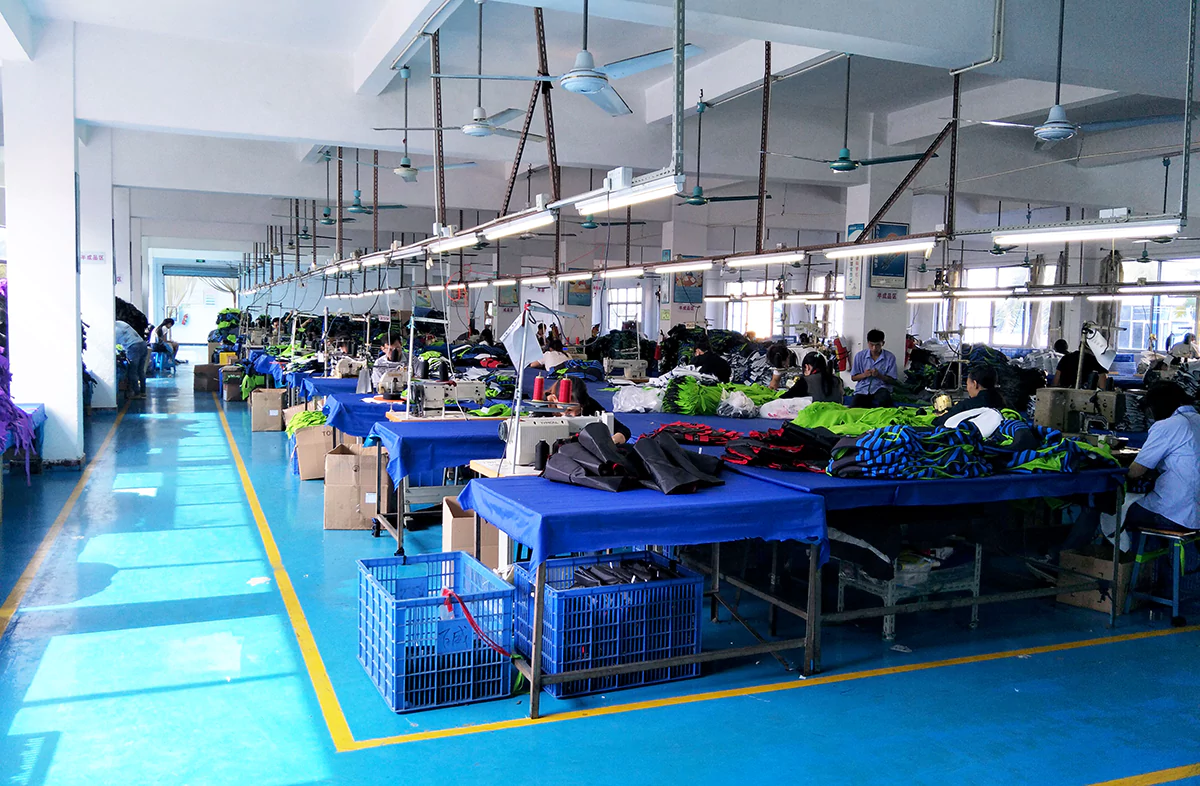
FYBagCustom is Your Trusted Custom Clear Bag Manufacturer in China, with 15+ years of manufacturing experience and dedicated clear-material production capability. For brands producing stadium bags, event bags, and transparent fashion accessories, our capabilities include:
Contact our production team to discuss clear bag material selection, anti-yellowing specifications, and stadium-compliant manufacturing for your program.
A clear bag that arrives crystal-clear and odor-free is not lucky — it is the result of controlled material selection, calibrated heat-sealing, post-production ventilation, and systematic QC. For B2B buyers producing clear bags, three core takeaways:
If your program includes clear stadium bags, event bags, or transparent fashion accessories — and you need them to arrive crystal-clear, odor-free, and stadium-compliant — now is the time to specify the material, the anti-yellowing controls, and the dimensional compliance. Contact FYBagCustom to discuss PVC vs. TPU options, anti-yellowing manufacturing protocols, and stadium-bag production — and receive clarity-tested samples, typically within 5–7 days.
FYBagCustom manufactures clear bags with anti-yellowing UV-stabilized material, calibrated heat-sealing, post-production ventilation, and stadium-compliant dimensions — for NFL events, music festivals, and branded transparent fashion. Clarity-tested samples in 5–7 days.
Start Your Custom Bag Project →