Tel/WhatsAapp:+86 18011919834
E-mail: chloe.x@fybagcustom.com

Tel/WhatsAapp:+86 18011919834
E-mail: chloe.x@fybagcustom.com
Send Your Inquiry Today


Who this guide is for: DTC brand founders, Shopify sellers, independent e-commerce operators, cross-border sellers, and any B2B buyer who ships custom handbags directly to consumers and pays for last-mile delivery based on dimensional (volumetric) weight. If your shipping cost per order is eating into your margin because your bags ship as large, air-filled boxes — and you want to understand how to engineer a bag that folds completely flat for shipping without sacrificing its structured appearance when the consumer opens it — this guide covers the construction modifications, the bottom-stitching techniques, and the dimensional weight math that can reduce your per-order shipping cost by 30–40%.
There is a number that haunts every DTC handbag seller: dimensional weight. When you ship a structured tote bag to a customer — a bag that stands upright, holds its shape, and occupies a three-dimensional space of roughly 40 × 35 × 18 cm — the carrier does not charge you for the bag’s actual weight (which might be 600 grams). The carrier charges you for the volume the package occupies in their truck or plane, calculated as if the box were filled with material at a standardized density. A bag that weighs 600 grams but ships in a box measuring 45 × 38 × 22 cm is billed as if it weighs 3–4 kilograms — because that is the dimensional weight of the box.
This means you are paying to ship air. The bag itself occupies perhaps 30% of the box’s volume. The other 70% is void-fill, structural padding, and the empty interior cavity of the bag. The carrier charges for 100% of the volume. For a DTC brand shipping 50–200 orders per week, the difference between a 3D-shipped bag and a flat-packed bag is not a minor cost adjustment — it is 30–40% of total shipping expense, compounding across every order, every week, every month.
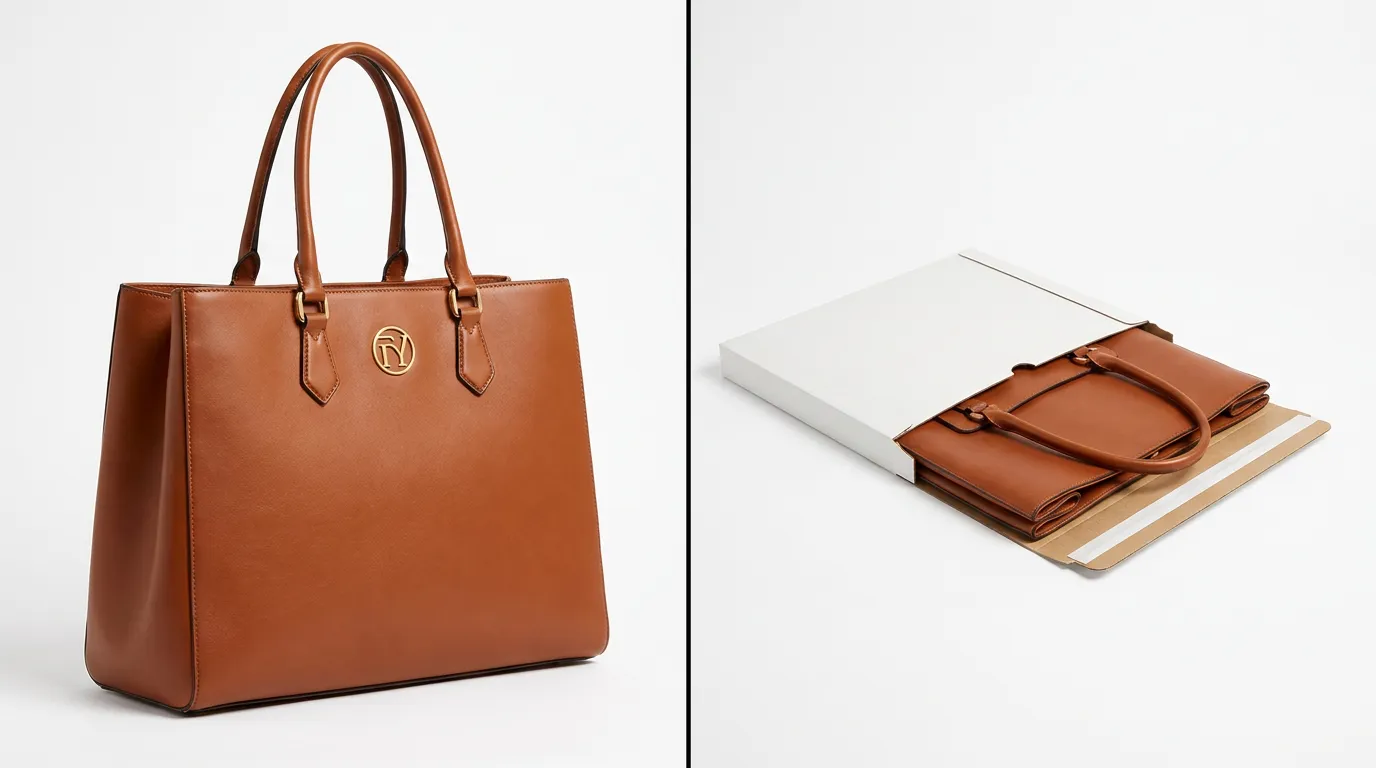
The flat-packable bag — a bag engineered with a “soft-fold” bottom construction that allows it to collapse completely flat for shipping, then spring into its full structured shape when the consumer opens it — is the design solution to this problem. It does not compromise the bag’s appearance, its structural integrity, or its perceived quality. It simply removes the rigid elements that prevent the bag from lying flat, and replaces them with flexible alternatives that achieve the same structural performance when the bag is in use.
This guide covers the dimensional weight math (so you can calculate exactly how much flat-packing saves), the soft-fold bottom construction technique, the materials that enable flat-packing without sacrificing structure, and the consumer experience engineering that ensures the bag looks premium when unboxed — not wrinkled, creased, or “obviously folded.”
Every major carrier (USPS, UPS, FedEx, DHL) calculates shipping cost as the greater of actual weight or dimensional weight. Dimensional weight converts the package’s volume into a weight equivalent using a standard divisor:
Dimensional weight (lb) = (Length × Width × Height in inches) ÷ Divisor
| Carrier | Divisor (domestic U.S.) | Divisor (international) |
|---|---|---|
| USPS (Priority Mail) | 166 | 166 |
| UPS | 139 | 139 |
| FedEx | 139 | 139 |
| DHL Express | 139 (or 5000 for metric: cm ÷ 5000 = kg) | 5000 (metric) |
Consider a structured tote bag (40 × 35 × 18 cm when standing upright):
| Shipping Configuration | Package Dimensions | Package Volume | Dimensional Weight | Actual Weight | Billed Weight |
|---|---|---|---|---|---|
| 3D shipping (bag standing upright in a box) | 45 × 40 × 22 cm (17.7 × 15.7 × 8.7 in) | 39,600 cm³ | 7.9 kg (17.5 lb) DHL metric | ~1.2 kg (bag + packaging) | 7.9 kg (dimensional — far higher than actual) |
| Flat-pack shipping (bag folded flat in a mailer) | 42 × 38 × 5 cm (16.5 × 15.0 × 2.0 in) | 7,980 cm³ | 1.6 kg (3.5 lb) | ~1.0 kg (bag + mailer) | 1.6 kg (dimensional — much closer to actual) |
| Savings | — | 80% less volume | 80% lower dimensional weight | — | Billed weight reduced by ~80% |
The dimensional weight drops from 7.9 kg to 1.6 kg — a reduction of approximately 80%. Because shipping cost is directly proportional to billed weight, the per-order shipping cost decreases by a comparable percentage. For carriers that use tiered pricing rather than linear per-kg pricing, the savings typically translate to 30–40% lower per-order shipping cost after accounting for rate tiers and minimums.
| Monthly Orders | Per-Order Shipping Savings (estimated) | Monthly Savings | Annual Savings |
|---|---|---|---|
| 100 orders/month | Meaningful per order | Significant monthly | Substantial annual — potentially enough to fund an additional production run |
| 500 orders/month | Same per order | Very significant | Major — can represent the difference between profitable and unprofitable unit economics |
| 2,000 orders/month | Same per order | Transformative | The flat-pack advantage at this volume is equivalent to hiring additional staff or funding a marketing campaign |
The math is unambiguous: for any DTC brand shipping more than a few dozen orders per month, the investment in flat-pack-capable bag design pays for itself within the first month of shipping.
A conventional structured bag cannot fold flat because of two rigid elements:
The soft-fold construction replaces both of these elements with flexible alternatives that achieve the same structural performance when the bag is in use, but allow the bag to collapse flat when not in use.
| Standard Construction | Soft-Fold Modification | Structural Effect When In Use | Effect When Flat-Packed |
|---|---|---|---|
| Rigid base board (Salpa 1.0–1.5 mm or HDPE) permanently installed inside the base panel | Removable flexible base insert — a semi-rigid insert (0.8–1.0 mm flexible polypropylene or multi-layer cardboard) that sits inside the bag on the base, held in place by friction or a snap/Velcro pocket, but can be removed for folding | The insert provides a flat, stable base — the bag stands upright just like a rigid-base bag | The insert is removed (or bends with the fold); the base panel folds flat |
| Box-stitch corners — the base-to-gusset seam is stitched with the fabric folded into a permanent triangle, creating a fixed-width base | Soft-fold corners — the base-to-gusset seam is stitched without the permanent triangle fold; instead, the seam is a simple straight join that can fold flat, and the base width is created by the inserted base board when in use | When the base insert is in place, it pushes the soft-fold seams outward, creating the same box-shaped base as traditional box-stitch | Without the insert, the base panel and gussets fold flat against each other — the bag collapses to a fraction of its 3D volume |
The traditional box-stitch corner works like this: the base panel is sewn to the gusset panel, and then the corner is folded into a triangle and stitched across the triangle’s base, permanently locking the corner at a fixed angle. This creates the “box” shape that gives the bag its base width. The triangle is permanent — it cannot unfold without cutting the stitch.
The soft-fold corner works differently: the base panel and gusset panel are joined with a simple straight seam — no triangle fold, no permanent cross-stitch. When the base insert is placed inside the bag, the insert pushes the seams outward, creating the base width mechanically rather than structurally. When the insert is removed, the seams relax and the panels fold flat against each other.
| Element | Box-Stitch Corner | Soft-Fold Corner |
|---|---|---|
| Seam type | Triangle fold, cross-stitched | Simple straight seam (no fold, no cross-stitch) |
| Base width created by | The permanent triangle fold defines the base width | The removable base insert pushes the seams outward to define the base width |
| Can the bag fold flat? | No — the triangle is permanent | Yes — remove the insert and the panels fold flat |
| Base stability when in use | Very stable — the triangle is structural | Stable — the insert provides the same function, but the stability depends on the insert being in place |
| Consumer action required | None | Consumer places the insert in the base when first using the bag (a 5-second action); removes it for flat storage if desired |
| Element | Specification | Why |
|---|---|---|
| Material | Flexible polypropylene (PP) sheet, 0.8–1.0 mm; or multi-layer cardboard (acid-free), 1.0–1.5 mm | PP is semi-rigid: stiff enough to create a stable base but flexible enough to bend if the bag is folded with the insert inside (it will not crack); cardboard is an alternative that is lighter but less durable |
| Dimensions | Cut to the exact base interior dimensions minus 3 mm on each side (so it drops in without forcing) | Must fit snugly to provide stability; must not be so tight that it is difficult to insert or remove |
| Covering | Covered in matching lining fabric or placed inside a fabric pocket sewn to the base lining | The insert should not be visible as raw plastic or cardboard; the fabric covering integrates it into the bag’s interior aesthetic |
| Retention | Held in place by a lining pocket (the insert slides into a pocket at the base); or by Velcro patches (two 3 × 3 cm Velcro squares on the insert and on the base lining) | The insert must stay in place during daily use; it should not slide, shift, or ride up against the contents |
| Replacement | The insert is a replaceable component — if it bends, warps, or wears out, the consumer can request a replacement | Include a note in the product instructions: “This bag includes a removable base insert. To fold the bag flat for storage or travel, remove the insert.” |
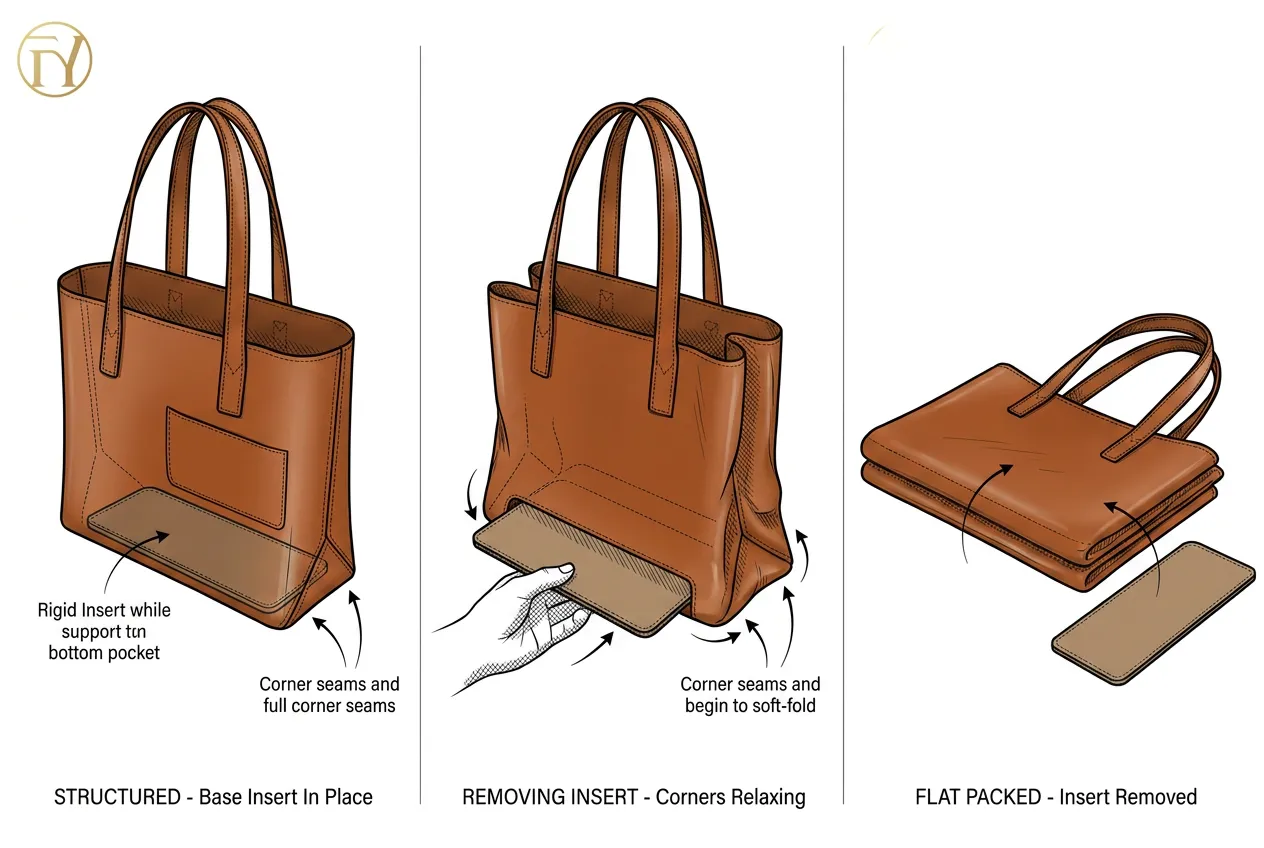
The base is the primary obstacle to flat-packing, but other structural elements can also prevent a bag from folding flat. A comprehensive flat-pack design addresses every element that creates fixed three-dimensionality.
| Structural Element | Flat-Pack Compatible? | If No, How to Modify | Impact on In-Use Quality |
|---|---|---|---|
| Rigid base board | No — the core blocker | Replace with removable flexible insert (see above) | Minimal — the removable insert provides equivalent base stability |
| Box-stitch corners | No — creates permanent 3D corners | Replace with soft-fold straight seams | Minimal when insert is in place — the insert creates the corner geometry |
| Body panel interlining (fusible) | Yes — flexible interlining bends with the panel | No modification needed — specify flexible fusible, not rigid | None — the bag folds and the interlining bends with it; no crease memory in flexible fusible |
| Body panel interlining (Salpa board) | No — Salpa cracks when folded | Replace Salpa with microfiber backing or heavyweight flexible fusible on body panels | Slight reduction in maximum stiffness; microfiber provides equivalent resilience without the cracking risk |
| Edge wire / piping cord | Depends — thin wire bends; thick wire resists | Use thin, flexible piping cord (not wire) or eliminate edge stiffening | Minimal — flexible cord maintains the top-edge shape when in use and bends flat for packing |
| Metal feet (base) | Yes — feet are attached to the bag, not to the insert; they fold flat with the base panel | No modification needed | None |
| Handles | Yes — handles fold flat against the bag body naturally | No modification — handles are always flexible | None |
| Shoulder strap | Yes — strap coils or folds alongside the bag | No modification | None |
| Hardware (zipper, closure) | Yes — zippers lie flat; closures sit flush | No modification — close the bag before folding | None — the closed bag’s hardware creates no dimensional obstacle |
The conclusion: only three elements must be modified for full flat-pack capability: the rigid base board (replace with removable insert), the box-stitch corners (replace with soft-fold seams), and any rigid interlining on body panels (replace with flexible alternatives). Everything else — handles, straps, hardware, flexible interlining, piping — is naturally flat-pack compatible.
The material must tolerate repeated folding and unfolding without developing permanent crease marks. This is the same requirement as the “recovery” property discussed in our unstructured bag guides — but applied to a bag that is DESIGNED to be folded flat (during shipping and possibly during consumer storage) and then deployed into its full structured shape.
| Material | Fold-Crease Recovery | Time to Fully Recover After Flat-Packing | Risk of Permanent Crease | Flat-Pack Suitability |
|---|---|---|---|---|
| PU leather (garment-grade, soft) | Very good — PU’s fabric backing provides recovery | 1–4 hours at room temperature | Very low — PU has minimal crease memory | Excellent — the recommended default for flat-pack DTC bags |
| PU leather (standard bag-grade, stiffer) | Moderate — stiffer PU resists folding and may hold crease marks longer | 4–12 hours | Low–Moderate — depends on interlining | Good — specify flexible interlining; avoid rigid backing |
| Genuine leather (soft calfskin, 0.7–0.9 mm) | Good — leather’s fiber structure has natural elasticity | 2–6 hours | Low — soft leather recovers well | Good — but monitor for crease marks on the fold line |
| Genuine leather (stiff/thick, 1.2+ mm) | Moderate — thick leather resists folding and can hold creases | 8–24 hours | Moderate — thick leather at the fold line may develop a visible softened zone | Moderate — not ideal for flat-pack; consider only if the bag design requires thick leather |
| Nylon (any weight) | Excellent — nylon has almost zero crease memory | 10–30 minutes | Very low — nylon recovers almost instantly | Excellent — the best flat-pack material; wrinkle-free upon unfolding |
| Canvas (cotton, 10–16 oz) | Moderate — canvas holds fold marks, especially when pressed flat for weeks | 12–48 hours (may need light steaming for full recovery) | Moderate — heavy canvas at the fold line may show a softened crease | Moderate — acceptable if consumers are instructed to let the bag “rest” upright after unboxing |
| Microfiber leather | Very good — synthetic microfiber has excellent recovery | 2–4 hours | Low | Very good |
When a structured bag is folded flat, the material at the fold line (typically across the center of the front and back panels) experiences the tightest bend radius and the longest sustained pressure. Even materials with good recovery can develop a visible “fold line” — a subtle crease or softened zone across the panel — if the bag is packed flat for weeks.
Three solutions to minimize the fold-line mark:
| Solution | How It Works | Effectiveness | Consumer Effort |
|---|---|---|---|
| Tissue paper buffer | A sheet of acid-free tissue paper is placed along the fold line before folding; the tissue distributes the fold pressure and prevents the two panel surfaces from pressing directly against each other | Moderate — reduces but does not eliminate the fold mark on long-duration storage | None — the tissue is placed at the factory during packing |
| Foam rod insert at the fold line | A thin foam rod (8–10 mm diameter, EVA or EPE) is placed inside the bag at the fold line; when the bag is folded, the foam rod creates a gentle curve rather than a sharp crease | Very good — the rod converts a sharp fold into a gradual curve; a curve produces a much lighter mark than a crease | The consumer removes the foam rod after unboxing (or keeps it for future flat storage) |
| “Rest and recover” instruction card | An insert card in the package instructs the consumer: “To restore your bag’s full shape, remove the base insert, unfold the bag, re-insert the base, and let the bag stand upright for 2–4 hours. Any fold marks from shipping will disappear.” | Addresses the consumer’s expectation — if she knows a slight fold mark is temporary and normal, she does not perceive it as a defect | Consumer follows the instruction — a 5-second action + 2–4 hours of passive recovery |
The recommended system: foam rod at the fold line (placed during factory packing) + tissue paper buffer + “rest and recover” instruction card. This three-part approach minimizes the fold mark physically (foam rod + tissue) and manages the consumer’s expectation psychologically (instruction card). The result: the consumer unfolds the bag, reads the card, places the base insert, lets the bag stand for a few hours, and has a perfectly structured bag by evening — with zero perception of a “defect.”
A flat-pack bag arrives in a slim mailer or a thin box — a dramatically different unboxing experience from a standard 3D-shipped bag arriving in a large, padded box. The flat-pack unboxing must be designed to feel premium despite the slim packaging, and the consumer must be guided through the simple setup process.
| Step | Consumer Action | What She Sees / Feels | Design Element That Makes It Premium |
|---|---|---|---|
| 1 | Opens the mailer / slim box | A flat package — the bag is visible inside, folded neatly | Branded mailer or slim box (custom-printed, brand colors); branded sticker seal |
| 2 | Removes the flat bag (still in its dust bag) | The bag feels surprisingly light and compact | Cotton dust bag with brand logo; the dust bag itself is the first “reveal” |
| 3 | Opens the dust bag; unfolds the bag | The bag unfolds from flat into its approximate 3D shape; the soft-fold seams relax outward | The material’s recovery begins immediately — within seconds, the bag starts to take shape |
| 4 | Finds the base insert (included in a separate pocket or compartment inside the dust bag) | A flat rigid-ish panel, wrapped in matching lining fabric | The insert is a “component,” not a defect — it should feel like a designed part of the product |
| 5 | Reads the instruction card | Clear, friendly, branded instruction: “Place the base insert in the bottom of your bag. Let the bag stand for 2–4 hours to fully restore its shape. Welcome to [brand name].” | The card normalizes the flat-pack setup process; the branded language makes it feel intentional, not makeshift |
| 6 | Places the base insert; stands the bag upright | The bag immediately assumes its structured silhouette; over the next 2–4 hours, any residual fold marks fade | The moment the insert drops in and the bag “snaps” into its 3D shape is the “wow” moment — a surprising, satisfying mechanical transformation |
| 7 | After 2–4 hours | All fold marks have disappeared; the bag looks and feels exactly like a conventionally shipped structured bag | The consumer photographs the bag and shares — the flat-to-structured transformation is inherently sharable content |
Rather than apologizing for or hiding the flat-pack construction, the most successful DTC brands celebrate it as a feature:
| Messaging Angle | Product Page Copy | Why It Works |
|---|---|---|
| Sustainability | “Shipped flat to reduce packaging waste and carbon emissions by up to 40%.” | Positions the flat-pack as an environmental choice, not a cost-cutting measure |
| Smart design | “Engineered to ship flat and spring into its full structured shape when you need it. Smart design that saves space — in transit and in your closet.” | Positions the flat-pack as a design innovation — the bag is cleverer than conventional bags |
| Storage benefit | “When you’re not carrying it, fold it flat and slide it into a drawer. No shelf space needed.” | Reframes the flat-pack capability as a consumer convenience feature for urban living (small apartments, limited closet space) |
| Travel benefit | “Pack it flat in your suitcase. Unfold it at your destination. A spare bag that takes zero luggage space.” | Positions the bag as a travel accessory — a “packable tote” that the consumer brings on trips |
The sustainability and smart-design angles are the most commercially effective for DTC brands in 2026. Consumers increasingly expect brands to minimize packaging waste, and a flat-packed bag in a slim mailer is visibly less wasteful than a bag shipped in a large box filled with void-fill material. The flat-pack becomes a proof point for the brand’s environmental values.
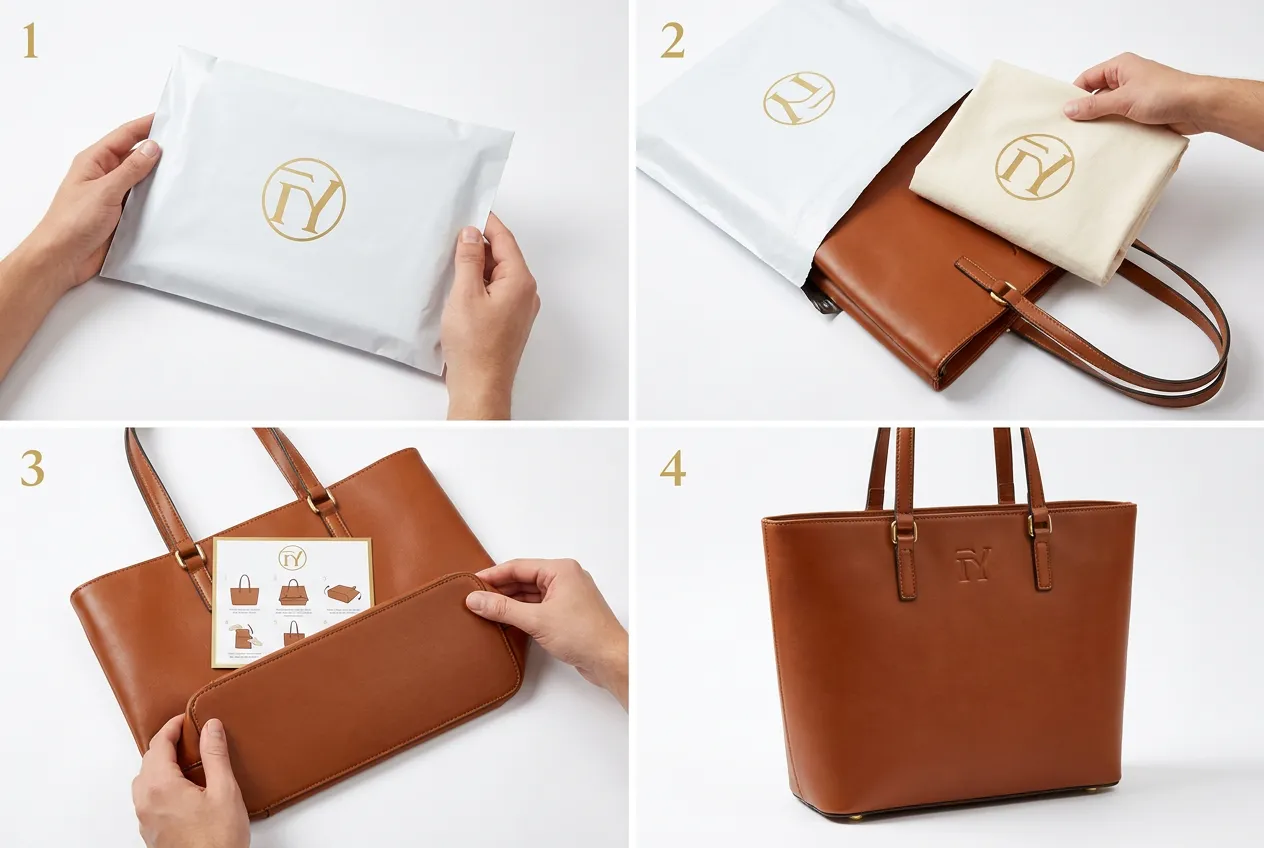
The flat-pack shipping package is dramatically simpler and lighter than the 3D shipping package — which is the entire point. The package must protect the flat bag during last-mile transit (which involves less stress than ocean freight — no 5-week container stacking) while minimizing volume and weight.
| Component | Specification | Function | Notes |
|---|---|---|---|
| Poly mailer (standard DTC) | Custom-printed or branded LDPE poly mailer, sized to the folded bag + 3 cm on each side | Outer protection; waterproof; lightweight; the carrier’s billing dimension | The poly mailer is the most cost-efficient outer for flat-pack; for premium positioning, use a padded kraft mailer or a slim rigid mailer |
| Dust bag | Cotton or non-woven, with brand logo | Wraps the folded bag; provides surface protection; the consumer keeps it | Same dust bag used for in-store or gift-box configurations |
| Foam rod (fold-line protector) | 8–10 mm diameter EVA rod, cut to the fold width | Prevents a sharp crease at the fold line during transit | Placed inside the bag at the fold line before folding |
| Tissue paper buffer | 1 sheet acid-free tissue at the fold line | Additional crease protection; adds the “unboxing” tactile layer | Placed between the two folded panels at the fold line |
| Base insert (inside the dust bag or in a separate pocket) | Removable flexible PP or cardboard, fabric-covered | The structural component the consumer installs upon unboxing | Must be clearly identifiable — do not let it look like a piece of cardboard accidentally left in the package |
| Instruction card | Branded card (A6 or business-card size) with setup steps + care instructions + QR code to brand website | Guides the consumer through the flat-to-structured setup; manages expectations about fold marks | Include the “rest and recover” timing (2–4 hours) and the brand story about why the bag ships flat |
| Sticker seal | Branded sticker sealing the dust bag or the tissue wrap | The “peel” moment — adds polish and intentionality to the flat-pack unboxing | Same sticker used in 3D packaging |
| Metric | 3D Package (box + void-fill + full-form bag) | Flat-Pack Package (mailer + folded bag) | Reduction |
|---|---|---|---|
| Package dimensions | 45 × 40 × 22 cm | 42 × 38 × 5 cm | 80% volume reduction |
| Package weight (total) | 1.2–1.8 kg (bag + box + tissue + void-fill) | 0.7–1.0 kg (bag + mailer + insert + instruction card) | 35–45% weight reduction |
| Dimensional weight (DHL metric) | 7.9 kg | 1.6 kg | 80% reduction |
| Material cost (packaging) | Box + tissue + void-fill + sticker + dust bag | Mailer + dust bag + foam rod + tissue sheet + sticker + card | Significantly lower — the mailer replaces the rigid box and all void-fill |
The packaging itself is simpler, lighter, and less expensive than 3D packaging — the mailer replaces a rigid gift box, corrugated void-fill, and multiple layers of tissue. The flat-pack approach saves on both shipping cost (dimensional weight) AND packaging material cost.
Not every bag silhouette is equally suited for flat-pack engineering. The primary requirement is that the bag has a rectangular or trapezoidal cross-section (front panel + back panel + gussets) that can fold flat along a single fold line. Curved, cylindrical, and deeply three-dimensional silhouettes are less suitable.
| Silhouette | Flat-Pack Suitability | How It Folds | Folded Thickness | Notes |
|---|---|---|---|---|
| Tote bag (structured) | Excellent — the ideal flat-pack format | Front and back panels fold against each other; gussets fold inward; handles fold flat on top | 3–5 cm | The commercial sweet spot for flat-pack DTC |
| Crossbody (structured) | Very good | Same fold geometry; strap coils on top or folds alongside | 3–5 cm | Smaller silhouette = smaller mailer = even lower shipping cost |
| Shoulder bag (structured) | Very good | Same geometry | 3–5 cm | Works for most rectangular shoulder bags |
| Clutch / pouch | Naturally flat — no modification needed | Clutches are already flat; they ship in slim mailers as standard | 1–3 cm | Already flat-pack by default |
| Weekender / duffle | Good — if the bottom is soft-fold engineered | Front and back fold together; the soft-fold base collapses; the bag folds to approximately 1/4 of its 3D volume | 5–8 cm | Larger folded dimensions than a tote, but still dramatically less than 3D |
| Backpack | Moderate — the padded back panel adds thickness | The backpack folds but the padded back panel does not compress fully flat | 6–10 cm | Acceptable — the folded thickness is greater, but the dimensional weight is still much lower than 3D |
| Doctor bag / frame bag | Poor — the metal frame prevents flat-folding | The frame creates a permanent 3D structure that cannot collapse | N/A | Not suitable for flat-pack — must ship 3D |
| Bucket bag | Moderate — the circular opening resists flat-folding cleanly | The bag can be pressed flat but the circular top edge may crease awkwardly | 4–6 cm | Possible but requires careful fold-line placement |
For DTC brands building a flat-pack-optimized collection:
| SKU | Silhouette | Folded Thickness | Mailer Size | Shipping Impact |
|---|---|---|---|---|
| Flat-Pack Structured Tote (hero) | Medium tote, soft-fold base + removable insert | 4 cm | 42 × 38 × 5 cm poly mailer | Maximum dimensional weight savings — the hero of the flat-pack line |
| Flat-Pack Crossbody | Structured crossbody, same soft-fold engineering | 3 cm | 28 × 24 × 4 cm poly mailer | Even slimmer — the most efficient flat-pack product |
| Flat-Pack Weekender | Soft-fold duffle/weekender | 6 cm | 55 × 40 × 8 cm slim box or large poly mailer | Larger but still dramatically less volume than 3D shipping |
The soft-fold construction requires specific modifications to the standard bag production process. These modifications are relatively simple — they do not require new equipment or specialized skills — but they must be specified clearly in the tech pack to avoid the factory defaulting to standard box-stitch construction.
| Production Step | Standard Construction | Soft-Fold Modification | Complexity Impact |
|---|---|---|---|
| Base-to-gusset seaming | Box-stitch: fold, pin, cross-stitch the corner triangle | Straight seam: join base to gusset with a simple straight seam; no triangle fold | Simpler — actually faster than box-stitch because the triangle fold/pin/cross-stitch steps are eliminated |
| Base board installation | Permanent: the rigid board is sewn or glued inside the base | Removable: a fabric pocket is sewn into the base lining; the flexible insert slides into the pocket after the bag is assembled | Slightly more complex — the pocket adds one additional sewing step; but the insert is not installed until packing |
| Body panel interlining | Standard: any interlining (including rigid Salpa) may be used | Flat-pack: only flexible interlining (fusible woven, fusible non-woven, or microfiber backing) on body panels; no Salpa on any panel that must fold | No additional complexity — just a material substitution in the interlining selection |
| Packing sequence | Standard: stuff with tissue, place in dust bag, place in box, carton | Flat-pack: place foam rod at fold line, fold bag flat, wrap in tissue, place in dust bag, place in mailer, add instruction card | Different sequence — requires a brief training for the packing team; the packing itself is simpler (fewer components, no void-fill) |
Before approving a flat-pack design for production, perform the flat-pack recovery test on the PP sample:
| Step | Action | Duration |
|---|---|---|
| 1 | Remove the base insert; fold the bag flat (as it would be packed for shipping) | — |
| 2 | Place the folded bag inside the mailer | — |
| 3 | Stack 2 kg of weight on top of the mailer (simulating the pressure of other packages in a carrier’s truck) | 72 hours (3 days — simulating domestic transit time) |
| 4 | Remove the weight; remove the bag from the mailer; unfold; insert the base; stand upright | — |
| 5 | Photograph immediately (the “just unboxed” state) | — |
| 6 | Let the bag stand at room temperature for 4 hours | 4 hours |
| 7 | Photograph again (the “recovered” state) | — |
| Check | At Step 5 (immediately after unfolding) | At Step 7 (after 4 hours of recovery) |
|---|---|---|
| Silhouette | The bag stands upright with approximately 90% of its intended shape; some settling is acceptable | The bag stands upright with 100% of its intended shape — indistinguishable from a bag that was never folded |
| Fold-line mark | A light fold line may be visible across the front/back panels | The fold line is invisible at arm’s length under normal room lighting |
| Panel flatness | Panels may show a gentle curve from the fold | Panels are flat and straight — no residual curve |
| Corner definition | Corners may be slightly rounded | Corners have returned to their intended sharpness |
| Overall impression | “This bag was folded but it’s recovering” — acceptable | “This bag was never folded” — the target state |
If the bag does not meet the Step 7 criteria after 4 hours, the material, interlining, or fold-line protection needs adjustment. Common fixes:
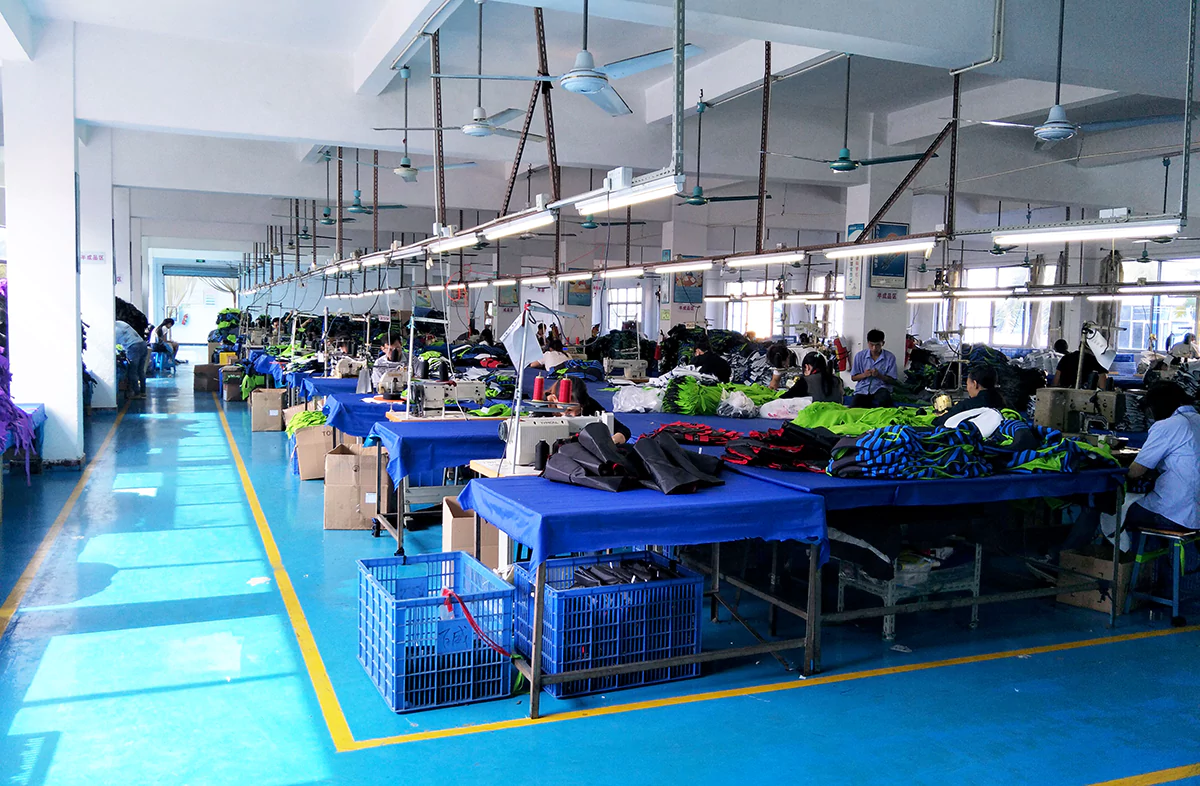
FYBagCustom is Your Trusted Custom HandBag Manufacturer in China, with 15+ years of manufacturing experience and a production system that supports both 3D and flat-pack shipping configurations. For DTC brands optimizing last-mile shipping costs, our flat-pack capabilities include:
Contact our development team to discuss soft-fold construction, flat-pack testing, and DTC packaging specifications for your brand.
The flat-packable bag is not a compromise — it is a design optimization that reduces shipping cost, reduces packaging waste, adds a consumer storage benefit, and creates a brand story around smart design and sustainability. For DTC brands shipping handbags to consumers, three core takeaways:
If your DTC brand is paying to ship air inside every package, now is the time to specify soft-fold construction, removable base inserts, and flat-pack packing protocols. Contact FYBagCustom to discuss flat-pack engineering, material recovery testing, and DTC packaging optimization — and receive a flat-pack-tested sample, typically within 5–7 days.
FYBagCustom’s soft-fold construction enables structured bags to ship flat — reducing dimensional weight by up to 80% and cutting last-mile shipping costs by 30–40%. Flat-pack-tested samples with removable base inserts in 5–7 days.
Start Your Custom Bag Project →