Tel/WhatsAapp:+86 18011919834
E-mail: chloe.x@fybagcustom.com

Tel/WhatsAapp:+86 18011919834
E-mail: chloe.x@fybagcustom.com
Send Your Inquiry Today

Who this guide is for: brand owners, sourcing managers, product developers, hardware designers, DTC founders, premium Amazon FBA sellers, and private label developers who are specifying custom hardware for handbag collections. If you want to understand the plating processes that create luxury-grade finishes, the laser engraving techniques that put logos onto metal at jewelry-level precision, and the wear-resistance testing that separates hardware that lasts from hardware that tarnishes in three months — this guide translates the metalwork science into specifiable, verifiable factory standards.
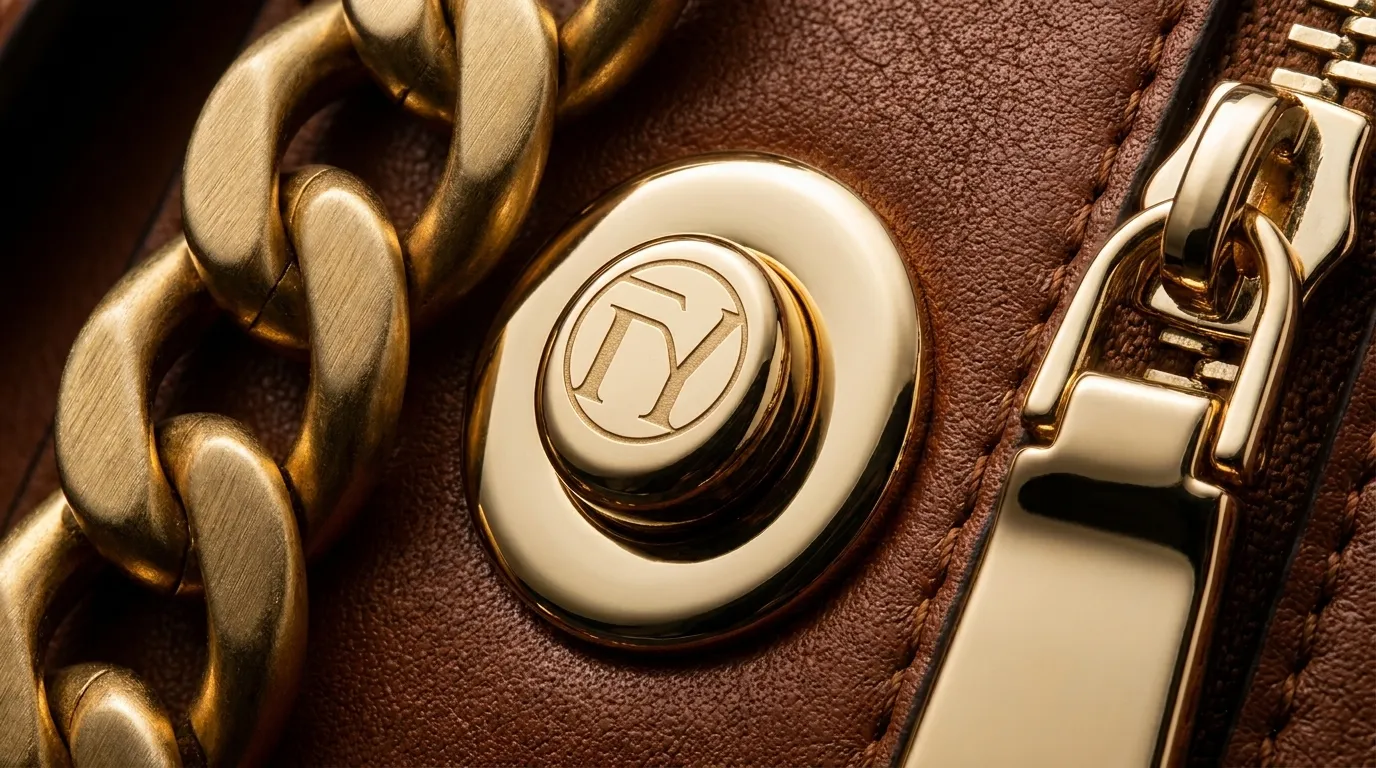
Hardware was once the forgotten component of handbag design — a functional necessity specified by the factory’s default and accepted by the brand without scrutiny. In 2026, hardware has become the primary quality signal and the single most scrutinized detail in premium and contemporary handbag design. Consumers now evaluate a bag’s hardware the way they evaluate jewelry: by the warmth of the finish, the weight in the hand, the precision of the engraving, and — after weeks of use — whether the plating holds or reveals cheap base metal underneath.
This shift toward “jewelry-inspired” hardware is driven by two converging forces. First, the “quiet luxury” movement has stripped away large logos, bold prints, and decorative embellishments — leaving hardware as the primary visual accent on clean, minimal bag designs. When the front panel is unadorned leather in a muted tone, the turn-lock, the zipper pull, and the chain link carry the entire aesthetic weight of the product. Second, social media close-up photography and unboxing videos have made hardware detail visible in a way that store-shelf browsing never did. A consumer can zoom into a product photo and see whether the plating is smooth, whether the engraving is crisp, whether the finish is consistent — and she does.
For B2B buyers, hardware is simultaneously the highest-impact and most misunderstood component of handbag manufacturing. The difference between a 2.50 custom-engraved, gold-plated zipper pull is barely visible in a cost spreadsheet — but it is immediately visible in the consumer’s hand, in her product review, and in whether she perceives your $95 bag as “worth it” or “trying too hard.” This guide covers the complete hardware landscape: base metals, plating processes, finishing techniques, laser engraving, logo application, durability testing, and how to specify hardware that meets the jewelry standard without the jewelry price.
Before discussing finishes and plating, it helps to understand the base metal underneath — the structural material that determines the hardware’s weight, strength, casting detail, and cost.
| Base Metal | Weight | Casting Detail | Corrosion Resistance | Plating Adhesion | Cost | Best For |
|---|---|---|---|---|---|---|
| Zinc alloy (Zamak) | Medium — satisfying heft without excess | Excellent — captures fine detail in casting | Moderate — corrodes without plating | Excellent — the industry standard for plated hardware | Low–Medium | 90%+ of all handbag hardware; the recommended default |
| Brass (copper-zinc alloy) | Heavy — noticeably substantial | Good — slightly less fine than zinc alloy | Very good — naturally resists tarnish | Very good — bonds well with most platings | Medium–High | Premium and luxury hardware; heritage positioning; unplated “aged brass” |
| Stainless steel | Heavy | Moderate — harder to cast with fine detail | Excellent — the most corrosion-resistant option | Moderate — requires specialized plating processes | High | Marine/outdoor hardware; medical-grade applications; niche |
| Aluminum | Very light | Good | Moderate — anodizes well but softer | Good for anodizing; moderate for traditional plating | Low–Medium | Lightweight hardware where weight matters (sport bags, travel bags) |
| Plastic (ABS, nylon) | Very light | Excellent — injection molding captures fine detail | N/A — does not corrode | Can be vacuum-metallized for metallic appearance | Very low | Budget hardware; sport/casual; decorative non-structural pieces |
Zinc alloy (specifically Zamak 3 and Zamak 5) accounts for the vast majority of handbag hardware worldwide because it hits the optimal balance across every dimension: it is heavy enough to feel substantial in the hand (consumers associate weight with quality), it casts with excellent detail (logos and decorative elements reproduce crisply), it accepts all standard plating processes, and it costs significantly less than brass or stainless steel.
The weight perception principle: when a consumer picks up a zipper pull, feels the heft of a turn-lock, or swings a chain strap, she is subconsciously weighing the metal. Lightweight hardware — regardless of how it looks — registers as “cheap.” The minimum perceived-quality threshold for hardware weight:
| Hardware Piece | Minimum Weight for “Premium Feel” | Typical Budget Weight | Premium Zinc Alloy Weight |
|---|---|---|---|
| Zipper slider (#5) | 8 g | 4–6 g | 8–12 g |
| Zipper pull (decorative) | 5 g | 2–3 g | 6–10 g |
| Turn-lock (complete) | 15 g | 8–10 g | 15–25 g |
| D-ring (20 mm) | 6 g | 3–4 g | 6–10 g |
| Magnetic snap (pair) | 8 g | 5–6 g | 8–14 g |
| Chain link (per 10 cm of chain) | 15 g | 8–10 g | 15–25 g |
Specify minimum hardware weights in your tech pack alongside finish and dimension specifications. A factory that provides hardware matching your finish spec but below your weight spec has delivered visually correct but tactilely cheap components.
The finish you see on handbag hardware — gold, silver, antique brass, matte black — is not the base metal’s natural color. It is a plating layer applied through electrochemical or physical processes. The plating determines the color, the luster, the corrosion resistance, and the longevity of the finish. Understanding plating is understanding what your hardware actually is underneath its surface.
| Process | How It Works | Finish Quality | Durability | Thickness Range | Cost | Best Finishes |
|---|---|---|---|---|---|---|
| Electroplating | Base metal submerged in electrolyte solution containing dissolved metal ions; electric current deposits a thin metal layer onto the surface | Very good — smooth, uniform, reflective | Good — depends on thickness and top coat | 0.5–5 µm (microns) | Low–Medium | Gold, silver, nickel, chrome |
| PVD (Physical Vapor Deposition) | Metal is vaporized in a vacuum chamber and deposited atom-by-atom onto the base metal surface | Excellent — extremely uniform, can achieve colors impossible with electroplating | Excellent — the most durable standard plating | 0.5–3 µm | Medium–High | Matte black, gunmetal, rose gold, any custom color |
| Vacuum metallization | Aluminum or other metal is evaporated in a vacuum and condensed onto the surface (thinner and less durable than PVD) | Good — shiny, reflective | Moderate — thinner layer, less wear-resistant than PVD | 0.05–0.5 µm | Low | Budget metallic finishes; decorative non-structural |
| Chemical antiquing / patina | Chemical solution applied to electroplated or raw brass surface to create controlled oxidation | Unique — each piece varies slightly (the appeal of antiqued finishes) | Good — the patina IS the finish; it does not “wear off” in the same way | N/A — surface treatment, not a deposited layer | Low | Antique brass, antique gold, antique silver, aged bronze |
| Lacquer / clear coat (top coat) | Transparent protective layer applied over any plating to seal it against wear, sweat, and environmental exposure | N/A — invisible layer over the visible finish | Critical — extends all other platings’ lifespan by 2–5× | 5–15 µm | Low (applied as a final step) | Applied over ALL finishes as standard for boutique quality |
| Finish | Plating Method | Visual Effect | 2026 Demand | Positioning |
|---|---|---|---|---|
| Light gold | Electroplated gold (14K or 18K color match) | Warm, luminous, classic — the “jewelry gold” | Very high — the dominant finish in premium bags | Luxury, quiet luxury, timeless |
| Brushed gold | Electroplated gold + mechanical brushing | Warm with matte texture — less reflective, more subtle | Very high — the “quiet luxury” alternative to polished gold | Premium contemporary, editorial |
| Rose gold | Electroplated copper-gold alloy | Pink-warm, feminine, distinctive | High — sustained from previous years | Feminine brands, Coquette aesthetic, gifting |
| Antique brass | Electroplated brass + chemical antiquing | Warm, aged, heritage — each piece slightly unique | High — driven by Tenniscore and retro trends | Heritage, vintage-inspired, country club |
| Matte black | PVD coating | Dark, modern, graphic — absorbs light rather than reflecting | High — growing as the “alternative neutral” | Streetwear-adjacent, modern minimalist, editorial |
| Polished silver | Electroplated nickel or chrome | Cool, bright, reflective — the classic “silver” | Moderate — stable but less trending than warm tones | Cool-toned brands, modern, tech-adjacent |
| Gunmetal | PVD or electroplated dark nickel | Dark silver-gray, industrial-elegant | Growing — the sophisticated alternative to black | Contemporary, urban, premium |
| Tonal / color-matched | PVD in custom color matched to bag material | The hardware “disappears” into the bag — seamless, monochromatic | Growing — the most “quiet luxury” approach possible | Ultra-premium, monochromatic collections |
Polished gold was the default luxury hardware finish for decades. In 2026, brushed gold has overtaken it for a specific reason: brushed finishes are more forgiving of micro-scratches, fingerprints, and light wear — all of which are immediately visible on polished surfaces. A polished gold turn-lock that picks up a hairline scratch on day one looks “damaged.” A brushed gold turn-lock with the same scratch looks unchanged because the directional brush marks absorb and camouflage micro-imperfections.
For B2B buyers, the practical implication is that brushed gold hardware generates fewer quality complaints and returns related to hardware appearance — even though the actual durability is identical to polished gold. The finish is its own quality insurance.
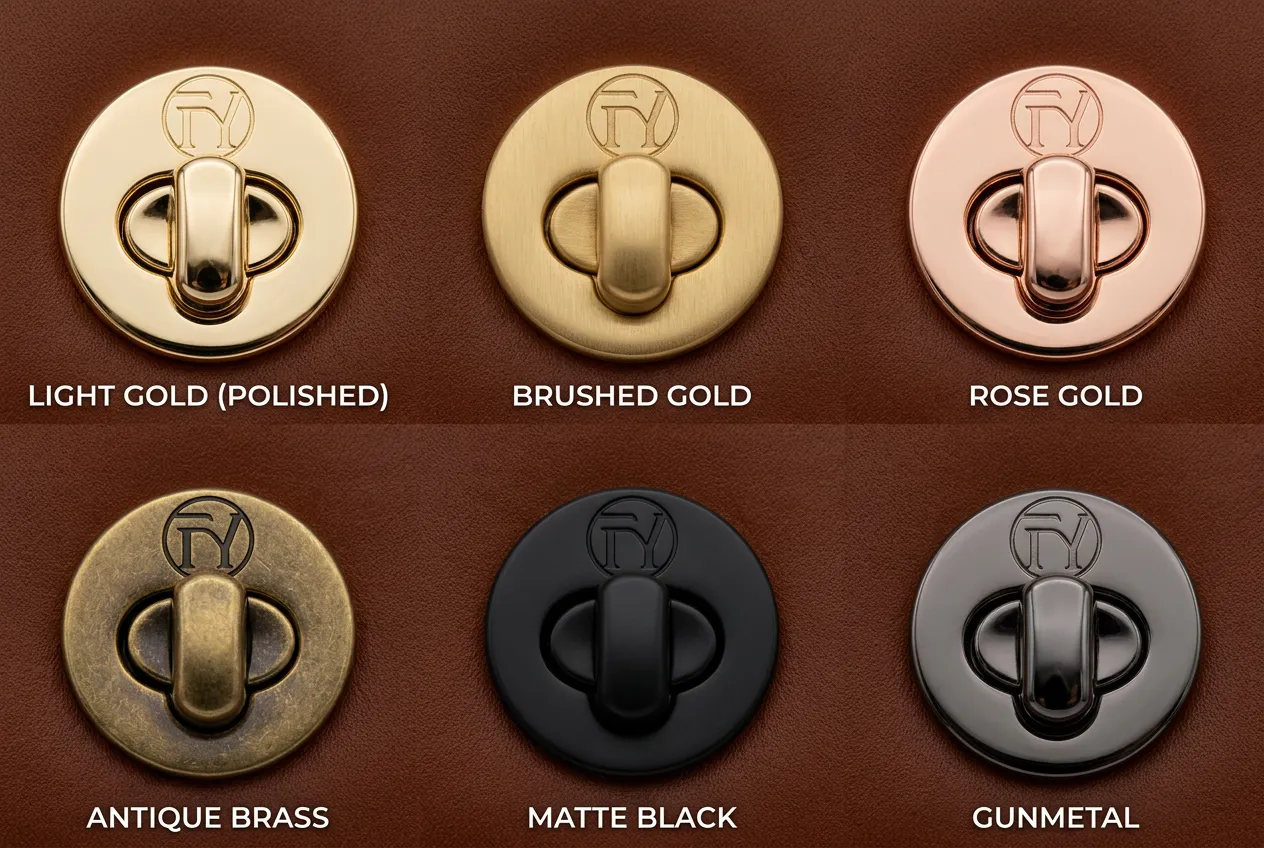
Plating thickness — measured in microns (µm) — is the single most important durability specification for hardware finishes. A thicker plating layer takes longer to wear through to the base metal underneath. The relationship is roughly linear: double the thickness, double the wear life.
| Quality Tier | Typical Plating Thickness | Approximate Wear Life (daily use) | Salt Spray Test Performance | Cost Impact |
|---|---|---|---|---|
| Budget | 0.3–0.8 µm | 3–6 months before base metal shows | 8–16 hours | Baseline |
| Mid-market | 1.0–2.0 µm | 6–18 months | 24–48 hours | +15–30% over budget |
| Premium / boutique | 2.5–5.0 µm | 2–5 years | 48–96 hours | +40–70% over budget |
| Luxury (gold plating with base layers) | 5.0–10.0+ µm (multi-layer) | 5–10+ years | 96–200+ hours | +80–150% over budget |
Premium and luxury hardware uses multi-layer plating rather than a single deposited layer. Each layer serves a different function:
| Layer | Material | Thickness | Function |
|---|---|---|---|
| 1. Base strike (adhesion layer) | Copper or nickel | 0.5–2 µm | Bonds to the zinc alloy surface; provides a smooth foundation for subsequent layers |
| 2. Barrier layer | Nickel | 1–3 µm | Provides corrosion resistance; prevents base metal ions from migrating through to the surface |
| 3. Color layer | Gold, rose gold, or decorative metal | 0.5–3 µm | Provides the visible color and luster |
| 4. Top coat | Clear lacquer or nano-ceramic coating | 5–15 µm | Seals the entire system against sweat, humidity, scratches, and environmental exposure |
The top coat is the most important layer — and the one most often omitted on budget hardware. Without a protective top coat, even thick gold plating will eventually tarnish from contact with human sweat (which contains salt and acids). A lacquered top coat extends hardware life by 2–5× and should be specified on every piece of hardware in a boutique-quality program.
Specification for tech pack: “All hardware: multi-layer plating with copper strike, nickel barrier, [gold/brass/specified finish] color layer, and clear lacquer top coat. Minimum total plating thickness: 3.0 µm (excluding top coat).”
The salt spray test (also called the salt fog test, per ASTM B117 or ISO 9227) is the international standard for evaluating the corrosion resistance of plated metal. It simulates years of real-world exposure in an accelerated timeframe by subjecting the hardware to a continuous salt-water fog in a controlled chamber.
| Element | Specification |
|---|---|
| Environment | Sealed chamber at 35°C (95°F) with continuous 5% NaCl (salt) fog |
| Duration | Measured in hours of continuous exposure |
| Evaluation | Hardware is inspected at intervals for signs of corrosion, discoloration, bubbling, peeling, or base metal exposure |
| Result | Reported as hours to first failure (first visible defect) |
| Salt Spray Hours | Real-World Equivalent (approximate) | Quality Tier |
|---|---|---|
| 8–16 hours | 3–6 months of daily handling in normal conditions | Budget — plating will degrade within one season |
| 24–48 hours | 1–2 years of normal use | Mid-market — acceptable for bags priced under $60 |
| 48–96 hours | 2–5 years of normal use | Premium / boutique — the standard for 200 bags |
| 96–200+ hours | 5–10+ years of normal use | Luxury — hardware will outlast the bag body |
For boutique-quality hardware, specify: “All hardware must pass minimum 48-hour salt spray test per ASTM B117 with no visible corrosion, discoloration, or base metal exposure. Test report required from hardware supplier.”
This single specification eliminates the most common hardware quality failure — tarnishing after 3–6 months of use — which is the #1 hardware-related complaint in handbag product reviews. The factory’s hardware supplier should be able to provide salt spray test reports for their standard finishes; if they cannot, the hardware has not been tested and the durability is unknown.
Laser engraving has replaced stamping, etching, and printing as the dominant method for applying logos and text to handbag hardware. It offers precision, permanence, and versatility that no other method matches.
A focused laser beam removes or alters the surface of the metal (or the plating layer) in a controlled pattern defined by a digital design file. The result is a permanent mark — either recessed (material removed) or color-changed (surface oxidized/annealed without material removal) — that cannot wear off, peel, or rub away.
| Method | How It Works | Visual Effect | Depth | Durability | Best On | Cost Per Piece |
|---|---|---|---|---|---|---|
| Ablation engraving | Laser removes the plating layer, exposing the base metal underneath | Recessed mark in base-metal color against plated surface | 0.02–0.1 mm | Permanent — the mark IS the metal | Gold-plated, silver-plated, any plated finish | 0.20 |
| Deep engraving | Laser removes both plating and base metal, creating a visible cavity | Deep recessed mark with shadow; tactile (you can feel it with a fingernail) | 0.1–0.5 mm | Permanent — structurally carved | Zinc alloy, brass, stainless steel | 0.40 |
| Annealing (color marking) | Laser heats the surface without removing material; oxidation creates a color change | Dark mark on light metal (or light mark on dark finishes); no depth change | 0 mm (surface only) | Very good — does not wear off easily but can be polished away with abrasive | Stainless steel, brushed finishes | 0.15 |
| Fill engraving + enamel | Deep engraving followed by enamel paint fill in the cavity | Colored recessed mark — the most visually striking and “jewelry-grade” option | 0.1–0.3 mm | Excellent — enamel is protected within the cavity | Zinc alloy, brass | 0.50 |
Not every hardware piece can accommodate a detailed logo. The minimum engraving area depends on the logo’s complexity:
| Hardware Piece | Engravable Area (typical) | Maximum Logo Complexity | Best Content |
|---|---|---|---|
| Zipper pull (teardrop) | 8 × 6 mm | Simple — wordmark or icon only | Brand initials (2–3 letters) or a simplified icon |
| Zipper pull (rectangular) | 12 × 8 mm | Moderate — short wordmark + simple icon | Brand name (up to 8 characters) or logo |
| Turn-lock face | 15–25 mm diameter | Moderate–High — wordmark, icon, or monogram | Full brand mark or decorative motif |
| Magnetic snap face (hidden) | 12–18 mm diameter | Moderate | Brand name or icon — a “hidden” branding element discovered during use |
| D-ring flat section | 5 × 15 mm (on flat section) | Simple — wordmark only | Brand name in small caps |
| Chain link (individual) | 8 × 5 mm per link | Very simple — single letter or icon | Individual letters spelling the brand name across multiple links (advanced, high-cost) |
| Metal nameplate | 30–60 × 10–15 mm | High — full wordmark, tagline, or decorative border | Complete brand identity — the most versatile engraving surface |
The 2026 trend toward jewelry-inspired hardware has pushed laser engraving toward micro-scale detail that was previously reserved for actual jewelry manufacturing. Techniques now available for handbag hardware include:
| Technique | What It Creates | Visual Effect | Minimum Feature Size | Best Application |
|---|---|---|---|---|
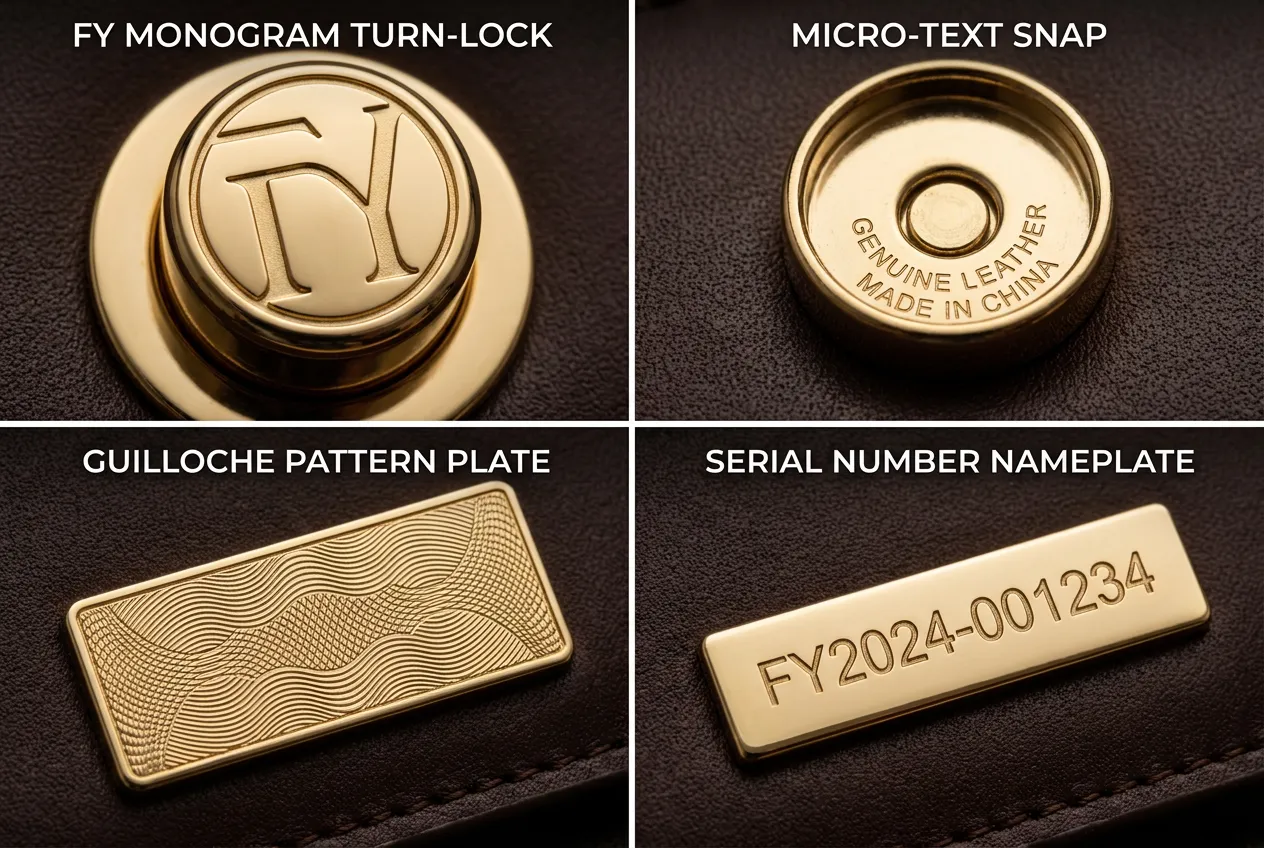
| Micro-text | Tiny text readable only with close inspection or magnification | “Hidden message” — a personal touch or brand story etched in 1–2 mm text | 0.3 mm character height | Interior hardware (snap face, hidden plate) — the “discovery” detail |
| Guilloche pattern | Machine-engraved geometric patterns covering the hardware surface | Fine parallel lines, crosshatch, or wave patterns that catch light differently at every angle | 0.1 mm line spacing | Turn-lock faces, clasp plates, decorative hardware — replaces smooth metal with textured luxury |
| Serialization | Unique serial number engraved on each unit | Authenticity verification; limited-edition numbering | 1.5 mm character height | Interior hardware plate — “001 of 200” limited edition numbering |
| QR code engraving | Functional QR code engraved into metal | Links to authentication page, brand story, or registration | 10 × 10 mm minimum | Interior nameplate — connects physical product to digital brand experience |
Creating custom hardware — shapes, sizes, and designs unique to your brand rather than selected from a supplier’s catalog — involves a tooling and production process that adds cost and timeline but creates maximum brand differentiation.
| Stage | What Happens | Duration | Cost | Output |
|---|---|---|---|---|
| 1. Design / 3D model | Your hardware concept is translated into a 3D CAD model | 2–5 days | 150 per piece (design fee) | 3D file for approval |
| 2. Mold / die creation | A steel or aluminum mold is CNC-machined from the approved 3D model | 5–10 days | 300 per piece (one-time tooling) | Production mold — reusable for thousands of pieces |
| 3. Casting / stamping | Zinc alloy or brass is cast or stamped using the mold | 3–5 days for first batch | 2.00 per piece (depends on size, complexity, and metal) | Raw hardware pieces |
| 4. Finishing / polishing | Raw castings are tumbled, polished, and prepared for plating | 1–2 days | Included in per-piece cost | Smooth, ready-for-plating hardware |
| 5. Plating | Electroplating or PVD coating in specified finish | 1–3 days | 0.50 per piece (depends on method and thickness) | Finished hardware in final color |
| 6. Laser engraving (if applicable) | Logo, text, or pattern engraved after plating | 1 day | 0.50 per piece | Branded hardware |
| 7. Top coat | Clear lacquer or nano-ceramic protective coating | 1 day | 0.10 per piece | Protected, finished hardware ready for bag assembly |
Total timeline for custom hardware: 14–26 days from design approval to finished pieces. This runs in parallel with bag material sourcing, so it typically does not add to the overall production timeline if initiated at the same time as the bag development process.
Total one-time tooling cost: 300 per unique hardware piece. For a bag with a custom turn-lock, custom zipper pull, and custom nameplate, total tooling is 900 — a one-time investment amortized across all future production runs.
| Hardware Decision | Use Standard (from supplier catalog) | Use Custom (mold + unique design) |
|---|---|---|
| Zippers (teeth and tape) | Almost always — custom zipper teeth are unnecessary | — |
| Zipper pull | Standard for first order | Custom from second order onward (the highest-visibility hardware element) |
| Turn-lock / closure | Standard for first order | Custom when the closure is a brand signature |
| D-rings, snap hooks | Almost always standard — functional, not decorative | Custom only for visible decorative D-rings |
| Rivets | Standard dome-head | Custom only if rivet heads carry a logo |
| Nameplate | — | Almost always custom — the dedicated brand-identity hardware |
| Chain links | Standard for most applications | Custom for brands where the chain IS the design statement |
| Base feet | Standard | Custom when feet are visible and branded |
The practical recommendation for most brands: use standard hardware with custom zipper pulls and a custom nameplate on your first production run. These two custom pieces (tooling cost: 600 total) create the strongest brand-identity hardware impact at the lowest investment. Add custom turn-locks and other pieces on subsequent runs as the brand develops its hardware language.
Salt spray tests corrosion resistance, but real-world hardware also faces abrasion, impact, and chemical exposure. A comprehensive hardware durability specification includes multiple tests:
| Test | What It Measures | Method | Boutique Pass Standard | What Failure Looks Like |
|---|---|---|---|---|
| Salt spray (ASTM B117) | Corrosion resistance | 5% NaCl fog at 35°C, continuous exposure | 48+ hours to first defect | Bubbling, discoloration, base metal showing through |
| Abrasion test (Taber) | Surface wear resistance | Rotating abrasive wheel applied to plated surface under controlled pressure | 200+ cycles at 250 g load before plating wears through | Plating thinning, base metal exposure at contact points |
| Pull test (hardware attachment) | Attachment strength to bag body | Hardware pulled at 90° from the bag surface with increasing force | 10+ kg for D-rings and strap hooks; 5+ kg for decorative elements | Hardware pulling out of the bag body; rivets deforming |
| Sweat simulation | Resistance to human sweat acids | Hardware immersed in synthetic perspiration solution (ISO 105-E04) for 24 hours | No discoloration, no tarnishing, no color transfer | Plating darkens, discolors, or transfers color to adjacent material |
For boutique-quality programs, request salt spray and sweat simulation test reports from your hardware supplier. These two tests cover the most common real-world hardware failures. Abrasion and pull tests can be performed on your proto sample at the bag factory’s QC station.
The most successful handbag brands develop a consistent hardware language — a set of finish, weight, shape, and detail conventions that repeat across every product in the collection. Over time, this hardware language becomes as recognizable as the brand’s logo.
| Element | What to Define | Why It Becomes Recognizable | Example |
|---|---|---|---|
| 1. Finish | One signature finish across all hardware | A brand “known for brushed gold hardware” is immediately identifiable | “All hardware: brushed gold, multi-layer plating, lacquer top coat” |
| 2. Weight class | A consistent weight perception across all pieces | The “heavy” or “substantial” feel becomes associated with the brand | “All hardware: zinc alloy, minimum weights per piece as specified” |
| 3. Shape language | A consistent geometric vocabulary — rounded vs. angular, organic vs. geometric | Shape consistency reads as “designed by one mind” | “All pulls, D-rings, and plates: softened rectangle with 2 mm corner radius” |
| 4. Logo placement | A consistent position and method for the brand mark on hardware | Consumers learn where to look for the mark | “Logo on every zipper pull (ablation engraved) and on the interior nameplate (deep engraved + enamel)” |
| 5. Signature piece | One unique hardware element that only your brand uses | The “that’s a [your brand] bag — I recognize the turn-lock” moment | A custom-shaped turn-lock, a distinctive chain pattern, or a unique clasp mechanism |
The hardware language should be established by your third collection and then maintained consistently from that point forward. The first collection can use standard hardware with custom pulls and nameplate. The second collection refines the finish and adds a custom closure. The third collection locks in the signature piece that becomes the brand’s visual anchor.
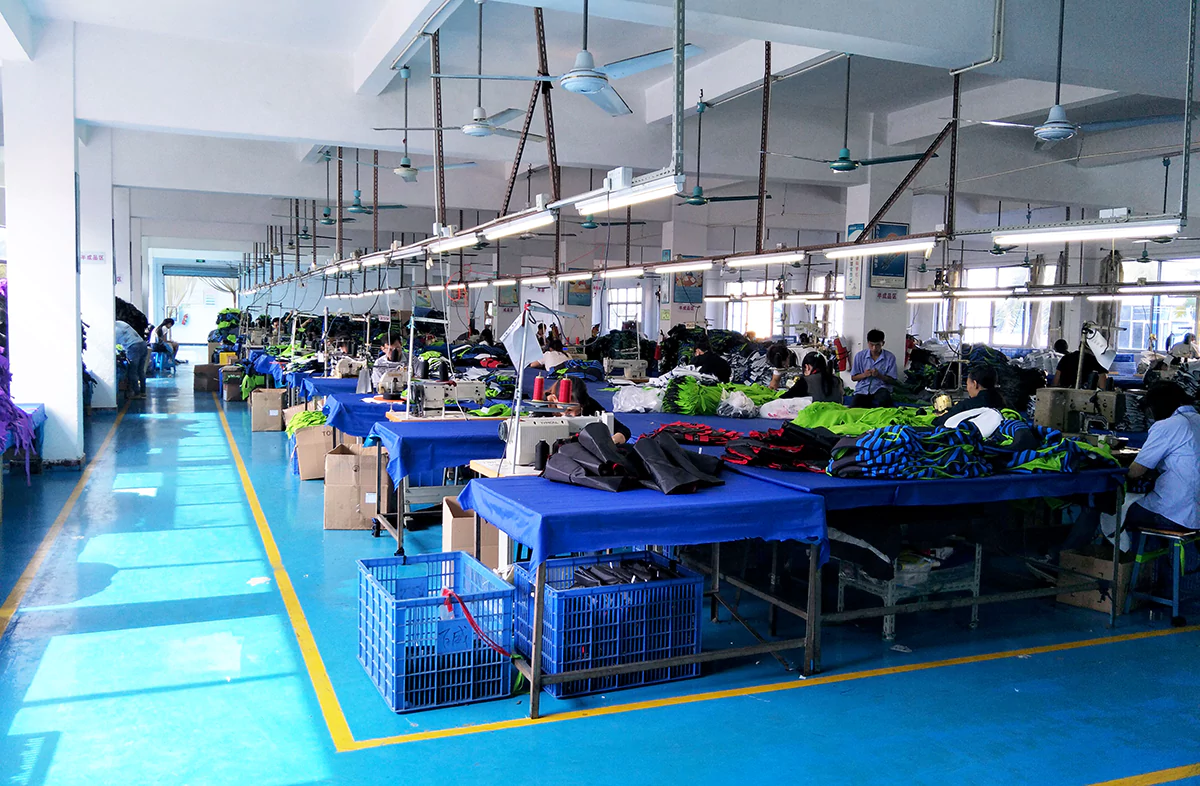
FYBagCustom is Your Trusted Custom Bag Manufacturer in China, with 15+ years of manufacturing experience and in-house custom hardware development for OEM and ODM programs. For brands developing jewelry-inspired hardware for their handbag collections, our capabilities include:
Our 50,000 m² factory in Guangzhou with 10+ production lines and 500+ professional staff produces bags with custom and standard hardware for DTC brands, Amazon FBA sellers, boutique retailers, premium labels, and fashion brands across international markets.
In the minimalist, quiet-luxury market of 2026, hardware carries more aesthetic weight than ever before. It is the detail consumers touch first, evaluate closest, and complain about loudest when it fails. For B2B buyers developing handbag hardware programs, three core takeaways:
If your 2026 collection needs custom hardware — from a laser-engraved zipper pull to a fully bespoke turn-lock mechanism — now is the time to finalize designs and initiate tooling. Contact FYBagCustom to discuss plating options, engraving techniques, and custom mold development — and receive hardware samples with your logo, typically within 10–14 days.
FYBagCustom’s OEM team develops custom handbag hardware with multi-layer plating, laser-engraved logos, jewelry-inspired finishes, and salt-spray-tested durability — from standard library pieces to fully bespoke tooling at low MOQ with hardware samples in 10–14 days.
Start Your Custom Bag Project →