Tel/WhatsAapp:+86 18011919834
E-mail: chloe.x@fybagcustom.com

Tel/WhatsAapp:+86 18011919834
E-mail: chloe.x@fybagcustom.com
Send Your Inquiry Today

Who this guide is for: premium brands and product developers producing the woven-leather look — the interlaced intrecciato-style handbags that signal quiet luxury without a logo and hold their commercial position year-round, season after season, while printed and trend textures cycle in and out. Woven leather earns that position the hard way: it is among the most labor-intensive constructions in the bag industry, a sequence of material transformations — hide into strips, strips into weave, weave into panel, panel into bag — where every stage is a specialized skill and every shortcut is visible in the finished surface. This guide follows that sequence stage by stage: the strip preparation that decides the weave’s quality before a single strand is crossed, the tension discipline that is the weaver’s core craft, the backing that gives a woven panel structure without killing its suppleness, and the edge finishing that secures dozens of strip-ends into borders worthy of an investment price. It closes with the program decisions — hand versus machine, weave scale, leather selection, market tier — that position a woven line from accessible-premium to investment-luxury. It is distinct from our natural-fiber weave guidance: raffia and straw share the word “weave” and none of leather’s preparation, tension, or finishing demands.
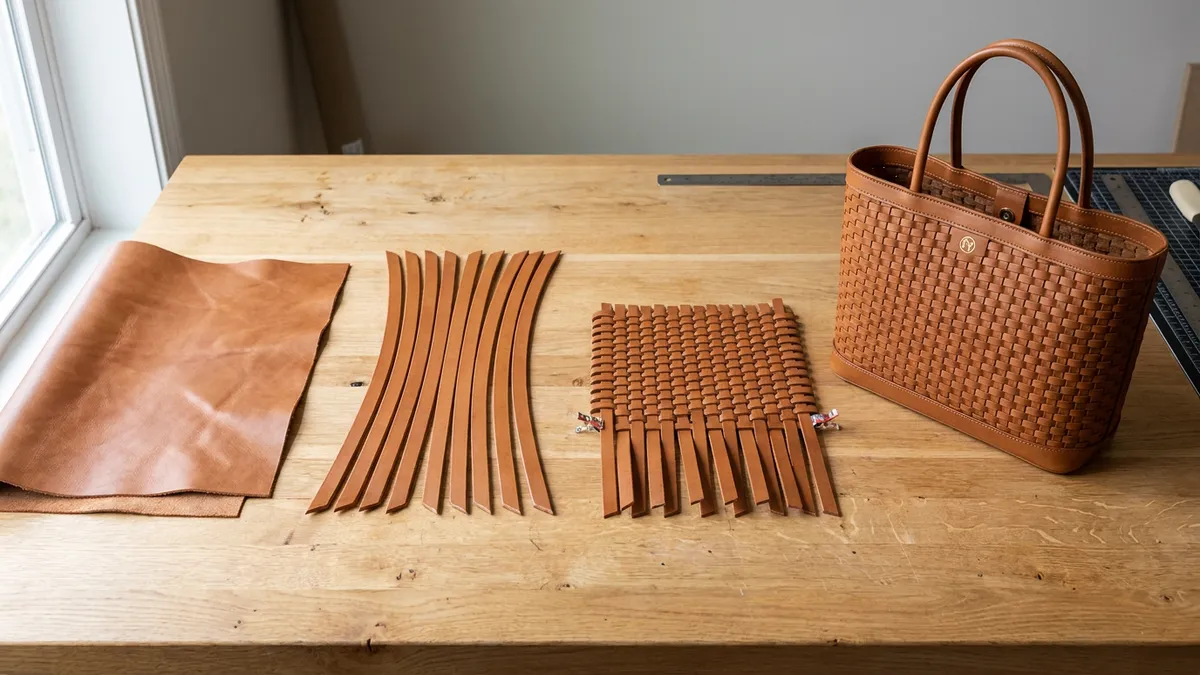
Every material has a reason customers pay for it. Woven leather’s reason is unusually legible: the surface shows its labor. An interlaced panel cannot be printed, stamped, or shortcut into existence — the viewer’s eye reads hundreds of individual crossings and understands, without being told, that hands and hours went in. That legibility is why the woven bag reads as luxury across the room, why it needs no logo to communicate its tier, and why it holds value year-round: handwork doesn’t go out of season.
The same legibility cuts the other way. Because the surface shows its labor, it also shows its corner-cutting — uneven strips, slack tension, crude edges — with a clarity that flat materials never impose on their makers. A cheap printed bag can hide behind its print; a cheap woven bag confesses on sight. That is the whole commercial logic of this category in one sentence: the making is the product, so the manufacturer’s skill is not a cost line behind the product but the visible substance of it. What follows is the making, in the order it happens.
One boundary worth drawing before the stages: woven leather and woven natural fiber are different crafts that share a vocabulary. A raffia or straw weave works with a material that arrives strand-shaped, costs little per meter, and forgives irregularity as rustic charm; leather arrives as a hide that must be transformed into strips at real material cost, and its market forgives nothing. The natural-fiber weaver’s skills are real but different — the leather weave adds strip preparation, skiving, edge treatment, and premium edge finishing that have no straw-bag equivalent, which is why a factory competent in one is not automatically competent in the other, and why this guide exists separately from our natural-weave coverage.
Everything the finished weave will be is decided at the strip stage, before any weaving begins. The strips are the weave’s raw vocabulary — if they are inconsistent, no weaving skill downstream can produce a consistent surface.
| Element | Specification | Why It Decides the Outcome |
|---|---|---|
| The leather selection | A supple, fine-grained leather that takes thinning well — fine calf, lamb, and soft nappa are the classic intrecciato choices; the leather is chosen for weaving, not adapted to it | Stiff, thick, or loose-grained leather fights the weave — it won’t interlace cleanly, won’t drape, and telegraphs every flaw |
| Uniform strip width | Every strip cut to an exact, repeated width — precision-cut, not freehand | The weave’s visual rhythm is its regularity; a few strips a millimeter off produce a wandering, amateur-looking grid |
| Skiving to weaving thickness | Strips thinned (skived) to a consistent gauge that interlaces cleanly and stays supple without bulking | Full-thickness leather makes a stiff, lumpy weave; over-skived strips weaken; the consistent in-between is a trained operation and the stage most cheap producers skip |
| Strip edge treatment | The cut edges of each strip finished so no raw, pale, or fuzzy edge shows in the weave’s gaps | The weave exposes every strip’s edges at every crossing — untreated edges gray the whole surface with visual noise |
| Grain and stretch direction | Strips cut with the hide’s grain and stretch behavior in mind, so they respond uniformly under weaving tension | Leather stretches directionally; ignore it and strips distort unevenly as they’re tensioned, warping the grid |
| Joins hidden by design | Where strip lengths must join, the join engineered to land beneath a crossing strip, invisible on the surface | A visible join is a scar on a surface whose entire point is continuity |
The stage-one principle: strip prep is invisible in the finished bag and responsible for most of its quality. When a woven sample disappoints, the diagnosis usually starts here — which is why an experienced buyer evaluating a new supplier asks to see loose prepared strips, not just finished panels.
The weaving itself is the category’s signature labor, and its governing variable is tension — how firmly and how evenly every strip is drawn against its neighbors across the whole panel.
| Element | Specification | Why |
|---|---|---|
| Even tension across the panel | Every crossing drawn to the same firmness, edge to edge, corner to corner | Uneven tension is the most visible weaving flaw — the panel puckers where tight and gaps where loose, and light exposes every variation across the interlaced surface |
| The correct tension level | Firm enough that the grid is stable and gap-free; relaxed enough that the panel keeps the supple, cushioned hand that is woven leather’s tactile signature | This is the craft’s central judgment call — too loose reads sloppy, too tight reads rigid, and the right point is learned in the hands, not written in a spec |
| Pattern discipline | The over-under sequence kept perfect — no skipped crossings, no drift, no irregular spacing | The eye forgives nothing in a regular grid; a single skipped crossing draws the gaze like a dropped stitch |
| Weave scale as design | Strip width sets the register: fine, narrow weave reads dressy and refined; wide-strip weave reads bold, modern, casual | Scale is a program decision (below) executed at this stage — and mixed-scale or diagonal-weave variations are design territory once the standard weave is mastered |
| Consistency across panels and the run | Every panel in a bag, and every bag in an order, woven to matching tension, scale, and pattern | A front panel firmer than its gusset looks wrong even to a buyer who can’t say why; a retail shelf of mismatched bags looks worse |
| Hand versus machine execution | Hand-weaving is the artisanal premium standard; jig-assisted and machine methods reproduce the look at volume and lower cost | The method is a positioning decision with real cost and authenticity implications — treated in the program section below |
A freshly woven sheet of interlaced leather is beautiful and useless: it stretches, sags, and holds no shape. Turning it into a bag panel — structured enough to build with, supple enough to stay luxurious — is a balancing act most buyers never see and every finished bag reveals.
| Element | Specification | Why |
|---|---|---|
| The backing decision | The woven sheet bonded or mounted to a backing — fine leather, fabric, or a technical stabilizer — that arrests stretch and distortion | Unbacked weave distorts under its own use; the backing is what makes the weave buildable |
| Structure without stiffness | The backing specifiedjustheavy enough — the panel holds form but still flexes and cushions under the hand | Over-backing is the most common panel-stage failure: it turns the weave into a printed-looking board and deletes the suppleness the customer is paying for |
| The hand test | The backed panel should compress slightly under a pressing thumb and recover — the woven “give” that distinguishes real interlacing from embossed imitation at a touch | This tactile give is woven leather’s handshake; buyers check it deliberately, customers feel it unconsciously |
| Panel-to-structure transitions | Where the woven panel meets solid-leather frames, bases, and trims, the transition engineered clean — the weave entering the border without bunching or gaps | The transition zones are where construction quality is most exposed |
| Interior standard | Lining and interior finishing at the tier the exterior promises | An investment-priced exterior with a budget interior breaks the story on first opening |
Here the woven construction meets its most distinctive challenge, one flat materials never pose: at every panel edge, dozens of individual strip-ends terminate, and each one is a potential unraveling point. Securing and finishing those edges is the final specialized skill, and it is where a woven bag’s longevity is decided.
| Element | Specification | Why |
|---|---|---|
| Strip-end security | Every strip-end captured — stitched down, bound, or locked inside a border — before finishing | An unsecured weave edge unravels with use; edge security is a durability requirement, not an aesthetic one |
| The solid-leather border | The panel edged in solid leather binding or framing that swallows the strip-ends and presents a continuous, refined line | The border is the transition from craft surface to structural frame — the woven field held inside a clean leather boundary is the classic intrecciato composition |
| Premium edge finish on the border | The border’s own edges painted, burnished, or turned to fine-leather-goods standard | The border edge is inspected as closely as any luxury bag’s edges; it carries the same standard |
| Invisible security | The capturing stitchwork concealed or integrated so the finished edge shows no mechanics | Visible securing stitches read as repair, not craft |
| Handles, straps, and anchors | Carry hardware anchored into the solid structure or through reinforced zones — never into unreinforced weave | The weave is a surface, not an anchor substrate; loads route to the frame |
| Edge durability testing | Finished edges flexed and stress-tested for strip-end retention over the bag’s life | An investment bag’s edges must outlast years of daily contact — the edge is where wear concentrates |
Because the surface shows everything, a trained eye can grade a woven bag in under a minute. These are the tells — useful both for evaluating suppliers and for understanding what your own product must not do.
| The Tell | What It Betrays |
|---|---|
| Wandering strip widths | No precision cutting — strip prep skipped or rushed; the grid’s rhythm visibly stutters |
| Pale or fuzzy lines at the crossings | Untreated strip edges — the giveaway that gray-noises the whole surface |
| Puckering and gapping across the panel | Uneven weave tension — the unmistakable mark of unskilled or hurried weaving |
| A board-stiff panel with no give | Over-backing — or worse, an embossed wovenpatternon solid material posing as a weave; the thumb test exposes both |
| Raw or crudely stitched panel edges | Strip-ends unsecured or visibly mechanically captured — the bag will age badly and looks unfinished now |
| Weave entering borders unevenly | Poor panel-to-frame transition work — bunching or gaps at exactly the zones a close inspection visits first |
| Panels that don’t match each other | No cross-panel consistency control — front, back, and gussets woven at different tensions |
A supplier whose samples pass all seven checks has the full skill chain; a sample that fails any one of them fails at a specific, diagnosable stage — which is precisely why this guide is organized by stage.
With the production understood, the strategic decisions that shape a woven program:
| Decision | The Options | The Positioning Logic |
|---|---|---|
| Hand vs. machine weave | Hand-woven (artisanal, highest labor, highest price); jig-assisted (consistent, mid-tier); machine-produced woven material (volume, accessible) | The method is the tier: hand-weave supports investment pricing and an artisanal story; machine methods open the look to accessible price points honestly, provided the marketing doesn’t claim handwork it didn’t buy |
| Leather vs. premium PU | Fine calf/ lamb/ nappa for the genuine article; quality woven PU and vegan alternatives for the vegan-positioned and entry tiers | The vegan woven bag is a real market, not a compromise — the weave’s visual craft carries even in alternative materials |
| Weave scale | Fine/narrow (dressy, classic, refined) to wide-strip (bold, contemporary, casual) | Scale is register: a fine-weave clutch and a wide-weave tote speak to different customers from the same skill base |
| Tonal vs. two-tone | The classic single-color weave letting texture speak; mixed-color strips for pattern-in-weave effects | Tonal is the quiet-luxury default; two-tone is the fashion-forward variation once the core sells |
| The color plan | Investment neutrals (tan, black, chocolate, cream) as the permanent core; seasonal shades as accents | The neutrals are the year-round engine — this is the category where a brand builds apermanentline, restocked not redesigned |
| Branding restraint | Tonal embroidery, a discreet metal signature, embossed marks on the solid-leather borders via textured treatments | The weave is the statement; branding that competes with it undercuts the quiet-luxury logic the customer is buying |
The year-round economics, spelled out: a woven program’s commercial profile is the inverse of a trend texture’s. Development is slower and costlier (the skills, the sampling, the labor), but the finished line doesn’t expire — the same tan woven tote sells in March and November, this year and next, which amortizes the development over a product life trend textures never reach. For a premium brand, that trade — higher entry cost, permanent shelf life — is usually the better side of the bargain, and it can be scoped concretely with our development team against the intended tier and volumes.
| SKU | Format | The Role |
|---|---|---|
| Woven tote | Tote | The signature and the volume anchor — tan and black, the permanent core |
| Woven shoulder bag | Shoulder bag | The structured day-to-evening piece |
| Woven clutch / pouch | Clutch | Fine-weave, gift-ready — the entry into the investment tier |
| Woven crossbody | Crossbody | The accessible everyday silhouette |
| Woven hobo | Hobo | The soft, slouched register — where the weave’s suppleness shows best |
| Woven-panel bucket bag | Bucket | Woven field within solid structure — the composition statement |
The application fit: the woven range lives in premium daily commuting and work (the investment work tote), gift and promotional (the luxury and corporate-gift tier, where the visible handwork does the gift’s talking), and travel and adventure (the premium weekender and resort piece) — a year-round footprint across all three.
| Check | Method | Standard |
|---|---|---|
| Strip consistency | Prepared strips measured for width and gauge uniformity; edges inspected | Uniform, treated, join-concealed |
| Tension and grid regularity | Panels examined under raking light for pucker, gap, and pattern drift | Even, firm-supple, perfectly regular |
| The thumb test | Backed panels pressed for the woven give | Compresses slightly and recovers — never board-stiff |
| Cross-panel and cross-run match | Panels within each bag and bags across the order compared | Matching tension, scale, and color throughout |
| Edge security | Panel edges flexed and stressed; strip-end capture inspected | No loosening, no unraveling, no visible mechanics |
| Border finish | Solid-leather borders checked to fine-leather edge standard | Painted/burnished/turned, clean and durable |
| Anchor routing | Handle and strap loads verified into structure, not weave | Full load-bearing durability |
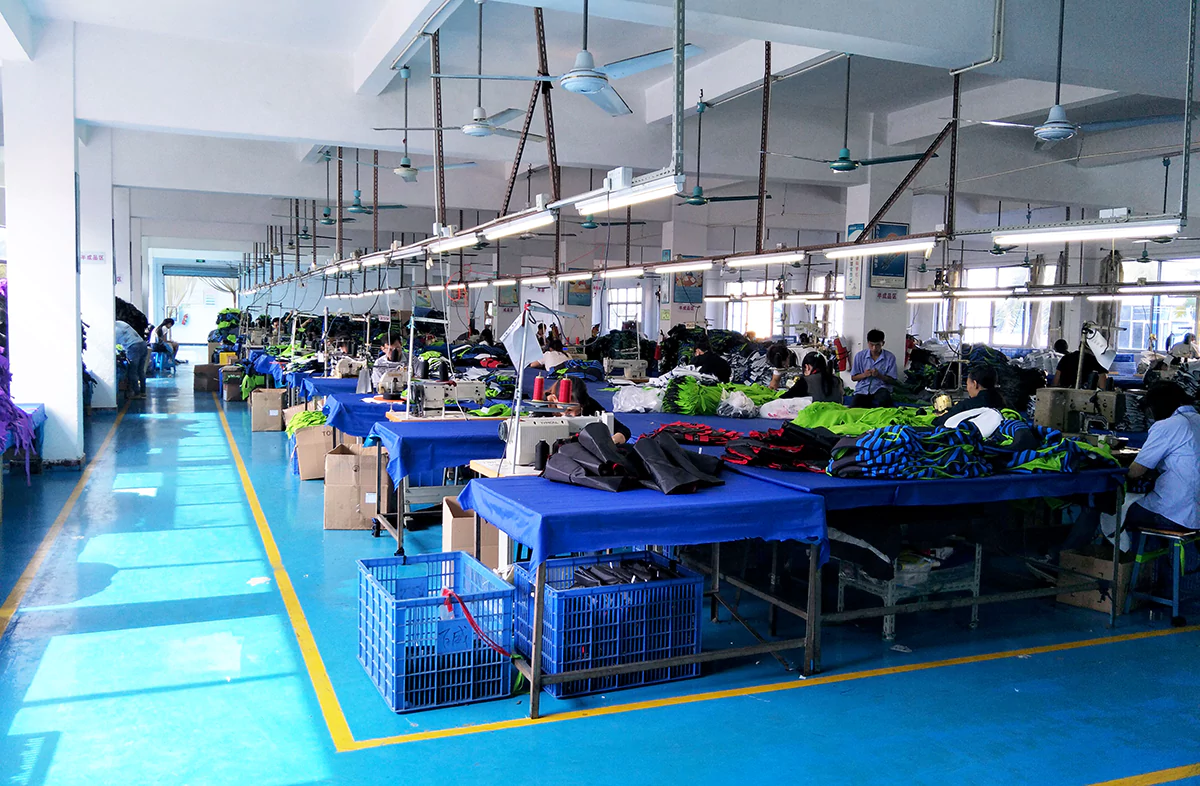
FYBagCustom is Your Trusted Custom Bag Manufacturer in China, with 15+ years of manufacturing experience and the full four-stage skill chain woven leather demands. For premium brands producing the intrecciato look, our capabilities include:
Woven leather is the rare category where the customer can see the manufacturing quality from across a room — which makes the manufacturing the whole game. For premium brands, three core takeaways:
If you are producing a woven-leather line — an investment hand-woven range, an accessible machine-woven tier, or a vegan woven alternative — contact FYBagCustom to brief your program, and receive a strips-to-edges woven sample in 10–14 days.
FYBagCustom runs the full woven-leather skill chain — precision strip prep, even-tension weaving, thumb-test backing, and secured, edge-painted borders — for permanent ranges from investment hand-weave to quality vegan alternatives. Woven samples in 10–14 days.
Start Your Custom Bag Project →