Tel/WhatsAapp:+86 18011919834
E-mail: chloe.x@fybagcustom.com

Tel/WhatsAapp:+86 18011919834
E-mail: chloe.x@fybagcustom.com
Send Your Inquiry Today


Who this guide is for: brand owners, sustainability leads, and product developers at mid-tier handbag brands who want to strengthen their sustainability story — on product pages, in retailer conversations, in B Corp applications — without switching to experimental bio-leathers that carry untested durability, volatile pricing, and uncertain supply. If your sustainability strategy has stalled because the aspirational options (cactus leather, mycelium leather, apple waste leather) are too costly, too early-stage, or too risky for your production volume, this guide is the practical alternative: a ranked list of sustainability upgrades that use proven, commercially available materials and processes, ordered by the ratio of environmental impact to production disruption.
Bio-leathers get the press. Cactus leather makes headlines. Mycelium leather wins innovation awards. Apple waste leather earns Instagram shares. And they deserve the attention — these materials represent genuine long-term innovation in the fashion supply chain.
But for the mid-tier brand producing 5,000–50,000 handbags per year, bio-leathers are, in 2026, still a high-risk proposition: limited supplier bases, inconsistent batch quality, unproven 3+ year durability, and material costs that can be 3–5× conventional equivalents. A brand that bets its core collection on a bio-leather and discovers a durability issue at month eight faces a recall, a review crisis, and a supply scramble.
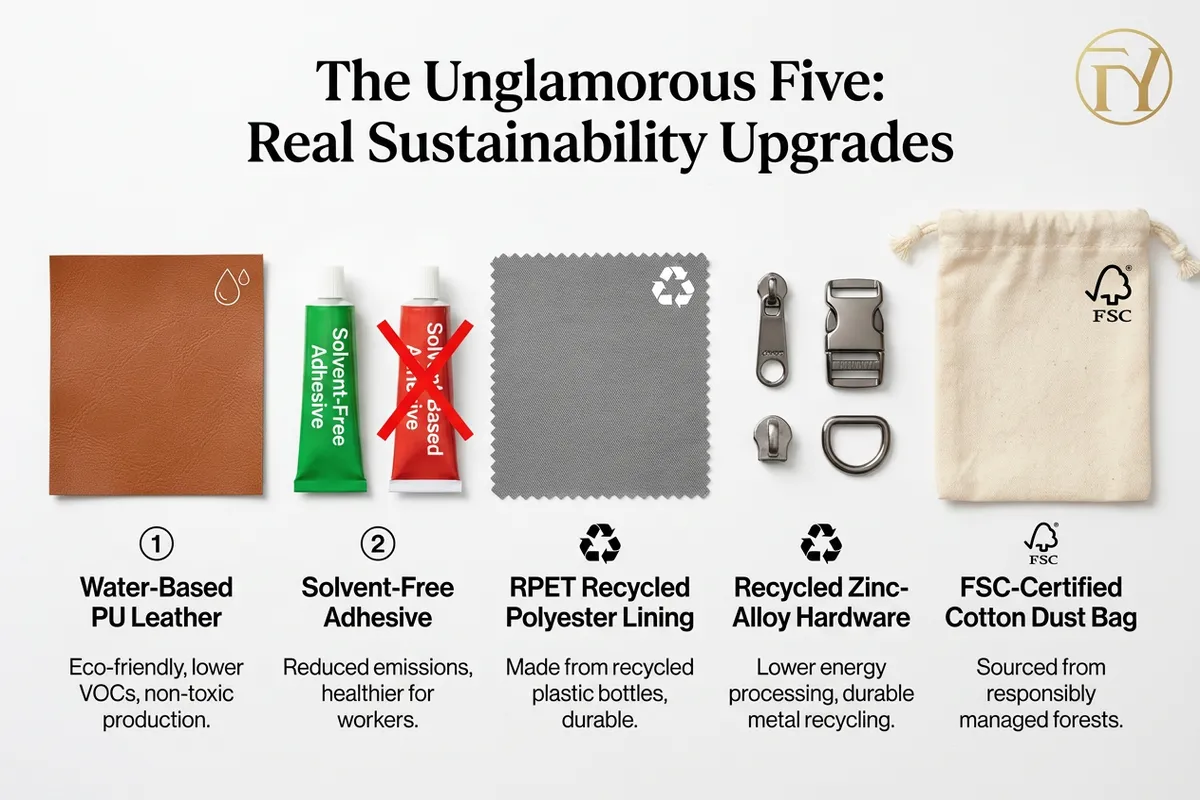
The sustainability wins that are low-risk, production-proven, and available at scale today are less glamorous. They live inside the material stack — the PU formulation, the adhesive chemistry, the lining fiber, the hardware alloy, the packaging material — where switching from a conventional input to a sustainable input changes the environmental profile without changing the consumer’s experience, the bag’s performance, or the production timeline.
These are the upgrades this guide covers, ranked by the ratio of environmental improvement to production disruption.
| Rank | Upgrade | What Changes | Environmental Impact | Production Disruption | Consumer-Facing Story |
|---|---|---|---|---|---|
| 1 | Solvent-free or water-based adhesives | The glue that bonds interlining to panels, lining to structure, and edge folds | High — eliminates the largest source of VOC (volatile organic compound) emissions in bag manufacturing | Very Low — the adhesive type changes; the application method does not; the production line does not need modification | Moderate — “solvent-free construction” is a legitimate claim; consumers and retailers increasingly understand VOC reduction |
| 2 | Water-based PU leather | The exterior material’s coating chemistry — from solvent-based polyurethane to water-based polyurethane | High — reduces the PU manufacturing process’s VOC emissions by 80–95%; reduces hazardous waste | Low — the PU supplier changes formulation; the bag factory’s cutting and sewing processes are identical | Strong — “water-based PU” or “low-VOC material” is a clear, communicable upgrade; aligns with OEKO-TEX and REACH compliance stories |
| 3 | RPET (recycled polyester) lining | The lining fabric — from virgin polyester to polyester made from recycled PET bottles | Moderate — diverts plastic waste from landfill; reduces virgin polyester production energy by ~30–50% | Very Low — RPET polyester sews identically to virgin polyester; no production change; the material is a drop-in replacement | Strong — “lining made from recycled plastic bottles” is one of the most consumer-understandable sustainability claims; the “X bottles per bag” math is compelling content |
| 4 | Recycled-content hardware | Zinc alloy or brass hardware cast from recycled metal feedstock | Moderate — reduces primary metal mining and smelting energy | Low — the hardware supplier changes feedstock; the casting, plating, and finishing processes are identical; the finished hardware is indistinguishable from virgin-metal hardware | Moderate — “recycled-metal hardware” is a niche claim that sustainability-conscious brands and retailers value |
| 5 | Sustainable packaging stack | FSC-certified paper, organic or recycled cotton dust bags, soy-based inks, compostable mailers | Moderate — reduces forestry impact, cotton farming impact, and post-consumer waste | Very Low — packaging suppliers offer certified alternatives as standard stock; no production process changes | Strong — the packaging is the first thing the consumer touches; “FSC-certified packaging” and “organic cotton dust bag” are visible, touchable claims |
In conventional bag manufacturing, the adhesives that bond interlining to exterior panels, lining to structural layers, and fold edges are solvent-based — they contain organic solvents (toluene, acetone, MEK) that evaporate during the bonding process, releasing VOCs into the factory air and, residually, into the finished product’s off-gassing profile.
Water-based and solvent-free adhesives replace these solvents with water as the carrier or with reactive hot-melt systems that contain no solvents at all.
| Metric | Solvent-Based Adhesive | Water-Based / Solvent-Free | Improvement |
|---|---|---|---|
| VOC content | 50–80% organic solvents by weight | < 5% (water-based); 0% (reactive hot-melt) | 80–100% VOC reduction |
| Hazardous air emissions (factory) | Significant — toluene and MEK are regulated hazardous air pollutants | Minimal to none | Eliminates the factory’s #1 source of hazardous air emissions in the assembly department |
| Worker exposure | Requires ventilation, PPE, and exposure monitoring | Standard factory conditions; no solvent-specific PPE required | Improves worker health and safety |
| Off-gassing (finished product) | The “new bag smell” — residual solvent evaporating from the finished product | Minimal — the finished product has no solvent residue to off-gas | Eliminates the chemical odor that consumers sometimes report on new bags |
| Property | Solvent-Based | Water-Based | Solvent-Free Hot-Melt |
|---|---|---|---|
| Bond strength | Very good — the benchmark | Good to very good — modern water-based adhesives match solvent performance on most substrates | Very good — reactive hot-melts provide excellent bond strength |
| Open time (working time before the adhesive sets) | Long — solvents evaporate slowly, giving the operator time to position components | Shorter — water evaporates faster; the operator must work more quickly | Moderate — the hot-melt has a controlled working window |
| Drying time | Moderate | Longer — water evaporates more slowly than solvents in humid conditions; factory humidity control matters | Fast — the adhesive sets as it cools |
| Substrate compatibility | Works on virtually all materials | Works on most materials; may require primer on some slick PU surfaces | Excellent on most substrates |
| Cost (relative) | Baseline | 10–20% higher per unit of adhesive (but the adhesive is a small fraction of total FOB — the net FOB increase is typically less than 2%) | 15–25% higher per unit |
“All adhesives used in panel lamination, interlining bonding, lining attachment, and edge folding: water-based (< 5% VOC) or solvent-free reactive hot-melt. No solvent-based adhesives containing toluene, MEK, or acetone permitted in any production step.”
Conventional PU leather is manufactured by coating a fabric backing with a polyurethane solution dissolved in DMF (dimethylformamide) — a solvent classified as a reproductive toxin by the EU and regulated under REACH. The DMF evaporates during the coating process, releasing VOCs and leaving residual DMF in the finished material (which must be below regulated limits for EU and some US markets).
Water-based PU replaces DMF with water as the carrier for the polyurethane. The coating process is similar, but the chemistry is fundamentally different: no DMF, no hazardous solvent emissions, and no residual DMF in the finished material.
| Metric | Solvent-Based (DMF) PU | Water-Based PU | Improvement |
|---|---|---|---|
| DMF content (finished material) | Requires testing to ensure compliance (EU limit: 0.1% by weight); non-compliant lots must be rejected | 0% DMF — no testing required; inherently compliant | Eliminates DMF risk entirely |
| VOC emissions (manufacturing) | High — DMF and co-solvents evaporate during coating | 80–95% lower — water replaces solvents | The single largest emissions reduction available in PU production |
| Hazardous waste (manufacturing) | Solvent recovery and disposal required | Minimal — wastewater treatment replaces solvent recovery | Reduces the PU supplier’s hazardous waste stream |
| REACH compliance | Requires testing and certification per batch | Inherently compliant (no regulated solvents) | Simplifies supply-chain compliance documentation |
| OEKO-TEX eligibility | Requires testing | Easier to achieve — the absence of DMF removes the primary testing concern | Supports OEKO-TEX Standard 100 certification, which some retailers require |
| Property | Solvent-Based PU | Water-Based PU | Notes |
|---|---|---|---|
| Hand-feel | The benchmark — soft, supple, consistent | Very similar — modern water-based PU formulations have closed the hand-feel gap; the consumer cannot distinguish them by touch in a blind test | Five years ago, water-based PU was stiffer; the formulation has matured significantly |
| Durability (flex, abrasion) | Very good | Good to very good — slight reduction in flex life on some formulations; specify the same flex-test requirements as conventional PU and require the supplier to meet them | The flex-test specification is the safeguard — it forces the water-based PU supplier to deliver equivalent performance |
| Color consistency | Very good | Good — water-based PU can show slightly more batch variation in very light or very saturated colors; per our color matching guide, tighten ΔE tolerances on these hues | Manageable with standard color-management protocols |
| Surface finish options | Full range (matte, satin, gloss, metallic, pearlized) | Full range — water-based PU is now available in every finish that solvent-based PU offers | No finish limitations |
| Thickness range | 0.6–1.8 mm | 0.6–1.5 mm (the upper end is slightly thinner than solvent-based; 1.5 mm is adequate for all standard handbag applications) | No practical limitation for handbag production |
| Odor | “New PU” smell (residual DMF/solvents) — the chemical odor consumers sometimes detect on new bags | Minimal to no chemical odor — the absence of solvents means no off-gassing | A real consumer-experience improvement; “no chemical smell” prevents the “smells like chemicals” review |
“Exterior material: water-based polyurethane (WB-PU), DMF-free, VOC content < 5% (per supplier’s test report). All performance requirements (flex resistance, abrasion, color fastness, tensile strength) identical to the specification for conventional PU. Supplier to provide DMF-free certification and REACH compliance documentation per roll.”
Standard polyester lining fabric is made from virgin polyester (derived from petroleum). RPET (recycled PET) polyester is made from post-consumer PET plastic — typically recycled beverage bottles — that is collected, cleaned, melted, and extruded into polyester fiber, then woven or knitted into lining fabric.
| Metric | Virgin Polyester | RPET Polyester | Improvement |
|---|---|---|---|
| Raw material | Petroleum (a non-renewable resource) | Post-consumer PET bottles (a waste stream) | Diverts plastic waste from landfill/ocean; reduces petroleum extraction |
| Energy (production) | Baseline | 30–50% less energy than virgin polyester production | Meaningful energy reduction |
| CO₂ emissions | Baseline | 30–60% lower than virgin polyester | Direct carbon footprint improvement |
| Water use | Baseline | Comparable (the weaving/finishing stages are similar) | Minimal difference |
| Consumer story | None — “polyester lining” is invisible to the consumer | “Lining made from recycled plastic bottles — approximately X bottles per bag” | The most consumer-friendly sustainability claim in the entire upgrade list |
The “how many bottles per bag” calculation is the most powerful consumer-facing data point RPET offers. The math:
This number belongs on the product page, the care card, and the brand’s sustainability statement. “Each bag diverts 6 recycled bottles from landfill” is concrete, verifiable, and emotionally resonant.
| Property | Virgin Polyester | RPET Polyester | Notes |
|---|---|---|---|
| Hand-feel | The benchmark | Identical — the consumer cannot distinguish RPET from virgin polyester by touch | RPET polyester is physically the same polymer; the recycling process does not change the fiber properties |
| Color range | Full range | Full range — RPET takes dye identically to virgin polyester | No limitation |
| Durability | The benchmark | Identical | Same polymer, same durability |
| GSM range | Full range (40–200+ g/m²) | Full range | Specify the same GSM as you would for virgin |
| Sewing behavior | The benchmark | Identical — RPET sews, cuts, and serges identically | No production change required; a true drop-in replacement |
RPET claims must be verifiable. The GRS (Global Recycled Standard) is the industry certification for recycled-content textiles. A GRS-certified RPET lining comes with a Transaction Certificate (TC) that traces the recycled content from bottle collection through fiber production through fabric weaving. Require the TC from your lining supplier — without it, the “recycled” claim is unverifiable and potentially misleading.
Specification language: “Lining fabric: RPET recycled polyester, GRS-certified, minimum 80% recycled content. Supplier to provide GRS Transaction Certificate per shipment. GSM, weave, and color specification identical to current virgin polyester specification.”
Standard handbag hardware (zippers, D-rings, snap hooks, magnetic snaps, base feet) is typically cast from virgin zinc alloy or brass. Recycled-content hardware uses post-industrial or post-consumer recycled metal as the casting feedstock — the scrap zinc or brass is melted, purified, and re-cast into the same hardware shapes.
| Metric | Virgin Metal Hardware | Recycled-Content Hardware | Improvement |
|---|---|---|---|
| Primary resource extraction | Requires mining and smelting of zinc ore or copper/tin ore | Uses existing metal that has already been extracted and refined | Eliminates the mining, extraction, and primary smelting stages — the most energy-intensive steps in metal production |
| Energy (production) | Baseline | Recycled zinc requires approximately 60–75% less energy than primary zinc smelting; recycled brass requires approximately 50–65% less | Significant energy and emissions reduction |
| Quality | The benchmark | Identical — the recycled metal, once re-melted and purified, has the same metallurgical properties as virgin metal | The casting, plating, and finishing processes are identical; the finished hardware is indistinguishable |
Zero. Recycled zinc alloy hardware that has been properly melted, purified, and cast performs identically to virgin hardware in every test: tensile strength, plating adhesion, salt-spray corrosion resistance, and surface finish quality. The recycling process does not degrade the metal.
Unlike RPET (which has the GRS certification), recycled-content hardware does not yet have a universally adopted third-party certification. The verification pathway is supplier documentation: request a recycled-content declaration from the hardware supplier specifying the percentage of recycled metal in the feedstock (typically 30–80% recycled, blended with virgin metal for quality control).
Specification language: “All hardware: cast from feedstock containing minimum 30% recycled zinc alloy (post-industrial or post-consumer). Supplier to provide recycled-content declaration per order. All performance specifications (plating thickness, salt-spray resistance, tensile strength) identical to current specification.”
The packaging stack — dust bags, tissue, boxes, cards, mailers — offers a set of material swaps that are among the simplest sustainability upgrades because the packaging supply chain already offers certified alternatives as standard stock.
| Component | Conventional Material | Sustainable Swap | Certification |
|---|---|---|---|
| Dust bag | Virgin cotton, conventionally farmed | Organic cotton (GOTS-certified) or recycled cotton | GOTS (Global Organic Textile Standard) for organic; GRS for recycled |
| Gift box / hangtag | Virgin paper/cardboard | FSC-certified paper (from responsibly managed forests) | FSC (Forest Stewardship Council) — the most recognized paper-sustainability standard |
| Tissue paper | Conventional acid-free tissue | FSC-certified tissue or recycled-content tissue | FSC |
| Printing inks | Petroleum-based inks | Soy-based or water-based inks | No universal certification; supplier declares soy/water-based formulation |
| Sticker seal | PVC or vinyl sticker | Paper-based sticker with compostable adhesive | Compostable certification (BPI / OK Compost) |
| Mailer | Poly (plastic) mailer | Recycled paper padded mailer or compostable mailer (PLA or PBAT-based) | FSC for paper mailers; BPI for compostable |
| Stuffing | Conventional tissue | Recycled tissue or shredded recycled paper | FSC or recycled-content declaration |
When the full sustainable-packaging swap is implemented, the brand can claim:
These claims are concrete, auditable, and consumer-understandable — unlike vague claims like “eco-friendly packaging” or “sustainable packaging” (which are unverifiable and increasingly penalized by regulatory bodies under greenwashing rules).
| Claim | Supporting Evidence |
|---|---|
| “Constructed with water-based, solvent-free adhesives — zero VOC emissions during assembly” | Adhesive supplier’s technical data sheet showing < 5% VOC or solvent-free formulation |
| “Exterior crafted from water-based PU leather — DMF-free, low-VOC” | PU supplier’s DMF-free test report and water-based formulation certificate |
| “Interior lining made from RPET recycled polyester — approximately [X] recycled bottles per bag” (GRS-certified) | GRS Transaction Certificate from lining supplier |
| “Hardware cast from recycled-content metal” | Recycled-content declaration from hardware supplier |
| “Packaged in FSC-certified paper, organic cotton, and soy-based inks” | FSC chain-of-custody certificate; GOTS certificate; ink supplier declaration |
| Claim | Why It Is Problematic |
|---|---|
| “Sustainable” (unqualified) | Too vague; unverifiable; increasingly targeted by greenwashing regulations (EU Green Claims Directive, US FTC Green Guides) |
| “Eco-friendly” (unqualified) | Same — no product is universally “eco-friendly”; the claim implies zero environmental impact, which is never true |
| “Carbon-neutral bag” | Requires a full lifecycle carbon assessment (LCA) and verified offsets; implementing the five upgrades reduces carbon but does not achieve neutrality |
| “Vegan leather” (for PU) | Legally acceptable but ethically debated — PU is petroleum-derived; “vegan” implies environmental virtue that petroleum products do not automatically possess; prefer “animal-free” or simply “PU leather” and let the water-based/DMF-free claims carry the environmental story |
Not every upgrade needs to happen simultaneously. The recommended implementation sequence prioritizes the upgrades that require the least production disruption and deliver the most visible story:
| Phase | Upgrade | Timeline | Why This Sequence |
|---|---|---|---|
| Phase 1 (immediate — next order) | Sustainable packaging (FSC paper, organic cotton dust bag, soy inks) + RPET lining | Add to the next production order | Zero production disruption; the material swaps are drop-in; the sustainability claims are immediately visible (the packaging) and easily communicated (“recycled bottle” math) |
| Phase 2 (next quarter) | Solvent-free adhesives | Implement on the next new-SKU development or next reorder of existing SKUs | Requires coordination with the factory’s adhesive supplier; the factory may already have water-based adhesives available; the production process does not change |
| Phase 3 (next season) | Water-based PU | Specify water-based PU on new SKU developments; transition existing SKUs at reorder | Requires qualifying a water-based PU from the material supplier; lab dips and performance testing before adoption; the bag factory’s production process does not change |
| Phase 4 (ongoing) | Recycled-content hardware | Specify on new hardware orders as recycled-content supply becomes available from your hardware supplier | Supply availability is the constraint — not all hardware suppliers offer recycled-content feedstock yet; the specification is the demand signal that encourages suppliers to develop the capability |
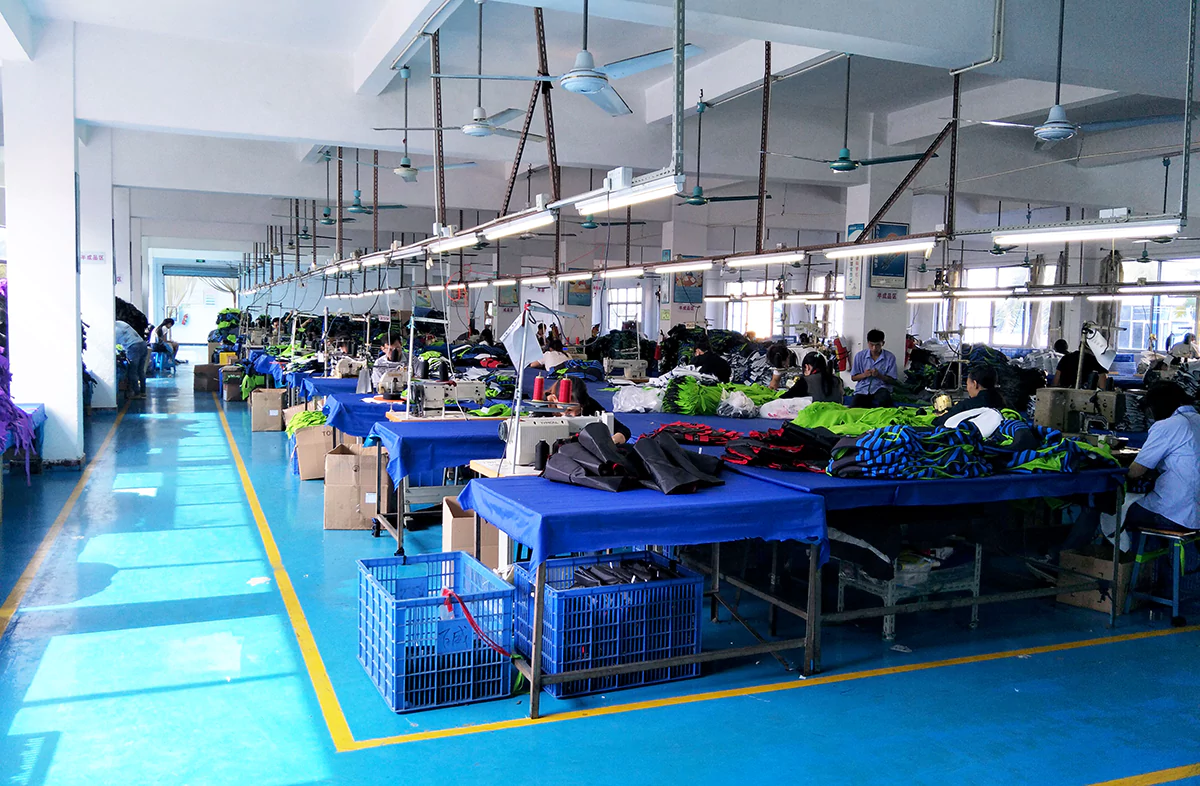
FYBagCustom is Your Trusted Custom Bag Manufacturer in China, with 15+ years of manufacturing experience and an active sustainability-upgrade program across our supply chain. For brands implementing the upgrades in this guide, our capabilities include:
Contact our sustainability team to discuss which upgrades align with your brand’s sustainability roadmap and receive samples with the sustainable materials specified.
Bio-leathers will transform the handbag industry — eventually. In 2026, the sustainability upgrades that transform YOUR handbag line are the proven, scalable, certifiable changes inside the material stack. For B2B buyers building a sustainability story, three core takeaways:
If your 2026 line needs sustainability upgrades that are production-proven, certifiable, and compatible with your existing quality specification, contact FYBagCustom to discuss water-based PU, solvent-free adhesives, RPET linings, and the sustainable packaging stack — and receive samples with full certification documentation.
FYBagCustom produces with water-based PU, solvent-free adhesives, GRS-certified RPET linings, recycled-content hardware, and FSC-certified packaging — all with the supplier certificates your sustainability claims require. Sustainable-spec samples in 5–7 days.
Start Your Custom Bag Project →