Tel/WhatsAapp:+86 18011919834
E-mail: chloe.x@fybagcustom.com

Tel/WhatsAapp:+86 18011919834
E-mail: chloe.x@fybagcustom.com
Send Your Inquiry Today

Who this guide is for: brand owners, sourcing managers, wholesale buyers, Amazon FBA sellers, DTC founders, adaptive fashion labels, occupational therapists with product ventures, and inclusive lifestyle brands who are developing handbags and accessories for women with disabilities, chronic conditions, or limited dexterity. If you want to understand how to engineer magnetic closures, one-hand operation, wheelchair-attachable straps, and seated-access compartment layouts into bags that look like mainstream luxury — not medical equipment — this guide covers the functional requirements, the design principles, and the production specifications.
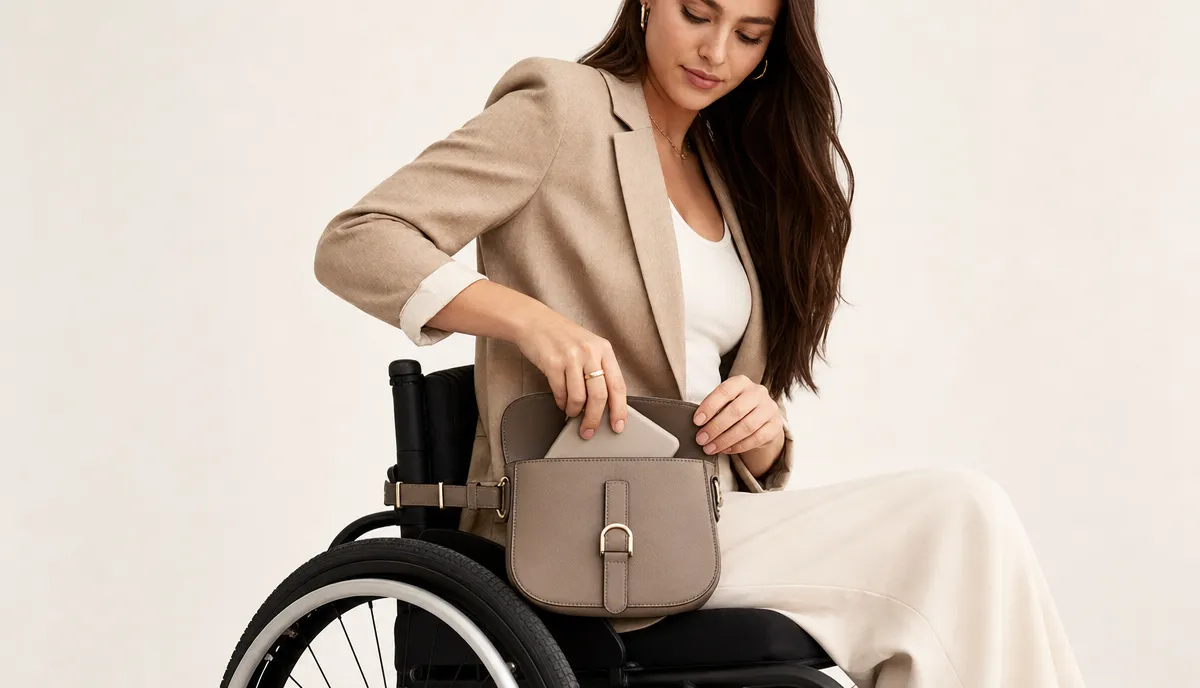
Approximately 28 million women in the United States live with a disability that affects their mobility, dexterity, or motor function. Some use wheelchairs. Some have limited grip strength from arthritis, multiple sclerosis, stroke recovery, or connective tissue conditions. Some have the use of only one hand. Some experience chronic pain that makes repetitive motions — like unzipping, buckling, or reaching into a deep bag — exhausting or impossible.
Every one of these women uses a bag. And almost none of the bags available to her were designed with her body in mind.
The mainstream bag market designs for two hands, full grip strength, standing height, and unrestricted range of motion. Zippers require bilateral pinch-and-pull coordination. Buckles demand fine motor dexterity. Crossbody straps assume the ability to reach across the torso and pull a strap over the head. Tote handles assume the grip strength to support 3–5 kg of contents. Interior layouts assume the ability to reach deep into a vertical cavity and locate items by touch. For millions of women, one or more of these assumptions is incorrect — and the result is daily frustration with products that were not made for them.
In 2026, the adaptive fashion movement has reached a tipping point. Search volume for “adaptive handbags” is growing rapidly, driven by both disabled consumers and the brands recognizing the commercial opportunity in a market that has been systematically underserved. The opportunity is not small: the disability community in the U.S. controls an estimated $490 billion in disposable income, and women with disabilities are among the most brand-loyal consumer segments — when they find a brand that genuinely serves their needs, they return and recommend with exceptional consistency.
This guide approaches adaptive bag design as what it is: a design engineering discipline that produces better products for a specific set of functional requirements. Not charity. Not inspiration. Design.
Adaptive design is not about taking a standard bag and adding a wheelchair clip. It is about re-examining every interaction between the user and the bag — every opening, every closure, every reach, every grip, every attachment — and engineering each one to work within the user’s actual range of ability.
| Principle | What It Means | Design Implication |
|---|---|---|
| One-hand operable | Every closure, zip, and pocket can be opened and closed with a single hand | Magnetic closures, pull-tab zippers, push-button snaps, D-ring pull loops |
| Low-force | No interaction requires more than 2 lbs (0.9 kg) of force | Light-action magnetic snaps, smooth-glide zippers, no stiff buckles or tight snaps |
| Minimal fine motor | No interaction requires pinching, twisting, or precise finger coordination | Large pull tabs (15 mm+), oversized zipper pulls, magnetic rather than mechanical closures |
| Seated-accessible | All compartments and closures are reachable from a seated position (wheelchair or otherwise) | Top-access and front-access design; no bottom-only compartments; contents visible from above |
| Fashion-indistinguishable | The adaptive features are invisible or indistinguishable from standard fashion hardware | Magnetic closures that look like decorative hardware; wheelchair straps that look like bag straps |
The fifth principle — fashion-indistinguishable — is the one that most existing adaptive products fail. Medical-grade functionality wrapped in medical-grade aesthetics produces a bag that solves the physical problem but creates a social one: the bag announces “I have a disability” before the wearer chooses to disclose. The goal is a bag that an able-bodied consumer would also choose based on its appearance — and that happens to work perfectly for a consumer with limited mobility or dexterity.
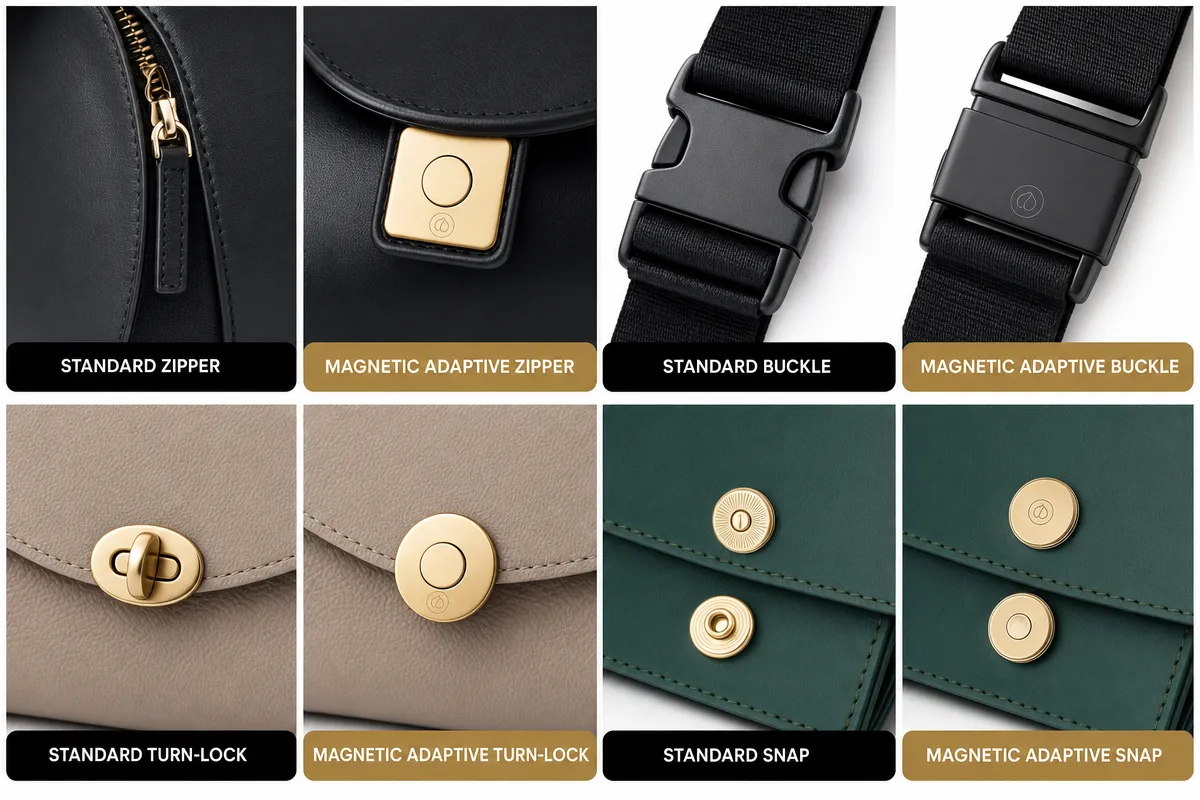
Magnetic closures are the single most important hardware innovation for adaptive bags. They replace zippers, buckles, turn-locks, and snaps — all of which require some combination of bilateral coordination, fine motor control, and grip strength — with a closure that operates on proximity alone. Bring the two halves near each other, and they close. Pull them apart with minimal force, and they open. One hand. No pinching. No twisting.
| Type | Mechanism | Force to Open | One-Hand Operable | Visual Read | Best Application | Cost |
|---|---|---|---|---|---|---|
| Standard magnetic snap | Two-piece disc magnet sewn into fabric/leather | 1.0–2.0 kg | Yes | Subtle — invisible when closed | Flap closures, pocket closures, main bag closure | 0.40 |
| Heavy-duty magnetic snap | Larger disc, stronger magnet | 2.0–3.5 kg | Yes, with moderate pull | Subtle | Main bag closure where security is priority | 0.60 |
| Magnetic turn-lock (decorative) | Magnet behind a decorative plate that mimics a turn-lock | 1.0–2.0 kg | Yes — plate is decorative only, not functional | Looks like a turn-lock — fashion-indistinguishable | Front flap closure — replaces actual turn-lock | 2.00 |
| Magnetic zipper bridge | Magnetic strips along the bag opening that align and “zip” magnetically | 0.5–1.5 kg per cm of contact | Yes — one-hand press-to-close | Modern, clean — visible seam line | Full-width bag openings — replaces traditional zipper | 5.00 |
| Fidlock-type magnetic buckle | Twist-free magnetic buckle that snaps together on contact | 1.0–2.5 kg | Yes — one-hand, no fine motor | Modern — recognizable as “innovative hardware” | Strap closures, adjustable elements | 4.00 |
| Specification | Recommended Value | Why |
|---|---|---|
| Opening force | Maximum 2.0 kg (4.4 lbs) | Must be openable by users with reduced grip strength; 2 kg is the upper limit for most hand-impairment conditions |
| Closing force | Self-closing from 10–15 mm gap | Magnet should “grab” when the two halves are brought near each other — the user should not need to align precisely |
| Alignment tolerance | ±5 mm | Magnets must engage even when the user’s hand placement is imprecise |
| Magnet material | Neodymium (NdFeB) with nickel plating | Strongest magnet-to-size ratio; nickel plating prevents corrosion |
| Safety | Magnets sewn into a pocket, not surface-mounted | Prevents magnet detachment, which is a choking hazard and a pacemaker concern |
| QC test | 500+ open/close cycles at the specified force | Must maintain magnetic strength and closure reliability over the product’s lifetime |
| Standard Closure | Problem for Limited Dexterity | Magnetic Replacement | Visual Difference |
|---|---|---|---|
| Zipper (main compartment) | Requires bilateral pinch-and-pull; slider is small | Magnetic zipper bridge or magnetic flap closure | Magnetic bridge looks like a modern design detail; flap looks like a fashion choice |
| Buckle (strap adjustment) | Requires two hands + fine motor threading | Fidlock magnetic buckle | Looks like premium hardware |
| Turn-lock (front flap) | Requires pinch + twist coordination | Magnetic turn-lock (decorative plate over magnet) | Visually identical to a real turn-lock — but opens with a pull, not a twist |
| Snap button | Requires moderate force + precise alignment | Magnetic snap (standard) | Invisible — looks like a normal snap when closed |
| Drawstring | Requires two-hand pull + cinching | Magnetic closure at opening + elastic gathering | Slight visual change — but eliminates the most inaccessible closure type |
For women who use wheelchairs, a standard bag creates three distinct problems: it falls off the lap during movement, it is inaccessible when placed on the back of the chair, and it interferes with wheel operation if positioned at the side. A wheelchair-attachable bag solves all three — but only if the attachment system is engineered for the specific geometry of wheelchair frames.
| Method | How It Works | Attachment Point on Chair | Security | Ease of Attach/Detach | Visual | Cost |
|---|---|---|---|---|---|---|
| Adjustable loop strap (Velcro + buckle) | Webbing strap wraps around the wheelchair push handle or armrest frame | Push handle, armrest post, or frame tube | Very good — Velcro + buckle is redundant | Moderate — 15–20 seconds | Visible but can match bag material/color | +2.00 |
| Carabiner clip system | 2 carabiner clips on short webbing straps; clip to frame tubes | Frame tubes, armrest, push handle | Good — quick but can unclip if bumped | Very easy — 5 seconds per clip | Moderate — clips visible | +1.20 |
| Universal clamp mount | Adjustable clamp (fits 18–30 mm tube diameter) with quick-release bag attachment | Any frame tube | Excellent — mechanically locked | Moderate — clamp adjustment on first use; quick-release thereafter | Most visible — clamp is functional hardware | +6.00 |
| Integrated armrest hook | Built-in hook on the bag’s back panel that slides over armrest | Armrest (flat top) | Moderate — relies on armrest width and angle | Very easy — slide on/off | Minimal — hook sits flat against back panel | +0.80 |
| Magnetic seat-back panel | Strong magnetic panel on bag back that attaches to a steel plate mounted on the chair back | Chair seatback (requires plate installation) | Very good — strong magnetic hold | Very easy — place and remove by pull | Cleanest — no visible hardware when detached | +8.00 (includes plate) |
For the broadest compatibility across wheelchair types (manual, power, transport), the adjustable loop strap is the recommended primary attachment. It fits around push handles (standard on manual chairs), armrest posts, and frame tubes of varying diameters. The strap material should match the bag’s exterior (leather-look PU or webbing in the bag’s color) so it reads as a design element rather than a medical accessory.
Strap specification:
| Element | Specification |
|---|---|
| Length | Adjustable 15–40 cm (covers push handles and armrest circumferences) |
| Width | 20–25 mm |
| Material | Matching PU leather or nylon webbing |
| Closure | Velcro (primary) + side-release buckle (security backup) |
| Quantity per bag | 2 straps (top and bottom attachment — prevents bag from swinging) |
| Attachment to bag | Sewn to back panel at reinforced webbing points; or detachable via D-rings (for users who don’t need wheelchair attachment) |
The detachable via D-rings option is important: it allows the same bag to function as a standard handbag (straps removed) or a wheelchair-attached bag (straps clipped on). This versatility means the bag serves users who sometimes use a wheelchair and sometimes do not — a common reality for many people with mobility conditions.
A bag mounted at the side of a wheelchair is accessed from above and from the front — not from the top-down perspective of a standing person opening a tote. The interior layout must be designed for this access angle.
| Design Decision | Standard Bag Design | Adaptive Seated-Access Design |
|---|---|---|
| Main opening | Top-zip or top-flap, accessed from directly above | Front-panel opening (L-shaped or U-shaped zip), accessed from the front while bag hangs at the side |
| Pocket depth | Deep pockets — items sink to the bottom | Shallow, wide pockets — all contents visible and reachable without deep insertion |
| Interior visibility | Dark lining, contents obscured | Light-colored lining (cream, blush, pale gray) — high contrast makes contents visible |
| Key pocket | Interior, buried among other items | Exterior, quick-access, with retractable key clip on a 20 cm cord |
| Phone pocket | Interior slip pocket | Exterior zip pocket, positioned at the bag’s upper-front — accessible without opening the main compartment |
| Wallet | Loose in main compartment | Dedicated front-panel wallet pocket with magnetic closure — one-hand access |
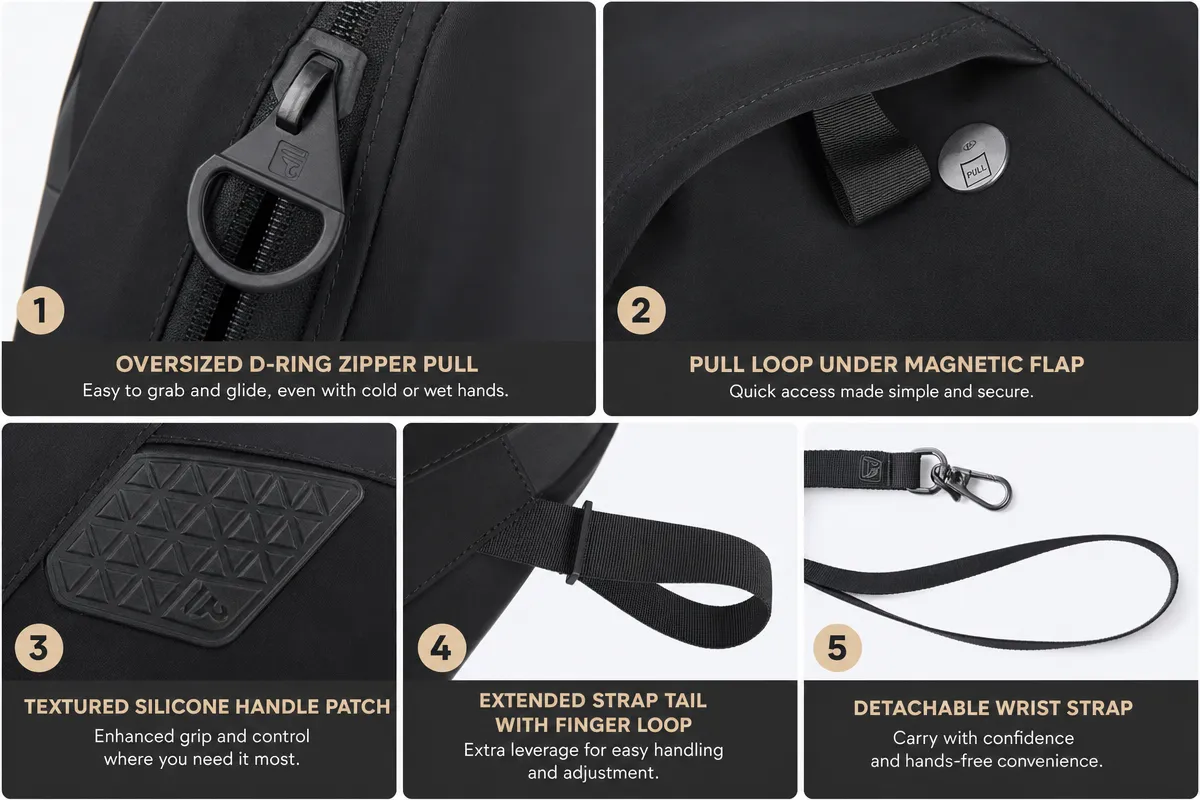
For users with reduced grip strength (arthritis, neurological conditions, prosthetic hands), even opening a well-designed magnetic closure can be challenging if the pull point is too small or too smooth.
| Feature | What It Is | Where It Goes | User Benefit | Cost |
|---|---|---|---|---|
| Oversized zipper pulls | D-ring pulls, 20–25 mm diameter, with leather or silicone grip tab | Every zipper on the bag | Can be hooked with a finger rather than pinched between fingertips | +0.30 per pull |
| Pull loops on flaps | 15–20 mm webbing or leather loops sewn to the underside of magnetic flap closures | Under every flap that the user needs to lift | Provides a finger-hook point for opening flaps with limited grip | +0.20 per loop |
| Textured grip patches | Silicone or rubberized grip zones on handles and strap shoulder pads | Handle underside, strap shoulder section | Prevents bag from sliding out of a weak grip | +0.50 |
| Extended strap tail with loop | The adjustment strap tail ends in a finger loop rather than a raw-cut end | Shoulder strap adjustment point | Allows one-hand strap adjustment by hooking a finger through the loop | +0.10 |
| Wrist strap (detachable) | Short wrist loop that attaches to the bag’s handle or D-ring | Bag handle or top D-ring | Secures the bag to the wrist for users who cannot maintain a grip | +0.60 |
These features cost a combined 1.70 per unit and collectively transform the tactile experience of using the bag. They should be specified on every adaptive bag — they are the details that occupational therapists recommend and that users mention most frequently in product reviews.
Adaptive bags must meet the same material and finishing standards as mainstream fashion bags — and in some cases, exceed them, because the bag may experience more contact with wheelchair frames, armrests, and medical equipment than a standard handbag.
| Material | Fashion Perception | Durability for Wheelchair/Adaptive Use | Wipe-Clean | Weight | Recommendation |
|---|---|---|---|---|---|
| Pebbled PU leather | Very high — reads as designer | Very good — pebble texture hides scuffs from chair contact | Excellent | Medium | Best overall — recommended default |
| Smooth PU leather | Very high — polished, editorial | Good — shows scratches from chair frames more readily | Excellent | Medium | Good for non-wheelchair users |
| Microfiber leather | Very high — closest to genuine | Excellent — superior abrasion resistance | Very good | Medium | Premium positioning |
| Genuine leather | Premium — luxury | Good — develops character but marks more easily | Moderate | Heavy — may add fatigue for users with limited strength | Use selectively — weight is a concern |
| Nylon (fashion-grade, 420D+) | Medium–High — modern, clean | Excellent — lightest, most durable | Excellent | Light — best for users where weight matters | Best for lightweight priority |
Weight is a more important specification in adaptive bags than in mainstream bags. A heavy bag on a wheelchair adds strain to push effort; a heavy bag on the shoulder or wrist of someone with limited strength accelerates fatigue. Target empty bag weight under 600 g for crossbody and shoulder bags, under 800 g for totes. Use lightweight hardware (zinc alloy, not brass), thin but adequate padding (5 mm, not 10 mm), and nylon webbing straps (not leather straps) to hit these targets.
Adaptive bags generally perform better in compact sizes. Large, heavy bags are harder to manage with limited strength or one-hand operation. The target consumer is not looking for maximum capacity — she is looking for a bag that holds her daily essentials in an organized, accessible layout.
| Format | Width | Height | Depth | Capacity | Contents | Primary User |
|---|---|---|---|---|---|---|
| Adaptive crossbody (hero) | 22–26 cm | 16–20 cm | 6–9 cm | 3–5 L | Phone, wallet, keys, medication, small essentials | Broadest — all mobility types |
| Adaptive shoulder tote (compact) | 30–35 cm | 24–28 cm | 10–14 cm | 8–12 L | All crossbody contents + tablet, planner, water bottle | Users who carry more; seated access important |
| Wheelchair-attached pouch | 18–22 cm | 14–18 cm | 5–7 cm | 1.5–3 L | Phone, cards, keys, medication | Wheelchair users — ultra-compact, always attached |
| Adaptive backpack | 28–32 cm | 38–42 cm | 12–16 cm | 12–18 L | Full daily carry including laptop | Users with back/shoulder strength; powered wheelchair users |
The adaptive crossbody is the recommended hero product. It serves the broadest range of mobility conditions, is compact enough for one-hand management, works both standing and seated, and can be adapted for wheelchair attachment with the adjustable loop straps.
How adaptive bags are described, photographed, and marketed is as important as how they are engineered. The adaptive consumer is attuned to language and imagery that patronizes, medicalizes, or inspires — and she rejects all three.
| Do | Do Not | Why |
|---|---|---|
| Show disabled models using the bag naturally — not “overcoming” | Show only able-bodied models “demonstrating” the features | The product is FOR disabled consumers; they should see themselves |
| Describe features functionally: “magnetic closure for easy one-hand opening” | Describe features emotionally: “designed to empower those who struggle” | Functional language respects competence; emotional language implies helplessness |
| Use identity-first OR person-first language as the community prefers (both are acceptable) | Use euphemisms: “differently abled,” “special needs,” “handicapable” | These terms are widely rejected by the disability community |
| Position adaptive features as good design that benefits everyone | Position adaptive features as charity or “giving back” | Good design is universal — magnetic closures, light weight, and easy access benefit ALL consumers |
| Include the product in your main collection, not a separate “adaptive” sub-site | Segregate adaptive products onto a separate “accessible” page | Separation implies the products are lesser; integration normalizes them |
| Price adaptive products at the same tier as your mainstream products | Price higher “because of the specialized features” or lower “because it’s a social mission” | Equal pricing signals equal product quality |
The most commercially effective framing for adaptive bags is universal design — the principle that products designed for accessibility are better products for everyone. Magnetic closures are easier for able-bodied users too. Lightweight construction benefits everyone. Organized, visible interiors help all consumers find their keys faster. A wheelchair strap is a feature; a front-access opening is a feature; an oversized zipper pull is a feature. Marketing them as features — not accommodations — normalizes the product and broadens the addressable market beyond the disability community to include elderly consumers, travelers, parents carrying children, and anyone who values effortless interaction with their bag.
| Buyer Type | Order Context | Typical Volume | Price Sensitivity | Channel |
|---|---|---|---|---|
| DTC adaptive fashion brand | Core product line | 100–1,000+ pcs per style | Low — consumer expects premium for quality | Own e-commerce site |
| Amazon FBA seller | Niche product targeting underserved keywords | 200–500 pcs initial run | Medium | Amazon — “adaptive” is a growing search filter |
| Occupational therapy clinics | Recommend to patients; some stock for sale | 10–50 pcs | Medium — needs to be affordable for patients | Direct, clinical supply |
| Corporate gifting / ERG programs | Employee gifts for disability ERG members or inclusive-branding programs | 50–200 pcs | Low — corporate budget, strong per-unit tolerance | Corporate procurement |
| Nonprofit / advocacy organizations | Branded merchandise, fundraiser items, awareness campaigns | 50–500 pcs | High — budget-constrained | Direct, grant-funded |
| Mainstream fashion brands adding inclusive SKUs | Extending an existing collection with adaptive variants | 200–1,000+ pcs | Medium | Existing retail + e-commerce channels |
The mainstream fashion brand adding inclusive SKUs segment is the fastest-growing B2B channel. Major retailers increasingly require or incentivize adaptive product offerings in their vendor assortments, and brands that can demonstrate adaptive capability capture shelf space and media attention that pure-fashion competitors cannot.
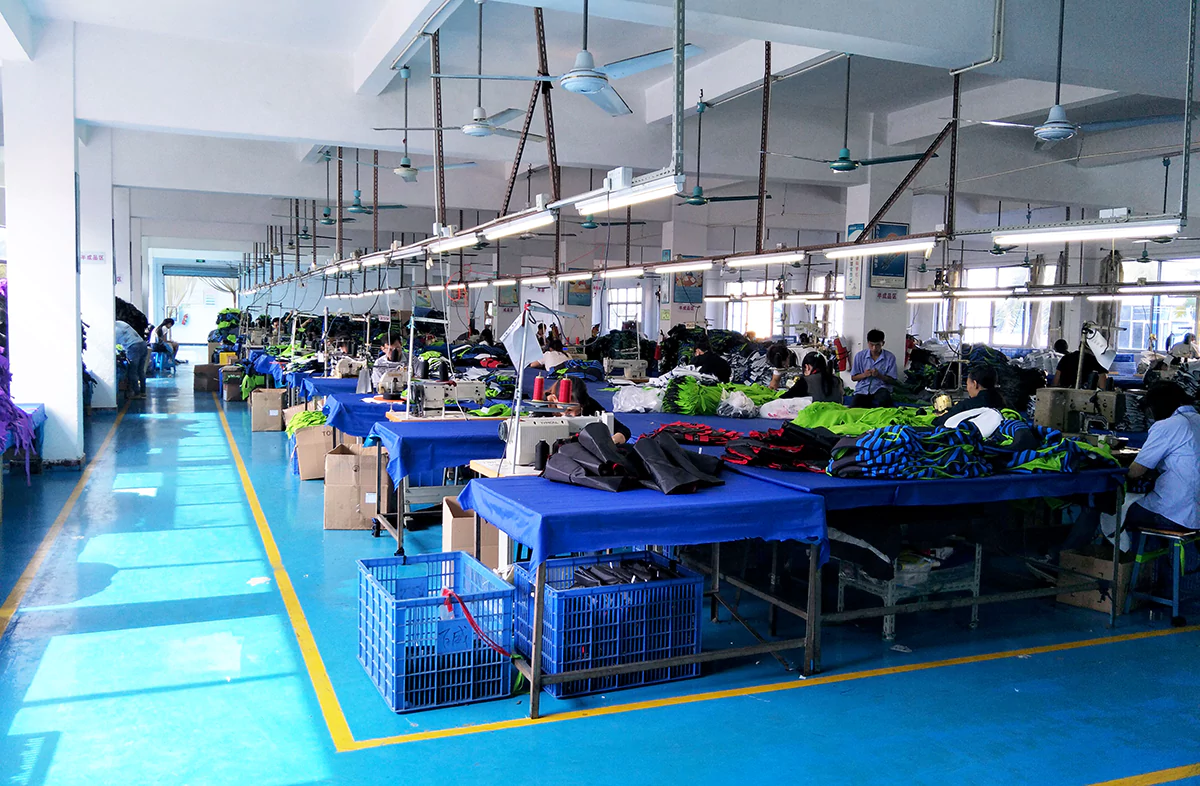
FYBagCustom is Your Trusted Custom Bag Manufacturer in China, with 15+ years of manufacturing experience producing multi-function bags, custom hardware integration, and specialized accessories for brands worldwide. For buyers developing adaptive handbags and wheelchair-attachable accessories, our capabilities include:
Our 50,000 m² factory in Guangzhou produces adaptive, multi-function, and inclusive-design bag programs for adaptive fashion brands, DTC sellers, mainstream fashion labels, corporate programs, and advocacy organizations across international markets.
Adaptive bag design is not about adding a wheelchair clip to an existing product. It is about re-engineering the fundamental interactions between a human body and a bag — opening, closing, reaching, gripping, carrying — so that they work for bodies with a wide range of ability. For B2B buyers developing adaptive bags in 2026, three core takeaways:
If your 2026 product line includes adaptive bags, wheelchair-attachable accessories, or inclusive fashion products, now is the time to specify magnetic hardware, wheelchair attachment systems, and seated-access layouts. Contact FYBagCustom to discuss adaptive engineering, magnetic closure options, and lightweight construction — and receive physical samples with one-hand operation and magnetic-force testing, typically within 5–7 days.
FYBagCustom’s OEM and ODM team works with adaptive fashion brands, DTC founders, mainstream labels, and inclusive-design companies to produce custom adaptive bags — with magnetic closures, wheelchair attachment systems, one-hand operation, lightweight construction, and fashion-grade finishing at low MOQ with samples in 5–7 days.
Start Your Custom Bag Project →