Tel/WhatsAapp:+86 18011919834
E-mail: chloe.x@fybagcustom.com

Tel/WhatsAapp:+86 18011919834
E-mail: chloe.x@fybagcustom.com
Send Your Inquiry Today

Who this guide is for: brand owners, product developers, and sourcing managers producing faux fur handbags, shearling-look totes, and plush accessories for the fall/winter season and the December–January gift peak. Faux fur is the biggest tactile story of FW26 — and one of the most technically unforgiving materials in bag production. Pile length changes every downstream decision. The backing fabric, not the fur, determines whether the bag holds a shape. And shedding — loose fibers transferring to the consumer’s coat — is the #1 quality complaint in the category and the review that kills a listing in gift season. This guide is the production playbook: fiber selection, pile specification, backing engineering, seam construction in pile, and the shedding-control protocol that separates a giftable plush bag from a lint problem.
Fur owned the FW26 runways. Faux fur coats at Gucci and Chanel, shearling across Louis Vuitton and Burberry, shaggy pile silhouettes at Bottega Veneta — and, decisively for the bag category, fur moved off the coat and onto the accessory: Stella McCartney trimmed the Falabella bag itself in faux fur, and Milan’s novelty hit was a faux-shearling clutch. The trend direction matters as much as the trend itself: FW26 fur is refined and lower-pile — shearling looks, calf-hair effects, and softer plush — a step back from the previous cycle’s oversized shag.
The commercial logic is equally clear. Fur bags convert hardest in the December–January window: they photograph as gifts, they occupy the “cozy” emotional register that holiday buying rewards, and their tactile appeal survives translation to video — a hand stroking a plush bag is a complete piece of content. And with genuine fur now a reputational liability for most mainstream brands (a handful of luxury houses excepted), faux is the only commercially safe play — which concentrates the entire opportunity on a synthetic material that most bag factories handle badly.
Faux fur punishes factories that treat it like a fabric. It is a pile system: fibers anchored in a backing, with direction, density, and length that interact with every cutting, sewing, and finishing decision. Get the system right and the bag is irresistible in hand. Get it wrong and the consumer opens her gift, strokes the bag once, and watches fibers cling to her sleeve.
A faux fur is three decisions, not one.
| Fiber | Characteristics | Hand-Feel | Shedding Tendency | Best For |
|---|---|---|---|---|
| Modacrylic | The premium faux-fur fiber; fine, soft, holds crimp and luster; inherently flame-resistant | The closest to animal fur — soft, dense, slightly cool | Lowest of the three (with proper backing anchor) | Premium and luxury-look programs; the fiber behind convincing “mink-look” and shearling-look furs |
| Acrylic | The volume standard; good softness and color range at moderate cost | Soft, slightly warmer and less lustrous than modacrylic | Moderate — quality varies widely by mill | Mid-market plush; high-pile statement pieces |
| Polyester | The budget fiber; also the fiber for specific effects (teddy/sherpa curl, boucle) | Ranges from plush (quality sherpa) to coarse (cheap pile) | Higher on straight pile; low on tightly curled sherpa (the curl locks fibers together) | Teddy/sherpa-look bags; budget programs; RPET recycled versions for sustainability positioning |
| Blends (modacrylic/acrylic, acrylic/polyester) | Mills blend to balance cost against hand-feel | Between the parent fibers | Depends on the blend and construction | Most commercial faux furs are blends; specify the ratio, not just “faux fur” |
The sustainability note: recycled-polyester (RPET) faux fur and sherpa are commercially available with GRS certification, and bio-based pile fibers are emerging (an FW26 Milan novelty was a faux-shearling bag made from potato-starch fiber). For brands with sustainability positioning, RPET sherpa is the production-ready option today; specify the GRS Transaction Certificate per our sustainability upgrade guide.
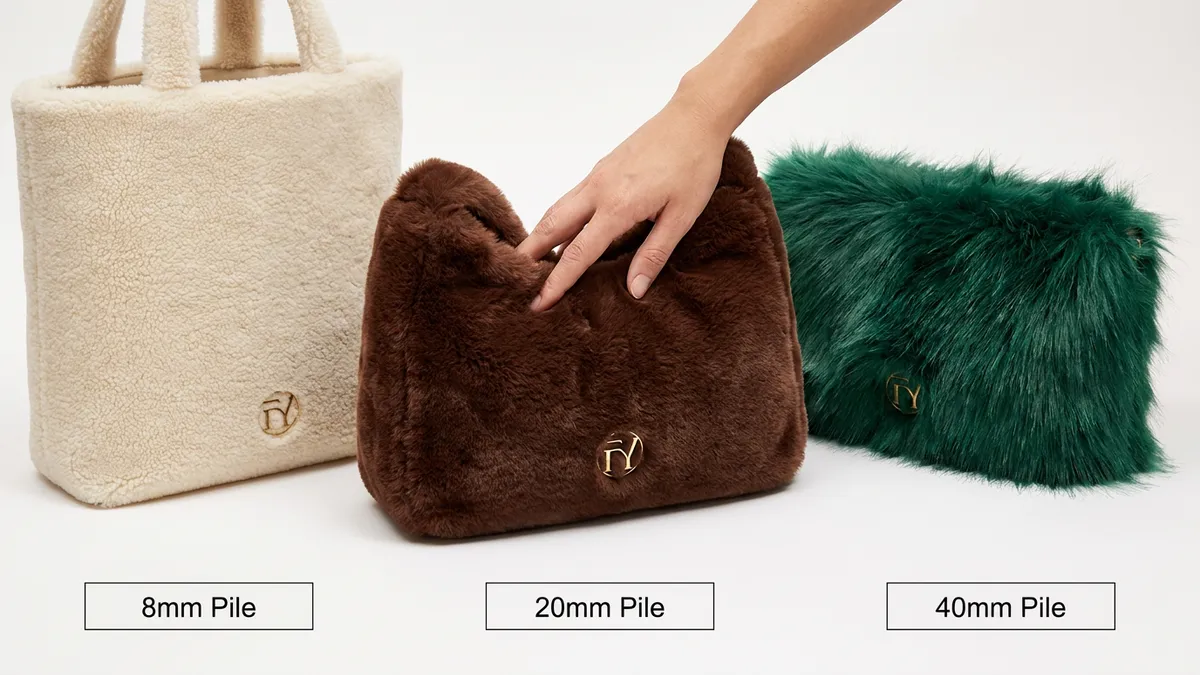
Pile length is the master variable — it determines the bag’s look, its construction method, its shedding risk, and its seam engineering.
| Pile Length | The Look | Construction Implications | Shedding Risk | FW26 Alignment |
|---|---|---|---|---|
| 6–12 mm (low pile) | Shearling, teddy, calf-hair effects — the refined end | Behaves closest to a normal fabric: seams stay slim, hardware mounts cleanly, edges finish conventionally | Lowest — short fibers anchor deeply relative to their length | The FW26 hero range — the season’s direction is refined low-pile, not shag |
| 15–25 mm (mid pile) | Classic plush — the “fur bag” the gift buyer pictures | Seams need pile-clearing (see below); hardware needs mounting patches; the pile begins to dominate the silhouette | Moderate — manageable with quality backing and finishing | The commercial core for gift-season plush |
| 30–50 mm (high pile) | Statement shag — editorial, maximal | Every construction step fights the pile: seams disappear into it, hardware sinks, closures snag | Highest — long fibers lever against their anchor with every touch | The content-driving statement SKU; produce in small quantities |
| Curled (sherpa/teddy) | The boucle curl — cozy, casual | Curl locks the surface together; the most forgiving pile to construct with | Low — the curl mechanically traps loose fibers | The volume play — sherpa totes are the category’s proven seller |
Pile density and direction: density (fibers per square centimeter) separates a rich fur from a sparse one — sparse pile shows its backing through the fibers under direct light, and no photograph hides it. Direction matters the way suede nap does, doubled: every panel must be cut with the pile lying the same way (downward, on a vertical bag), or adjacent panels read as different colors and the stroke test feels wrong in one direction.
The backing — the woven or knit substrate the pile is anchored into — is the structural truth of a faux fur bag. The fur is the surface; the backing is the material.
| Backing Type | Properties | Structural Behavior | Best For |
|---|---|---|---|
| Woven backing | Stable in both directions; minimal stretch | Holds panel shape; accepts fusible interfacing; the backing for structured fur bags | Totes and structured silhouettes — any bag that must hold a shape |
| Knit backing | Stretches, drapes, conforms | Cannot hold structure alone; panels grow and distort under load unless stabilized | Soft, slouchy fur bags — and only with a stabilizing layer bonded behind it |
| The anchor quality question | How firmly the pile is locked into the backing — the variable that determines shedding more than any other | — | Specify by test result, not by claim (see the shedding protocol below) |
The structural rule: a faux fur bag is built like a laminated composite — fur backing + fusible interfacing (bonded to the backing, never near the pile side) + optional foam + lining. The interfacing does on a fur bag exactly what it does on a PU bag: fills the panel, holds the silhouette, and prevents the “hollow squeeze.” Without it, a fur tote is a fur pillowcase.
Every negative review pattern in the faux fur bag category converges on one word: shedding. Fibers on the consumer’s coat. Fibers on the car seat. Fibers on the gift recipient’s sweater on December 25th. Shedding is not an inherent property of faux fur — it is the sum of four controllable production variables.
| Source | Mechanism | Production Control |
|---|---|---|
| 1. Weak pile anchor | The fibers were never firmly locked into the backing at the mill; every touch pulls a few free | Source from mills whose material passes the tape test (below) at incoming inspection; reject rolls that fail — no downstream step can fix a weak anchor |
| 2. Cut-edge fallout | Cutting the material severs thousands of fibers at every panel edge; these cut fragments migrate out of seams for weeks unless removed | Razor-cut from the backing side (cut the backing only, then pull the panels apart — the pile separates uncut); vacuum every cut panel before sewing; never scissor-cut through the pile |
| 3. Seam-trapped fragments | Pile crushed and severed inside seam allowances works loose through the seam line during use | Shear the pile from seam allowances before sewing (trim the allowance to 2–3 mm pile height); the seam then closes on backing, not on compressed fur |
| 4. Loose surface fiber | Manufacturing residue riding on the pile surface from the mill and the cutting room | Final-stage finishing: full-surface vacuuming plus air-blast cleaning of every finished bag before packing; a bag packed with residue sheds its residue onto the first thing it touches |
| Test | Method | Pass Criterion |
|---|---|---|
| Tape test (incoming material) | Press a strip of clear adhesive tape onto the pile with firm pressure; peel; inspect the tape | Scattered individual fibers: pass. Clumps or a visible fiber mat on the tape: reject the roll |
| Stroke test (finished bag) | Stroke the bag firmly 20 times with a dark microfiber cloth | Fewer than a light dusting of fibers on the cloth; no continued release on strokes 15–20 (release should taper, not persist) |
| Shake test (finished bag) | Shake the bag vigorously over a dark surface for 15 seconds | No visible fiber fall beyond isolated strands |
| Wear simulation (PP sample) | Rub the bag’s body panel against a dark wool swatch, 50 cycles, moderate pressure | The wool swatch shows minimal transfer; the bag’s pile shows no bald tracking |
Specification language: “Faux fur material: pile anchor to pass tape test at incoming inspection per roll. All panels razor-cut from backing side and vacuumed before assembly. Seam allowances sheared to 3 mm pile before sewing. Every finished unit vacuumed and air-cleaned before packing. PP sample to pass the 20-stroke and 50-cycle wear tests.”
| Challenge | The Problem | The Technique |
|---|---|---|
| Pile trapped in seams | Fur caught in the stitch line creates lumpy, gapping seams and a visible “crease” through the pile | Shear the allowance (as above); after sewing, work trapped fibers out of the seam from the right side with a pin or pile brush — the seam disappears into the pile |
| Seam bulk | Fur + backing + interfacing layers stack thick at seams | Shear allowances, grade the layers (trim each internal layer slightly shorter), and press from the backing side only — never iron the pile side; heat crushes and kinks synthetic pile permanently |
| Direction mismatches | Two panels sewn with opposing pile direction read as a color break at the seam | Direction-mark every cut panel on the backing side; QC checks direction match at panel pairing, before sewing |
| Element | The Fur Problem | The Specification |
|---|---|---|
| Hardware mounting | Hardware mounted through pile sinks into it, sits crooked on the compressible surface, and works loose | Shear a mounting footprint to 2–3 mm pile; mount the hardware through a leather or PU trim patch bonded over the sheared zone — the patch gives the hardware a firm, flat seat and reads as an intentional design detail |
| Zippers | Pile feeds into the zipper coil — the single most common functional failure on fur bags; a jammed zipper on a gift is a returned gift | Sheared pile channels (5–8 mm clear on both sides of the zip tape) plus a PU or grosgrain zip guard strip sewn along the tape; specify the 20-cycle zip test on every PP sample with the bag stuffed (stuffing pushes pile toward the coil) |
| Magnetic snaps | Snap halves buried in pile fail to align and engage | Mount both halves on trim patches over sheared zones |
| Handles and straps | Fur handles crush, mat, and soil within weeks at the grip zone | Handles and straps in leather or PU — the contrast is the industry standard (fur body, smooth handles) because fur cannot survive the grip; anchor points reinforced with patches per standard practice, mounted through sheared, trim-patched zones |
| Edges | Fur has no finishable edge — the pile hides any edge treatment | All exposed structural edges (handle, straps, trim) belong to the leather/PU components; fur panel edges live inside seams, always |
| Base | A fur base panel mats, soils, and collects debris from every surface the bag touches | Base panel in PU or leather (matching the handles), with base feet; the fur stops at the base seam |
The design pattern that solves most of this: the FW26 fur bag is rarely all fur. The commercial formula is fur body + smooth trim system — leather or PU handles, base, zip surrounds, and hardware patches. The trim system carries every functional element that pile defeats, and the material contrast reads as considered design. Stella McCartney’s fur-trimmed Falabella works the same logic in reverse — fur as the accent on a structured bag — which is the lower-risk entry point for brands testing the category.
| SKU | Pile Spec | Construction | Role |
|---|---|---|---|
| Sherpa tote | Curled polyester or RPET sherpa, cream/oat | Woven backing + fusible; PU handles, base, and top band | The volume seller — the proven cozy-casual formula; the lowest shedding risk in the line |
| Low-pile shearling-look shoulder bag | 8–12 mm modacrylic or blend, chocolate/camel/black | Structured build; leather-look trim; suede-effect backing details | The FW26 trend hero — matches the season’s refined direction |
| Mid-pile plush crossbody | 18–22 mm plush, one neutral + one bold color | Soft-structured; full trim system; zip guard mandatory | The gift-season core — the bag under the tree |
| High-pile statement mini | 35–45 mm shag, one saturated color | Simple silhouette (the pile IS the design); minimal hardware | The content SKU — small run, editorial photography, social video |
Colorway note: the FW26 palette runs two tracks — the refined naturals (chocolate, camel, cream, black — the shearling register) and the bold plush colors the season’s runways played with. One bold SKU earns its place as the scroll-stopper; the naturals carry the volume.
| Milestone | Timing | Note |
|---|---|---|
| Material selection + tape testing | May–June | Fur mills’ FW books are open; test candidate materials before committing |
| Sampling | June–July | Fur samples need the full shedding protocol run on the PP — allow one revision round |
| Bulk production | August–September | Fur bags are bulkier per unit than smooth bags; carton counts drop and freight volume rises — plan the shipping math per our volumetric guide |
| Ocean freight | September–October | In warehouse by early November |
| Holiday selling window | November–January | The gift peak; restock decisions by mid-December are already too late for ocean — hold an air-freight contingency for a runaway SKU |
The window is unforgiving: fur bags sell in a 10-week window. A production delay that costs three weeks in September costs a third of the season. Compress nothing; buffer everything.
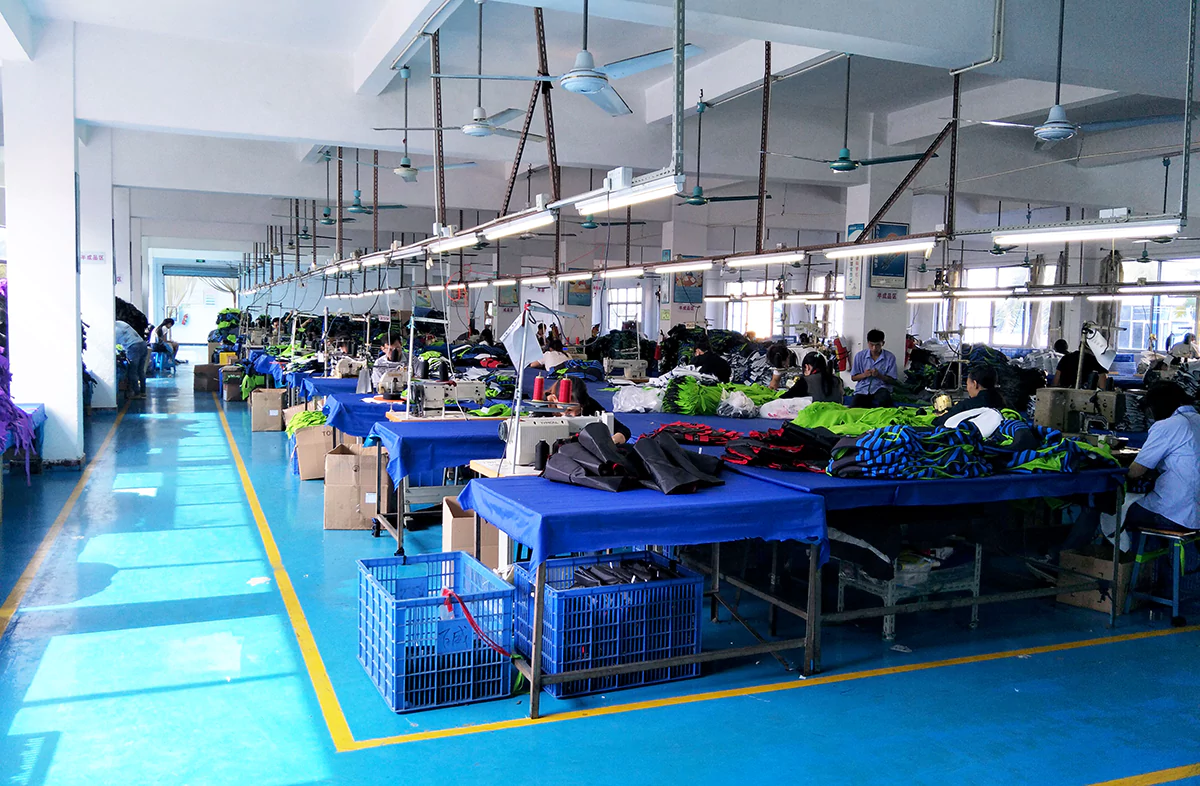
FYBagCustom is Your Trusted Custom Bag Manufacturer in China, with 15+ years of manufacturing experience including the pile-handling discipline that faux fur demands. For brands producing FW26 fur programs, our capabilities include:
Contact our development team to brief your FW26 fur program — sherpa totes, shearling-look shoulder bags, plush gift SKUs, or fur-trim accents.
Faux fur rewards the factories that treat it as a pile system and punishes the ones that treat it as a fuzzy fabric. For B2B buyers building FW26 fur programs, three core takeaways:
If you are building an FW26 fur program and need a factory with pile-handling discipline, shedding QC, and a seasonal calendar built around the December peak, contact FYBagCustom to brief your line — and receive shedding-tested samples in 7–10 days.
FYBagCustom builds faux fur bags with tape-tested materials, razor-cut panels, sheared seams, trim-mounted hardware, and full shedding QC on every unit — scheduled to hit the December gift peak. Shedding-tested samples in 7–10 days.
Start Your Custom Bag Project →