Tel/WhatsAapp:+86 18011919834
E-mail: chloe.x@fybagcustom.com

Tel/WhatsAapp:+86 18011919834
E-mail: chloe.x@fybagcustom.com
Send Your Inquiry Today

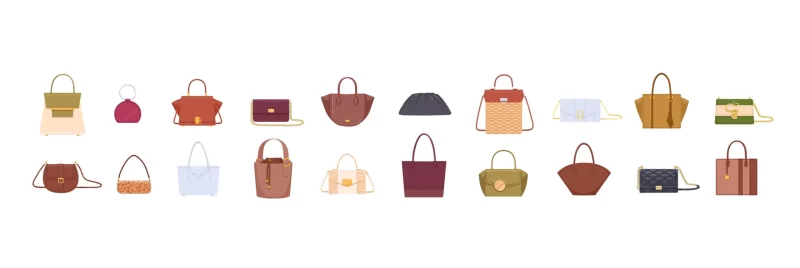
Who this guide is for: brand owners, product developers, sourcing managers, DTC founders, and private label developers who are engineering handbags with hidden expandable capacity — bags that present a slim, minimalist silhouette when lightly loaded but expand dramatically to accommodate a full day’s or weekend’s worth of contents through concealed accordion gusset construction. If you want to understand how factories engineer pleated gusset panels that fold flat inside the bag’s profile, how the pattern geometry enables controlled expansion without distorting the exterior, and how to specify this structurally demanding construction in a tech pack for OEM production — this guide covers the folding architecture, the material science, the reinforcement strategy, and the QC protocols specific to accordion gusset bags.
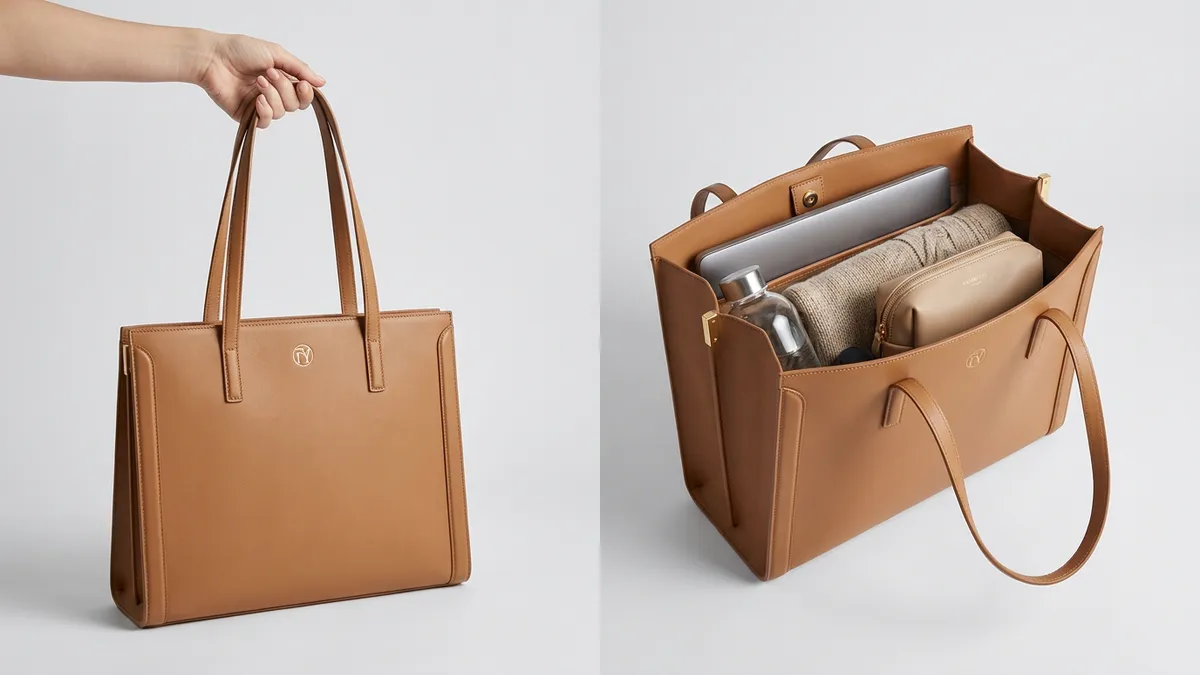
The minimalist handbag has a fundamental contradiction. The consumer wants a bag that looks slim (clean lines, flat profile, architectural proportions) and holds everything (laptop, water bottle, wallet, sunglasses, cosmetics pouch, phone, keys, a light layer for the evening). These two desires are geometrically opposed: volume requires depth, and depth destroys the slim profile that the consumer selected the bag for in the first place.
The hidden accordion gusset resolves this contradiction through engineering rather than compromise. The gusset — the side panel that connects the bag’s front and back — is constructed with concealed pleats (accordion folds) that collapse flat when the bag is lightly loaded, maintaining the slim profile, but expand outward when the bag is filled, multiplying the internal capacity by 2–3× without changing the bag’s height, width, or exterior design language.
The bag presents one face to the world (the minimalist exterior) and reveals another to its owner (the expandable interior). From the outside, it is a 7–8 cm slim tote. From the inside, it is a 18–22 cm full-capacity carry-all. The transition between these two states is seamless — the accordion gusset expands gradually as the consumer adds contents, with no zippers to unzip, no snaps to unsnap, and no visible “expansion mechanism.” The bag simply grows.
For B2B buyers, the accordion gusset bag occupies a high-value niche: it solves a genuine daily problem (the bag that works for both the morning commute and the after-work gym stop, the office meeting and the weekend market), it demonstrates visible engineering sophistication that justifies premium pricing, and the “watch this expand” moment is inherently shareable content. The challenge is entirely on the manufacturing side — accordion gussets are among the most technically demanding constructions in handbag production, requiring precision pattern cutting, exact fold placement, and reinforcement strategies that most factories have limited experience with.
An accordion gusset is a side panel constructed from a single continuous piece of material that is pleated — folded back and forth in a zigzag pattern (like the bellows of an accordion) — so that the folds nest inside each other when collapsed and spread apart when expanded.
| State | Gusset Appearance | Bag Depth | Capacity |
|---|---|---|---|
| Collapsed (lightly loaded or empty) | The pleats are folded flat against each other; the gusset presents a slim edge that is only as thick as the combined material layers | 6–8 cm (the width of the collapsed pleat stack) | Minimal — the bag holds flat items (tablet, documents, slim wallet) |
| Partially expanded (moderate load) | Some pleats have opened; the gusset shows a partial zigzag | 12–16 cm | Moderate — the bag holds a laptop, a medium wallet, and a few accessories |
| Fully expanded (maximum load) | All pleats are open; the gusset displays its full zigzag depth | 18–25 cm | Maximum — the bag holds a laptop, water bottle, sweater, cosmetics pouch, and full daily carry |
The expansion ratio is the relationship between the bag’s collapsed depth and its fully expanded depth. This ratio is determined by the number of accordion folds and the depth of each fold.
| Number of Folds | Fold Depth (each) | Collapsed Depth | Expanded Depth | Expansion Ratio |
|---|---|---|---|---|
| 2 folds (simplest) | 4 cm each | ~7 cm | ~15 cm | 2.1× |
| 3 folds (standard) | 4 cm each | ~7 cm | ~19 cm | 2.7× |
| 4 folds (maximum practical) | 4 cm each | ~8 cm | ~24 cm | 3.0× |
| 3 folds (deeper folds) | 5 cm each | ~8 cm | ~23 cm | 2.9× |
The 3-fold accordion at 4–5 cm fold depth is the recommended default. It provides a 2.5–3.0× expansion ratio — enough to transform a slim commuter tote into a full-capacity carry-all — while keeping the collapsed profile within the 7–8 cm range that reads as “slim” to the consumer. Two folds provide insufficient expansion to justify the construction complexity; four folds create a collapsed profile that is noticeably thick (the stacked pleat layers add up).
Accordion gusset construction begins on the cutting table. The gusset panel must be cut as a single continuous piece with fold lines precisely marked, because any misalignment in the fold positions propagates through the entire expansion mechanism — a fold that is 3 mm off-center at the cutting stage becomes a visible asymmetry in the finished bag.
A three-fold accordion gusset panel, laid flat before folding, looks like a wide strip with six fold lines (three mountain folds and three valley folds, alternating). The total width of the flat panel equals the sum of all fold segments plus the two end segments that attach to the front and back panels.
| Segment | Width | Function |
|---|---|---|
| Front attachment tab | 2–3 cm | The edge that is sewn to the bag’s front panel; this is NOT part of the accordion — it is a flat seam allowance |
| Fold segment 1 (mountain fold) | 4–5 cm | The first visible “pleat” — this segment folds outward when expanded |
| Fold segment 2 (valley fold) | 4–5 cm | Folds inward, nesting against segment 1 when collapsed |
| Fold segment 3 (mountain fold) | 4–5 cm | Folds outward — the deepest point of the expansion |
| Fold segment 4 (valley fold) | 4–5 cm | Folds inward, nesting against segment 3 |
| Fold segment 5 (mountain fold) | 4–5 cm | Folds outward |
| Fold segment 6 (valley fold) | 4–5 cm | Folds inward — the last pleat |
| Back attachment tab | 2–3 cm | The edge sewn to the bag’s back panel |
| Total flat width | 28–37 cm (for a 3-fold accordion with 4–5 cm segments) | This single piece of material, when folded, collapses to just 7–8 cm |
The fold lines on the accordion gusset pattern must be marked and scored with a tolerance of ±1 mm. Here is why:
| If fold lines are accurate (±1 mm) | If fold lines are off by 3+ mm |
|---|---|
| All pleat segments are equal width | Pleat segments are visibly unequal — some fat, some thin |
| The collapsed gusset folds flat and symmetrically | The collapsed gusset bunches unevenly — some folds stack neatly, others protrude |
| The expanded gusset opens symmetrically — left and right sides match | The expanded gusset is asymmetric — one side opens more than the other; the bag leans or distorts |
| The fold lines align with the bag’s top and bottom edges | Fold lines drift — the pleats do not run parallel to the bag’s horizontal axis; the bag looks “twisted” |
How to achieve fold-line precision:
| Method | Accuracy | Best For |
|---|---|---|
| Laser-cut scoring (the fold lines are lightly scored by laser on the material’s back surface) | Excellent — ±0.5 mm | Premium programs; genuine leather and PU leather; the recommended method |
| Metal-rule die scoring (a scoring die with metal rules at the fold positions is pressed into the material) | Very good — ±1 mm | Mid-to-premium programs; PU leather and coated fabrics |
| Manual marking (fold lines drawn or traced from a template) | Moderate — ±2–3 mm depending on operator skill | Only if laser or die scoring is unavailable; requires highly experienced operators |
The accordion gusset must be exactly the same height as the front and back panels. If the gusset is even 2 mm taller, the excess material creates a visible ridge along the top seam. If 2 mm shorter, the gusset pulls the top seam inward, creating a dip. Both defects are immediately visible on a minimalist bag where clean, straight top lines are the defining aesthetic.
Specification: “Accordion gusset height must match front and back panel height to within ±1 mm. Verify by measuring all three components (front, back, gusset) after cutting and before assembly. Reject any gusset that deviates by more than 1.5 mm.”
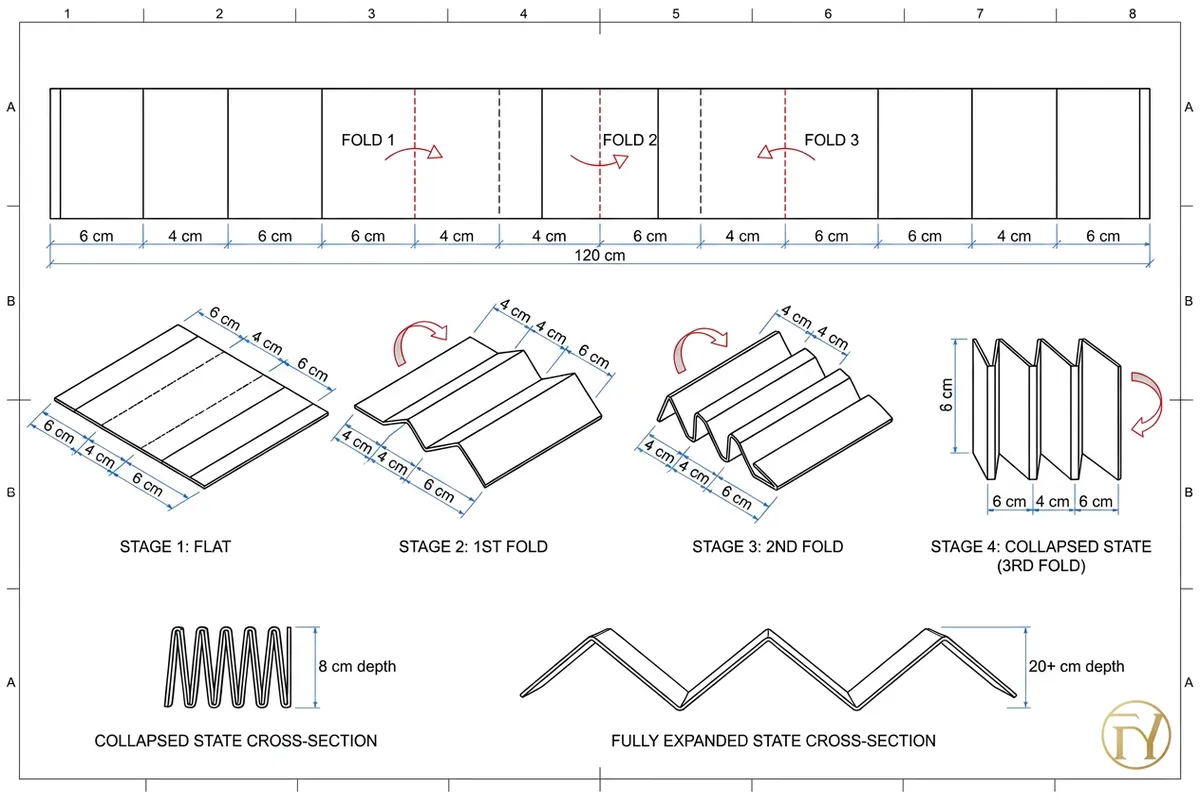
Not all accordion gussets are built the same way. Three architectural approaches exist, each with different visual, structural, and functional characteristics.
| Architecture | How the Pleats Are Constructed | Visual When Expanded | Visual When Collapsed | Complexity | Best For |
|---|---|---|---|---|---|
| Exposed accordion (visible pleats) | The pleats are visible from the exterior — the zigzag pattern is the design feature | The accordion folds are proudly displayed as a textural, architectural detail | The folds compress visually — the zigzag is still readable but tighter | Moderate | Bags where the accordion IS the design statement — the engineering is celebrated, not hidden |
| Hidden accordion (concealed pleats) | The pleats are hidden behind the front and back panels — the gusset tucks entirely behind the bag’s main surfaces when collapsed | When expanded, the gusset emerges from behind the panels like a hidden compartment opening | When collapsed, the gusset is invisible — the bag appears to have no gusset at all; just a slim gap between front and back | High — the panels must be sized and shaped to fully conceal the gusset in its collapsed state | Bags where the minimalist exterior must show NO indication of the expansion capability — maximum stealth |
| Hybrid (partially concealed) | The gusset is visible at the top but concealed at the sides and bottom — a slim strip of accordion is visible, signaling expansion capability without dominating the design | A controlled reveal — the consumer can see the accordion at the top edge but the sides appear clean | The visible strip is minimal; the bag reads as slim with a subtle “something interesting” at the top | Medium–High | The commercial sweet spot — the consumer can see the expansion feature (which helps in product photography and in-store discovery) without the exterior being dominated by accordion folds |
For most commercial handbag programs, the hybrid architecture is recommended. It offers the best balance between minimalist exterior aesthetics and consumer comprehension of the expansion feature.
The problem with the fully hidden accordion: the consumer does not know the bag expands until she is told. In a retail environment, she may never discover the feature. In e-commerce, the feature must be demonstrated in photography and video — adding content production requirements.
The hybrid architecture solves this by providing a visible cue (a slim strip of accordion folds visible at the top edge) that communicates “this bag has more to offer” while keeping the side and bottom profiles clean and minimal. The consumer sees the cue, explores the bag, discovers the expansion — and the discovery moment becomes a selling moment.
The accordion gusset material must endure hundreds or thousands of fold-unfold cycles over the bag’s lifetime without developing permanent crease marks, cracking at the fold lines, or losing its ability to collapse flat. This makes fold durability the primary material selection criterion — more important than color range, softness, or cost.
| Material | Fold Durability (cycles before visible degradation) | Fold Mark Recovery | Cracking Risk at Fold Lines | Weight | Recommendation |
|---|---|---|---|---|---|
| Garment-grade soft PU leather | 5,000–10,000+ cycles | Very good — fold marks disappear within minutes | Very low — the fabric backing prevents the PU surface from cracking | Light | Excellent — the recommended default for most programs |
| Full-grain calfskin (0.7–0.9 mm) | 2,000–5,000 cycles (depends on finish) | Good — leather’s natural elasticity recovers the fold, but a slight “memory” may develop over years | Low–Moderate — unfinished leather at tight fold radii can develop micro-cracks over many cycles; a light topcoat prevents this | Medium | Good — for premium programs; specify a flexible finish and ≤0.9 mm thickness |
| Lambskin (0.5–0.7 mm) | 1,000–3,000 cycles | Moderate — lambskin’s thinness means fold marks may become visible sooner | Moderate — the thinnest leathers are most vulnerable to fold-line cracking | Light | Conditional — only for designs where the accordion gusset is NOT the primary flex zone; the gusset may need a PU or fabric backing for reinforcement |
| Nylon (technical, 100D+) | 50,000+ cycles | Excellent — nylon has virtually zero fold memory | Very low — nylon does not crack | Very light | Excellent — for sport-lifestyle and travel bags; the best fold durability |
| Canvas (10–14 oz) | 3,000–8,000 cycles | Moderate — canvas holds fold marks more than PU or nylon; fold marks may become part of the aesthetic | Low — canvas fibers are flexible; cracking is not a concern | Medium | Good — for heritage and casual-premium positioning; the fold marks become “character” |
| Microfiber leather | 5,000–10,000+ cycles | Very good | Very low | Light | Very good — similar fold performance to PU with a more leather-like hand-feel |
At each fold line, the material bends at its tightest radius — the point of maximum stress. Over thousands of cycles, this stress can cause:
These failures can be prevented with fold-line reinforcement — a flexible strip of material applied to the back of the gusset at each fold line, distributing the bending stress across a wider area.
| Reinforcement | Material | Application | Fold-Life Extension |
|---|---|---|---|
| Bias tape backing | Woven bias tape (cotton or nylon) glued or sewn along each fold line on the gusset’s interior face | Adhesive or catch-stitch — the tape must be flexible enough to fold with the material | 2–3× — the tape distributes stress and prevents localized cracking |
| Flexible fusible strip | A 2–3 cm strip of lightweight flexible fusible interlining applied at each fold line | Fused (ironed) to the gusset’s interior at each fold position | 1.5–2× — the fusible adds a thin flexible reinforcement without adding bulk |
| None (for high-durability materials) | N/A | N/A | N/A — nylon, technical PU, and high-durability microfiber may not need fold-line reinforcement |
Recommendation: for PU and genuine leather accordion gussets, bias tape reinforcement at every fold line is recommended as standard. The labor cost is modest (one strip per fold × 6 folds = 6 strips per gusset × 2 gussets = 12 strips per bag), and the fold-life extension is significant. For nylon and technical fabrics, fold-line reinforcement is optional.
The accordion gusset multiplies the bag’s internal volume — but expanded volume without organization creates a cavernous, disorganized interior where contents sink to the bottom and become impossible to find. The interior architecture must provide organized access within the expandable space.
| Element | Location | Purpose | Construction Note |
|---|---|---|---|
| Central divider (removable) | A soft panel that divides the interior into front and back zones, suspended from the top seam | Prevents all contents from pooling into a single mass; creates two organized zones (e.g., tech items in front, personal items in back) | Must be flexible and removable — a rigid divider would prevent the accordion from collapsing; attach with snaps or Velcro at the top seam |
| Padded laptop sleeve | Back wall of the interior, against the back panel | Protects the laptop within the expandable space; the sleeve is sewn to the back panel (which does not move during expansion) | Standard padded sleeve construction; 10 mm foam; Velcro or elastic top closure |
| Slip pockets (flat, on the back panel) | Back panel interior face, above and below the laptop sleeve | Phone, wallet, cards — items that should be accessible without rummaging | Flat pockets sewn to the BACK PANEL (not the gusset) — the back panel is stable; the gusset moves |
| Zip pocket (on the front panel interior) | Front panel interior face | Secure storage for valuables | Same principle — sewn to the FRONT PANEL, not the gusset |
| Key leash | Attached to a D-ring on the back panel interior | Keys — the most-lost item in a deep bag | Retractable cord clip, 15–20 cm |
Critical rule: no pockets, sleeves, or organizational elements should be attached to the accordion gusset itself. The gusset must fold and unfold freely — any attached element would interfere with the folding mechanism, preventing the bag from collapsing properly. All interior organization is attached to the front panel or back panel, which are stable, non-moving surfaces.
The accordion gusset bag’s exterior must communicate “minimalist” regardless of its expansion state. This means the exterior design should not change appearance dramatically between collapsed and expanded modes — the bag should look intentional and composed in both states.
| Principle | What It Means | How to Achieve It |
|---|---|---|
| Clean top line | The bag’s top edge should remain a straight, unbroken horizontal line whether collapsed or expanded | The accordion gusset attaches to the top seam at a single point (or a narrow strip); it does not ripple, bunch, or distort the top edge during expansion |
| Consistent handle integration | The handles should sit at the same angle and position regardless of the bag’s depth | Handles attach to the front and back panels (which do not move) — not to the gusset; the handle position is fixed regardless of expansion state |
| No visible hardware for expansion | The expansion mechanism should be purely structural (the pleats open under the weight of contents) — no zippers, snaps, or buckles that “unlock” the expansion | The accordion gusset opens passively — gravity and content volume push the pleats apart; no consumer action is required beyond placing items in the bag |
| Symmetrical expansion | Both gussets (left and right) must expand equally; asymmetric expansion makes the bag look distorted | Specify identical gusset panels (same material, same fold positions, same fold-line reinforcement); QC test by loading the bag centrally and verifying equal expansion on both sides |
| Proportional silhouette in both states | The bag should look well-proportioned when slim (collapsed) AND when full (expanded) — not “too thin” when empty or “too boxy” when full | Design the bag’s height-to-width ratio to work at both depth extremes; a 2:3 height-to-width ratio generally maintains attractive proportions across the full expansion range |
Some accordion bag designs include a slim-mode retention feature — a mechanism that holds the gusset in its collapsed position, preventing the bag from expanding unless the consumer releases the retention.
| Retention Method | How It Works | Consumer Interaction | Best For |
|---|---|---|---|
| Internal magnetic snaps | Magnets on the inner faces of the front and back panels hold the panels together, keeping the gusset collapsed | The magnets release naturally when enough contents are placed inside (the weight overcomes the magnetic force); or the consumer manually pulls the panels apart | The most elegant — no visible mechanism; the bag “chooses” to expand when enough contents justify it |
| Strap + snap at the gusset | A short leather strap with a snap closure bridges the collapsed gusset, holding it folded; the consumer unsnaps to expand | The consumer unsnaps the retention strap when she wants full capacity | More deliberate — the consumer makes an active choice to expand; good for bags that are used in both “slim meeting mode” and “full carry mode” |
| No retention (free expansion) | The gusset opens and closes freely based on contents | No consumer interaction — the bag self-regulates based on contents | The simplest; appropriate when the consumer always carries a similar load |
| Silhouette | Accordion Benefit | Why It Works | Recommended Fold Count | Target Consumer |
|---|---|---|---|---|
| Structured tote (the hero format) | Maximum — the tote is the silhouette most constrained by the slim-vs-capacity trade-off | The tote carries the widest range of daily items; the accordion allows it to be slim for commuting and full for errands | 3 folds | The professional woman who commutes, works, and shops with one bag |
| Work bag / laptop bag | Very high — the laptop + documents + accessories loadout varies daily | Monday (laptop + notebook) = slim mode; Friday (laptop + gym clothes + lunch) = expanded mode | 3 folds | The hybrid worker whose daily loadout varies |
| Crossbody (medium) | Good — a compact crossbody that expands for shopping or travel | The crossbody starts at phone-wallet-keys slim and expands to accommodate impulse purchases or a light jacket | 2 folds | The urban explorer; the traveler who wants one bag for the day |
| Shoulder bag | Good — similar to the tote but at a smaller scale | The accordion allows a medium shoulder bag to hold substantially more than its appearance suggests | 2–3 folds | The everyday carrier who values a moderate-sized bag that “holds more than it looks” |
| Weekender / travel bag | Moderate — weekenders are already large; the accordion adds expansion for the return trip (souvenirs, shopping) | “Pack light on the way there; expand on the way back” — the accordion accommodates the asymmetric packing reality of travel | 2–3 folds | The traveler who buys things at the destination |
| Clutch / document holder | Niche — a slim document clutch that expands to hold a tablet and accessories | Useful for meetings and conferences where the loadout grows during the day (handouts, swag, business cards received) | 1–2 folds | The conference attendee; the meeting-goer |
Accordion gusset bags follow the minimalist hardware philosophy: the fewer hardware elements, the cleaner the design. The accordion mechanism is purely structural — no hardware is needed to operate it. Hardware should be limited to closures, carry attachment, and branding.
| Component | Specification | Why |
|---|---|---|
| Main closure | Concealed magnetic snap (within the top-edge seam allowance) or a minimal zip | The closure should not compete visually with the clean exterior; concealed magnets are the most minimal option |
| Handles | Stitched or riveted to the front and back panels — not to the gusset | Handles must be on stable, non-moving panels; gusset-attached handles would shift position during expansion |
| D-ring (interior) | For key leash or removable pouch clip; sewn to the back panel interior | Functional interior hardware; invisible from outside |
| Base feet | 4 metal feet, matching finish | The bag will be set on surfaces at various expansion depths; feet protect the base in any configuration |
| Brand hardware | Single logo plate (15–20 mm) or debossed logo on the front panel | Minimalist branding — one element maximum; the accordion engineering is the statement |
Standard bag QC tests (stitching, alignment, hardware function) apply, but accordion bags require additional tests that verify the expansion mechanism’s performance.
| Test | Method | Pass Criteria | Why This Test |
|---|---|---|---|
| 1. Expansion symmetry | Load the bag with 3 kg of contents distributed centrally; measure the expanded depth on both gussets | Left and right gusset expansion depth within ±3 mm of each other | Asymmetric expansion means the fold lines are misaligned between the two gussets; the bag leans or distorts |
| 2. Collapse test | Remove all contents; press the front and back panels together; measure the collapsed depth | Collapses to within ±2 mm of the design target (typically 7–8 cm); all folds nest flat without bunching | If the gusset does not collapse fully, a fold is misaligned, a reinforcement strip is too stiff, or excess material is trapped in the folds |
| 3. Fold-cycle durability | Expand and collapse the gusset 200 times (simulating ~6 months of daily use); inspect fold lines for cracking, delamination, or permanent crease marks | No visible cracking, no delamination, no permanent marks visible at arm’s length | The fold lines are the highest-stress zone; this test verifies fold-line reinforcement is adequate |
| 4. Top-line straightness | With the bag both collapsed and expanded, photograph the top edge from directly above | The top edge is a straight horizontal line (±1 mm deviation) in both states | A wavy top line means the gusset is distorting the top seam during expansion or collapse |
| 5. Load distribution | Fill the bag to maximum capacity; carry on one shoulder for 5 minutes; inspect for strap stress, seam stress, and shape distortion | No seam separation, no strap deformation, no gusset tearing at the panel attachment points | Maximum-load carry is the highest-stress use scenario; the front-to-gusset and back-to-gusset seams must hold under full load |
Before approving an accordion gusset bag for bulk production, perform all five tests on the PP sample. In addition, perform a 72-hour flat-storage test: collapse the bag, place it flat under 2 kg of weight for 72 hours (simulating storage or shipping), then remove the weight and expand the bag. The gusset should return to full expansion capability with no permanent deformation of the folds.
| SKU | Silhouette | Collapsed Depth | Expanded Depth | Expansion Ratio | Folds | Hero Use Case |
|---|---|---|---|---|---|---|
| The Commuter (hero) | Structured tote with padded laptop sleeve | 7 cm | 19 cm | 2.7× | 3 | Morning commute (slim) → after-work errands (expanded) |
| The Day Bag | Medium crossbody with adjustable strap | 5 cm | 13 cm | 2.6× | 2 | Sightseeing (slim) → shopping finds (expanded) |
| The Traveler | Large weekender with shoulder strap + trolley sleeve | 10 cm | 25 cm | 2.5× | 3 | Outbound trip (slim, packed light) → return trip (expanded, souvenirs aboard) |
| Challenge | Why It Occurs | Factory Solution |
|---|---|---|
| Fold-line precision across all units | Each bag requires 12 precisely positioned fold lines (6 per gusset × 2 gussets); manual marking introduces variability | Laser scoring or die scoring — eliminate manual marking entirely; every bag receives identical fold positions |
| Gusset-to-panel seam alignment | The gusset’s top and bottom edges must align exactly with the front and back panel edges; any mismatch creates visible bulging or puckering at the seam | Pre-assembly dimension check — measure all three panels (front, back, gusset) after cutting and before assembly; reject any panel that deviates by more than 1.5 mm |
| Fold-line reinforcement application | Bias tape or fusible strips must be positioned exactly at each fold line; off-center reinforcement causes uneven fold behavior | Guided application jig — a simple alignment tool that positions the reinforcement strip at the exact fold location; eliminates placement guesswork |
| Bulk consistency | Every bag in a 200-unit order must have identical expansion behavior — the accordion is a visible, testable mechanism where unit-to-unit variation is immediately noticeable | First-article inspection — produce and fully test the first 3 units before continuing the bulk run; verify expansion depth, symmetry, collapse, and fold-cycle durability on these first articles |
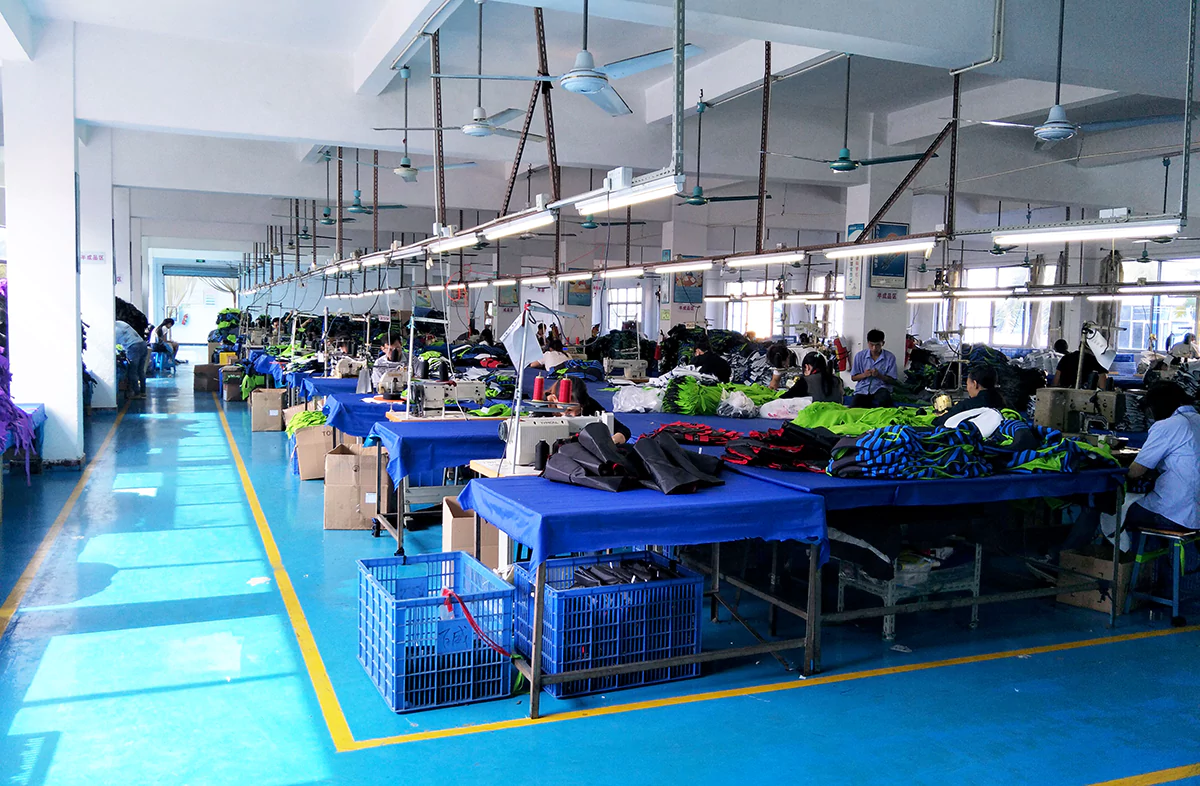
FYBagCustom is Your Trusted Custom Bag Manufacturer in China, with 15+ years of manufacturing experience and a pattern engineering team experienced in complex structural constructions. For brands developing accordion gusset bags, our capabilities include:
Explore our full range of custom bag types or contact our pattern engineering team to discuss accordion gusset specifications for your collection.
The accordion gusset is engineering at its most elegant — it solves the fundamental contradiction of minimalist bag design (slim appearance vs. generous capacity) without compromise, without visible mechanism, and without requiring the consumer to do anything except fill the bag. For B2B buyers developing expandable-capacity bags, three core takeaways:
If your collection needs bags that solve the slim-vs-capacity problem — commuter totes, expandable crossbodies, or variable-depth travel bags — now is the time to engineer the accordion gusset pattern, specify fold-line reinforcement, and test the expansion mechanism. Contact FYBagCustom to discuss accordion architecture, fold-line precision, and expansion testing — and receive a fully tested accordion sample, typically within 7–10 days.
FYBagCustom’s pattern engineering team develops accordion gusset bags with laser-scored fold lines, bias-tape reinforcement, hybrid architecture, and five-point expansion QC — from 7 cm slim to 23 cm full capacity. Accordion-tested samples in 7–10 days.
Start Your Custom Bag Project →