Tel/WhatsAapp:+86 18011919834
E-mail: chloe.x@fybagcustom.com

Tel/WhatsAapp:+86 18011919834
E-mail: chloe.x@fybagcustom.com
Send Your Inquiry Today

Who this guide is for: beauty and skincare brand owners, packaging and sourcing managers, gift-with-purchase program leads, retail merchandisers and DTC founders who are developing branded cosmetic bags, makeup pouches or kit packaging.
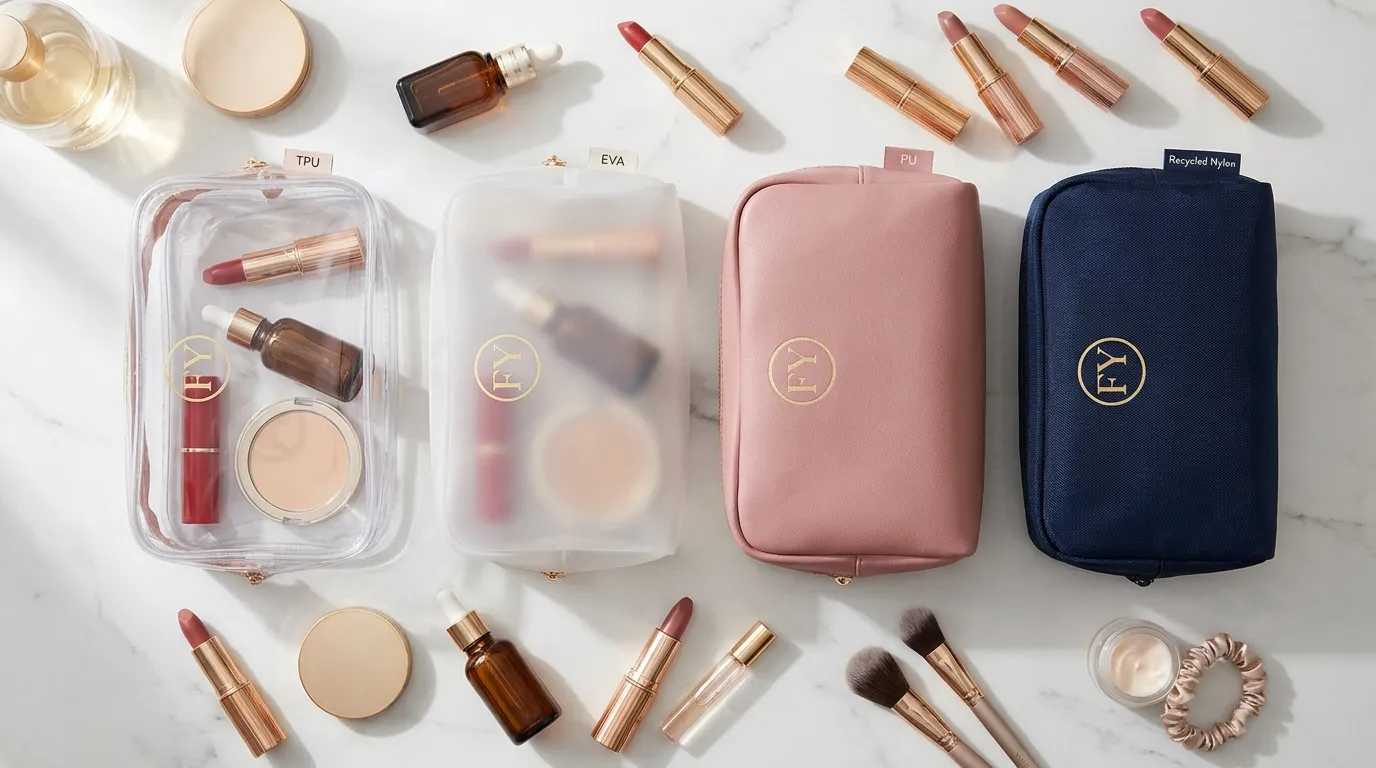
A cosmetic bag carries a beauty brand’s logo into bathrooms, gym lockers and carry-on bags for years, and it often decides whether a gift-with-purchase feels generous or cheap. Choosing a custom cosmetic bag manufacturer means matching three things to your program: the material, the level of leak protection your products need, and a production plan that hits a launch date. Brands building custom makeup bags for retail, kits or promotions face different trade-offs in each.
Quick answer: Beauty brands should look for a custom cosmetic bag manufacturer that works with wipe-clean materials such as TPU, EVA, coated nylon and phthalate-free PVC, can explain how its seams and zippers resist leaks, and supplies third-party test reports for the materials you choose. For gift-with-purchase programs, add sampling speed, color matching and the ability to deliver large runs on a fixed launch date.
Start with the job the bag does in your business. The same zip pouch can be a retail product with its own margin, a gift that supports a skincare launch, or the outer packaging for a discovery set. Each role changes how you balance cost, finish and timing.
| Program type | Role of the bag | Volume pattern | Cost priority | Quality bar | Timing pressure |
|---|---|---|---|---|---|
| Retail SKU | Sold on its own with a margin | Repeat orders by color | Moderate | High: customers judge it as a product | Moderate |
| Gift with purchase (GWP) | Incentive tied to a spend threshold | Large single runs | High: tight unit cost targets | Must look premium in photos | High: fixed launch window |
| Purchase with purchase (PWP) | Add-on at a reduced price | Medium runs | Moderate to high | Close to retail grade | High |
| Kit or set packaging | Holds a curated product set | Matches set volume | Moderate | Must fit products exactly | High: tied to filling schedule |
| PR and influencer kits | Unboxing and social content | Small runs | Low | Highest visual impact | Moderate |
| Travel and toiletry line | Functional bag for liquids | Repeat orders | Moderate | Leak resistance is critical | Low to moderate |
GWP and kit programs share one constraint: the bag arrives at a filling line or a warehouse on a set date, and a delay holds up the whole launch. Retail SKUs give you more time but face harder scrutiny, because the customer paid for the bag itself.
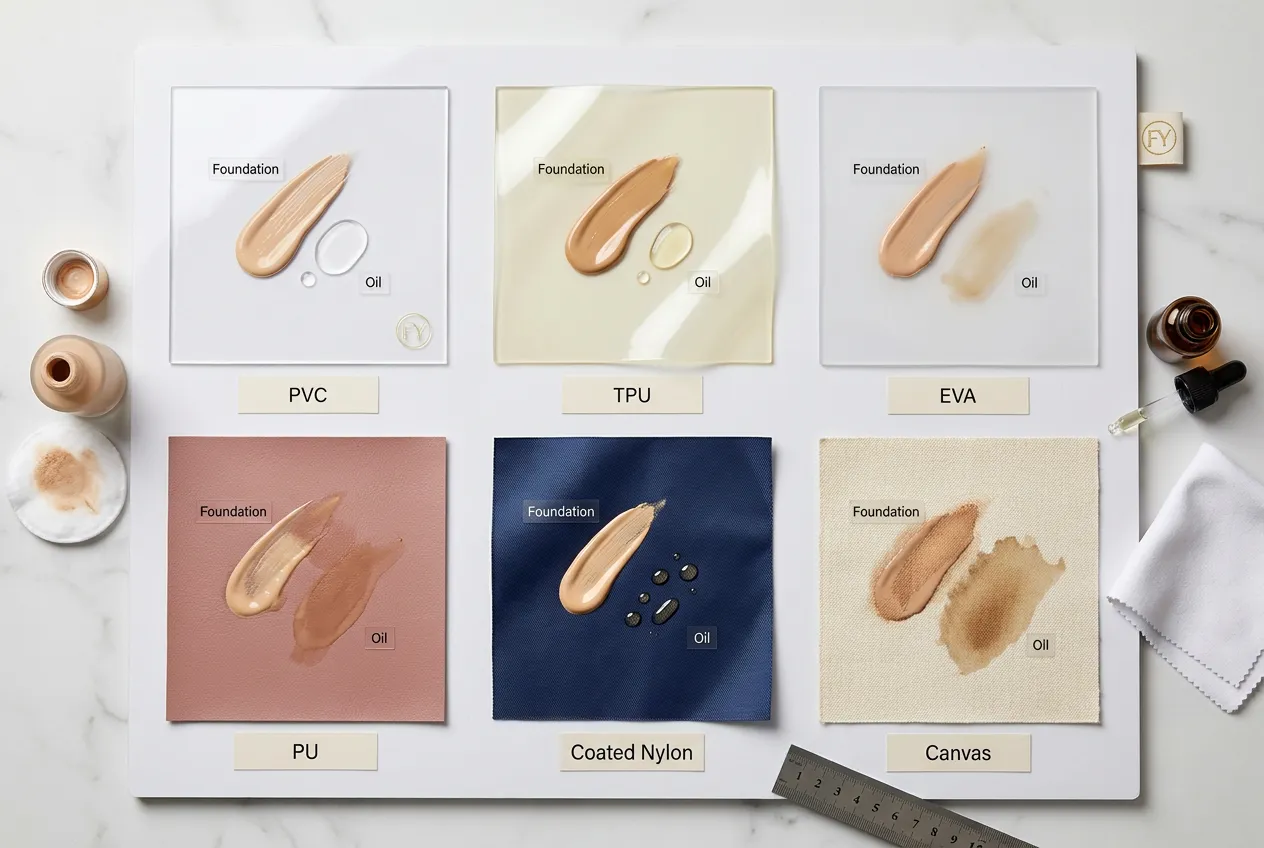
Cosmetic bags live with liquids, powders and oils, so the shell and lining need to wipe clean and resist staining. The table compares the materials beauty brands use most.
| Material | Look and feel | Liquid resistance | Relative cost | Watch-outs |
|---|---|---|---|---|
| PVC (clear or tinted) | Glossy, transparent | High on the surface; seams depend on construction | Lowest | Yellowing, plasticizer odor, cracking in cold; specify phthalate-free |
| TPU | Clear, soft, rubbery hand | High | Moderate to high | Aromatic grades can yellow under UV; aliphatic grades resist it at higher cost |
| EVA | Frosted, matte translucent | High | Low to moderate | Lower clarity than PVC or TPU; scuffs show on dark colors |
| PU or vegan leather | Leather look, wide color range | Good surface resistance | Low to moderate | Coating can peel over time; check resistance to oils and solvents |
| Coated nylon | Light, technical, soft structure | Good if coated and lined | Moderate | Sewn seams leak unless taped or lined |
| Polyester or rPET | Printable, wide color range | Moderate unless coated | Low | Needs a coated lining for liquids |
| Cotton canvas | Natural, eco look | Low unless lined | Low to moderate | Absorbs spills; pair with a wipe-clean lining |
| Velvet, teddy or terry | Trend-led, tactile | Low | Moderate | Needs a waterproof lining; pile can crush in packing |
Clear materials dominate travel and toiletry programs because airport security and customers both want to see what is inside. Our PVC bag materials page covers clear and tinted options for custom programs. If you choose PVC, plan for its two common problems, yellowing and odor, from the first sample; our guide on preventing PVC yellowing and odor in mass production explains the formulation and storage factors.
For opaque pouches, PU and coated nylon cover most mid-market programs. Recycled polyester suits brands with sustainability claims, provided the recycled content is documented. For a deeper comparison of pouch fabrics, see our zipper pouch materials guide.
One test belongs in every material decision: put your own products on the swatch. Foundation, sunscreen, facial oil and nail polish remover each attack coatings in different ways. Acetone, for example, softens or dissolves many PVC and PU surfaces. Leave the smears for 24 hours, then wipe the swatch and check for softening, staining or a tacky surface.
“Leak-proof” means different things to different suppliers, so define the level you need before sampling. Three levels cover most programs:
Sewing creates needle holes, and every needle hole is a potential leak path. Construction, more than the shell material, decides how well a bag holds a spill.
| Construction method | Protection level | Best for | Relative cost |
|---|---|---|---|
| Coated lining (PEVA or TPU-laminated polyester) | Leak resistant | Everyday makeup bags | Low |
| Bound or taped interior seams | Leak resistant | Coated nylon and polyester pouches | Moderate |
| High-frequency (RF) welded seams on PVC or TPU | Sealed body | Clear toiletry bags, wet bags | Moderate to high; needs a welding die |
| Water-resistant zipper with laminated tape | Reduces leakage at the closure | Travel and liquid-focused bags | Moderate |
| Removable, washable liner | Leak resistant plus easy cleaning | Premium retail pouches | Moderate |
| Gusseted base with no bottom seam | Fewer leak paths at the base | Upright toiletry cases | Moderate |
The zipper is usually the weakest point. A standard coil zipper lets liquid through the teeth, so a sealed body with a standard zipper still leaks when the bag tips over. Laminated zipper tape reduces leakage, and a zipper garage or flap over the slider adds protection.
Test leak performance on samples before approval. A simple inverted test works: pour a measured amount of water into the bag, close it, hold it upside down over paper for a set time and check for drips at seams and the zipper. Repeat with an oil-based product to check staining. For coated fabrics, a hydrostatic head test such as ISO 811 measures how much water pressure the fabric resists, and an accredited lab can run it on the material lot you plan to use.
Regulators usually treat cosmetic bags as general consumer articles, but beauty retailers and chemical rules still set limits on what the materials contain. The main checks:
Ask your manufacturer for third-party test reports that match the exact material, color and supplier in your bill of materials. A report for a different color or a different mill does not cover your bag. Many beauty brands also commission their own tests on pre-production materials, which gives them reports in their own name.
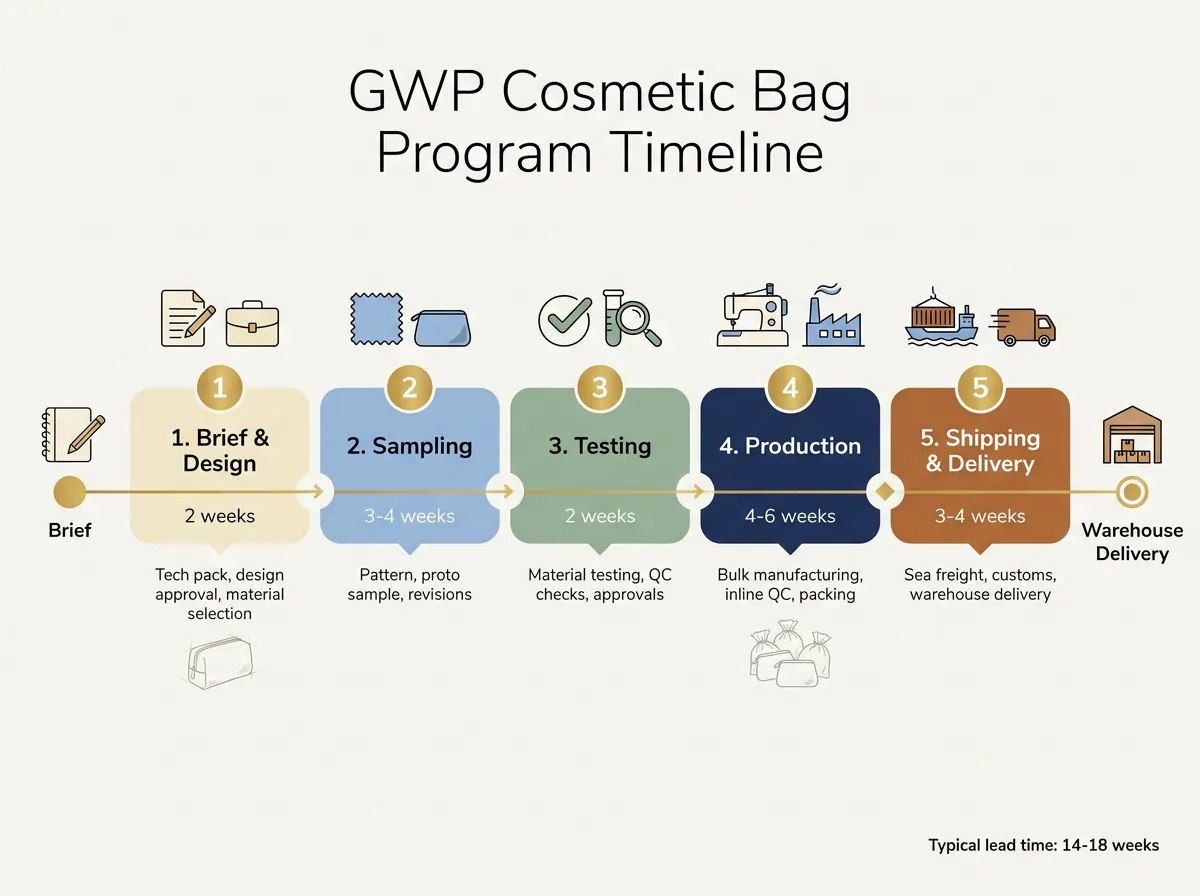
A gift-with-purchase bag has to look premium in campaign photos, cost little enough to protect the promotion’s margin, and arrive before the first order ships. Planning backward from the launch date keeps those three goals in balance.
| Stage | Typical duration | What happens |
|---|---|---|
| Brief and quotation | 1–2 weeks | Size, material, decoration, quantity, target cost tier and delivery date agreed |
| Sampling and revisions | 2–4 weeks | First samples, color and logo corrections, leak and stain tests |
| Material approval and testing | 2–3 weeks (can overlap sampling) | Color standards signed off; lab tests on bulk materials |
| Bulk production | Roughly 4–6 weeks | Cutting, printing, sewing or welding, inline checks |
| Final inspection and shipping | Roughly 1 week plus transit | AQL inspection, packing, sea or air freight to the warehouse |
Most GWP programs need roughly four to five months from brief to warehouse when shipping by sea. Compress that window and air freight usually becomes the only option, which can wipe out the savings from a lower unit cost.
Design choices also make GWP programs easier to run. A flat pouch packs densely and ships cheaply. A boxy case looks premium but takes carton space. Color matching to your brand’s Pantone references needs approved lab dips or color standards for each material, since PU, nylon and zipper tape take dye differently. Plan a small overage for defects, replacements and PR use, and agree on carton labels and barcodes with your warehouse or kitting partner before production starts. Our GWP bag manufacturing guide covers Q4 campaign planning in more detail.
Decoration choice depends on the substrate and the look your brand wants. Clear and coated materials limit some options.
| Method | Best substrates | Look | Relative unit cost |
|---|---|---|---|
| Screen printing | PVC, TPU, nylon, polyester, canvas | Crisp spot colors | Low at volume; one screen per color |
| Heat transfer | Nylon, polyester, PU | Fine detail, gradients | Low to moderate |
| Sublimation (digital) | Light-colored polyester | Full-color, all-over prints | Moderate |
| Embroidery | Canvas, nylon, velvet | Textured, premium | Moderate |
| Debossing or embossing | PU, leather | Tonal, understated | Low per unit after a plate |
| Hot-foil stamping | PU, leather | Metallic gold, silver or color | Low to moderate |
| Custom zipper puller | Any | Branded metal or rubber pull | Moderate; may need a mold |
| Printed or jacquard lining | Any lined bag | Repeat logo inside | Moderate; fabric minimums apply |
For clear bags, printing on the inside surface protects the ink from abrasion, though it reverses the artwork. Ask for rub tests on printed samples, because cosmetic bags get handled with oily fingers every day.
Use these questions to compare suppliers on the same terms:
A capable supplier answers with specifics and asks about your products in return. If a factory cannot tell you how it stops a zipper from leaking, it has probably not built many toiletry bags.
FYBagCustom is Your Trusted Custom Cosmetic Bag Manufacturer in China, offering OEM, ODM and private label development for beauty brands, retailers and promotional programs.
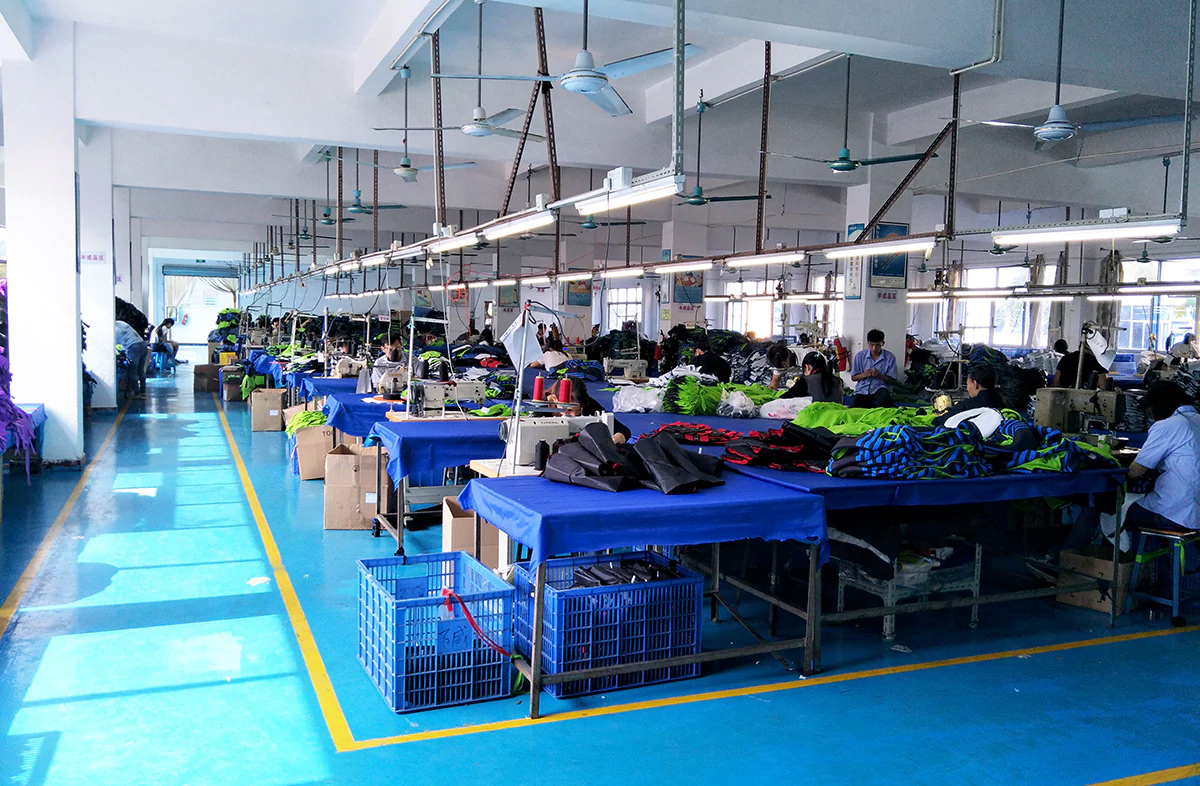
FYBagCustom, a custom bag factory in Huadu District, Guangzhou, brings 15+ years of bag manufacturing, a 5,000 m² facility, 500+ staff and 10+ production lines to cosmetic bag programs. For a beauty brand, that translates into:
Share your product list, launch date and target cost tier through our contact page, and our team will recommend materials and a leak-protection approach to sample.
For clear bags, TPU offers the best mix of clarity, softness and cold resistance, while phthalate-free PVC costs less. For opaque bags, PU and coated nylon wipe clean and suit most mid-market programs. Recycled polyester works for sustainability-led brands when paired with a coated lining. Test any material against your own products, because oils and solvents affect coatings differently.
Rarely. Sewing leaves needle holes, and standard zippers let liquid pass through the teeth. A coated lining and taped seams make a sewn bag leak resistant, which suits most makeup bags. For liquids, use high-frequency welded seams on PVC or TPU combined with a water-resistant zipper, and confirm performance with an inverted water test on samples.
Plan roughly four to five months from brief to warehouse when shipping by sea. That covers one to two weeks of quoting, two to four weeks of sampling, overlapping material approval and testing, about four to six weeks of bulk production, then inspection and transit. Air freight can shorten the timeline but usually erodes the cost advantage of the program.
Most markets treat cosmetic bags as general consumer articles, but restrictions still apply to materials. EU REACH limits certain phthalates and lead in PVC, and California’s Proposition 65 requires warnings for listed chemicals. Bags marketed to children in the United States fall under CPSIA. Ask for third-party reports covering your exact materials and colors.
Screen printing is the most common choice for clear bags, giving crisp spot colors at a low unit cost once screens exist. Printing on the inside surface protects the ink from rubbing, although the artwork must be reversed. Heat transfer suits finer detail. Ask for rub and scratch tests on printed samples before approving bulk.
FYBagCustom’s OEM/ODM team develops custom cosmetic bags for beauty brands, retail merchandisers and gift-with-purchase programs. Send your product list and launch date: we respond with material recommendations, 5–7 day sampling, decoration from screen printing to hot-foil, and flexible MOQ blended across colors and sizes.
Start Your Custom Bag Project →