Tel/WhatsAapp:+86 18011919834
E-mail: chloe.x@fybagcustom.com

Tel/WhatsAapp:+86 18011919834
E-mail: chloe.x@fybagcustom.com
Send Your Inquiry Today

Who this guide is for: brand owners, sourcing managers, wholesale buyers, Amazon FBA sellers and DTC founders who are shortlisting bag or handbag factories in China and want a repeatable way to separate capable manufacturers from polished sales pages.
Most bag sourcing problems start months before production, on the day a buyer picks a supplier because of a catalog, a quick quote and one good sample. Knowing how to find a reliable bag manufacturer in China comes down to checking what a professional auditor checks: what the factory has made before, how it controls quality, and whether its documents hold up when you verify them yourself. This checklist breaks that work into 21 checks you can run from your desk, on a video call or on the factory floor.
Quick answer: To find a reliable bag manufacturer in China, confirm the match the factory’s past products to your bag construction, and inspect a sample made on its own line. Then ask how the factory runs AQL final inspection, and test communication through one full sample round before committing to bulk.
The failures repeat across categories. A sample room produces a beautiful prototype on a line that has never sewn that construction in bulk. The approved PU turns out to be leftover mill stock, so bulk arrives in a slightly different grain and shade. A supplier skips inline checks and finds crooked handles after the cartons are sealed.
The 21 checks below follow that order, from cheap desk research to the questions that need a camera or a plane ticket.
Your first job is to identify what kind of supplier sits on the other side of the chat window. Sourcing agents can add value, especially for mixed-category orders, but you need to know who controls the sewing line, because that party controls your quality and your lead time.
| Supplier type | Who controls production | Typical strengths | Typical risks | How to tell |
|---|---|---|---|---|
| Manufacturer with its own factory | The supplier, on its own lines | Direct control of quality, cost and schedule; engineering feedback on your design | Narrower category range; may prefer constructions it already runs | a live video walk shows cutting, sewing and QC |
| Sourcing agent | Factories the agent selects | Local presence, negotiation help, can coordinate QC across suppliers | Commission conflicts; agent quality varies widely | Ask for the fee structure and the names of the factories they use |
| Marketplace storefront | Either of the above | Fast discovery, platform payment protection | Stock photos; “manufacturer” badges depend on each platform’s checks | the storefront company name |
Once you have confirmed a real manufacturer, the next decision is the partnership model. Our comparison of OEM vs ODM partnerships for handbag brands covers how much design work each model leaves with you.
The checklist groups 21 checks into five stages. Run stage one on every candidate, then spend video time and audit budget only on the factories that pass it.
| # | Check | What to ask for or look at | Red flag |
|---|---|---|---|
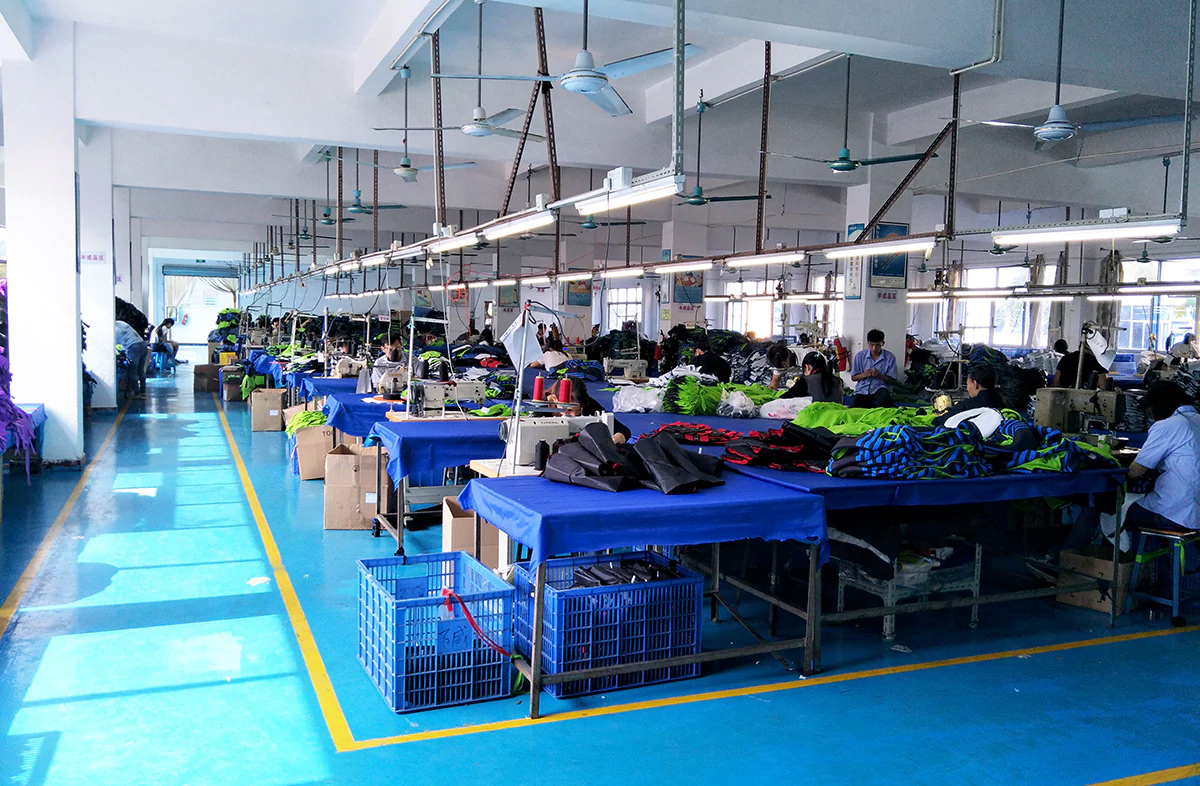
| 1 | factory environment | factory photo | not clean |
| 2 | Production address | the address of the actual workshop | office address; no production site named |
| 3 | production history | production file | do not have |
| 4 | Export track record | Bill-of-lading import data or redacted shipping documents | No export history |
| 5 | Category focus | Website, catalog and trade-show history | Bags listed next to electronics, furniture and garden tools |
| 6 | Construction match | Recent production of bags built like yours | Shows only flat totes when you need a framed handbag |
| 7 | Pattern and sample room | Pattern makers, sample sewers, revision log | Samples outsourced; nobody can explain the pattern |
| 8 | Material sourcing | Supplier network, material library, lab dip process | Cannot say where the PU, lining or hardware comes from |
| 9 | Equipment | Cutting presses and dies, skiving, post-bed and cylinder-arm machines, edge painting, embroidery | Only flatbed machines for three-dimensional handbags |
| 10 | Capacity and scheduling | Number of lines, current loading, slot for your order | Promises any quantity in any lead time |
| 11 | Incoming material inspection | Checks on color, thickness, defects and plating at receiving | Materials go straight from truck to cutting table |
| 12 | Approved sample control | Sealed pre-production sample kept at the line | Operators work from phone photos |
| 13 | Inline inspection | Checkpoints during sewing and who can stop the line | Inspection only at the end |
| 14 | Final inspection method | AQL sampling to ISO 2859-1, inspection level, defect limits, report template | “We check everything” with no method or report |
| 15 | Defect handling | Rework records and corrective actions after a failed lot | No records; blames the material supplier |
| 16 | Social audit | amfori BSCI, SMETA, WRAP or similar report with date and site address | Certificate image only; expired audit; different address |
| 17 | Material certifications | GRS transaction certificates, OEKO-TEX certificate numbers for specific materials | A mill’s certificate presented as cover for the finished bag |
| 18 | Chemical testing | Third-party reports for REACH, CPSIA or Prop 65, matched to your materials | Reports for unrelated materials or several years old |
| 19 | Quote transparency | Breakdown by material, labor, hardware, packaging and tooling | One lump number; large jumps after sampling |
| 20 | Contract terms | Payment schedule, tooling ownership, NNN agreement, defect terms | Refuses written terms |
| 21 | Communication | Named project manager, response times, written change control | A different contact every week; changes agreed only by voice |
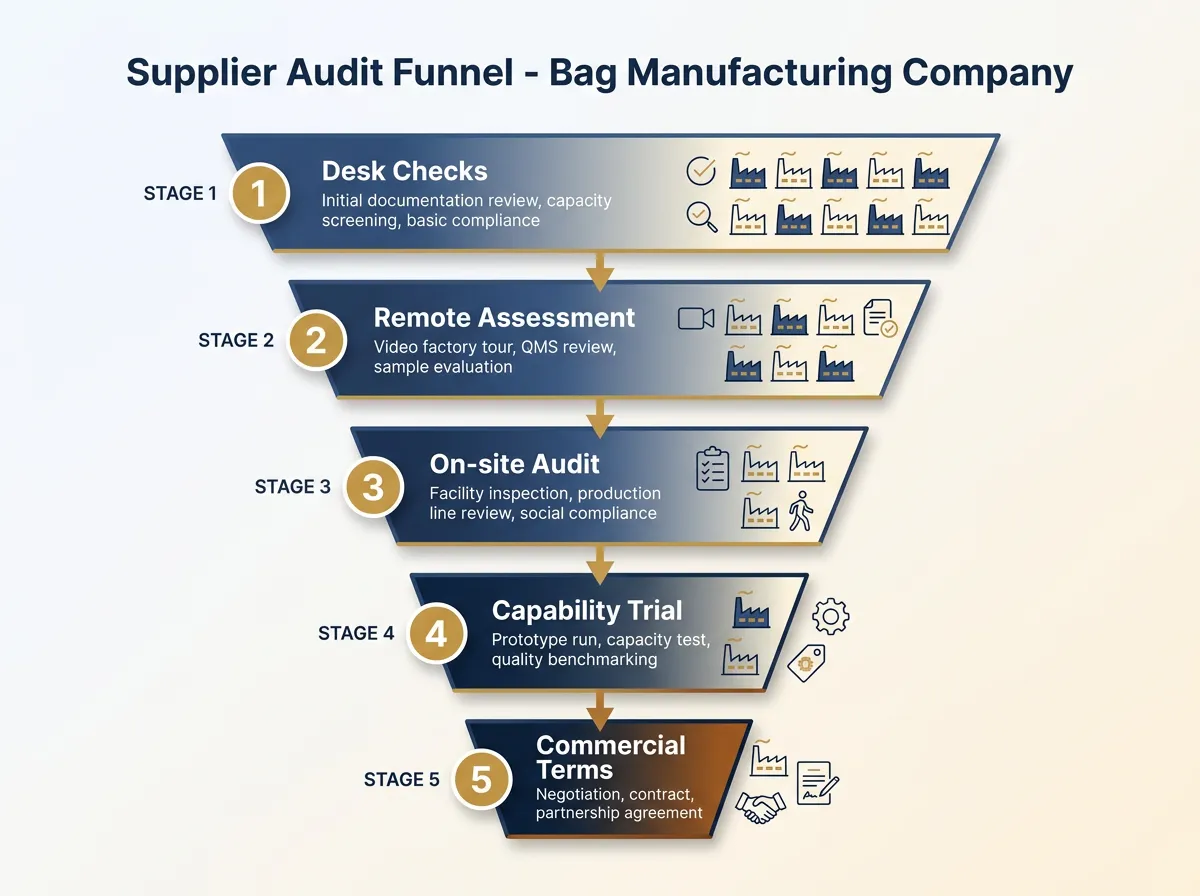
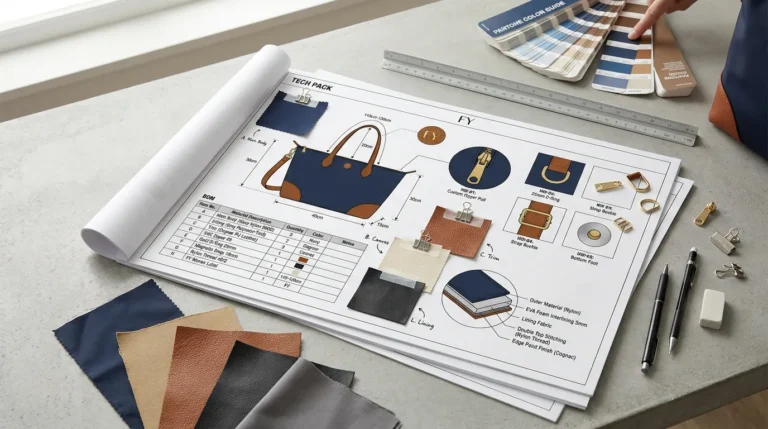
Need to see the production workshop and production process, sample room, etc.
“Bags” covers several distinct skill sets. A factory that sews cotton totes on flatbed machines may struggle with a structured top-handle bag that needs skiving, edge painting and post-bed stitching around curved panels. A technical backpack line needs bartacking, webbing and foam handling. Ask for two or three recent products with constructions close to yours, and ask what went wrong on them. Capable factories answer with specifics, such as a lining that wrinkled at the corners or a handle anchor they had to reinforce.
On capacity, ask how many lines run your category and how full they are for your production window.
Quality control in bag manufacturing happens at three points: when materials arrive, while bags move down the line, and before cartons close. Ask to see each one. At receiving, inspectors should check leather and PU thickness, color against the approved swatch, coating defects and hardware plating. On the line, a sealed pre-production sample should sit within reach of the operators.
Final inspection should follow AQL sampling under ISO 2859-1. Many consumer goods buyers use general inspection level II with limits of zero critical defects, 2.5 for major and 4.0 for minor, though you can tighten these for premium lines. Ask for a blank or redacted inspection report. A good report lists the lot size, sample size, defects found by class and photos of each defect.
Retail chains and many marketplaces require a recent social audit, and some programs require recycled-content or chemical documentation. Requirements vary by market and buyer, so decide which documents your program needs before you ask. Ask the supplier for current reports, then check each one against the issuer’s records using the verification table below.
A transparent quote separates material, labor, hardware, packaging and one-time tooling. That breakdown lets you see what changes when you swap a material or drop a pocket. Payment terms in the bag trade often follow a deposit before material purchase and the balance before shipment. Put tooling ownership in writing: emboss plates, custom hardware molds and cutting dies are paid for by you and should stay yours. An NNN agreement (non-disclosure, non-use, non-circumvention) drafted for enforcement in China protects your design better than a generic NDA.
Each certificate covers a named site or material for a fixed period, so read the scope line, the site address and the expiry date first.
| Document | What it covers | How to verify | Common misuse |
|---|---|---|---|
| amfori BSCI audit | Social compliance at a specific production site | Ask for the full report and audit ID; amfori members can view results on the amfori platform | Old audit or an address that differs from the factory |
| SMETA (Sedex) | Labor standards, health and safety; four-pillar audits add environment and business ethics | The factory grants you access on Sedex; match the site reference | Only the summary page is shared |
| ISO 9001 | Quality management system | Check the certificate number with the certification body or IAF CertSearch; confirm scope and expiry | Unaccredited issuer; scope covers trading rather than manufacturing |
| GRS | Recycled content and chain of custody | Find the scope certificate in Textile Exchange’s database; request a transaction certificate per shipment | A fabric mill’s certificate shown as the bag factory’s |
| OEKO-TEX STANDARD 100 | Harmful substances in a tested textile article | Enter the certificate number in OEKO-TEX’s online label check | Certificate covers a different product or has expired |
Two points catch most problems. First, a material supplier’s certificate does not transfer to the bag factory; GRS, for example, requires each stage of the chain to hold its own certification. Second, a photo of a certificate proves nothing until the issuer’s database confirms it.
Budget and order size decide the method. Most buyers combine two or three.
| Method | Relative cost | What it confirms | Limits | Best for |
|---|---|---|---|---|
| Desk audit | Lowest | Legal existence, history, export footprint | Cannot see the floor | Cutting a long list to a shortlist |
| Live video audit | Low | Floor layout, machines, staff, work in progress | The supplier holds the camera | Narrowing a shortlist to two or three |
| Third-party audit firm | Moderate | Structured scoring of capacity, quality system, social conditions | A one-day snapshot; auditor skill varies | Before a first bulk order |
| Your own visit | Highest | Everything above, plus how the team works together | Travel time and cost | Large or long-term programs |
For a video audit, ask for one continuous call with no cuts. Start at the gate, then walk receiving, the material warehouse, cutting, sewing, the QC station and packing. Ask the guide to show the production schedule board and to point the camera at work-in-progress tickets. Pick a random machine and ask the operator to sew a seam. If the guide keeps steering you back to the showroom, write that down.
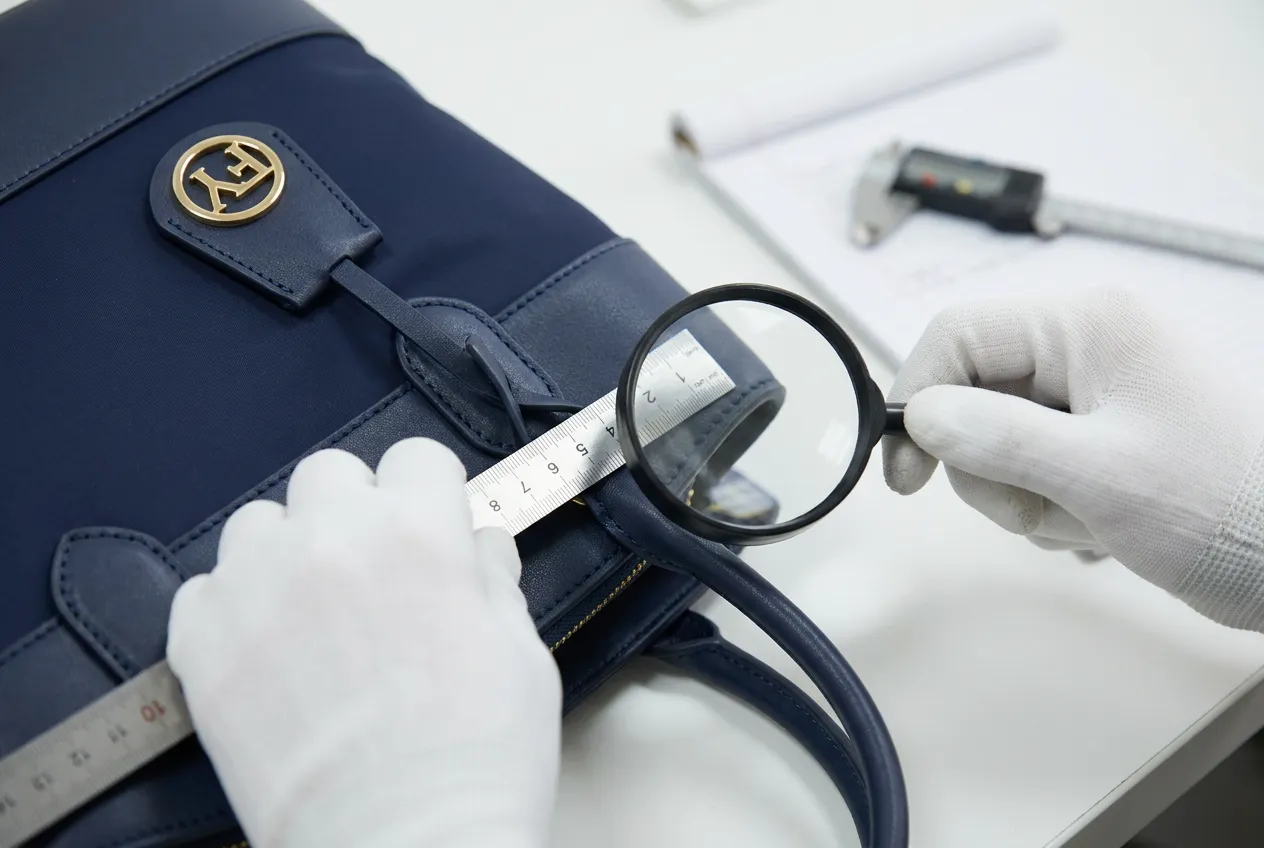
A sample is your most practical audit tool, provided you know who made it. Ask whether the sample room or a production line sewed it, and whether the bulk line has made a similar construction in the past few months.
Inspect it the way a final inspector would:
Then watch how the factory handles your comments. A useful exercise is to send a written revision brief and judge the second sample against it. Our guide to reading a first handbag sample and closing in two revision rounds shows how to structure that brief.
Some findings justify walking away without further checks:
FYBagCustom is Your Trusted Custom Bag Manufacturer in China, offering OEM, ODM and private label development for brands that want a factory they can check line by line.
FYBagCustom, a custom bag factory in Huadu District, Guangzhou, works inside the Shiling Town leather goods cluster. Mapped against the 21 checks, these are the facts we can confirm:
The fastest way to test us is to run the checklist. Send your tech pack and questions through our contact page, and judge the answers, the sample and the inspection report for yourself.
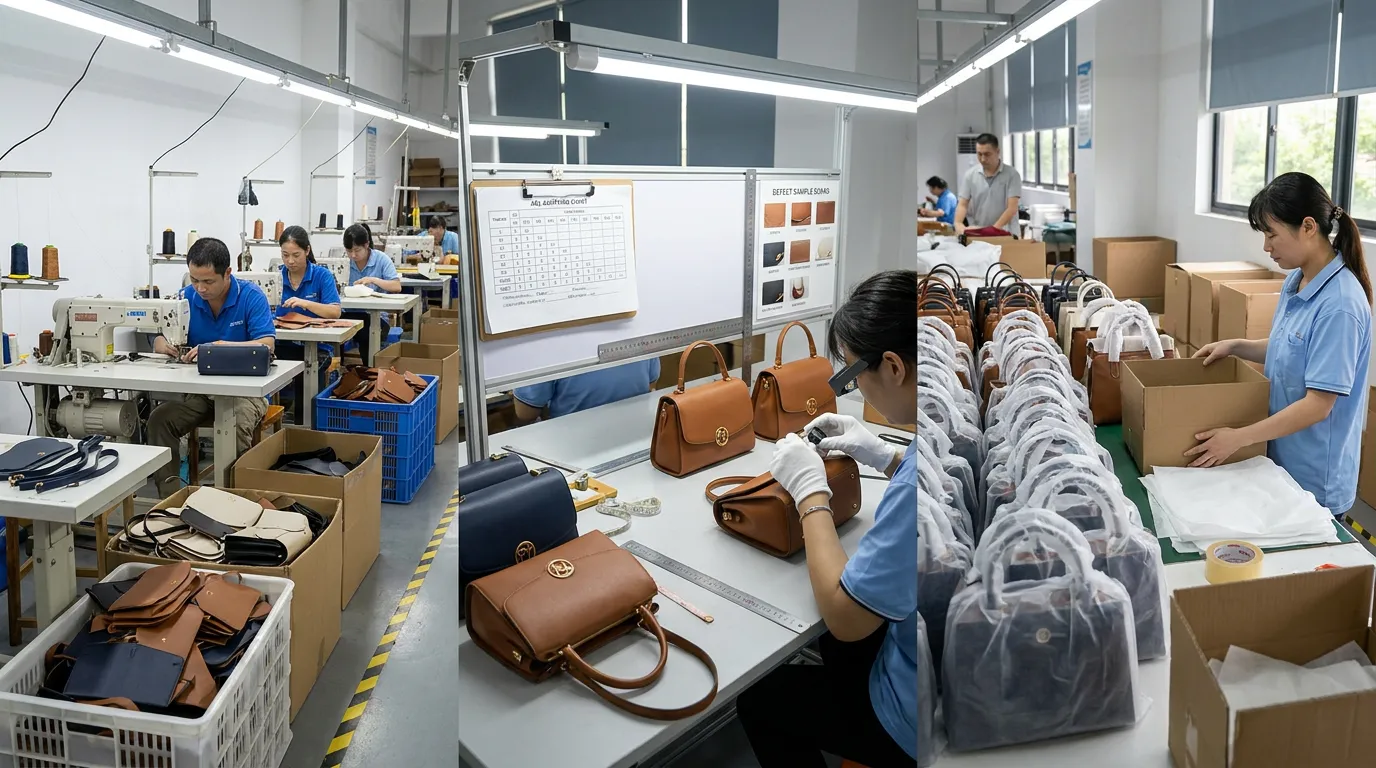
For a modest first order, a desk audit plus a live video audit and one full sample round often gives enough confidence. For large programs, retail chain orders or products with compliance requirements, add a third-party audit or your own visit. The video call shows the floor, while an independent auditor scores systems, records and working conditions.
Many buyers inspect handbags under ISO 2859-1 at general inspection level II, accepting zero critical defects, 2.5 for major defects and 4.0 for minor defects. Premium lines often tighten major defects to 1.5. Agree on the levels and a written defect list before production, so the factory and your inspector judge bags against the same standard.
That depends on your market and customers. Retail chains often ask for a social audit such as amfori BSCI or SMETA. Recycled-material claims need GRS chain-of-custody documents, and children’s or skin-contact products need chemical test reports. In every case, verify the certificate number, site address, scope and expiry date in the issuing body’s database.
A practical funnel starts with ten to fifteen candidates for desk checks, narrows to three to five for video calls and quotes, and ends with two finalists for sampling. Sampling with two factories costs more up front, but it gives you a benchmark for quality, price and communication, plus a backup supplier if the first choice falls short.
FYBagCustom’s OEM/ODM team works with brand owners, sourcing managers and Amazon FBA sellers who want a bag factory they can verify. Send your tech pack and audit questions: we respond with 5–7 day sampling, flexible MOQ blended across colors and sizes, and 100% pre-shipment inspection with AQL final inspection to ISO 2859-1.
Start Your Custom Bag Project →