Tel/WhatsAapp:+86 18011919834
E-mail: chloe.x@fybagcustom.com

Tel/WhatsAapp:+86 18011919834
E-mail: chloe.x@fybagcustom.com
Send Your Inquiry Today

Who this guide is for: first-time brand founders who have a design concept but do not know how to communicate it to a factory, product developers tightening up specifications that have been too vague, and sourcing managers who want a standardized tech-pack format they can use across every custom handbag style in their collection. If you have ever sent a factory a mood board and received a quote that was double your budget — or received a sample that looked nothing like your vision — the missing document is the tech pack, and this guide walks through every section of a complete one.
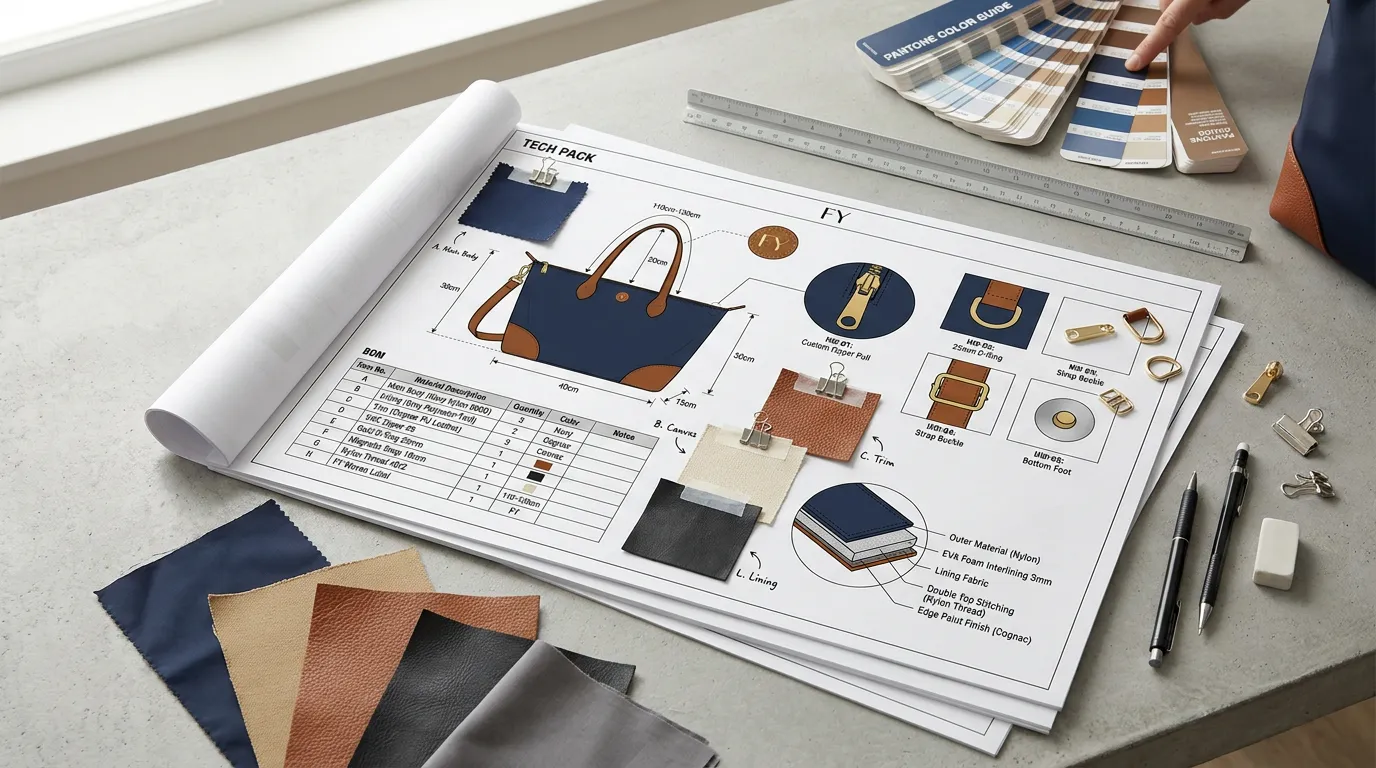
A tech pack is the blueprint for your bag. It is the document that translates your design idea — which exists in your head, in your mood board, in your sketches — into the language a factory can execute. Without it, the factory is guessing: guessing the dimensions, guessing the material weight, guessing the hardware finish, guessing the stitch density, guessing the lining color. With each guess, the probability that the sample matches your vision decreases. By the time a factory processes a dozen guesses, the sample reflects the factory’s interpretation of your mood board — not your actual design.
A complete tech pack eliminates guessing. It specifies every dimension, every material, every hardware piece, every construction method, and every quality standard — in a format the factory can pin to the workstation and follow line by line. The result: the first sample is closer. The revision brief is shorter. The bulk production is consistent. The total development time compresses from months to weeks.
This guide walks through the tech pack section by section, with the exact format and language that production teams expect. By the end, you will have either a complete tech pack or a clear understanding of what to hand your product developer to build one.
| A Tech Pack IS | A Tech Pack IS NOT |
|---|---|
| A manufacturing specification document with every detail needed to produce the bag | A mood board, a Pinterest collection, or a set of reference images (these are inspiration, not instruction) |
| Written in measurements, material codes, Pantone references, and construction terminology | Written in brand-voice marketing language (“luxurious feel,” “artisan quality,” “premium craftsmanship”) |
| Precise enough that two different factories receiving the same tech pack would produce effectively identical samples | Vague enough to be interpreted differently by different people |
| The contractual reference for quality — “this is what we agreed you would make” | A suggestion or a starting point for discussion |
| Section | What It Contains | Why It Is Essential |
|---|---|---|
| 1. Cover page | Style identity, version tracking, dates | So the factory knows which bag this is and which version of the spec they are reading |
| 2. Flat sketch with dimensions | Front, back, side, base, and interior views with every measurement annotated | The primary visual communication of the bag’s geometry |
| 3. Bill of Materials (BOM) | Every material in the bag — exterior, lining, interlining, thread, binding — with descriptions and references | The factory’s shopping list — what to source before production begins |
| 4. Hardware schedule | Every hardware piece — zipper, closure, D-ring, snap, feet, buckle — with type, size, finish, and quantity | Hardware must be ordered from hardware suppliers; this schedule is the order document |
| 5. Color specification | Pantone references, lab dip instructions, ΔE tolerances, evaluation illuminants | The binding color standard; prevents the “the color is wrong” dispute |
| 6. Construction details | Seam types, stitch density, edge treatments, reinforcement map, closure mechanism | How the bag is assembled — the manufacturing method, not just the materials |
| 7. Lining and interior layout | Lining material, pocket positions, label placement, interior organization | The interior is a separate design; it needs its own specification |
| 8. Branding and labeling | Logo placement, logo method (deboss, print, embroidery, label), hang tag, care label | Where and how the brand identity appears on the bag |
| 9. Packaging specification | Dust bag, tissue, box, mailer, tags, instruction cards | What the consumer receives; how the bag is packed |
| 10. Quality standards | Acceptable/unacceptable defects, test requirements, tolerance summary | The QC contract — what constitutes a pass and what constitutes a fail |
The cover page identifies the document and prevents version confusion.
──────────────────────────────────────────────
TECH PACK — COVER PAGE
──────────────────────────────────────────────

Brand:              [Brand name]
Style name:         [e.g., "The Commuter Tote"]
Style number:       [e.g., FYB-TT-2026-001]
Season:             [e.g., SS26 / FW26 / Core]
Category:           [Tote / Crossbody / Shoulder /
                     Clutch / Backpack]
Designer:           [Name]
Tech pack version:  [e.g., v2.1]
Date:               [Date of this version]
Previous version:   [v2.0, dated ___]
Status:             [DRAFT / SAMPLING / APPROVED
                     FOR BULK]

Change log:
v2.1 — [date] — Updated handle drop from 20 to
        22 cm; changed hardware from polished to
        brushed gold
v2.0 — [date] — Revised BOM: lining changed from
        taffeta to twill
v1.0 — [date] — Initial tech pack

──────────────────────────────────────────────
Why version tracking matters: tech packs evolve through sampling. Without version numbers and a change log, the factory may produce from an outdated version — and the buyer cannot prove which specification was current.
The flat sketch is the tech pack’s centerpiece — the visual specification that shows the bag from every angle, with every measurement annotated.
| View | What It Shows | Key Dimensions to Annotate |
|---|---|---|
| Front view | The bag’s face — the primary panel, closure, exterior pockets, logo position | Overall width, overall height, pocket dimensions and positions, logo position (measured from edges), closure position |
| Back view | The rear panel — back pocket, strap attachment, label position (if exterior) | Back pocket dimensions and position; strap anchor positions |
| Side view | The gusset — depth, profile shape, strap attachment | Depth at base, depth at top (if different — tapered gussets), strap drop |
| Base view | The bottom — base shape, feet positions | Base length, base width, feet spacing |
| Top view (open bag, looking down) | The interior layout — pocket positions, dividers, laptop sleeve | Interior pocket dimensions; divider position; laptop sleeve width |
| Handle / strap detail | Handle construction, strap width, adjuster position | Handle drop, handle width, handle length; strap width, total strap length, adjuster position |
| Rule | Why |
|---|---|
| Every dimension in centimeters (not inches) | Centimeters are the international manufacturing standard; factories in China measure in cm |
| Measurements are of the finished bag (not the pattern pieces) | The factory drafts the pattern from the finished dimensions; specifying pattern dimensions confuses the process |
| Every measurement includes a tolerance (e.g., “32 cm ± 1 cm”) | Without a tolerance, the factory has no guidance on how much variation is acceptable |
| Measurements annotated with leader lines pointing to the exact measurement location | A dimension of “32 cm” without a leader line could refer to the width at the top, the width at the base, or the width at the widest point — each is a different number |
Design tip: you do not need to be an illustrator. A clean flat sketch can be drawn in Adobe Illustrator, Procreate, or even PowerPoint. Alternatively, provide a dimensioned photograph — print a photo of a similar bag and mark the dimensions on it with a pen. A dimensioned photo is better than a beautiful sketch with no measurements.
The BOM is the complete list of every material in the bag — the factory’s sourcing document. Every material that appears in the finished product must appear on the BOM.
──────────────────────────────────────────────
BILL OF MATERIALS (BOM)
──────────────────────────────────────────────

 #  Component        Material          Weight/    Color/          Reference/
                     Description       Thickness  Finish          Swatch
 ─── ─────────────── ───────────────── ───────── ──────────────── ──────────
 1   Exterior body   Pebbled PU        1.0 mm    Pantone 19-1118  ALD-001
                     leather                     (cognac)
 2   Exterior trim   Same as #1        1.0 mm    Same as #1       —
 3   Lining          Polyester twill   100 g/m²  Pantone 19-4005  ALD-002
                                                 (navy)
 4   Interlining     Woven fusible     90 g/m²   White            —
     (body panels)
 5   Interlining     EVA foam          2 mm      White/gray       —
     (front + back)
 6   Base stiffener  Flexible PP       0.8 mm    —                —
                     (removable
                     insert)
 7   Pocket lining   Polyester twill   70 g/m²   Pantone 19-4005  —
 8   Thread (top-    Bonded nylon      Tex 35    Tonal — match    —
     stitching)                                  exterior ΔE ≤3
 9   Thread          Bonded nylon      Tex 40    Match lining     —
     (structural)
 10  Edge paint      Water-based PU    —         Tonal — match    —
                     (4-coat system)             exterior ΔE ≤2
 11  Binding tape    Nylon bias tape   25 mm     Match lining     —
 12  Reinforcement   Nylon webbing     1.5 mm    —                —
     patches         (40 × 60 mm)
 13  Fusible strip   Woven fusible     —         —                —
     (pocket
     openings)

──────────────────────────────────────────────
| Practice | Why |
|---|---|
| Number every line item | The factory (and you) can reference items by number: “BOM #3 — change from taffeta to twill” is faster and clearer than “change the lining material” |
| Specify weight or thickness for every material | Without this, the factory selects whatever weight is cheapest; a “polyester lining” without a GSM is an invitation for substitution |
| Specify color for every visible material | Including thread, edge paint, binding tape, and lining — every visible element needs a color call |
| Reference approved swatches or lab dips | The BOM should link to physical references that the factory has; “Pantone 19-1118” is a target; “ALD-001” is the approved physical standard |
Every hardware piece is specified individually — type, material, size, finish, quantity per bag, and the supplier reference (if you have one).
──────────────────────────────────────────────
HARDWARE SCHEDULE
──────────────────────────────────────────────

 #  Component       Type          Material     Size       Finish       Qty
 ─── ─────────────── ──────────── ──────────── ────────── ──────────── ────
 H1  Main zipper    YKK (or      Metal teeth  #5, 35 cm  Brushed      1
                    equiv.)                               gold
 H2  Zipper pull    Teardrop     Zinc alloy   15 mm      Brushed      1
                                                          gold
 H3  Interior       YKK (or      Nylon coil   #3, 20 cm  Match        1
     zip pocket     equiv.)                               lining
 H4  Magnetic       Neodymium    Zinc alloy   18 mm      Brushed      1
     snap                        housing                  gold         set
 H5  D-rings        Welded wire  Zinc alloy   20 mm      Brushed      2
                                                          gold
 H6  Swivel snap    Trigger      Zinc alloy   15 mm      Brushed      2
     hooks                                                gold
 H7  Strap          Slide        Zinc alloy   25 mm      Brushed      1
     adjuster       (tri-glide)                           gold
 H8  Base feet      Dome         Zinc alloy   12 mm      Brushed      4
                                              dia.       gold
 H9  Interior       Welded wire  Zinc alloy   15 mm      Brushed      1
     D-ring                                               gold
     (key leash)

HARDWARE NOTES:
- All hardware: same finish (brushed/satin gold)
  across every piece — no mixing polished and brushed
- D-rings: welded wire, minimum 4 mm gauge
- All hardware: salt spray test 48 hours minimum
  without tarnishing
- Zipper: paraffin-lubricated teeth
──────────────────────────────────────────────
Color is specified separately from the BOM because it requires its own evaluation protocol, tolerance, and reference system.
──────────────────────────────────────────────
COLOR SPECIFICATION
──────────────────────────────────────────────

EXTERIOR:
  Reference:     Pantone 19-1118 TCX (provide
                 PHYSICAL TCX swatch with tech pack)
  Lab dip:       Required — 3–5 swatches on actual
                 production PU
  Evaluation:    D65 daylight + 2700K warm light
  Tolerance:     ΔE ≤ 1.5 from approved lab dip

LINING:
  Reference:     Pantone 19-4005 TCX
  Tolerance:     ΔE ≤ 2.5

THREAD (topstitching):
  Reference:     Tonal — match exterior within
                 ΔE ≤ 3.0

EDGE PAINT:
  Reference:     Tonal — match exterior within
                 ΔE ≤ 2.0

HARDWARE:
  Reference:     Brushed gold — match hardware
                 supplier reference [code]
  Tolerance:     Perceptual match to reference
                 under D65

──────────────────────────────────────────────
This section specifies HOW the bag is built — not what it is built from (that is the BOM) but the methods, the stitch specifications, the edge treatments, and the structural reinforcements.
──────────────────────────────────────────────
CONSTRUCTION DETAILS
──────────────────────────────────────────────

STITCHING:
  Topstitch SPI:      8 minimum
  Topstitch tolerance: ±10% stitch length;
                       ±0.5 mm straightness
  Thread (topstitch):  BOM #8 (bonded nylon, Tex 35,
                       tonal)
  Structural SPI:      6–7
  Thread (structural): BOM #9 (bonded nylon, Tex 40)
  Thread ends:         Tucked and invisible (not cut
                       and visible)

EDGE FINISHING:
  Handles and straps:  4-coat system (sealer + 2
                       color + satin clear coat)
                       with beveling
  Top edge:            Same 4-coat system
  Body panel edges:    Hidden in seams — no exposed
                       edges
  Edge paint:          BOM #10 (water-based PU,
                       tonal-matched)

INTERLINING:
  Front + back panels: BOM #4 (woven fusible 90 g/m²)
                       + BOM #5 (2 mm EVA foam)
                       Full-panel coverage — no strip
                       fusing
  Gusset panels:       BOM #4 only (no foam)
  Base:                BOM #6 (removable PP insert
                       in lining pocket)

REINFORCEMENT:
  Handle attachments:  BOM #12 (nylon webbing patch
                       40 × 60 mm) behind each
                       attachment; box-X bartack
                       through all layers
  Strap D-ring tabs:   Same webbing patch + bartack
  Zipper ends:         Reinforcement bartack across
                       tape ends
  Base corners:        Double-stitched seam;
                       thread Tex 40
  Pocket openings:     BOM #13 (fusible strip
                       2 cm wide) + bar-tack at
                       each corner

HANDLE CONSTRUCTION:
  Type:                Double-layer sandwich
                       (exterior PU + lining PU)
  Width:               25 mm
  Core:                Cotton rope, 8 mm diameter
  Edge:                4-coat painted, beveled
  Drop:                22 cm (measured from handle
                       arch to bag top edge)

CLOSURE:
  Type:                Magnetic snap (H4) concealed
                       under flap
  Flap dimensions:     [width] × [depth] cm
  Snap position:       Centered, [X] cm from flap edge

STRAP:
  Architecture:        Single-layer PU + slide
                       adjuster (H7)
  Width:               25 mm
  Length range:         75–130 cm (adjustable)
  Attachment:          Swivel snap hooks (H6) to
                       D-rings (H5)
  Edge:                4-coat painted

──────────────────────────────────────────────
The interior is a separate design. It needs its own specification — not a footnote on the BOM.
──────────────────────────────────────────────
LINING AND INTERIOR LAYOUT
──────────────────────────────────────────────

LINING MATERIAL:   BOM #3 (polyester twill,
                   100 g/m², Pantone 19-4005)

SEAM FINISHING:    All interior seams serged
                   (overlocked); no raw edges

POCKETS:
  Back wall:
    1 × Padded laptop sleeve — 28 × 38 cm opening,
        10 mm foam padding, elastic top closure
    1 × Slip pocket above laptop sleeve — 18 × 15 cm
        (phone-sized)
  Front wall:
    1 × Zip pocket — 20 × 15 cm, YKK #3 nylon coil
        zipper (H3), welted opening
  Gusset (left):
    1 × Slip pocket — 10 × 12 cm (card-sized)

KEY LEASH:
    Retractable cord, 15 cm, attached to interior
    D-ring (H9) on back wall, upper right

LABEL:
    Woven brand label, 3 × 5 cm, positioned inside
    the zip pocket (centered above zipper, 1 cm
    from pocket top edge)

BASE INSERT POCKET:
    Open-top pocket in the base lining, sized to hold
    the removable base insert (BOM #6); the insert
    slides in and is held by friction

──────────────────────────────────────────────
──────────────────────────────────────────────
BRANDING AND LABELING
──────────────────────────────────────────────

EXTERIOR BRANDING:
  Method:        Blind deboss (no foil, no color)
  Position:      Front panel, lower center,
                 [X] cm from base, centered
                 horizontally
  Size:          Logo artwork: [width] × [height] mm
  Artwork:       [Attached — vector file, .AI format]

INTERIOR LABEL:
  Type:          Woven label
  Size:          3 × 5 cm
  Content:       Brand name + "Made in China" +
                 material composition
  Position:      Inside zip pocket (see Section 7)

CARE LABEL:
  Type:          Printed satin label
  Size:          3 × 6 cm
  Content:       Care symbols + text (per market
                 requirements)
  Position:      Sewn to the lining seam below
                 the woven label

HANG TAG:
  Size:          [dimensions]
  Content:       Brand name, style name, color,
                 material, barcode/SKU
  Attachment:    Cotton string tie to interior D-ring
                 (not to hardware — prevents scratching)

──────────────────────────────────────────────
──────────────────────────────────────────────
PACKAGING SPECIFICATION
──────────────────────────────────────────────

STUFFING:
  Type:          Acid-free tissue paper (inside the
                 bag to maintain shape during transit)
  Note:          Include foam rod at fold line if
                 the bag ships flat-packed

DUST BAG:
  Material:      Unbleached cotton muslin, drawstring
                 closure
  Size:          [width × height] cm (sized to fit
                 the bag with 5 cm excess)
  Branding:      Screen-printed brand logo,
                 centered, [Pantone code]

GIFT BOX (if applicable):
  Type:          Collapsible self-erecting magnetic
                 box
  Size:          [L × W × H] cm assembled
  Wrap:          [Color] art paper, [finish]
  Logo:          Foil-stamped, [position]

OUTER PACKAGING (for shipping):
  DTC:           Padded kraft mailer, [dimensions];
                 OR gift box is the shipping
                 container (SIOC)
  Wholesale:     Double-wall corrugated carton,
                 [dimensions]; corrugated dividers
                 between units
  Carton marking: "THIS SIDE UP" + stacking limit
                  + FNSKU label (if FBA)

──────────────────────────────────────────────
The quality section defines the acceptance criteria — what the factory must deliver and what constitutes a defect.
──────────────────────────────────────────────
QUALITY STANDARDS
──────────────────────────────────────────────

DIMENSIONAL TOLERANCE:
  Overall dimensions:  ±1 cm
  Pocket dimensions:   ±0.5 cm
  Handle drop:         ±1 cm
  Strap width:         ±2 mm
  Hardware position:   ±3 mm

COLOR TOLERANCE:
  Exterior material:   ΔE ≤ 1.5 from ALD
  Lining:              ΔE ≤ 2.5
  Thread:              ΔE ≤ 3.0 from exterior
  Edge paint:          ΔE ≤ 2.0 from exterior
  Measurement method:  Spectrophotometer, D65/10°

STITCHING:
  Topstitch SPI:       8 minimum
  Stitch consistency:  ±10% length; ±0.5 mm straight
  Thread ends:         Tucked; no visible cut ends
  Skipped stitches:    Zero tolerance

EDGE FINISHING:
  Smoothness:          No rough spots, drips, or
                       thin areas detectable by thumb
  Adhesion:            ISO 2409 cross-cut test,
                       rating 0 or 1

STRUCTURAL:
  Handle pull test:    15 kg sustained for 60 seconds
                       — no failure
  Zipper function:     50 open/close cycles — smooth,
                       no catching
  Closure function:    50 cycles — engages and holds
  Strap adjuster:      Slip test — zero slip under
                       4 kg after 5 min walking
                       simulation

MATERIAL:
  Color fastness:      Lightfastness ISO 105-B02:
                       4 minimum
                       Dry crocking: 4 minimum
                       Wet crocking: 3 minimum

DEFECT CLASSIFICATION:
  Critical (reject):   Hole, tear, wrong material,
                       wrong color (ΔE > tolerance),
                       missing hardware, functional
                       failure (closure, zipper)
  Major (limit 2.5%):  Visible stitch error, edge
                       paint inconsistency visible
                       at arm's length, visible
                       misalignment > tolerance,
                       hardware scratch > 5 mm
  Minor (limit 4.0%):  Thread tail > 3 mm, minor
                       glue residue not visible at
                       arm's length, slight material
                       variation within tolerance

INSPECTION:
  AQL level:           II (per ISO 2859-1)
  Inspection point:    Final — after packing, before
                       carton sealing
  Buyer's right:       Third-party inspection at
                       buyer's expense; factory to
                       provide 48 hours notice before
                       shipment readiness

──────────────────────────────────────────────
| Mistake | Consequence | Fix |
|---|---|---|
| No version number | The factory produces from an outdated tech pack; the buyer cannot prove which spec was current | Always include version number + date + change log on the cover page |
| Dimensions without tolerances | Every measurement becomes a dispute: “I specified 32 cm; you delivered 33 cm — is that acceptable?” Without a tolerance, neither party knows | Add ±tolerance to every dimension |
| “Leather” without specifying the grade | The factory uses the cheapest grade (coated split); the buyer expected full-grain | Specify: “Full-grain calfskin” or “Top-grain corrected PU” or the exact material per our leather sourcing guide |
| No hardware schedule | The factory selects generic hardware; the finish does not match across pieces; some pieces are the wrong size | Specify every hardware piece individually with type, size, finish, and quantity |
| “Matching color” without a Pantone or swatch | The factory matches to their interpretation of “matching”; the buyer and factory disagree on what “matching” means | Specify Pantone TCX + provide a physical swatch; define ΔE tolerance |
| No interlining specification | The factory uses the thinnest (cheapest) interlining — or none at all; the bag feels hollow | Specify the interlining type, weight (g/m²), and coverage (full-panel, not strip) per our construction guide |
| No reinforcement map | The factory skips the reinforcement patches at stress points; the handles tear out at month 4 | Include the 5-point reinforcement specification: handle attachments, D-ring tabs, zipper ends, base corners, pocket openings |
| Marketing language instead of specifications | “Premium feel” and “luxury quality” tell the factory nothing; they cannot measure “premium” | Replace every subjective term with a measurable specification: SPI, GSM, ΔE, mm, coating layers |
If you are a first-time founder with a design concept but no tech pack, you have three options:
| Option | What Happens | Quality of Outcome |
|---|---|---|
| Send a mood board / reference images to the factory | The factory interprets your images and creates a spec internally (ODM approach); you review the sample and iterate | Fastest start; but the first sample may diverge significantly from your vision; you lose specification control |
| Hire a freelance product developer to create the tech pack | A professional builds the tech pack from your sketches and reference images; you submit the completed tech pack to the factory | Best outcome — a professional tech pack leads to a closer first sample and fewer revision rounds; the upfront investment pays for itself in saved development time |
| Work with the factory’s development team | Some factories (including FYBagCustom) offer in-house development support: you provide your concept (sketches, references, material preferences), and the factory’s team helps build the specification collaboratively | Good middle ground — the factory’s experience fills in the technical details you may not know (interlining weights, hardware gauges, construction methods); the tech pack is created collaboratively |
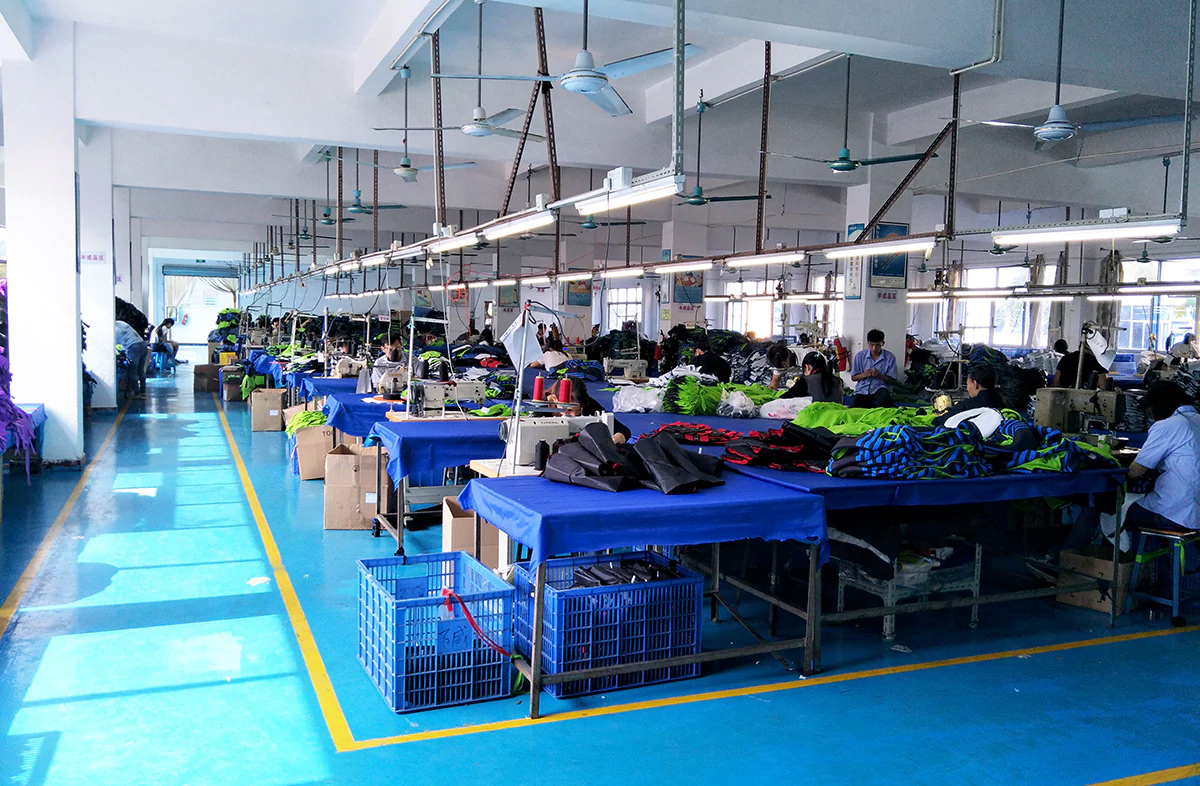
FYBagCustom is Your Trusted Custom Bag Manufacturer in China, with 15+ years of manufacturing experience and a development team that reads tech packs the way architects read blueprints — every line, every number, every reference. For brands at every stage of tech pack readiness, our capabilities include:
Contact our development team to submit your tech pack — or to start the collaborative development process from your concept.
A complete tech pack costs time and effort to build. It repays that investment on the first sample — in a closer match, fewer revision rounds, a faster timeline, and a bulk order that looks like what you approved. For B2B buyers developing custom handbags, three core takeaways:
If you are developing a custom handbag and need a tech pack reviewed, completed, or built from scratch, contact FYBagCustom — and receive a first sample built from your specification, typically within 5–7 days.
FYBagCustom’s development team reads tech packs line by line — or helps you build one from scratch. Submit your specification and receive a first sample in 5–7 days, with every dimension, material, and hardware piece executed as written.
Start Your Custom Bag Project →