Tel/WhatsAapp:+86 18011919834
E-mail: chloe.x@fybagcustom.com

Tel/WhatsAapp:+86 18011919834
E-mail: chloe.x@fybagcustom.com
Send Your Inquiry Today

Who this guide is for: boho and artisanal-positioned brands, resort lines, and beach-lifestyle labels producing the knotted-rope and macramé bags that carry one of fashion’s most enduring handcrafted aesthetics — and that present a production challenge most bag manufacturers have never faced. A macramé handbag is made of knotted cord, and knotted cord has no inherent structure: it doesn’t hold a shape, it doesn’t protect contents, and small items fall through the open knotwork. Turning that into a functional bag — one that holds its silhouette, keeps possessions contained, and survives real use — requires solving problems that simply don’t exist in solid-fabric construction. This guide covers the knotting techniques that create the macramé surface, the structure-integration solutions that give a rope bag form, the lining approaches that make it functional, handle and strap engineering on a cord body, durability for a material that wears differently from woven cloth, and the artisanal-boho and resort market this product serves. It is the handcraft companion to our woven-leather and straw bag guides — a different material, a different craft, a shared challenge of turning a non-rigid material into a working bag.
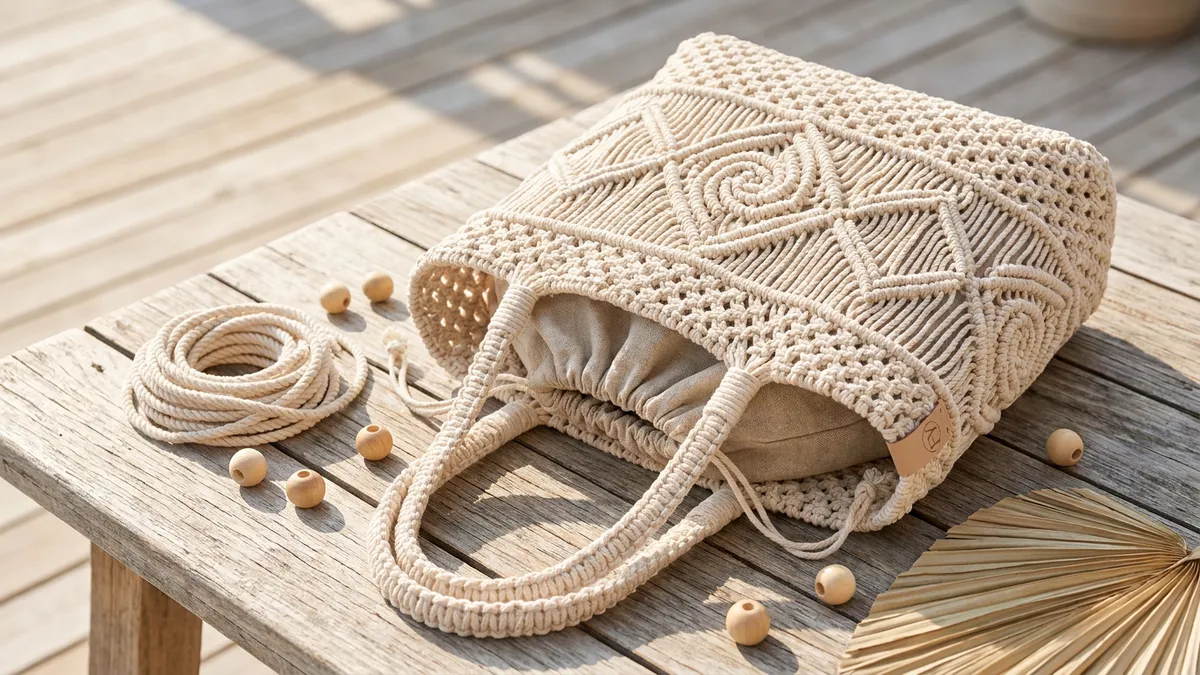
Macramé and cotton-rope bags hold a specific place in the accessory market: they are among the most visually handmade products a brand can carry, and that handcrafted character is their entire appeal. The visible knotwork, the textural dimension, the natural-material honesty of cotton cord — all of it signals an artisanal sensibility that the boho, resort, and conscious-lifestyle customer values precisely because it is the opposite of machine-perfect fashion. Macramé is one of the few bag categories where the imperfections of handwork are the value, where the knot pattern is the design, and where the material communicates an ethos (natural, sustainable, slow-crafted) before the brand says a word.
That appeal is durable: macramé has cycled through fashion repeatedly over decades — from the 1970s bohemian moment through its periodic revival — and each time it returns stronger, because the underlying customer desire for handcrafted, natural, artisanal products has grown. It is no longer a trend; it is a permanent segment with a loyal, repeat-buying audience concentrated in resort, beach, boho, and conscious-lifestyle retail. For a brand positioned in any of those channels, a macramé bag line is a reliable, distinctive, and margin-friendly product that reinforces the brand’s artisanal identity every time a customer carries it.
But the category’s manufacturing challenge is real and specific: cotton rope and knotted cord have no rigidity, no water resistance, and no containment — and a bag, by definition, must contain things. Every macramé bag is therefore a hybrid product: a handcrafted knotwork exterior married to an internal structure and lining system that gives it function. Getting that marriage right — so the bag looks handmade and works like a bag — is the production skill this guide covers.
Macramé is a knotting craft with a defined vocabulary of knots, each creating a different pattern and density. The knots chosen set the bag’s look, its openness, and its structural density.
| Knot | Pattern | Character |
|---|---|---|
| Square knot | A flat, blocky knot creating a regular grid pattern — the most common macramé knot and the one most associated with the classic macramé look | The workhorse — produces a stable, relatively dense knotwork with a structured feel; the default for bag bodies |
| Spiral / half-square knot | A twisting spiral created by repeating only one half of the square knot — a decorative, dimensional, spiraling cord | The decorative accent — used for handles, straps, edging, and detail elements rather than full body panels |
| Half-hitch and double half-hitch | A knot that creates diagonal, chevron, and wave patterns — the pattern-making knot | The designer’s knot — creates the patterned, directional motifs that make a macramé surface visually complex |
| Gathering knot | A wrapping knot that bundles multiple cords together into a clean gathered point | The structural and transitional knot — where cords converge (at handles, at a bag’s base, at strap attachments), the gathering knot creates a clean, secure bundle |
| Josephine knot / Chinese knot | A decorative, looping ornamental knot | The statement detail — the focal-point knot used sparingly for ornamental emphasis |
| Variable | Detail |
|---|---|
| Knot density | How closely the knots are spaced determines how open or closed the knotwork is — a dense knotwork is more structural and more containing; an open knotwork is more decorative but lets items fall through, so it needs a liner |
| Cord weight and ply | The thickness and ply of the cord (single-strand, 3-ply, braided) determines the knot scale, the bag’s weight, and the texture — fine cord for delicate, dressy macramé; thick rope for bold, chunky, beach-resort macramé |
| Pattern design | The arrangement and combination of knots create the pattern — from simple repeating grids (the accessible, volume look) to complex multi-knot compositions (the artisan-premium look) |
| Knot consistency | In handwork, the consistency of knot tension across the piece is the quality marker — even, regular knots are the sign of a skilled maker, just as even weave tension defines woven leather |
| Hand vs. assisted production | Traditional macramé is hand-knotted; for volume, machine-knotted or jig-assisted methods reproduce the look at accessible price points — a positioning and cost decision, with the handmade provenance carrying the premium |
Here is the core manufacturing challenge of the category, and the section that separates a real macramé-bag maker from a decorator: cotton rope has zero inherent structure. A knotted cotton panel, left to itself, is a floppy textile that holds no shape, sags under load, and collapses when set down. Turning it into a bag that stands, holds its silhouette, and functions requires integrating structure — and doing it in a way that preserves the handcrafted look rather than hiding it behind a rigid box.
| Solution | Specification | Best For |
|---|---|---|
| A structured base or frame | A rigid or semi-rigid base panel (wood, acrylic, leather, or stiffened fabric) that the knotwork is built onto or attached to, giving the bag a flat, stable bottom | The structured tote, the market bag — the base gives the bag a footprint and lets it stand; the knotwork rises from it as the body |
| Internal framework | A lightweight internal frame (wire, boning, or a structured shell) that holds the bag’s silhouette while the knotwork drapes over it | The structured silhouette bag — where the knotwork is the exterior surface and the frame is the shape |
| A structural liner | A firm, structured fabric liner that becomes the bag’s shape, with the knotwork as the decorative exterior | The widest-use solution — the liner is the bag, the macramé is the finish; explored fully below |
| Cord density as structure | A very dense, tight knotwork that is stiff enough to hold shape on its own, without additional structure | Limited — works for small, simple shapes (a small clutch, a rigid basket shape), but not for larger bags or bags that must hold heavy contents |
| A combination | A structured base PLUS a structural liner — the most reliable approach for a functional bag | The serious functional macramé bag uses this: a rigid base, a structured liner, and the knotwork as the exterior, combining stability, containment, and handcraft |
The design principle: the structure exists to make the macramé bag work as a bag while letting the macramé look like a handcrafted textile. The structure should be felt (the bag holds shape) but not dominate (the bag still reads as a macramé bag, not a lined bag with a knotted cover). It’s a balance, and it’s the design decision that defines the product. A brand deciding how much structure its macramé line needs can discuss the options with our development team to match form to function at the right price point.
The lining is where containment, protection, and function live — because the open knotwork of a macramé body does not, on its own, contain anything smaller than the knot gaps.
| Approach | Specification | Best For |
|---|---|---|
| The removable drawstring pouch | A separate fabric pouch (typically cotton or linen) that sits inside the macramé bag, with a drawstring top that closes over contents — removable so the macramé can be enjoyed empty as an object | The classic solution — the most common lining for macramé bags; the pouch is the containment, the macramé is the carry and the look; the drawstring provides closure the open knotwork can’t |
| The attached/fixed fabric liner | A fabric liner sewn or attached to the macramé body, giving the bag a functional interior that moves with the knotwork | The more conventional bag feel — the liner turns the macramé into a lined bag rather than a vessel-and-pouch set |
| The structured liner-as-bag | A fully structured, self-standing fabric bag (with pockets, closure, and form) over which the macramé exterior is fitted as a decorative shell | The premium functional approach — the liner IS the bag; the macramé is the texture layer |
| The partial liner | A liner covering only the base and lower body, leaving the upper knotwork unlined and visible | The compromise — containment where things settle (the base), with the visible knotwork above |
| The no-liner option | Unlined macramé, used where containment isn’t needed — decorative bags, plant holders, and the intentionally open beach/market bag | The decorative or open-use case — functional for large items (a towel, a book) but not for small possessions |
| Lining Material | Detail |
|---|---|
| Cotton and linen | The natural-material match — keeping the bag’s material story consistent (cotton cord exterior, cotton/linen interior) |
| Canvas | Durable, the structured-liner choice for form-holding |
| Printed cotton | A printed liner — the hidden design detail and an add-on branding surface |
| Light polyester or nylon | Where water resistance or easy cleaning is needed (the beach bag reality — sand and sunscreen) |
Handles and straps on a macramé bag are a specific engineering problem, because the cord body they attach to is not a woven fabric with structured seam allowances — it is a knotwork, and it distributes load differently.
| Element | Specification | Why |
|---|---|---|
| Integrated knotted handles | Handles formed from the cord itself — extended, gathered, or braided cord ends that become the handle — the purest macramé approach | Maintains the all-cord aesthetic; the handle is part of the craft |
| Reinforced attachment | Where handles (knotted, wooden, metal, or leather) attach to the knotwork, the attachment point is reinforced — knotwork under load will distort at the anchor unless the load is spread across multiple knots and cords | The cord body distributes load differently from woven fabric; an unreinforced handle attachment pulls through the knots |
| Wooden, bamboo, or ring handles | Rigid handles (wooden rings, bamboo bars, metal rings) that the knotwork wraps around or is lashed to — a strong attachment because the load spreads around the ring | The structural-handle approach — the ring or bar is the anchor, and the knotwork grips it |
| Leather straps and handles | Leather handles attached through or around the knotwork at reinforced points | The leather-and-macramé hybrid — premium look and genuine load-bearing strength |
| Load testing | Every handle-and-strap configuration loaded and tested, because the cord body’s behavior under load is less predictable than a woven one | A handle that works empty may pull, stretch, or distort the knotwork when loaded; testing catches it |
| The crossbody strap option | An adjustable strap (leather, woven, or macramé) for hands-free carry — attached at reinforced points, load-distributed | Adds hands-free versatility; the attachment is the challenge and must be reinforced |
Cotton rope and macramé have material characteristics that affect the bag’s life and care, and the honest brand designs for them and communicates them clearly.
| Element | Detail |
|---|---|
| Stretch and distortion | Cotton cord stretches under sustained load, and the knotwork can distort if heavily loaded for long periods — the bag is designed for a normal daily load, not as a heavy-duty carrier, and the product communicates it |
| Water and wet | Cotton absorbs water, dries slowly, and can mildew if stored wet — the bag needs drying after a beach day, and the care guidance says so; a water-resistant liner protects contents even if the exterior gets wet |
| Soiling | Natural cotton shows dirt and stains; a pre-wash or a protective treatment helps, and the care card advises spot-cleaning |
| Color and dye | Cotton rope takes dye well (and comes in natural, undyed tones for the purest artisanal look); dyed cord needs fastness testing so it doesn’t bleed onto clothes or contents |
| The durability framing | A macramé bag is a durable, reusable, long-lived product — not disposable — but its material has limits (stretch, water, soil) that the design addresses and the care card communicates honestly; the customer who cares for a cotton bag keeps it for years |
| Repairability | Macramé is repairable — a broken cord or a loose knot can be retied — which is part of its artisanal, long-life story |
| Sustainability | Cotton rope (especially organic and natural-dyed) is a genuinely sustainable, biodegradable material, which fits the conscious-lifestyle positioning the category serves; brands building on this story can brief our team on the organic and natural-dyed options available through our supplier network |
| Element | Detail |
|---|---|
| Natural / undyed | The natural off-white or ecru cotton tone — the purest artisanal signal, the classic macramé look |
| Earth tones | Dyed cord in warm earth tones (sand, terracotta, sage, ochre, brown) — the boho palette |
| Seasonal and resort color | Dyed cord in resort and seasonal colors (coral, seafoam, dusty blue) for range variety |
| Mixed-tone and ombré | Mixing dyed and natural cord within the knotwork for pattern color — a design feature |
| Beads, shells, and accents | Wooden beads, shell accents, fringe, and tassel finishing — the boho embellishment vocabulary; the accents are threaded or knotted into the cord and load-tested for security |
| Fringe | Fringe (loose cord ends) as a deliberate design element — the quintessential boho finish |
| Print and branding | The macramé aesthetic favors minimal branding — a small woven label, a tonal tag, a branded embroidered element on the liner rather than the knotwork; the liner is the natural branding surface |
| Digital-printed liners | A printed liner carries the brand’s identity inside the bag without disrupting the handcrafted exterior — the hidden-brand detail |
| SKU | Format | Spec Summary |
|---|---|---|
| Macramé market tote | Tote | Structured base, cotton body, drawstring liner, knotted handles — the hero |
| Macramé shoulder bag | Shoulder bag | Medium, lined, leather or wooden ring handle — the versatile crossover |
| Macramé clutch / pouch | Clutch | Dense-knot small format, lined, zip closure — the dressy piece |
| Macramé crossbody | Crossbody | Hands-free, reinforced strap attachment, lined — the festival and travel format |
| Macramé bucket bag | Bucket | Structured base, knotwork body, drawstring liner — the statement shape |
| Macramé beach / open bag | Open tote | Unlined or partial-lined, open knotwork for a towel and a book — the beach bag |
The application fit: macramé bags sit in the travel and adventure program (the resort and beach core), the gift and promotional vertical (the artisanal-positioned gift and the resort-retail program), and daily commuting and work for the lined, structured pieces in the boho-lifestyle register — with the fitness and active-life segment covered by the open beach bag.
| Check | Method | Standard |
|---|---|---|
| Knot consistency | Knot tension and regularity checked across the piece | Even, regular, consistent knots — the handcraft quality marker |
| Pattern accuracy | Knot pattern checked against the approved design | Correct pattern; no skipped or misplaced knots |
| Handle and strap load | Handles and strap attachments loaded and checked for pull-through, distortion, and cord stretch | Holds at rated load without distorting the knotwork |
| Structure and shape | The bag checked for shape-holding (base, liner, frame) | Holds its silhouette; stands if designed to |
| Liner fit and function | Liner checked for fit, drawstring or closure function, and containment | Contains small items; fits the knotwork body |
| Cord fastness | Dyed cord checked for colorfastness (wet and dry) | No bleed onto clothes or contents |
| Bead and accent security | Beads, shells, and accents pull-tested | Securely attached; no loss under normal use |
| Stretch under load | The loaded bag checked for cord stretch and shape retention | Manageable stretch; shape retained |
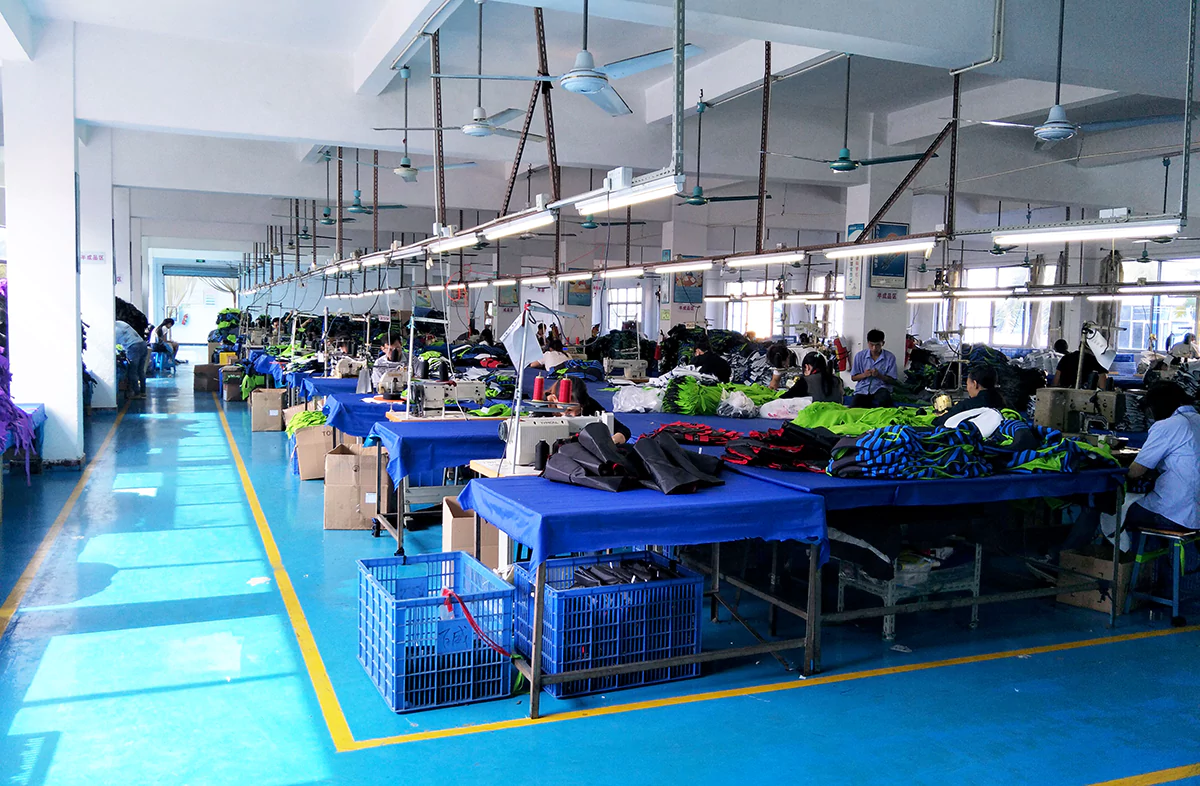
FYBagCustom is Your Trusted Custom Bag Manufacturer in China, with 15+ years of manufacturing experience spanning handcraft and machine-assisted production, and the structure-integration discipline macramé bags demand. For boho, artisanal, and resort brands, our capabilities include:
Cotton rope and macramé bags carry the artisanal-boho aesthetic that a loyal market loves, and they reward the manufacturer who solves the craft’s real production challenges. For boho, artisanal, and resort brands, three core takeaways:
If you are building a macramé or cotton-rope bag line — structured totes, resort pieces, or a full artisanal range — contact FYBagCustom to brief your line, and receive a hand-knotted, structure-integrated sample in 10–14 days.
FYBagCustom produces macramé and cotton-rope bags with the structure, lining, and handle engineering that turn a knotted textile into a real bag — consistent handwork, reinforced construction, and the artisanal-boho finishing the market loves. Hand-knotted samples in 10–14 days.
Start Your Custom Bag Project →