Tel/WhatsAapp:+86 18011919834
E-mail: chloe.x@fybagcustom.com

Tel/WhatsAapp:+86 18011919834
E-mail: chloe.x@fybagcustom.com
Send Your Inquiry Today

Who this guide is for: travel and commuter brands producing bags that change size — the expandable bags that grow when the customer needs more room and the foldable/packable bags that compress into almost nothing when they don’t. Both solve a real problem in the travel and daily-carry market: the customer who doesn’t want to carry a big bag when they don’t need one, or who needs a bag to grow on the return trip when they’ve shopped. This guide covers the engineering of both: gusset-zip expansion mechanisms (the zip-around panel that adds depth and volume on demand), packable self-storing construction (the bag that folds into its own pocket), and the fabric-and-structure balance that is the category’s central engineering challenge — making a bag that folds flat or compresses small yet holds its shape and functions as a real bag when deployed. It complements our foldable travel-suit-bag article by covering the broader expandable and packable category across totes, duffels, backpacks, and day bags.
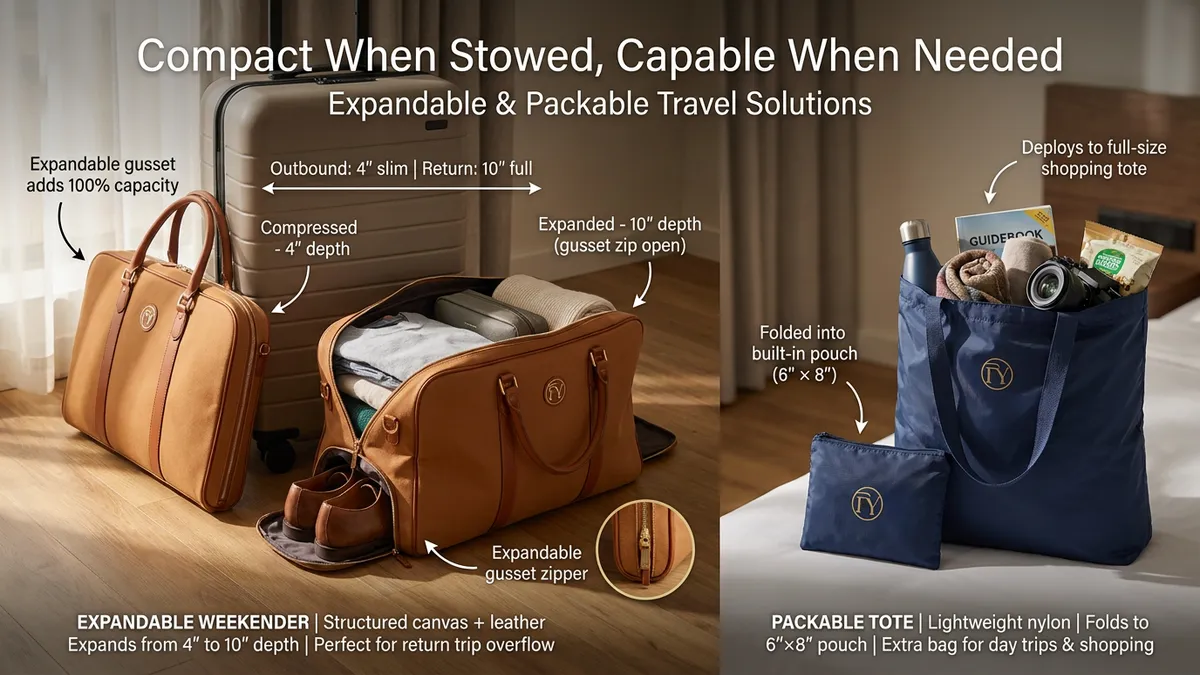
The expandable and foldable bag category exists because luggage is a commitment problem: carrying a large bag “just in case” wastes space and effort when the bag is half-empty, but carrying only a small bag means having nowhere to put the souvenirs, the extra jacket, or the duty-free. The expandable bag solves it by growing on demand — the same bag carries the Monday commute kit and the Friday bring-everything-home load. The packable bag solves it by disappearing — a full-sized tote or duffel that, when empty, folds into a pocket-sized pouch the traveler stows inside their main luggage until they need it.
Both are among the highest-performing functional features in the travel and commuter bag markets. “Expandable” and “packable” are search-and-feature keywords that reliably drive purchase decisions, because they solve the problem every frequent traveler and every commuter has experienced. But both are also engineering challenges disguised as simple concepts: a bag that expands must expand smoothly, hold its shape in both states, and not look like a deflated balloon when compressed; a bag that packs must fold small, deploy into a real bag rather than a limp sack, and survive being folded and unfolded hundreds of times without the fold lines wearing through. This guide covers the engineering of both.
The expandable bag’s core mechanism is the gusset zip — a concealed zipper that, when opened, reveals a hidden panel of material (the gusset) that adds depth, width, or both to the bag, increasing its volume.
| Element | Specification | Why |
|---|---|---|
| The concealed gusset | A panel of fabric folded and hidden between the bag’s outer shell and its lining (or between two layers), held closed by a zip; when the zip is opened, the panel unfolds and the bag gains volume | The expansion is built into the bag’s construction from the start — not a stretchy fabric that distorts, but a deliberate, engineered volume increase |
| The zip location | Typically around the bag’s perimeter (a full-perimeter gusset zip adds depth uniformly) or along the base/sides; the location determines how and where the volume grows | Perimeter expansion grows the bag evenly; side or base expansion is more targeted |
| Volume increase | Typically 20–40% additional capacity when expanded — enough to be genuinely useful (an extra set of clothes, a shopping haul, a jacket) without being so much that the bag becomes unwieldy | The expansion must be meaningful but proportionate; too little is a gimmick, too much makes the expanded bag awkward |
| The zip quality | The expansion zip must be smooth, durable, and (on travel bags) water-resistant or covered by a storm flap — this zip is opened and closed frequently and is often longer than the bag’s main zip | The expansion zip is a high-use, high-stress component; it must match or exceed the main zip’s quality |
| Element | Specification | Why |
|---|---|---|
| Shape retention when expanded | The expanded bag must hold its shape and function as a normal bag — not sag, bulge unevenly, or look like it’s been forcibly enlarged | The expanded state is a real bag, not a temporary workaround; if the expansion makes the bag look distorted, the customer won’t use it |
| Strap and handle load in expanded state | The handles and straps must carry the expanded bag’s full loaded weight — the expansion adds volume, and the customer fills it; the anchor points must support the heavier load | The expanded bag is the heavier bag; the anchors are spec’d for that weight, not the compressed state’s |
| Structure in the gusset | The gusset panel itself has enough body to hold form when deployed — a limp, flimsy gusset panels makes the expanded bag shapeless | The gusset material is chosen for body, not just to fill the gap |
| Base stability | If the expansion adds depth, the base must remain stable — a bag that gets deeper but doesn’t get a deeper base wobbles; a foldable base panel that extends with the gusset is the premium solution | The base keeps the expanded bag standing and carrying level |
A brand developing its first expandable format can discuss the gusset placement, volume target, and structure with our development team to prototype the expansion before committing a full design — the mechanism is best resolved in physical samples rather than renders.
| Element | Specification | Why |
|---|---|---|
| Flat, clean profile | When the gusset is zipped closed, the bag reads as a normal-sized bag — no visible bulge, no excess material bunching, no obvious “there’s more in here” look | The compressed state is the everyday state; it must look designed, not deflated |
| Gusset storage | The folded gusset sits flat between the shell and the lining without adding visible bulk | The hidden gusset is hidden — felt only as a slight thickness, not a visible lump |
| Zip concealment | The expansion zip concealed within the bag’s design — a welt zip, a covered zip, or a zip hidden behind a panel — so the compressed bag doesn’t have a visible zip around its perimeter | The zip is a functional element, not a design feature; it’s hidden when closed |
The packable bag is a different product from the expandable — rather than a bag that grows, it’s a bag that disappears: a full-sized tote, duffel, or backpack that folds, rolls, or stuffs into a small integrated pouch when not in use, and deploys into a functional bag when needed.
| Element | Specification | Why |
|---|---|---|
| The self-storing pocket | The bag folds into one of its own pockets — the pocket becomes the pouch, with the rest of the bag compressed inside it; the pouch typically has a zip or snap closure and a small carry handle or clip | Self-storing means the bag carries itself when packed — no separate stuff sack to lose; the bag IS its own carrying case |
| The fold/roll pattern | The bag is designed with a specific fold or roll sequence that compresses it to minimum size without fighting itself — the fold lines planned, not random | A designed fold is fast, compact, and repeatable; a random stuff is slow, bulky, and frustrating |
| The packed size | Small enough to fit inside a carry-on, a purse, or a coat pocket — the value is proportional to how small it gets; the best packables compress to a size that genuinely disappears | The smaller the packed size, the more likely the customer carries it “just in case” |
| The deployment | Unfolding and deploying into a usable bag in seconds — fast, intuitive, and producing a bag that’s ready to use without fussing | Deployment must be as fast as the pack; a bag that takes five minutes to unfold and shake into shape loses the customer |
Here is the engineering trade-off that defines the packable category and separates a real product from a disposable-feeling giveaway: the same properties that make a bag fold small (thin, unstructured, lightweight) are the properties that make it feel flimsy when deployed. The craft is in finding the balance.
| Property | The Fold Wants | The Function Wants | The Balance |
|---|---|---|---|
| Structure | None — structure prevents folding | Shape, form, the bag stands and holds its silhouette | Enough body that the bag functions without permanent stiffeners that prevent the fold |
| Material weight | Ultralight — lighter folds smaller | Substance — the bag must feel like a bag, not a garbage bag | A lightweight fabric with enough hand and body that it doesn’t feel disposable when deployed |
| Stiffeners and reinforcement | None — they create bulk and resist folding | A stable base, reinforced handles, shape | Flexible reinforcement that folds (a foldable base panel, a cord-stiffened rim) rather than rigid structure |
| Hardware | Minimal — hardware adds bulk and catches during the fold | Functional hardware (zips, clasps, adjusters) for the bag’s function | Flat-profile, low-bulk hardware that lies within the fold without creating pressure points |
| The hand and feel | Thin, compliant | Quality, considered, premium | A thin-but-quality fabric (high-denier ripstop, premium nylon, silky polyester) that packs small and feels good when carried |
The honest positioning: a packable bag is not a replacement for a structured, full-featured primary bag — it is the secondary bag, the emergency extra, the “I didn’t think I’d need a bag and now I do.” Its competition is the plastic shopping bag and the cheap tote giveaway; its premium is that it looks, feels, and functions like a real bag when deployed, and disappears when not needed. Positioning it correctly — as the brilliant backup, not the everyday workhorse — sets honest expectations and earns repeat purchase. Travel brands building a packable add-on to their existing range can brief our team on the fabric, fold, and packed-size targets to develop the packable alongside the primary line.
Packable bags are folded and unfolded repeatedly — potentially hundreds of times over their life — and the fold lines are where the material wears, cracks, and eventually fails. Fold-line durability is the packable bag’s defining longevity challenge.
| Element | Specification | Why |
|---|---|---|
| Fabric flex resistance | The fabric tested for repeated folding at the same crease lines — flex-crack testing at thousands of cycles | Coated fabrics crack at fold lines; uncoated fabrics abrade; the chosen fabric must survive its fold life |
| Coating and finish at folds | If the fabric is coated (DWR, PU, etc.), the coating tested for cracking at fold lines — the most common failure on coated packables | A cracked coating at the fold line looks worn, leaks water, and ages the bag prematurely; the coating is formulated to flex |
| Reinforced fold zones | The designed fold points reinforced or the fold pattern varied to distribute wear rather than concentrating it on one crease | A fold that always lands on the same line wears through that line; the fold is designed to spread the stress |
| Thread and seam at folds | Seams that cross fold lines tested for thread fatigue and seam integrity at the fold point | A seam at a fold line concentrates stress; the seam construction survives the repeated flex |
| The print at fold lines | If the bag is printed, the print tested for cracking, peeling, or fading at fold lines | Print cracks at the fold are the visible sign of wear on printed packables |
| Material | Application | The Read |
|---|---|---|
| Ripstop nylon | The packable workhorse — lightweight, tear-resistant, folds compactly, and holds enough body to deploy well | The default packable material for good reason |
| High-denier polyester (incl. recycled) | Packable and expandable bodies — durable, printable, and the sustainability-positioned option | The cost-effective and eco-friendly alternative |
| Silky/lightweight nylon | The premium-feel packable — thin, smooth, with a quality hand that reads as a luxury travel accessory rather than an emergency bag | The premium packable register |
| Technical canvas (coated/waxed) | Expandable bag bodies — more structure than ripstop, the heritage-travel register | The expandable commuter and heritage-travel look |
| Leather and PU trim | Handles, corners, and accents on expandable bags | The premium frame — leather trim on the expandable makes it read as a primary bag |
| Lightweight webbing | Straps and handles on packables | The strap material that folds without bulk |
Construction non-negotiables: smooth, durable expansion zips (covered or concealed), reinforced handle and strap anchors at the expanded-state load, designed fold patterns with flex-tested fold lines, self-storing-pocket construction, and enough body in the deployed state that the bag functions and feels real. Branding via embroidery and heat-transfer on expandable bags, digital print on packables (tested at fold lines), with waterproof and multi-function design features.
| SKU | Type | Format | Spec Summary |
|---|---|---|---|
| Expandable weekender duffel | Expandable | Duffel | Gusset-zip expansion, 30–40% volume increase, structured in both states — the travel hero |
| Expandable commuter backpack | Expandable | Backpack | Zip-expand for the Friday overload, clean profile Monday–Thursday |
| Expandable tote | Expandable | Tote | The shopping and market-day expansion — tote-to-big-tote |
| Packable tote | Packable | Tote | Self-storing into its own pocket — the travel-day backup |
| Packable duffel | Packable | Duffel | Folds into a pouch, deploys to a full duffel — the return-trip bag |
| Packable backpack | Packable | Backpack | The ultralight backup daypack — the hiker’s and traveler’s second bag |
| Packable crossbody | Packable | Crossbody | The smallest packable — a hands-free bag from a pocket-sized pouch |
| Hybrid expandable + packable | Both | Duffel/tote | The premium format: expandable when full, packable when empty — the maximum-versatility travel piece |
The application fit: expandable and packable bags sit primarily in travel and adventure (the core market — the return-trip bag, the travel daypack, the expandable weekender), daily commuting and work (the expandable commuter, the packable backup), gift and promotional (the branded packable tote as a travel-program or event giveaway), and fitness and active-life (the packable gym bag).
| Check | Method | Standard |
|---|---|---|
| Expansion-zip smoothness | The gusset zip opened and closed through full cycles | Smooth, no jamming, no catching; covered when closed |
| Shape in both states | The bag inspected in compressed and expanded states for shape, structure, and clean profile | Holds shape in both; no sag, no bulge, no visible gusset when closed |
| Expanded-load anchors | Handles and straps loaded at the expanded-state maximum weight | Holds at full expanded load; no pulling or deformation |
| Pack-and-deploy cycle | The packable bag folded into its pouch and deployed, repeatedly | Packs small and fast; deploys into a functional bag; the fold is intuitive and repeatable |
| Fold-line flex test | The packed bag’s fold lines flexed at thousands of cycles; coatings and prints inspected at folds | No cracking, no coating failure, no print peeling at fold lines |
| Self-storing pouch | The pouch’s zip, closure, and attachment inspected | Closes securely; attached and won’t be lost; compact |
| Deployed feel and function | The packable bag deployed and assessed for look, feel, and function | Looks and feels like a real bag, not a disposable; functions as a bag |
| Material durability | The fabric, seams, and hardware tested for the product’s intended life | Survives its use life — the travel cycles it’s designed for |
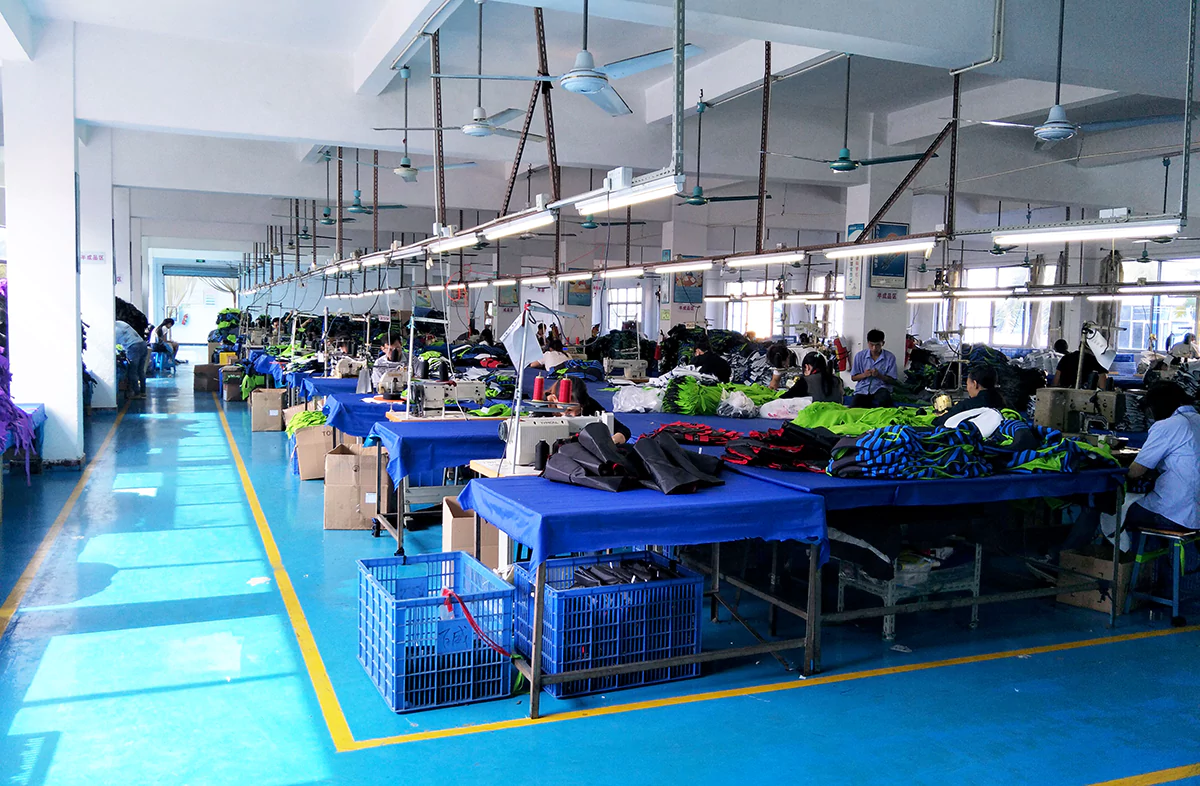
FYBagCustom is Your Trusted Custom Bag Manufacturer in China, with 15+ years of manufacturing experience and the gusset-construction and packable-engineering discipline these formats demand. For travel and commuter brands, our capabilities include:
Expandable and packable bags solve the same problem from opposite ends — too much bag or too little — and both reward the engineering that makes the mechanism invisible when it’s not in use. For travel and commuter brands, three core takeaways:
If you are building an expandable or packable bag program — gusset-zip weekenders, self-storing travel totes, or a full expand-and-pack range — contact FYBagCustom to brief your program, and receive a mechanism-built, fold-tested sample in 7–10 days.
FYBagCustom engineers expandable and packable bags — concealed gusset-zip expansion, self-storing packable construction, and fold-line durability testing — so volume appears when needed and vanishes when it doesn’t. Mechanism-built samples in 7–10 days.
Start Your Custom Bag Project →