Tel/WhatsAapp:+86 18011919834
E-mail: chloe.x@fybagcustom.com

Tel/WhatsAapp:+86 18011919834
E-mail: chloe.x@fybagcustom.com
Send Your Inquiry Today

Who this guide is for: brand owners and product developers producing the FW26 chain-strap look — the revival riding what the trend press calls the mass nostalgia for 2016. The evidence spans the season: Valentino’s chunky chain shoulder bags, Chloé’s leather pouches swung from chains, Stella McCartney’s XL chain-strap totes, Ferragamo’s oblong chain clutches — with Dior’s chunky-link slouchy totes on the spring runways and Chanel, where the chain strap never left, showing them at couture. The chain strap is the rare component that is simultaneously the bag’s jewelry, its structure, and its highest-stress system: every carried gram passes through its links, its end connectors, and its anchors, and the 2016 era left the market with vivid memories of chains that dug into shoulders, pulled out of grommets, and shed their gold onto coat sleeves. This guide covers chain-strap production for daily bags — the link vocabulary, the weight and comfort math, the leather-woven chain construction, the attachment systems that survive daily loads, and the quilted-flap pairing that completes the revival package. It extends our general strap-engineering guide into the chain-specific territory the season demands.
The chain strap’s return arrived with a thesis. As Refinery29’s trend reporting frames it, the bags that defined the mid-2010s — the Marmont, the Dionysus, the Boy Bag, the Rockstud — shared one component: the chain strap. Their revival is the revival of that hardware language, and it is broad rather than niche: chunky chains on structured shoulder bags, delicate chains on pouches and clutches, chains on totes scaled up to XL, chains woven with leather in the Chanel tradition that, as Marie Claire notes, has run unbroken since 1955. When the trend press declares that a component this established has “earned its breakout moment,” the practical meaning for manufacturers is volume: chain straps are moving from the evening niche onto daily-carry silhouettes across every tier.
Daily carry is the engineering event. An evening clutch’s chain carries under a kilogram for four hours; a daily crossbody or tote chain carries one to three kilograms for eight, swinging through commutes, catching on doorframes, grinding link against link with every step. The chain systems that satisfied the occasion vertical — covered in our occasion-clutch guide, whose welded-link and load-test standards this article inherits — are the floor for the FW26 daily programs, not the ceiling. The season’s chain bag succeeds or fails on four engineering fronts: the link itself, the weight on the shoulder, the attachment into the body, and the plating that must survive metal-on-metal contact no other hardware on the bag experiences.
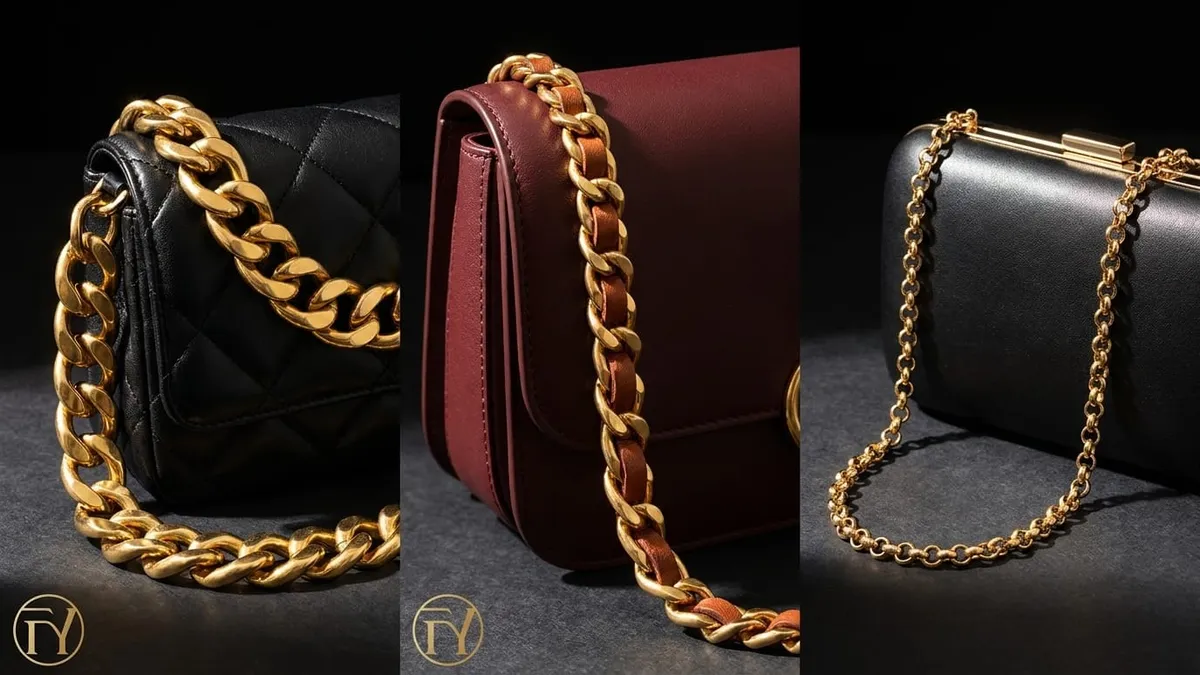
The chain is the bag’s most visible hardware statement, and each link family carries its own weight, drape, durability, and reference.
| Link Type | Profile | Drape & Behavior | The FW26 Read | Engineering Notes |
|---|---|---|---|---|
| Curb | Twisted-flat interlocking links lying flush in one plane | Lies flat against the body; the classic “watch chain” run | The revival’s default — the Marmont-era reference; reads luxe at every scale | The flat lie distributes shoulder pressure best of the classic links; link faces abrade each other at the twist points — plating spec matters |
| Rollo / belcher | Round wire circles, uniform | Fluid, rounded, slightly dimensional | The delicate register — pouches, clutches, jewelry-adjacent minis | Round wire = smallest contact patch on the shoulder; keep rollo for light-load formats |
| Cable | Oval links, alternating orientation | The most flexible drape | The utilitarian-minimal read | The workhorse; hides wear well |
| Chunky oversized link | Outsize curb or cable, 15–25 mm link width | Sculptural, heavy, unmistakable | The statement signal — the Valentino chunky shoulder bag, Dior’s slouchy-tote straps | The weight problem concentrated (below); hollow-link construction is nearly mandatory at this scale |
| Flat / snake / omega | Continuous articulated flat surface | Ribbon-like, liquid | The sleek-modern register | The most comfortable on bare shoulders; the most complex to repair — specify quality once, because field repair is impractical |
| Motif chain | Cast decorative links — interlocking logos, sculptural shapes (the Gancini-style reference) | Depends on geometry | The brand-signature play — the chain as identity | Each cast link is a small hardware part with mold, finish, and strength specs; motif chains are custom tooling investments and MOQ carriers |
| Leather-woven chain | Chain with leather threaded through the links | Softer visual, quieter, lighter pressure feel | The Chanel-tradition signal — the revival’s most requested construction | Its own section below |
The single-finish rule, squared: the chain multiplies the bag’s visible metal by more than any other component — the chain, its end connectors, the anchors, and every other hardware piece hold one finish, verified under one light, because a chain that reads half a tone off the turnlock is a mismatch repeated two hundred times per bag.
Chain is mass. A chunky-link shoulder chain in solid brass can weigh 300–500 g before the bag exists — a strap that outweighs some finished mini bags — and shoulder comfort, not aesthetics, is where the 2016 era’s chain bags generated their quietest dissatisfaction.
| Engineering Decision | Specification |
|---|---|
| The strap weight budget | Weigh the chain as a line item at design stage: target under 150 g for crossbody-length chains on minis, under 250 g for shoulder chains on midi bags; chunky statement chains above that threshold require the mitigations below |
| Hollow-link construction | Cast and formed hollow links deliver the chunky profile at 40–60% of solid weight — the statement register’s standard; specify per-meter weight alongside the visual sample, and verify crush resistance (a hollow link that dents under a firm squeeze fails the daily-carry standard) |
| Alloy selection | Zinc alloy and aluminum-core systems cut weight further at the cost of plating adhesion complexity; brass and steel carry the premium heft-and-feel at full mass — the material choice is a positioning choice, made consciously |
| The pressure problem | Chain concentrates load on link contact points; a loaded chain digs into the shoulder in a way no flat strap does |
| The shoulder solution set | Three mitigations, combinable: (1) the leather shoulder pad — a slide-positioned leather sleeve or stitched rest over the chain’s shoulder zone; (2) the half-and-half strap — chain on the visible drop sections, flat leather through the shoulder zone (the construction quietly used across the premium market for exactly this reason); (3) the leather-woven chain, whose threaded leather widens and softens the contact patch |
| The link-fit noise spec | Loose-fitting links jingle with every step — charming on an evening bag, wearing on a daily one; specify link tolerance by sample approval with a shake test: the chain lifted and dropped 10 cm onto padding should thud, not chime |
The chain with leather threaded through its links — the construction Chanel has run since the fifties, and the detail the FW26 revival most often specifies — is a hand operation with a specification of its own.
| Element | Specification |
|---|---|
| The leather element | A skived leather or PU strip, edges finished (painted or folded) before weaving, width matched to the link’s inner window — typically 60–75% of the window height so the weave sits full but not forced |
| The weave pattern | Single-thread (the strip passes through every link, the classic), or over-under variants; the pattern is specified by reference sample and held consistent across the run — a weave that changes rhythm mid-strap is visible at a glance |
| Tension | The defining quality variable: woven too tight, the strap stiffens and the leather stresses at every link edge; too loose, the leather bunches and gaps. Specify by reference sample with a drape test — the finished woven chain held horizontally should curve smoothly, no kinks, no gaps |
| The ends | The leather terminates inside the end connectors or is stitched back on itself around the final link — never cut raw and glued; the end is where woven straps unravel |
| Labor honesty | Weaving is hand work: minutes per strap that scale linearly with volume, belonging in the quote as its own line — the woven chain costs more than the plain chain plus the leather, and the premium is the labor |
| The whipstitch-edge variant | The related construction — chain stitched along a bag’s edges with leather thread (the Falabella-style signal) — is an edge-finishing operation rather than a strap, with its own stitch-spacing and tension specs; it shares the hand-labor economics |
The 2016 era’s most memorable chain failure was the attachment: grommets pulling out of flap corners, jump rings opening at the end links, chains separating from bags in motion. The attachment system is where the chain’s jewelry identity meets tote-grade structural requirements.
| System | Construction | Specification |
|---|---|---|
| Through-body grommets (the Chanel-tradition entry: chain passes through eyelets into the bag interior) | Metal grommets set through the body panel at reinforced points; the chain threads through and anchors inside | The grommet zone is a full reinforcement stack: interlining + backing washer + an interior anchor plate or reinforced tab the chain’s end link fixes to — the grommet is the chain’s passage, never its anchor; load transfers to the interior anchor, not the grommet rim |
| D-ring and end-link | The chain’s terminal link (or a cast end connector) closes onto a D-ring mounted on an exterior tab | The tab per strap-anchor norms (webbing patch + bartack through all layers); the terminal connection is a soldered or cast closure — no open jump rings anywhere in a daily-load chain, the standard inherited from the occasion program and doubled in importance at daily loads |
| Cast end connectors | A dedicated cast piece — often the brand’s hardware signature — joining chain to tab | The connector is a structural part: specify its pull strength with the chain assembly, because a beautiful cast connector with a thin internal web is the system’s hidden weak point |
| The load standard | The full assembled system (chain + connectors + rings + tabs + anchors) load-tested as one unit | 10 kg sustained, 60 seconds for daily-carry chain bags — double the occasion-clutch standard, reflecting the daily bag’s loaded weight plus dynamic shock (the bag swung onto a shoulder, caught on a rail); plus the 500-cycle swing test with plating and link inspection after |
The revival’s daily-bag context makes convertibility a core spec rather than a bonus.
| Mode | Mechanics | Specification |
|---|---|---|
| Doubled shoulder / single crossbody | A long chain (110–120 cm) worn doubled through both anchors for a short shoulder drop, or single for crossbody | Anchor spacing wide enough that the doubled chain lies in two clean parallel runs without bunching; the doubling must not trap the leather weave on woven chains — test the doubled configuration on the PP, not just the single |
| Detachable chain | Swivel clasps at both ends | Cast swivel lobster clasps gauge-matched to the 10 kg standard; detachability also serves the retail story (chain sold as a swappable accessory across the line — the chain as the new strap bar) |
| The half-leather hybrid | Chain drops + leather shoulder section, fixed or modular | The comfort solution doubling as a design signature; the chain-to-leather junctions are load-path connections with the same cast-closure standard |
| Chain-plus-flat-strap two-strap box | The bag ships with both a chain and a plain adjustable strap | The adoption insurance for daily-carry positioning — the customer who loves the look but commutes heavy uses the flat strap on workdays; a packing configuration, not a construction change |
Chain is the only hardware on the bag that wears against itself — every step articulates every link against its neighbors, and the contact points abrade from the inside of the system out.
| Risk | Specification |
|---|---|
| Link-on-link abrasion | Plating at the top commercial thickness band for chains, verified by an articulation test: the chain assembly cycled through 5,000 flex articulations, then inspected at link contact points for base-metal exposure — the standard salt-spray test alone misses this failure mode entirely |
| Skin and clothing contact | The chain rides on the neck, shoulder, and clothing more than any other hardware: nickel-release compliance documented, and the crock-adjacent check — the chain rubbed against a white cloth 20 passes — for plating transfer on new production |
| The gold question | Gold-tone is the revival’s dominant finish (the 2016 reference is a gold-chain reference); gold plating systems vary widely in wear behavior — approve by articulation-tested sample, and consider brushed and antiqued golds whose micro-texture hides early wear the way mirror gold cannot |
| Salt spray | 48-hour minimum, per the strap-hardware standard — the chain is strap hardware |
The FW26 chain bag’s most commercial expression pairs the chain with the quilted flap body — the Marmont-and-Boy-Bag-era package the nostalgia is actually for. The quilting is its own construction discipline, briefly:
| Element | Specification |
|---|---|
| The quilt stack | Face material + 3–5 mm foam + backing scrim, stitched through all layers in the pattern grid (diamond or chevron — the two revival signatures) |
| Pattern discipline | Grid spacing uniform ± 1 mm; rows straight over the panel’s full run; and the premium tell — pattern matching at seams and across the flap edge, where the diamond points align across the construction break; matched quilting costs cutting yield exactly as croc panel-matching does, and it is the same cheapest-luxury-signal economics |
| Stitch spec | Shorter stitch (higher SPI) than structural seams, thread tonal, tension tuned to dimple the foam without puckering the face |
| The chain interaction | Quilted bodies are soft bodies — the chain’s grommet or tab anchors need the full reinforcement stack through the quilt layers, with the anchor zones’ quilting pattern designed to accommodate the hardware placement rather than colliding with it |
| SKU | The Runway Reference | Spec Summary | Role |
|---|---|---|---|
| Quilted flap crossbody | The Marmont-era revival center | Diamond-quilted leather/PU flap body, curb chain with half-leather shoulder option, through-body or tab anchors at 10 kg standard | The hero — the nostalgia object itself |
| Chunky-chain shoulder bag | The Valentino signal | Structured handbag body, oversized hollow-link chain, cast end connectors | The statement — weight-budgeted chunk |
| Chain-strap XL tote | The Stella McCartney signal | Soft tote body, chain-plus-leather hybrid straps rated to tote loads | The surprise format — the chain at carryall scale |
| Oblong chain clutch | The Ferragamo signal | East-West clutch with slim rollo or motif chain, detachable | The occasion crossover, per the occasion program’s chain standards |
| Leather-woven chain pouch | The Chloé-and-Chanel register | Soft pouch on a woven chain, drawstring or zip | The tradition play — the hand-labor premium worn visibly |
Colorways: black-with-gold carries the revival’s core reference; the FW26 browns take antiqued gold; oxblood and bottle green from the season’s palette give the chain program its fashion colorways — with the chain finish held constant across all of them.
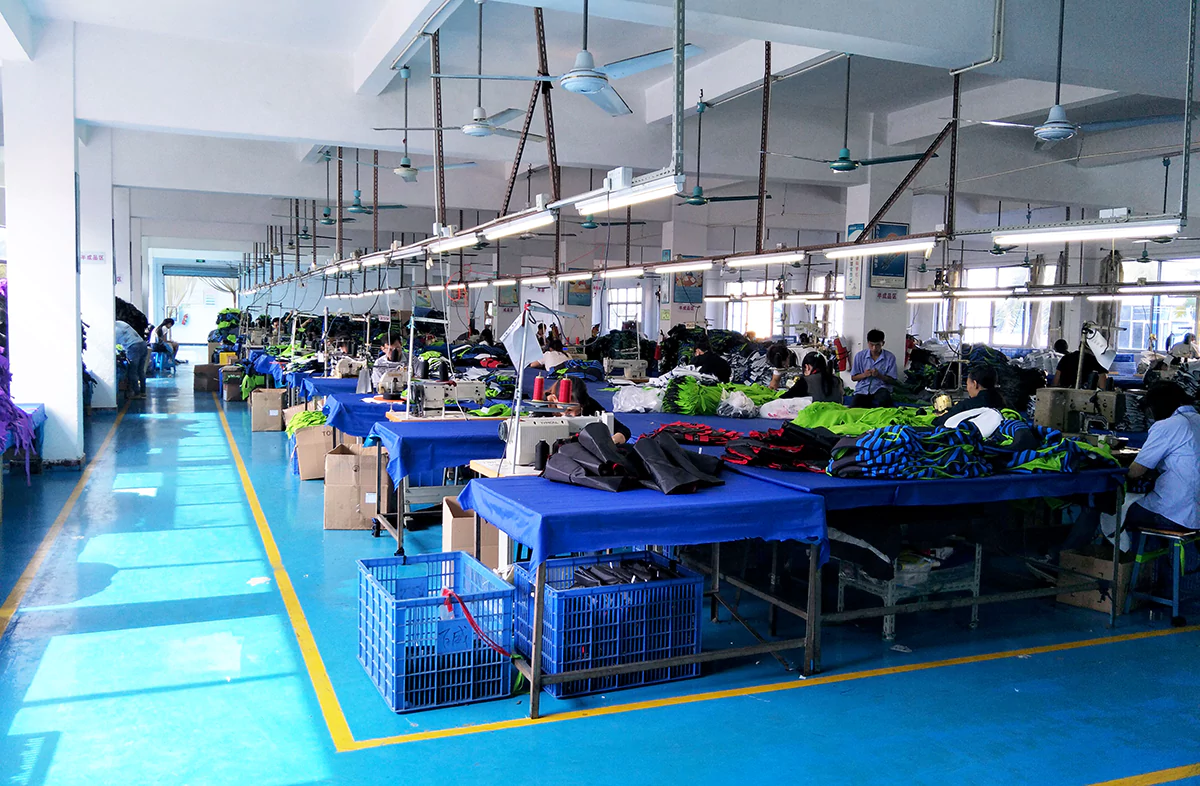
FYBagCustom is Your Trusted Custom Bag Manufacturer in China, with 15+ years of manufacturing experience and the chain-system discipline the revival demands. For brands producing FW26 chain programs, our capabilities include:
Contact our development team to brief your chain program — the links, the weave, the anchors, and the quilted package.
The chain-strap revival sells nostalgia and depends on engineering the nostalgia-era bags often lacked. For B2B buyers producing FW26 chain programs, three core takeaways:
If you are producing the FW26 chain revival and need the links, the weave, and the anchors engineered as one system, contact FYBagCustom to brief your program — and receive a load-tested, articulation-checked chain sample in 7–10 days.
FYBagCustom builds chain-strap programs end to end — hollow-link weight budgets, hand-woven leather chains, 10 kg attachment systems, articulation-tested gold, and matched quilted bodies. Chain-system samples in 7–10 days.
Start Your Custom Bag Project →