Tel/WhatsAapp:+86 18011919834
E-mail: chloe.x@fybagcustom.com

Tel/WhatsAapp:+86 18011919834
E-mail: chloe.x@fybagcustom.com
Send Your Inquiry Today

Who this guide is for: brand owners, product developers, and sourcing managers adding animal-print and suede SKUs to their 2026 assortments who need to choose between the three completely different production methods for achieving “animal print” on a handbag — printed PU, embossed leather/PU, and genuine cowhide/pony — each with different cost structures, MOQ requirements, compliance considerations, and consumer-care implications. If you have seen the FW26 runway coverage (Khaite, Valentino, Balenciaga, Givenchy, The Attico) and know you need animal print in your line but do not know which sourcing route to specify, this guide is the decision tree.
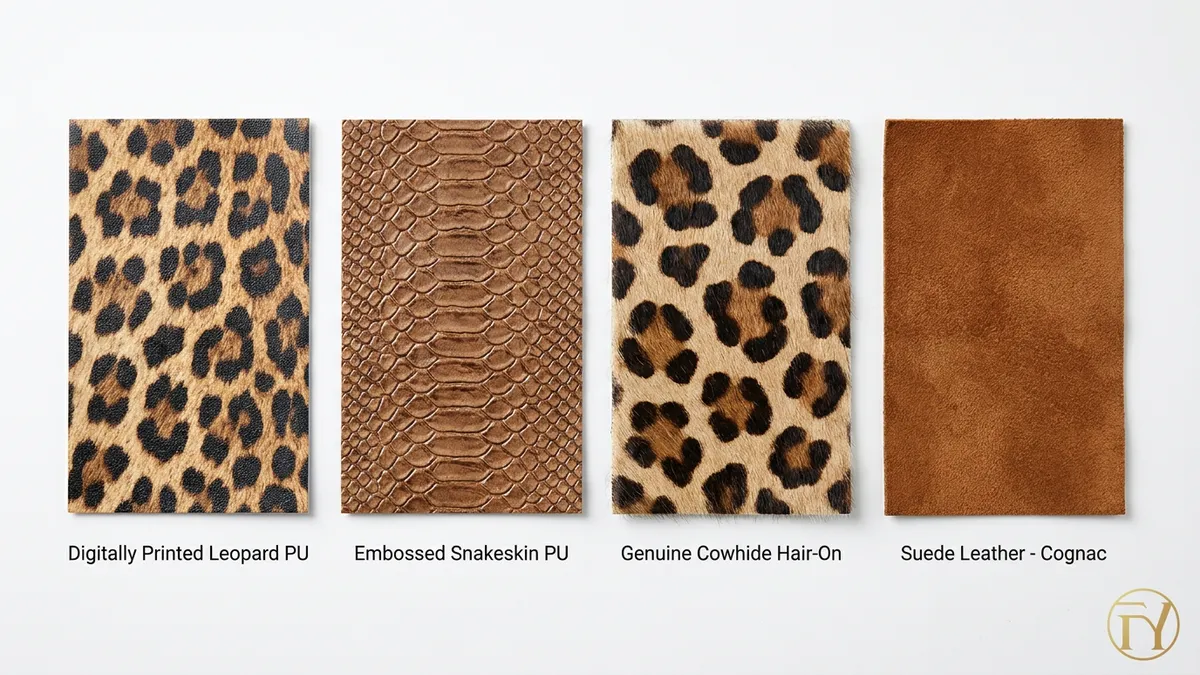
Animal print is a permanent category in fashion — it never fully disappears and periodically surges. The 2026 surge is confirmed: Khaite showed leopard and zebra across multiple silhouettes; Valentino paired snake-print bags with monochromatic tailoring; Balenciaga and The Attico showed exaggerated animal-print shoulder bags; Givenchy gave animal print a “simultaneously fierce and refined” treatment at FW26; and Chanel’s leopard Maxi Flap Bags kept the feline pattern in the luxury conversation. Across multiple editorial sources, the 2026 consensus is that zebra, tiger, and snakeskin are outpacing leopard as the freshest animal-print choices — though leopard remains the commercial staple.
Suede is the companion trend: Bottega Veneta, Chanel, and Dior all showed suede bags prominently for Spring 2026, and the material has been confirmed as a “year-round essential” rather than a seasonal accent across multiple forecast platforms.
For B2B buyers, the critical insight is that “animal print” is not one sourcing decision — it is three. A digitally printed leopard PU, an embossed python-texture leather, and a genuine hair-on cowhide are three fundamentally different materials with different supplier bases, different lead times, different minimum orders, and different consumer-care requirements. And suede, despite being a “return to basics” material story, has its own sourcing challenges around color consistency, staining, and care communication.
This guide maps each route.
Not all animal prints perform equally in 2026. The runway and editorial data reveals a clear hierarchy:
| 2026 Status | Consumer Read | Sourcing Complexity | Recommendation | |
|---|---|---|---|---|
| Zebra | The freshest — the #1 “new” animal print for 2026; graphic, bold, highly photographable | Modern, confident, statement; the print reads as “fashion-forward, not heritage” | Moderate — available as printed PU and genuine hair-on cowhide | Develop — the strongest trend-driven animal print this season |
| Snakeskin / python | Strong — confirmed across multiple runway reports; the “exotic” option | Sleek, editorial, slightly edgy; the most “luxurious” animal print to the consumer’s eye | Moderate — available as printed PU, embossed PU/leather, and (restricted) genuine skin | Develop — versatile; works as an all-over material or as a trim accent |
| Tiger / cheetah | Growing — specifically called out as outpacing leopard in 2026; bolder, more graphic than leopard | Dramatic, confident, slightly wild | Moderate — primarily available as printed PU | Develop selectively — one SKU; the boldest option in the animal-print collection |
| Leopard | Perennial — never goes away; the commercial workhorse; Chanel keeps it in the luxury conversation | Classic, versatile, “basically a neutral” (per industry stylist commentary); the safest animal print | Low — the most widely available animal-print material across all production methods | Maintain — always in stock; the core animal print that needs no trend justification |
| Cowhide (natural spot pattern) | Growing — “graphic cow patches” noted on oversized totes and Western-influenced silhouettes | Rustic, Americana, Western-chic; the most “raw” animal pattern | Higher — genuine cowhide is the primary route; printed versions exist but lack the authentic texture | Selective — works for Western-influenced or bohemian positioning; niche |
| Giraffe | Niche — mentioned but not widely confirmed on 2026 runways | Playful, unexpected, slightly whimsical | Low — primarily printed PU | Optional — a novelty option for brands with a playful identity |
The most accessible and most commonly used production method. A standard PU leather base (smooth or lightly textured) is printed with the animal pattern using digital or rotary printing — the pattern is ink on the PU’s surface coating.
| Dimension | Specification |
|---|---|
| How it works | The animal pattern (leopard, zebra, snake, etc.) is printed onto the PU surface using digital printing (inkjet) or rotary screen printing before the PU is shipped to the bag factory |
| Available patterns | Virtually unlimited — any animal pattern in any color scale, any scale modification, any artistic interpretation; the pattern is a digital file, so customization is straightforward |
| Surface texture | Flat — the print is two-dimensional; the PU surface is smooth or lightly textured (pebbled), but the animal pattern itself has no three-dimensional relief |
| Durability | Good — the print is applied beneath a protective topcoat; it does not peel or flake under normal use; dry-crocking fastness (ISO 105-X12) rating 4 minimum is standard |
| Color flexibility | Maximum — any color combination; traditional (brown/black leopard) or fashion-forward (pink zebra, blue snake, neon cheetah) |
| MOQ | Moderate — digital printing can run smaller lots (50–100 meters of PU); rotary screen printing requires 300+ meters for die setup |
| Lead time | Standard PU lead time + 3–5 days for printing |
| Consumer perception | “Printed” — the informed consumer can tell this is print-on-PU; appropriate for mid-market and accessible-premium; does not pretend to be genuine exotic |
| Best for | Volume programs; fashion-forward color interpretations; any brand that wants to change the print each season without tooling investment |
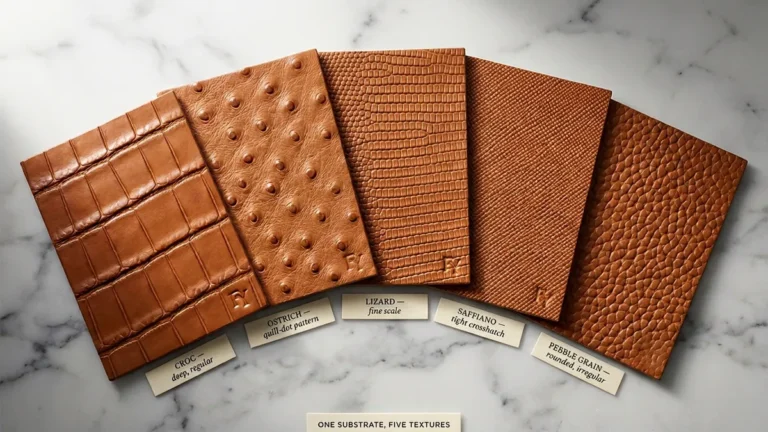
The pattern is pressed into the material using a heated embossing die — creating a three-dimensional texture that mimics the scales, grain, or hide pattern of the animal. The embossed material can then be colored (dyed or painted) to enhance the pattern’s depth.
| Dimension | Specification |
|---|---|
| How it works | A steel or copper die with the inverse of the animal pattern is heated and pressed into the PU or leather surface under hydraulic pressure; the material deforms permanently into the die’s three-dimensional pattern (per our embossing guide) |
| Available patterns | Crocodile/alligator, python/snake, ostrich, lizard, and custom exotic textures; each requires a specific embossing die |
| Surface texture | Three-dimensional — the scales, ridges, or quill marks are physically raised and recessed in the material; the consumer can feel the texture |
| Durability | Excellent — the embossing is a permanent physical deformation of the material; it cannot fade, peel, or wash off |
| Color flexibility | Moderate — the embossed material is typically dyed in a single base color, then the recesses and ridges may be highlighted with a contrast hand-painting or spray treatment (“antiquing”) for depth |
| MOQ | Embossed PU: often available as stock material (saffiano, croc, snake are standard stock textures at most PU suppliers) — no embossing MOQ for stock patterns. Custom embossed leather: requires a die (one-time tooling, 8–16 days) + material MOQ |
| Lead time | Stock embossed PU: standard lead time. Custom embossed leather: die production + embossing + bag production |
| Consumer perception | “Premium texture” — the three-dimensional embossing feels more luxurious than flat printing; the consumer’s fingers register the relief; this is the method that creates the “exotic-look without the exotic-price” positioning |
| Best for | Premium bags that want the tactile luxury of exotic texture without genuine exotic skin; structured silhouettes (the firm surface holds the embossed pattern cleanly); year-round staple SKUs that justify die investment |
The most premium and most limited route. Hair-on cowhide (often called “pony” in the fashion industry, though it is typically bovine, not equine) is genuine animal skin with the natural hair retained — the pattern (spots, patches, or natural coloring) is the actual pattern on the animal’s hide.
| Dimension | Specification |
|---|---|
| How it works | Cowhide is processed with the hair left intact (not removed during tanning as it is for smooth leather); the hide’s natural spot or patch pattern provides the visual interest; the hair can be dyed or printed for non-natural patterns (leopard, zebra, etc.) |
| Available patterns | Natural cowhide patterns (brown/white patches — “cowhide”); dyed/printed patterns (leopard, zebra, cheetah) applied to the natural hair surface |
| Surface texture | Genuinely textured — the short, dense hair is tactilely distinct from any synthetic; the consumer feels real animal hair; this is a polarizing tactile experience (some consumers love it; some are uncomfortable with it) |
| Durability | Moderate — the hair can shed over time at high-friction zones (where the bag contacts clothing during carry); the hair is also vulnerable to matting, moisture damage, and staining |
| Color flexibility | Moderate — natural patterns are fixed by the animal; printed/dyed patterns on hair-on cowhide are possible but the color sits ON the hair, not IN it (it can rub off at high-contact points) |
| MOQ | Variable — genuine cowhide is sold by the hide (each hide covers approximately 40–60 sq ft); the number of bag panels per hide depends on the pattern placement (the pattern must be positioned for visual consistency across panels) |
| Lead time | Longer — sourcing genuine hair-on hides takes 2–4 weeks beyond standard material lead time; panel cutting requires manual pattern placement per hide |
| Consumer perception | “Genuine” / “luxury” / “artisanal” — the consumer who wants real animal material values the authenticity and the tactile uniqueness; the consumer who avoids animal materials will object |
| Ethical/regulatory considerations | Hair-on cowhide uses bovine hide (a meat-industry byproduct — not an endangered species); it is NOT exotic skin (no CITES restrictions); however, brands must verify no misleading “pony” or “exotic” labeling; some markets/retailers require declaration of animal-origin materials |
| Best for | Premium accessories; Western/bohemian positioning; statement pieces; brands with an explicit animal-material identity |
| Question | If Yes → | If No → |
|---|---|---|
| Do you need a three-dimensional, tactile animal texture? | Route 2 (embossed) or Route 3 (genuine hair-on) | Route 1 (printed PU) |
| Do you need fashion-forward colors (non-natural animal palettes — pink leopard, blue snake, neon zebra)? | Route 1 (printed PU — unlimited color) | Route 2 or 3 |
| Does the consumer expect to feel real animal material? | Route 3 (genuine hair-on) | Route 1 or 2 |
| Does the brand position as vegan or animal-free? | Route 1 (printed PU) ONLY | Route 1, 2 (if PU-based), or 3 |
| Is the SKU a seasonal trend bet (limited run, may not reorder)? | Route 1 (printed PU — no tooling; low MOQ) | Route 2 (for a permanent exotic-texture staple) |
| Is the retail tier luxury or super-premium? | Route 3 (genuine hair-on) or Route 2 (custom-embossed leather) | Route 1 (printed PU) or Route 2 (stock embossed PU) |
| Element | Specification |
|---|---|
| Pattern anatomy | Irregular rosettes (leopard — clusters of spots forming a ring with a darker center) or solid spots (cheetah — individual round spots without rings) |
| Scale | Natural scale: rosettes 15–25 mm; oversized (trend-forward): rosettes 30–50 mm; micro (subtle): rosettes 8–12 mm |
| Color palette (classic) | Warm tan ground with dark brown/black rosettes — the “neutral” that goes with everything |
| Color palette (2026 fashion) | Cream/black (high contrast); blush/chocolate (soft); all-black tonal (leopard embossed, same-color — the quiet-luxury interpretation) |
| Best route | Printed PU for color variations; embossed for tonal/same-color; genuine cowhide (printed hair-on) for luxury |
| Element | Specification |
|---|---|
| Pattern anatomy | Bold, graphic, alternating stripes — wide, irregular, and organic (not machine-perfect parallel lines) |
| Scale | Standard: stripes 15–30 mm wide; oversized: 40–60 mm (the 2026 “exaggerated” interpretation) |
| Color palette (classic) | Black/white or black/cream |
| Color palette (2026 fashion) | Brown/cream (the warmest zebra); navy/white (the coolest); black/gray (tonal, subtle) |
| Best route | Printed PU (most common and most flexible); genuine hair-on cowhide (printed zebra pattern on natural hair) |
| Element | Specification |
|---|---|
| Pattern anatomy | Elongated, overlapping diamond-shaped scales with a directional flow; the scales graduate in size from large at center to small at edges (python) |
| Scale | Natural python scale: diamonds 20–35 mm; small snake: 8–15 mm (more subtle, refined) |
| Color palette | Natural (cream/brown/gray — the realistic python palette); metallic (gold, silver, bronze — the evening interpretation); fashion (bright blue, green, pink — the editorial statement) |
| Best route | Embossed (the three-dimensional scales are the defining feature — flat printing cannot replicate the tactile effect); printed PU for flat-pattern fashion colors |
| Compliance note | Genuine python skin is CITES-regulated — commercial trade in python requires CITES permits and supply-chain documentation; most B2B programs use embossed or printed alternatives to avoid the regulatory complexity and the ethical concerns |
| Element | Specification |
|---|---|
| Pattern anatomy | Bold, directional stripes — wider and more irregular than zebra; organic, curving, and asymmetric |
| Scale | Standard: stripes 20–40 mm |
| Color palette | Classic orange/black; warm brown/dark brown (the subtler, “earthy” interpretation — stronger in 2026 than orange); tonal cream/tan (the most wearable version) |
| Best route | Printed PU — tiger is primarily a print-driven pattern; embossing does not replicate stripes effectively |
Suede — the napped underside of leather (or its synthetic equivalent, microfiber suede) — is the material that pairs with animal print in the 2026 narrative: where animal print is bold and statement, suede is soft, tactile, and grounding. Together, they represent the return of texture-forward, material-led bag design.
| Dimension | Genuine Suede (Split Leather, Napped) | Microfiber Suede (Synthetic) |
|---|---|---|
| What it is | The flesh side (lower split) of a leather hide, buffed to create a soft, velvety nap | A polyester-polyurethane microfiber engineered to replicate the look and feel of genuine suede |
| Hand-feel | Warm, soft, organic — the “real thing”; slight variations in nap direction and density add to the natural character | Very soft, uniform, consistent — slightly denser and more uniform than genuine suede; the closest synthetic approximation |
| Durability | Moderate — suede absorbs moisture, stains easily, and the nap can mat at high-friction points; requires consumer care | Good–Very good — microfiber suede resists staining and matting better than genuine; some are machine-washable |
| Water/stain resistance | Low — suede absorbs water and stains readily; a waterproofing spray improves resistance but does not eliminate it | Moderate — the synthetic fibers repel moisture better than leather fibers; stains wipe off more easily |
| Color consistency (batch) | Moderate — hide-to-hide variation in nap density and base color; the nap direction affects perceived color (the same suede looks different when stroked in different directions) | Very good — manufactured material produces consistent color and nap batch to batch |
| Appropriate for | Premium-to-luxury bags where the consumer values genuine material and accepts the care requirements | Mid-market-to-premium bags where the consumer values the suede look with lower maintenance; vegan/animal-free positioning |
| Retail tier ceiling | No ceiling — genuine suede on a Bottega-inspired tote reads as luxury | Premium — microfiber suede is an excellent material but does not carry the “genuine” label |
| Consideration | Detail |
|---|---|
| Nap direction marking | Every suede panel must be cut with the nap running in the same direction (typically downward on a vertical bag); opposing nap directions create visible color differences between panels — the same suede looks lighter when stroked one way and darker the other; this is the #1 visible defect on suede bags |
| Color matching challenge | Suede’s napped surface scatters light, making color matching more difficult than on smooth leather — the perceived color changes with viewing angle, lighting, and nap direction; specify lab-dip evaluation at two nap angles |
| Water spot test | Before committing to genuine suede for an exterior material, test it: place a water drop on the suede surface; it will absorb immediately and leave a dark spot. The spot fades as it dries (usually within 1–4 hours) but may leave a faint mark. This behavior is inherent to suede; the consumer must be educated |
| Protective treatment | Apply a suede-protector spray (silicone-based waterproofing) at the factory before packing — include a suede care card with the bag: “Your suede bag has been pre-treated with a protective spray. Reapply every 3–6 months with a quality suede protector.” |
| Suede in combination | The strongest 2026 application is suede combined with smooth leather — suede body + smooth leather trim, or suede flap on a smooth leather body. The texture contrast is the design, and the smooth leather carries the structural elements (handles, edges, base) where suede would be vulnerable |
| Color | Trend Read | Production Notes |
|---|---|---|
| Cognac / tan | The hero suede color — warm, rich, the most “suede” suede | The easiest suede color to produce consistently; aligns with the natural leather base |
| Chocolate brown | The dark suede — the luxury everyday option | Strong — dark suede hides marks well; very durable nap appearance |
| Sage green / olive | The trend crossover — sage suede connects to the WGSN Transformative Teal narrative and the earth-first aesthetic | Moderate difficulty — green suede requires careful dye control to avoid yellow or blue drift |
| Dusty rose | The feminine option — soft, warm, gentle | Beautiful but stain-visible — recommend for evening/occasion use, not everyday |
| Black | The safe option — always works, always sells | The easiest to produce; the most forgiving for marks and wear |
| Cream / off-white | The editorial option — stunning in photographs | Very high maintenance — suede in white is a soiling magnet; recommend for limited editions and editorial-only SKUs |
The strongest commercial expression of both trends simultaneously: suede body + animal-print accent, or animal-print body + suede trim. The texture contrast creates a richer sensory experience than either material alone.
| Format | How It Works | Visual Effect | Production Notes |
|---|---|---|---|
| Animal-print tote with suede handles and trim | The body panels are animal-print (printed or embossed PU); the handles, top band, and base trim are genuine suede or microfiber suede | The “composed” version — the print makes the statement; the suede grounds it | Ensure the suede’s color is drawn from the print’s palette (the brown of the leopard’s ground, the cream of the zebra’s stripe) for tonal coherence |
| Suede crossbody with animal-print flap | The body is suede; the front flap is animal-print PU or embossed leather | The “reveal” version — the bag reads as suede until the flap is lifted or viewed from the front | The flap’s animal print should be in the same color family as the suede body |
| Color-blocked animal print + suede | Two or three panels in contrasting treatments — e.g., the front panel in printed leopard, the gussets in cognac suede, the back panel in smooth leather | The “material story” version — each material occupies a defined zone; the bag is a showcase of the brand’s material range | More complex cutting and assembly — the three material types have different handling properties |
Both animal print and suede require specific consumer education — and the absence of that education generates the reviews that damage the listing.
For printed animal-print PU:
“Your bag features a precision-printed animal pattern on durable PU leather. Wipe clean with a soft, damp cloth. Avoid prolonged exposure to direct sunlight, which may cause the print to fade over time. Store in the included dust bag when not in use.”
For embossed animal-texture leather/PU:
“Your bag features a three-dimensional embossed texture. The embossed pattern is permanent and will not wear away. Treat with leather conditioner every 3–6 months to maintain the material’s suppleness.”
For genuine hair-on cowhide:
“Your bag is made from genuine hair-on cowhide — a natural material with inherent variation. Over time, the hair at high-contact points may show slight wear (this is a natural characteristic, not a defect). Avoid water and humidity; store in the included dust bag; brush gently with a soft bristle brush to restore the nap.”
For suede:
“Your bag is crafted from genuine suede, pre-treated with a protective spray. Reapply a quality suede protector every 3–6 months. Avoid water, oil, and dark-colored fabrics (denim) in prolonged contact. If the suede becomes wet, let it dry naturally (away from direct heat), then gently brush the nap with a soft suede brush to restore the texture.”
| Material | Labeling Requirement | Regulatory Notes |
|---|---|---|
| Printed PU | Must be labeled as “PU leather,” “synthetic,” or “man-made material” — not as “leather” | No animal-origin compliance required; no CITES restrictions |
| Embossed PU | Same as printed PU | Same |
| Embossed genuine leather | May be labeled as “leather” — but must NOT be labeled with the exotic animal’s name (e.g., “python leather”) unless it IS genuine python; “embossed [animal] pattern” or “embossed to resemble [animal]” is correct | Labeling must not mislead the consumer into thinking the material is genuine exotic skin |
| Genuine hair-on cowhide | Label as “genuine cowhide” or “natural cowhide hair-on” — not as “pony” (misleading species claim unless it IS equine) | Bovine cowhide is NOT CITES-regulated; it is a meat-industry byproduct; no exotic-animal permits required |
| Genuine exotic skin (python, crocodile, ostrich) | Must comply with CITES (Convention on International Trade in Endangered Species); requires species identification, origin documentation, and CITES permits at export and import | Complex regulatory compliance — most B2B programs at the mid-to-premium tier avoid genuine exotics and use embossed alternatives |
| Genuine suede (bovine) | Label as “suede” or “suede leather” — accurate and standard | No exotic-animal compliance; standard bovine origin |
| Microfiber suede | Label as “microfiber suede,” “synthetic suede,” or “faux suede” — not as “suede” alone (which implies genuine leather) | No animal-origin compliance |
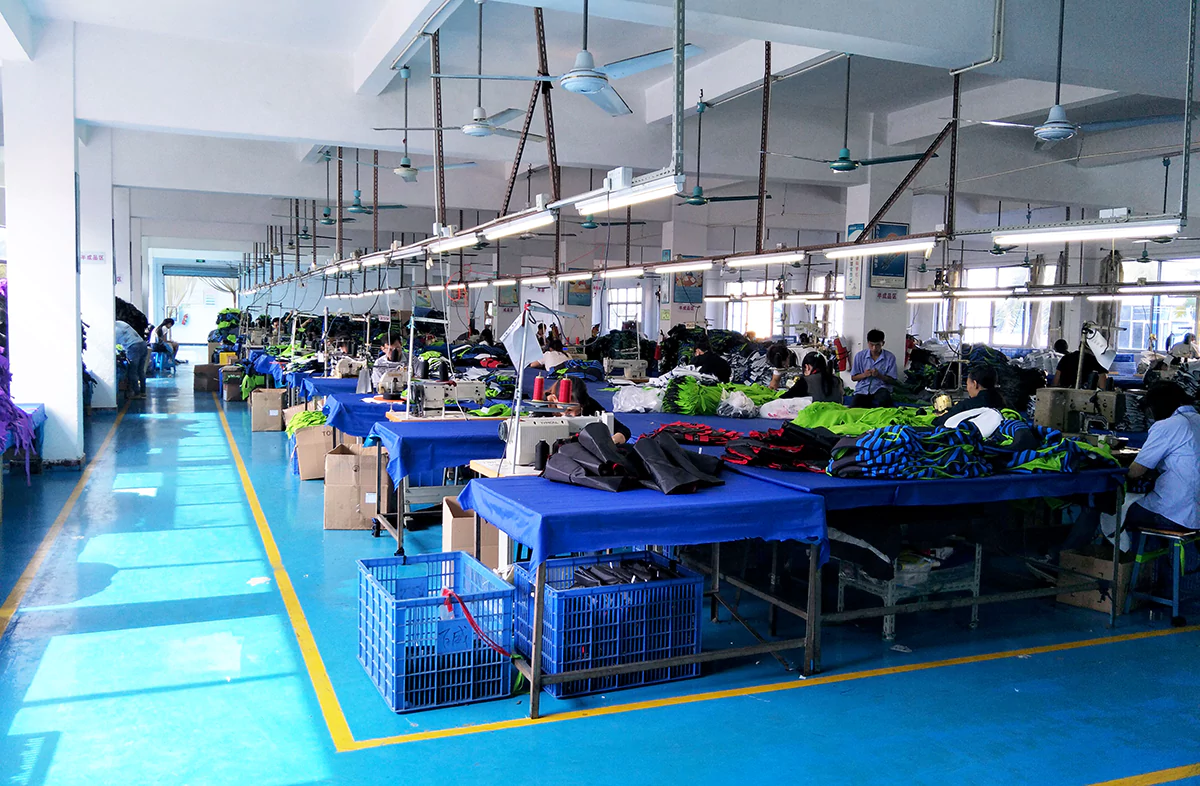
FYBagCustom is Your Trusted Custom Bag Manufacturer in China, with 15+ years of manufacturing experience and a material sourcing network covering all three animal-print routes and both suede types. For brands developing animal-print and suede SKUs for 2026, our capabilities include:
Contact our development team to discuss animal-print sourcing routes, suede specifications, and 2026 trend SKU development.
“Animal print” is a sourcing conversation before it is a design conversation — the route determines the material’s texture, its color flexibility, its MOQ, and its consumer-care profile. For B2B buyers adding animal print and suede to 2026 collections, three core takeaways:
If your 2026 collection needs animal-print and suede SKUs — from digitally printed leopard PU to custom-embossed python leather to genuine hair-on cowhide — contact FYBagCustom to discuss sourcing routes, embossing dies, and suede specification, and receive material samples across all three routes, typically within 5–14 days.
FYBagCustom sources all three animal-print routes — printed PU, embossed leather, and genuine hair-on cowhide — plus genuine and microfiber suede, with protective pre-treatment and nap-controlled cutting as standard. Material samples in 5–14 days.
Start Your Custom Bag Project →