Tel/WhatsAapp:+86 18011919834
E-mail: chloe.x@fybagcustom.com

Tel/WhatsAapp:+86 18011919834
E-mail: chloe.x@fybagcustom.com
Send Your Inquiry Today

Years Manufacturing
Factory Area
Professional Staff
Inspection Rate
Sublimation printing serves brands and sellers who need all-over graphic coverage on polyester bags — fashion brands, outdoor companies, promotional distributors, Amazon FBA sellers, and sports/team-merchandise companies.



Every other print method applies ink to a defined area on a pre-cut panel — there’s always a border, a print boundary, an unprinted edge. Sublimation prints on continuous polyester yardage BEFORE cutting — the printed fabric IS the bag. No borders. No edges. No limitations. Five properties make sublimation the ultimate method for graphic-intensive polyester bags.

Artwork extends from one seam to the next — across the entire bag surface. Front panel, back panel, gussets, straps, and pockets can all be part of a continuous graphic. No other method covers this much surface area this efficiently. All-over patterns, photographic wraps, and continuous-graphic bags are sublimation’s native format.

The dye IS the fiber. Not on top of it, not bonded to the surface — molecularly integrated INTO the polyester structure. The printed area feels identical to unprinted polyester. Same drape, same texture, same softness. No film, no ink layer, no surface thickness. The only print method with truly zero tactile difference. Superior to DTG and far superior to heat transfer.

Sublimated dye cannot crack (no surface layer). Cannot peel (nothing on the surface). Cannot wash out (molecular bond, not mechanical adhesion). 100+ wash cycles with zero degradation. UV-fade resistance superior to all surface-applied inks. The dye outlasts the fabric itself. The most permanent print available on any bag material.

Full CMYK output at 720–1440 DPI. Photographic images, complex gradients, fine detail — all at the resolution of the sublimation printer. No per-color cost (unlike screen printing). Unlimited color complexity at flat per-unit cost. Photo-quality artwork is sublimation’s native strength.

Sublimation prints on continuous polyester fabric rolls — the same roll is printed, then cut into bag panels. No panel-by-panel printing. No jig placement. No alignment per unit. At high volume, sublimation on yardage is faster and more efficient than any panel-by-panel method. The most scalable full-color method on polyester.
Sublimation works on any bag made from polyester or high-polyester-content fabric (65%+ polyester). White or light-colored polyester produces the most vibrant results. Here are the eight most-ordered sublimation-printed formats.
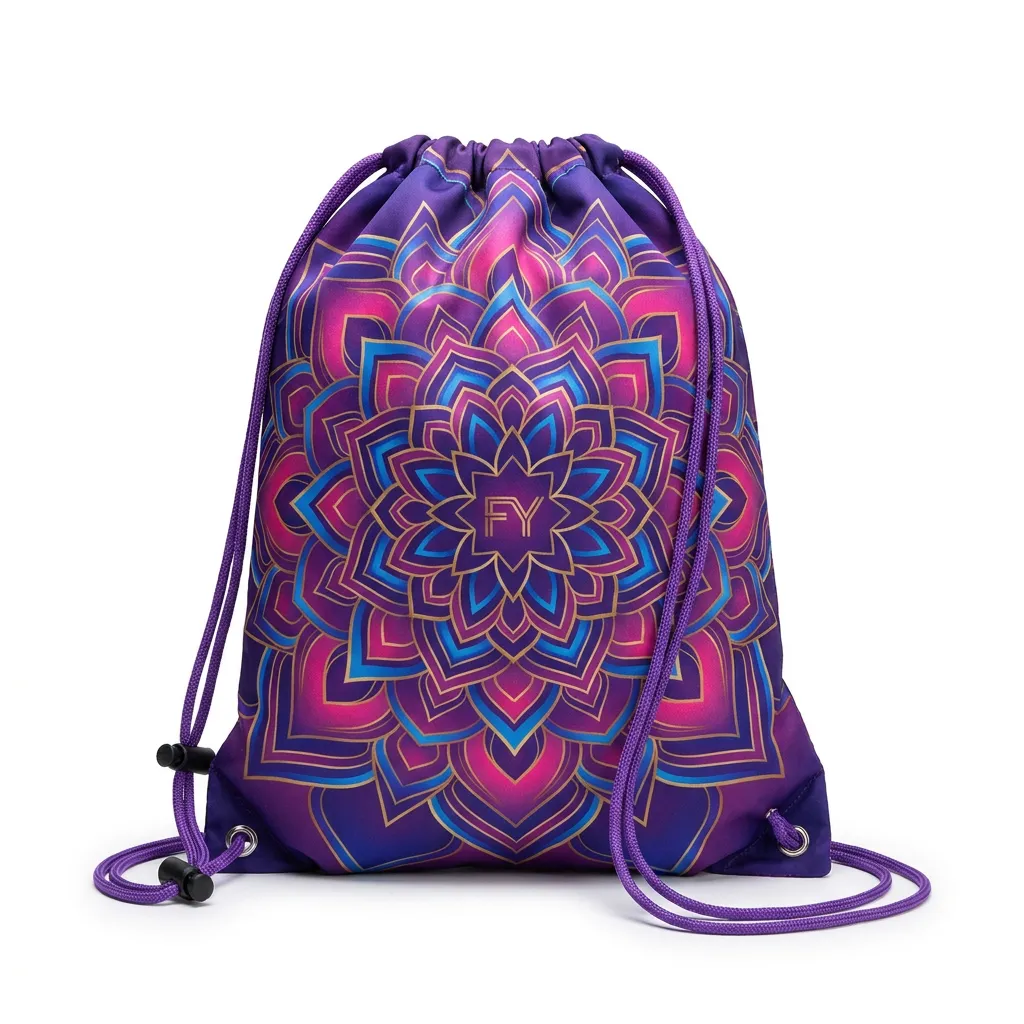
Full-coverage sublimation on polyester drawstring bag. For events, sports teams, school programs, and promotional giveaways. The most cost-effective all-over-print bag format. High-volume production speeds.
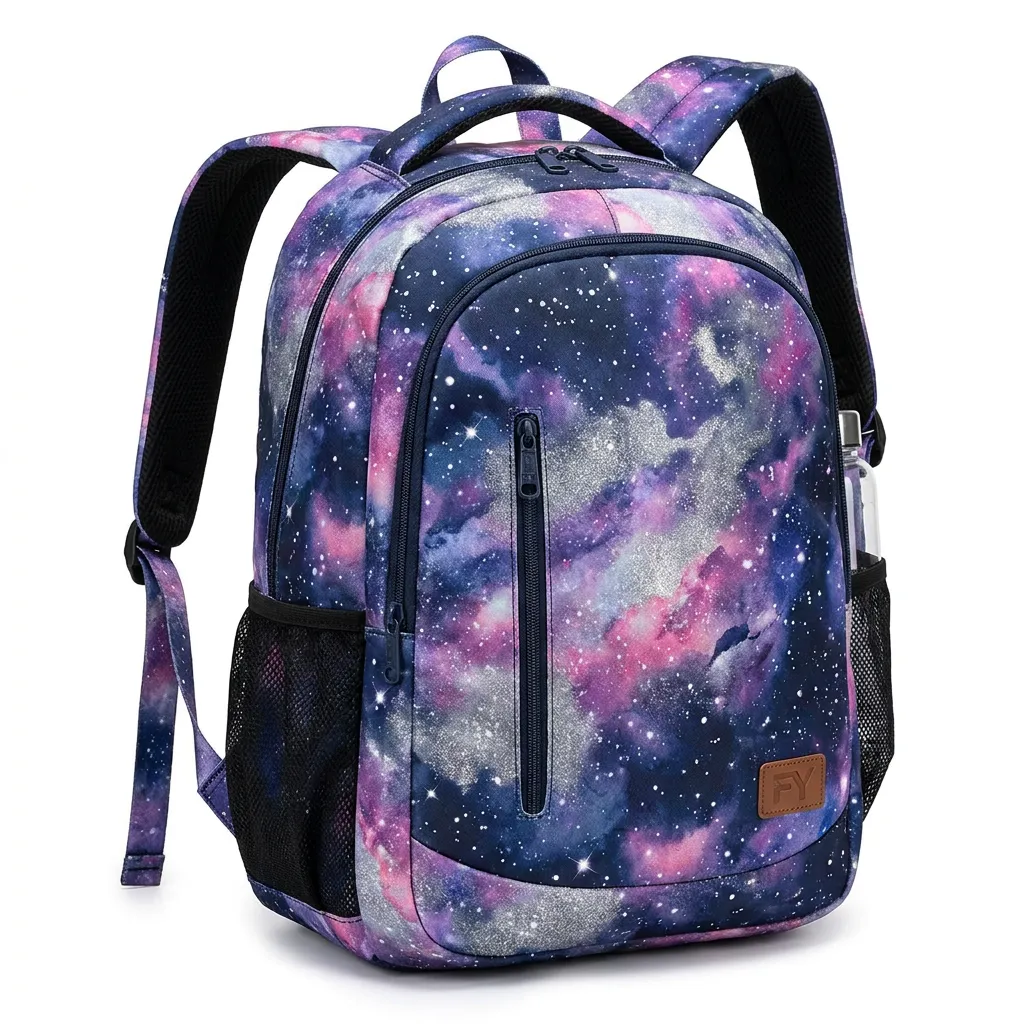
All-over graphic on polyester backpack body panels. For fashion brands, Amazon FBA sellers, and custom-merch. The most visually striking backpack format — the entire bag surface is the artwork.
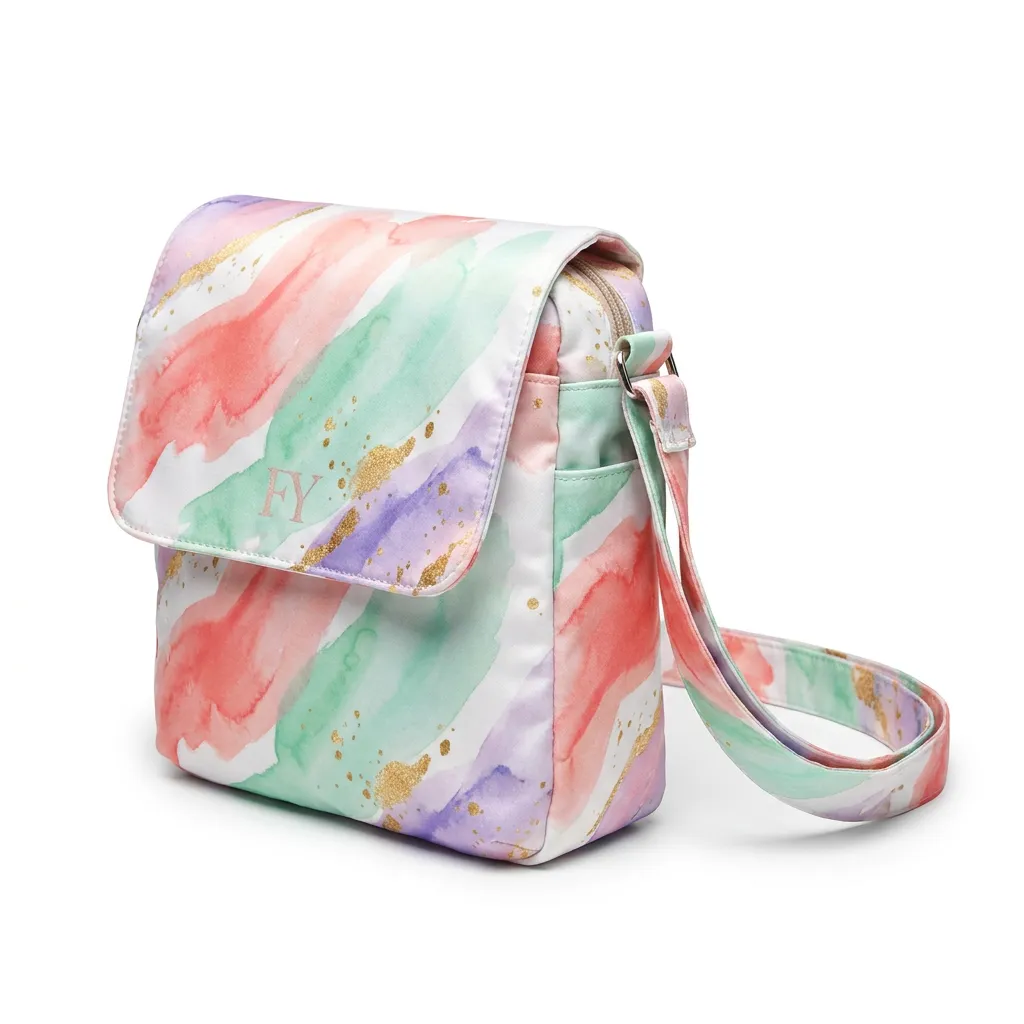
All-over photographic or pattern print on polyester crossbody. For fashion and graphic-design brands. Continuous artwork from flap to body to strap. The most graphic-intensive crossbody format.
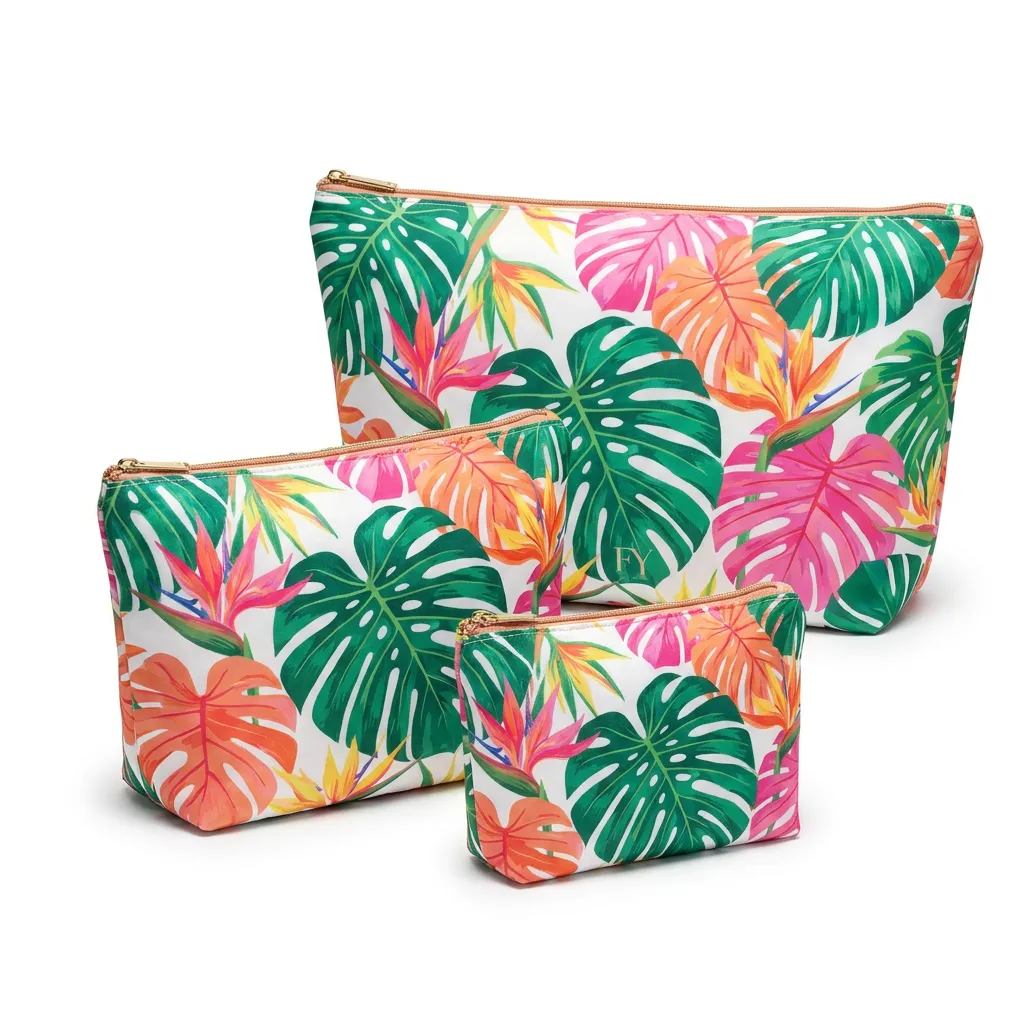
Full-coverage sublimation on polyester cosmetic pouches. S/M/L nested sets. For fashion brands, beauty lines, and gift sets. Vivid all-over patterns on small-format polyester — ideal for multi-design collections.
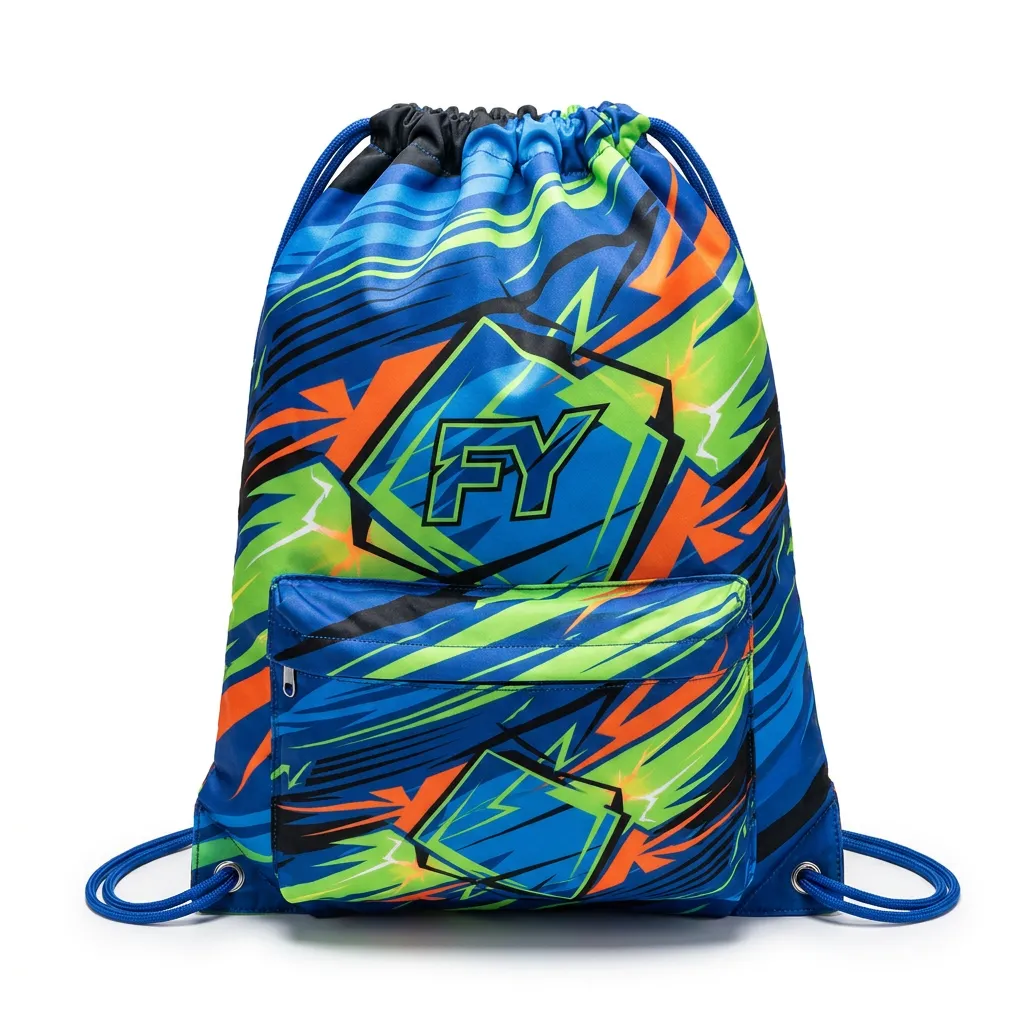
All-over team colors, logos, and graphics on polyester gym drawstring sack. For sports teams, school programs, and fan merchandise. Sublimation permanence handles heavy-wash sports use — 100+ cycles with zero fade.
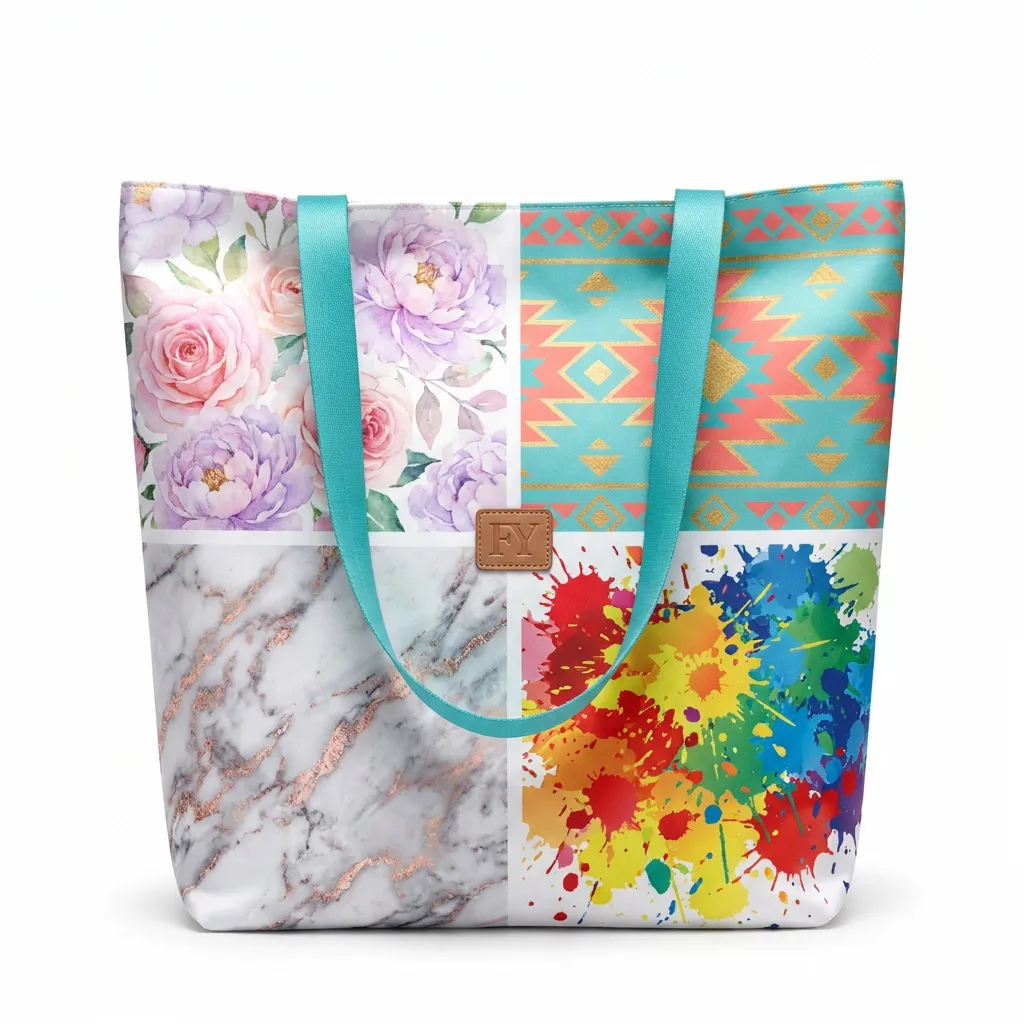
10+ artwork variants on polyester bags — printed on yardage, then cut and assembled. Different designs on the same fabric base. For Amazon multi-listing strategies, gift collections, and seasonal design rotations. Design changes require only new print files.
Sublimation is not printing in the traditional sense — it’s a phase-change chemistry process. The dye transitions from solid → gas → solid, bypassing the liquid state entirely. Under heat and pressure, the gaseous dye molecules penetrate the polyester fiber’s molecular structure and permanently bond inside. Understanding this process explains why sublimation is polyester-only, why it’s permanent, and why it produces zero hand feel.
Step 1: Print on Paper
Artwork is printed onto special sublimation transfer paper using dye-sublimation ink (water-based ink containing sublimation dye). Printed via large-format inkjet printer at 720–1440 DPI. Full CMYK. The paper holds the dye in solid form. This is a mirror image of the final artwork (it will be flipped during transfer).
Step 2: Heat Press
Printed paper is placed face-down on white polyester fabric and pressed at 190–210°C for 40–60 seconds under medium pressure. The heat causes the solid sublimation dye to transition directly to gas (sublimation phase change). The gaseous dye molecules penetrate the polyester fiber structure while the fiber’s molecular chains are opened by heat.
Step 3: Dye Bond
When pressure is released and the fabric cools, the polyester molecular chains close — trapping the dye molecules permanently inside the fiber. The dye doesn’t sit on the surface; it’s locked within the polyester structure at the molecular level. This is why sublimated prints cannot crack, peel, or wash out — there’s nothing on the surface to fail.
Why Polyester Only
Sublimation dye only bonds to polyester (PET) molecules. The dye molecules are specifically sized to fit between polyester molecular chains when those chains expand under heat. Cotton, nylon, and other fibers have different molecular structures that don’t open or accept sublimation dye. Minimum 65% polyester content for acceptable results; 100% polyester for best vibrancy.
Why White Fabric
Sublimation dye is transparent — it has no white ink. The dye tints the fiber but cannot cover it. On white polyester, the dye creates vivid CMYK color. On colored polyester, the existing fabric color mixes with the dye, shifting the printed color. Black polyester produces near-invisible prints. For accurate color reproduction, white or very light polyester is required.
Yardage vs. Panel
Two sublimation workflows: yardage (print on continuous polyester rolls, then cut into panels and sew — best for all-over designs and high volume) and panel (print on pre-cut transfer paper sized to bag panels, heat-press onto pre-cut polyester panels — best for logo-area prints on pre-made bags). We use both workflows depending on design coverage and order volume.
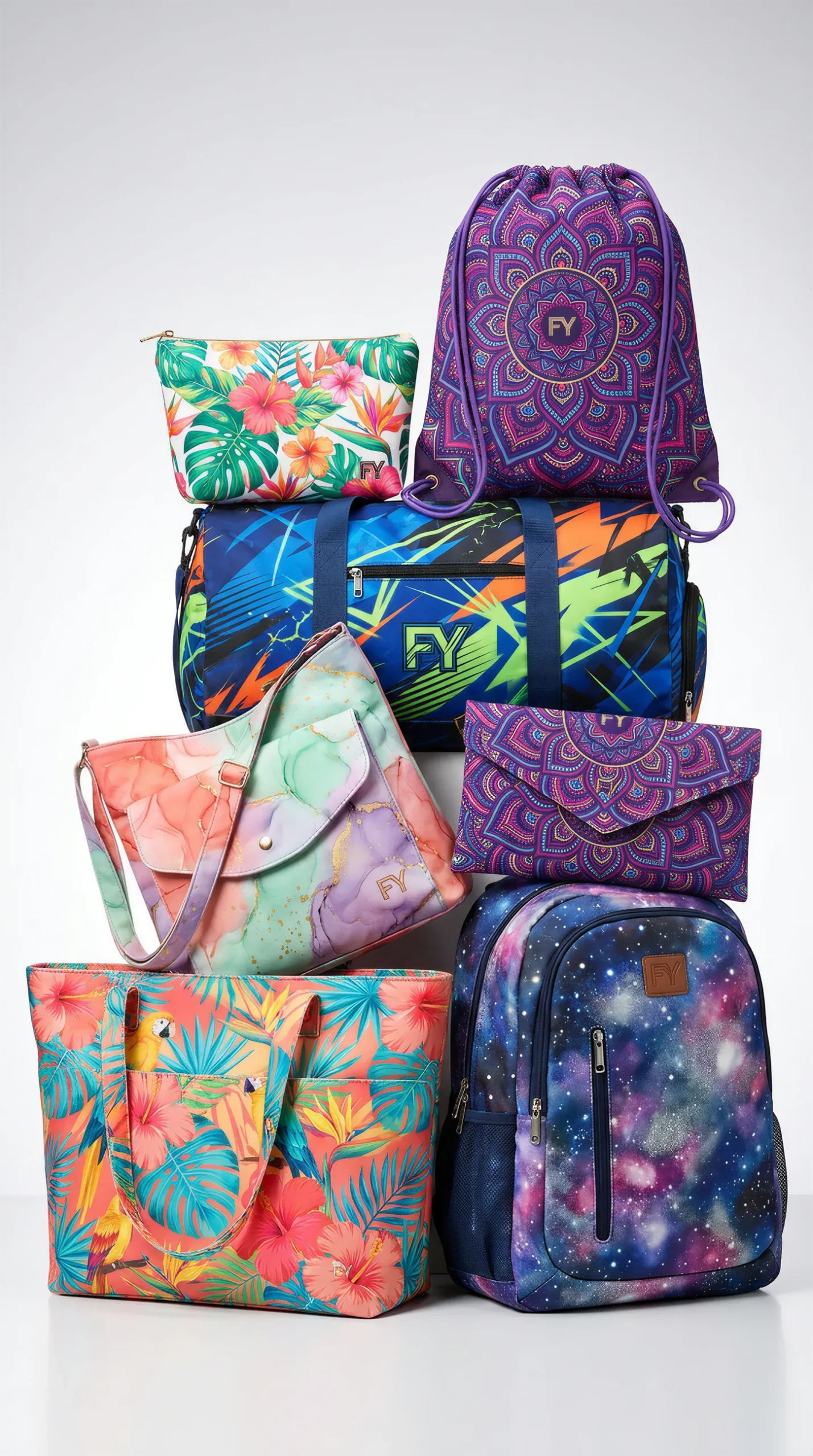
With sublimation, the complete 6-page printing-method suite is now available. Here’s how sublimation compares to all five other methods — honest, side-by-side, across the dimensions that matter for B2B sourcing.
Fabric Range
Sublimation: polyester only (65%+ content, white/light preferred). Most restrictive. Heat transfer: any fabric. Screen print: any woven. DTG: cotton/canvas. UV: PU leather/PVC/coated. Lamination: non-woven. Each method owns a fabric segment.
Coverage Area
Sublimation: all-over, edge-to-edge, seam-to-seam — printed on yardage before cutting. No other method matches this. All others: defined print area on pre-cut panels — always bounded by print-area limits, panel edges, and registration.
Hand Feel
Sublimation: absolute zero — dye is IN the fiber. DTG: near-zero on cotton. Screen (water-based): soft. UV (flat): thin surface. Heat transfer: noticeable film. Lamination: film surface. Sublimation wins on hand feel — the only method with truly zero tactile difference.
Durability
Sublimation: 100+ washes, zero degradation — molecular bond, cannot crack/peel. The most permanent. Screen print: 50+ washes (excellent). DTG: 30–50 washes. UV: good scratch resistance. Heat transfer: 20–40 washes. Lamination: permanent (encapsulated). Sublimation and lamination tie for longest life; sublimation wins on flexibility (no film to crack).
Color Limitation
Sublimation: no white ink — dye is transparent, cannot print white or opaque on dark/colored polyester. White fabric required. DTG/UV/heat transfer: all include white ink for dark substrates. Screen print: white ink available. This is sublimation’s biggest limitation — it only works to full potential on white or light polyester.
Best For
Sublimation: all-over patterns on white polyester, photographic wraps, continuous-graphic bags, sports/team merch, promotional full-coverage bags, and any application where zero hand feel and absolute permanence matter. Not for: cotton/canvas (use DTG), PU leather (use UV), dark polyester (use heat transfer), non-woven (use lamination), 1–3 color logos at volume (use screen print).
In-house sublimation printing (large-format inkjet), heat-press transfer, cutting, sewing, and QC. Yardage and panel workflows available. Every sublimated bag leaves our Guangzhou factory with verified color accuracy and dye permanence. Sample turnaround in 5–7 days.
Free Add-on: Professional Product Photography Included
Free white-background product photos for your online shop, Amazon listings, and wholesale catalogs — no additional charge on production orders.
Sublimation is chemistry-dependent — the ink, fabric, temperature, and press time must all be within specification for the phase-change to occur correctly. Understanding these parameters prevents color shifts, ghosting, and dye migration.
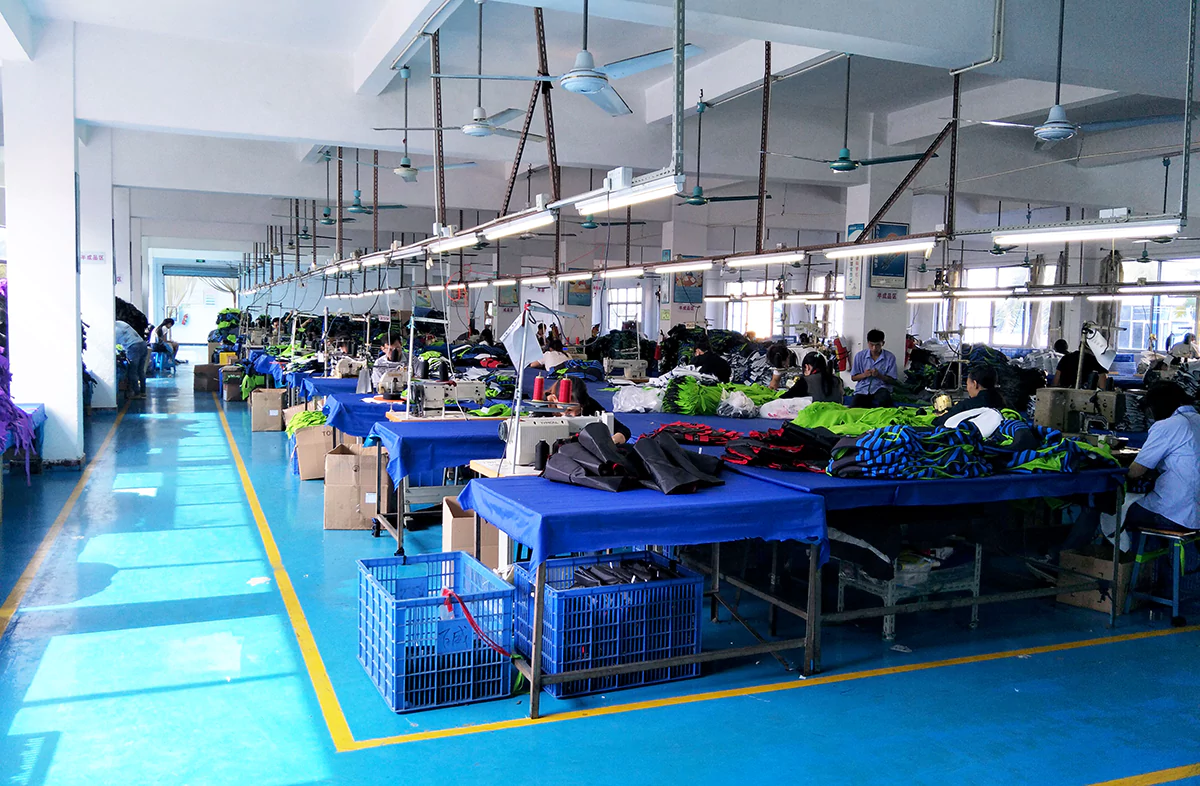
FY Bag Custom operates its own vertically integrated factory in Guangzhou, Guangdong — sublimation printing, heat-press transfer, cutting, sewing, and QC all under one roof. Our sublimation department works alongside our screen-printing, heat-transfer, DTG, and UV departments — all six print methods under one roof means we can recommend and deliver the right method for every order.
In-house sublimation means we control dye transfer, press parameters, and color consistency directly. For all-over designs, sublimated yardage is printed and inspected before cutting — the artwork is verified on the continuous roll before a single bag is assembled.
Years in Manufacturing
Factory Floor Area
Professional Staff
Production Lines
Monthly Capacity
Pre-Shipment Inspection
Sublimation QC focuses on color accuracy (temperature-dependent — ±5°C shifts color), ghosting (paper movement during press = double image), dye migration (heat bleed on stored fabric), and fabric-content verification (under 65% polyester = poor dye uptake). Our 6-stage QC targets each one. Third-party inspections welcome.
Polyester content verified on incoming fabric — minimum 65%, ideally 100%. Fabric color verified (white/light only for accurate reproduction). Fabric weight and weave checked. Sub-spec polyester content = faded, incomplete dye transfer. Fabric rejected before printing begins.
Physical sublimated proof on actual production polyester. ICC-profiled. Color accuracy verified against artwork. Vibrancy assessed on the specific polyester being used (different polyester weaves absorb dye slightly differently). Approved in writing before production.
Temperature (190–210°C), press time (40–60 sec), and pressure verified at the start of every production run and monitored throughout. ±5°C temperature drift visibly shifts color. Over-press yellows white areas. Press parameters are the #1 quality variable in sublimation.
Transfer paper alignment verified — any paper shift during pressing creates a ghost (faint double-image). For all-over yardage prints, registration between printed roll and fabric roll monitored continuously. Ghosting is the most common sublimation defect — prevented by secure paper fixation.
Every sublimated panel or yardage section inspected for: color accuracy, vibrancy uniformity, ghosting, white-area clarity (no yellowing), edge sharpness, and pattern registration (all-over designs). Defective sections marked and excluded from cutting.

Sample from every batch wash-tested (40°C, 30 min) — zero color change expected. Assembled bags inspected one by one — print quality, sewing, hardware, overall construction. Sublimated bags packed carefully to avoid heat exposure during storage (stored sublimated polyester near other polyester can cause dye migration).
Sublimation production is efficient — printing on yardage is fast, and heat-press transfer is a single-step process. All-over designs on yardage add a pre-cutting print stage. Sample in 5–7 days, bulk in 20–30 days.
Day 1–2
Send artwork (CMYK, 300 DPI+); FOB quote in 24 hours.
Day 3–12
Sublimated proof on polyester + bag prototype in 5–7 days.
Day 13–15
30% T/T deposit; balance before shipment.
Day 16–42
Print yardage/panels → press → cut → sew → QC. Daily WIP.
Day 43–48
100% print + wash test + final inspection.
Day 46–55
Sea, air, express, or direct-to-FBA.
Sample Lead Time
5–7 Days
Mass Production
25–35 Days
Payment Terms
30% T/T · 70% Before Shipment
Shipping Terms
FOB · CIF · DDP · Amazon FBA
Sublimation serves buyers who need maximum visual impact on polyester bags — all-over graphics that make the entire bag the artwork.
Edge-to-edge sublimation photographic botanical prints on 300D white polyester totes — 8 artwork variants. Yardage-printed for seamless coverage. Vivid color, zero hand feel. Retail-ready packaging. FOB to US and EU. Retail $14–20. Seasonal artwork refresh every quarter — only the digital file changes, same polyester base.
ODM partnership on sublimated polyester drawstring bags — 15 artwork variants (galaxy, geometric, floral, abstract, camo) for Amazon multi-listing strategy. Each variant is a separate ASIN. FNSKU labeling, Amazon packaging, all-over photography. Ranked across 5+ search terms. Sublimation’s zero-changeover enables rapid design testing.
All-over team-color sublimation on polyester drawstring gym sacks — 20 team variants, each with unique color scheme and logo placement. 500 pcs per team × 20 teams = 10,000 total. Sublimation permanence (100+ washes) handles heavy sports use. Reordered annually with roster updates.
Global Shipping Options
•Sea Freight
•Air Freight
•Express (DHL, FedEx, UPS)
•Rail Freight
•Door-to-Door
•Direct-to-Amazon FBA
Straight answers to the questions buyers ask most about dye-sublimation printing on bags.
Sublimation dye molecules are specifically sized to fit between polyester (PET) molecular chains when those chains expand under heat (190–210°C). When the fabric cools, the chains close and trap the dye permanently. Cotton, nylon, and other fibers have different molecular structures that don’t open or accept sublimation dye. Minimum 65% polyester content for acceptable results; 100% polyester for best vibrancy.
No. Sublimation dye is transparent — it tints the polyester fiber but cannot cover it. White areas in a sublimated print are simply unprinted white polyester showing through. This is why white or light-colored polyester is required for accurate color reproduction. On colored polyester, the fabric color mixes with the dye and shifts the printed color unpredictably. For white ink on dark fabric, use DTF heat transfer or UV printing instead.
Sublimation: dye IN the fiber (zero hand feel, 100+ washes, permanent, no cracking/peeling). DTF heat transfer: ink ON the surface via film (slight film feel, 30–40 washes, can peel eventually). Sublimation is objectively superior on white polyester — better hand feel, better durability, better wash resistance. DTF’s advantage: works on dark polyester (white underbase), works on cotton/nylon, and works on fabrics where sublimation cannot.
Sublimation has no per-design setup cost (digital workflow), so print-method MOQs are low. However, all-over-print yardage production has an efficient minimum roll length. For panel prints (logo area only), minimums are comparable to other digital methods. Bag-construction MOQ applies separately. Contact us with your coverage type (all-over vs. panel) and quantity for a specific confirmation.
Sublimated dye has superior UV-fade resistance compared to surface-applied inks. The dye is molecularly bonded inside the polyester fiber — UV light must penetrate the fiber to reach the dye, which significantly slows fading. Sublimated prints maintain color vibrancy for years of normal use including outdoor exposure. For extreme UV applications (permanent outdoor display), all dyes will eventually fade — but sublimation fades last.
Yes. The polyester body panels are sublimation-printed on yardage, then cut and assembled into the backpack. Straps, zippers, and hardware are assembled after printing. The all-over graphic covers every fabric surface — front, back, sides, and pockets. The most visually striking backpack format available.
Yes. FNSKU labeling, Amazon-compliant packaging, and carton labeling handled at our Guangzhou factory. Free product photography of sublimated bags included — all-over prints photograph exceptionally well for Amazon listings.
Yes. European Industrial Park, Shiling Town, Huadu District, Guangzhou. Monday–Saturday. Video tours available for remote buyers.
Send us your artwork (CMYK, 300 DPI+), polyester preference, and coverage type (all-over or panel) — we’ll come back within 24 hours with a detailed FOB quotation. Physical sublimated proof on actual polyester included before production. No templates, no copy-paste pricing.